Articles | Volume 7, issue 3
https://doi.org/10.5194/wcd-7-1211-2026
© Author(s) 2026. This work is distributed under
the Creative Commons Attribution 4.0 License.
https://doi.org/10.5194/wcd-7-1211-2026
© Author(s) 2026. This work is distributed under
the Creative Commons Attribution 4.0 License.
WCD Ideas: hydrologically driven throughflow in the coupled ocean–atmosphere system
Department of Applied Physics, University of Granada, Granada, 18071, Spain
Andalusian Institute for Earth System Research (IISTA), Granada, 18071, Spain
Related authors
Jesús Abril-Gago, Irene Tovar, Enrique Echeverría-Martín, Juana Andújar-Maqueda, Pablo Ortiz-Amezcua, Germán Cabrera-Carrillo, Penélope Serrano-Ortiz, Francisco Domingo, Lucas Alados-Arboledas, Andrew S. Kowalski, Enrique P. Sánchez-Cañete, and Juan Luis Guerrero-Rascado
Biogeosciences, 23, 2569–2581, https://doi.org/10.5194/bg-23-2569-2026, https://doi.org/10.5194/bg-23-2569-2026, 2026
Short summary
Short summary
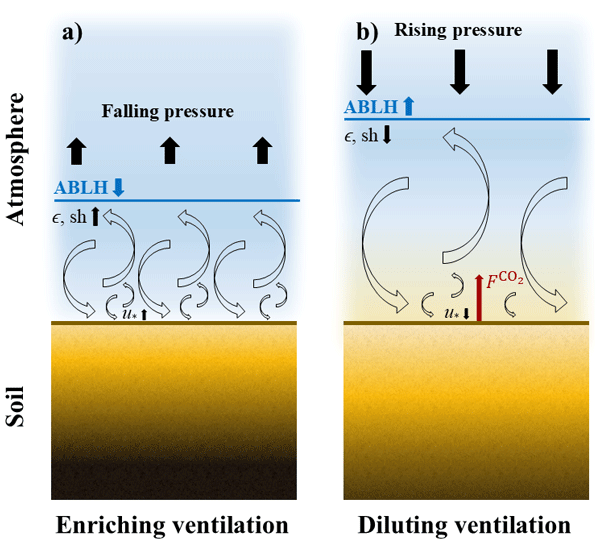
This study investigates non-biological soil CO2 ventilation in a semiarid Mediterranean shrubland and standardizes the criteria for its detection. Ten ventilation events were identified during the SCARCE (Synchronized Characterization of Aerosol, Radon and Carbon dioxide Exchanges in drylands) campaign, with several atmospheric parameters acting as drivers. Surface pressure emerged as the primary driver at the site, while friction velocity and boundary layer turbulence were also found to be relevant, highlighting the value of Doppler lidar for soil–atmosphere exchange studies.
Andrew S. Kowalski, Ivan A. Janssens, and Oscar Pérez-Priego
Biogeosciences, 22, 8005–8012, https://doi.org/10.5194/bg-22-8005-2025, https://doi.org/10.5194/bg-22-8005-2025, 2025
Short summary
Short summary
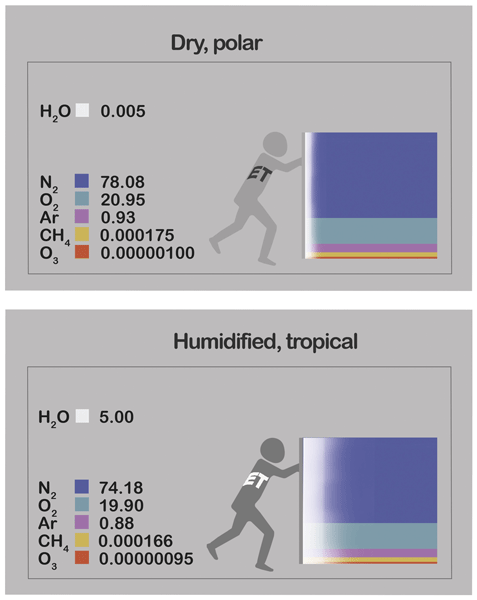
Humidification of air reduces the abundances of dry-air gas components such as oxygen, explaining why tropical humidity can be "stifling". This is overlooked due to the common expression of gas concentrations as fractions of dry air. Such neglect of water vapour also masks the key role of its sources and sinks in activating transport mechanisms of other gases. Humidity should be quantified whenever reporting gas concentrations.
Andrew S. Kowalski
EGUsphere, https://doi.org/10.5194/egusphere-2025-2814, https://doi.org/10.5194/egusphere-2025-2814, 2025
Preprint archived
Short summary
Short summary
This manuscript demonstrates that a mass-based (inertial) framework is essential to the correct definition of diffusive transport, and therefore for defining Ficks first law. It invalidates the molar-based framework used by Roderick and Shakespeare (2025) to identify the contribution of the Soret effect (mass transport due to a temperature gradient) to open-water evaporation.
Andrew S. Kowalski
Biogeosciences, 22, 785–789, https://doi.org/10.5194/bg-22-785-2025, https://doi.org/10.5194/bg-22-785-2025, 2025
Short summary
Short summary
The laws of physics show that leaf oxygen is not photosynthetically enriched but extremely dilute due to the overwhelming effects of humidification. This challenges the prevailing diffusion-only paradigm regarding leaf gas exchanges because non-diffusive transport is required. Such transport also explains why fluxes of carbon dioxide and water vapour become decoupled at very high temperatures, as has been observed but not explained by plant physiologists.
Sergio Aranda-Barranco, Penélope Serrano-Ortiz, Andrew S. Kowalski, and Enrique P. Sánchez-Cañete
SOIL, 11, 213–232, https://doi.org/10.5194/soil-11-213-2025, https://doi.org/10.5194/soil-11-213-2025, 2025
Short summary
Short summary
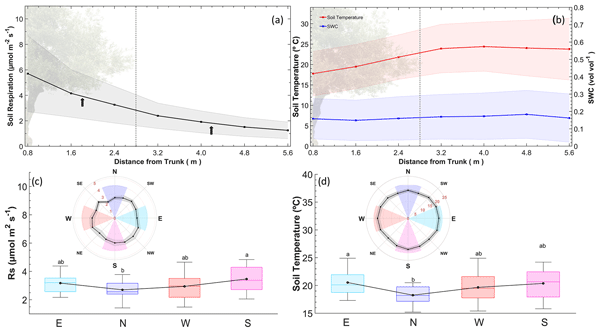
This study investigated soil respiration and the main factors involved in a semi-arid environment (olive grove). For this purpose, 1 year's worth of automatic multi-chamber measurements was used, accompanied by ecosystem respiration data obtained using the eddy covariance technique. The soil respiration annual balance, Q10 parameter, rain pulses, and spatial and temporal variability of soil respiration are presented in this paper.
Ihab Alfadhel, Ignacio Peralta-Maraver, Isabel Reche, Enrique P. Sánchez-Cañete, Sergio Aranda-Barranco, Eva Rodríguez-Velasco, Andrew S. Kowalski, and Penélope Serrano-Ortiz
Biogeosciences, 21, 5117–5129, https://doi.org/10.5194/bg-21-5117-2024, https://doi.org/10.5194/bg-21-5117-2024, 2024
Short summary
Short summary
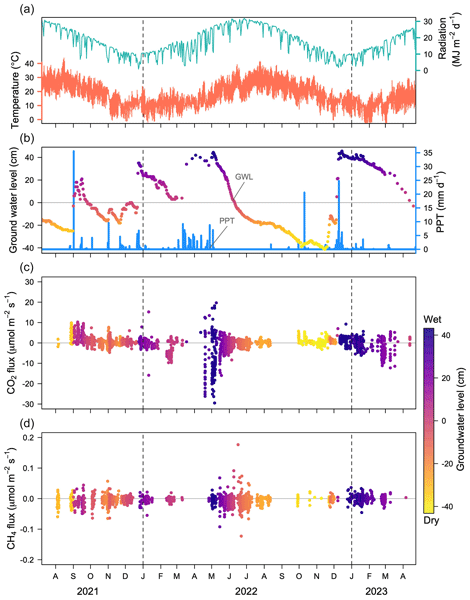
Inland saline lakes are crucial in the global carbon cycle, but increased droughts may alter their carbon exchange capacity. We measured CO2 and CH4 fluxes in a Mediterranean saline lake using the eddy covariance method under dry and wet conditions. We found the lake acts as a carbon sink during wet periods but not during droughts. These results highlight the importance of saline lakes in carbon sequestration and their vulnerability to climate-change-induced droughts.
Jesús Abril-Gago, Irene Tovar, Enrique Echeverría-Martín, Juana Andújar-Maqueda, Pablo Ortiz-Amezcua, Germán Cabrera-Carrillo, Penélope Serrano-Ortiz, Francisco Domingo, Lucas Alados-Arboledas, Andrew S. Kowalski, Enrique P. Sánchez-Cañete, and Juan Luis Guerrero-Rascado
Biogeosciences, 23, 2569–2581, https://doi.org/10.5194/bg-23-2569-2026, https://doi.org/10.5194/bg-23-2569-2026, 2026
Short summary
Short summary
This study investigates non-biological soil CO2 ventilation in a semiarid Mediterranean shrubland and standardizes the criteria for its detection. Ten ventilation events were identified during the SCARCE (Synchronized Characterization of Aerosol, Radon and Carbon dioxide Exchanges in drylands) campaign, with several atmospheric parameters acting as drivers. Surface pressure emerged as the primary driver at the site, while friction velocity and boundary layer turbulence were also found to be relevant, highlighting the value of Doppler lidar for soil–atmosphere exchange studies.
Andrew S. Kowalski, Ivan A. Janssens, and Oscar Pérez-Priego
Biogeosciences, 22, 8005–8012, https://doi.org/10.5194/bg-22-8005-2025, https://doi.org/10.5194/bg-22-8005-2025, 2025
Short summary
Short summary
Humidification of air reduces the abundances of dry-air gas components such as oxygen, explaining why tropical humidity can be "stifling". This is overlooked due to the common expression of gas concentrations as fractions of dry air. Such neglect of water vapour also masks the key role of its sources and sinks in activating transport mechanisms of other gases. Humidity should be quantified whenever reporting gas concentrations.
Andrew S. Kowalski
EGUsphere, https://doi.org/10.5194/egusphere-2025-2814, https://doi.org/10.5194/egusphere-2025-2814, 2025
Preprint archived
Short summary
Short summary
This manuscript demonstrates that a mass-based (inertial) framework is essential to the correct definition of diffusive transport, and therefore for defining Ficks first law. It invalidates the molar-based framework used by Roderick and Shakespeare (2025) to identify the contribution of the Soret effect (mass transport due to a temperature gradient) to open-water evaporation.
Andrew S. Kowalski
Biogeosciences, 22, 785–789, https://doi.org/10.5194/bg-22-785-2025, https://doi.org/10.5194/bg-22-785-2025, 2025
Short summary
Short summary
The laws of physics show that leaf oxygen is not photosynthetically enriched but extremely dilute due to the overwhelming effects of humidification. This challenges the prevailing diffusion-only paradigm regarding leaf gas exchanges because non-diffusive transport is required. Such transport also explains why fluxes of carbon dioxide and water vapour become decoupled at very high temperatures, as has been observed but not explained by plant physiologists.
Sergio Aranda-Barranco, Penélope Serrano-Ortiz, Andrew S. Kowalski, and Enrique P. Sánchez-Cañete
SOIL, 11, 213–232, https://doi.org/10.5194/soil-11-213-2025, https://doi.org/10.5194/soil-11-213-2025, 2025
Short summary
Short summary
This study investigated soil respiration and the main factors involved in a semi-arid environment (olive grove). For this purpose, 1 year's worth of automatic multi-chamber measurements was used, accompanied by ecosystem respiration data obtained using the eddy covariance technique. The soil respiration annual balance, Q10 parameter, rain pulses, and spatial and temporal variability of soil respiration are presented in this paper.
Ihab Alfadhel, Ignacio Peralta-Maraver, Isabel Reche, Enrique P. Sánchez-Cañete, Sergio Aranda-Barranco, Eva Rodríguez-Velasco, Andrew S. Kowalski, and Penélope Serrano-Ortiz
Biogeosciences, 21, 5117–5129, https://doi.org/10.5194/bg-21-5117-2024, https://doi.org/10.5194/bg-21-5117-2024, 2024
Short summary
Short summary
Inland saline lakes are crucial in the global carbon cycle, but increased droughts may alter their carbon exchange capacity. We measured CO2 and CH4 fluxes in a Mediterranean saline lake using the eddy covariance method under dry and wet conditions. We found the lake acts as a carbon sink during wet periods but not during droughts. These results highlight the importance of saline lakes in carbon sequestration and their vulnerability to climate-change-induced droughts.
Cited articles
Acheson, J. D.: Elementary fluid dynamics, Clarendon Press, Oxford, ISBN 9780198596790, 1990.
Andrews, D. G. and McIntyre, M. E.: Planetary waves in horizontal and vertical shear: the generalized Eliassen–Palm relation and the mean zonal acceleration, J. Atmos. Sci., 33, 2031–2048, 1976.
Andrews, D. G., Holton, J. R., and Leovy, C. B.: Middle atmosphere dynamics, Academic Press, Orlando, ISBN 9780120585762, 1987.
Batchelor, G. K.: An introduction to fluid dynamics, Cambridge University Press, Cambridge, ISBN O 521663962, 2000.
Dey, D. and Döös, K.: The coupled ocean–atmosphere hydrologic cycle, Tellus A, 71, 1650413, https://doi.org/10.1080/16000870.2019.1650413, 2019.
Döös, K. and Nilsson, J.: Analysis of the meridional energy transport by atmospheric overturning circulations, J. Atmos. Sci., 68, 1806–1820, 2011.
Elling, V.: Relative entropy and compressible potential flow, Acta Math. Sci. B, 35, 763–776, 2015.
Holopainen, E. O.: On the mean meridional circulation and the flux of angular momentum over the northern hemisphere, Tellus, 19, 1–13, 1967.
Holton, J. R.: An introduction to dynamic meteorology, Elsevier, Amsterdam, 535 pp., ISBN 0-12-354015-1, 2004.
Kowalski, A. S.: The boundary condition for vertical velocity and its interdependence with surface gas exchange, Atmos. Chem. Phys., 17, 8177–8187, https://doi.org/10.5194/acp-17-8177-2017, 2017.
Kowalski, A. S. and García-Valdecasas Ojeda, M.: Global oxygen distributions at the Earth's surface, Sci. Total Environ., 1031, 181809, https://doi.org/10.1016/j.scitotenv.2026.181809, 2026.
Kowalski, A. S., Janssens, I. A., and Pérez-Priego, O.: Water vapour dynamics as a key determinant of atmospheric composition and transport mechanisms, Biogeosciences, 22, 8005–8012, https://doi.org/10.5194/bg-22-8005-2025, 2025.
Kundu, P. K. and Cohen, I. M.: Fluid Mechanics, Academic Press, San Diego, 730 pp., ISBN 0-12-1782514, 2002.
Laliberté, F., Zika, J., Mudryk, L., Kushner, P. J., Kjellsson, J., and Döös, K.: Constrained work output of the moist atmospheric heat engine in a warming climate, Science, 347, 540–543, https://doi.org//10.1126/science.1257103, 2015.
Lindzen, R. S. and Hou, A. V.: Hadley circulations for zonally averaged heating centered off the equator, J. Atmos. Sci., 45, 2416–2427, 1988.
Liu, Q., Li, T., and Zhou, W.: Impacts of multi-timescale circulations on meridional moisture transport, J. Climate, 34, 8065–8085, https://doi.org/10.1175/JCLI-D-20-0126.1, 2021.
Pauluis, O., Czaja, A., and Korty, R.: The global atmospheric circulation on moist isentropes, Science, 321, 1075–1078, https://doi.org/10.1126/science.1159649, 2008.
Peixoto, J. P. and Oort, A. H.: Physics of Climate, American Institute of Physics, New York, 520 pp., ISBN 978-0-88318-712, 1992.
Schanze, J. J., Schmitt, R. W., and Yu, L. L.: The global oceanic freshwater cycle: A state-of-the-art quantification, J. Mar. Res., 68, 569–595, 2010.
Trenberth, K. E. and Guillemot, C. J.: Evaluation of the atmospheric moisture and hydrological cycle in the NCEP/NCAR reanalyses, Clim. Dynam., 14, 213–231, 1998.
Zurbenko, I. and Luo, M.: Surface Humidity Changes in Different Temporal Scales, Am. J. Clim. Change, 4, 226–238, https://doi.org/10.4236/ajcc.2015.43018, 2015.
Short summary
Textbooks describe the atmosphere’s north–south motion as closed circulation cells. This study shows that the water cycle also drives a subtle one-way flow of air, moving it from the humidified subtropics toward regions dried by rain and condensation. This hidden transport helps explain gradients of inert gases and suggests that large-scale atmospheric circulation may be more open than commonly assumed.
Textbooks describe the atmosphere’s north–south motion as closed circulation cells. This study...