Articles | Volume 7, issue 3
https://doi.org/10.5194/wcd-7-1733-2026
© Author(s) 2026. This work is distributed under
the Creative Commons Attribution 4.0 License.
https://doi.org/10.5194/wcd-7-1733-2026
© Author(s) 2026. This work is distributed under
the Creative Commons Attribution 4.0 License.
Global shifts in mountain wave turbulence within high resolution climate models

Isabel H. Smith
CORRESPONDING AUTHOR
Department of Meteorology, University of Reading, Reading, UK
now at: Department of Earth Sciences, University of Oxford, Oxford, UK
Paul D. Williams
Department of Meteorology, University of Reading, Reading, UK
Reinhard Schiemann
Department of Meteorology, University of Reading, Reading, UK
National Centre for Atmospheric Sciences, Reading, UK
Related authors
No articles found.
Reinhard K. H. Schiemann, Grenville Lister, Rosalyn Hatcher, Dan Hodson, Bryan Lawrence, Len Shaffrey, Jeff Cole, Andrea Dittus, Jenny Mecking, Jon Robson, Simon Wilson, Yevgeny Aksenov, Adam T. Blaker, Ben Harvey, Oscar Martínez-Alvarado, Annette Osprey, Stephanie Rynders, Sharar Ahmadi, Jake Aylmer, Laura Baker, David Case, Emanuele Silvio Gentile, Steve George, Kevin Hodges, Eliza Karlowska, Charlotte Lang, Hua Lu, Niamh O'Callaghan, Weronika Osmolska, Scott Osprey, Tony Phillips, David Schröder, Robin Smith, Andrew G. Turner, Steve Woolnough, Martin Andrews, Andrew Coward, Steven Hardiman, James Harle, John W. Rostron, David M. H. Sexton, Bablu Sinha, Jonny Williams, and Chris Wilson
EGUsphere, https://doi.org/10.5194/egusphere-2026-2281, https://doi.org/10.5194/egusphere-2026-2281, 2026
This preprint is open for discussion and under review for Geoscientific Model Development (GMD).
Short summary
Short summary
This paper presents a new large ensemble of climate model simulations: The CANARI HadGEM3 Large Ensemble (CANARI LE). The CANARI LE has a comparatively high resolution, provides sub-daily output on atmospheric pressure levels, and boundary conditions for driving regional model simulations. The CANARI LE is thus a community resource that lends itself for the study of physical coupled climate processes, weather systems, and impacts in a changing climate.
Prince Xavier, Martin Willett, Tim Graham, Paul Earnshaw, Dan Copsey, Nikesh Narayan, Charline Marzin, Alistair Sellar, Duncan Ackerley, Adam Blaker, Ed Blockley, Alejandro Bodas-Salcedo, Andrew Bushell, Nakbin Choi, Xin Rong Chua, Catherine Guiavarc'h, Muhammad Hassim, Julian Heming, Debra Hudson, Sarah Ineson, Anthony Jones, Colin Jones, Richard Keane, Kiwook Kim, Jiyeong Kim, Till Kuhlbrodt, Myong-In Lee, Richard Levine, Chen Li, Gill Martin, Alex Megann, Anne Mccabe, Aurel Moise, Leighton Regayre, Jeff Ridley, Luke Roberts, Sandeep Sahany, Reinhard K. H. Schiemann, David Storkey, Warren Tennant, Lorenzo Tomassini, Yoko Tsushima, Graham P. Weedon, Alex West, Matthew C. Wheeler, Keith Williams, Xiaobing Zhou, and Hongyan Zhu
EGUsphere, https://doi.org/10.5194/egusphere-2026-4281, https://doi.org/10.5194/egusphere-2026-4281, 2026
This preprint is open for discussion and under review for Geoscientific Model Development (GMD).
Short summary
Short summary
GC5 is the Met Office's newest climate and weather model, combining an updated atmosphere/land component with an improved ocean and sea-ice component. Compared to its predecessor GC4, it better simulates global temperatures, winds, monsoons over India and SE Asia, and African weather, and forecasts tropical cyclones more accurately. Southern Ocean errors shrank too. Some tropical patterns and regional biases worsened slightly. A lower-resolution version will underpin the UK's Earth System Model.
Andrea Rivosecchi, Andrea Dittus, Ed Hawkins, Reinhard Schiemann, and Erich Fischer
EGUsphere, https://doi.org/10.5194/egusphere-2026-1733, https://doi.org/10.5194/egusphere-2026-1733, 2026
Short summary
Short summary
We analysed 250-year global temperature trends under zero CO2 emissions in the UK Earth System Model. Stopping emissions while global temperatures remain below +2 °C limits the post-net-zero mean surface warming. Annual hot extremes cool regionally after zero emissions in the midlatitudes, due to the expansion of evergreen vegetation. However, in this framework vegetation change is largely unconstrained by modern land-use changes, highlighting a potential limitation of idealised model protocols.
Tommaso Alberti, Davide Faranda, Mohamed Foudad, Erika Coppola, Lia Rapella, Rachel Burbidge, Miguel A. C. Teixeira, and Paul Williams
EGUsphere, https://doi.org/10.5194/egusphere-2026-1178, https://doi.org/10.5194/egusphere-2026-1178, 2026
Short summary
Short summary
We developed TurboMeter to study whether climate change is making airplane turbulence stronger. By comparing current atmospheric conditions with similar past situations, we find that most turbulence events in 2024 were intensified by human-caused climate change, especially over the North Atlantic, East Asia, and the United States. This work shows that climate change is already affecting flight safety and highlights the need for climate-informed planning in aviation.
Corwin J. Wright, Phoebe E. Noble, Timothy P. Banyard, Sarah J. Freeman, and Paul D. Williams
Atmos. Chem. Phys., 25, 18267–18290, https://doi.org/10.5194/acp-25-18267-2025, https://doi.org/10.5194/acp-25-18267-2025, 2025
Short summary
Short summary
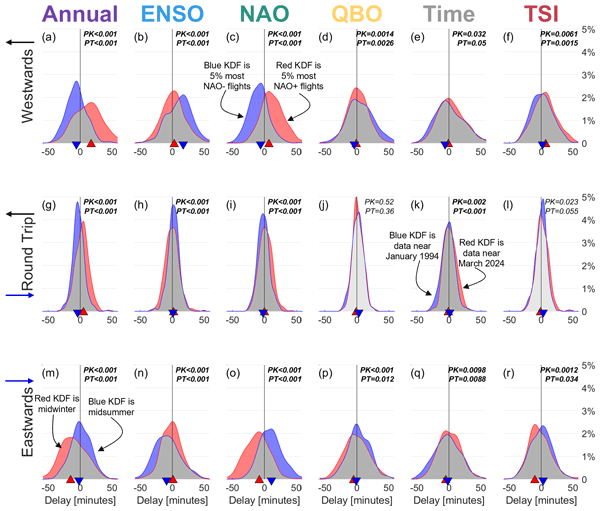
We use measured transatlantic flight times since 1994 from the IAGOS (In-Service Aircraft for a Global
Observing System) program to assess the impact of the North Atlantic Oscillation, El Nino-Southern Oscillation, Quasi-Biennial Oscillation and solar cycle. We show that they drive changes to one-way flight times of over an hour and to round-trip flight times by several minutes per flight. They thus cause variability in total CO2 emissions of 10s of kT/month and financial cost of millions of US dollars/month over the full transatlantic fleet.
Alex T. Archibald, Bablu Sinha, Maria R. Russo, Emily Matthews, Freya A. Squires, N. Luke Abraham, Stephane J.-B. Bauguitte, Thomas J. Bannan, Thomas G. Bell, David Berry, Lucy J. Carpenter, Hugh Coe, Andrew Coward, Peter Edwards, Daniel Feltham, Dwayne Heard, Jim Hopkins, James Keeble, Elizabeth C. Kent, Brian A. King, Isobel R. Lawrence, James Lee, Claire R. Macintosh, Alex Megann, Bengamin I. Moat, Katie Read, Chris Reed, Malcolm J. Roberts, Reinhard Schiemann, David Schroeder, Timothy J. Smyth, Loren Temple, Navaneeth Thamban, Lisa Whalley, Simon Williams, Huihui Wu, and Mingxi Yang
Earth Syst. Sci. Data, 17, 135–164, https://doi.org/10.5194/essd-17-135-2025, https://doi.org/10.5194/essd-17-135-2025, 2025
Short summary
Short summary
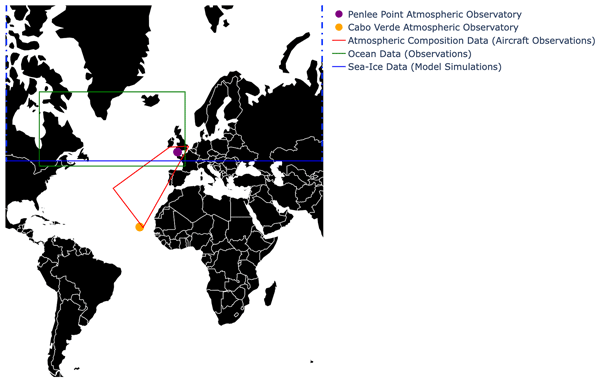
Here, we present an overview of the data generated as part of the North Atlantic Climate System Integrated Study (ACSIS) programme that are available through dedicated repositories at the Centre for Environmental Data Analysis (CEDA; www.ceda.ac.uk) and the British Oceanographic Data Centre (BODC; bodc.ac.uk). The datasets described here cover the North Atlantic Ocean, the atmosphere above (it including its composition), and Arctic sea ice.
Charlie C. Suitters, Oscar Martínez-Alvarado, Kevin I. Hodges, Reinhard K. H. Schiemann, and Duncan Ackerley
Weather Clim. Dynam., 4, 683–700, https://doi.org/10.5194/wcd-4-683-2023, https://doi.org/10.5194/wcd-4-683-2023, 2023
Short summary
Short summary
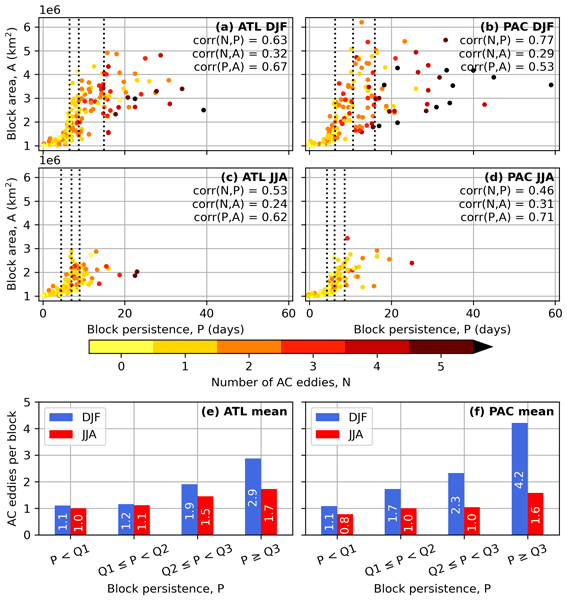
Atmospheric blocking describes large and persistent high surface pressure. In this study, the relationship between block persistence and smaller-scale systems is examined. Persistent blocks result from more interactions with small systems, but a block's persistence does not depend as strongly on the strength of these smaller features. This work is important because it provides more knowledge as to how blocks can be allowed to persist, which is something we still do not fully understand.
Elliott Michael Sainsbury, Reinhard K. H. Schiemann, Kevin I. Hodges, Alexander J. Baker, Len C. Shaffrey, Kieran T. Bhatia, and Stella Bourdin
Weather Clim. Dynam., 3, 1359–1379, https://doi.org/10.5194/wcd-3-1359-2022, https://doi.org/10.5194/wcd-3-1359-2022, 2022
Short summary
Short summary
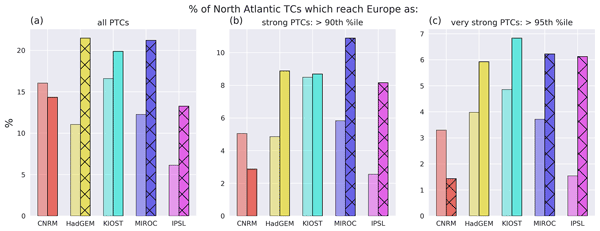
Post-tropical cyclones (PTCs) can bring severe weather to Europe. By tracking and identifying PTCs in five global climate models, we investigate how the frequency and intensity of PTCs may change across Europe by 2100. We find no robust change in the frequency or intensity of Europe-impacting PTCs in the future. This study indicates that large uncertainties surround future Europe-impacting PTCs and provides a framework for evaluating PTCs in future generations of climate models.
Ambrogio Volonté, Andrew G. Turner, Reinhard Schiemann, Pier Luigi Vidale, and Nicholas P. Klingaman
Weather Clim. Dynam., 3, 575–599, https://doi.org/10.5194/wcd-3-575-2022, https://doi.org/10.5194/wcd-3-575-2022, 2022
Short summary
Short summary
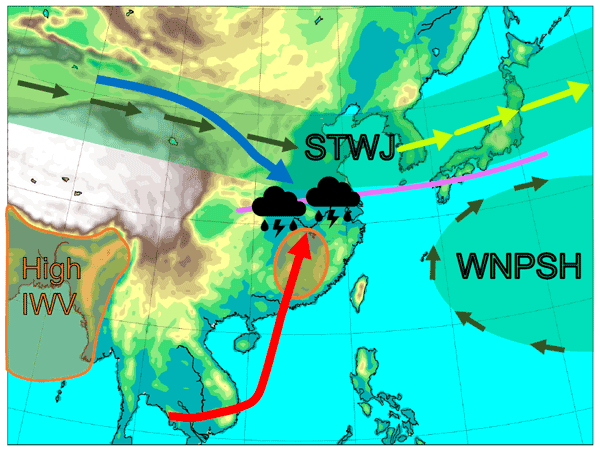
In this study we analyse the complex seasonal evolution of the East Asian summer monsoon. Using reanalysis data, we show the importance of the interaction between tropical and extratropical air masses converging at the monsoon front, particularly during its northward progression. The upper-level flow pattern (e.g. the westerly jet) controls the balance between the airstreams and thus the associated rainfall. This framework provides a basis for studies of extreme events and climate variability.
Mark R. Muetzelfeldt, Reinhard Schiemann, Andrew G. Turner, Nicholas P. Klingaman, Pier Luigi Vidale, and Malcolm J. Roberts
Hydrol. Earth Syst. Sci., 25, 6381–6405, https://doi.org/10.5194/hess-25-6381-2021, https://doi.org/10.5194/hess-25-6381-2021, 2021
Short summary
Short summary
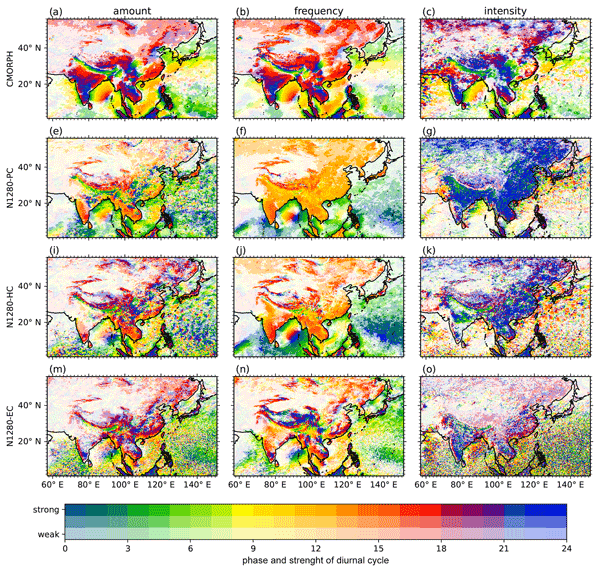
Simulating East Asian Summer Monsoon (EASM) rainfall poses many challenges because of its multi-scale nature. We evaluate three setups of a 14 km global climate model against observations to see if they improve simulated rainfall. We do this over catchment basins of different sizes to estimate how model performance depends on spatial scale. Using explicit convection improves rainfall diurnal cycle, yet more model tuning is needed to improve mean and intensity biases in simulated summer rainfall.
Cited articles
Chun, H. and Kim, Y.: Secondary waves generated by breaking of convective gravity waves in the mesosphere and their influence in the wave momentum flux, J. Geophys. Res.-Atmos., 113, https://doi.org/10.1029/2008JD009792, 2008.
Clark, T. L., Hall, W. D., Kerr, R. M., Middleton, D., Radke, L., Ralph, F. M., Neiman, P. J., and Levinson, D.: Origins of Aircraft-Damaging Clear-Air Turbulence during the 9 December 1992 Colorado Downslope Windstorm: Numerical Simulations and Comparison with Observations, J. Atmos. Sci., 57, 1105–1131, https://doi.org/10.1175/1520-0469(2000)057<1105:OOADCA>2.0.CO;2, 2000.
Deng, K., Liu, W., Azorin-Molina, C., Yang, S., Li, H., Zhang, G., Minola, L., and Chen, D.: Terrestrial stilling projected to continue in the Northern Hemisphere mid-latitudes, Earths Future, 10, e2021EF002448, https://doi.org/10.1029/2021EF002448, 2022.
Doyle, J. D., Shapiro, M. A., Jiang, Q., and Bartels, D. L.: Large-Amplitude Mountain Wave Breaking over Greenland, J. Atmos. Sci., 62, 3106–3126, https://doi.org/10.1175/JAS3528.1, 2005.
Foudad, M., Sanchez-Gomez, E., Jaravel, T., Rochoux, M. C., and Terray, L.: Past and future trends in clear-air turbulence over the northern hemisphere, J. Geophys. Res.-Atmos., 129, https://doi.org/10.1029/2023JD040261, 2024.
Gill, P. and Buchanan, P. L.: An ensemble based turbulence forecasting system, Meteorol. Appl., 21, 12–18, https://doi.org/10.1002/met.1373, 2018.
Gill, P. G. and Stirling, A. J.: Including convection in global turbulence forecasts, Meteorol. Appl., 20, 107–114, https://doi.org/10.1002/met.1315, 2012.
Guarino, M., Teixeria, M. A. C., Keller, T. L., and Sharman, R. D.: Mountain-Wave Turbulence in the Presence of Directional Wind Shear over the Rocky Mountains, J. Atmos. Sci. Amer. Meteor. Soc., 75, 1285–1305 https://doi.org/10.1175/JAS-D-17-0128.1, 2018.
Gutjahr, O., Putrasahan, D., Lohmann, K., Jungclaus, J. H., von Storch, J.-S., Brüggemann, N., Haak, H., and Stössel, A.: Max Planck Institute Earth System Model (MPI-ESM1.2) for the High-Resolution Model Intercomparison Project (HighResMIP), Geosci. Model Dev., 12, 3241–3281, https://doi.org/10.5194/gmd-12-3241-2019, 2019.
Haarsma, R., Acosta, M., Bakhshi, R., Bretonnière, P.-A., Caron, L.-P., Castrillo, M., Corti, S., Davini, P., Exarchou, E., Fabiano, F., Fladrich, U., Fuentes Franco, R., García-Serrano, J., von Hardenberg, J., Koenigk, T., Levine, X., Meccia, V. L., van Noije, T., van den Oord, G., Palmeiro, F. M., Rodrigo, M., Ruprich-Robert, Y., Le Sager, P., Tourigny, E., Wang, S., van Weele, M., and Wyser, K.: HighResMIP versions of EC-Earth: EC-Earth3P and EC-Earth3P-HR – description, model computational performance and basic validation, Geosci. Model Dev., 13, 3507–3527, https://doi.org/10.5194/gmd-13-3507-2020, 2020.
Haarsma, R. J., Roberts, M. J., Vidale, P. L., Senior, C. A., Bellucci, A., Bao, Q., Chang, P., Corti, S., Fučkar, N. S., Guemas, V., von Hardenberg, J., Hazeleger, W., Kodama, C., Koenigk, T., Leung, L. R., Lu, J., Luo, J.-J., Mao, J., Mizielinski, M. S., Mizuta, R., Nobre, P., Satoh, M., Scoccimarro, E., Semmler, T., Small, J., and von Storch, J.-S.: High Resolution Model Intercomparison Project (HighResMIP v1.0) for CMIP6, Geosci. Model Dev., 9, 4185–4208, https://doi.org/10.5194/gmd-9-4185-2016, 2016.
Kim, J., Sharman, R., Strahan, M., Scheck, J., Bartholomew, C., Cheung, J., and Gait, N.: Improvements in Nonconvective Aviation Turbulence Prediction for the World Area Forecast System, B. Am. Meteorol. Soc., 99, 2295–2311, https://doi.org/10.1175/BAMS-D-17-0117.1, 2018.
Kim, J., Sharman, R. D., Benjamin, S., G., Brown, M. J., Park, S. H., and Klemp, J. B.: Improvement of Mountain-Wave Turbulence Forecasts in NOAA’s Rapid Refresh (RAP) Model with the Hybrid Vertical Coordinate System, B. Am. Meteorol. Soc., 34, 773–780 https://doi.org/10.1175/WAF-D-18-0187.1, 2019.
Kim, S., Kim, J., Chun, H., and Sharman, R. D.: Global response of upper-level aviation turbulence from various sources to climate change, npj Clim. Atmos. Sci., 6, 92, https://doi.org/10.1038/s41612-023-00421-3, 2023.
Lane, T., Doyle, J., Sharman, R. D., Shapiro, M. A., and Watson, C. D.: Statistics and dynamics of aircraft encounters of turbulence over Greenland, Mon. Weather Rev., 137, 2687–2702, https://doi.org/10.1175/2009MWR2878.1, 2009.
Lester, P. F.: Turbulence: A New Perspective for Pilots, Jeppesen Sanderson, Englewood, CO, ISBN 0-88487-141-X, 1993.
Park, S., Kim, J., Sharman, R., and Klemp, J.: Update of upper level turbulence forecast by reducing unphysical components of topography in the numerical weather prediction model, Geophys. Res. Lett., 43, 7718–7724, https://doi.org/10.1002/2016GL069446, 2016.
Prosser, M. C., Williams, P. D., Marlton, G. J., and Harrison, R. G.: Evidence for large increases in clear-air turbulence over the past four decades, Geophys. Res. Lett., 50, e2023GL103814, https://doi.org/10.1029/2023GL103814, 2023.
Roberts, M. J., Baker, A., Blockley, E. W., Calvert, D., Coward, A., Hewitt, H. T., Jackson, L. C., Kuhlbrodt, T., Mathiot, P., Roberts, C. D., Schiemann, R., Seddon, J., Vannière, B., and Vidale, P. L.: Description of the resolution hierarchy of the global coupled HadGEM3-GC3.1 model as used in CMIP6 HighResMIP experiments, Geosci. Model Dev., 12, 4999–5028, https://doi.org/10.5194/gmd-12-4999-2019, 2019.
Sharman, R. and Lane, T.: Aviation Turbulence: Processes, Detection, Prediction, Springer International Publishing, https://doi.org/10.1007/978-3-319-23630-8, 2016.
Sharman, R. and Pearson, J. M.: Prediction of energy dissipation rates for aviation turbulence. Part I: Forecasting nonconvective turbulence, J. Appl. Meteorol. Clim., 56, 317–337, https://doi.org/10.1175/JAMC-D-16-0205.1, 2017.
Sharman, R., Tebaldi, C., Wiener, G., and Wolff, J.: An integrated approach to mid- and upper-level turbulence forecasting, Weather Forecast., 21, 268–287, https://doi.org/10.1175/WAF924.1, 2006.
Sharman, R. D., Cornman, L. B., Meymaris, G., Pearson, J., and Farrar, T.: Description and derived climatologies of automated in situ eddy-dissipation-rate reports of atmospheric turbulence, J. Appl. Meteorol. Clim., 53, 1416–1432, https://doi.org/10.1175/JAMC-D-13-0329.1, 2014.
Smith, I. H., Williams, P. D., and Schiemann, R.: Clear-air turbulence trends over the North Atlantic in high-resolution climate models, Clim. Dynam., 61, https://doi.org/10.1007/s00382-023-06694-x, 2023.
Storer, L. N., Williams, P. D., and Joshi, M. M.: Global response of clear-air turbulence to climate change, Geophys. Res. Lett., 44, 9976–9984, https://doi.org/10.1002/2017GL074618, 2017.
Whiteway, J. A., Pavelin, E. G., Busen, R., Hacker, J., and Vosper, S.: Airborne measurements of gravity wave breaking at the tropopause, Geophys. Res. Lett., 30, https://doi.org/10.1029/2003GL018207, 2003.
Williams, P. D. and Joshi, M. M.: Intensification of winter transatlantic aviation turbulence in response to climate change, Nat. Clim. Change, 3, 644–648, https://doi.org/10.1038/nclimate1866, 2013.
Williams, P. D. and Storer, L. N.: Can a climate model successfully diagnose clear-air turbulence and its response to climate change?, Q. J. Roy. Meteor. Soc., 148, 1424–1438, https://doi.org/10.1002/qj.4270, 2022.
Wilms, H., Bramberger, M., and Dörnbrack, A.: Observation and simulation of mountain wave turbulence above Iceland: Turbulence intensification due to wave interference, Q. J. Roy. Meteor. Soc., 146, 3326–3346, https://doi.org/10.1002/qj.3848, 2020.
Wolff, J. and Sharman, R. D.: Climatology of upper-level turbulence over the contiguous United States, J. Appl. Meteorol. Clim., 47, 2198–2214, https://doi.org/10.1175/2008JAMC1799.1, 2008.
Zeng, Z., Ziegler, A., Searchinger, T., Yang, L., Chen, A., Ju, K., Piao, S., Li, L., Ciais, P., Chen, D., Liu, J., Azorin-Molina, C., Chappell, A., Medvigy, D., and Wood, E.: A reversal in global terrestrial stilling and its implications for wind energy production, Nat. Clim. Change, 9, 979–985, https://doi.org/10.1038/s41558-019-0622-6, 2019.
Short summary
Mountain wave turbulence (MWT) has a dangerous and costly impact on the aviation sector. There is a lack of research into future projected MWT with global warming. This paper quantifies global changes in moderate or greater MWT within a high-end warming scenario by 2050. An increase in MWT is projected for the Antarctic, Greenland, Georgia, Azerbaijan and parts of Chile and Argentina. A decline in MWT is projected for the Alps, Atlas and northern and central Andes.
Mountain wave turbulence (MWT) has a dangerous and costly impact on the aviation sector. There...