
the Creative Commons Attribution 4.0 License.
the Creative Commons Attribution 4.0 License.
 | 10 Apr 2026
What advances monsoon onset over India?
Bidyut Bikash Goswami
Caroline Jane Muller
In the monsoon regions, atmospheric convection is typically stronger over the oceans than over land. Rainfall over land is potentially affected by the dynamic response of the atmosphere to deep convection over the adjacent oceans. Here, we show, in the case of the Indian summer monsoon, that enhanced atmospheric deep convection over the Bay of Bengal ∼ 2 weeks before onset, advances monsoon onset over India. Since the sea surface temperature of the Bay of Bengal is already hot during spring, warm anomalies further enhance convection that drives a convergence of low-level winds. A part of this circulation response blows from central India to the Bay of Bengal. It paves the way for monsoon circulation over India and advances the onset of monsoon. We tested this hypothesis using an atmospheric model forcing it by warm sea surface temperature anomalies over the Bay of Bengal 10–15 d before monsoon onset. Although the experiments with warm sea surface temperature anomalies over the Bay of Bengal does not reproduce earlier onset, which we attribute to uncertainties linked to the parameterization of convection, it does show a circulation response consistent with our hypothesis.
- Article
(6126 KB) - Full-text XML
-
Supplement
(11673 KB) - BibTeX
- EndNote


The long-term mean onset date of the Indian summer monsoon is 1 June. Nonetheless, there is considerable interannual variability. From 1948–2020, in India, the earliest monsoon onset recorded by the India Meteorology Department (IMD) was on 14 May (in 1960), and the latest is on 18 June (in 1972) (Satish and Suneetha, 2022). The standard deviation of the onset date is 7 d, as per the IMD's definition of monsoon onset, which is associated with sudden and vigorous rainfall activity for several days in the Kerala state situated on the southwestern coast of India. For a monsoon season lasting approximately four months, from June to September, a standard deviation of 7 d arguably leaves a margin of error for forecasters, further because the Indian monsoon exhibits considerable internal variability (Ajaya Mohan and Goswami, 2003). It underscores the need to understand the monsoon dynamics better, for there is a tremendous socio-economic consequence of an accurate monsoon onset forecast for the one-sixth of the global population living in India.
Designing an objective definition of monsoon onset is difficult (Wang et al., 2009; Bombardi et al., 2020). IMD's definition of monsoon onset criteria depends on a combination of rainfall over Kerala, winds, and outgoing long-wave radiation. This definition is known as the monsoon onset over Kerala (MOK) (Ananthakrishnan and Soman, 1988). Meteorologically, the monsoon activity starts in the Bay of Bengal (Wu and Zhang, 1998; Mao and Wu, 2007). What is intriguing to note, however, is that the onset of monsoon over Kerala has exhibited a delaying trend (Sahana et al., 2015; Sabeerali and Ajayamohan, 2017) while that over the Bay of Bengal advancing in the recent past (Wei-Dong et al., 2012). We do not intend to provide a unified explanation for this contrasting monsoon onset behavior over India and the Bay of Bengal. Nonetheless, these observations suggest a potential influence of the Bay of Bengal on the progress of monsoon.
Warming of the climatologically warm waters of the Bay of Bengal (BoB) can generate a dynamic response in the atmosphere (Goswami et al., 2021). The atmospheric response to the warm SST that we find 10–15 d before monsoon onset (detailed in Sect. 3) can result in two situations. Before discussing these two possibilities, we note that in either, it will arguably enhance deep convection in the region. This enhanced convection will drive low-level convergence. The monsoon low-level jet (LLJ) is a profound feature of these low-level winds (Joseph and Sijikumar, 2004). The LLJ is a lifeline of monsoon since it plays a dominant role in carrying the moisture that fuels the monsoon rainfall. Winds at 850 hPa can reliably represent the LLJ (Thapliyal, 2023). Convection over the Bay of Bengal is known to steer the LLJ over the Indian Ocean during pre-monsoon and monsoon seasons (Joseph and Sijikumar, 2004; Wilson et al., 2019). Recall that our observations are essentially pre-monsoon. During this time, the LLJ winds are climatologically westerly, blowing from the eastern coast of Somalia to the southern Bay of Bengal. The first possibility is that the enhanced convection over the BoB may drive a tighter low-level convergence and delay the migration of this pre-monsoon westerly LLJ to a monsoon south-westerly LLJ from the Arabian Sea to the Indian landmass thereby delaying the monsoon onset over India. A second possibility is, on the contrary, enhanced convection centered over the BoB might draw low-level winds from central India to BoB, and help the migration of the pre-monsoon LLJ northward to advance the onset over India. Since we found warm SST anomalies over BoB for the early-onset years, we suspect the second possibility to be dominant. We analyzed meteorological variables of the period starting when we detected warm SST anomalies in the BoB until monsoon onset and found circulation patterns (Fig. 3i) that suggest the second possibility to be primary. It should be noted that convective activity in monsoon region is not only sensitive to SSTs, and shear may also play a role (Hsiao et al., 2024). While we do not rule out the role of shear, in this study we document the response of the atmosphere to the positive SST anomalies noted over the northern BoB. Based on our results, we propose a hypothesis schematically depicted in Fig. 1. Warm SST anomalies over BoB for early-onset cases enhance convection locally and drive converging circulation. As part of this circulation, winds that flow from India to BoB pave the path for forthcoming monsoon circulation.
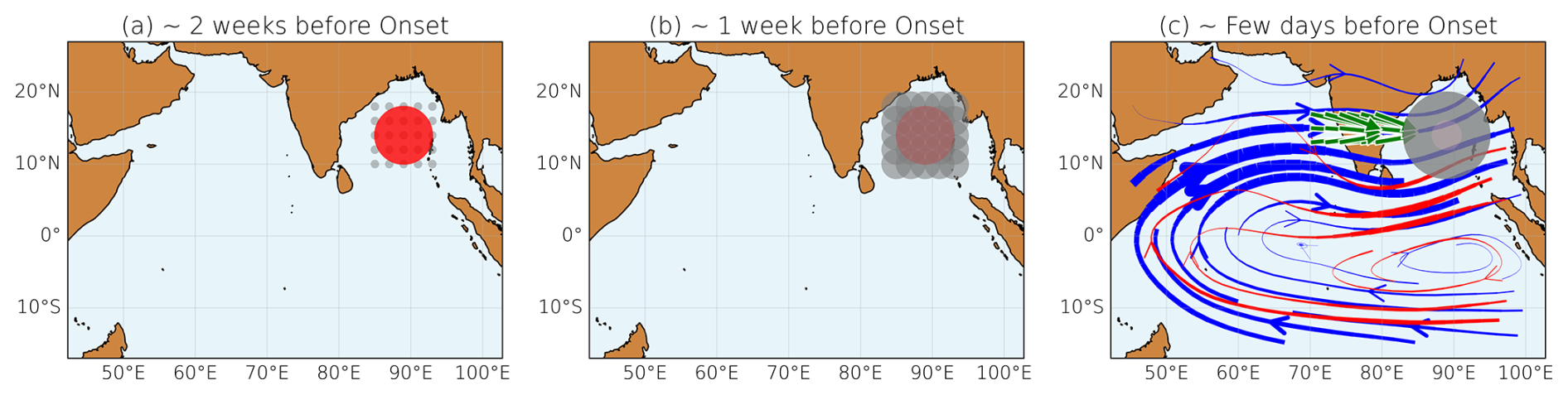
Figure 1Schematic of the hypothesis. (a) Warm SST anomalies (red disk) enhance convection over the BoB (∼ 2 weeks before onset). (b) Convection gradually peaks up and about a week before the onset, the strengthening convection tends to do two things: (1) drives the convergence of winds and, (2) reduces incoming solar radiation by cloud shading (gray). (c) SST is cooling down. The converging winds (depicted only the winds from India to BoB; green arrows) pave the path for the monsoon flow a few days before onset. In all panels: The red circular patch indicates positive SST anomalies that weaken from left to right panels; grey circular patches indicate convection that strengthens from left to right panels. In the the rightmost panel: green arrows indicate 850 hPa winds aligned in favor of monsoon low-level flow; red streamlines indicate mean circulation for May (essentially pre-monsoon) and blue streamlines indicate mean circulation for June (essentially monsoon), at 850 hPa. In panel (c), our hypothesis means that green arrows help red streamlines to transition to blue streamlines.
To better our understanding of the Indian monsoon onset, we adopt a known methodology. We contrasted the remarkably early monsoon onset years against the late-onset ones. We computed composites of the two categories of years to suppress the interannual variations in the data. In composite analysis, since all onset dates are aligned, interannual variations are suppressed and it yields a common picture of onset evolution across the different years. We used the large-scale tropospheric temperature gradient index of Xavier et al. (2007) to identify the early and late-onset years. It is noteworthy that there exist multiple definitions of monsoon onset (e.g., Table 1 of Chevuturi et al., 2019). However, we chose the tropospheric temperature gradient index of Xavier et al. (2007) because of its ability to represent the large-scale thermodynamic forcing and because it does not depend on any arbitrary thresholds (a detailed list of different monsoon indices large-scale, regional, and local can be found in Bombardi et al., 2020 and Li et al., 2024). We find, which we shall discuss in detail in Results to follow, a clear warm patch of SST in the Bay of Bengal for years with early onset, 10–15 d before onset. It is the only outstanding patch of ocean in the northern hemisphere in this context (Fig. S1 in the Supplement). We say outstanding because for the early-onset years, compared to the late-onset years, the sun is in a relatively southward position; hence northern hemisphere oceans are expected to be colder if they were to be heated only by solar radiation. This observation naturally raises two questions: What is the cause of this warm patch of SST in the Bay of Bengal, and what is the effect of it? We shall not investigate the drivers of the SST warm anomaly in this study and only mention some possibilities in Discussion later for future investigations. As for effect, we shall report, analyzing observations and performing modeling experiments on how this warm patch of SST advances monsoon onset over India.
Air-sea interactions in the Indian monsoon domain are complex. Therefore, a concern regarding the warm SST that we find 10–15 d before monsoon onset (Fig. 3a) might be if it is a consequence of atmospheric processes as opposed to our argument that the atmosphere responds to it. Reportedly, in intraseasonal time-scale during the Indian summer monsoon the ocean plays an active role in the northern BoB (Xi et al., 2015). The northern BoB region emphasized in Fig. 2a of Xi et al. (2015) is consistent with the positive SST anomalies in the BoB we found in our analyses. It instills more confidence in our hypothesis. Further, the reported lag of 6 d in the rainfall response to underlying SST in the same study (Xi et al., 2015) is another piece of evidence that is consistent with our hypothesis. However, it should be noted that growing convection (schematically represented by the growing gray circles from Fig. 1a to c, and depicted as rainfall anomalies in Fig. 3b, e, and h) interact with and modify surface winds and also interrupt the incoming short-wave radiation which then affects the SST as we shall discuss in detail in the Results section while reporting Fig. 3.
We tested our hypothesis by performing modeling experiments. We forced the Community Atmospheric Model (CAM) with positive SST anomalies over BoB. Since the Indian monsoon is an atmosphere-ocean coupled phenomenon, an SST-forced atmospheric modeling approach arguably would have serious limitations. Nonetheless, it has been instrumental in providing insights into the role of Indian Ocean SST on the Indian monsoon. For brevity and in the interest of not diverging from the narration of our research, we mention a minuscule number of the studies that used the SST-forced atmospheric modeling approach successfully to understand the role of Indian Ocean SST on the Indian monsoon, e.g., the studies by Shukla (1975), Washington et al. (1977), Yamazaki (1988), Zhu and Houghton (1996), Chandrasekar and Kitoh (1998), Chung and Ramanathan (2006), Roxy et al. (2015), Goswami et al. (2021), Goswami (2022), etc. While we shall discuss the experiment details and the model responses in the following sections, it is worth mentioning that we found the atmospheric model responds with an advanced annual cycle of rainfall over India, that is, early onset of monsoon, when warm SST anomalies over BoB are imposed 10–15 d before the model onset date.
2.1 Onset criteria and Observation data
A brief discussion of various monsoon onset indices can be found in Pai et al. (2009) and Pradhan et al. (2017). Excellent reviews of various onset indices can be found in Bombardi et al. (2020) and Li et al. (2024). These reviews demonstrate that all indices have advantages and disadvantages and no one index is superior then the other. Nonetheless, they considerably correlate with each other. We used the tropospheric temperature gradient (∇TT) index of Xavier et al. (2007) to define monsoon onset. Although monsoon onset is realized via synoptic activities, we chose the ∇TT considering the large-scale dynamics and thermodynamics of the monsoon. The transition of ∇TT from negative to positive values, indicating a huge latent heat release over the Indian monsoon region, is a widely accepted metric to identify monsoon onset. We used the temperature data from the National Centers for Environmental Prediction (NCEP) reanalysis product (Kalnay et al., 1996) to compute ∇TT. Once we defined monsoon onset dates using the ∇TT index, we identified the years that are early or late by more than 60 % of their standard deviation from the mean onset date and called them early or late-onset years, respectively. We found our results generally largely immune to reasonable changes in this definition. For the early and late years, we contrasted composite SST (obtained from the Optimum Interpolation Sea Surface Temperature (OISST) v2 (Banzon et al., 2016) provided by the National Oceanic and Atmospheric Administration (NOAA)) and different dynamic and thermodynamic fields (obtained from NCEP) for different time leads (in days) from the onset date.
In our analysis, we have used rainfall data from the India Meteorological Department (IMD) (Rajeevan et al., 2010; Pai et al., 2015) and the Tropical Rainfall Measurement Mission (TRMM) Multi-Satellite Precipitation Analysis (TMPA) 3B42 Version 7 product (Huffman et al., 2007).
2.2 Model configuration and Experimental design
We used the atmospheric model of the Community Earth System Model, version 2.1.3 (CESM 2.1.3) (Danabasoglu et al., 2020), that is the Community Atmosphere Model, version 6 (CAM6) (Danabasoglu et al., 2020), developed and maintained at the National Center for Atmospheric Research (NCAR), with longitude and latitude specifications 1.25 and 0.9°, respectively, and 32 vertical levels. We forced the model by HadISST1 climatological daily mean SST data provided by the Met Office Hadley Centre (Rayner, 2003). Our simulations are performed with compset “F2000climo” in CESM terms. These are essentially atmospheric simulations forced by the climatological present-day climate. All simulations are 35 years long, and we analyzed the last 30 years of each simulation, considering the first 5 years as spin-up and discarding. Five years is more than enough for an atmospheric model to spin. To its reputation, CAM is a state-of-the-art model, and its simulations, contributed by NCAR, are used in the IPCC assessments.
We performed a simulation following the above specifications that we deem our control (CTRL) simulation. We checked the mean monsoon onset date in CTRL (we used the ∇TT index to find this mean onset date for CTRL). Let us call this date T0. We performed an experiment (EXPT), a carbon copy of CTRL, except for an added warming over BoB to the forcing SST, the positive SST anomalies that we found contrasting early and late-onset years. We imposed this warming for 5 d from T0 − 15 to T0 − 10 d. To check the consistency of the model response with our hypothesis, we compared rainfall and 850 hPa winds in the CTRL and EXPT simulations.
To suit our narration, we shall use the word/phrase “monsoon” and “low-level winds” to mean Indian summer monsoon and winds at 850 hPa height, respectively, when it is evident reference to the context.
3.1 15 d to onset
Figure 2 depicts the monsoon onset dates from 1985–2019. The mean onset day is the ∼ 152nd day (1 June) of a 365 d year. The consistency of this date with the climatological onset date as per the definition of onset by IMD is intriguing because IMD's monsoon onset definition is formulated based on synoptic scale signals, and the index used (∇TT see Methods) represents the large-scale state over the monsoon region. There is considerable year-to-year variability among the onset dates. We calculated composite for different meteorological variables for early and late-onset years, defined as below and above 60 % standard deviation of the mean onset day, respectively. The early and late-onset years are marked by blue and red circles, respectively, in Fig. 2.
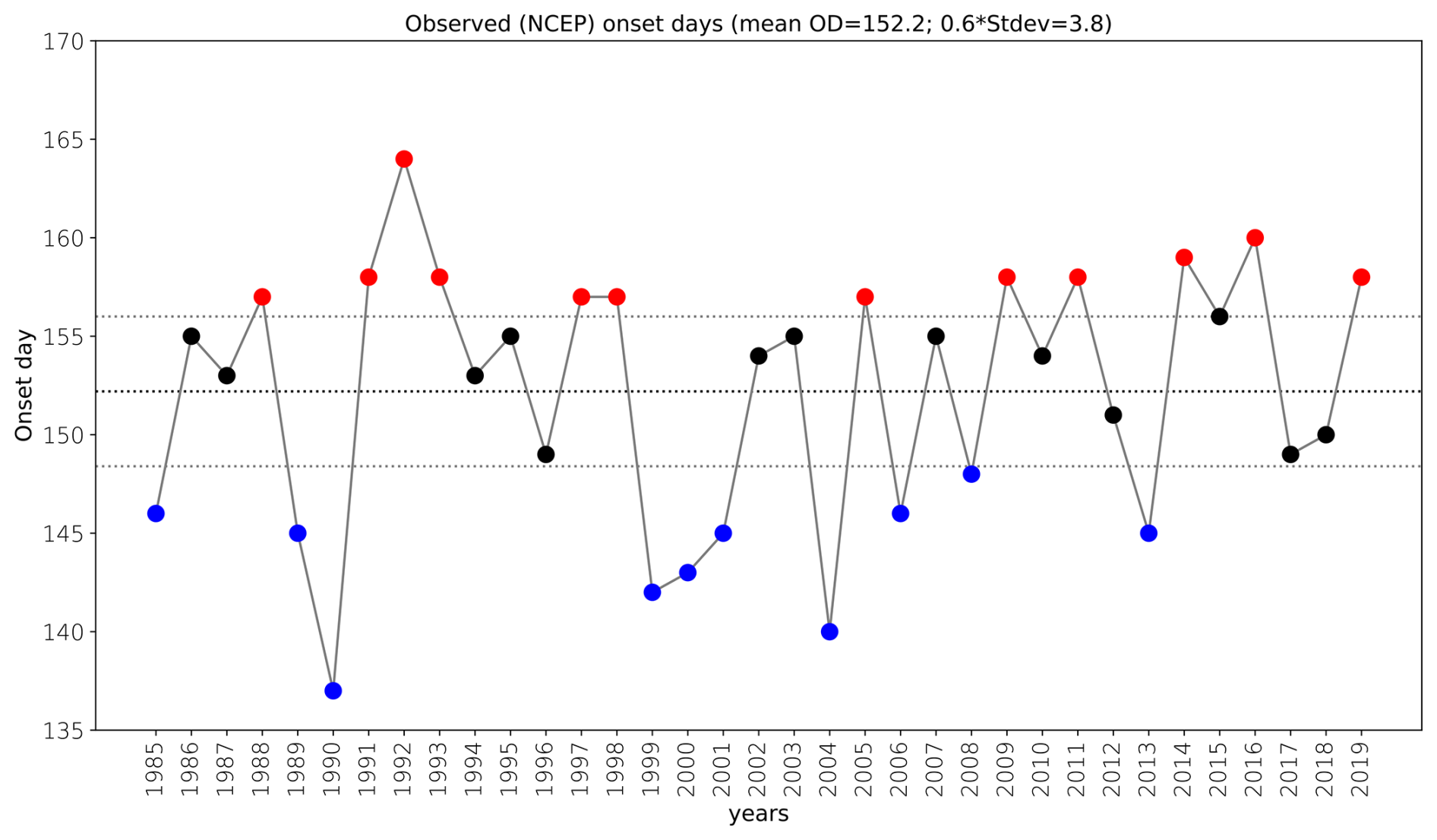
Figure 2Onset dates. Monsoon onset dates were calculated using NCEP temperature data (1985–2019) based on the tropospheric temperature gradient index of Xavier et al. (2007). The mean onset day is indicated by the black dotted line. The grey dotted lines indicate a 60 % standard deviation. The blue, black, and red circular markers indicate early, normal, and late-onset years, respectively.
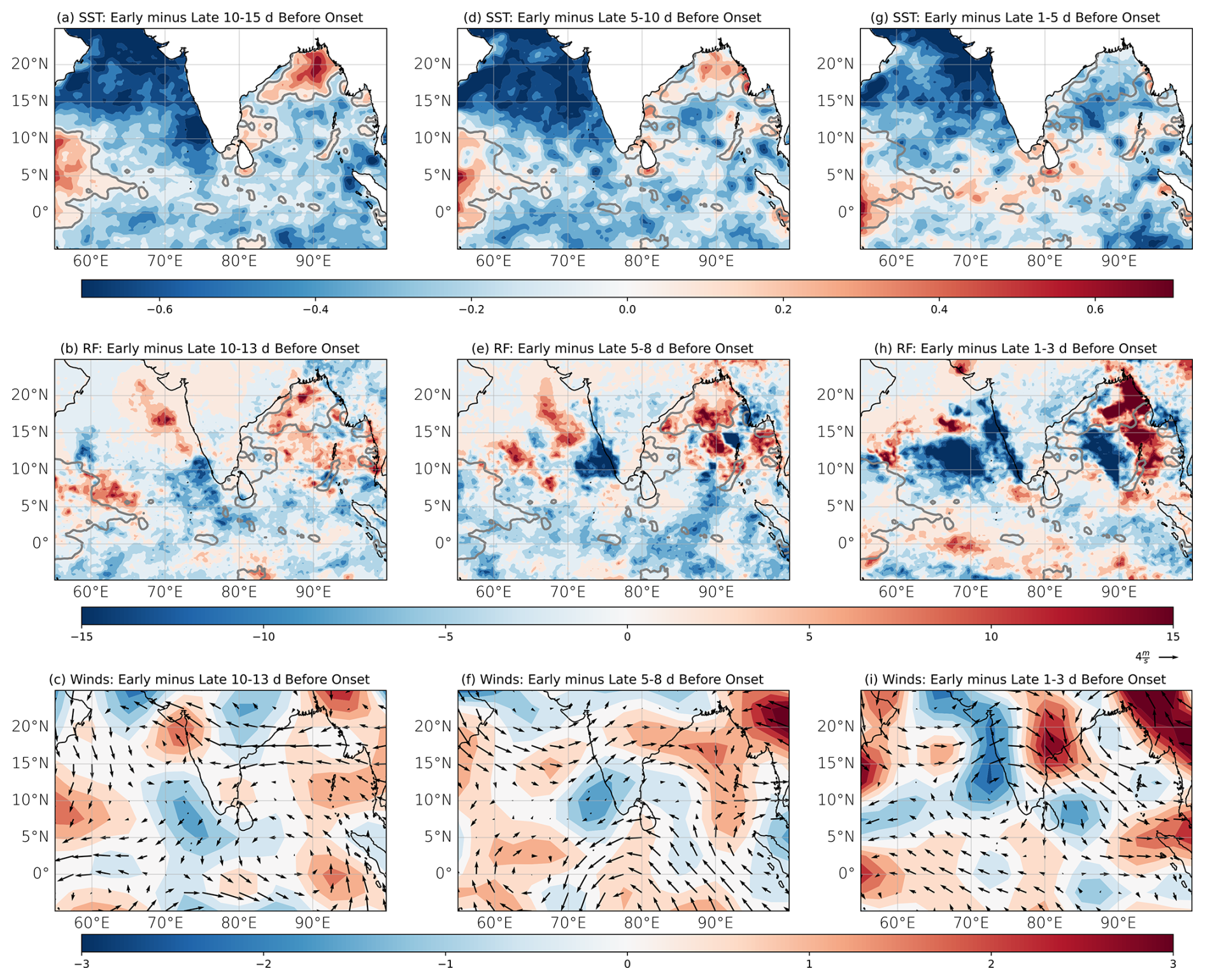
Figure 3Early monsoon onset anomalies. The observed SST (°C) (top panels), rainfall (mm d−1) (middle panels), and 850 hPa winds (m s−1) and convergence (106 m−1) (bottom panels); anomalous composite fields for early-onset years compared to late-onset years: (a) 10–15 d, (d) 5–10 d, and (g) 1–5 d; and (b–c) 10–13 d, (e–f) 5–8 d, and (h–i) 1–3 d before monsoon onset date. The gray thick line in panels (a), (b), (d), (e), (g), and (h) indicate zero-contour of the SST anomalies in panel (a).
Figure 3 depicts anomalous composite fields for early-onset years compared to late-onset years of observed SST (Fig. 3, top panels), rainfall (Fig. 3, middle panels), and 850 hPa winds and convergence (Fig. 3, bottom panels). The SST and wind data are from OISST and NCEP, respectively, while rainfall is from TRMM (1998–2019). The early-onset composites are based on 10 cases (7 cases for rainfall due to limited availability of TRMM data), and the late-onset composites are based on 12 cases (7 cases for rainfall). The SST fields are averaged over 10–15, 5–10, and 1–5 d. The atmosphere over the warm SST of the BoB responds with a local enhancement of rainfall (Goswami et al., 2021). We included a 2 d delay in the precipitation response to SST anomalies to account for some lag in the precipitation response (Roxy, 2014; Xi et al., 2015). For example, precipitation fields are shown for an average over 13 to 10 d before monsoon onset, corresponding to SST anomalies averaged over 15 to 10 d before monsoon onset, counting the monsoon onset day as day 0. The circulation responses are shown for the same durations as precipitation. Analyzing low-level jet strength over the Arabian Sea, Joseph and Sijikumar (2004) reported that LLJ strength over the Arabian Sea peaks 2–3 d after convection peaks over the BoB. This 2–3 d lag in the peaking of LLJ strength over the Arabian Sea in response to convection over the BoB indicates that the local circulation responds to atmospheric heating almost instantaneously. We performed this exercise for different lead times but show the results in Fig. 3 since they are sufficient to emphasize the main features of the sequence of events we discuss. We note positive rainfall anomalies in the Arabian Sea off the western coast of India, but they are not persistent and are not investigated further.
Positive SST anomalies can be seen over BoB 10–15 d before early monsoon onset (Fig. 3a). We learn from Fig. 2 that the mean onset day for early-onset years is 144 (i.e., 15 May) and that for late-onset years is 158 (i.e., 8 June). It means, in essence, that Fig. 3a depicts the difference of SST averaged from 1 to 5 May (for early-onset years) minus SST averaged from 24 to 29 May (for late-onset years). It is noteworthy that, the exact dates for averaging SST are different for each year and Fig. 3 is a difference-of-composites. Understandably under a larger solar angle, on 1–5 May, the northern hemisphere oceans are colder than on 24–29 May (Fig. S1). Hence, the warm anomalies over BoB are intriguing (Figs. 3a and S1). These anomalies are noticeable even when we remove the seasonal cycle from the SST data (Fig. S2). A preliminary analysis reveals that these warm anomalies are largely insensitive to the definition of monsoon onset. When IMD-declared monsoon onset dates are considered, SST warm anomalies over the BoB associated with early-onset cases remain evident (Fig. S2), although the anomaly distributions differ (more widespread) from those shown in Fig. 3a. Consistent with warm anomalies, enhanced rainfall is apparent over BoB (Fig. 3b). However, the enhanced rainfall locations are not confined only within warm SST anomalies. We can understand it by emphasizing springtime mean SST in BoB. During spring, BoB SST is typically hot (∼ 30 °C) (Fig. S2). It is the time of monsoon onset over BoB (Wang and LinHo, 2002). For such warm SSTs, tiny warm anomalies, for example, seen over the north BoB for the early-onset years (Fig. 3a), can generate considerable atmospheric responses (Palmer and Mansfield, 1984). However, the resultant enhanced rainfall (Fig. 3b) is not strictly confined to warm SST anomalies (Fig. 3b). Nonetheless, it is consistent with the corresponding latent heat flux (LHF) anomalies. To understand why latent heat flux (LHF), and hence rainfall, does not strictly follow the SST warm anomaly distribution, we recall that LHF is a measure of surface evaporation (Fig. S4) as a response to surface wind speed (Fig. S4) and air-sea humidity difference. Thermodynamically, warm SST anomalies enhance LHF. However, the dependence of LHF on surface wind speed adds complexity to this relation (Zhang and McFarlane, 1995). Observational evidence suggests that wind speed, and hence LHF, over high SST experience more dynamical control involving interaction between convection and large-scale circulation. To quote Zhang and McFarlane (1995), “high SST → unstable atmosphere/cumulus convection → large-scale low-level convergence → weak surface wind → low LHF.” Therefore, over warm oceans (like BoB during May), warm SST anomalies might not always result in collocated LHF anomalies because, due to convection growing, LHF is significantly affected by surface gust winds resulting from dry and cold convective downdrafts. The complexity of the relative contribution of dynamic and thermodynamic control over LHF over high SST (Kumar et al., 2017) explains why we see positive precipitation anomalies 10–15 d before an early monsoon onset that match the corresponding LHF pattern reasonably well (Fig. S4) but are not strictly confined within the positive SST anomalies (comparing the red shaded rainfall anomalies and the gray thick contour in Fig. 3b). It is noteworthy that, several earlier studies reported a BoB monsoon onset vortex (MOV) (Lau et al., 1998; Liu et al., 2002; Wu et al., 2011, 2012) that usually develops over the eastern BOB in response to a warm BoB SST. The MOV drives intense moisture convergence and enhances precipitation (Fig. 7 of Wu et al., 2012). Further, the optically thick convective clouds, a response to warm SST anomalies, block solar radiation from reaching the surface (Fig. S4) resulting in a cooling of the BoB 1–5 d before onset (Fig. 3g). It suggests that warm SST anomalies (Fig. 3a) enhance convection (Fig. 3b), and while the convection continues to grow (from Fig. 3b to e to h) the SST anomalies get negatively affected back by the convection that it produced and exhibit a cooling (from Fig. 3a to d to g). We superimpose the zero-contour in Fig. 3a (indicated by the thick gray line) on Fig. 3b, d, e, g, and h for easy visual inspection of the SST and rainfall anomalies and their evolution over time.
During early-onset years, the atmospheric column over BoB, 10–15 d before onset, is expectedly colder than that for the late-onset years. We also found the total moisture content (specific humidity) is not substantially different. However, since the atmosphere is colder for early-onset years, it has a relatively higher relative humidity considering total moisture content is comparable. Higher relative humidity makes the atmosphere conducive for convection (Singh et al., 2019). Time-height cross-sections of different meteorological fields over BoB are shown in Fig. S5. We investigated these time-height cross-sections focusing only on the positive SST anomaly region in the head BoB (Fig. 3a) and the results do not change except more pronounced (Fig. S6). In these figures, a noticeable injection of moisture, 1–5 d before monsoon onset at about 850 hPa, is evident that arguably is contributed by the strengthening monsoon low-level jet.
In the circulation pattern depicted in Fig. 3i, northwesterly winds blow from central India to BoB. It is the southern branch of the cyclonic circulation (in the north) of a Rossby wave response to atmospheric heating due to latent heating over BoB (Fig. S7 and also reported by Liu et al., 2015). The flow pattern helps set the monsoon circulation earlier over India because, understandably, it favors the mean monsoon circulation. This circulation response to the convection over BoB that we argue is linked with the warm SST anomalies in the BoB is the basis of our hypothesis depicted in Fig. 1.
Our hypothesis arguably indicates a mechanism that can be impacted by intraseasonal activities. For example, many studies report that monsoon onset is favored during the wet phase of the intraseasonal monsoon modes (Wang et al., 2009; Shroyer et al., 2021; Qian et al., 2019; Kikuchi, 2021; Lenka et al., 2024, etc.). In addition to these monsoon modes, which are part of the monsoon dynamics itself, an important driver of monsoon onset is the Madden–Julian Oscillation (MJO). MJO convection arriving over the Indian Ocean in May can propagate northward, triggering the onset (Bhatla et al., 2017; Taraphdar et al., 2018; Lenka et al., 2023). These multiple intraseasonal drivers, apart from advancing and delaying monsoon onset, sometimes result in bogus and double onsets (Flatau et al., 2001; Tyagi et al., 2025). A preliminary analysis of MJO phase during May for early and late onset years is provided in Fig. S8 (MJO phase is plotted using the real-time multivariate MJO index (RMM) data (Gottschalck et al., 2010) obtained from the Australian Bureau of Meteorology). MJO activity over the Indian Ocean appears to be slightly more active for late onset years, consistent with the findings of Taraphdar et al. (2018). Nonetheless, there is considerable year-to-year variability. It should be noted that, in addition to intraseasonal modes, slowly varying boundary conditions, for example the Pacific Decadal Oscillation (PDO) (Watanabe and Yamazaki, 2014; Hu et al., 2023), the El Niño Southern Oscillation (ENSO) (Li et al., 2018; Choudhury et al., 2021), and the Indian Ocean Dipole (IOD) (Sankar et al., 2011; Cherchi et al., 2021) also affect the monsoon onset. Recently, the North Pacific Victoria Mode has also been reported to affect the monsoon onset (Zhang et al., 2024). We did not pursue a detailed analysis of intraseasonal modes and slowly varying boundary conditions contrasting early and late onset cases, since our interest is the manifestation of these various factors, which arguably is a warm SST in the northern BoB 10–15 d before monsoon onset, and our motivation is investigating the atmospheric response to it. Alternatively, the warm anomalies in the northern BoB might be a feature of the background conditions that interact with the intraseasonal variabilities, for example, the MJO as argued by Taraphdar et al. (2018) affecting monsoon onset.
3.2 Hypothesis testing
To test the validity of our hypothesis, we evaluated the response of the CAM to BoB warming. The model simulation that we named CTRL, is a standard simulation setup of CAM and has already been studied for monsoon analyses (e.g., Goswami, 2022). Nonetheless, we have provided Fig. S9 depicting model simulated monsoon daily precipitation climatology alongside TRMM observation. The model simulates the monsoon rainfall reasonably well in the sense that the model could capture the overall pattern of the mean rainfall distribution.
We first analyzed the CTRL simulation to identify the mean onset date in the model using the ∇TT index. We found it the 133rd day of a year (Fig. S10). The simulated mean onset day is 16 d earlier than that in observations. This is a bias in the model. However, it is noteworthy that our simulations are idealized and forced by climatological SST and it would be unrealistic to expect such a simulation to match the observations in terms of accuracy of simulation of the onset day. This bias is partly attributable to the design of our simulations. Moreover, we aim to assess monsoonal circulation response to warm SST anomalies in the BoB and not evaluate the model fidelity to simulate the exact date of monsoon onset. In the observation analysis, we had noticed the warm SST signal in BoB 10–15 d before onset. Therefore, we forced our model, in EXPT simulation, by positive SST anomalies over the BoB, also 10–15 d before the mean onset day in the model, that is, during 117–122 d. It is worth noting that, in EXPT simulations, we used only the positive SST anomalies to force CAM (Fig. S11) since it is the only outstanding patch of ocean in the northern hemisphere with positive anomalies and hence relevant to our hypothesis. Based on our hypothesis what we expect to see in the EXPT simulation is a stronger convection over BoB, early growth and development of monsoon LLJ and early onset.
Before comparing pre-onset meteorology in the CTRL and EXPT simulation, we identified the mean onset date in EXPT using the ∇TT index. While we expected monsoon onset to occur earlier in EXPT, we found the same onset day as CTRL, that is 133rd day of a year (Fig. S10). The ∇TT index is a large-scale index. The same onset date in CTRL and EXPT, as identified by the ∇TT index, suggests similar large-scale states for the tropospheric temperature. We hypothesize that this could be due to too strong homogenization of upper level temperatures in the model compared to observations and/or inaccurate SST-convection relationship in the model. Another possibility is that, since the onset in CAM is already early, the model's large-scale conditions (for example, land temperatures) may not support an even earlier monsoon onset in response to the prescribed warm SST anomalies in the Bay of Bengal. Arguably, an alternative can be to test the hypothesis by prescribing cold anomalies in the Bay of Bengal and checking if the model produces a delayed onset. However, since our hypothesis is based on the atmospheric dynamic response to warming of already warm mean SSTs (Goswami et al., 2021), prescribing cold SST anomalies is not consistent with our hypothesis. Since it is the absolute SST that is critical (Shroyer et al., 2021), the model cannot be expected to yield dynamically mirror-opposite results for cold and warm anomalies. Although we do not see an early onset in terms of an altered large-scale state of the model, we shall see below that the circulation response is consistent with our hypothesis when the warm SST anomaly is imposed.
We suspect that the unaltered large-scale tropospheric temperature (depicted by the ∇TT index) in response to warm SST anomalies in the northern BoB reflects biases in simulating convection and/or the SST-convection relationship in the model. Observations indicate a lagged convection response to SST increase (Roxy, 2014). In climate models, convection is sometimes over-sensitive to SST changes (Goswami et al., 2014). This compelled us to examine model responses using circulation-based onset indices. This does not necessarily indicate any superiority of circulation-based indices over the ∇TT index (Bombardi et al., 2020). Rather, we adopted this approach to investigate whether the model exhibits any response that is consistent with our hypothesis. We checked monsoon onset using some circulation-based indices, for example, the Webster and Yang index (Webster and Yang, 1992), Wang and Fan index (Wang and Fan, 1999), and the Monsoon Hadley circulation index (Goswami et al., 1999), in CTRL and EXPT simulations (Fig. S12). We analyzed these circulation based indices to assess the model response to warm SST via enhanced convection over BoB. The Webster-Yang and the Wang-Fan indices are indicators of zonal wind shear over the monsoon region. The Hadley circulation Index is a measure of meridional shear which is proportional to the strength and distance of off-equatorial monsoonal latent heating. These circulation indices, consistent with our earlier observation based on the ∇TT index, also indicate an earlier onset in both the models compared to observations. The zonal-shear-based circulation indices do not distinguish onset timings between CTRL and EXPT. The Hadley circulation index suggests an earlier monsoon onset in EXPT simulation (Fig. S12c). While the annual cycle of the Webster-Yang and the Wang-Fan indices suggests that these indices get critically affected by the abrupt response of the model to the prescribed warm SST forcing, an early onset in EXPT simulation indicated by the monsoon Hadley circulation index conforms to our hypothesis. In the interest of a consistent analysis, we shall use the onset dates in the models as identified by the ∇TT index in our analysis.
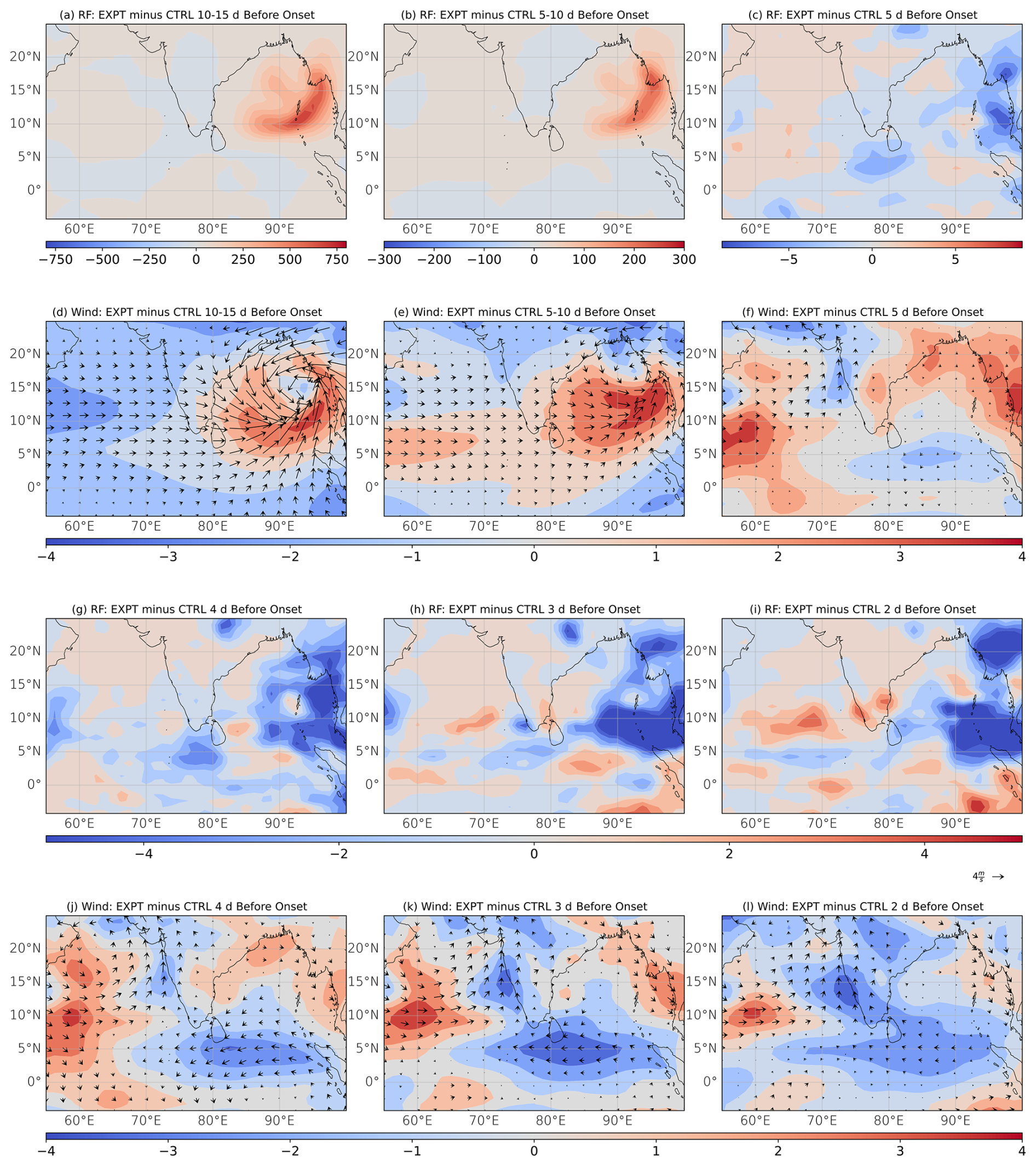
Figure 4Model response. Model simulated rainfall (mm d−1) (1st and 3rd-row panels) and 850 hPa winds (m s−1) (wind speed in colors) (2nd and 4th-row panels) for EXPT minus CTRL simulation: (a, d) 10–15 d, (b, e) 5–10 d, (c, f) 5 d, (g, j) 4 d, (h, k) 3 d, and (i, l) 2 d, before monsoon onset date in the models.
Figure 4 depicts rainfall and circulation response to warm anomalies in the BoB in the simulations. Like for the observations, we investigated the evolution of rainfall and circulation in the model from the time we imposed the warming over the BoB until onset. Given the same onset date in CTRL and EXPT, we compare the same days of the year in the two simulations, from 117th (27 April) to 132nd (12 May) day of a 365 d year. We notice, 10–15 d before onset, a cyclonic wind response at 850 hPa and increase in rainfall over BoB. Like in the observations, the enhanced rainfall is not collocated with the imposed warm SST anomalies over BoB. The convective activity over BoB further strengthens 5–10 d before onset. The model precipitation response to prescribed SST anomalies considerably resemble the observed precipitation anomalies in early onset years (comparing Figs. 4a–b and 3e). It is however impulsive and very strong (Fig. S13). From 4 d-to-onset onward convection can be seen reaching the Indian south-western coast and eventually onset. Arguably, the model onset does not take 15 d from the imposed SST warm anomalies to start precipitating over the south-western coast of India. The model response in this sense, is faster compared to the observed timeline of sequence of events. Intriguingly, the positive rainfall anomalies over the south-western coast of India (Fig. 4g to i) suggest that, synoptically monsoon onset indeed occurs earlier in the EXPT simulation compared to CTRL. The annual cycle of rainfall over India also corroborates this (Fig. 5a). In addition the annual cycle of low-level jet strength also exhibits a clear bump when warm SST anomaly is imposed (Fig. 5b). This is a clear evidence of role of BoB warm SST to cause LLJ strengthening prior to onset for early-onset years that advocates in favor of our hypothesis. The model simulated cyclonic circulation response (Fig. 4d) resembles the observed anomalous circulation pattern (Fig. 3i) in the case of the early-onset years. This circulation response seemingly appears to be a Gill-Matsuno-type response to the heating.
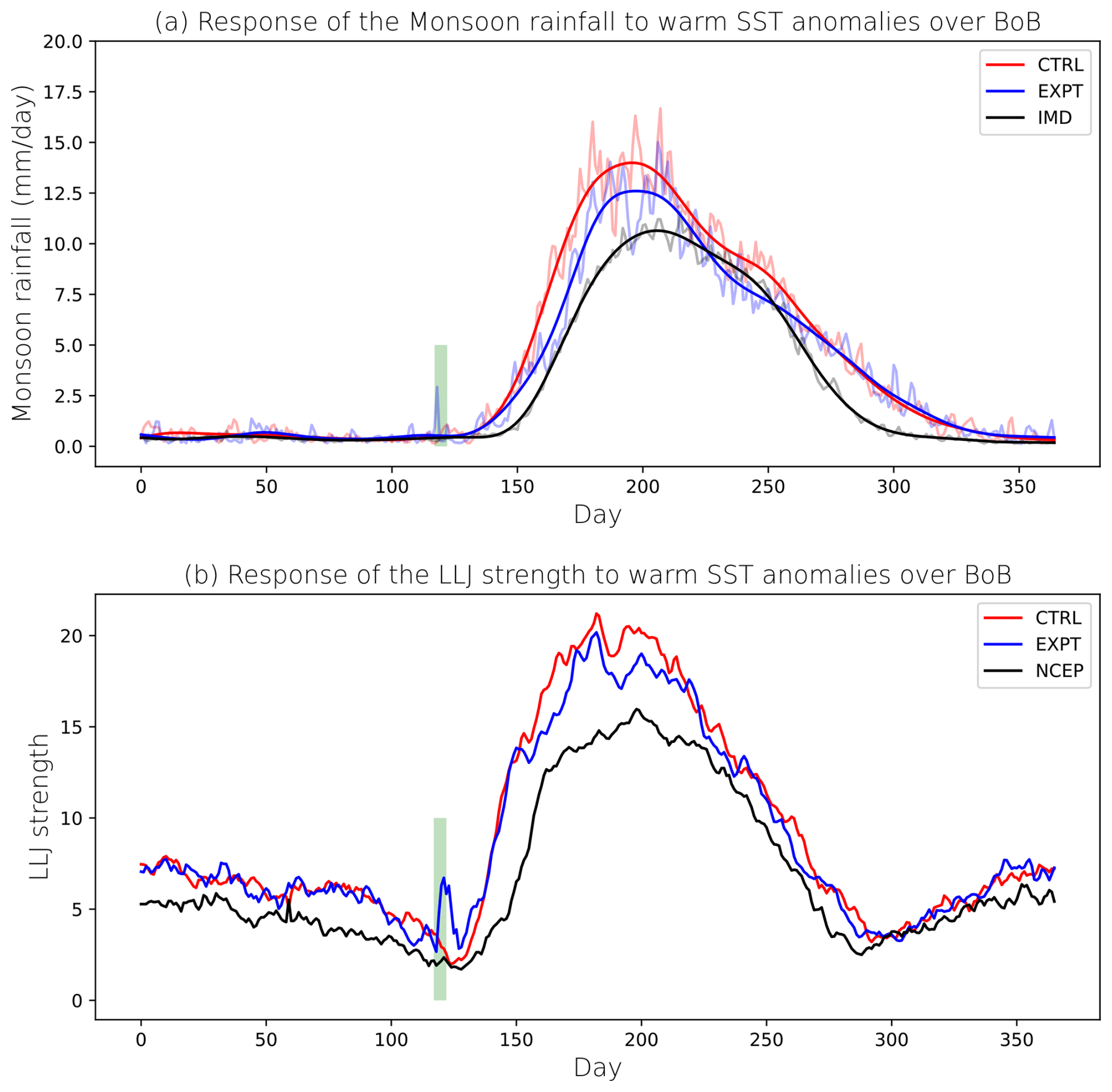
Figure 5Central India rainfall and LLJ annual cycle. Annual cycles of (a) observed (IMD) and model-simulated rainfall (averaged over central India: 75–84° E, 18–28° N), and (b) observed (NCEP) and model-simulated LLJ strength (850 hPa wind speed averaged over 50–70° E, 5–15° N). The green shaded patch in panels (a) and (b) indicates the timing of the imposed SST in the EXPT simulation.
4.1 Findings
We found warm SST anomalies in the Bay of Bengal a common factor, distinguishing early from late-onset years, which occurred during 1985–2019. The monsoon onset criteria we used was the meridional tropospheric temperature gradient over the Indian monsoon region defined by Xavier et al. (2007). We used an ad-hoc 60 % standard deviation criteria to identify early and late-onset. Onset dates earlier or later by 60 % of standard deviation from the climatological onset date were termed early or late-onsets, respectively. Using this definition, we identified 10 early and 12 late-onset years. The mean onset date for the 10 early-onset years was 15 May, and that for the 12 late-onset years was 8 June. Composite analyses revealed the presence of warm SST anomalies in the Bay of Bengal 10–15 d before monsoon onset in the case of the early-onset years.
During the spring, the sea surface temperature in the Bay of Bengal is typically hot. The warm SST anomalies that we found in the case of the early-onset years enhance deep convection over the Bay of Bengal. The atmospheric circulation responds to the associated latent heating such that the low-level wind direction over India harmonizes with the mean Indian monsoon circulation. It advances the onset of monsoon circulation and rainfall. We tested this hypothesis (depicted in Fig. 1) by evaluating the response of the Community Atmospheric Model (CAM) to warm SST anomalies in the BoB 10–15 d before monsoon onset in the model.
We compared CAM simulations produced with present-day climatological SST forcing, with and without warm SST anomalies over the BoB 10–15 d before monsoon onset. The models simulated a fairly realistic monsoon but showed limited skill in simulating the monsoon onset, simulating it 2 weeks earlier than observations. We expected early monsoon onset in the simulation with SST warming. However, our large-scale indicator of monsoon onset did not indicate any change in the mean date of monsoon onset for 30 years of simulation data. Yet, a closer look at the annual cycle of rainfall over central India and the strength of the monsoon low-level jet (LLJ) reveals that CAM responds to warm SST anomalies over BoB, imposed 10–15 d before monsoon onset in the model, with an early start to rainfall accompanied by a stronger LLJ concurrent with the timing of the imposed SST anomalies. An early onset of monsoon rainfall over India, contrary to an unaltered monsoon onset timing according to the index, suggests a synoptic response in the model to BoB warm SST anomalies. A meridional-shear-based monsoon onset index indicates an early onset in EXPT simulation.
4.2 Limitations
We used the meridional tropospheric temperature gradient index to identify monsoon onset. Since warm ocean waters contribute to tropospheric temperature by transferring heat from the surface to the troposphere via atmospheric convection, our definition is not immune to the warm SST anomalies over BoB. It may not alter our key findings but contaminate the finer details.
We used an atmosphere-only model to verify our hypothesis. The model-simulated monsoon onset is significantly earlier than that in the observations and has a slightly higher year-to-year variability of the onset date. Moreover, the model response to the warm SST anomalies was arguably abrupt (a sharp increase in the LLJ strength). Perhaps this explains why we see a cyclonic circulation response in the model 10–15 d before monsoon onset (Fig. 4d) instead of 1–5 d before in the observations (Fig. 3i). The model-simulated precipitation response before monsoon onset was dominant primarily in the region approximately from 5–10° N around 90° E. Moreover, the smoothed climatological rainfall annual cycle curves (Fig. 5a) indicate that CTRL simulation exhibits an earlier monsoon onset than EXPT simulation. It conflicts with our hypothesis and can be partly related to uncertainties linked to the parameterization of convection in the model we used and partly to the missing atmosphere-ocean coupling processes in our simulations. These limitations arguably might result in biases in simulating adequate convective memory required to sustain organized convection (Goswami et al., 2025). A circulation response that is limited only to a few days after the prescription of the positive SST anomalies in the EXPT simulation (we note that the CTRL and EXPT simulated LLJ are almost identical around the 150th day in Fig. 5b) is a possible consequence of these shortcomings in our simulations. More detailed experiments using a comprehensive coupled climate model will be required to address these issues. It would also help us understand with more confidence if the unaltered large-scale monsoon onset date in the warming experiment is a limitation of the model we used or a realistic response.
The abrupt response of the model to the prescribed warm anomalies in the BoB is a matter of concern (Fig. S13). This behavior demands further investigation. It is, however, beyond the scope of our study. We suspect it is related to how the model mimics atmospheric convection. Qualitatively, the model response advocates in favor of our hypothesis. A less abrupt model response to warm SST anomalies is desirable, which might result in a gradual and more realistic onset of monsoon following the warm SST anomalies.
4.3 Future scope
A detailed study targeting specific early and late-onset cases perhaps would be a litmus test of our hypothesis. However, this would require meticulously curated diagnostics to distill various factors affecting monsoon onset. Another possible future analysis is to understand what warms the Bay of Bengal during spring, more in some years. Warm sea surface temperatures of the Bay of Bengal are primarily attributable to solar heating of a shallow oceanic mixed layer (Wu et al., 2011, 2012; Liu et al., 2013). However, solar heating over the Bay is undeniably weaker in the case of early-onset years compared to the late-onset years. An investigation addressing this issue might help us identify remote drivers of monsoon onset via a synoptic response with predictive values. For example, disentangling the effect of ENSO from the pool of selected early and late-onset years (Zhou et al., 2019). It is noteworthy that, analyzing IMD-declared monsoon onset dates, Preenu et al. (2017) found that El Niño (La Niña)-type SST anomalies are associated with delayed (early) monsoon onset. A case study of the 2019 monsoon by Sankar et al. (2021) corroborates this. They argue that the 2019 delayed monsoon onset was partly caused by the presence of an El Niño Modoki. On the other hand, analyzing monsoon onset defined by the rainfall accumulation-based criteria of Liebmann and Marengo (2001), a recent study by Jayasankar and Misra (2025) did not find any robust teleconnection between monsoon onset and interannual forcing such as ENSO or IOD. The discrepancy in findings on the co-variability of monsoon onset timing with interannual forcing like ENSO partly stems from differences in definitions of monsoon onset. In this regard, it is noteworthy that we found robust warm anomalies over the Bay of Bengal favoring early onset for two different definitions of monsoon onset (tropospheric temperature-based onset dates: the dates indicated in Fig. 2 and SST anomalies in Fig. 3a; and IMD-declared onset dates: the dates indicated in Table 1 of Satish and Suneetha, 2022 and SST anomalies in Fig. S2). Hence, investigating the source of these warm anomalies remains our top future research priority. Implications of our findings would be even more critical in a changing climate with a rapidly warming Indian Ocean (Rao et al., 2012; Roxy et al., 2014; Sharma et al., 2023) and claims of a delayed monsoon onset in recent times (Sahana et al., 2015; Sabeerali and Ajayamohan, 2017). It would be intriguing to investigate factors causing the warm anomalies over the BoB that impact the monsoon onset. Essentially, the most important task would be to understand remote versus local or fast drivers, and atmospheric versus oceanic processes.
All codes used for analyses of the simulation data are available from the corresponding author upon reasonable request.
The supplement related to this article is available online at https://doi.org/10.5194/wcd-7-583-2026-supplement.
BBG conceptualized the study with inputs from CJM and performed the simulations. All authors interpreted and discussed the results. BBG wrote the manuscript and both authors approved the final manuscript.
The contact author has declared that neither of the authors has any competing interests.
Publisher's note: Copernicus Publications remains neutral with regard to jurisdictional claims made in the text, published maps, institutional affiliations, or any other geographical representation in this paper. The authors bear the ultimate responsibility for providing appropriate place names. Views expressed in the text are those of the authors and do not necessarily reflect the views of the publisher.
We thank the two anonymous reviewers for their constructive comments, which helped improve and further clarify the manuscript. We also acknowledge the support of the Scientific Service Units (SSU) at ISTA for their assistance in performing the model simulations.
This research has been supported by the European Research Council, H2020 European Research Council (grant no. 805041).
This paper was edited by Dariusz Baranowski and reviewed by two anonymous referees.
Ajaya Mohan, R. S. and Goswami, B. N.: Potential predictability of the Asian summer monsoon on monthly and seasonal time scales, Meteorol. Atmos. Phys., 84, 83–100, https://doi.org/10.1007/s00703-002-0576-4, 2003. a
Ananthakrishnan, R. and Soman, M.: The onset of the southwest monsoon over Kerala: 1901–1980, J. Climatol., https://doi.org/10.1002/joc.3370080305, 1988. a
Banzon, V., Smith, T. M., Chin, T. M., Liu, C., and Hankins, W.: A long-term record of blended satellite and in situ sea-surface temperature for climate monitoring, modeling and environmental studies, Earth Syst. Sci. Data, 8, 165–176, https://doi.org/10.5194/essd-8-165-2016, 2016. a
Bhatla, R., Singh, M., and Pattanaik, D. R.: Impact of Madden-Julian oscillation on onset of summer monsoon over India, Theor. Appl. Climatol., 128, https://doi.org/10.1007/s00704-015-1715-4, 2017. a
Bombardi, R. J., Moron, V., and Goodnight, J. S.: Detection, variability, and predictability of monsoon onset and withdrawal dates: A review, Int. J. Climatol., 40, 641–667, https://doi.org/10.1002/joc.6264, 2020. a, b, c, d
Chandrasekar, A. and Kitoh, A.: Impact of Localized Sea Surface Temperature Anomalies over the Equatorial Indian Ocean on the Indian Summer Monsoon, J. Meteorol. Soc. Jpn. Ser. II, 76, 841–853, https://doi.org/10.2151/jmsj1965.76.6_841, 1998. a
Cherchi, A., Terray, P., Ratna, S. B., Sankar, S., Sooraj, K. P., and Behera, S.: Indian Ocean Dipole influence on Indian summer monsoon and ENSO: A review, Indian Summer Monsoon Variability, 157–182, https://doi.org/10.1016/B978-0-12-822402-1.00011-9, 2021. a
Chevuturi, A., Turner, A. G., Woolnough, S. J., Martin, G. M., and MacLachlan, C.: Indian summer monsoon onset forecast skill in the UK Met Office initialized coupled seasonal forecasting system (GloSea5-GC2), Clim. Dynam., 52, 6599–6617, https://doi.org/10.1007/S00382-018-4536-1, 2019. a
Choudhury, D., Nath, D., and Chen, W.: The modulation of Indian summer monsoon onset processes during ENSO through equatorward migration of the subtropical jet stream, Clim. Dynam., 57, https://doi.org/10.1007/s00382-021-05700-4, 2021. a
Chung, C. E. and Ramanathan, V.: Weakening of north Indian SST gradients and the monsoon rainfall in India and the Sahel, J. Climate, 19, 2036–2045, https://doi.org/10.1175/JCLI3820.1, 2006. a
Danabasoglu, G., Lamarque, J., Bacmeister, J., Bailey, D. A., DuVivier, A. K., Edwards, J., Emmons, L. K., Fasullo, J., Garcia, R., Gettelman, A., Hannay, C., Holland, M. M., Large, W. G., Lauritzen, P. H., Lawrence, D. M., Lenaerts, J. T. M., Lindsay, K., Lipscomb, W. H., Mills, M. J., Neale, R., Oleson, K. W., Otto‐Bliesner, B., Phillips, A. S., Sacks, W., Tilmes, S., Kampenhout, L., Vertenstein, M., Bertini, A., Dennis, J., Deser, C., Fischer, C., Fox‐Kemper, B., Kay, J. E., Kinnison, D., Kushner, P. J., Larson, V. E., Long, M. C., Mickelson, S., Moore, J. K., Nienhouse, E., Polvani, L., Rasch, P. J., and Strand, W. G.: The Community Earth System Model Version 2 (CESM2), J. Adv. Model. Earth Sy., 12, https://doi.org/10.1029/2019MS001916, 2020. a, b
Flatau, M. K., Flatau, P. J., and Rudnick, D.: The dynamics of double monsoon onsets, J. Climate, 14, https://doi.org/10.1175/1520-0442(2001)014<4130:TDODMO>2.0.CO;2, 2001. a
Goswami, B. B.: Role of the eastern equatorial Indian Ocean warming in the Indian summer monsoon rainfall trend, Clim. Dynam., 1, 1–16, https://doi.org/10.1007/S00382-022-06337-7, 2022. a, b
Goswami, B. B., Deshpande, M., Mukhopadhyay, P., Saha, S. K., Rao, S. A., Murthugudde, R., and Goswami, B. N.: Simulation of monsoon intraseasonal variability in NCEP CFSv2 and its role on systematic bias, Clim. Dynam., 43, 2725–2745, https://doi.org/10.1007/s00382-014-2089-5, 2014. a
Goswami, B. B., Murtugudde, R., and An, S.-I.: Role of the Bay of Bengal warming in the Indian summer monsoon rainfall trend, Clim. Dynam., https://doi.org/10.1007/s00382-021-06068-1, 2021. a, b, c, d
Goswami, B. B., Polesello, A., and Muller, C.: An Assessment of Representing Land-Ocean Heterogeneity via CAPE Relaxation Timescale in the Community Atmospheric Model 6 (CAM6), J. Adv. Model. Earth Sy., 17, e2025MS005035, https://doi.org/10.1029/2025MS005035, 2025. a
Goswami, B. N., Krishnamurthy, V., and Annmalai, H.: A broad-scale circulation index for the interannual variability of the Indian summer monsoon, Q. J. Roy. Meteor. Soc., 125, 611–633, https://doi.org/10.1002/QJ.49712555412, 1999. a
Gottschalck, J., Wheeler, M., Weickmann, K., Vitart, F., Savage, N., Lin, H., Hendon, H., Waliser, D., Sperber, K., Nakagawa, M., Prestrelo, C., Flatau, M., and Higgins, W.: A framework for assessing operational Madden–Julian oscillation forecasts: A CLIVAR MJO working group project, B. Am. Meteorol. Soc., 91, 1247–1258, https://doi.org/10.1175/2010BAMS2816.1, 2010. a
Hsiao, W. T., Maloney, E. D., Leitmann-Niimi, N. M., and Kummerow, C. D.: Observed Relationships between Sea Surface Temperature, Vertical Wind Shear, Tropical Organized Deep Convection, and Radiative Effects, J. Climate, 37, 1277–1293, https://doi.org/10.1175/JCLI-D-23-0262.1, 2024. a
Hu, P., Chen, W., Chen, S., Wang, L., and Liu, Y.: Impacts of Pacific Ocean SST on the interdecadal variations of tropical Asian summer monsoon onset: new eastward-propagating mechanisms, Clim. Dynam., 61, https://doi.org/10.1007/s00382-023-06824-5, 2023. a
Huffman, G. J., Bolvin, D. T., Nelkin, E. J., Wolff, D. B., Adler, R. F., Gu, G., Hong, Y., Bowman, K. P., and Stocker, E. F.: The TRMM Multisatellite Precipitation Analysis (TMPA): Quasi-Global, Multiyear, Combined-Sensor Precipitation Estimates at Fine Scales, J. Hydrometeorol., 8, 38–55, https://doi.org/10.1175/JHM560.1, 2007. a
Jayasankar, C. B. and Misra, V.: Probabilistic seasonal outlook for the rainy season over India by monitoring the onset dates using GPM IMERG satellite-based precipitation, Weather Clim. Dynam., 6, 981–993, https://doi.org/10.5194/wcd-6-981-2025, 2025. a
Joseph, P. V. and Sijikumar, S.: Intraseasonal Variability of the Low-Level Jet Stream of the Asian Summer Monsoon, Tech. Rep. 7, https://doi.org/10.1175/1520-0442(2004)017<1449:IVOTLJ>2.0.CO;2, 2004. a, b, c
Kalnay, E., Kanamitsu, M., Kistler, R., Collins, W., Deaven, D., Gandin, L., Iredell, M., Saha, S., White, G., Woollen, J., Zhu, Y., Leetmaa, A., Reynolds, R., Chelliah, M., Ebisuzaki, W., Higgins, W., Janowiak, J., Mo, K. C., Ropelewski, C., Wang, J., Jenne, R., and Joseph, D.: The NCEP/NCAR 40-Year Reanalysis Project, B. Am. Meteorol. Soc., 77, 437–471, https://doi.org/10.1175/1520-0477(1996)077<0437:TNYRP>2.0.CO;2, 1996. a
Kikuchi, K.: The boreal summer intraseasonal oscillation (BSISO): A review, J. Meteorol. Soc. Jpn. Ser. II, 99, 933–972, https://doi.org/10.2151/jmsj.2021-045, 2021. a
Kumar, B. P., Cronin, M. F., Joseph, S., Ravichandran, M., and Sureshkumar, N.: Latent Heat Flux Sensitivity to Sea Surface Temperature: Regional Perspectives, J. Climate, 30, 129–143, https://doi.org/10.1175/JCLI-D-16-0285.1, 2017. a
Lau, K.-M., Wu, H.-T., and Yang, S.: Hydrologic Processes Associated with the First Transition of the Asian Summer Monsoon: A Pilot Satellite Study, B. Am. Meteorol. Soc., 79, 1871–1882, https://doi.org/10.1175/1520-0477(1998)079<1871:HPAWTF>2.0.CO;2, 1998. a
Lenka, S., Gouda, K. C., Devi, R., and Joseph, C. M.: Dynamical influence of MJO phases on the onset of Indian monsoon, Environ. Res. Commun., 5, https://doi.org/10.1088/2515-7620/acde3a, 2023. a
Lenka, S., Gouda, K. C., Devi, R., and Joseph, C. M.: Dynamics of Indian summer monsoon in different phases, Clim. Dynam., 62, https://doi.org/10.1007/s00382-023-06925-1, 2024. a
Li, K., Liu, Y., Li, Z., Yang, Y., Feng, L., Khokiattiwong, S., Yu, W., and Liu, S.: Impacts of ENSO on the Bay of Bengal Summer Monsoon Onset via Modulating the Intraseasonal Oscillation, Geophys. Res. Lett., 45, https://doi.org/10.1029/2018GL078109, 2018. a
Li, X., Wang, L., Zhong, S., and Liu, L.: Comparative analysis of indices in capturing the onset and withdrawal of the South Asian Summer Monsoon, Environ. Res. Commun., 6, 031007, https://doi.org/10.1088/2515-7620/ad352b, 2024. a, b
Liebmann, B. and Marengo, J.: Interannual Variability of the Rainy Season and Rainfall in the Brazilian Amazon Basin, J. Climate, 14, 4308–4318, https://doi.org/10.1175/1520-0442(2001)014<4308:IVOTRS>2.0.CO;2, 2001. a
Liu, B., Wu, G., Mao, J., and He, J.: Genesis of the South Asian High and Its Impact on the Asian Summer Monsoon Onset, J. Climate, 26, 2976–2991, https://doi.org/10.1175/JCLI-D-12-00286.1, 2013. a
Liu, B., Liu, Y., Wu, G., Yan, J., He, J., and Ren, S.: Asian summer monsoon onset barrier and its formation mechanism, Clim. Dynam., 45, 711–726, https://doi.org/10.1007/s00382-014-2296-0, 2015. a
Liu, Y., Chan, J. C. L., Mao, J., and Wu, G.: The Role of Bay of Bengal Convection in the Onset of the 1998 South China Sea Summer Monsoon, Mon. Weather Rev., 130, 2731–2744, https://doi.org/10.1175/1520-0493(2002)130<2731:TROBOB>2.0.CO;2, 2002. a
Mao, J. and Wu, G.: Interannual variability in the onset of the summer monsoon over the Eastern Bay of Bengal, Theor. Appl. Climatol., 89, 155–170, https://doi.org/10.1007/s00704-006-0265-1, 2007. a
Pai, D. S., Bhate, J., Sreejith, O. P., and Hatwar, H. R.: Impact of MJO on the intraseasonal variation of summer monsoon rainfall over India, Clim. Dynam., 36, 41–55, https://doi.org/10.1007/s00382-009-0634-4, 2009. a
Pai, D. S., Sridhar, L., Badwaik, M. R., and Rajeevan, M.: Analysis of the daily rainfall events over India using a new long period (1901–2010) high resolution (0.25° × 0.25°) gridded rainfall data set, Clim. Dynam., 45, 755–776, https://doi.org/10.1007/s00382-014-2307-1, 2015. a
Palmer, T. N. and Mansfield, D. A.: Response of two atmospheric general circulation models to sea-surface temperature anomalies in the tropical East and West Pacific, Nature, 310, 483–485, https://doi.org/10.1038/310483a0, 1984. a
Pradhan, M., Rao, A. S., Srivastava, A., Dakate, A., Salunke, K., and Shameera, K. S.: Prediction of Indian Summer-Monsoon Onset Variability: A Season in Advance, Sci. Rep., 7, 14229, https://doi.org/10.1038/s41598-017-12594-y, 2017. a
Preenu, P. N., Joseph, P. V., and Dineshkumar, P. K.: Variability of the date of monsoon onset over Kerala (India) of the period 1870–2014 and its relation to sea surface temperature, J. Earth Syst. Sci., 126, 76, https://doi.org/10.1007/s12040-017-0852-9, 2017. a
Qian, Y., Hsu, P. C., and Kazuyoshi, K.: New real-time indices for the quasi-biweekly oscillation over the Asian summer monsoon region, Clim. Dynam., 53, https://doi.org/10.1007/s00382-019-04644-0, 2019. a
Rajeevan, M., Gadgil, S., and Bhate, J.: Active and break spells of the indian summer monsoon, J. Earth Syst. Sci., 119, 229–247, https://doi.org/10.1007/S12040-010-0019-4, 2010. a
Rao, S. A., Dhakate, A. R., Saha, S. K., Mahapatra, S., Chaudhari, H. S., Pokhrel, S., and Sahu, S. K.: Why is Indian Ocean warming consistently?, Climatic Change, 110, 709–719, https://doi.org/10.1007/s10584-011-0121-x, 2012. a
Rayner, N. A.: Global analyses of sea surface temperature, sea ice, and night marine air temperature since the late nineteenth century, J. Geophys. Res., 108, https://doi.org/10.1029/2002JD002670, 2003. a
Roxy, M.: Sensitivity of precipitation to sea surface temperature over the tropical summer monsoon region-and its quantification, Clim. Dynam., 43, 1159–1169, https://doi.org/10.1007/s00382-013-1881-y, 2014. a, b
Roxy, M. K., Ritika, K., Terray, P., and Masson, S.: The curious case of Indian Ocean warming, J. Climate, 27, 8501–8509, https://doi.org/10.1175/JCLI-D-14-00471.1, 2014. a
Roxy, M. K., Ritika, K., Terray, P., Murtugudde, R., Ashok, K., and Goswami, B. N.: Drying of Indian subcontinent by rapid Indian ocean warming and a weakening land-sea thermal gradient, Nat. Commun., 6, 1–10, https://doi.org/10.1038/ncomms8423, 2015. a
Sabeerali, C. T. and Ajayamohan, R. S.: On the shortening of Indian summer monsoon season in a warming scenario, Clim. Dynam., 50, 1609–1624, https://doi.org/10.1007/S00382-017-3709-7, 2017. a, b
Sahana, A. S., Ghosh, S., Ganguly, A., and Murtugudde, R.: Shift in Indian summer monsoon onset during 1976/1977, Environ. Res. Lett., 10, 054006, https://doi.org/10.1088/1748-9326/10/5/054006, 2015. a, b
Sankar, S., Kumar, M. R., and Reason, C.: On the relative roles of El Nino and Indian Ocean Dipole events on the Monsoon Onset over Kerala, Theor. Appl. Climatol., 103, https://doi.org/10.1007/s00704-010-0306-7, 2011. a
Sankar, S., Vijaykumar, P., Abhilash, S., and Mohanakumar, K.: Influence of the strongest positive Indian Ocean Dipole and an El Niño Modoki event on the 2019 Indian summer monsoon, Dynam. Atmos. Oceans, 95, 101235, https://doi.org/10.1016/j.dynatmoce.2021.101235, 2021. a
Satish, P. and Suneetha, P.: Understanding the Physical Processes in Indian Monsoon Onset Extremes, Pure Appl. Geophys., 179, 863–878, https://doi.org/10.1007/s00024-021-02939-0, 2022. a, b
Sharma, S., Ha, K. J., Yamaguchi, R., Rodgers, K. B., Timmermann, A., and Chung, E. S.: Future Indian Ocean warming patterns, Nat. Commun., 14, 1–11, https://doi.org/10.1038/s41467-023-37435-7, 2023. a
Shroyer, E., Tandon, A., Sengupta, D., Fernando, H. J., Lucas, A. J., Farrar, J. T., Chattopadhyay, R., de Szoeke, S., Flatau, M., Rydbeck, A., Wijesekera, H., McPhaden, M., Seo, H., Subramanian, A., Venkatesan, R., Joseph, J., Ramsundaram, S., Gordon, A. L., Bohman, S. M., Pérez, J., Simoes-Sousa, I. T., Jayne, S. R., Todd, R. E., Bhat, G. S., Lankhorst, M., Schlosser, T., Adams, K., Jinadasa, S. U., Mathur, M., Mohapatra, M., Rao, E. P. R., Sahai, A. K., Sharma, R., Lee, C., Rainville, L., Cherian, D., Cullen, K., Centurioni, L. R., Hormann, V., MacKinnon, J., Send, U., Anutaliya, A., Waterhouse, A., Black, G. S., Dehart, J. A., Woods, K. M., Creegan, E., Levy, G., Kantha, L. H., and Subrahmanyam, B.: Bay of Bengal intraseasonal oscillations and the 2018 monsoon onset, B. Am. Meteorol. Soc., 102, https://doi.org/10.1175/BAMS-D-20-0113.1, 2021. a, b
Shukla, J.: Effect of Arabian Sea-Surface Temperature Anomaly on Indian Summer Monsoon: A Numerical Experiment with the GFDL Model, Tech. Rep. 3, https://doi.org/10.1175/1520-0469(1975)032<0503:EOASST>2.0.CO;2, 1975. a
Singh, M. S., Warren, R. A., and Jakob, C.: A Steady‐State Model for the Relationship Between Humidity, Instability, and Precipitation in the Tropics, J. Adv. Model. Earth Sy., 11, 3973–3994, https://doi.org/10.1029/2019MS001686, 2019. a
Taraphdar, S., Zhang, F., Leung, L. R., Chen, X., and Pauluis, O. M.: MJO Affects the Monsoon Onset Timing Over the Indian Region, Geophys. Res. Lett., 45, https://doi.org/10.1029/2018GL078804, 2018. a, b, c
Thapliyal, R.: The Monsoon Low-Level Jet: Climatology and Impact on Monsoon Rainfall over the West Coast and Central Peninsular India, J. Meteorol. Res., 37, 112–125, https://doi.org/10.1007/s13351-023-2099-5, 2023. a
Tyagi, V., Das, S., Das, S. K., and Shukla, B. P.: On double monsoon onset and its predictive signature, Meteorol. Atmos. Phys., 137, 18, https://doi.org/10.1007/s00703-025-01064-0, 2025. a
Wang, B. and Fan, Z.: Choice of South Asian Summer Monsoon Indices, B. Am. Meteorol. Soc., 80, 629–638, https://doi.org/10.1175/1520-0477(1999)080<0629:COSASM>2.0.CO;2, 1999. a
Wang, B. and LinHo: Rainy Season of the Asian–Pacific Summer Monsoon, J. Climate, 15, 386–398, https://doi.org/10.1175/1520-0442(2002)015<0386:RSOTAP>2.0.CO;2, 2002. a
Wang, B., Ding, Q., and Joseph, P. V.: Objective Definition of the Indian Summer Monsoon Onset, J. Climate, 22, 3303–3316, https://doi.org/10.1175/2008JCLI2675.1, 2009. a, b
Washington, W. M., Chervin, R. M., and Rao, G. V.: Effects of a variety of Indian Ocean surface temperature anomaly patterns on the summer monsoon circulation: Experiments with the NCAR general circulation model, Pure Appl. Geophys. PAGEOPH, 115, 1335–1356, https://doi.org/10.1007/BF00874412, 1977. a
Watanabe, T. and Yamazaki, K.: Decadal-scale variation of South Asian summer monsoon onset and its relationship with the pacific decadal oscillation, J. Climate, 27, https://doi.org/10.1175/JCLI-D-13-00541.1, 2014. a
Webster, P. and Yang, S.: Monsoon and ENSO: Selectively interactive systems, Q. J. Roy. Meteor. Soc., https://doi.org/10.1002/qj.49711850705, 1992. a
Wei-Dong, Y., Jian-Wei, S., Lin, L., Kui-Ping, L., Yan-Liang, L., and Hui-Wu, W.: The Onset of the Monsoon over the Bay of Bengal: The Observed Common Features for 2008–2011, Atmos. Ocean. Sc. Lett., 5, 314–318, https://doi.org/10.1080/16742834.2012.11447009, 2012. a
Wilson, S. S., Mohanakumar, K., and Roose, S.: A Study on the Structural Transformation of the Monsoon Low-Level Jet Stream on Its Passage Over the South Asian Region, Pure Appl. Geophys., 176, 3681–3695, https://doi.org/10.1007/s00024-019-02162-y, 2019. a
Wu, G. and Zhang, Y.: Tibetan Plateau Forcing and the Timing of the Monsoon Onset over South Asia and the South China Sea, Mon. Weather Rev., 126, 913–927, https://doi.org/10.1175/1520-0493(1998)126<0913:TPFATT>2.0.CO;2, 1998. a
Wu, G., Guan, Y., Wang, T., Liu, Y., Yan, J., and Mao, J.: Vortex genesis over the Bay of Bengal in spring and its role in the onset of the Asian Summer Monsoon, Sci. China Earth Sci., 54, 1–9, https://doi.org/10.1007/s11430-010-4125-6, 2011. a, b
Wu, G., Guan, Y., Liu, Y., Yan, J., and Mao, J.: Air–sea interaction and formation of the Asian summer monsoon onset vortex over the Bay of Bengal, Clim. Dynam., 38, 261–279, https://doi.org/10.1007/s00382-010-0978-9, 2012. a, b, c
Xavier, P., Marzin, C., and Goswami, B. N.: An objective definition of the Indian summer monsoon season and a new perspective on the ENSO-monsoon relationship, Q. J. Roy. Meteor. Soc., 133, 749–764, https://doi.org/10.1002/qj.45, 2007. a, b, c, d, e
Xi, J., Zhou, L., Murtugudde, R., and Jiang, L.: Impacts of intraseasonal SST anomalies on precipitation during indian summer monsoon, J. Climate, 28, 4561–4575, https://doi.org/10.1175/JCLI-D-14-00096.1, 2015. a, b, c, d
Yamazaki, K.: Influence of Sea Surface Temperature Anomalies over the Indian Ocean and Pacific Ocean on the Tropical Atmospheric Circulation, J. Meteorol. Soc. Jpn. Ser. II, 66, 797–806, https://doi.org/10.2151/jmsj1965.66.5_797, 1988. a
Zhang, G. J. and McFarlane, N. A.: Sensitivity of climate simulations to the parameterization of cumulus convection in the Canadian climate centre general circulation model, Atmos.-Ocean, 33, 407–446, https://doi.org/10.1080/07055900.1995.9649539, 1995. a, b
Zhang, S., Hu, P., Huang, G., and Qu, X.: Observed impacts of the North Pacific Victoria Mode on Indian summer monsoon onset, Atmos. Res., 297, https://doi.org/10.1016/j.atmosres.2023.107126, 2024. a
Zhou, Z. Q., Zhang, R., and Xie, S. P.: Interannual Variability of Summer Surface Air Temperature over Central India: Implications for Monsoon Onset, J. Climate, 32, 1693–1706, https://doi.org/10.1175/JCLI-D-18-0675.1, 2019. a
Zhu, Y. and Houghton, D. D.: The Impact of Indian Ocean SST on the Large‐Scale Asian Summer Monsoon and the Hydrological Cycle, Int. J. Climatol., 16, 617–632, https://doi.org/10.1002/(SICI)1097-0088(199606)16:6<617::AID-JOC32>3.0.CO;2-I, 1996. a