
Articles | Volume 7, issue 2
https://doi.org/10.5194/wcd-7-695-2026
© Author(s) 2026. This work is distributed under
the Creative Commons Attribution 4.0 License.
the Creative Commons Attribution 4.0 License.
https://doi.org/10.5194/wcd-7-695-2026
© Author(s) 2026. This work is distributed under
the Creative Commons Attribution 4.0 License.
the Creative Commons Attribution 4.0 License.
Research article
| 
29 Apr 2026
Research article |
| 29 Apr 2026
| 29 Apr 2026
Sea-effect snowfall in the Baltic Sea area in 1998–2018 derived from convection-permitting climate model data

Finnish Meteorological Institute, Helsinki, Finland
Taru Olsson
Finnish Meteorological Institute, Helsinki, Finland
Petter Lind
Rossby Centre, Swedish Meteorological and Hydrological Institute, Norrköping, Sweden
Kirsti Jylhä
Finnish Meteorological Institute, Helsinki, Finland
Related authors
Meri Virman, Terhi K. Laurila, Antti Mäkelä, Petter Lind, Anna Luomaranta, and Hilppa Gregow
EGUsphere, https://doi.org/10.5194/egusphere-2026-4247, https://doi.org/10.5194/egusphere-2026-4247, 2026
Short summary
Short summary
Possible future changes in atmospheric conditions favourable for thunderstorms in Fennoscandia are investigated using HCLIM climate model data at 3 km spatial resolution. The frequency of thunderstorm- and severe-thunderstorm-favourable days is projected to increase across Fennoscandia under medium- and high-emission scenarios. The findings improve understanding of future thunderstorm hazards and support climate adaptation in Fennoscandia, where such information is currently limited.
Taru Olsson, Terhi K. Laurila, Ari Aaltonen, and Kirsti Jylhä
Nat. Hazards Earth Syst. Sci., 26, 4621–4640, https://doi.org/10.5194/nhess-26-4621-2026, https://doi.org/10.5194/nhess-26-4621-2026, 2026
Short summary
Short summary
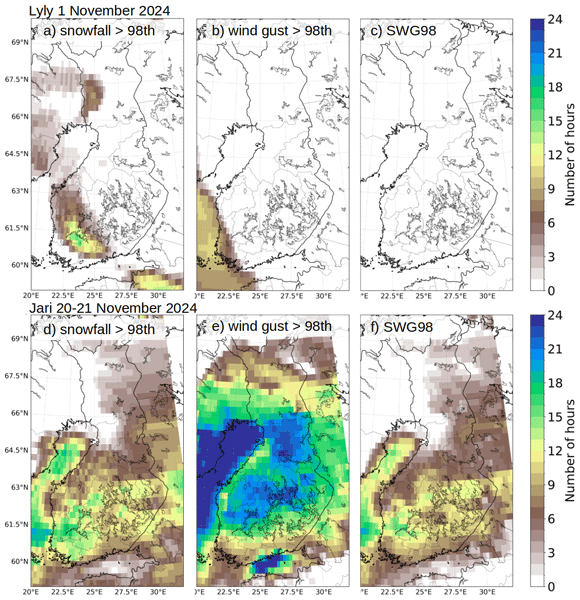
Strong winds coinciding with heavy snowfall can damage infrastructure, disrupt daily life and threaten safety. We examined how often these events occur in Finland and how long-lasting and severe they are, using reanalysis data. Such events were most common in coastal and eastern areas and usually short, while long and intense cases were rare. These events can challenge energy supply and essential services, highlighting the need to consider combined weather hazards in societal risk planning.
Meri Virman, Terhi K. Laurila, Antti Mäkelä, Petter Lind, Anna Luomaranta, and Hilppa Gregow
EGUsphere, https://doi.org/10.5194/egusphere-2026-4247, https://doi.org/10.5194/egusphere-2026-4247, 2026
Short summary
Short summary
Possible future changes in atmospheric conditions favourable for thunderstorms in Fennoscandia are investigated using HCLIM climate model data at 3 km spatial resolution. The frequency of thunderstorm- and severe-thunderstorm-favourable days is projected to increase across Fennoscandia under medium- and high-emission scenarios. The findings improve understanding of future thunderstorm hazards and support climate adaptation in Fennoscandia, where such information is currently limited.
Danijel Belušić and Petter Lind
Weather Clim. Dynam., 6, 863–877, https://doi.org/10.5194/wcd-6-863-2025, https://doi.org/10.5194/wcd-6-863-2025, 2025
Short summary
Short summary
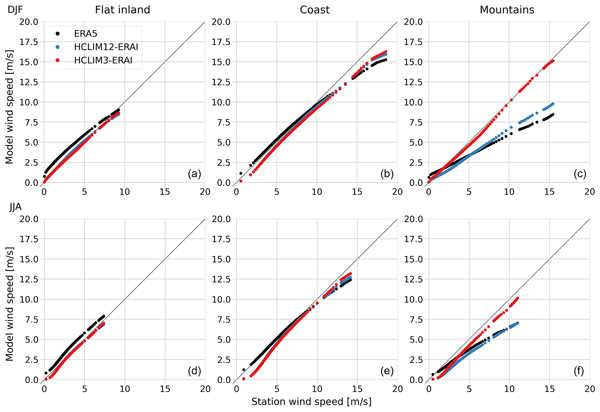
Kilometer (km)-scale climate models have large added value for modeling precipitation, but their benefits for winds are less studied. We show that the km-scale model better reproduces strong winds in complex terrain, which are up to twice as strong as in a coarser model, and can capture downslope glacier winds in higher terrain. Future changes in mean and strong winds are governed by the large-scale circulation change, whereas for weak winds, they are governed by the temperature change, which is less uncertain.
Natalia Korhonen, Otto Hyvärinen, Virpi Kollanus, Timo Lanki, Juha Jokisalo, Risto Kosonen, David S. Richardson, and Kirsti Jylhä
Nat. Hazards Earth Syst. Sci., 25, 1865–1879, https://doi.org/10.5194/nhess-25-1865-2025, https://doi.org/10.5194/nhess-25-1865-2025, 2025
Short summary
Short summary
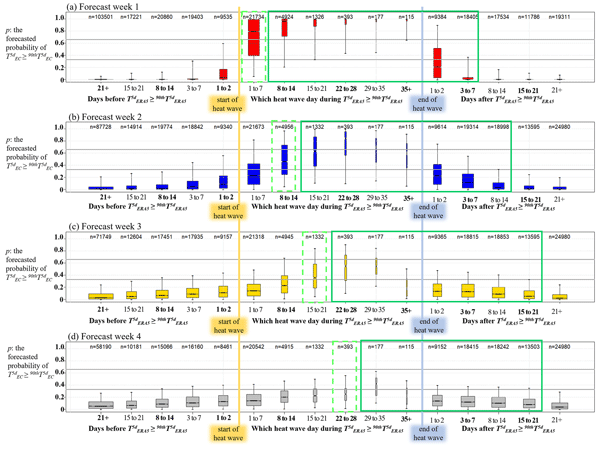
The skill of hindcasts from the European Centre for Medium-Range Weather Forecasts in forecasting heat wave days, defined as periods with the 5 d moving average temperature exceeding its local summer 90th percentile over Europe 1 to 4 weeks ahead, is examined. Forecasts of heat wave days show potential for warning of heat risk 1 to 2 weeks in advance and enhanced accuracy in forecasting prolonged heat waves up to 3 weeks ahead, when the heat wave had already begun before forecast issuance.
Fredrik Lagergren, Robert G. Björk, Camilla Andersson, Danijel Belušić, Mats P. Björkman, Erik Kjellström, Petter Lind, David Lindstedt, Tinja Olenius, Håkan Pleijel, Gunhild Rosqvist, and Paul A. Miller
Biogeosciences, 21, 1093–1116, https://doi.org/10.5194/bg-21-1093-2024, https://doi.org/10.5194/bg-21-1093-2024, 2024
Short summary
Short summary
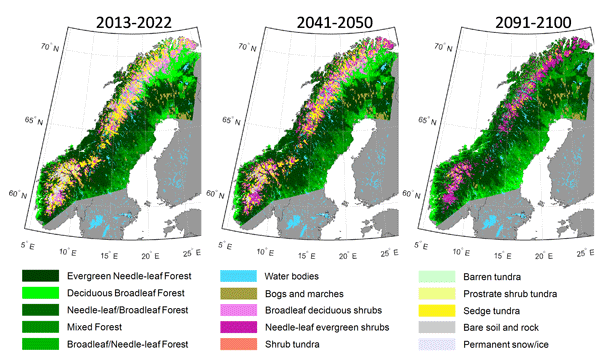
The Fennoscandian boreal and mountain regions harbour a wide range of ecosystems sensitive to climate change. A new, highly resolved high-emission climate scenario enabled modelling of the vegetation development in this region at high resolution for the 21st century. The results show dramatic south to north and low- to high-altitude shifts of vegetation zones, especially for the open tundra environments, which will have large implications for nature conservation, reindeer husbandry and forestry.
Erika Médus, Emma D. Thomassen, Danijel Belušić, Petter Lind, Peter Berg, Jens H. Christensen, Ole B. Christensen, Andreas Dobler, Erik Kjellström, Jonas Olsson, and Wei Yang
Nat. Hazards Earth Syst. Sci., 22, 693–711, https://doi.org/10.5194/nhess-22-693-2022, https://doi.org/10.5194/nhess-22-693-2022, 2022
Short summary
Short summary
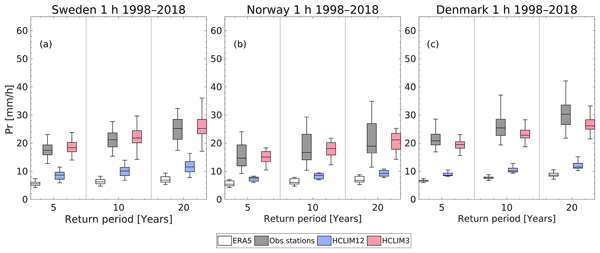
We evaluate the skill of a regional climate model, HARMONIE-Climate, to capture the present-day characteristics of heavy precipitation in the Nordic region and investigate the added value provided by a convection-permitting model version. The higher model resolution improves the representation of hourly heavy- and extreme-precipitation events and their diurnal cycle. The results indicate the benefits of convection-permitting models for constructing climate change projections over the region.
Anna Rutgersson, Erik Kjellström, Jari Haapala, Martin Stendel, Irina Danilovich, Martin Drews, Kirsti Jylhä, Pentti Kujala, Xiaoli Guo Larsén, Kirsten Halsnæs, Ilari Lehtonen, Anna Luomaranta, Erik Nilsson, Taru Olsson, Jani Särkkä, Laura Tuomi, and Norbert Wasmund
Earth Syst. Dynam., 13, 251–301, https://doi.org/10.5194/esd-13-251-2022, https://doi.org/10.5194/esd-13-251-2022, 2022
Short summary
Short summary
A natural hazard is a naturally occurring extreme event with a negative effect on people, society, or the environment; major events in the study area include wind storms, extreme waves, high and low sea level, ice ridging, heavy precipitation, sea-effect snowfall, river floods, heat waves, ice seasons, and drought. In the future, an increase in sea level, extreme precipitation, heat waves, and phytoplankton blooms is expected, and a decrease in cold spells and severe ice winters is anticipated.
Mika Rantanen, Kirsti Jylhä, Jani Särkkä, Jani Räihä, and Ulpu Leijala
Nat. Hazards Earth Syst. Sci. Discuss., https://doi.org/10.5194/nhess-2021-314, https://doi.org/10.5194/nhess-2021-314, 2021
Revised manuscript not accepted
Short summary
Short summary
Using sea level and precipitation observations, we analysed the meteorological characteristics of days when heavy precipitation and high sea level occur simultaneously in Finland. We found that around 5 % of all heavy precipitation and high sea level events on the Finnish coast are so called compound events when they both occur simultaneously, and these events were associated with close passages of mid-latitude cyclones. Our results act as a basis for compound flooding research in Finland.
Cited articles
Baltaci, H., da Silva, M. C. L., and Gomes, H. B.: Climatological conditions of the Black Sea-effect snowfall events in Istanbul, Turkey, Int. J. Climatol., 41, 2017–2028, https://doi.org/10.1002/joc.6944, 2021. a
Batrak, Y., Kourzeneva, E., and Homleid, M.: Implementation of a simple thermodynamic sea ice scheme, SICE version 1.0-38h1, within the ALADIN–HIRLAM numerical weather prediction system version 38h1, Geosci. Model Dev., 11, 3347–3368, https://doi.org/10.5194/gmd-11-3347-2018, 2018. a
Bednorz, E., Czernecki, B., and Tomczyk, A. M.: Climatology and extreme cases of sea-effect snowfall on the southern Baltic Sea coast, Int. J. Climatol., 1–15, https://doi.org/10.1002/joc.7546, 2022. a, b, c, d
Belušić, D., de Vries, H., Dobler, A., Landgren, O., Lind, P., Lindstedt, D., Pedersen, R. A., Sánchez-Perrino, J. C., Toivonen, E., van Ulft, B., Wang, F., Andrae, U., Batrak, Y., Kjellström, E., Lenderink, G., Nikulin, G., Pietikäinen, J.-P., Rodríguez-Camino, E., Samuelsson, P., van Meijgaard, E., and Wu, M.: HCLIM38: a flexible regional climate model applicable for different climate zones from coarse to convection-permitting scales, Geosci. Model Dev., 13, 1311–1333, https://doi.org/10.5194/gmd-13-1311-2020, 2020. a, b
Bengtsson, L., Andrae, U., Aspelien, T., Batrak, Y., Calvo, J., de Rooy, W., Gleeson, E., Hansen-Sass, B., Homleid, M., Hortal, M., Ivarsson, K., Lenderink, G., Niemelä, S., Nielsen, K. P., Onvlee, J., Rontu, L., Samuelsson, P., Muñoz, D. S., Subias, A., Tijm, S., Toll, V., Yang, X., and Køltzow, M. Ø: The HARMONIE–AROME Model Configuration in the ALADIN – HIRLAM NWP System, Mon. Weather Rev., 145, 1919–1935, https://doi.org/10.1175/MWR-D-16-0417.1, 2017. a
Dee, D. P., Uppala, S. M., Simmons, A. J., Berrisford, P., Poli, P., Kobayashi, S., Andrae, U., Balmaseda, M. A., Balsamo, G., Bauer, P., Bechtold, P., Beljaars, A. C. M., van de Berg, L., Bidlot, J., Bormann, N., Delsol, C., Dragani, R., Fuentes, M., Geer, A. J., Haimberger, L., Healy, S. B., Hersbach, H., Hólm, E. V., Isaksen, L., Kållberg, P., Köhler, M., Matricardi, M., McNally, A. P., Monge-Sanz, B. M., Morcrette, J.-.-J., Park, B.-.-K., Peubey, C., de Rosnay, P., Tavolato, C., Thépaut, J.-.-N. and Vitart, F.: The ERA-Interim reanalysis: configuration and performance of the data assimilation system, Q. J. Roy. Meteor. Soc., 137, 553–597, https://doi.org/10.1002/qj.828, 2011. a
Eisenman, I.: Geographic muting of changes in the Arctic sea ice cover, Geophys. Res. Lett., 37, https://doi.org/10.1029/2010GL043741, 2010. a
Ghafarian, P., Pegahfar, N., and Owlad, E.: Multiscale analysis of lake-effect snow over the southwest coast of the Caspian Sea (31 January–5 February 2014), Weather, 73, 9–14, https://doi.org/10.1002/wea.3055, 2018. a
Hersbach, H., Bell, B., Berrisford, P., Hirahara, S., Horányi, A., Muñoz-Sabater, J., Nicolas, J., Peubey, C., Radu, R., Schepers, D., Simmons, A., Soci, C., Abdalla, S., Abellan, X., Balsamo, G., Bechtold, P., Biavati, G., Bidlot, J., Bonavita, M., De Chiara, G., Dahlgren, P., Dee, D., Diamantakis, M., Dragani, R., Flemming, J., Forbes, R., Fuentes, M., Geer, A., Haimberger, L., Healy, S., Hogan, R. J., Hólm, E., Janisková, M., Keeley, S., Laloyaux, P., Lopez, P., Lupu, C., Radnoti, G., de Rosnay, P., Rozum, I., Vamborg, F., Villaume, S., and Thépaut, J.-N.: : The ERA5 global reanalysis, Q. J. Roy. Meteor. Soc., 146, 1999–2049, https://doi.org/10.1002/qj.3803, 2020. a
Hjelmfelt, M. R. and Braham, R. R.: Numerical Simulation of the Airflow over Lake Michigan for a Major Lake-Effect Snow Event, Mon. Weather Rev., 111, 205–219, https://doi.org/10.1175/1520-0493(1983)111<0205:NSOTAO>2.0.CO;2, 1983. a
Holroyd, E. W.: Lake-Effect Cloud Bands as Seen From Weather Satellites, J. Atmos. Sci., 28, 1165–1170, https://doi.org/10.1175/1520-0469(1971)028<1165:LECBAS>2.0.CO;2, 1971. a, b
Jeworrek, J., Wu, L., Dieterich, C., and Rutgersson, A.: Characteristics of convective snow bands along the Swedish east coast, Earth Syst. Dynam., 8, 163–175, https://doi.org/10.5194/esd-8-163-2017, 2017. a
Juga, I.: Sea-effect snowfall – a special hazard for road traffic in the coastal areas of Finland, in: Proceedings of the 15th SIRWEC Conference, Quebec City, Canada, 2010. a
Jungefeldt, L.: A Case Study Evaluating the Performance of the NWP Model HARMONIE in Simulating Convective Snowbands, Dissertation, Uppsala University, https://urn.kb.se/resolve?urn=urn:nbn:se:uu:diva-428791 (last access: 1 April 2026), 2020. a
Laird, N. F., Kristovich, D. A. R., and Walsh, J. E.: Idealized Model Simulations Examining the Mesoscale Structure of Winter Lake-Effect Circulations, Mon. Weather Rev., 131, 206–221, https://doi.org/10.1175/1520-0493(2003)131<0206:IMSETM>2.0.CO;2, 2003. a
Lind, P., Belušić, D., Christensen, O. B., Dobler, A., Kjellström, E., Landgren, O., Lindstedt, D., Matte, D., Pedersen, R. A., Toivonen, E., and Wang, F.: Benefits and Added Value of Convection-Permitting Climate Modeling over Fenno-Scandinavia, Clim. Dynam., 55, 1893–1912, https://doi.org/10.1007/s00382-020-05359-3, 2020. a, b, c
Lindstedt, D., Lind, P., Kjellström, E., and Jones, C.: A new regional climate model operating at the meso-gamma scale: performance over Europe, Tellus A, 67, 24138, https://doi.org/10.3402/tellusa.v67.24138, 2015. a
Lucas-Picher, P., Laprise, R., and Winger, K.: Evidence of added value in North American regional climate model hindcast simulations using ever-increasing horizontal resolutions, Clim. Dynam., 48, 2611–2633, https://doi.org/10.1007/s00382-016-3227-z, 2017. a
Lucas-Picher, P., Argüeso, D., Brisson, E., Tramblay, Y., Berg, P., Lemonsu, A., Kotlarski, S., and Caillaud, C.: Convection-permitting modeling with regional climate models: Latest developments and next steps, WIREs Clim. Change, 12, e731, https://doi.org/10.1002/wcc.731, 2021. a, b
Markowski, P. and Richardson, Y.: The Boundary Layer, in: Mesoscale Meteorology in Midlatitudes, chap. 4, John Wiley & Sons, Ltd, 73–114, https://doi.org/10.1002/9780470682104.ch4, 2010. a, b
Masson, V., Le Moigne, P., Martin, E., Faroux, S., Alias, A., Alkama, R., Belamari, S., Barbu, A., Boone, A., Bouyssel, F., Brousseau, P., Brun, E., Calvet, J.-C., Carrer, D., Decharme, B., Delire, C., Donier, S., Essaouini, K., Gibelin, A.-L., Giordani, H., Habets, F., Jidane, M., Kerdraon, G., Kourzeneva, E., Lafaysse, M., Lafont, S., Lebeaupin Brossier, C., Lemonsu, A., Mahfouf, J.-F., Marguinaud, P., Mokhtari, M., Morin, S., Pigeon, G., Salgado, R., Seity, Y., Taillefer, F., Tanguy, G., Tulet, P., Vincendon, B., Vionnet, V., and Voldoire, A.: The SURFEXv7.2 land and ocean surface platform for coupled or offline simulation of earth surface variables and fluxes, Geosci. Model Dev., 6, 929–960, https://doi.org/10.5194/gmd-6-929-2013, 2013. a
Mazon, J., Niemelä, S., Pino, D., Savijärvi, H., and Vihma, T.: Snow bands over the Gulf of Finland in wintertime, Tellus A, https://doi.org/10.3402/tellusa.v67.25102, 2015. a, b, c, d
Médus, E., Thomassen, E. D., Belušić, D., Lind, P., Berg, P., Christensen, J. H., Christensen, O. B., Dobler, A., Kjellström, E., Olsson, J., and Yang, W.: Characteristics of precipitation extremes over the Nordic region: added value of convection-permitting modeling, Nat. Hazards Earth Syst. Sci., 22, 693–711, https://doi.org/10.5194/nhess-22-693-2022, 2022. a, b, c
Michelson, D. B., Andersson, T., Koistinen, J., Collier, C. G., Riedl, J., Szturc, J., Gjertsen, U., Nielsen, A., and Overgaard, S.: BALTEX Radar Data Centre Products and their Methodologies, Reports Meteorology and Climatology, 90, Swedish Meteorological and Hydrological Institute (SMHI), Norrköping, Sweden, 76 pp., 2000. a, b
Niziol, T. A.: Operational forecasting of lake effect snowfall in western and central New York, Weather Forecast., 2, 310–321, https://doi.org/10.1175/1520-0434(1987)002<0310:OFOLES>2.0.CO;2, 1987. a, b, c
Norris, J., Vaughan, G., and Schultz, D. M.: Snowbands over the English Channel and Irish Sea during cold-air outbreaks, Q. J. Roy. Meteor. Soc., 139, 1747–1761, https://doi.org/10.1002/qj.2079, 2013. a
Notaro, M., Bennington, V., and Vavrus, S.: Dynamically Downscaled Projections of Lake-Effect Snow in the Great Lakes Basin, J. Climate, 28, 1661–1684, https://doi.org/10.1175/JCLI-D-14-00467.1, 2015. a
Olsson, J., Du, Y., An, D., Uvo, C. B., Sörensen, J., Toivonen, E., Belušić, D., and Dobler, A.: An Analysis of (Sub-)Hourly Rainfall in Convection-Permitting Climate Simulations Over Southern Sweden From a User’s Perspective, Front. Earth Sci., 9, 681312, https://doi.org/10.3389/feart.2021.681312, 2021. a, b
Olsson, T., Post, P., Rannat, K., Keernik, H., Perttula, T., Luomaranta, A., Jylhä, K., Kivi, R., and Voormansik, T.: Sea-effect snowfall case in the Baltic Sea region analysed by reanalysis, remote sensing data and convection-permitting mesoscale modelling, Geophysica, 53, 65–91, 2018. a
Olsson, T., Luomaranta, A., Jylhä, K., Jeworrek, J., Perttula, T., Dieterich, C., Wu, L., Rutgersson, A., and Mäkelä, A.: Statistics of sea-effect snowfall along the Finnish coastline based on regional climate model data, Adv. Sci. Res., 17, 87–104, https://doi.org/10.5194/asr-17-87-2020, 2020. a
Rutgersson, A., Kjellström, E., Haapala, J., Stendel, M., Danilovich, I., Drews, M., Jylhä, K., Kujala, P., Larsén, X. G., Halsnæs, K., Lehtonen, I., Luomaranta, A., Nilsson, E., Olsson, T., Särkkä, J., Tuomi, L., and Wasmund, N.: Natural hazards and extreme events in the Baltic Sea region, Earth Syst. Dynam., 13, 251–301, https://doi.org/10.5194/esd-13-251-2022, 2022. a
Saarikivi, P.: Characteristics of Mesoscale Precipitation Bands in Southern Finland, Mon. Weather Rev., 117, 2584–2593, https://doi.org/10.1175/1520-0493(1989)117<2584:COMPBI>2.0.CO;2, 1989. a
Solantie, R. and Pirinen, P.: Consideration of the orographical effect in the areal analysis of October–March precipitation, Report 2006:8, Finnish Meteorological Institute, http://hdl.handle.net/10138/354 (last access: 1 April 2026), 2006 (in Finnish). a
Steenburgh, W. J. and Nakai, S.: Perspectives on Sea- and Lake-Effect Precipitation from Japan’s “Gosetsu Chitai”, B. Am. Meteorol. Soc., 101, E58–E72, https://doi.org/10.1175/BAMS-D-18-0335.1, 2020. a
The HARMONIE Climate community: NorCP HCLIM 3km ERA-Interim data, NIRD RDA [data set], https://doi.org/10.11582/2025.00064, 2025. a
Vihma, T. and Haapala, J.: Geophysics of sea ice in the Baltic Sea: A review, Prog. Oceanogr., 80, 129–148, https://doi.org/10.1016/j.pocean.2009.02.002, 2009. a, b
Westerblom, S.: Projected changes in sea-effect snowfall over the Swedish Baltic Sea region: Results from a high-resolution regional climate model, Dissertation, Uppsala University, https://urn.kb.se/resolve?urn=urn:nbn:se:uu:diva-539684 (last access: 1 April 2026), 2024. a
Short summary
We use a kilometer-scale regional climate model to investigate the occurrence and intensity of sea-effect snowfall in the Baltic Sea region during 1998–2018. Sea-effect snowbands occur most frequently from November to February and when low-level winds have an easterly component near the eastern coast of Sweden and the southern coast of Finland. Over the southern Baltic Sea, snowbands tend to occur under northerly low-level winds and are most common from December to March.
We use a kilometer-scale regional climate model to investigate the occurrence and intensity of...


