Articles | Volume 7, issue 2
https://doi.org/10.5194/wcd-7-805-2026
© Author(s) 2026. This work is distributed under
the Creative Commons Attribution 4.0 License.
https://doi.org/10.5194/wcd-7-805-2026
© Author(s) 2026. This work is distributed under
the Creative Commons Attribution 4.0 License.
A cyclone phase space dedicated to extratropical cyclones
Laboratoire de Météorologie Dynamique–IPSL, Sorbonne Université/CNRS/École Normale Supérieure–PSL Université/École Polytechnique–Institut Polytechnique de Paris, Paris, France
Gwendal Rivière
Laboratoire de Météorologie Dynamique–IPSL, Sorbonne Université/CNRS/École Normale Supérieure–PSL Université/École Polytechnique–Institut Polytechnique de Paris, Paris, France
Sébastien Fromang
Laboratoire des Sciences du Climat et de l'Environnement–IPSL, CEA/CNRS/UVSQ/Université Paris–Saclay, Gif-sur-Yvette, France
Related authors
No articles found.
Étienne Vignon, Lea Raillard, Audran Borella, Gwendal Rivière, and Jean-Baptiste Madeleine
Atmos. Chem. Phys., 26, 1847–1865, https://doi.org/10.5194/acp-26-1847-2026, https://doi.org/10.5194/acp-26-1847-2026, 2026
Short summary
Short summary
Polar low-level clouds are most often of mixed-phase composition as they contain both liquid droplets and ice crystals. Such clouds are challenging to simulate in climate models, leading to uncertainties in the projection of polar climates. This study presents major advances in the representation of polar mixed-phase clouds in a climate model thanks to the adaptation of an original subgrid parameterization which considers interactions between turbulent eddies and clouds.
Stella Bourdin, Sébastien Fromang, William Dulac, Julien Cattiaux, and Fabrice Chauvin
Geosci. Model Dev., 15, 6759–6786, https://doi.org/10.5194/gmd-15-6759-2022, https://doi.org/10.5194/gmd-15-6759-2022, 2022
Short summary
Short summary
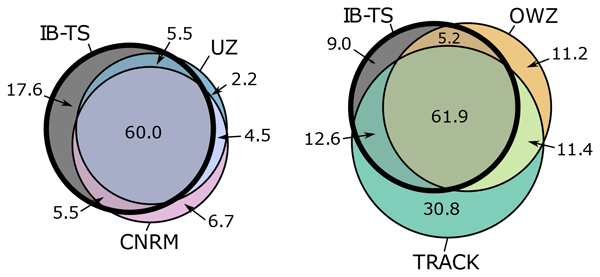
When studying tropical cyclones in a large dataset, one needs objective and automatic procedures to detect their specific pattern. Applying four different such algorithms to a reconstruction of the climate, we show that the choice of the algorithm is crucial to the climatology obtained. Mainly, the algorithms differ in their sensitivity to weak storms so that they provide different frequencies and durations. We review the different options to consider for the choice of the tracking methodology.
Cited articles
Aizawa, T. and Tanaka, H. L.: Axisymmetric structure of the long lasting summer Arctic cyclones, Polar Sci., 10, 192–198, https://doi.org/10.1016/j.polar.2016.02.002, 2016. a, b
Azad, R. and Sorteberg, A.: A diagnosis of warm-core and cold-core extratropical cyclone development using the Zwack–Okossi equation, Atmos. Sci. Lett., 10, 220–225, https://doi.org/10.1002/asl.244, 2009. a
Bjerknes, J. and Solberg, H.: Life cycle of cyclones and the polar front theory of atmospheric circulation, Cammermeyers Bogh., https://doi.org/10.1175/1520-0493(1922)50<468:JBAHSO>2.0.CO;2, 1922. a
Bourdin, S.: CPyS: A package for efficient computation of the Cyclone Phase Space parameters, GitHub [code], https://github.com/stella-bourdin/CPyS (last access: 4 May 2026), 2024. a
Cai, M. and Mak, M.: On the basic dynamics of regional cyclogenesis, J. Atmos. Sci., 47, 1417–1442, 1990. a
Catto, J. L.: Extratropical cyclone classification and its use in climate studies, Rev. Geophys., 54, 486–520, https://doi.org/10.1002/2016RG000519, 2016. a
Catto, J. L., Jakob, C., Berry, G., and Nicholls, N.: Relating global precipitation to atmospheric fronts, Geophys. Res. Lett., 39, https://doi.org/10.1029/2012GL051736, 2012. a
Cavallo, S. M. and Hakim, G. J.: Composite Structure of Tropopause Polar Cyclones, Mon. Weather Rev., 138, 3840–3857, https://doi.org/10.1175/2010MWR3371.1, 2010. a
Chang, E. K. M., Lee, S., and Swanson, K. L.: Storm track dynamics, J. Climate, 15, 2163–2183, 2002. a
Charney, J. G.: The dynamics of long waves in a baroclinic westerly current, J. Atmos. Sci., 4, 136–162, 1947. a
Christ, S., Quinting, J., and Pinto, J. G.: Characteristics of diabatically influenced cyclones with high wind damage potential in Europe, Q. J. Roy. Meteor. Soc., e70083, https://doi.org/10.1002/qj.70083, 2025. a
Croad, H. L., Methven, J., Harvey, B., Keeley, S. P. E., Volonté, A., and Hodges, K. I.: A Climatology of Summer-Time Arctic Cyclones Using a Modified Phase Space, Geophys. Res. Lett., 50, https://doi.org/10.1029/2023GL105993, 2023b. a, b, c
Dacre, H. F., Hawcroft, M. K., Stringer, M. A., and Hodges, K. I.: An extratropical cyclone atlas: a tool for illustrating cyclone structure and evolution characteristics, B. Am. Meteorol. Soc., 93, 1497–1502, https://doi.org/10.1175/BAMS-D-11-00164.1, 2012. a
Eady, E. T.: Long waves and cyclone waves, Tellus, 1, 33–52, https://doi.org/10.3402/tellusa.v1i3.8507, 1949. a
Emanuel, K.: Tropical cyclones, Annu. Rev. Earth Pl. Sc., 31, 75–104, https://doi.org/10.1146/annurev.earth.31.100901.141259, 2003. a
Emanuel, K., Alberti, T., Bourdin, S., Camargo, S. J., Faranda, D., Flaounas, E., Gonzalez-Aleman, J. J., Lee, C.-Y., Miglietta, M. M., Pasquero, C., Portal, A., Ramsay, H., Reale, M., and Romero, R.: CYCLOPs: a Unified Framework for Surface Flux-Driven Cyclones Outside the Tropics, Weather Clim. Dynam., 6, 901–926, https://doi.org/10.5194/wcd-6-901-2025, 2025. a
Fink, A. H., Brücher, T., Ermert, V., Krüger, A., and Pinto, J. G.: The European storm Kyrill in January 2007: synoptic evolution, meteorological impacts and some considerations with respect to climate change, Nat. Hazards Earth Syst. Sci., 9, 405–423, https://doi.org/10.5194/nhess-9-405-2009, 2009. a
Flaounas, E., Davolio, S., Raveh-Rubin, S., Pantillon, F., Miglietta, M. M., Gaertner, M. A., Hatzaki, M., Homar, V., Khodayar, S., Korres, G., Kotroni, V., Kushta, J., Reale, M., and Ricard, D.: Mediterranean cyclones: current knowledge and open questions on dynamics, prediction, climatology and impacts, Weather Clim. Dynam., 3, 173–208, https://doi.org/10.5194/wcd-3-173-2022, 2022. a
Gray, S. L. and Volonté, A.: Extreme low-level wind jets in Storm Ciarán, Weather, 79, 384–389, https://doi.org/10.1002/wea.7620, 2024. a
Gray, S. L., Volonté, A., Martínez-Alvarado, O., and Harvey, B. J.: A global climatology of sting-jet extratropical cyclones, Weather Clim. Dynam., 5, 1523–1544, https://doi.org/10.5194/wcd-5-1523-2024, 2024. a, b
Hersbach, H., Bell, B., Berrisford, P., Hirahara, S., Horányi, A., Muñoz-Sabater, J., Nicolas, J., Peubey, C., Radu, R., Schepers, D., Simmons, A., Soci, C., Abdalla, S., Abellan, X., Balsamo, G., Bechtold, P., Biavati, G., Bidlot, J., Bonavita, M., De Chiara, G., Dahlgren, P., Dee, D., Diamantakis, M., Dragani, R., Flemming, J., Forbes, R., Fuentes, M., Geer, A., Haimberger, L., Healy, S., Hogan, R. J., Hólm, E., Janisková, M., Keeley, S., Laloyaux, P., Lopez, P., Lupu, C., Radnoti, G., de Rosnay, P., Rozum, I., Vamborg, F., Villaume, S., and Thépaut, J.-N.: The ERA5 global reanalysis, Q. J. Roy. Meteor. Soc., 146, 1999–2049, https://doi.org/10.1002/qj.3803, 2020. a
Hodges, K.: Feature tracking on the unit-sphere, Mon. Weather Rev., 123, 3458–3465, 1995. a
Hoskins, B. J. and Hodges, K. I.: New Perspectives on the Northern Hemisphere Winter Storm Tracks, J. Atmos. Sci., 59, 1041–1061, https://doi.org/10.1175/1520-0469(2002)059<1041:NPOTNH>2.0.CO;2, 2002. a
Lindzen, R. S. and Farrell, B.: A simple approximate result for the maximum growth rate of baroclinic instabilities, J. Atmos. Sci., 37, 1648–1654, 1980. a
Neu, U., Akperov, M. G., Bellenbaum, N., Benestad, R., Blender, R., Caballero, R., Cocozza, A., Dacre, H. F., Feng, Y., Fraedrich, K., Grieger, J., Gulev, S., Hanley, J., Hewson, T., Inatsu, M., Keay, K., Kew, S. F., Kindem, I., Leckebusch, G. C., Liberato, M. L. R., Lionello, P., Mokhov, I. I., Pinto, J. G., Raible, C. C., Reale, M., Rudeva, I., Schuster, M., Simmonds, I., Sinclair, M., Sprenger, M., Tilinina, N. D., Trigo, I. F., Ulbrich, S., Ulbrich, U., Wang, X. L., and Wernli, H.: IMILAST: A Community Effort to Intercompare Extratropical Cyclone Detection and Tracking Algorithms, B. Am. Meteorol. Soc., 94, 529–547, https://doi.org/10.1175/BAMS-D-11-00154.1, 2013. a
Pinto, J. G., Spangehl, T., Ulbrich, U., and Speth, P.: Sensitivities of a cyclone detection and tracking algorithm: individual tracks and climatology, Meteorol. Z., 14, 823–838, https://doi.org/10.1127/0941-2948/2005/0068, 2005. a
Priestley, M. D. K. and Catto, J. L.: Future changes in the extratropical storm tracks and cyclone intensity, wind speed, and structure, Weather Clim. Dynam., 3, 337–360, https://doi.org/10.5194/wcd-3-337-2022, 2022. a
Rivière, G. and Joly, A.: Role of the low-frequency deformation field on the explosive growth of extratropical cyclones at the jet exit. Part I: Barotropic critical region, J. Atmos. Sci., 63, 1965–1981, https://doi.org/10.1175/JAS3728.1, 2006a. a
Rivière, G. and Joly, A.: Role of the low-frequency deformation field on the explosive growth of extratropical cyclones at the jet exit. Part II: Baroclinic critical region, J. Atmos. Sci., 63, 1982–1995, https://doi.org/10.1175/JAS3729.1, 2006b. a, b, c, d
Rivière, G., Arbogast, P., and Joly, A.: Eddy kinetic energy redistribution within idealized extratropical cyclones using a two-layer quasi-geostrophic model, Q. J. Roy. Meteor. Soc., 141, 207–223, https://doi.org/10.1002/qj.2350, 2015. a
Rivière, G., Delanoë, J., Doyle, J. D., et al.: The THINICE field campaign: Interactions between arctic cyclones, tropopause polar vortices, clouds, and sea ice in summer, B. Am. Meteorol. Soc., 105, E2330–E2354, https://doi.org/10.1175/BAMS-D-23-0143.1, 2024. a, b, c
Schär, C.: Orographic Effects: Lee Cyclogenesis, Encyclopedia of Atmospheric Sciences, 2nd edn., 4, 103–113, https://doi.org/10.1016/B978-0-12-382225-3.00290-5, 2003. a
Schultz, D. M., Keyser, D., and Bosart, L. F.: The Effect of Large-Scale Flow on Low-Level Frontal Structure and Evolution in Midlatitude Cyclones, Mon. Weather Rev., 126, 1767–1791, https://doi.org/10.1175/1520-0493(1998)126<1767:TEOLSF>2.0.CO;2, 1998. a
Schäfler, A., Craig, G., Wernli, H., Arbogast, P., Doyle, J. D., McTaggart-Cowan, R., Methven, J., Rivière, G., Ament, F., Boettcher, M., Bramberger, M., Cazenave, Q., Cotton, R., Crewell, S., Delanoë, J., Dörnbrack, A., Ehrlich, A., Ewald, F., Fix, A., Grams, C. M., Gray, S. L., Grob, H., Groß, S., Hagen, M., Harvey, B., Hirsch, L., Jacob, M., Kölling, T., Konow, H., Lemmerz, C., Lux, O., Magnusson, L., Mayer, B., Mech, M., Moore, R., Pelon, J., Quinting, J., Rahm, S., Rapp, M., Rautenhaus, M., Reitebuch, O., Reynolds, C. A., Sodemann, H., Spengler, T., Vaughan, G., Wendisch, M., Wirth, M., Witschas, B., Wolf, K., and Zinner, T.: The North Atlantic Waveguide and Downstream Impact Experiment, B. Am. Meteorol. Soc., 99, 1607–1637, https://doi.org/10.1175/BAMS-D-17-0003.1, 2018. a
Serreze, M., Box, J., Barry, R., and Walsh, J.: Characteristics of Arctic synoptic activity, 1952–1989, Meteorol. Atmos. Phys., 51, 147–164, 1993. a
Shapiro, M. A. and Keyser, D.: Fronts, jet streams and the tropopause, Springer, https://doi.org/10.1007/978-1-944970-33-8_10, 1990. a, b
Simmons, A. J. and Hoskins, B. J.: The life cycles of some nonlinear baroclinic waves, J. Atmos. Sci., 35, 414–432, 1978. a
Ulbrich, U., Leckebusch, G. C., and Pinto, J. G.: Extra-tropical cyclones in the present and future climate: a review, Theor. Appl. Climatol., 96, 117–131, https://doi.org/10.1007/s00704-008-0083-8, 2009. a
Ullrich, P. A.: TempestExtremes GitHub Repository, GitHub, https://github.com/ClimateGlobalChange/tempestextremes (last access: 4 May 2026), 2015. a
Ullrich, P. A.: TempestExtremes User Guide, UC Davis, https://climate.ucdavis.edu/tempestextremes.php (last access: 15 July 2021), 2020. a
Ullrich, P. A. and Zarzycki, C. M.: TempestExtremes: a framework for scale-insensitive pointwise feature tracking on unstructured grids, Geosci. Model Dev., 10, 1069–1090, https://doi.org/10.5194/gmd-10-1069-2017, 2017. a
Ullrich, P. A., Zarzycki, C. M., McClenny, E. E., Pinheiro, M. C., Stansfield, A. M., and Reed, K. A.: TempestExtremes v2.1: a community framework for feature detection, tracking, and analysis in large datasets, Geosci. Model Dev., 14, 5023–5048, https://doi.org/10.5194/gmd-14-5023-2021, 2021. a, b
Volonté, A. and Riboldi, J.: The origins of Storm Ciarán: From diabatic Rossby wave to warm-seclusion cyclone with a sting jet, Weather, 79, 390–396, https://doi.org/10.1002/wea.7632, 2024. a, b
Wang, Z., Yang, M., Walsh, J. E., Rauber, R. M., and Peng, M.: A Diagnostic Analysis of the Mechanisms for Arctic Cyclone Intensity Evolution, J. Atmos. Sci., 81, 1383–1399, https://doi.org/10.1175/JAS-D-23-0130.1, 2024. a
Wernli, H. and Schwierz, C.: Surface Cyclones in the ERA-40 Dataset (1958–2001). Part I: Novel Identification Method and Global Climatology, J. Atmos. Sci., 63, 2486–2507, https://doi.org/10.1175/JAS3766.1, 2006. a
Short summary
Extratropical cyclones are key weather features that often lead to strong wind and precipitations. We focus on those formed in the northern midlatitudes through the prism of their core temperature, thermal asymmetry and baroclinic growth rate. With these variables is built a new cyclone phase space that allows a distinction between warm-core cyclones, that fit with the classical baroclinic wave models and are the most common in the midlatitudes, and cold-core cyclones, that are more intriguing.
Extratropical cyclones are key weather features that often lead to strong wind and...