
Articles | Volume 6, issue 4
https://doi.org/10.5194/wcd-6-1815-2025
© Author(s) 2025. This work is distributed under
the Creative Commons Attribution 4.0 License.
the Creative Commons Attribution 4.0 License.
https://doi.org/10.5194/wcd-6-1815-2025
© Author(s) 2025. This work is distributed under
the Creative Commons Attribution 4.0 License.
the Creative Commons Attribution 4.0 License.
Research article
| 
15 Dec 2025
Research article |
| 15 Dec 2025
| 15 Dec 2025
Resolution dependence and biases in cold and warm frontal heavy precipitation over Europe in CMIP6 and EURO-CORDEX models
Armin Schaffer
CORRESPONDING AUTHOR

Wegener Center for Climate and Global Change, University of Graz, Graz, Austria
Tobias Lichtenegger
Wegener Center for Climate and Global Change, University of Graz, Graz, Austria
Albert Ossó
Wegener Center for Climate and Global Change, University of Graz, Graz, Austria
Douglas Maraun
Wegener Center for Climate and Global Change, University of Graz, Graz, Austria
Related authors
David Kneidinger, Armin Schaffer, and Douglas Maraun
Geosci. Model Dev., 19, 5119–5137, https://doi.org/10.5194/gmd-19-5119-2026, https://doi.org/10.5194/gmd-19-5119-2026, 2026
Short summary
Short summary
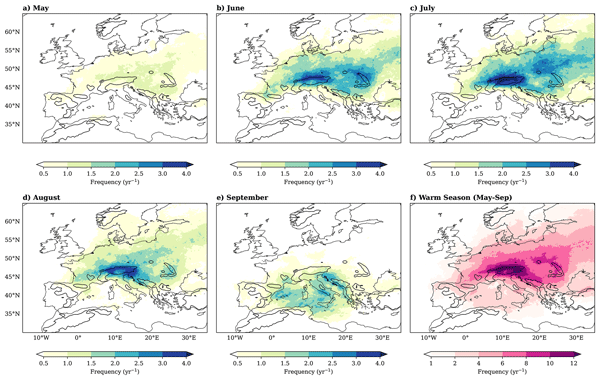
Mesoscale Convective Systems cause extreme weather and flash floods, yet they remain difficult to simulate in climate models. We developed a tracking tool to identify these storms using standard model data. Our 27-year record for Europe shows these systems drive over 60 percent of heavy hourly rain in the warm-season. This algorithm allows us to evaluate climate model performance and investigate how these intense storms will change in a warming climate.
Armin Schaffer, Albert Ossó, and Douglas Maraun
EGUsphere, https://doi.org/10.5194/egusphere-2026-1712, https://doi.org/10.5194/egusphere-2026-1712, 2026
Short summary
Short summary
Atmospheric fronts are a major cause of heavy rainfall in Europe. To understand how climate change affects these events, we analyzed two sets of global and regional climate models. We found that while changing weather patterns may reduce frontal frequency in some areas, the number of heavy rain events will surge. Extreme rainfall events are projected to more than double per degree of warming, driven by increased humidity rather than storm dynamics.
Kai Kornhuber, Emanuele Bevacqua, Mariana Madruga de Brito, Wiebke S. Jäger, Pauline Rivoire, Cassandra D. W. Rogers, Fabiola Banfi, Fulden Batibeniz, James Carruthers, Carlo De Michele, Silvia De Angeli, Cristina Deidda, Marleen C. de Ruiter, Andreas H. Fink, Henrique M. D. Goulart, Katharina Küpfer, Patrick Ludwig, Douglas Maraun, Gabriele Messori, Shruti Nath, Fiachra O'Loughlin, Joaquim G. Pinto, Benjamin Poschlod, Alexandre M. Ramos, Colin Raymond, Andreia F. S. Ribeiro, Deepti Singh, Laura Suarez Gutierrez, Philip J. Ward, and Christopher J. White
Nat. Hazards Earth Syst. Sci., 26, 4309–4334, https://doi.org/10.5194/nhess-26-4309-2026, https://doi.org/10.5194/nhess-26-4309-2026, 2026
Short summary
Short summary
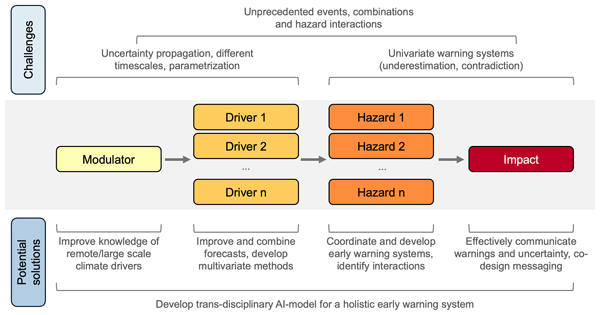
Impacts from extreme weather events may become more severe due to increased likelihood of compounding events under global warming, which challenge present day climate modelling and forecasting capacities. In this perspective we reflect on the usability of compound event research to bridge the gap between academic research and real-world applications.
David Kneidinger, Armin Schaffer, and Douglas Maraun
Geosci. Model Dev., 19, 5119–5137, https://doi.org/10.5194/gmd-19-5119-2026, https://doi.org/10.5194/gmd-19-5119-2026, 2026
Short summary
Short summary
Mesoscale Convective Systems cause extreme weather and flash floods, yet they remain difficult to simulate in climate models. We developed a tracking tool to identify these storms using standard model data. Our 27-year record for Europe shows these systems drive over 60 percent of heavy hourly rain in the warm-season. This algorithm allows us to evaluate climate model performance and investigate how these intense storms will change in a warming climate.
Daniel Viviroli, Martin Jury, Maria Staudinger, Martina Kauzlaric, Heimo Truhetz, and Douglas Maraun
Nat. Hazards Earth Syst. Sci., 26, 1835–1857, https://doi.org/10.5194/nhess-26-1835-2026, https://doi.org/10.5194/nhess-26-1835-2026, 2026
Short summary
Short summary
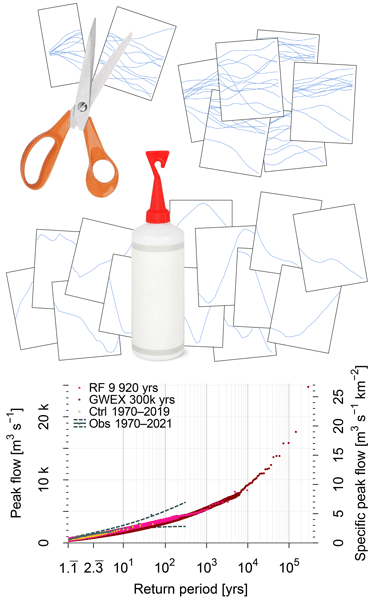
Estimating the frequency and magnitude of floods is challenging due to the limited length of streamflow records. Here, we explore whether an extensive archive of meteorological forecasts run over past dates can assist in this context. After processing and concatenating these data for use as input to a hydrological model, we derive flood statistics from simulated streamflow. Results are promising for the larger catchments studied, providing a valuable complementary perspective on rare floods.
Armin Schaffer, Albert Ossó, and Douglas Maraun
EGUsphere, https://doi.org/10.5194/egusphere-2026-1712, https://doi.org/10.5194/egusphere-2026-1712, 2026
Short summary
Short summary
Atmospheric fronts are a major cause of heavy rainfall in Europe. To understand how climate change affects these events, we analyzed two sets of global and regional climate models. We found that while changing weather patterns may reduce frontal frequency in some areas, the number of heavy rain events will surge. Extreme rainfall events are projected to more than double per degree of warming, driven by increased humidity rather than storm dynamics.
Kamilya Yessimbet, Andrea K. Steiner, Florian Ladstädter, and Albert Ossó
Atmos. Chem. Phys., 24, 10893–10919, https://doi.org/10.5194/acp-24-10893-2024, https://doi.org/10.5194/acp-24-10893-2024, 2024
Short summary
Short summary
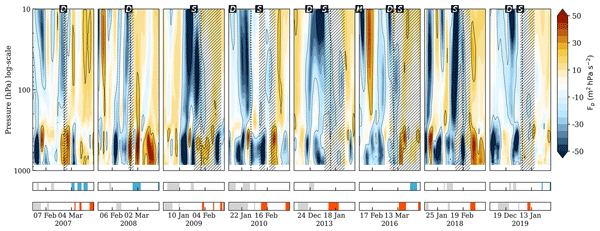
Major sudden stratospheric warmings (SSWs) and atmospheric blocking can markedly influence winter extratropical surface weather. To study the relationship between SSWs and blocking, we examine dynamic stratosphere–troposphere coupling using vertically highly resolved observations from global navigation satellite system radio occultation for 2007–2019. Our results provide a purely observational view of the evolution of major SSWs, their link to blocking, and their effect on the polar tropopause.
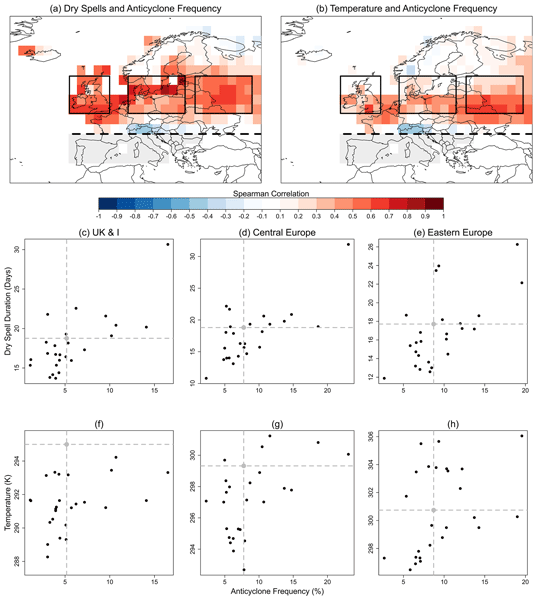
Colin Manning, Martin Widmann, Douglas Maraun, Anne F. Van Loon, and Emanuele Bevacqua
Weather Clim. Dynam., 4, 309–329, https://doi.org/10.5194/wcd-4-309-2023, https://doi.org/10.5194/wcd-4-309-2023, 2023
Short summary
Short summary
Climate models differ in their representation of dry spells and high temperatures, linked to errors in the simulation of persistent large-scale anticyclones. Models that simulate more persistent anticyclones simulate longer and hotter dry spells, and vice versa. This information is important to consider when assessing the likelihood of such events in current and future climate simulations so that we can assess the plausibility of their future projections.
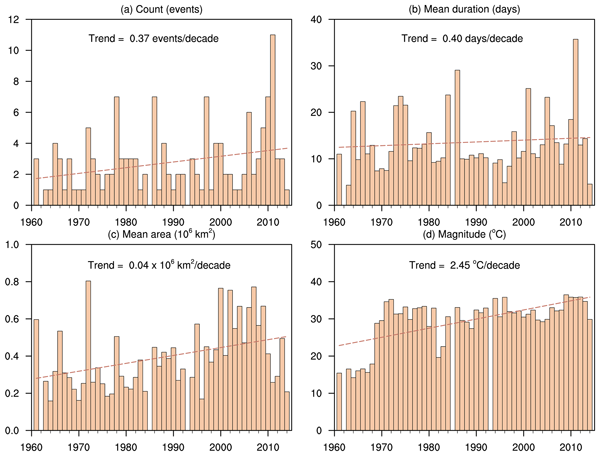
Yi Yang, Douglas Maraun, Albert Ossó, and Jianping Tang
Nat. Hazards Earth Syst. Sci., 23, 693–709, https://doi.org/10.5194/nhess-23-693-2023, https://doi.org/10.5194/nhess-23-693-2023, 2023
Short summary
Short summary
This study quantifies the spatiotemporal variation and characteristics of compound long-duration dry and hot events in China over the 1961–2014 period. The results show that over the past few decades, there has been a substantial increase in the frequency of these compound events across most parts of China, which is dominated by rising temperatures. We detect a strong increase in the spatially contiguous areas experiencing concurrent dry and hot conditions.
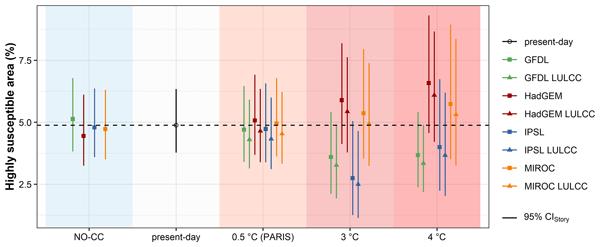
Raphael Knevels, Helene Petschko, Herwig Proske, Philip Leopold, Aditya N. Mishra, Douglas Maraun, and Alexander Brenning
Nat. Hazards Earth Syst. Sci., 23, 205–229, https://doi.org/10.5194/nhess-23-205-2023, https://doi.org/10.5194/nhess-23-205-2023, 2023
Short summary
Short summary
In summer 2009 and 2014, rainfall events occurred in the Styrian Basin (Austria), triggering thousands of landslides. Landslide storylines help to show potential future changes under changing environmental conditions. The often neglected uncertainty quantification was the aim of this study. We found uncertainty arising from the landslide model to be of the same order as climate scenario uncertainty. Understanding the dimensions of uncertainty is crucial for allowing informed decision-making.
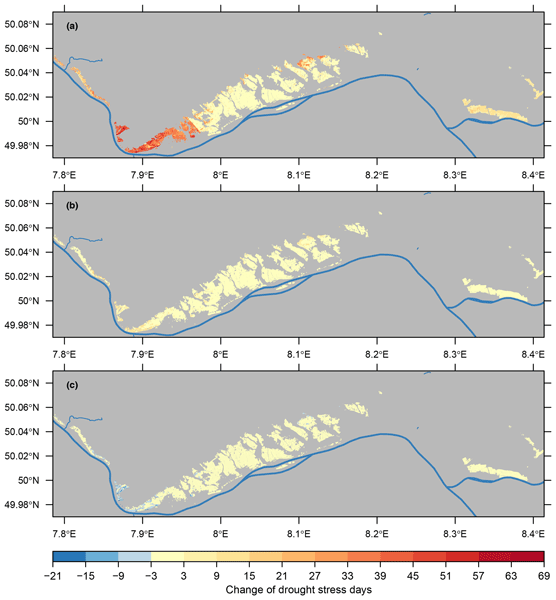
Marco Hofmann, Claudia Volosciuk, Martin Dubrovský, Douglas Maraun, and Hans R. Schultz
Earth Syst. Dynam., 13, 911–934, https://doi.org/10.5194/esd-13-911-2022, https://doi.org/10.5194/esd-13-911-2022, 2022
Short summary
Short summary
We modelled water budget developments of viticultural growing regions on the spatial scale of individual vineyard plots with respect to landscape features like the available water capacity of the soils, slope, and aspect of the sites. We used an ensemble of climate simulations and focused on the occurrence of drought stress. The results show a high bandwidth of projected changes where the risk of potential drought stress becomes more apparent in steep-slope regions.
Gerard van der Schrier, Richard P. Allan, Albert Ossó, Pedro M. Sousa, Hans Van de Vyver, Bert Van Schaeybroeck, Roberto Coscarelli, Angela A. Pasqua, Olga Petrucci, Mary Curley, Mirosław Mietus, Janusz Filipiak, Petr Štěpánek, Pavel Zahradníček, Rudolf Brázdil, Ladislava Řezníčková, Else J. M. van den Besselaar, Ricardo Trigo, and Enric Aguilar
Clim. Past, 17, 2201–2221, https://doi.org/10.5194/cp-17-2201-2021, https://doi.org/10.5194/cp-17-2201-2021, 2021
Short summary
Short summary
The 1921 drought was the most severe drought to hit Europe since the start of the 20th century. Here the climatological description of the drought is coupled to an overview of its impacts, sourced from newspapers, and an analysis of its drivers. The area from Ireland to the Ukraine was affected but hardest hit was the triangle between Brussels, Paris and Lyon. The drought impacts lingered on until well into autumn and winter, affecting water supply and agriculture and livestock farming.
Cited articles
Catto, J. L. and Pfahl, S.: The importance of fronts for extreme precipitation, J. Geophys. Res.-Atmos., 118, 10791–10801, https://doi.org/10.1002/jgrd.50852, 2013. a
Catto, J. L., Jakob, C., Berry, G., and Nicholls, N.: Relating global precipitation to atmospheric fronts, Geophys. Res. Lett., 39, 2012GL051736, https://doi.org/10.1029/2012GL051736, 2012. a, b
Catto, J. L., Nicholls, N., Jakob, C., and Shelton, K. L.: Atmospheric fronts in current and future climates, Geophys. Res. Lett., 41, 7642–7650, https://doi.org/10.1002/2014GL061943, 2014. a, b
Collins, M., Minobe, S., Barreiro, M., Bordoni, S., Kaspi, Y., Kuwano-Yoshida, A., Keenlyside, N., Manzini, E., O’Reilly, C. H., Sutton, R., Xie, S.-P., and Zolina, O.: Challenges and opportunities for improved understanding of regional climate dynamics, Nat. Clim. Change, 8, 101–108, https://doi.org/10.1038/s41558-017-0059-8, 2018. a
Eyring, V., Bony, S., Meehl, G. A., Senior, C. A., Stevens, B., Stouffer, R. J., and Taylor, K. E.: Overview of the Coupled Model Intercomparison Project Phase 6 (CMIP6) experimental design and organization, Geosci. Model Dev., 9, 1937–1958, https://doi.org/10.5194/gmd-9-1937-2016, 2016. a, b
Harvey, B. J., Cook, P., Shaffrey, L. C., and Schiemann, R.: The Response of the Northern Hemisphere Storm Tracks and Jet Streams to Climate Change in the CMIP3, CMIP5, and CMIP6 Climate Models, J. Geophys. Res.-Atmos., 125, e2020JD032701, https://doi.org/10.1029/2020jd032701, 2020. a
Hersbach, H., Bell, B., Berrisford, P., Hirahara, S., Horányi, A., Muñoz‐Sabater, J., Nicolas, J., Peubey, C., Radu, R., Schepers, D., Simmons, A., Soci, C., Abdalla, S., Abellan, X., Balsamo, G., Bechtold, P., Biavati, G., Bidlot, J., Bonavita, M., Chiara, G., Dahlgren, P., Dee, D., Diamantakis, M., Dragani, R., Flemming, J., Forbes, R., Fuentes, M., Geer, A., Haimberger, L., Healy, S., Hogan, R. J., Hólm, E., Janisková, M., Keeley, S., Laloyaux, P., Lopez, P., Lupu, C., Radnoti, G., Rosnay, P., Rozum, I., Vamborg, F., Villaume, S., and Thépaut, J.: The ERA5 global reanalysis, Q. J. Roy. Meteor. Soc., 146, 1999–2049, https://doi.org/10.1002/qj.3803, 2020. a, b
Hewson, T. D.: Objective fronts, Meteorol. Appl., 5, 37–65, https://doi.org/10.1017/S1350482798000553, 1998. a
Hénin, R., Ramos, A. M., Schemm, S., Gouveia, C. M., and Liberato, M. L. R.: Assigning precipitation to mid-latitudes fronts on sub-daily scales in the North Atlantic and European sector: Climatology and trends, Int. J. Climatol., 39, 317–330, https://doi.org/10.1002/joc.5808, 2019. a, b
IPCC: Climate Change 2021 – The Physical Science Basis: Working Group I Contribution to the Sixth Assessment Report of the Intergovernmental Panel on Climate Change, Cambridge University Press, 1st edn., https://doi.org/10.1017/9781009157896, ISBN 978-1-009-15789-6, 2023. a
Jacob, D., Petersen, J., Eggert, B., Alias, A., Christensen, O. B., Bouwer, L. M., Braun, A., Colette, A., Déqué, M., Georgievski, G., Georgopoulou, E., Gobiet, A., Menut, L., Nikulin, G., Haensler, A., Hempelmann, N., Jones, C., Keuler, K., Kovats, S., Kröner, N., Kotlarski, S., Kriegsmann, A., Martin, E., Van Meijgaard, E., Moseley, C., Pfeifer, S., Preuschmann, S., Radermacher, C., Radtke, K., Rechid, D., Rounsevell, M., Samuelsson, P., Somot, S., Soussana, J.-F., Teichmann, C., Valentini, R., Vautard, R., Weber, B., and Yiou, P.: EURO-CORDEX: new high-resolution climate change projections for European impact research, Reg. Environ. Change, 14, 563–578, https://doi.org/10.1007/s10113-013-0499-2, 2014. a, b
Jenkner, J., Sprenger, M., Schwenk, I., Schwierz, C., Dierer, S., and Leuenberger, D.: Detection and climatology of fronts in a high-resolution model reanalysis over the Alps, Meteorol. Appl., 17, 1–18, https://doi.org/10.1002/met.142, 2009. a
King, M. J., Reeder, M. J., and Jakob, C.: Strong temperature falls as a cold frontal metric in Australian station observations, reanalyses and climate models, Q. J. Roy. Meteor. Soc., 150, 4788–4805, https://doi.org/10.1002/qj.4841, 2024. a
Lichtenegger, T., Schaffer, A., Ossó, A., Martínez‐Alvarado, O., and Maraun, D.: A Cold Frontal Life Cycle Climatology and Front–Cyclone Relationships Over the North Atlantic and Europe, Int. J. Climatol., 45, e8830, https://doi.org/10.1002/joc.8830, 2025. a
Marotzke, J., Jakob, C., Bony, S., Dirmeyer, P. A., O'Gorman, P. A., Hawkins, E., Perkins-Kirkpatrick, S., Quéré, C. L., Nowicki, S., Paulavets, K., Seneviratne, S. I., Stevens, B., and Tuma, M.: Climate research must sharpen its view, Nat. Clim. Change, 7, 89–91, https://doi.org/10.1038/nclimate3206, 2017. a
Pacey, G., Pfahl, S., Schielicke, L., and Wapler, K.: The climatology and nature of warm-season convective cells in cold-frontal environments over Germany, Nat. Hazards Earth Syst. Sci., 23, 3703–3721, https://doi.org/10.5194/nhess-23-3703-2023, 2023. a
Priestley, M. D. K., Ackerley, D., Catto, J. L., Hodges, K. I., McDonald, R. E., and Lee, R. W.: An Overview of the Extratropical Storm Tracks in CMIP6 Historical Simulations, J. Climate, 33, 6315–6343, https://doi.org/10.1175/jcli-d-19-0928.1, 2020. a
Rüdisühli, S., Sprenger, M., Leutwyler, D., Schär, C., and Wernli, H.: Attribution of precipitation to cyclones and fronts over Europe in a kilometer-scale regional climate simulation, Weather Clim. Dynam., 1, 675–699, https://doi.org/10.5194/wcd-1-675-2020, 2020. a
Schaffer, A., Lichtenegger, T., Truhetz, H., Ossó, A., Martínez‐Alvarado, O., and Maraun, D.: Drivers of Cold Frontal Hourly Extreme Precipitation: A Climatological Study Over Europe, Geophys. Res. Lett., 51, e2024GL111025, https://doi.org/10.1029/2024GL111025, 2024. a, b, c
Schemm, S., Nisi, L., Martinov, A., Leuenberger, D., and Martius, O.: On the link between cold fronts and hail in Switzerland, Atmos. Sci. Lett., 17, 315–325, https://doi.org/10.1002/asl.660, 2016. a
Volosciuk, C., Maraun, D., Semenov, V. A., and Park, W.: Extreme Precipitation in an Atmosphere General Circulation Model: Impact of Horizontal and Vertical Model Resolutions, J. Climate, 28, 1184–1205, https://doi.org/10.1175/JCLI-D-14-00337.1, 2015. a
Short summary
Heavy rainfall in Europe is often linked to weather fronts. To understand how these events may change in the future, we first need to evaluate how well climate models represent them. We found that all models show substantial biases, particularly for cold fronts, while higher-resolution models improve their simulation. Warm fronts also show biases, though they are generally better represented than cold fronts. This highlights the importance of high-resolution models for reliable projections.
Heavy rainfall in Europe is often linked to weather fronts. To understand how these events may...


