
the Creative Commons Attribution 4.0 License.
the Creative Commons Attribution 4.0 License.
 | 08 Jul 2026
WCD Ideas: hydrologically driven throughflow in the coupled ocean–atmosphere system
Potential flow theory predicts bulk fluid motion driven by spatially separated sources and sinks of mass. In the atmosphere, such exchanges are dominated by the hydrological cycle: subtropical sources of water vapour combine with equatorial and high-latitude sinks to induce meridional source–sink flows in each hemisphere. Conventional gas-phase frameworks that represent mean meridional circulations as purely cellular neglect these throughflows. Here, these flows are identified as atmospheric branches of coupled ocean–atmosphere circulations termed Latent cells. Evidence indicates that they dominate among mechanisms effecting large-scale transport of inert tracers, and they may influence atmospheric momentum budgets.
- Article
(582 KB) - Full-text XML
- BibTeX
- EndNote


The discussion that follows argues that the mean meridional flow of the atmosphere in each hemisphere includes streamlines that do not close, and that purely cellular descriptions are therefore incomplete. To support this view – and to distinguish clearly between motions of different scales and types – this section defines meridional transport processes of global relevance along a spectrum that increases in spatial scale and defines three dynamically distinct transport mechanisms. These distinctions matter because only some classes of motion can explain conveyance of net mass and momentum across certain latitudes.
At the smallest scales considered here are baroclinic eddies. Their synoptic-scale stirring causes fluid properties to migrate relative to the bulk flow, for example when water vapour is transported poleward down humidity gradients. Although the meridional bulk flow associated with these eddies averages to zero over long times or distances, their pseudo-random redistribution influences the mean flow through flux divergences (Andrews and McIntyre, 1976). While neither molecular nor purely stochastic, eddy redistribution is referred to here – by convention and for convenience, including quotation marks – as “diffusion”, which acts down concentration gradients.
Larger in scale are cellular motions that rotate on average about persistently zonal axes, namely the Hadley, Ferrel, and Polar cells. These meridionally confined circulations can produce up-gradient transport, as when the Hadley cell conveys very dry air aloft toward the pole and humid air at lower levels toward the tropics. However, these cells possess no net linear momentum when averaged meridionally or temporally – with streamfunctions vanishing at their endpoints (Döös and Nilsson, 2011). Likewise, they possess no net meridional momentum when averaged vertically. Therefore, they are categorised here as forms of recirculation.
Largest on the spectrum is net transport of fluid, analogous to flow through a pipe or channel. This class of motion is characterised by open streamlines that originate at one location and terminate at another, thereby conveying mass from sources to sinks. Because such bulk motions represent actual displacement of fluid across large distances, they are referred to here as throughflow.
The central claim of this paper is that throughflow occurs at the largest atmospheric scales – nearly hemispheric – and that it coexists with, rather than replaces, the more familiar recirculating components of the general circulation.
In recent years, substantial progress has been made in describing the global atmospheric circulation using thermodynamic coordinates. In particular, Pauluis et al. (2008) and Laliberté et al. (2015) introduced formulations based on potential temperature and equivalent potential temperature that provide physically insightful descriptions of mass and energy transport. These approaches reveal circulation aspects that are not apparent in conventional Eulerian frameworks and have clarified the role of moist processes in shaping large-scale transport.
However, these formulations define time-mean streamfunctions that vanish at the domain boundaries and therefore describe recirculating flows with zero net mass transport across latitude circles. As such, they do not explicitly represent source–sink-driven throughflow arising from spatially structured mass exchange with the surface. The present work complements these approaches by focusing on this component of the circulation.
In fluid dynamics, potential flow theory describes how localized additions and removals of mass – idealized as sources and sinks – generate motion through gradients in the velocity potential (Batchelor, 2000; Kundu and Cohen, 2002). Although the term “potential flow” is most commonly associated with incompressible fluids, it can also be applied to compressible cases (Elling, 2015). The purpose of invoking potential flow here is not to idealize the atmosphere as inviscid or laminar, but to isolate the large-scale consequences of mass conservation for regions that lie between sources and sinks.
When mass is injected at one location and removed at another, the resulting circulation contains streamlines that originate at sources and terminate at sinks. Such motion is often referred to as a source flow (Acheson, 1990; Batchelor, 2000). Here, the more inclusive term source–sink flow is used to emphasise that both mass addition and removal are relevant to the resulting circulation. Unlike purely cellular motions, source–sink flows are characterised by open streamlines – diverging away from sources and converging toward sinks – and therefore represent genuine throughflow.
A key and sometimes underappreciated property of source–sink flows is that, in a fluid composed of multiple constituents, a source or sink acting on only one component can induce motion in all components. A simple thought experiment illustrates this point. Consider an open cylindrical container nearly filled with liquid, consisting of a denser layer of water overlain by a less dense layer of oil that does not reach the rim. If water is injected at the bottom, both liquids must rise, and oil will eventually spill from the container – even though oil itself is not being injected. This bulk displacement follows directly from the irrotational nature of the flow and does not depend on the detailed arrangement of the constituents.
Crucially, this outcome holds whether the fluids are neatly stratified (Fig. 1a) or vigorously stirred, as by a mechanical blender (Fig. 1b). In the latter case, recirculation and eddy mixing (“diffusion”) respectively generate visible vortical motion and blur the distinction between layers. However, these motions are dynamically independent of the throughflow itself, which would vanish entirely if the water source were removed. The example therefore illustrates that a source or sink of a single constituent has two distinct effects on the fluid system as a whole: (i) it establishes or reinforces concentration gradients, giving rise to constituent transport relative to the bulk fluid (“diffusion”), and (ii) it generates velocity-potential gradients that induce bulk motion of all constituents in the form of throughflow.
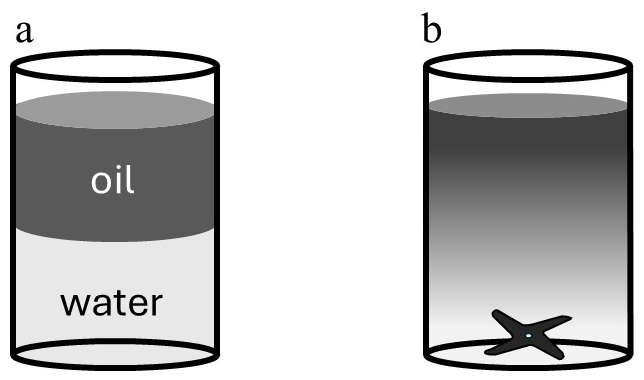
Figure 1Cylindrical containers nearly filled with water and oil, shown (a) in stratified layers and (b) energetically blended, in each case with a water source at the bottom. In (b), the greyscale gradient persists despite blending because of the water source at the bottom.
Situations resembling Fig. 1b are particularly prone to oversimplified interpretation. Suppose that evaporation at the top of the container exactly compensates the injection of water at the bottom, preventing overflow. Considered in isolation and at steady state, the oil component might then appear to be simply at rest. This apparent stationarity, however, conceals an important distinction: “diffusion” describes motion relative to the bulk flow, not the absence of motion altogether. Just as different constituents can migrate in opposite directions within a static fluid according to their concentration gradients, a constituent within a moving fluid can remain stationary by migrating against the throughflow. In the present example, this corresponds to downward migration of oil relative to an upward source–sink flow, or more generally, counter-current “diffusion”.
The water component in Fig. 1b, by contrast, is transported upward by tandem processes of throughflow and streamwise “diffusion”. Thus, even in a vigorously mixed system, throughflow and recirculation remain dynamically distinct. This separation of mechanisms is central to the arguments that follow, because it implies that the presence of strong stirring or closed circulations does not preclude the existence of a background source–sink flow.
These considerations are directly relevant to the atmosphere. Descriptions of large-scale meridional transport have traditionally focused on stirring by baroclinic eddies and recirculation by the Hadley, Ferrel, and Polar cells. The widely used assumption of “no net flow of mass across a latitudinal wall” (Peixoto and Oort, 1992), implicit in many formulations of the mean meridional circulation, effectively excludes throughflow by construction. However, when mass is added to and removed from the atmosphere in a latitudinally structured manner, then the absence of net meridional transport of a particular constituent does not imply the absence of bulk flow. Instead, apparent stationarity may reflect “diffusion” upstream against a background source–sink circulation.
Considerable effort has been devoted to identifying and quantifying sources and sinks of the individual components of air. From the perspective of large-scale dynamics, however, these exchanges are overwhelmingly dominated by those of water vapour. Micrometeorological studies show that, over most natural surfaces, humidification accounts for more than 99 % of the mass exchanged between the surface and the atmosphere (Kowalski, 2017). By contrast, exchanges of dry air – arising primarily from photosynthesis, respiration, and other trace-gas processes – are negligible when considering the dynamical consequences of atmospheric mass sources and sinks (Kowalski et al., 2025).
To a very good approximation, therefore, the gradients in atmospheric velocity potential established by surface exchange are set by the sources and sinks of humidity alone. This does not imply that other constituents are unimportant, but rather that their sources and sinks contribute negligibly to large-scale potential flow. In this sense, the hydrological cycle acts as the primary driver of atmospheric source–sink circulation at global scales.
Viewed in this way, the large-scale pattern of atmospheric mass exchange is closely aligned with the structure of the hydrological cycle. Strong net sources of water vapour occur in the subtropics, where evaporation – including transpiration – is most intense, while net sinks dominate regions where condensation and precipitation prevail, notably at higher latitudes and near the equator (Schanze et al., 2010). The resulting meridional transport of water vapour is well documented, for example poleward across the midlatitudes (Trenberth and Guillemot, 1998). What is less commonly emphasized is that these same mass exchanges necessarily modify velocity potentials and therefore induce meridional source–sink flows of air, directed away from the subtropics in each hemisphere.
This perspective differs from recent thermodynamic-coordinate analyses (e.g., Pauluis et al., 2008; Laliberté et al., 2015), which describe atmospheric transport using streamfunctions that vanish at the boundaries and therefore represent closed recirculations. While highly effective for diagnosing energy and mass redistribution, such formulations do not capture throughflow induced by net mass sources and sinks.
From a potential-flow perspective, global-scale streamlines associated with this circulation originate at net evaporative surfaces, generally oriented upward and concentrated in the subtropics, and diverge to terminate at net sinks that are found at higher latitudes and near the equator. These streamlines describe a background throughflow that coexists with smaller-scale circulations and is independent of whether the overlying flow field is dominated locally by eddies or closed cells.
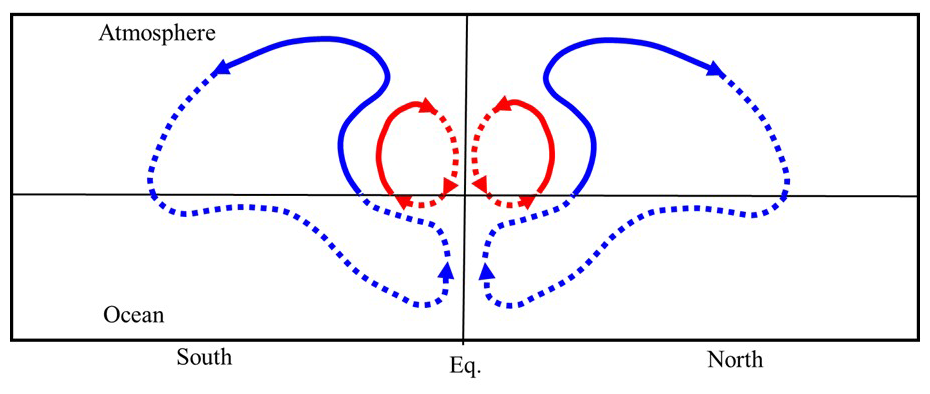
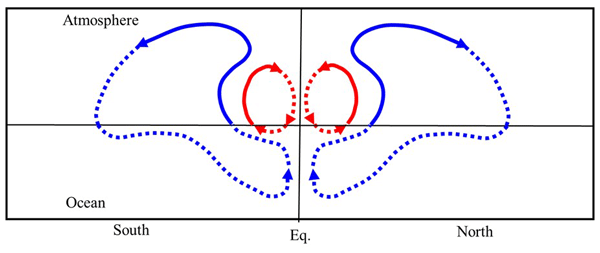
Figure 2Schematic representation of coupled ocean–atmosphere “Latent cells”. Dotted lines denote non-gaseous-phase mass transport associated with the hydrological cycle, terminating at regions of net evaporation in the subtropics. These regions act as sources of atmospheric mass, where water vapour enters the atmosphere. Solid lines denote gaseous source–sink flows that originate at these evaporative sources and terminate at regions of net phase change and precipitation (high latitudes and the equator) that remove atmospheric mass and add freshwater to the ocean. Together, these linked source–sink flows form closed circuits across the ocean–atmosphere system. Tropical branches are shown in red and extratropical branches in blue. Adapted from Dey and Döös (2019).
Like mass (m), meridional momentum (mv, where v represents the meridional component of velocity) is an extensive physical quantity. The meridional momentum of the atmosphere can therefore be expressed as the sum of the momenta of its individual constituents:
Among these constituents, only water vapour undergoes surface exchanges of sufficient magnitude to influence large-scale dynamics (Kowalski et al., 2025). As a result, the meridional momenta of all dry-air components may be neglected in this context, reducing Eq. (1) to
Sustained meridional transport of water vapour at any latitude therefore implies a corresponding motion of the atmosphere itself in the same direction. In other words, moisture transport driven by surface source–sink patterns necessarily entails bulk air motion across latitudinal circles, even if individual dry-air constituents appear meridionally stationary when considered in isolation.
Despite the link between moisture transport and bulk air motion implied by Eqs. (1) and (2), many treatments of slow, global-scale atmospheric circulation effectively suppress the influence of the hydrological cycle by imposing a condition of zero net mass transport across the lower boundary. For example, in their formulation of the zonal-mean continuity equation, Andrews et al. (1987) express the meridional circulation using a streamfunction that vanishes at both the upper and lower boundaries. While mathematically convenient, this formulation implicitly assumes zero vertically integrated meridional mass transport at each latitude.
Such an assumption is appropriate for purely recirculating flows but is incompatible with the presence of spatially structured mass sources and sinks at the lower boundary. When atmospheric mass is injected across the surface through evaporation, the streamfunction at that boundary cannot, in general, be zero. Instead, its non-uniform distribution establishes gradients in velocity potential that drive meridional motion in the form of a compressible source–sink flow. In this framework, the absence of a return flow in the gas phase is not anomalous but is a defining characteristic of throughflow.
The apparent meridional stationarity of dry air under these conditions does not indicate the absence of bulk motion. Rather, it reflects the migration of dry-air constituents upstream against a background source–sink flow oriented away from moisture sources and toward moisture sinks. This behaviour follows directly from the fact that humidification both dilutes and displaces dry air (Kowalski et al., 2025). In this sense, the classical picture of zero net meridional transport of dry air is recovered not by the absence of flow, but by the near cancellation of throughflow by opposing “diffusion” of dry-air components.
Water vapour provides the dominant forcing for this circulation. Its strong net sources in the subtropics, combined with net sinks at higher latitudes and near the equator, establish hemispheric-scale velocity-potential gradients that necessarily induce meridional source–sink flows of air. These flows are directed away from the subtropics in each hemisphere and connect surface evaporation regions to regions of net condensation and precipitation through open streamlines.
The large-scale source–sink flows described here constitute the atmospheric branches of what are here termed “Latent cells” (Fig. 2). The proposed name reflects both their association with phase changes of water and the fact that their atmospheric branches are not manifest in traditional, purely cellular descriptions of the mean meridional circulation (e.g., Holton, 2004). Latent cells provide a conceptual link between the well-established meridional transport of mass by the oceans (Dey and Döös, 2019) and more subtle but systematic meridional drifts in the atmosphere.
From this perspective, the meridional component of the atmospheric general circulation is not purely cellular. Instead, it may be viewed as a hemispheric-scale throughflow (Fig. 2) within which familiar recirculating structures – the Hadley, Ferrel, and Polar cells – appear as embedded, quasi-stationary eddies. Likewise, the baroclinic eddies – whose stirring is so important for meridional transport of some constituents – are embedded in flow that is not purely zonal. These closed-streamline circulations remain dynamically important, but they operate within, rather than define, the background transport of atmospheric mass established by hydrologically driven potential flow.
Figure 2 illustrates the proposed coupling between oceanic and atmospheric branches of the hydrological cycle. In the ocean, net freshwater gain through precipitation and runoff defines sources that are balanced by net evaporation in the subtropics, where freshwater is removed. These evaporative regions act simultaneously as sources of atmospheric mass, as water vapour enters the atmosphere. The resulting atmospheric source–sink flow originates in the subtropics and terminates in regions of net phase change and precipitation that act as sinks of atmospheric mass and return freshwater to the ocean.
In this way, oceanic and atmospheric transports are linked through the phase changes of water, forming continuous source–sink circuits across the coupled system. The gas-phase segments of these circuits correspond to the throughflows described here, while the liquid-phase segments provide the return pathway required to close the mass budget.
Dey and Döös (2019) conceived hemispheric water cells but did not relate them to mean meridional throughflow in the atmosphere. The vertical evolution of the Latent cells depicted here derive from that paper's Fig. 4 and are not meant to imply specific knowledge about the depths of atmospheric and oceanic transport. As noted by Dey and Döös (2019), these cells are mass budget cells and do not necessarily represent pathways of individual fluid parcels. However, transport by this background meridional mass flow of air plays an important role in the distributions of certain atmospheric constituents, particularly those that are inert – like the oil in the example of Fig. 1 – or nearly so.
For water vapour itself, meridional transport associated with throughflow is readily quantified and is relatively modest. Manipulating the momentum relationships introduced in Sect. 3, division of Eq. (2) by a control volume yields
where ρ is density and ρv represents a meridional flux density (). Denoting the meridional flux density of water vapour as Fv, Eq. (3) may be rearranged to give the meridional velocity of air as
Multiplying this velocity by the density of water vapour (ρv) defines the non-diffusive component of water vapour transport,
Equation (5) shows that the fraction of water vapour transport conveyed by throughflow is equal to the mass fraction of water vapour, or specific humidity (). Such conveyance is mechanistically independent of transport by smaller-scale circulations with closed streamlines. Because q is small – negligible at most latitudes and limited to a few percent even in the tropics (Zurbenko and Luo, 2015) – the direct contribution of atmospheric throughflow to the meridional transport of water vapour itself is minor. Most moisture transport therefore occurs via “diffusion” or recirculation.
Average throughflow velocity magnitudes can be estimated from Eq. (4) using column-integrated values of meridional mass transport (; Liu et al., 2021) and mass (), yielding average meridional velocities of order 1 mm s−1. Although modest in magnitude, their significance becomes apparent when considering transport of inert or nearly inert constituents. As shown for oxygen by Kowalski and García-Valdecasas Ojeda (2026), large-scale concentration gradients of certain atmospheric constituents can arise primarily from dilution by water vapour rather than from their own sources and sinks. Because increases in humidity reduce the partial pressures of dry-air components, regions of high q are systematically depleted in inert or weakly reactive gases, while dry regions are relatively enriched. Humidification produces meridional concentration gradients across the midlatitudes that are largely independent of the intrinsic biogeochemical cycling of the constituent.
Argon provides a particularly clear example because it is effectively inert. In the midlatitudes, both baroclinic eddies and Ferrel-cell overturning transport argon equatorward, driven by humidity-induced concentration gradients. These gradients – far larger than those of any trace gas, including carbon dioxide – drive strong equatorward “diffusive” transport of argon by synoptic-scale motions, independent of any net meridional mass flow. Ferrel-cell overturning further contributes to equatorward transport, as relatively dry, argon-rich air moves equatorward aloft while more humid, argon-poor air moves poleward near the surface. Despite these tandem mechanisms transporting argon equatorward, argon remains enriched in cold, dry polar air and depleted in warm, humid regions.
The persistence of this argon gradient implies a compensating poleward transport, which is naturally interpreted as non-diffusive conveyance by the atmospheric branch of the Latent cell that balances – and approximately equals – the combined equatorward transports by eddies and recirculation. Throughflow therefore dominates the net meridional transport mechanisms acting on argon in the midlatitudes, even though it is not readily apparent in conventional circulation diagnostics.
Closely analogous behaviour is observed for oxygen, notwithstanding its stoichiometric similarity to carbon dioxide. Although biologically active, oxygen is effectively inert with respect to its atmospheric abundance, and its large-scale distribution is primarily determined by humidity (Kowalski and García-Valdecasas Ojeda, 2026). Relative to its familiar concentration of 20.95 % in cold, dry air, oxygen is suppressed by many thousands of parts per million in warm, humid tropical and subtropical environments (Kowalski et al., 2025), regardless of its own surface sources and sinks. These strong gradients drive equatorward “diffusion” through the Ferrel cell that is orders of magnitude greater than that of carbon dioxide.
Oxygen is also transported equatorward by Ferrel-cell overturning, owing to humidity contrasts between its meridional branches, in much the same way as argon. As with argon, these equatorward transports by recirculation and eddy “diffusion” are nearly offset by poleward, non-diffusive conveyance associated with atmospheric throughflow. Unlike argon, however, the small residual transport reflects the influence of oxygen's surface sources and sinks, which slightly perturb the balance among large, nearly compensating transport mechanisms.
The implications of hemispheric-scale meridional throughflow extend beyond atmospheric composition and can be illustrated by contrasting linear and angular momentum advection in the midlatitudes. Poleward mass transport through the Ferrel cell carries linear momentum from subtropical regions of relatively weak zonal winds toward higher latitudes dominated by strong westerlies, corresponding to negative advection. Angular momentum behaves differently: poleward throughflow transports it from the subtropics, where it is relatively large, toward the planetary rotation axis, where it vanishes, implying positive advection.
Classical treatments of meridional momentum transport generally exclude such behaviour by assuming zero net mass flux across latitude circles (e.g., Holopainen, 1967; Lindzen and Hou, 1988). While appropriate for recirculating frameworks, these assumptions may require reconsideration in the presence of a persistent, hydrologically driven background throughflow.
The atmospheric general circulation in each hemisphere includes meridional potential flows that are forced by subtropical sources and high-latitude or equatorial sinks of air. These additions and removals of atmospheric mass are dominated by the hydrological cycle. The resulting hemispheric motions have no gas-phase return flow and are therefore not inherently cellular unless considered together with the opposing mass transport that occurs in the oceans. Taken together, these atmospheric and oceanic branches form Latent cells in geophysical fluid dynamics.
Within these meridional atmospheric throughflows are embedded familiar, quasi-stationary eddies such as the Hadley, Ferrel, and Polar cells. While these structures remain central to our understanding of atmospheric dynamics, the background meridional mass transport highlighted here plays a key role in the redistribution of atmospheric constituents. Its implications for the budgets of linear and angular momentum, in particular, suggest directions for further investigation rather than definitive revision. An important direction for future work is to examine how hydrologically driven throughflow might be represented within thermodynamic-coordinate frameworks such as those developed by Pauluis et al. (2008) and Laliberté et al. (2015).
No data sets were used in this article.
The author has declared that there are no competing interests.
Publisher's note: Copernicus Publications remains neutral with regard to jurisdictional claims made in the text, published maps, institutional affiliations, or any other geographical representation in this paper. The authors bear the ultimate responsibility for providing appropriate place names. Views expressed in the text are those of the authors and do not necessarily reflect the views of the publisher.
This work was supported by the project NATURAL (grant no. PID2024-158786NB-C21) funded by MICIU/AEI/10.13039/501100011033 and by ERDF, EU; the Grant DGP_PIDI_2024_00812 funded by Consejería de Universidad, Investigación e Innovación and by ERDF Andalusia Program 2021–2027; and the project ESFRI_GICS-2025-04-Campus_nev-04, co-funded by the ERDF of the Programa Plurirregional de España 2021–2027, through the Ministerio de Ciencia, Innovación y Universidades. Technologies assisted by AI improved paragraph concision and reading comprehension.
This work was supported by the project NATURAL (grant no. PID2024-158786NB-C21) funded by MICIU/AEI/10.13039/501100011033 and by ERDF, EU.
This paper was edited by Stephan Pfahl and reviewed by two anonymous referees.
Acheson, J. D.: Elementary fluid dynamics, Clarendon Press, Oxford, ISBN 9780198596790, 1990.
Andrews, D. G. and McIntyre, M. E.: Planetary waves in horizontal and vertical shear: the generalized Eliassen–Palm relation and the mean zonal acceleration, J. Atmos. Sci., 33, 2031–2048, 1976.
Andrews, D. G., Holton, J. R., and Leovy, C. B.: Middle atmosphere dynamics, Academic Press, Orlando, ISBN 9780120585762, 1987.
Batchelor, G. K.: An introduction to fluid dynamics, Cambridge University Press, Cambridge, ISBN O 521663962, 2000.
Dey, D. and Döös, K.: The coupled ocean–atmosphere hydrologic cycle, Tellus A, 71, 1650413, https://doi.org/10.1080/16000870.2019.1650413, 2019.
Döös, K. and Nilsson, J.: Analysis of the meridional energy transport by atmospheric overturning circulations, J. Atmos. Sci., 68, 1806–1820, 2011.
Elling, V.: Relative entropy and compressible potential flow, Acta Math. Sci. B, 35, 763–776, 2015.
Holopainen, E. O.: On the mean meridional circulation and the flux of angular momentum over the northern hemisphere, Tellus, 19, 1–13, 1967.
Holton, J. R.: An introduction to dynamic meteorology, Elsevier, Amsterdam, 535 pp., ISBN 0-12-354015-1, 2004.
Kowalski, A. S.: The boundary condition for vertical velocity and its interdependence with surface gas exchange, Atmos. Chem. Phys., 17, 8177–8187, https://doi.org/10.5194/acp-17-8177-2017, 2017.
Kowalski, A. S. and García-Valdecasas Ojeda, M.: Global oxygen distributions at the Earth's surface, Sci. Total Environ., 1031, 181809, https://doi.org/10.1016/j.scitotenv.2026.181809, 2026.
Kowalski, A. S., Janssens, I. A., and Pérez-Priego, O.: Water vapour dynamics as a key determinant of atmospheric composition and transport mechanisms, Biogeosciences, 22, 8005–8012, https://doi.org/10.5194/bg-22-8005-2025, 2025.
Kundu, P. K. and Cohen, I. M.: Fluid Mechanics, Academic Press, San Diego, 730 pp., ISBN 0-12-1782514, 2002.
Laliberté, F., Zika, J., Mudryk, L., Kushner, P. J., Kjellsson, J., and Döös, K.: Constrained work output of the moist atmospheric heat engine in a warming climate, Science, 347, 540–543, https://doi.org//10.1126/science.1257103, 2015.
Lindzen, R. S. and Hou, A. V.: Hadley circulations for zonally averaged heating centered off the equator, J. Atmos. Sci., 45, 2416–2427, 1988.
Liu, Q., Li, T., and Zhou, W.: Impacts of multi-timescale circulations on meridional moisture transport, J. Climate, 34, 8065–8085, https://doi.org/10.1175/JCLI-D-20-0126.1, 2021.
Pauluis, O., Czaja, A., and Korty, R.: The global atmospheric circulation on moist isentropes, Science, 321, 1075–1078, https://doi.org/10.1126/science.1159649, 2008.
Peixoto, J. P. and Oort, A. H.: Physics of Climate, American Institute of Physics, New York, 520 pp., ISBN 978-0-88318-712, 1992.
Schanze, J. J., Schmitt, R. W., and Yu, L. L.: The global oceanic freshwater cycle: A state-of-the-art quantification, J. Mar. Res., 68, 569–595, 2010.
Trenberth, K. E. and Guillemot, C. J.: Evaluation of the atmospheric moisture and hydrological cycle in the NCEP/NCAR reanalyses, Clim. Dynam., 14, 213–231, 1998.
Zurbenko, I. and Luo, M.: Surface Humidity Changes in Different Temporal Scales, Am. J. Clim. Change, 4, 226–238, https://doi.org/10.4236/ajcc.2015.43018, 2015.