
Articles | Volume 7, issue 1
https://doi.org/10.5194/wcd-7-165-2026
© Author(s) 2026. This work is distributed under
the Creative Commons Attribution 4.0 License.
the Creative Commons Attribution 4.0 License.
https://doi.org/10.5194/wcd-7-165-2026
© Author(s) 2026. This work is distributed under
the Creative Commons Attribution 4.0 License.
the Creative Commons Attribution 4.0 License.
Research article
| 
22 Jan 2026
Research article |
| 22 Jan 2026
| 22 Jan 2026
Assimilating WIVERN windpseudo-observations in WRF model: an application to the outstanding case of the Medicane Ianos

CNR-ISAC, via del Fosso del Cavaliere 100, 00133 Rome, Italy
Rosa Claudia Torcasio
CNR-ISAC, via del Fosso del Cavaliere 100, 00133 Rome, Italy
Claudio Transerici
CNR-ISAC, via del Fosso del Cavaliere 100, 00133 Rome, Italy
Mario Montopoli
CNR-ISAC, via del Fosso del Cavaliere 100, 00133 Rome, Italy
Cinzia Cambiotti
Dipartimento di Ingegneria dell’Ambiente, del Territorio, Politecnico di Torino, Turin, Italy
Francesco Manconi
Dipartimento di Ingegneria dell’Ambiente, del Territorio, Politecnico di Torino, Turin, Italy
Alessandro Battaglia
Dipartimento di Ingegneria dell’Ambiente, del Territorio, Politecnico di Torino, Turin, Italy
Maryam Pourshamsi
ESA-ESTEC, Noordwijk, the Netherlands
Related authors

Mario Marcello Miglietta, Elenio Avolio, Alessandro Bracci, Massimiliano Burlando, Francesco Cairo, Federico Canepa, Vincenzo Capozzi, Sebastiano Carpentari, Federico Cassola, Alessandro Ceppi, Silvio Davolio, Francesco De Martin, Giorgio Doglioni, Costanza Di Felice Fabrizi, Luca Di Liberto, Francesco Domenichini, Stefano Federico, Massimo Enrico Ferrario, Federico Grazzini, Antonio Iengo, Sante Laviola, Agostino Manzato, Paolo Paganini, Antonio Parodi, Alessandro Pavan, Andrea Piazza, Arturo Pucillo, Giovanni Ravezzani, Francesco Sioni, Barbara Turato, Gianfranco Vulpiani, Marco Zanatta, and Dino Zardi
Nat. Hazards Earth Syst. Sci., 26, 3395–3415, https://doi.org/10.5194/nhess-26-3395-2026, https://doi.org/10.5194/nhess-26-3395-2026, 2026
Short summary
Short summary
This paper represents a summary of the contribution that the Italian meteorological community is willing to provide to the forthcoming European field campaign on Thunderstorm Intensification from Mountains to plains, planned in 2028–2030. Critical issues regard both the available instrumentation and the accuracy of numerical models. These limitations, in the context of climate change making severe convective episodes more frequent, make the need for a dedicated field campaign urgent.
Rosa Claudia Torcasio, Alessandra Mascitelli, Eugenio Realini, Stefano Barindelli, Giulio Tagliaferro, Silvia Puca, Stefano Dietrich, and Stefano Federico
Nat. Hazards Earth Syst. Sci., 23, 3319–3336, https://doi.org/10.5194/nhess-23-3319-2023, https://doi.org/10.5194/nhess-23-3319-2023, 2023
Short summary
Short summary
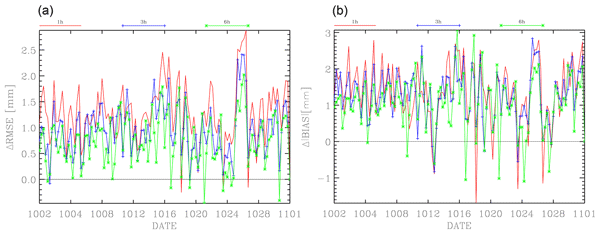
This work shows how local observations can improve precipitation forecasting for severe weather events. The improvement lasts for at least 6 h of forecast.
Mario Marcello Miglietta, Elenio Avolio, Alessandro Bracci, Massimiliano Burlando, Francesco Cairo, Federico Canepa, Vincenzo Capozzi, Sebastiano Carpentari, Federico Cassola, Alessandro Ceppi, Silvio Davolio, Francesco De Martin, Giorgio Doglioni, Costanza Di Felice Fabrizi, Luca Di Liberto, Francesco Domenichini, Stefano Federico, Massimo Enrico Ferrario, Federico Grazzini, Antonio Iengo, Sante Laviola, Agostino Manzato, Paolo Paganini, Antonio Parodi, Alessandro Pavan, Andrea Piazza, Arturo Pucillo, Giovanni Ravezzani, Francesco Sioni, Barbara Turato, Gianfranco Vulpiani, Marco Zanatta, and Dino Zardi
Nat. Hazards Earth Syst. Sci., 26, 3395–3415, https://doi.org/10.5194/nhess-26-3395-2026, https://doi.org/10.5194/nhess-26-3395-2026, 2026
Short summary
Short summary
This paper represents a summary of the contribution that the Italian meteorological community is willing to provide to the forthcoming European field campaign on Thunderstorm Intensification from Mountains to plains, planned in 2028–2030. Critical issues regard both the available instrumentation and the accuracy of numerical models. These limitations, in the context of climate change making severe convective episodes more frequent, make the need for a dedicated field campaign urgent.
Kalliopi Artemis Voudouri, Eleni Marinou, Ilianna Koutsoupi, Vassilis Spyrakos, Dimitra Karkani, Ioanna Tsikoudi, Alessandro Battaglia, Pavlos Kollias, Eleni Giannakaki, and Vassilis Amiridis
EGUsphere, https://doi.org/10.5194/egusphere-2026-2384, https://doi.org/10.5194/egusphere-2026-2384, 2026
Short summary
Short summary
Cloud observations from the CloudSat mission (2007–2017) reveal how clouds vary per altitude and season across the Mediterranean. Comparisons with ERA5 reanalysis show good overall agreement, though ice clouds are often underestimated. Early EarthCARE mission data are also presented, towards improving long-term climate records.
Susmitha Sasikumar, Alessandro Battaglia, Bernat Puigdomènech Treserras, and Pavlos Kollias
Atmos. Meas. Tech., 19, 2313–2328, https://doi.org/10.5194/amt-19-2313-2026, https://doi.org/10.5194/amt-19-2313-2026, 2026
Short summary
Short summary
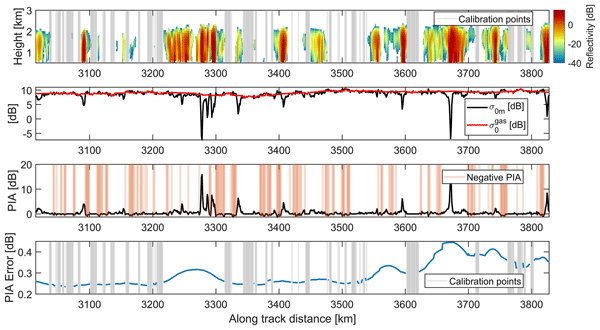
The study present a method to estimate how much the radar signal is weakened as it passes through rain or clouds, designed to implement in the new EarthCARE satellite cloud profiling radar data. The approach builds on the method used in the CloudSat mission, with key improvements that make it robust under non-ideal instrument conditions in the early mission phase. This leads to more reliable retrieval of clouds and rainfall during initial satellite operations.
Zhuocan Xu, Pavlos Kollias, Susmitha Sasikumar, Alessandro Battaglia, Bernat Puigdomènech Treserras, and Matthew L. Walker McLinden
Atmos. Chem. Phys., 26, 4619–4632, https://doi.org/10.5194/acp-26-4619-2026, https://doi.org/10.5194/acp-26-4619-2026, 2026
Short summary
Short summary
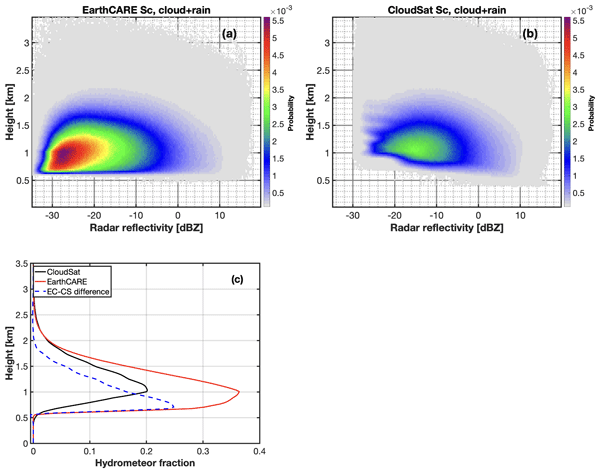
It has been a challenge to observe marine low-level clouds from space. A comparison with CloudSat climatology in this study shows a greatly improved detection of marine stratocumulus clouds and drizzle occurrence by the EarthCARE radar due to the enhanced sensitivity and full suppression of ground clutter above 0.5 km. A more accurate observational constraint on marine low clouds is now available on global scale.
Karina McCusker, Chris Westbrook, Alessandro Battaglia, Kamil Mroz, Benjamin M. Courtier, Peter G. Huggard, Hui Wang, Richard Reeves, Christopher J. Walden, Richard Cotton, Stuart Fox, and Anthony J. Baran
Atmos. Meas. Tech., 18, 7833–7852, https://doi.org/10.5194/amt-18-7833-2025, https://doi.org/10.5194/amt-18-7833-2025, 2025
Short summary
Short summary
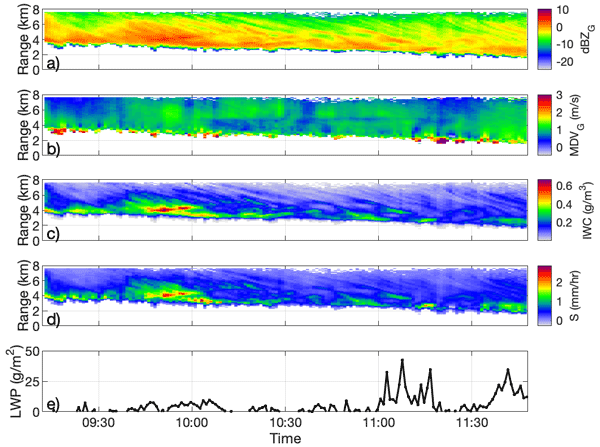
This work presents the first known retrievals of ice cloud and snowfall properties using G-band radar, representing a major step forward in the use of high-frequency radar for atmospheric remote sensing. We present theory and simulations to show that ice water content (IWC) and snowfall rate (S) can be retrieved efficiently with a single frequency G-band radar if the mass of a wavelength-sized particle is known or can be assumed, while details of the particle size distribution are not required.
Aida Galfione, Alessandro Battaglia, Bernat Puigdomènech Treserras, and Pavlos Kollias
Atmos. Meas. Tech., 18, 6747–6763, https://doi.org/10.5194/amt-18-6747-2025, https://doi.org/10.5194/amt-18-6747-2025, 2025
Short summary
Short summary
Convection drives atmospheric circulation but is difficult to observe and model. EarthCARE's radar provides the first space-based vertical wind data, capturing updrafts and downdrafts. Combined with satellite imagery from other sensors, it offers a broader view of convective storms. While resolution limits detail, cloud-top cooling helps track storm development. This combined approach improves understanding and modeling of convection.
Jiseob Kim, Pavlos Kollias, Bernat Puigdomènech Treserras, Alessandro Battaglia, and Ivy Tan
Atmos. Chem. Phys., 25, 15389–15402, https://doi.org/10.5194/acp-25-15389-2025, https://doi.org/10.5194/acp-25-15389-2025, 2025
Short summary
Short summary
The EarthCARE satellite’s Cloud Profiling Radar (CPR) can now measure how fast particles fall within clouds from space. In this study, we compared these new satellite measurements with ground-based radar data and found that, after proper corrections, the CPR gives reliable results, especially in ice clouds. This means scientists can confidently use EarthCARE data to better understand clouds and improve weather and climate predictions.
Filippo Emilio Scarsi, Alessandro Battaglia, Maximilian Maahn, and Stef Lhermitte
The Cryosphere, 19, 4875–4892, https://doi.org/10.5194/tc-19-4875-2025, https://doi.org/10.5194/tc-19-4875-2025, 2025
Short summary
Short summary
Snowfall measurements at high latitudes are crucial for estimating ice sheet mass balance. Spaceborne radar and radiometer missions help estimate snowfall but face uncertainties. This work evaluates uncertainties in snowfall estimates from a fixed near-nadir radar (CloudSat-like) and a conically scanning radar (WIVERN-like), showing that a WIVERN-like radar will provide better estimates than a CloudSat-like radar at smaller spatial and temporal scales.
Bernat Puigdomènech Treserras, Pavlos Kollias, Alessandro Battaglia, Simone Tanelli, and Hirotaka Nakatsuka
Atmos. Meas. Tech., 18, 5607–5618, https://doi.org/10.5194/amt-18-5607-2025, https://doi.org/10.5194/amt-18-5607-2025, 2025
Short summary
Short summary
We investigate how seasonal solar illumination affects the pointing accuracy of EarthCARE’s cloud profile radar (CPR) antenna and introduce a correction based on surface Doppler measurements. The correction improves measurement accuracy by reducing Doppler velocity biases to within 5 and 7 cm s−1. Our results demonstrate the importance of continuous pointing characterization to maintain the scientific accuracy of EarthCARE’s CPR Doppler observations.
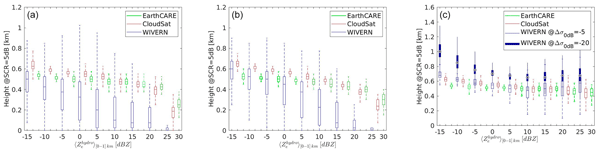
Marco Coppola, Alessandro Battaglia, Frederic Tridon, and Pavlos Kollias
Atmos. Meas. Tech., 18, 5071–5085, https://doi.org/10.5194/amt-18-5071-2025, https://doi.org/10.5194/amt-18-5071-2025, 2025
Short summary
Short summary
The WIVERN (WInd Velocity Radar Nephoscope) conically scanning Doppler W-band radar has the potential, for the first time, to map the mesoscale and synoptic variability of cloud dynamics and precipitation microphysics. This study shows that the oblique angle of incidence will be advantageous compared to standard nadir-looking radars due to substantial clutter suppression over the ocean surface. This feature will enable the detection and quantification of light and moderate precipitation, with improved proximity to the surface.
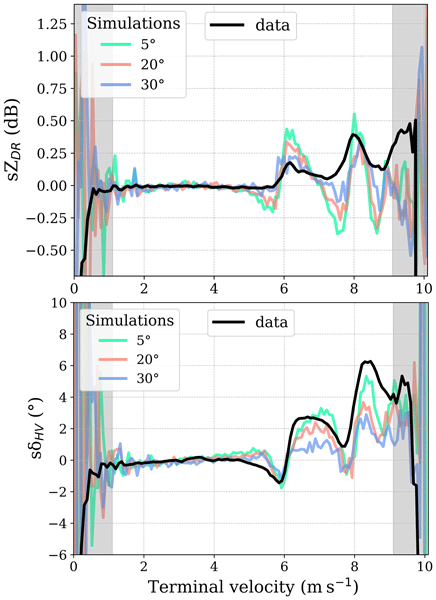
Ioanna Tsikoudi, Alessandro Battaglia, Christine Unal, and Eleni Marinou
Atmos. Meas. Tech., 18, 4857–4870, https://doi.org/10.5194/amt-18-4857-2025, https://doi.org/10.5194/amt-18-4857-2025, 2025
Short summary
Short summary
In the study, we simulate spectral polarimetric variables for raindrops as observed by cloud radar. Raindrops are modeled as oblate spheroids, and backscattering properties are computed via the T-matrix method, including noise, turbulence, and spectral averaging effects. When comparing simulations with measurements, differences in the amplitudes of polarimetric variables are noted. This shows the challenge of using simplified shapes to model raindrop polarimetric variables when moving to millimeter wavelengths.
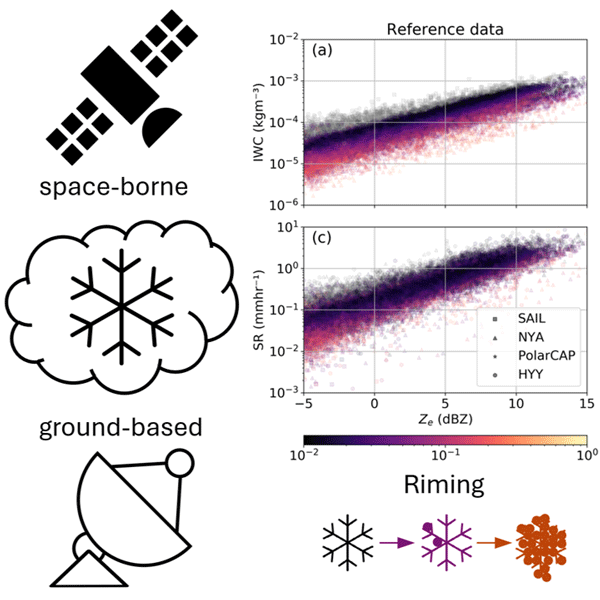
Nina Maherndl, Alessandro Battaglia, Anton Kötsche, and Maximilian Maahn
Atmos. Meas. Tech., 18, 3287–3304, https://doi.org/10.5194/amt-18-3287-2025, https://doi.org/10.5194/amt-18-3287-2025, 2025
Short summary
Short summary
Accurate measurements of ice water content (IWC) and snowfall rate (SR) are challenging due to high spatial variability and limitations of our measurement techniques. Here, we present a novel method to derive IWC and SR from W-band cloud radar observations, considering the degree of riming. We also investigate the use of the liquid water path (LWP) as a proxy for the occurrence of riming. LWP is easier to measure, so that the method can be applied to both ground-based and space-based instruments.
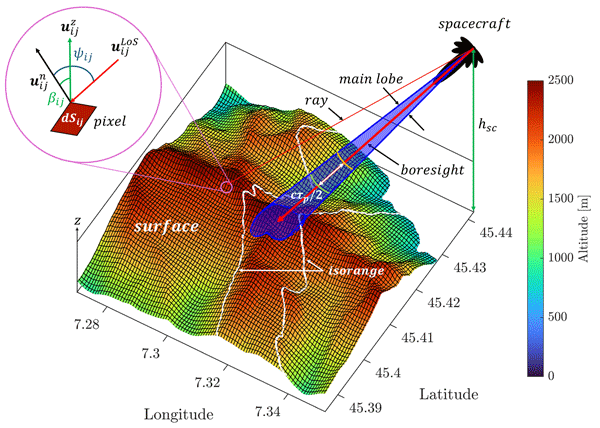
Francesco Manconi, Alessandro Battaglia, and Pavlos Kollias
Atmos. Meas. Tech., 18, 2295–2310, https://doi.org/10.5194/amt-18-2295-2025, https://doi.org/10.5194/amt-18-2295-2025, 2025
Short summary
Short summary
The paper aims to study the ground reflection, or clutter, of the signal from a spaceborne radar in the context of ESA's WIVERN (WInd VElocity Radar Nephoscop) mission, which will observe in-cloud winds. Using topography and land type data, with a model of the satellite orbit and rotating antenna, simulations of scans have been run over the Piedmont region of Italy. These measurements cover the full range of the ground clutter over land for WIVERN and have allowed for analyses of the precision and accuracy of velocity observations.
Benjamin M. Courtier, Alessandro Battaglia, and Kamil Mroz
Atmos. Meas. Tech., 17, 6875–6888, https://doi.org/10.5194/amt-17-6875-2024, https://doi.org/10.5194/amt-17-6875-2024, 2024
Short summary
Short summary
A new millimetre-wavelength radar is used to improve methods of retrieving information about the smallest droplets that exist within clouds. The radar is shown to be able to retrieve the vertical wind speed more accurately and more frequently and to retrieve the cloud properties for clouds with lower rainfall rates and smaller droplets than would be possible using longer-wavelength radars.
Annalina Lombardi, Barbara Tomassetti, Valentina Colaiuda, Ludovico Di Antonio, Paolo Tuccella, Mario Montopoli, Giovanni Ravazzani, Frank Silvio Marzano, Raffaele Lidori, and Giulia Panegrossi
Hydrol. Earth Syst. Sci., 28, 3777–3797, https://doi.org/10.5194/hess-28-3777-2024, https://doi.org/10.5194/hess-28-3777-2024, 2024
Short summary
Short summary
The accurate estimation of precipitation and its spatial variability within a watershed is crucial for reliable discharge simulations. The study is the first detailed analysis of the potential usage of the cellular automata technique to merge different rainfall data inputs to hydrological models. This work shows an improvement in the performance of hydrological simulations when satellite and rain gauge data are merged.
Kamil Mroz, Alessandro Battaglia, and Ann M. Fridlind
Atmos. Meas. Tech., 17, 1577–1597, https://doi.org/10.5194/amt-17-1577-2024, https://doi.org/10.5194/amt-17-1577-2024, 2024
Short summary
Short summary
In this study, we examine the extent to which radar measurements from space can inform us about the properties of clouds and precipitation. Surprisingly, our analysis showed that the amount of ice turning into rain was lower than expected in the current product. To improve on this, we came up with a new way to extract information about the size and concentration of particles from radar data. As long as we use this method in the right conditions, we can even estimate how dense the ice is.
Filippo Emilio Scarsi, Alessandro Battaglia, Frederic Tridon, Paolo Martire, Ranvir Dhillon, and Anthony Illingworth
Atmos. Meas. Tech., 17, 499–514, https://doi.org/10.5194/amt-17-499-2024, https://doi.org/10.5194/amt-17-499-2024, 2024
Short summary
Short summary
The WIVERN mission, one of the two candidates to be the ESA's Earth Explorer 11 mission, aims at providing measurements of horizontal winds in cloud and precipitation systems through a conically scanning W-band Doppler radar. This work discusses four methods that can be used to characterize and correct the Doppler velocity error induced by the antenna mispointing. The proposed methodologies can be extended to other Doppler concepts featuring conically scanning or slant viewing Doppler systems.
Rosa Claudia Torcasio, Alessandra Mascitelli, Eugenio Realini, Stefano Barindelli, Giulio Tagliaferro, Silvia Puca, Stefano Dietrich, and Stefano Federico
Nat. Hazards Earth Syst. Sci., 23, 3319–3336, https://doi.org/10.5194/nhess-23-3319-2023, https://doi.org/10.5194/nhess-23-3319-2023, 2023
Short summary
Short summary
This work shows how local observations can improve precipitation forecasting for severe weather events. The improvement lasts for at least 6 h of forecast.
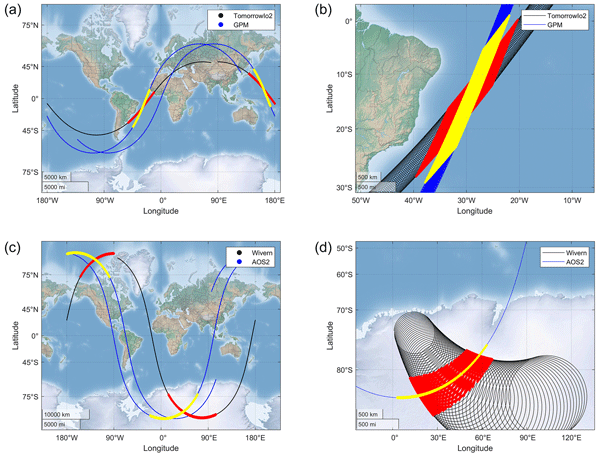
Alessandro Battaglia, Filippo Emilio Scarsi, Kamil Mroz, and Anthony Illingworth
Atmos. Meas. Tech., 16, 3283–3297, https://doi.org/10.5194/amt-16-3283-2023, https://doi.org/10.5194/amt-16-3283-2023, 2023
Short summary
Short summary
Some of the new generation of cloud and precipitation spaceborne radars will adopt conical scanning. This will make some of the standard calibration techniques impractical. This work presents a methodology to cross-calibrate radars in orbits by matching the reflectivity probability density function of ice clouds observed by the to-be-calibrated and by the reference radar in quasi-coincident locations. Results show that cross-calibration within 1 dB (26 %) is feasible.

Kamil Mroz, Bernat Puidgomènech Treserras, Alessandro Battaglia, Pavlos Kollias, Aleksandra Tatarevic, and Frederic Tridon
Atmos. Meas. Tech., 16, 2865–2888, https://doi.org/10.5194/amt-16-2865-2023, https://doi.org/10.5194/amt-16-2865-2023, 2023
Short summary
Short summary
We present the theoretical basis of the algorithm that estimates the amount of water and size of particles in clouds and precipitation. The algorithm uses data collected by the Cloud Profiling Radar that was developed for the upcoming Earth Clouds, Aerosols and Radiation Explorer (EarthCARE) satellite mission. After the satellite launch, the vertical distribution of cloud and precipitation properties will be delivered as the C-CLD product.
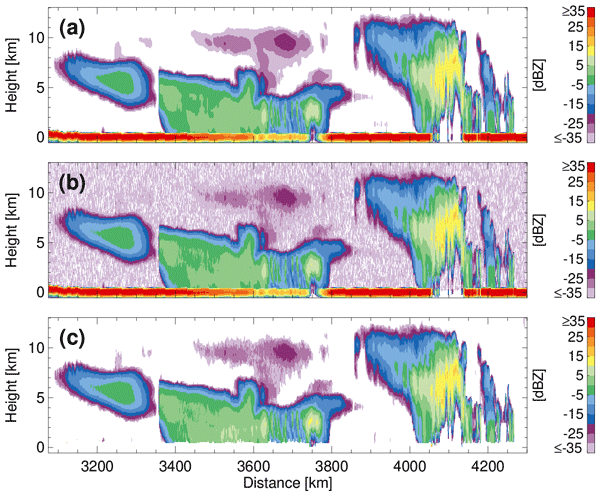
Pavlos Kollias, Bernat Puidgomènech Treserras, Alessandro Battaglia, Paloma C. Borque, and Aleksandra Tatarevic
Atmos. Meas. Tech., 16, 1901–1914, https://doi.org/10.5194/amt-16-1901-2023, https://doi.org/10.5194/amt-16-1901-2023, 2023
Short summary
Short summary
The Earth Clouds, Aerosols and Radiation (EarthCARE) satellite mission developed by the European Space Agency (ESA) and Japan Aerospace Exploration Agency (JAXA) features the first spaceborne 94 GHz Doppler cloud-profiling radar (CPR) with Doppler capability. Here, we describe the post-processing algorithms that apply quality control and corrections to CPR measurements and derive key geophysical variables such as hydrometeor locations and best estimates of particle sedimentation fall velocities.
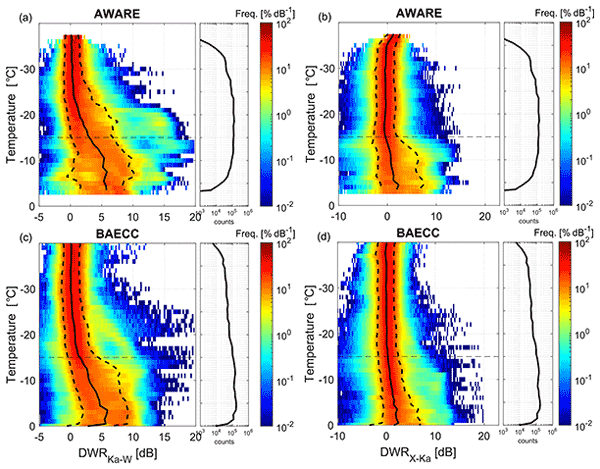
Frederic Tridon, Israel Silber, Alessandro Battaglia, Stefan Kneifel, Ann Fridlind, Petros Kalogeras, and Ranvir Dhillon
Atmos. Chem. Phys., 22, 12467–12491, https://doi.org/10.5194/acp-22-12467-2022, https://doi.org/10.5194/acp-22-12467-2022, 2022
Short summary
Short summary
The role of ice precipitation in the Earth water budget is not well known because ice particles are complex, and their formation involves intricate processes. Riming of ice crystals by supercooled water droplets is an efficient process, but little is known about its importance at high latitudes. In this work, by exploiting the deployment of an unprecedented number of remote sensing systems in Antarctica, we find that riming occurs at much lower temperatures compared with the mid-latitudes.
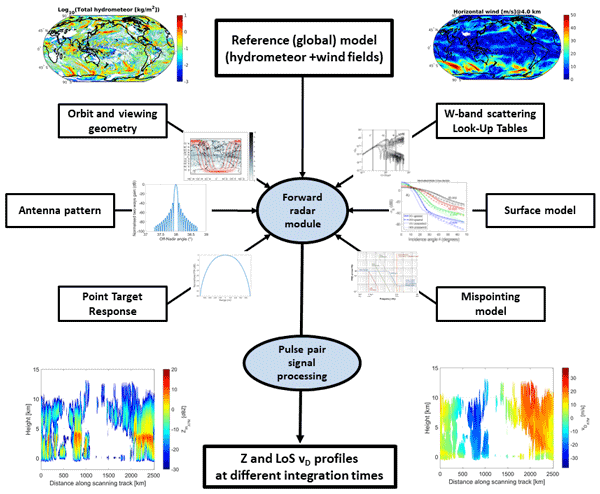
Alessandro Battaglia, Paolo Martire, Eric Caubet, Laurent Phalippou, Fabrizio Stesina, Pavlos Kollias, and Anthony Illingworth
Atmos. Meas. Tech., 15, 3011–3030, https://doi.org/10.5194/amt-15-3011-2022, https://doi.org/10.5194/amt-15-3011-2022, 2022
Short summary
Short summary
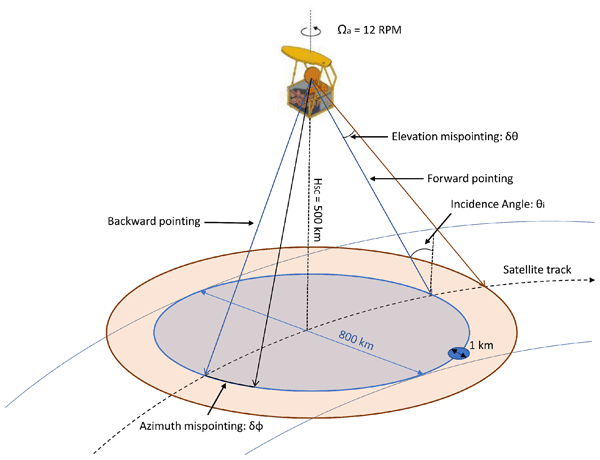
We present an instrument simulator for a new sensor, WIVERN (WInd VElocity Radar Nephoscope), a conically scanning radar payload with Doppler capabilities, recently down-selected as one of the four candidates for the European Space Agency Earth Explorer 11 program. The mission aims at measuring horizontal winds in cloudy areas. The simulator is instrumental in the definition and consolidation of the mission requirements and the evaluation of mission performances.
Alessandro Battaglia
Atmos. Meas. Tech., 14, 7809–7820, https://doi.org/10.5194/amt-14-7809-2021, https://doi.org/10.5194/amt-14-7809-2021, 2021
Short summary
Short summary
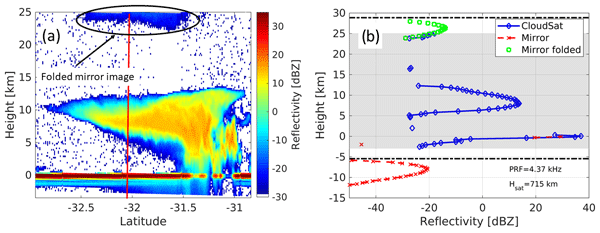
Space-borne radar returns can be contaminated by artefacts caused by radiation that undergoes multiple scattering events and appears to originate from ranges well below the surface range. While such artefacts have been rarely observed from the currently deployed systems, they may become a concern in future cloud radar systems, potentially enhancing cloud cover high up in the troposphere via ghost returns.
Cited articles
Ali, E., Cramer, W., Carnicer, J., Georgopoulou, E., Hilmi, N., Le Cozannet, G., and Lionello, P.: Cross-Chapter Paper 4: Mediterranean Region, in: Climate Change 2022: Impacts, Adaptation and Vulnerability. Contribution of Working Group II to the Sixth Assessment Report of the Intergovernmental Panel on Climate Change, edited by: Pörtner, H.-O., Roberts, D. C., Tignor, M., Poloczanska, E. S., Mintenbeck, K., Alegría, A., Craig, M., Langsdorf, S., Löschke, S., Möller, V., Okem, A., and Rama, B., Cambridge University Press, 2233–2272, https://doi.org/10.1017/9781009325844.021, 2023. a
Androulidakis, Y., Makris, C., Mallios, Z., Pytharoulis, I., Baltikas, V., and Krestenitis, Y.: Storm surges and coastal inundation during extreme events in the Mediterranean Sea: the IANOS Medicane, Nat. Hazards, 117, 939–978, https://doi.org/10.1007/s11069-023-05890-6, 2023. a
Baker, W. E., Atlas, R., Cardinali, C., Clement, A., Emmitt, G. D., Gentry, B. M., Hardesty, R. M., Källén, E., Kavaya, M. J., Langland, R., Ma, Z., Masutani, M., McCarty, W., Pierce, R. B., Pu, Z., Riishojgaard, L. P., Ryan, J., Tucker, S., Weissmann, M., and Yoe, J. G.: Lidar-Measured Wind Profiles: The Missing Link in the Global Observing System, B. Am. Meteorol. Soc., 95, 543–564, https://doi.org/10.1175/BAMS-D-12-00164.1, 2014. a
Barker, D. M., Huang, W., Guo, Y.-R., Bourgeois, A. J., and Xiao, Q. N.: A Three-Dimensional Variational Data Assimilation System for MM5: Implementation and Initial Results, Mon. Weather Rev., 132, 897–914, https://doi.org/10.1175/1520-0493(2004)132<0897:ATVDAS>2.0.CO;2, 2004. a, b, c
Battaglia, A., Martire, P., Caubet, E., Phalippou, L., Stesina, F., Kollias, P., and Illingworth, A.: Observation error analysis for the WInd VElocity Radar Nephoscope W-band Doppler conically scanning spaceborne radar via end-to-end simulations, Atmos. Meas. Tech., 15, 3011–3030, https://doi.org/10.5194/amt-15-3011-2022, 2022. a, b, c
Battaglia, A., Cambiotti, C., Carbone, A. F., and Da Silva, S.: Reconstruction of the Horizontal Wind Field Inside Weather Systems from the Sparse Sampling Envisaged for the Wind Velocity Radar Nephoscope (WIVERN) Mission, in: IGARSS 2024 - 2024 IEEE International Geoscience and Remote Sensing Symposium, 8925–8927, https://doi.org/10.1109/IGARSS53475.2024.10640420, 2024. a
Battaglia, A., Rizik, A., Sikaneta, I., and Tridon, F.: I and Qs Simulation and Processing Envisaged for Spaceborne Polarization Diversity Doppler Radars, IEEE T. Geosci. Remote, 63, 1–14, https://doi.org/10.1109/TGRS.2025.3529672, 2025. a
Battaglia, A., Rabino, R., Mroz, K., Tridon, F., and Parodi, A.: Non uniform beam filling correction for the Doppler velocity measured by the WIVERN conically scanning radar, J. Atmos. Ocean. Tech., https://doi.org/10.1175/JTECH-D-25-0050.1, in press, 2026. a
Bennitt, G. V., Johnson, H. R., Weston, P. P., Jones, J., and Pottiaux, E.: An assessment of ground-based GNSS Zenith Total Delay observation errors and their correlations using the Met Office UKV model, Q. J. Roy. Meteor. Soc., 143, 2436–2447, https://doi.org/10.1002/qj.3097, 2017. a
Comellas Prat, A., Federico, S., Torcasio, R. C., D'Adderio, L. P., Dietrich, S., and Panegrossi, G.: Evaluation of the Sensitivity of Medicane Ianos to Model Microphysics and Initial Conditions Using Satellite Measurements, Remote Sens., 13, 4984, https://doi.org/10.3390/rs13244984, 2021. a, b
D'Adderio, L. P., Casella, D., Dietrich, S., Sanò, P., and Panegrossi, G.: GPM-CO observations of Medicane Ianos: Comparative analysis of precipitation structure between development and mature phase, Atmos. Res., 273, 106174, https://doi.org/10.1016/j.atmosres.2022.106174, 2022. a, b, c
Dafis, S., Claud, C., Kotroni, V., Lagouvardos, K., and Rysman, J.-F.: Insights into the convective evolution of Mediterranean tropical-like cyclones, Q. J. Roy. Meteor. Soc., 146, 4147–4169, https://doi.org/10.1002/qj.3896, 2020. a
Di Francesca, V., D'Adderio, L. P., Sanò, P., Rysman, J.-F., Casella, D., and Panegrossi, G.: Passive microwave-based diagnostics of medicanes over the period 2000–2021, Atmos. Res., 316, 107922, https://doi.org/10.1016/j.atmosres.2025.107922, 2025. a
Dudhia, J.: Numerical Study of Convection Observed during the Winter Monsoon Experiment Using a Mesoscale Two-Dimensional Model, J. Atmos. Sci., 46, 3077–3107, https://doi.org/10.1175/1520-0469(1989)046<3077:NSOCOD>2.0.CO;2, 1989. a
Emanuel, K.: Genesis and maintenance of “Mediterranean hurricanes”, Adv. Geosci., 2, 217–220, https://doi.org/10.5194/adgeo-2-217-2005, 2005. a
Federico, S.: Implementation of a 3D-Var system for atmospheric profiling data assimilation into the RAMS model: initial results, Atmos. Meas. Tech., 6, 3563–3576, https://doi.org/10.5194/amt-6-3563-2013, 2013. a, b, c, d
Feng, C. and Pu, Z.: The impacts of assimilating Aeolus horizontal line-of-sight winds on numerical predictions of Hurricane Ida (2021) and a mesoscale convective system over the Atlantic Ocean, Atmos. Meas. Tech., 16, 2691–2708, https://doi.org/10.5194/amt-16-2691-2023, 2023. a
Ferrarin, C., Pantillon, F., Davolio, S., Bajo, M., Miglietta, M. M., Avolio, E., Carrió, D. S., Pytharoulis, I., Sanchez, C., Patlakas, P., González-Alemán, J. J., and Flaounas, E.: Assessing the coastal hazard of Medicane Ianos through ensemble modelling, Nat. Hazards Earth Syst. Sci., 23, 2273–2287, https://doi.org/10.5194/nhess-23-2273-2023, 2023. a
Fita, L. and Flaounas, E.: Medicanes as subtropical cyclones: the December 2005 case from the perspective of surface pressure tendency diagnostics and atmospheric water budget, Q. J. Roy. Meteor. Soc., 144, 1028–1044, https://doi.org/10.1002/qj.3273, 2018. a
Flaounas, E., Gray, S. L., and Teubler, F.: A process-based anatomy of Mediterranean cyclones: from baroclinic lows to tropical-like systems, Weather Clim. Dynam., 2, 255–279, https://doi.org/10.5194/wcd-2-255-2021, 2021. a
Flaounas, E., Davolio, S., Raveh-Rubin, S., Pantillon, F., Miglietta, M. M., Gaertner, M. A., Hatzaki, M., Homar, V., Khodayar, S., Korres, G., Kotroni, V., Kushta, J., Reale, M., and Ricard, D.: Mediterranean cyclones: current knowledge and open questions on dynamics, prediction, climatology and impacts, Weather Clim. Dynam., 3, 173–208, https://doi.org/10.5194/wcd-3-173-2022, 2022. a
Flaounas, E., Aragão, L., Bernini, L., Dafis, S., Doiteau, B., Flocas, H., Gray, S. L., Karwat, A., Kouroutzoglou, J., Lionello, P., Miglietta, M. M., Pantillon, F., Pasquero, C., Patlakas, P., Picornell, M. Á., Porcù, F., Priestley, M. D. K., Reale, M., Roberts, M. J., Saaroni, H., Sandler, D., Scoccimarro, E., Sprenger, M., and Ziv, B.: A composite approach to produce reference datasets for extratropical cyclone tracks: application to Mediterranean cyclones, Weather Clim. Dynam., 4, 639–661, https://doi.org/10.5194/wcd-4-639-2023, 2023. a, b, c, d, e
Garrett, K., Liu, H., Ide, K., Hoffman, R. N., and Lukens, K. E.: Optimization and impact assessment of Aeolus HLOS wind assimilation in NOAA's global forecast system, Q. J. Roy. Meteor. Soc., 148, 2703–2716, https://doi.org/10.1002/qj.4331, 2022. a
Giorgi, F. and Lionello, P.: Climate change projections for the Mediterranean region, Global Planet. Change, 63, 90–104, https://doi.org/10.1016/j.gloplacha.2007.09.005, 2008. a
Hagelin, S., Azad, R., Lindskog, M., Schyberg, H., and Körnich, H.: Evaluating the use of Aeolus satellite observations in the regional numerical weather prediction (NWP) model Harmonie–Arome, Atmos. Meas. Tech., 14, 5925–5938, https://doi.org/10.5194/amt-14-5925-2021, 2021. a
Hamill, T. M. and Snyder, C.: A Hybrid Ensemble Kalman Filter–3D Variational Analysis Scheme, Mon. Weather Rev., 128, 2905–2919, https://doi.org/10.1175/1520-0493(2000)128<2905:AHEKFV>2.0.CO;2, 2000. a
Horányi, A., Cardinali, C., Rennie, M., and Isaksen, L.: The assimilation of horizontal line-of-sight wind information into the ECMWF data assimilation and forecasting system. Part I: The assessment of wind impact, Q. J. Roy. Meteor. Soc., 141, 1223–1232, https://doi.org/10.1002/qj.2430, 2015. a, b
Illingworth, A. J., Barker, H. W., Beljaars, A., Ceccaldi, M., Chepfer, H., Clerbaux, N., Cole, J., Delanoë, J., Domenech, C., Donovan, D. P., Fukuda, S., Hirakata, M., Hogan, R. J., Huenerbein, A., Kollias, P., Kubota, T., Nakajima, T., Nakajima, T. Y., Nishizawa, T., Ohno, Y., Okamoto, H., Oki, R., Sato, K., Satoh, M., Shephard, M. W., Velázquez-Blázquez, A., Wandinger, U., Wehr, T., and van Zadelhoff, G.-J.: The EarthCARE Satellite: The Next Step Forward in Global Measurements of Clouds, Aerosols, Precipitation, and Radiation, B. Am. Meteorol. Soc., 96, 1311–1332, https://doi.org/10.1175/BAMS-D-12-00227.1, 2015. a
Illingworth, A. J., Battaglia, A., Bradford, J., Forsythe, M., Joe, P., Kollias, P., Lean, K., Lori, M., Mahfouf, J.-F., Melo, S., Midthassel, R., Munro, Y., Nicol, J., Potthast, R., Rennie, M., Stein, T. H. M., Tanelli, S., Tridon, F., Walden, C. J., and Wolde, M.: WIVERN: A New Satellite Concept to Provide Global In-Cloud Winds, Precipitation, and Cloud Properties, B. Am. Meteorol. Soc., 99, 1669–1687, https://doi.org/10.1175/BAMS-D-16-0047.1, 2018. a, b
Janjić, Z. I.: The Step-Mountain Eta Coordinate Model: Further Developments of the Convection, Viscous Sublayer, and Turbulence Closure Schemes, Mon. Weather Rev., 122, 927–945, https://doi.org/10.1175/1520-0493(1994)122<0927:TSMECM>2.0.CO;2, 1994. a
Jones, T. A., Knopfmeier, K., Wheatley, D., Creager, G., Minnis, P., and Palikonda, R.: Storm-Scale Data Assimilation and Ensemble Forecasting with the NSSL Experimental Warn-on-Forecast System. Part II: Combined Radar and Satellite Data Experiments, Weather Forecast., 31, 297–327, https://doi.org/10.1175/WAF-D-15-0107.1, 2016. a
Kalnay, E., Mote, S., and Da, C.: Earth system modeling, data assimilation and predictability: atmosphere, oceans, land and human systems, Cambridge University Press, ISBN 978-1-107-40146-4, 2024. a
Miglietta, M. M., Flaounas, E., González-Alemán, J. J., Panegrossi, G., Gaertner, M. A., Pantillon, F., Pasquero, C., Schultz, D. M., D'Adderio, L. P., Dafis, S., Husson, R., Ricchi, A., Carrió Carrió, D. S., Davolio, S., Fita, L., Picornell, M. Á., Pytharoulis, I., Raveh-Rubin, S., Scoccimarro, E., Bernini, L., Cavicchia, L., Conte, D., Ferretti, R., Flocas, H., Gutiérrez-Fernández, J., Hatzaki, M., Homar Santaner, V., Jansà, A., and Patlakas, P.: Defining Medicanes: Bridging the Knowledge Gap between Tropical and Extratropical Cyclones in the Mediterranean, B. Am. Meteorol. Soc., 106, E1955–E1971, https://doi.org/10.1175/BAMS-D-24-0289.1, 2025. a
Lagouvardos, K., Karagiannidis, A., Dafis, S., Kalimeris, A., and Kotroni, V.: Ianos – A Hurricane in the Mediterranean, B. Am. Meteorol. Soc., 103, E1621–E1636, https://doi.org/10.1175/BAMS-D-20-0274.1, 2022. a, b
Lfarh, W., Pantillon, F., and Chaboureau, J.-P.: The Downward Transport of Strong Wind by Convective Rolls in a Mediterranean Windstorm, Mon. Weather Rev., 151, 2801–2817, https://doi.org/10.1175/MWR-D-23-0099.1, 2023. a
Li, L., Žagar, N., Raeder, K., and Anderson, J. L.: Comparison of temperature and wind observations in the Tropics in a perfect-model, global EnKF data assimilation system, Q. J. Roy. Meteor. Soc., 149, 2367–2385, https://doi.org/10.1002/qj.4511, 2023. a
Li, Y., Wang, X., and Xue, M.: Assimilation of Radar Radial Velocity Data with the WRF Hybrid Ensemble–3DVAR System for the Prediction of Hurricane Ike (2008), Mon. Weather Rev., 140, 3507–3524, https://doi.org/10.1175/MWR-D-12-00043.1, 2012. a
Lorenc, A. C., Bowler, N. E., Clayton, A. M., Pring, S. R., and Fairbairn, D.: Comparison of Hybrid-4DEnVar and Hybrid-4DVar Data Assimilation Methods for Global NWP, Mon. Weather Rev., 143, 212–229, https://doi.org/10.1175/MWR-D-14-00195.1, 2015. a
Martin, A., Weissmann, M., and Cress, A.: Investigation of links between dynamical scenarios and particularly high impact of Aeolus on numerical weather prediction (NWP) forecasts, Weather Clim. Dynam., 4, 249–264, https://doi.org/10.5194/wcd-4-249-2023, 2023. a
Matsangouras, I., Avgoustoglou, E., Pytharoulis, I., and Nastos, P.: The Impact of Aeolus Wind Profile Measurements on Severe Weather Events: A COSMO NWP Case Study over Thessaly, Environ. Sci. Proc., 26, 47, https://doi.org/10.3390/environsciproc2023026047, 2023. a
Miglietta, M. M. and Rotunno, R.: Development mechanisms for Mediterranean tropical-like cyclones (medicanes), Q. J. Roy. Meteor. Soc., 145, 1444–1460, https://doi.org/10.1002/qj.3503, 2019. a
Mlawer, E. J., Taubman, S. J., Brown, P. D., Iacono, M. J., and Clough, S. A.: Radiative transfer for inhomogeneous atmospheres: RRTM, a validated correlated-k model for the longwave, J. Geophys. Res.-Atmos., 102, 16663–16682, https://doi.org/10.1029/97JD00237, 1997. a
Pan, Y., Zhu, K., Xue, M.,Wang, X., Hu, M., Benjamin, S. G., Weygandt, S. S., and Whitaker, J. S.: A GSI-Based Coupled EnSRF–En3DVar Hybrid Data Assimilation System for the Operational Rapid Refresh Model: Tests at a Reduced Resolution, Mon. Weather Rev., 142, 3756–3780, https://doi.org/10.1175/MWR-D-13-00242.1, 2014. a
Pandey, S. K. and Yadav, K.: A mathematical model for viscous flow dynamics of tropical cyclones, Eur. J. Mech. B-Fluid., 111, 72–80, https://doi.org/10.1016/j.euromechflu.2024.12.003, 2025. a
Pantillon, F., Davolio, S., Avolio, E., Calvo-Sancho, C., Carrió, D. S., Dafis, S., Gentile, E. S., Gonzalez-Aleman, J. J., Gray, S., Miglietta, M. M., Patlakas, P., Pytharoulis, I., Ricard, D., Ricchi, A., Sanchez, C., and Flaounas, E.: The crucial representation of deep convection for the cyclogenesis of Medicane Ianos, Weather Clim. Dynam., 5, 1187–1205, https://doi.org/10.5194/wcd-5-1187-2024, 2024. a, b, c, d, e, f
Parrish, D. F. and Derber, J. C.: The National Meteorological Center's Spectral Statistical-Interpolation Analysis System, Mon. Weather Rev., 120, 1747–1763, https://doi.org/10.1175/1520-0493(1992)120<1747:TNMCSS>2.0.CO;2, 1992. a
Rani, S. I., Jangid, B. P., Kumar, S., Bushair, M. T., Sharma, P., George, J. P., George, G., and Das Gupta, M.: Assessing the quality of novel Aeolus winds for NWP applications at NCMRWF, Q. J. Roy. Meteor. Soc., 148, 1344–1367, https://doi.org/10.1002/qj.4264, 2022. a
Raveh-Rubin, S. and Wernli, H.: Large-scale wind and precipitation extremes in the Mediterranean: dynamical aspects of five selected cyclone events, Q. J. Roy. Meteor. Soc., 142, 3097–3114, https://doi.org/10.1002/qj.2891, 2016. a
Rennie, M. P., Isaksen, L., Weiler, F., de Kloe, J., Kanitz, T., and Reitebuch, O.: The impact of Aeolus wind retrievals on ECMWF global weather forecasts, Q. J. Roy. Meteor. Soc., 147, 3555–3586, https://doi.org/10.1002/qj.4142, 2021. a, b
Sánchez, C., Gray, S., Volonté, A., Pantillon, F., Berthou, S., and Davolio, S.: The impact of preceding convection on the development of Medicane Ianos and the sensitivity to sea surface temperature, Weather Clim. Dynam., 5, 1429–1455, https://doi.org/10.5194/wcd-5-1429-2024, 2024. a
Saraceni, M., Silvestri, L., Bechtold, P., and Bongioannini Cerlini, P.: Mediterranean tropical-like cyclone forecasts and analysis using the ECMWF ensemble forecasting system with physical parameterization perturbations, Atmos. Chem. Phys., 23, 13883–13909, https://doi.org/10.5194/acp-23-13883-2023, 2023. a
Sasso, N., Borderies, M., Chambon, P., Berre, L., Girardot, N., Moll, P., Payan, C., Pourret, V., Battaglia, A., Illingworth, A., Rennie, M., and Pourshamsi, M.: Impact of WIVERN Wind Observations on ARPEGE Numerical Weather Prediction Model Forecasts Using an Ensemble of Data Assimilation Method, Q. J. Roy. Meteor. Soc., 151, e4991, https://doi.org/10.1002/qj.4991, 2025. a, b
Scarsi, F. E., Battaglia, A., Tridon, F., Martire, P., Dhillon, R., and Illingworth, A.: Mispointing characterization and Doppler velocity correction for the conically scanning WIVERN Doppler radar, Atmos. Meas. Tech., 17, 499–514, https://doi.org/10.5194/amt-17-499-2024, 2024. a
Scarsi, F. E., Battaglia, A., Maahn, M., and Lhermitte, S.: How to reduce sampling errors in spaceborne cloud radar-based snowfall estimates, The Cryosphere, 19, 4875–4892, https://doi.org/10.5194/tc-19-4875-2025, 2025. a
Skamarock, W., Klemp, J., Dudhia, J., Gill, D., Liu, Z., Berner, J., Wang, W., Powers, J., Duda, M., Barker, D., and Huang, X.-Y.: A Description of the Advanced Research WRF, Version 4, NCAR/TN-556+STR, https://doi.org/10.5065/1dfh-6p97, 2019. a, b
Stathopoulos, C., Chaniotis, I., and Patlakas, P.: Assimilating Aeolus SatelliteWind Data on a Regional Level: Application in a Mediterranean Cyclone Using the WRF Model, Atmosphere, 14, 1811, https://doi.org/10.3390/atmos14121811, 2023. a
Thompson, G., Field, P. R., Rasmussen, R. M., and Hall, W. D.: Explicit Forecasts of Winter Precipitation Using an Improved Bulk Microphysics Scheme. Part II: Implementation of a New Snow Parameterization, Mon. Weather Rev., 136, 5095–5115, https://doi.org/10.1175/2008MWR2387.1, 2008. a
Torcasio, R. C., Mascitelli, A., Realini, E., Barindelli, S., Tagliaferro, G., Puca, S., Dietrich, S., and Federico, S.: The impact of global navigation satellite system (GNSS) zenith total delay data assimilation on the short-term precipitable water vapor and precipitation forecast over Italy using the Weather Research and Forecasting (WRF) model, Nat. Hazards Earth Syst. Sci., 23, 3319–3336, https://doi.org/10.5194/nhess-23-3319-2023, 2023. a
Torcasio, R. C., Papa, M., Del Frate, F., Mascitelli, A., Dietrich, S., Panegrossi, G., and Federico, S.: Data Assimilation of Satellite-Derived Rain Rates Estimated by Neural Network in Convective Environments: A Study over Italy, Remote Sens., 16, 1769, https://doi.org/10.3390/rs16101769, 2024. a
Tridon, F., Battaglia, A., Rizik, A., Scarsi, F. E., and Illingworth, A.: Filling the Gap of Wind Observations Inside Tropical Cyclones, Earth and Space Science, 10, e2023EA003099, https://doi.org/10.1029/2023EA003099, 2023. a, b, c
Varlas, G., Pytharoulis, I., Steeneveld, G.-J., Katsafados, P., and Papadopoulos, A.: Investigating the impact of sea surface temperature on the development of the Mediterranean tropical-like cyclone “Ianos” in 2020, Atmos. Res., 291, 106827, https://doi.org/10.1016/j.atmosres.2023.106827, 2023. a
Wang, X., Hamill, T. M., Whitaker, J. S., and Bishop, C. H.: A Comparison of the Hybrid and EnSRF Analysis Schemes in the Presence of Model Errors due to Unresolved Scales, Mon. Weather Rev., 137, 3219–3232, https://doi.org/10.1175/2009MWR2923.1, 2009. a
WMO: The 7th WMO Workshop on the Impact of Various Observing Systems on NWP, Geneva, Switzerland, 30 November–3 December 2020, https://community.wmo.int/events/7th-wmo-workshop-impact-of-various-observing-systems-nwp (last access: 12 January 2026), 2020. a
Zhang, F., Zhang, M., and Poterjoy, J.: E3DVar: Coupling an Ensemble Kalman Filter with Three-Dimensional Variational Data Assimilation in a Limited-Area Weather Prediction Model and Comparison to E4DVar, Mon. Weather Rev., 141, 900–917, https://doi.org/10.1175/MWR-D-12-00075.1, 2013. a
Short summary
The Wind Velocity Radar Nephoscope (WIVERN) mission will be the first space-based mission to provide global in-cloud wind, cloud and precipitation measurements. The mission is proposed as a candidate for the ESA Earth Explorer 11. Its data could be beneficial to several sectors, including numerical weather prediction performance enhancement. This paper aims to contribute to the last point by analyzing the impact that WIVERN would have in the case of a Tropical-like cyclone event.
The Wind Velocity Radar Nephoscope (WIVERN) mission will be the first space-based mission to...


