
Articles | Volume 7, issue 3
https://doi.org/10.5194/wcd-7-1837-2026
© Author(s) 2026. This work is distributed under
the Creative Commons Attribution 4.0 License.
the Creative Commons Attribution 4.0 License.
https://doi.org/10.5194/wcd-7-1837-2026
© Author(s) 2026. This work is distributed under
the Creative Commons Attribution 4.0 License.
the Creative Commons Attribution 4.0 License.
Research article
| 
21 Sep 2026
Research article |
| 21 Sep 2026
| 21 Sep 2026
Spread/error relationship and spatial error representation in precipitation nowcasting: comparison of STEPS and generative AI
Martin Bonte
CORRESPONDING AUTHOR

Royal Meteorological Institute of Belgium, Brussels, Belgium
Lesley De Cruz
Royal Meteorological Institute of Belgium, Brussels, Belgium
Electronics and Informatics Department (ETRO), Vrije Universiteit Brussel, Brussels, Belgium
Fabian Debal
Royal Meteorological Institute of Belgium, Brussels, Belgium
Stéphane Vannitsem
School of Physical and Mathematical Sciences & The Asian School of the Environment, Nanyang Technological University, Singapore
Related authors
Martin Bonte and Stéphane Vannitsem
Nonlin. Processes Geophys., 32, 139–165, https://doi.org/10.5194/npg-32-139-2025, https://doi.org/10.5194/npg-32-139-2025, 2025
Short summary
Short summary
In recent years, there have been more and more floods due to intense precipitation, such as the July 2021 event in Belgium. Predicting precipitation is a difficult task, even just for the next few hours. This study focuses on a tool that assesses whether a given situation is stable or not (i.e., whether it is likely to stay as it is or could evolve in an unpredictable manner).
Alexandros Palatos-Plexidas, Simone Gremmo, Jeroen van Beeck, Lesley De Cruz, and Wim Munters
Wind Energ. Sci., 11, 3555–3585, https://doi.org/10.5194/wes-11-3555-2026, https://doi.org/10.5194/wes-11-3555-2026, 2026
Short summary
Short summary
In this study, we use advanced weather simulations, real-world measurements, and satellite images, showing that modeling wind farm effects improves accuracy, especially in areas influenced by turbines. Focusing on one of the largest wind farm clusters in the North Sea, we investigate wind speed deficits based on different atmospheric conditions. These findings help quantify the influence of large wind farm clusters, improve predictions, and support planning for future wind energy development.
Stéphane Vannitsem and Jonathan Demaeyer
EGUsphere, https://doi.org/10.5194/egusphere-2026-3631, https://doi.org/10.5194/egusphere-2026-3631, 2026
Short summary
Short summary
The tropical atmosphere is found to be more predictable than other regions in the world. In the present paper, however, we show that predictability is considerably limited when considering simplified versions of the atmospheric dynamics, contrasting with the common idea. These results open therefore new questions on the specific sources of higher predictability in the tropical atmosphere.
Fareeha Siddique, Daniel Fiifi Tawia Hagan, Guojie Wang, David Docquier, and Stéphane Vannitsem
EGUsphere, https://doi.org/10.5194/egusphere-2026-267, https://doi.org/10.5194/egusphere-2026-267, 2026
Short summary
Short summary
Understanding causality in Earth-system processes is challenging because multiple drivers act simultaneously and can distort causal estimates. We develop a diagnostic framework using controlled experiments and real land–atmosphere data to identify when external drivers affect how one variable influences another (via Liang–Kleeman Information Flow). This influence depends on system stress, guiding when multivariate conditioning is necessary.
Anouk Dierickx, Wout Dewettinck, Bert Van Schaeybroeck, Lesley De Cruz, Steven Caluwaerts, Piet Termonia, and Hans Van de Vyver
Earth Syst. Sci. Data, 17, 6747–6762, https://doi.org/10.5194/essd-17-6747-2025, https://doi.org/10.5194/essd-17-6747-2025, 2025
Short summary
Short summary
This study introduces the EURO-SUPREME dataset consisting of extreme precipitation events selected from a large ensemble of climate models over Europe. The dataset contains information on extreme precipitation events with a precipitation duration of 1 to 72 h that can lead to flooding, high mortality rates and infrastructure damage. We highlight the usefulness of the dataset as a benchmark for improving high-resolution climate models for risk assessment of future extreme floods.
Elke Debrie, Jonathan Demaeyer, and Stéphane Vannitsem
Earth Syst. Sci. Data, 17, 6405–6421, https://doi.org/10.5194/essd-17-6405-2025, https://doi.org/10.5194/essd-17-6405-2025, 2025
Short summary
Short summary
In this project, we developed a gridded hourly precipitation dataset for Belgium, covering over 70 years (1940–2016). The data has a spatial resolution of one kilometer, which means it provides highly localized precipitation information. To estimate precipitation for a specific day in the past, we searched for days in the recent radar data period with similar weather patterns, known as the analog method. The median of the produced dataset is available for public use and can be found on Zenodo.
Martin Bonte and Stéphane Vannitsem
Nonlin. Processes Geophys., 32, 139–165, https://doi.org/10.5194/npg-32-139-2025, https://doi.org/10.5194/npg-32-139-2025, 2025
Short summary
Short summary
In recent years, there have been more and more floods due to intense precipitation, such as the July 2021 event in Belgium. Predicting precipitation is a difficult task, even just for the next few hours. This study focuses on a tool that assesses whether a given situation is stable or not (i.e., whether it is likely to stay as it is or could evolve in an unpredictable manner).
Stéphane Vannitsem, X. San Liang, and Carlos A. Pires
Earth Syst. Dynam., 16, 703–719, https://doi.org/10.5194/esd-16-703-2025, https://doi.org/10.5194/esd-16-703-2025, 2025
Short summary
Short summary
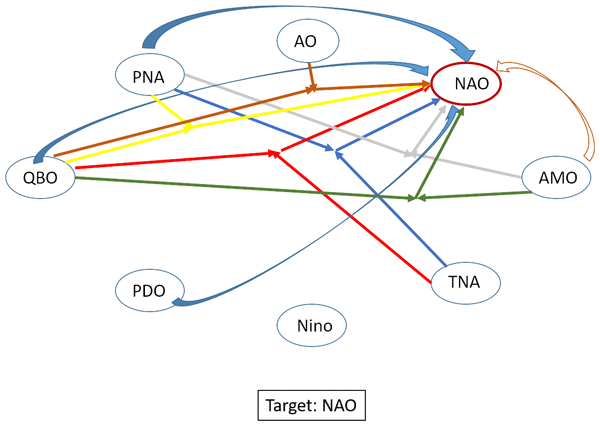
Large-scale modes of variability are present in the climate system. These modes are known to have influences on each other but are usually viewed as linear influences. The nonlinear connections among a set of key climate indices are explored here using tools from information theory, which allow us to characterize the causality between indices. It was found that quadratic nonlinear dependencies between climate indices are present at low frequencies, reflecting the complex nature of their dynamics.
Anupama K. Xavier, Jonathan Demaeyer, and Stéphane Vannitsem
Earth Syst. Dynam., 15, 893–912, https://doi.org/10.5194/esd-15-893-2024, https://doi.org/10.5194/esd-15-893-2024, 2024
Short summary
Short summary
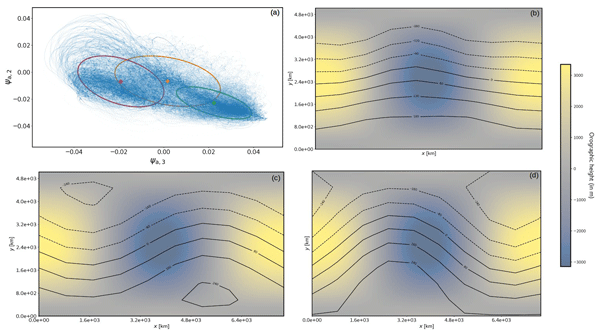
This research focuses on understanding different atmospheric patterns like blocking, zonal, and transition regimes and analyzing their predictability. We used an idealized land–atmosphere coupled model to simulate Earth's atmosphere. Then we identified these blocking, zonal, and transition regimes using Gaussian mixture clustering and studied their predictability using Lyapunov exponents.

Vera Melinda Galfi, Tommaso Alberti, Lesley De Cruz, Christian L. E. Franzke, and Valerio Lembo
Nonlin. Processes Geophys., 31, 185–193, https://doi.org/10.5194/npg-31-185-2024, https://doi.org/10.5194/npg-31-185-2024, 2024
Short summary
Short summary
In the online seminar series "Perspectives on climate sciences: from historical developments to future frontiers" (2020–2021), well-known and established scientists from several fields – including mathematics, physics, climate science and ecology – presented their perspectives on the evolution of climate science and on relevant scientific concepts. In this paper, we first give an overview of the content of the seminar series, and then we introduce the written contributions to this special issue.
David Docquier, Giorgia Di Capua, Reik V. Donner, Carlos A. L. Pires, Amélie Simon, and Stéphane Vannitsem
Nonlin. Processes Geophys., 31, 115–136, https://doi.org/10.5194/npg-31-115-2024, https://doi.org/10.5194/npg-31-115-2024, 2024
Short summary
Short summary
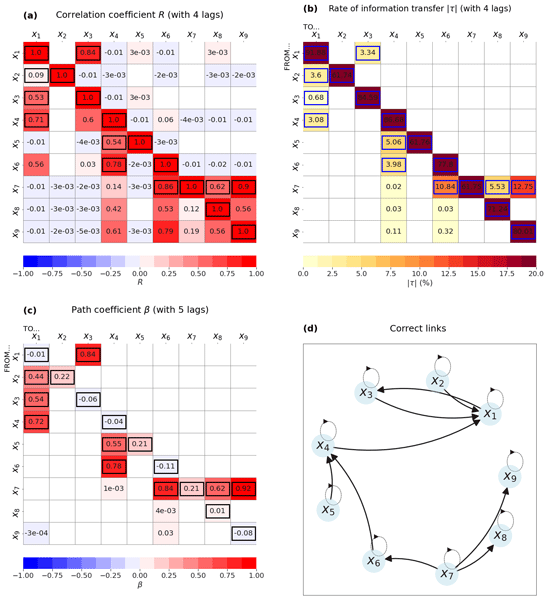
Identifying causes of specific processes is crucial in order to better understand our climate system. Traditionally, correlation analyses have been used to identify cause–effect relationships in climate studies. However, correlation does not imply causation, which justifies the need to use causal methods. We compare two independent causal methods and show that these are superior to classical correlation analyses. We also find some interesting differences between the two methods.
Michel Journée, Edouard Goudenhoofdt, Stéphane Vannitsem, and Laurent Delobbe
Hydrol. Earth Syst. Sci., 27, 3169–3189, https://doi.org/10.5194/hess-27-3169-2023, https://doi.org/10.5194/hess-27-3169-2023, 2023
Short summary
Short summary
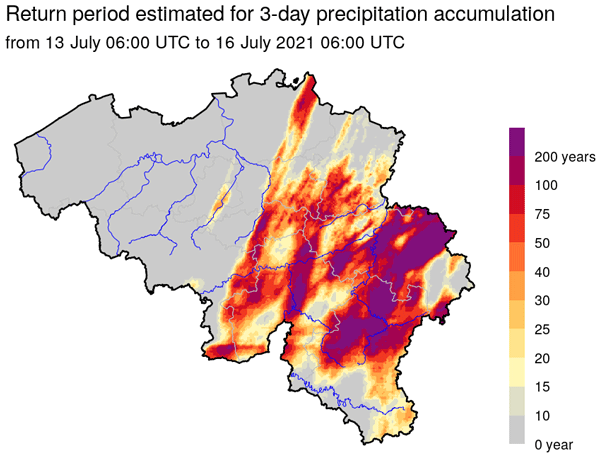
The exceptional flood of July 2021 in central Europe impacted Belgium severely. This study aims to characterize rainfall amounts in Belgium from 13 to 16 July 2021 based on observational data (i.e., rain gauge data and a radar-based rainfall product). The spatial and temporal distributions of rainfall during the event aredescribed. In order to document such a record-breaking event as much as possible, the rainfall data are shared with the scientific community on Zenodo for further studies.
Jonathan Demaeyer, Jonas Bhend, Sebastian Lerch, Cristina Primo, Bert Van Schaeybroeck, Aitor Atencia, Zied Ben Bouallègue, Jieyu Chen, Markus Dabernig, Gavin Evans, Jana Faganeli Pucer, Ben Hooper, Nina Horat, David Jobst, Janko Merše, Peter Mlakar, Annette Möller, Olivier Mestre, Maxime Taillardat, and Stéphane Vannitsem
Earth Syst. Sci. Data, 15, 2635–2653, https://doi.org/10.5194/essd-15-2635-2023, https://doi.org/10.5194/essd-15-2635-2023, 2023
Short summary
Short summary
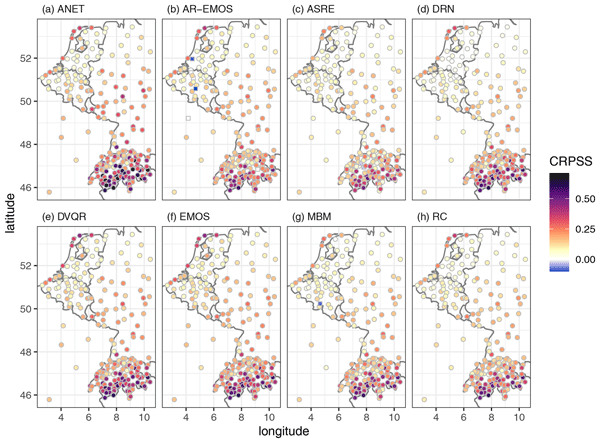
A benchmark dataset is proposed to compare different statistical postprocessing methods used in forecasting centers to properly calibrate ensemble weather forecasts. This dataset is based on ensemble forecasts covering a portion of central Europe and includes the corresponding observations. Examples on how to download and use the data are provided, a set of evaluation methods is proposed, and a first benchmark of several methods for the correction of 2 m temperature forecasts is performed.
David Docquier, Stéphane Vannitsem, and Alessio Bellucci
Earth Syst. Dynam., 14, 577–591, https://doi.org/10.5194/esd-14-577-2023, https://doi.org/10.5194/esd-14-577-2023, 2023
Short summary
Short summary
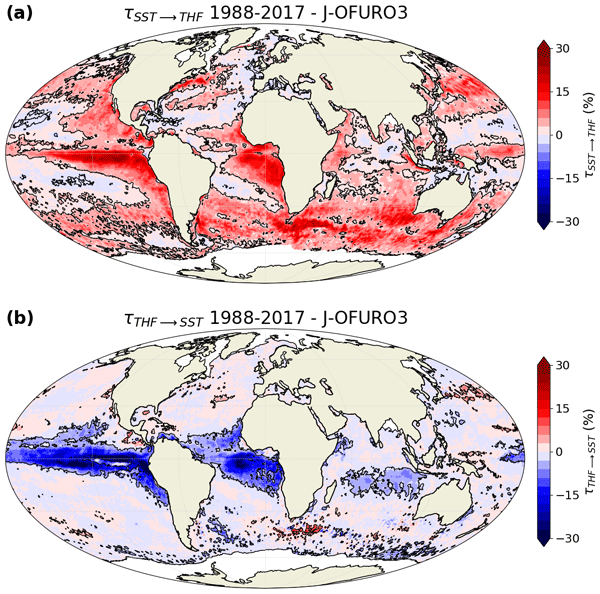
The climate system is strongly regulated by interactions between the ocean and atmosphere. However, many uncertainties remain in the understanding of these interactions. Our analysis uses a relatively novel approach to quantify causal links between the ocean surface and lower atmosphere based on satellite observations. We find that both the ocean and atmosphere influence each other but with varying intensity depending on the region, demonstrating the power of causal methods.

Stéphane Vannitsem
Nonlin. Processes Geophys., 30, 1–12, https://doi.org/10.5194/npg-30-1-2023, https://doi.org/10.5194/npg-30-1-2023, 2023
Short summary
Short summary
The impact of climate change on weather pattern dynamics over the North Atlantic is explored through the lens of information theory. These tools allow the predictability of the succession of weather patterns and the irreversible nature of the dynamics to be clarified. It is shown that the predictability is increasing in the observations, while the opposite trend is found in model projections. The irreversibility displays an overall increase in time in both the observations and the model runs.
David Docquier, Stéphane Vannitsem, Alessio Bellucci, and Claude Frankignoul
EGUsphere, https://doi.org/10.5194/egusphere-2022-1340, https://doi.org/10.5194/egusphere-2022-1340, 2022
Preprint withdrawn
Short summary
Short summary
Understanding whether variations in ocean heat content are driven by air-sea heat fluxes or by ocean dynamics is of crucial importance to enhance climate projections. We use a relatively novel causal method to quantify interactions between ocean heat budget terms based on climate models. We find that low-resolution models overestimate the influence of ocean dynamics in the upper ocean, and that changes in ocean heat content are dominated by air-sea fluxes at high resolution.
Nicolas Ghilain, Stéphane Vannitsem, Quentin Dalaiden, Hugues Goosse, Lesley De Cruz, and Wenguang Wei
Earth Syst. Sci. Data, 14, 1901–1916, https://doi.org/10.5194/essd-14-1901-2022, https://doi.org/10.5194/essd-14-1901-2022, 2022
Short summary
Short summary
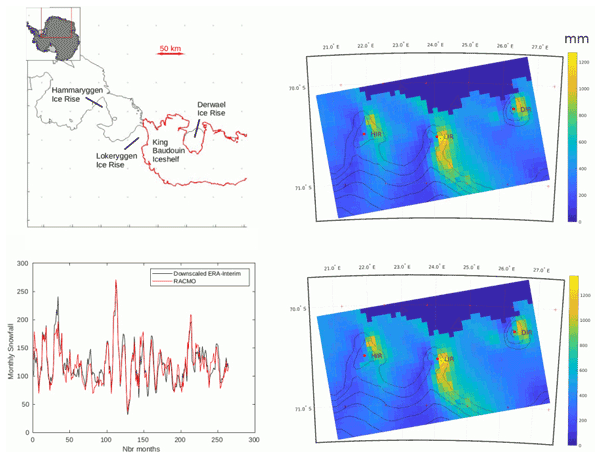
Modeling the climate at high resolution is crucial to represent the snowfall accumulation over the complex orography of the Antarctic coast. While ice cores provide a view constrained spatially but over centuries, climate models can give insight into its spatial distribution, either at high resolution over a short period or vice versa. We downscaled snowfall accumulation from climate model historical simulations (1850–present day) over Dronning Maud Land at 5.5 km using a statistical method.
Cited articles
Almeida, R., Otero, N., Fernández-Torres, M.-Á., and Ma, J.: On the Predictive Skill of Artificial Intelligence-based Weather Models for Extreme Events using Uncertainty Quantification, Artificial Intelligence for the Earth Systems, 5, 250113, https://doi.org/10.1175/AIES-D-25-0113.1, 2026. a
Baño-Medina, J., Sengupta, A., Doyle, J. D., Reynolds, C. A., Watson-Parris, D., and Monache, L. D.: Are AI weather models learning atmospheric physics? A sensitivity analysis of cyclone Xynthia, npj Clim. Atmos. Sci., 8, 92, https://doi.org/10.1038/s41612-025-00949-6, 2025. a
Bauer, P., Thorpe, A., and Brunet, G.: The quiet revolution of numerical weather prediction, Nature, 525, 47–55, 2015. a
Baño-Medina, J., Sengupta, A., Watson-Parris, D., Hu, W., and Delle Monache, L.: Toward Calibrated Ensembles of Neural Weather Model Forecasts, J. Adv. Model. Earth Sy., 17, e2024MS004734, https://doi.org/10.1029/2024MS004734, 2025. a
Bonte, M.: Climdyn/dynnow, Zenodo [computer software], https://doi.org/10.5281/zenodo.18341086, 2026. a
Bouallègue, Z. B., Clare, M. C. A., Magnusson, L., Gascón, E., Maier-Gerber, M., Janoušek, M., Rodwell, M., Pinault, F., Dramsch, J. S., Lang, S. T. K., Raoult, B., Rabier, F., Chevallier, M., Sandu, I., Dueben, P., Chantry, M., and Pappenberger, F.: The Rise of Data-Driven Weather Forecasting: A First Statistical Assessment of Machine Learning-Based Weather Forecasts in an Operational-Like Context, B. Am. Meteorol. Soc., 105, E864–E883, https://doi.org/10.1175/BAMS-D-23-0162.1, 2024. a
Bowler, N. E., Pierce, C. E., and Seed, A. W.: STEPS: A probabilistic precipitation forecasting scheme which merges an extrapolation nowcast with downscaled NWP, Q. J. Roy. Meteor. Soc., 132, 2127–2155, https://doi.org/10.1256/qj.04.100, 2006. a, b, c
Bröcker, J., Driscoll, S., Necker, T., Rodríguez, J., Dacre, H., Harvey, N., and Ben Bouallègue, Z.: Verification of AI-based environmental forecasting systems: What can we do, what do we need to do, and what are the challenges?, Journal of the European Meteorological Society, 4, 100032, https://doi.org/10.1016/j.jemets.2026.100032, 2026. a
Charlton-Perez, A. J., Dacre, H. F., Driscoll, S., Gray, S. L., Harvey, B., Harvey, N. J., Hunt, K. M. R., Lee, R. W., Swaminathan, R., Vandaele, R., and Volonté, A.: Do AI models produce better weather forecasts than physics-based models? A quantitative evaluation case study of Storm Ciarán, npj Clim. Atmos. Sci., 7, 93, https://doi.org/10.1038/s41612-024-00638-w, 2024. a
Feng, J., Toth, Z., Zhang, J., and Peña, M.: Ensemble forecasting: A foray of dynamics into the realm of statistics, Q. J. Royal Meteor. Soc., 150, 2537–2560, https://doi.org/10.1002/qj.4745, 2024. a
Fortin, V., Abaza, M., Anctil, F., and Turcotte, R.: Why should ensemble spread match the RMSE of the ensemble mean?, J. Hydrometeorol., 15, 1708–1713, 2014. a
Goudenhoofdt, E. and Delobbe, L.: Generation and Verification of Rainfall Estimates from 10-Yr Volumetric Weather Radar Measurements, J. Hydrometeorol., 17, 1223–1242, https://doi.org/10.1175/JHM-D-15-0166.1, 2016. a, b
Hersbach, H., Bell, B., Berrisford, P., Biavati, G., Horányi, A., Muñoz Sabater, J., Nicolas, J., Peubey, C., Radu, R., Rozum, I., Schepers, D., Simmons, A., Soci, C., Dee, D., and Thépaut, J.-N.: ERA5 hourly data on single levels from 1940 to present, Copernicus Climate Change Service (C3S) Climate Data Store (CDS) [data set], https://doi.org/10.24381/cds.adbb2d47, 2023. a
Hua, Z., Hakim, G., and Anderson-Frey, A.: Performance of the Pangu-Weather deep learning model in forecasting tornadic environments, Geophys. Res. Lett., 52, e2024GL109611, https://doi.org/10.1029/2024GL109611, 2025. a
Imhoff, R. O., De Cruz, L., Dewettinck, W., Brauer, C. C., Uijlenhoet, R., van Heeringen, K.-J., Velasco-Forero, C., Nerini, D., Van Ginderachter, M., and Weerts, A. H.: Scale-dependent blending of ensemble rainfall nowcasts and numerical weather prediction in the open-source pysteps library, Q. J. Roy. Meteor. Soc., 149, 1335–1364, https://doi.org/10.1002/qj.4461, 2023. a
Journée, M., Goudenhoofdt, E., Vannitsem, S., and Delobbe, L.: Quantitative rainfall analysis of the 2021 mid-July flood event in Belgium, Hydrol. Earth Syst. Sci., 27, 3169–3189, https://doi.org/10.5194/hess-27-3169-2023, 2023. a, b
Kalnay, E.: Atmospheric Modeling, Data Assimilation and Predictability, Cambridge University Press, Cambridge, https://doi.org/10.1017/CBO9780511802270, 2003. a
Lang, S., Alexe, M., Clare, M. C. A., Roberts, C., Adewoyin, R., Ben Bouallègue, Z., Chantry, M., Dramsch, J., Dueben, Peter D., Hahner, S., Maciel, P., Prieto-Nemesio, A., O’Brien, C., Pinault, F., Polster, J., Raoult, B., Tietsche, S., and Leutbecher, M.: AIFS-CRPS: ensemble forecasting using a model trained with a loss function based on the continuous ranked probability score, npj Artif. Intell., 2, 18, https://doi.org/10.1038/s44387-026-00073-7, 2026. a, b
Mahesh, A., Collins, W. D., Bonev, B., Brenowitz, N., Cohen, Y., Elms, J., Harrington, P., Kashinath, K., Kurth, T., North, J., O'Brien, T., Pritchard, M., Pruitt, D., Risser, M., Subramanian, S., and Willard, J.: Huge ensembles – Part 1: Design of ensemble weather forecasts using spherical Fourier neural operators, Geosci. Model Dev., 18, 5575–5603, https://doi.org/10.5194/gmd-18-5575-2025, 2025. a
Necker, T., Wolfgruber, L., Kugler, L., Weissmann, M., Dorninger, M., and Serafin, S.: The fractions skill score for ensemble forecast verification, Q. J. Roy. Meteor. Soc., 150, 4457–4477, 2024. a
Ochoa-Rodriguez, S., Wang, L.-P., Willems, P., and Onof, C.: A Review of Radar-Rain Gauge Data Merging Methods and Their Potential for Urban Hydrological Applications, Water Resour. Res., 55, 6356–6391, https://doi.org/10.1029/2018WR023332, 2019. a, b
Oczkowski, M., Szunyogh, I., and Patil, D. J.: Mechanisms for the Development of Locally Low-Dimensional Atmospheric Dynamics, J. Atmos. Sci., 62, 1135–1156, https://doi.org/10.1175/JAS3403.1, 2005. a
Olivetti, L. and Messori, G.: Do data-driven models beat numerical models in forecasting weather extremes? A comparison of IFS HRES, Pangu-Weather, and GraphCast, Geosci. Model Dev., 17, 7915–7962, https://doi.org/10.5194/gmd-17-7915-2024, 2024. a
Ono, K.: Assessing the Predictability of Mesoscale Moist Airflow Using the Ensemble Dimension, Weather Forecast., 40, 2601–2620, https://doi.org/10.1175/WAF-D-25-0042.1, 2025. a
Pasche, O. C., Wider, J., Zhang, Z., Zscheischler, J., and Engelke, S.: Validating deep learning weather forecast models on recent High-Impact extreme events, Artificial Intelligence for the Earth Systems, 4, e240033, https://doi.org/10.1175/AIES-D-24-0033.1, 2025. a
Patil, D. J., Hunt, B. R., Kalnay, E., Yorke, J. A., and Ott, E.: Local Low Dimensionality of Atmospheric Dynamics, Phys. Rev. Lett., 86, 5878–5881, https://doi.org/10.1103/PhysRevLett.86.5878, 2001. a
Price, I., Sanchez-Gonzalez, A., Alet, F., Andersson, T. R., El-Kadi, A., Masters, D., Ewalds, T., Stott, J., Mohamed, S., Battaglia, P., Lam, R., and Willson, M.: Gencast: Diffusion-based ensemble forecasting for medium-range weather, arXiv [preprint], https://doi.org/10.48550/arXiv.2312.15796, 2023. a
Pu, J., Mu, M., Feng, J., Zhong, X., and Li, H.: A fast physics-based perturbation generator of machine learning weather model for efficient ensemble forecasts of tropical cyclone track, npj Climate and Atmospheric Science, 8, 128, https://doi.org/10.1038/s41612-025-01009-9, 2025. a
Pulkkinen, S., Nerini, D., Pérez Hortal, A. A., Velasco-Forero, C., Seed, A., Germann, U., and Foresti, L.: Pysteps: an open-source Python library for probabilistic precipitation nowcasting (v1.0), Geosci. Model Dev., 12, 4185–4219, https://doi.org/10.5194/gmd-12-4185-2019, 2019. a, b, c, d
Radford, J. T., Ebert-Uphoff, I., Stewart, J. Q., Musgrave, K. D., DeMaria, R., Tourville, N., and Hilburn, K.: Accelerating community-wide evaluation of AI models for global weather prediction by facilitating access to model output, B. Am. Meteorol. Soc., 106, E68–E76, 2025. a
Ravuri, S., Lenc, K., Willson, M., Kangin, D., Lam, R., Mirowski, P., Fitzsimons, M., Athanassiadou, M., Kashem, S., Madge, S., Prudden, R., Mandhane, A., Clark, A., Brock, A., Simonyan, K., Hadsell, R., Robinson, N., Clancy, E., Arribas, A., and Mohamed, S.: Skilful precipitation nowcasting using deep generative models of radar, Nature, 597, 672–677, 2021. a, b
Rotunno, R. and Snyder, C.: A Generalization of Lorenz's Model for the Predictability of Flows with Many Scales of Motion, J. Atmos. Sci., 65, 1063–1076, https://doi.org/10.1175/2007JAS2449.1, 2008. a
Satterfield, E. and Szunyogh, I.: Predictability of the Performance of an Ensemble Forecast System: Predictability of the Space of Uncertainties, Mon. Weather Rev., 138, 962–981, https://doi.org/10.1175/2009MWR3049.1, 2010. a, b
Satterfield, E. and Szunyogh, I.: Assessing the Performance of an Ensemble Forecast System in Predicting the Magnitude and the Spectrum of Analysis and Forecast Uncertainties, Mon. Weather Rev., 139, 1207–1223, https://doi.org/10.1175/2010MWR3439.1, 2011. a
Schreiber, T. and Schmitz, A.: Improved Surrogate Data for Nonlinearity Tests, Phys. Rev. Lett., 77, 635–638, https://doi.org/10.1103/PhysRevLett.77.635, 1996. a
Schwartz, C. S., Kain, J. S., Weiss, S. J., Xue, M., Bright, D. R., Kong, F., Thomas, K. W., Levit, J. J., Coniglio, M. C., and Wandishin, M. S.: Toward improved convection-allowing ensembles: Model physics sensitivities and optimizing probabilistic guidance with small ensemble membership, Weather Forecast., 25, 263–280, 2010. a
Snyder, C., Hamill, T. M., and Trier, S. B.: Linear Evolution of Error Covariances in a Quasigeostrophic Model, Mon. Weather Rev., 131, 189–205, https://doi.org/10.1175/1520-0493(2003)131<0189:LEOECI>2.0.CO;2, 2003. a
Szunyogh, I., Kostelich, E. J., Gyarmati, G., Patil, D. J., Hunt, B. R., Kalnay, E., Ott, E., and Yorke, J. A.: Assessing a local ensemble Kalman filter: perfect model experiments with the National Centers for Environmental Prediction global model, Tellus A, 57, 528–545, https://doi.org/10.1111/j.1600-0870.2005.00136.x, 2005. a, b
Uboldi, F. and Trevisan, A.: Multiple-scale error growth in a convection-resolving model, Nonlin. Processes Geophys., 22, 1–13, https://doi.org/10.5194/npg-22-1-2015, 2015. a
Wei, M. and Toth, Z.: A New Measure of Ensemble Performance: Perturbation versus Error Correlation Analysis (PECA), Mon. Weather Rev., 131, 1549–1565, https://doi.org/10.1175//1520-0493(2003)131<1549:ANMOEP>2.0.CO;2, 2003. a
Zawadzki, I., Morneau, J., and Laprise, R.: Predictability of Precipitation Patterns: An Operational Approach, J. Appl. Meteorol. Clim., 33, 1562–1571, https://doi.org/10.1175/1520-0450(1994)033<1562:POPPAO>2.0.CO;2, 1994. a
Zhang, Y., Long, M., Chen, K., Xing, L., Jin, R., Jordan, M. I., and Wang, J.: Skilful nowcasting of extreme precipitation with NowcastNet, Nature, 619, 526–532, 2023. a
Short summary
The predictability of the generative AI-based nowcasting model LDCast is evaluated over Belgium, together with the pysteps implementation of the nowcasting algorithm STEPS. It appears that the ensembles of both models correctly estimate the error size through their spread, but fail at spatially representing the error. The analysis is done for two dynamically different types of events, showing how the models adapt their ensembles depending on the situation.
The predictability of the generative AI-based nowcasting model LDCast is evaluated over Belgium,...


