
Articles | Volume 7, issue 4
https://doi.org/10.5194/wcd-7-2133-2026
© Author(s) 2026. This work is distributed under
the Creative Commons Attribution 4.0 License.
the Creative Commons Attribution 4.0 License.
https://doi.org/10.5194/wcd-7-2133-2026
© Author(s) 2026. This work is distributed under
the Creative Commons Attribution 4.0 License.
the Creative Commons Attribution 4.0 License.
Research article
| 
05 Nov 2026
Research article |
| 05 Nov 2026
| 05 Nov 2026
Co-occurrence of atmospheric deserts over Europe with strong positive temperature anomalies, thunderstorms, and dust events

Department of Atmospheric and Cryospheric Sciences, Universität Innsbruck, Innsbruck, Austria
Achim Zeileis
Department of Statistics, Universität Innsbruck, Innsbruck, Austria
Isabell Stucke
Department of Atmospheric and Cryospheric Sciences, Universität Innsbruck, Innsbruck, Austria
Reto Stauffer
Department of Statistics & Digital Science Center, Universität Innsbruck, Innsbruck, Austria
Georg J. Mayr
Department of Atmospheric and Cryospheric Sciences, Universität Innsbruck, Innsbruck, Austria
Related authors

Fiona Fix-Hewitt, Achim Zeileis, Isabell Stucke, Reto Stauffer, and Georg J. Mayr
Weather Clim. Dynam., 7, 17–35, https://doi.org/10.5194/wcd-7-17-2026, https://doi.org/10.5194/wcd-7-17-2026, 2026
Short summary
Short summary
Atmospheric deserts are air masses from the boundary layer of desert regions. This study tracked them from North Africa to Europe during a two-year period (May 2022–April 2024). They can occur up to 60 % of the time, and can span large parts of Europe. They typically last about a day, and can alter the atmosphere throughout the free troposphere. On its way from Africa the air either rises and may become even warmer and drier, or it stays at mid-altitudes and cools, or retains its properties.
Fiona Fix, Georg Mayr, Achim Zeileis, Isabell Stucke, and Reto Stauffer
Weather Clim. Dynam., 5, 1545–1560, https://doi.org/10.5194/wcd-5-1545-2024, https://doi.org/10.5194/wcd-5-1545-2024, 2024
Short summary
Short summary
Atmospheric deserts (ADs) are air masses that are transported away from hot, dry regions. Our study introduces this new concept. ADs can suppress or boost thunderstorms and potentially contribute to the formation of heat waves, which makes them relevant for forecasting extreme events. Using a novel detection method, we follow an AD directly from North Africa to Europe for a case in June 2022, allowing us to analyse the air mass at any time and investigate how it is modified along the way.
Fiona Fix-Hewitt, Achim Zeileis, Isabell Stucke, Reto Stauffer, and Georg J. Mayr
Weather Clim. Dynam., 7, 17–35, https://doi.org/10.5194/wcd-7-17-2026, https://doi.org/10.5194/wcd-7-17-2026, 2026
Short summary
Short summary
Atmospheric deserts are air masses from the boundary layer of desert regions. This study tracked them from North Africa to Europe during a two-year period (May 2022–April 2024). They can occur up to 60 % of the time, and can span large parts of Europe. They typically last about a day, and can alter the atmosphere throughout the free troposphere. On its way from Africa the air either rises and may become even warmer and drier, or it stays at mid-altitudes and cools, or retains its properties.
Gregor Ehrensperger, Thorsten Simon, Georg J. Mayr, and Tobias Hell
Geosci. Model Dev., 18, 1141–1153, https://doi.org/10.5194/gmd-18-1141-2025, https://doi.org/10.5194/gmd-18-1141-2025, 2025
Short summary
Short summary
As lightning is a brief and localized event, it is not explicitly resolved in atmospheric models. Instead, expert-based auxiliary descriptions are used to assess it. This study explores how AI can improve our understanding of lightning without relying on traditional expert knowledge. We reveal that AI independently identified the key factors known to experts as essential for lightning in the Alps region. This shows how knowledge discovery could be sped up in areas with limited expert knowledge.
Fiona Fix, Georg Mayr, Achim Zeileis, Isabell Stucke, and Reto Stauffer
Weather Clim. Dynam., 5, 1545–1560, https://doi.org/10.5194/wcd-5-1545-2024, https://doi.org/10.5194/wcd-5-1545-2024, 2024
Short summary
Short summary
Atmospheric deserts (ADs) are air masses that are transported away from hot, dry regions. Our study introduces this new concept. ADs can suppress or boost thunderstorms and potentially contribute to the formation of heat waves, which makes them relevant for forecasting extreme events. Using a novel detection method, we follow an AD directly from North Africa to Europe for a case in June 2022, allowing us to analyse the air mass at any time and investigate how it is modified along the way.
Thomas Muschinski, Georg J. Mayr, Achim Zeileis, and Thorsten Simon
Nonlin. Processes Geophys., 30, 503–514, https://doi.org/10.5194/npg-30-503-2023, https://doi.org/10.5194/npg-30-503-2023, 2023
Short summary
Short summary
Statistical post-processing is necessary to generate probabilistic forecasts from physical numerical weather prediction models. To allow for more flexibility, there has been a shift in post-processing away from traditional parametric regression models towards modern machine learning methods. By fusing these two approaches, we developed model output statistics random forests, a new post-processing method that is highly flexible but at the same time also very robust and easy to interpret.
Deborah Morgenstern, Isabell Stucke, Georg J. Mayr, Achim Zeileis, and Thorsten Simon
Weather Clim. Dynam., 4, 489–509, https://doi.org/10.5194/wcd-4-489-2023, https://doi.org/10.5194/wcd-4-489-2023, 2023
Short summary
Short summary
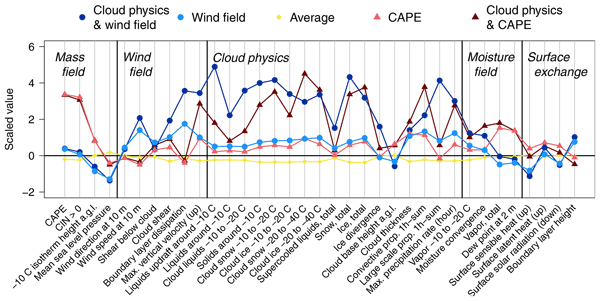
Two thunderstorm environments are described for Europe: mass-field thunderstorms, which occur mostly in summer, over land, and under similar meteorological conditions, and wind-field thunderstorms, which occur mostly in winter, over the sea, and under more diverse meteorological conditions. Our descriptions are independent of static thresholds and help to understand why thunderstorms in unfavorable seasons for lightning pose a particular risk to tall infrastructure such as wind turbines.
Thomas Muschinski, Moritz N. Lang, Georg J. Mayr, Jakob W. Messner, Achim Zeileis, and Thorsten Simon
Wind Energ. Sci., 7, 2393–2405, https://doi.org/10.5194/wes-7-2393-2022, https://doi.org/10.5194/wes-7-2393-2022, 2022
Short summary
Short summary
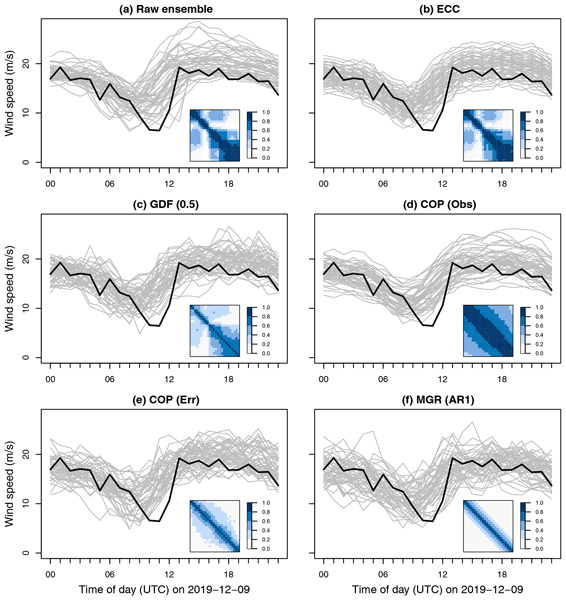
The power generated by offshore wind farms can vary greatly within a couple of hours, and failing to anticipate these ramp events can lead to costly imbalances in the electrical grid. A novel multivariate Gaussian regression model helps us to forecast not just the means and variances of the next day's hourly wind speeds, but also their corresponding correlations. This information is used to generate more realistic scenarios of power production and accurate estimates for ramp probabilities.
Deborah Morgenstern, Isabell Stucke, Thorsten Simon, Georg J. Mayr, and Achim Zeileis
Weather Clim. Dynam., 3, 361–375, https://doi.org/10.5194/wcd-3-361-2022, https://doi.org/10.5194/wcd-3-361-2022, 2022
Short summary
Short summary
Wintertime lightning in central Europe is rare but has a large damage potential for tall structures such as wind turbines. We use a data-driven approach to explain why it even occurs when the meteorological processes causing thunderstorms in summer are absent. In summer, with strong solar input, thunderclouds have a large vertical extent, whereas in winter, thunderclouds are shallower in the vertical but tilted and elongated in the horizontal by strong winds that increase with altitude.
Cited articles
Andrews, M. S., Gensini, V. A., Haberlie, A. M., Ashley, W. S., Michaelis, A. C., and Taszarek, M.: Climatology of the Elevated Mixed Layer over the Contiguous United States and Northern Mexico Using ERA5: 1979–2021, J. Climate, 37, 1833–1851, https://doi.org/10.1175/JCLI-D-23-0517.1, 2024. a, b, c
Banacos, P. C. and Ekster, M. L.: The Association of the Elevated Mixed Layer with Significant Severe Weather Events in the Northeastern United States, Weather Forecast., 25, 1082–1102, https://doi.org/10.1175/2010WAF2222363.1, 2010. a, b, c
Bangert, M., Nenes, A., Vogel, B., Vogel, H., Barahona, D., Karydis, V. A., Kumar, P., Kottmeier, C., and Blahak, U.: Saharan dust event impacts on cloud formation and radiation over Western Europe, Atmos. Chem. Phys., 12, 4045–4063, https://doi.org/10.5194/acp-12-4045-2012, 2012. a, b
Barkan, J., Alpert, P., Kutiel, H., and Kishcha, P.: Synoptics of dust transportation days from Africa toward Italy and central Europe, J. Geophys. Res.-Atmos., 110, D07208, https://doi.org/10.1029/2004JD005222, 2005. a, b, c, d
Brennan, K. P. and Wilhelm, L.: Saharan dust linked to European hail events, Atmos. Chem. Phys., 25, 10823–10836, https://doi.org/10.5194/acp-25-10823-2025, 2025. a, b
Carlson, T.: The Saharan Elevated Mixed Layer and its Aerosol Optical Depth, The Open Atmospheric Science Journal, 10, 26–38, https://doi.org/10.2174/1874282301610010026, 2016. a, b
Carlson, T. and Prospero, J. M.: The Large-Scale Movement of Saharian Air Outbreaks over the Northern Equatorial Atlantic, J. Appl. Meteor. Clim., 11, 283–297, https://doi.org/10.1175/1520-0450(1972)011<0283:TLSMOS>2.0.CO;2, 1972. a, b, c
Carlson, T. N., Anthes, R. A., Schwartz, M., Benjamin, S. G., and Baldwin, D. G.: Analysis and Prediction of Severe Storms Environment, American Meteorological Society, Tech. rep., Report Number AD-A94141, https://doi.org/10.1175/1520-0477-61.9.1018, 1980. a, b, c
Chakraborty, S., Guan, B., Waliser, D. E., da Silva, A. M., Uluatam, S., and Hess, P.: Extending the Atmospheric River Concept to Aerosols: Climate and Air Quality Impacts, Geophys. Res. Lett., 48, https://doi.org/10.1029/2020GL091827, 2021. a
Copernicus Atmosphere Monitoring Service: CAMS global atmospheric composition forecasts, Copernicus Atmosphere Monitoring Service (CAMS) Atmosphere Data Store [data set], https://doi.org/10.24381/04a0b097, 2021. a
Cordeira, J. M., Metz, N. D., Howarth, M. E., and Galarneau, T. J.: Multiscale upstream and in situ precursors to the elevated mixed layer and high-impact weather over the Midwest United States, Weather Forecas., 32, 905–923, https://doi.org/10.1175/WAF-D-16-0122.1, 2017. a, b, c, d, e, f, g, h, i, j
Cos, P., Olmo, M., Campos, D., Marcos-Matamoros, R., Palma, L., Muñoz, Á. G., and Doblas-Reyes, F. J.: Saharan warm-air intrusions in the western Mediterranean: identification, impacts on temperature extremes, and large-scale mechanisms, Weather Clim. Dynam., 6, 609–626, https://doi.org/10.5194/wcd-6-609-2025, 2025. a, b
Cuevas-Agulló, E., Barriopedro, D., García, R. D., Alonso-Pérez, S., González-Alemán, J. J., Werner, E., Suárez, D., Bustos, J. J., García-Castrillo, G., García, O., Barreto, Á., and Basart, S.: Sharp increase in Saharan dust intrusions over the western Euro-Mediterranean in February–March 2020–2022 and associated atmospheric circulation, Atmos. Chem. Phys., 24, 4083–4104, https://doi.org/10.5194/acp-24-4083-2024, 2024. a
de Villiers, M. P.: Europe extreme heat 22–26 July 2019: was it caused by subsidence or advection?, Weather, 75, 228–235, https://doi.org/10.1002/wea.3717, 2020. a, b, c
Dezfuli, A., Bosilovich, M. G., and Barahona, D.: A Dusty Atmospheric River Brings Floods to the Middle East, Geophys. Res. Lett., 48, https://doi.org/10.1029/2021GL095441, 2021. a
England, M. H., Li, Z., Huguenin, M. F., Kiss, A. E., Gupta, A. S., Holmes, R. M., and Rahmstorf, S.: Drivers of the extreme North Atlantic marine heatwave during 2023, Nature, 642, 636–643, https://doi.org/10.1038/s41586-025-08903-5, 2025. a
Enno, S. E., Sugier, J., Alber, R., and Seltzer, M.: Lightning flash density in Europe based on 10 years of ATDnet data, Atmos. Res., 235, https://doi.org/10.1016/j.atmosres.2019.104769, 2020. a
Feldmann, M., Germann, U., Gabella, M., and Berne, A.: A characterisation of Alpine mesocyclone occurrence, Weather Clim. Dynam., 2, 1225–1244, https://doi.org/10.5194/wcd-2-1225-2021, 2021. a
Feldmann, M., Domeisen, D. I. V., and Martius, O.: A pan-European analysis of large-scale drivers of severe convective outbreaks, Weather Clim. Dynam., 6, 1089–1106, https://doi.org/10.5194/wcd-6-1089-2025, 2025. a
Fix-Hewitt, F.: Code used in preparation of the manuscript “Co-occurrence of atmospheric deserts over Europe with strong positive temperature anomalies, thunderstorms, and dust events” by Fix-Hewitt et al., 2026 - reviewed submission, Zenodo [code], https://doi.org/10.5281/zenodo.19658813, 2026. a
Francis, D., Fonseca, R., Nelli, N., Bozkurt, D., Picard, G., and Guan, B.: Atmospheric rivers drive exceptional Saharan dust transport towards Europe, Atmos. Res., 266, 105959, https://doi.org/10.1016/j.atmosres.2021.105959, 2022. a, b
Gitro, C. M., Bikos, D., Szoke, E. J., Jurewicz, M. L., Cohen, A. E., and Foster, M. W.: A Demonstration of Modern Geostationary and Polar-Orbiting Satellite Products for the Identification and Tracking of Elevated Mixed Layers, Journal of Operational Meteorology, 7, 180–192, https://doi.org/10.15191/NWAJOM.2019.0713, 2019. a, b
Gkikas, A., Hatzianastassiou, N., and Mihalopoulos, N.: Aerosol events in the broader Mediterranean basin based on 7-year (2000–2007) MODIS C005 data, Ann. Geophys., 27, 3509–3522, https://doi.org/10.5194/angeo-27-3509-2009, 2009. a
Gkikas, A., Basart, S., Hatzianastassiou, N., Marinou, E., Amiridis, V., Kazadzis, S., Pey, J., Querol, X., Jorba, O., Gassó, S., and Baldasano, J. M.: Mediterranean intense desert dust outbreaks and their vertical structure based on remote sensing data, Atmos. Chem. Phys., 16, 8609–8642, https://doi.org/10.5194/acp-16-8609-2016, 2016. a
Gutleben, M., Groß, S., Wirth, M., and Mayer, B.: Radiative effects of long-range-transported Saharan air layers as determined from airborne lidar measurements, Atmos. Chem. Phys., 20, 12313–12327, https://doi.org/10.5194/acp-20-12313-2020, 2020. a, b, c
Haralick, R. M., Sternberg, S. R., and Zhuang, X.: Image Analysis Using Mathematical Morphology, IEEE T. Pattern Anal., PAMI-9, 532–550, https://doi.org/10.1109/TPAMI.1987.4767941, 1987. a, b
Helmert, J., Heinold, B., Tegen, I., Hellmuth, O., and Wendisch, M.: On the direct and semidirect effects of Saharan dust over Europe: A modeling study, J. Geophys. Res.-Atmos., 112, https://doi.org/10.1029/2006JD007444, 2007. a, b
Hermes, K., Quinting, J., Grams, C. M., Hoose, C., and Hoshyaripour, G. A.: Impact of Saharan dust outbreaks on short-range weather forecast errors in Europe, Q. J. Roy. Meteor. Soc., 150, 1704–1723, https://doi.org/10.1002/QJ.4666, 2024. a, b
Hersbach, H., Bell, B., Berrisford, P., Hirahara, S., Horányi, A., Muñoz-Sabater, J., Nicolas, J., Peubey, C., Radu, R., Schepers, D., Simmons, A., Soci, C., Abdalla, S., Abellan, X., Balsamo, G., Bechtold, P., Biavati, G., Bidlot, J., Bonavita, M., Chiara, G. D., Dahlgren, P., Dee, D., Diamantakis, M., Dragani, R., Flemming, J., Forbes, R., Fuentes, M., Geer, A., Haimberger, L., Healy, S., Hogan, R. J., Hólm, E., Janisková, M., Keeley, S., Laloyaux, P., Lopez, P., Lupu, C., Radnoti, G., de Rosnay, P., Rozum, I., Vamborg, F., Villaume, S., and Thépaut, J. N.: The ERA5 global reanalysis, Q. J. Roy. Meteor. Soc., 146, 1999–2049, https://doi.org/10.1002/qj.3803, 2020. a, b, c
Hersbach, H., Bell, B., Berrisford, P., Biavati, G., Horányi, A., Sabater, J. M., Nicolas, J., Peubey, C., R., R., Rozum, I., Schepers, D., Simmons, A., Soci, C., Dee, D., and Thépaut, J.-N.: ERA5 hourly data on single levels from 1940 to present, Copernicus Climate Change Service (C3S) Climate Data Store (CDS) [data set], https://doi.org/10.24381/cds.adbb2d47, 2023. a
Highwood, E. J. and Ryder, C. L.: Radiative Effects of Dust, Springer Netherlands, Dordrecht, 267–286, https://doi.org/10.1007/978-94-017-8978-3_11, ISBN 978-94-017-8978-3, 2014. a
Inness, A., Ades, M., Agustí-Panareda, A., Barré, J., Benedictow, A., Blechschmidt, A.-M., Dominguez, J. J., Engelen, R., Eskes, H., Flemming, J., Huijnen, V., Jones, L., Kipling, Z., Massart, S., Parrington, M., Peuch, V.-H., Razinger, M., Remy, S., Schulz, M., and Suttie, M.: The CAMS reanalysis of atmospheric composition, Atmos. Chem. Phys., 19, 3515–3556, https://doi.org/10.5194/acp-19-3515-2019, 2019. a, b
Israelevich, P., Ganor, E., Alpert, P., Kishcha, P., and Stupp, A.: Predominant transport paths of Saharan dust over the Mediterranean Sea to Europe, J. Geophys. Res.-Atmos., 117, 2205, https://doi.org/10.1029/2011JD016482, 2012. a
Juza, M., de Alfonso, M., and Fernández-Mora, Á.: Coastal ocean response during the unprecedented marine heatwaves in the western Mediterranean in 2022, in: 8th edition of the Copernicus Ocean State Report (OSR8), edited by: von Schuckmann, K., Moreira, L., Grégoire, M., Marcos, M., Staneva, J., Brasseur, P., Garric, G., Lionello, P., Karstensen, J., and Neukermans, G., Copernicus Publications, State Planet, 4-osr8, 14, https://doi.org/10.5194/sp-4-osr8-14-2024, 2024. a
Karyampudi, V. M., Palm, S. P., Reagen, J. A., Fang, H., Grant, W. B., Hoff, R. M., Moulin, C., Pierce, H. F., Torres, O., Browell, E. V., and Melfi, S. H.: Validation of the Saharan Dust Plume Conceptual Model Using Lidar, Meteosat, and ECMWF Data, B. Am. Meteorol. Soc., 80, 1045–1076, https://doi.org/10.1175/1520-0477(1999)080<1045:VOTSDP>2.0.CO;2, 1999. a, b
Knippertz, P.: Meteorological Aspects of Dust Storms, Springer Netherlands, Dordrecht, 121–147, https://doi.org/10.1007/978-94-017-8978-3_6, ISBN 978-94-017-8978-3, 2014. a
Knippertz, P. and Stuut, J.-B. W.: Introduction, Springer Netherlands, Dordrecht, 1–14, https://doi.org/10.1007/978-94-017-8978-3_1, ISBN 978-94-017-8978-3, 2014. a
Lanicci, J. M. and Warner, T. T.: A Synoptic Climatology of the Elevated Mixed-Layer Inversion over the Southern Great Plains in Spring. Part I: Structure, Dynamics, and Seasonal Evolution, Weather Forecast., 6, 181–197, https://doi.org/10.1175/1520-0434(1991)006<0181:ASCOTE>2.0.CO;2, 1991a. a
Lanicci, J. M. and Warner, T. T.: A Synoptic Climatology of the Elevated Mixed-Layer Inversion over the Southern Great Plains in Spring. Part III: Relationship to Severe-Storms Climatology, Weather Forecast., 6, 214–226, https://doi.org/10.1175/1520-0434(1991)006<0214:ASCOTE>2.0.CO;2, 1991b. a, b, c, d
Lemburg, A., Fink, A. H., Lima, M. M., and Pinto, J. G.: Lagrangian analysis of two flavours of Central European heatwaves: Formation under omega blocking versus initiation by subtropical ridges, Q. J. Roy. Meteor. Soc., 152, e70199, https://doi.org/10.1002/qj.70199, 2026. a
Lewis, M. W. and Gray, S. L.: Categorisation of synoptic environments associated with mesoscale convective systems over the UK, Atmos. Res., 97, 194–213, https://doi.org/10.1016/J.ATMOSRES.2010.04.001, 2010. a, b
Li, F., Chavas, D. R., Reed, K. A., Rosenbloom, N., and Dawson, D. T.: The Role of Elevated Terrain and the Gulf of Mexico in the Production of Severe Local Storm Environments over North America, J. Climate, 34, 7799–7819, https://doi.org/10.1175/JCLI-D-20-0607.1, 2021. a, b
Mohr, S., Wandel, J., Lenggenhager, S., and Martius, O.: Relationship between atmospheric blocking and warm-season thunderstorms over western and central Europe, Q. J. Roy. Meteor. Soc., 145, 3040–3056, https://doi.org/10.1002/QJ.3603, 2019. a
Nabat, P., Somot, S., Mallet, M., Sevault, F., Chiacchio, M., and Wild, M.: Direct and semi-direct aerosol radiative effect on the Mediterranean climate variability using a coupled regional climate system model, Clim. Dynam., 44, 1127–1155, https://doi.org/10.1007/S00382-014-2205-6, 2015. a, b
Penner, J. E., Andreae, M., Annegarn, H., Barrie, L., Feichter, J., Hegg, D., Jayaraman, A., Leaitch, R., Murphy, D., Nganga, J., Pitari, G., Ackerman, A., Adams, P., Austin, P., Boers, R., Boucher, O., Chin, M., Chuang, C., Collins, B., Cooke, W., Demott, P., Feng, Y., Fischer, H., Fung, I., Ghan, S., Ginoux, P., Gong, S.-L., Guenther, A., Herzog, M., Higurashi, A., Kaufman, Y., Kettle, A., Kiehl, J., Koch, D., Lammel, G., Land, C., Lohmann, U., Madronich, S., Mancini, E., Mishchenko, M., Nakajima, T., Quinn, P., Rasch, P., Roberts, D. L., Savoie, D., Schwartz, S., Seinfeld, J., Soden, B., Tanré, D., Taylor, K., Tegen, I., Tie, X., Vali, G., Dingenen, R. V., Weele, M. V., and Zhang, Y.: Aerosols, their Direct and Indirect Effects, in: Climate Change 2001: The Scientific Basis. Contribution of Working Group I to the Third Assessment Report of the Intergovernmental Panel on Climate Change, edited by: Houghton, J. T., Ding, Y., Griggs, D. J., Noguer, M., van der Linden, P. J., Dai, X., Maskell, K., and Johnson, C. A., Cambridge University Press, Cambridge, United Kingdom and New York, NY, USA, 881 pp., ISBN 0521 80767 0 hardback, ISBN 0521 01495 6 paperback, 2001. a
Peyraud, L.: Analysis of the 18 July 2005 Tornadic Supercell over the Lake Geneva Region, Weather Forecast., 28, 1524–1551, https://doi.org/10.1175/WAF-D-13-00022.1, 2013. a
Pfahl, S., Schwierz, C., Croci-Maspoli, M., Grams, C. M., and Wernli, H.: Importance of latent heat release in ascending air streams for atmospheric blocking, Nat. Geosci., 8, 610–614, https://doi.org/10.1038/ngeo2487, 2015. a
Prospero, J. M. and Carlson, T. N.: Vertical and areal distribution of Saharan dust over the western equatorial north Atlantic Ocean, J. Geophys. Res., 77, 5255–5265, https://doi.org/10.1029/JC077I027P05255, 1972. a, b
Prospero, J. M., Delany, A. C., Delany, A. C., and Carlson, T. N.: The Discovery of African Dust Transport to the Western Hemisphere and the Saharan Air Layer: A History, B. Am. Meteorol. Soc., 102, E1239–E1260, https://doi.org/10.1175/BAMS-D-19-0309.1, 2021. a, b
Ralph, F. M., Dettinger, M. C. L., Cairns, M. M., Galarneau, T. J., and Eylander, J.: Defining “Atmospheric River”: How the Glossary of Meteorology Helped Resolve a Debate, B. Am. Meteorol. Soc., 99, 837–839, https://doi.org/10.1175/BAMS-D-17-0157.1, 2018. a
Ribeiro, B. Z. and Bosart, L. F.: Elevated mixed layers and associated severe thunderstorm environments in South and North America, Mon. Weather Rev., 146, 3–28, https://doi.org/10.1175/MWR-D-17-0121.1, 2018. a, b, c, d
Rosenfeld, D., Rudich, Y., and Lahav, R.: Desert dust suppressing precipitation: A possible desertification feedback loop, P. Natl. Acad. Sci. USA, 98, 5975–5980, https://doi.org/10.1073/PNAS.101122798, 2001. a, b
Rostási, Á., Topa, B. A., Gresina, F., Weiszburg, T. G., Gelencsér, A., and Varga, G.: Saharan Dust Deposition in Central Europe in 2016 – A Representative Year of the Increased North African Dust Removal Over the Last Decade, Frontiers in Earth Science, 10, https://doi.org/10.3389/feart.2022.869902, 2022. a
Röthlisberger, M. and Martius, O.: Quantifying the Local Effect of Northern Hemisphere Atmospheric Blocks on the Persistence of Summer Hot and Dry Spells, Geophys. Res. Lett., 46, 10101–10111, https://doi.org/10.1029/2019GL083745, 2019. a
Röthlisberger, M. and Papritz, L.: Quantifying the physical processes leading to atmospheric hot extremes at a global scale, Nat. Geosci., 16, 210–216, https://doi.org/10.1038/s41561-023-01126-1, 2023. a
Schultz, D. M., Herrerías‐Azcué, F., Lowe, D., Kirshbaum, D. J., and Young, M. V.: Rethinking the Spanish plume: An airstream analysis challenges the canonical conceptual model, Q. J. Roy. Meteor. Soc., 151, https://doi.org/10.1002/QJ.5070, 2025a. a, b, c
Schultz, D. M., Young, M. V., and Kirshbaum, D. J.: The Spanish Plume Elevated Mixed Layer: A Review of Its Use and Misuse within the Scientific Literature, Mon. Weather Rev., 153, 737–761, https://doi.org/10.1175/MWR-D-24-0139.1, 2025b. a
Seifert, A., Bachmann, V., Filipitsch, F., Förstner, J., Grams, C. M., Hoshyaripour, G. A., Quinting, J., Rohde, A., Vogel, H., Wagner, A., and Vogel, B.: Aerosol–cloud–radiation interaction during Saharan dust episodes: the dusty cirrus puzzle, Atmos. Chem. Phys., 23, 6409–6430, https://doi.org/10.5194/acp-23-6409-2023, 2023. a, b
Sibley, A.: Thunderstorms from a Spanish Plume event on 28 June 2011, Weather, 67, 143–146, https://doi.org/10.1002/wea.1928, 2012. a, b, c
Sousa, P. M., Trigo, R. M., Barriopedro, D., Soares, P. M., and Santos, J. A.: European temperature responses to blocking and ridge regional patterns, Clim. Dynam., 50, 457–477, https://doi.org/10.1007/s00382-017-3620-2, 2018. a
Sprenger, M. and Wernli, H.: The LAGRANTO Lagrangian analysis tool – version 2.0, Geosci. Model Dev., 8, 2569–2586, https://doi.org/10.5194/gmd-8-2569-2015, 2015 (data available at: https://iacweb.ethz.ch/staff/sprenger/lagranto/, last access: 21 December 2022). a, b, c
Stephenson, D. B.: Use of the “Odds Ratio” for Diagnosing Forecast Skill, Weather Forecast., 15, 221–232, https://doi.org/10.1175/1520-0434(2000)015<0221:UOTORF>2.0.CO;2, 2000. a, b
Taszarek, M., Allen, J. T., Pucik, T., Hoogewind, K. A., and Brooks, H. E.: Severe Convective Storms across Europe and the United States. Part II: ERA5 Environments Associated with Lightning, Large Hail, Severe Wind, and Tornadoes, J. Climate, 33, 10263–10286, https://doi.org/10.1175/JCLI-D-20-0346.1, 2020. a
Varga, G., Kovács, J., and Újvári, G.: Analysis of Saharan dust intrusions into the Carpathian Basin (Central Europe) over the period of 1979–2011, Global Planet. Change, 100, 333–342, https://doi.org/10.1016/J.GLOPLACHA.2012.11.007, 2013. a, b
Xi, J., Wang, Y., Li, R., Wu, B., Fan, X., Ma, X., and Meng, Z.: The impact of Sahara dust aerosols on the three-dimensional structure of precipitation systems of different sizes in spring, Atmos. Chem. Phys., 26, 15–32, https://doi.org/10.5194/acp-26-15-2026, 2026. a
Young, M. V. and Grahame, N. S.: The history of UK weather forecasting: the changing role of the central guidance forecaster. Part 6: the late twentieth century: forecasting smaller-scale features, Weather, 78, 304–312, https://doi.org/10.1002/WEA.4370, 2023. a
Zschenderlein, P., Fink, A. H., Pfahl, S., and Wernli, H.: Processes determining heat waves across different European climates, Q. J. Roy. Meteor. Soc., 145, 2973–2989, https://doi.org/10.1002/QJ.3599, 2019. a
Short summary
Atmospheric deserts are air masses originating in the boundary layer of arid and/or elevated regions and therefore generalise elevated mixed layers. They occur often over Europe and can modify atmospheric profiles, influencing the local weather. We investigate whether unusually high temperatures, thunderstorms, and dust events occur more frequently when atmospheric deserts are present. Indeed, all of these extreme weather events are more likely given that atmospheric desert air is present.
Atmospheric deserts are air masses originating in the boundary layer of arid and/or elevated...


Altmetrics
Final-revised paper
Preprint