
Articles | Volume 7, issue 4
https://doi.org/10.5194/wcd-7-2193-2026
© Author(s) 2026. This work is distributed under
the Creative Commons Attribution 4.0 License.
the Creative Commons Attribution 4.0 License.
https://doi.org/10.5194/wcd-7-2193-2026
© Author(s) 2026. This work is distributed under
the Creative Commons Attribution 4.0 License.
the Creative Commons Attribution 4.0 License.
Research article
| 
09 Nov 2026
Research article |
| 09 Nov 2026
| 09 Nov 2026
Understanding the contrasting environments for localised and widespread heavy rainfall in the tropics

The ARC Centre of Excellence for Climate Extremes, Monash University, Melbourne, Victoria, Australia
School of Earth, Atmosphere and Environment, Monash University, Melbourne, Victoria, Australia
Martin S. Singh
School of Earth, Atmosphere and Environment, Monash University, Melbourne, Victoria, Australia
The ARC Centre of Excellence for Weather in the 21st Century, Monash University, Melbourne, Victoria, Australia
Yi-Xian Li
School of Earth, Atmosphere and Environment, Monash University, Melbourne, Victoria, Australia
Department of Civil and Environmental Engineering, Tohoku University, Sendai, Japan
Annabel J. Bowden
Climate Futures Research Group, School of Geography, Planning, and Spatial Sciences, University of Tasmania, Hobart, Australia
Related authors
Tamara Pletzer, Alexander Pletzer, Timothy C. Andrews, Dongqi Lin, and Marwan Katurji
EGUsphere, https://doi.org/10.5194/egusphere-2026-3377, https://doi.org/10.5194/egusphere-2026-3377, 2026
This preprint is open for discussion and under review for Geoscientific Model Development (GMD).
Short summary
Short summary
Simulations can resolve turbulence around individual buildings, yet a critical postprocessing step is often overlooked: interpolating staggered-grid velocities. Standard schemes violate no-through-flow conditions, yielding trajectories that penetrate solid objects. Our flux-conservative, mimetic interpolation solves this and combined with finite-time Lyapunov exponent analysis reveals channeling and shear structures in a wildfire-plume simulation that conventional methods obscure.

Dongqi Lin, Jiawei Zhang, Basit Khan, Marwan Katurji, and Laura E. Revell
Geosci. Model Dev., 17, 815–845, https://doi.org/10.5194/gmd-17-815-2024, https://doi.org/10.5194/gmd-17-815-2024, 2024
Short summary
Short summary
GEO4PALM is an open-source tool to generate static input for the Parallelized Large-Eddy Simulation (PALM) model system. Geospatial static input is essential for realistic PALM simulations. However, existing tools fail to generate PALM's geospatial static input for most regions. GEO4PALM is compatible with diverse geospatial data sources and provides access to free data sets. In addition, this paper presents two application examples, which show successful PALM simulations using GEO4PALM.

Dongqi Lin, Marwan Katurji, Laura E. Revell, Basit Khan, and Andrew Sturman
Atmos. Chem. Phys., 23, 14451–14479, https://doi.org/10.5194/acp-23-14451-2023, https://doi.org/10.5194/acp-23-14451-2023, 2023
Short summary
Short summary
Accurate fog forecasting is difficult in a complex environment. Spatial variations in soil moisture could impact fog. Here, we carried out fog simulations with spatially different soil moisture in complex topography. The soil moisture was calculated using satellite observations. The results show that the spatial variations in soil moisture do not have a significant impact on where fog occurs but do impact how long fog lasts. This finding could improve fog forecasts in the future.
Muhamad Reyhan Respati, Martin S. Singh, and Christian Jakob
Weather Clim. Dynam., 7, 2171–2192, https://doi.org/10.5194/wcd-7-2171-2026, https://doi.org/10.5194/wcd-7-2171-2026, 2026
Short summary
Short summary
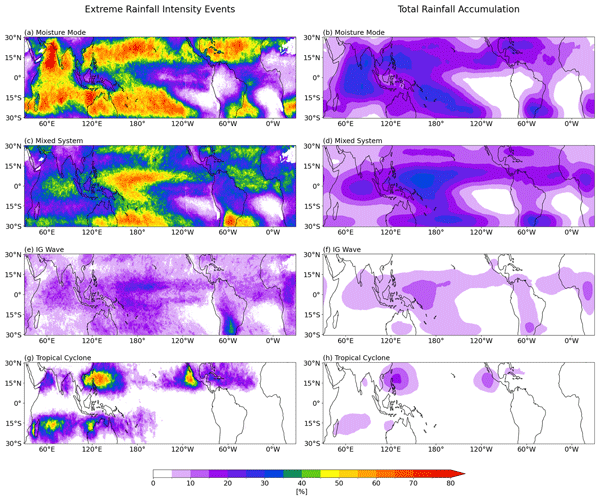
Unlike in the extratropics, there is no standard way to classify tropical weather systems. We introduce a new classification based on how fast a system moves and the relative importance of moisture and buoyancy in its driving mechanisms. We find that systems for which moisture is a key driver contribute up to 75 % of extreme rainfall in certain areas. This new model provides a much-needed "roadmap" for scientists to understand how tropical dynamics and rainfall are connected across the globe.
Tamara Pletzer, Alexander Pletzer, Timothy C. Andrews, Dongqi Lin, and Marwan Katurji
EGUsphere, https://doi.org/10.5194/egusphere-2026-3377, https://doi.org/10.5194/egusphere-2026-3377, 2026
This preprint is open for discussion and under review for Geoscientific Model Development (GMD).
Short summary
Short summary
Simulations can resolve turbulence around individual buildings, yet a critical postprocessing step is often overlooked: interpolating staggered-grid velocities. Standard schemes violate no-through-flow conditions, yielding trajectories that penetrate solid objects. Our flux-conservative, mimetic interpolation solves this and combined with finite-time Lyapunov exponent analysis reveals channeling and shear structures in a wildfire-plume simulation that conventional methods obscure.
Benjamin Hernandez, Martin S. Singh, Takanobu Yamaguchi, Graham Feingold, and Franziska Glassmeier
Atmos. Chem. Phys., 26, 9337–9356, https://doi.org/10.5194/acp-26-9337-2026, https://doi.org/10.5194/acp-26-9337-2026, 2026
Short summary
Short summary
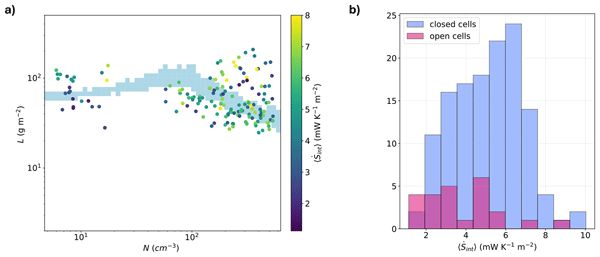
Using detailed numerical simulations, we quantify how stratocumulus cloud decks dissipate energy and produce entropy. We find that entropy production is dominated by irreversible moist processes and is much smaller than in deeper convective clouds. As a result, stratocumulus are remarkably inefficient at converting available energy into atmospheric motions.
Lucinda A. Palmer and Martin S. Singh
Weather Clim. Dynam., 6, 1565–1582, https://doi.org/10.5194/wcd-6-1565-2025, https://doi.org/10.5194/wcd-6-1565-2025, 2025
Short summary
Short summary
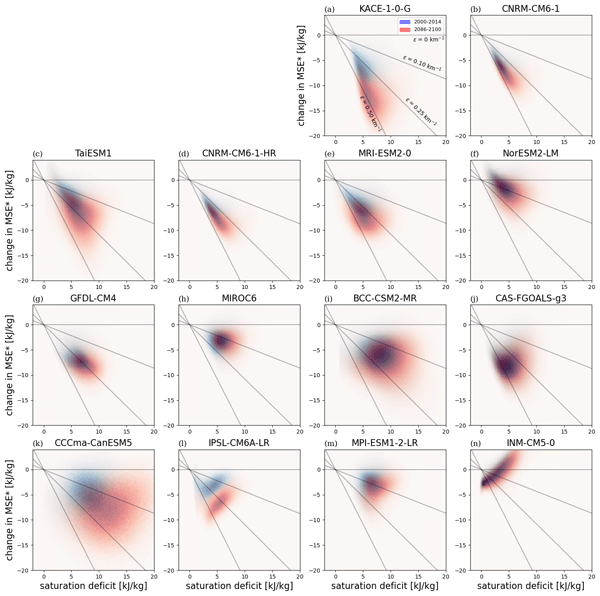
This study investigates the relationship between stability and humidity in the tropical troposphere in global climate models. We develop a method for quantifying the relationship and find varying relationships that are similar or even opposite to observations. We theorise that measures of intense thunderstorms and humid heatwaves are influenced by the stability-humidity relationship. Models that have a relationship like observations project greater increases in these measures under warming.
Dongqi Lin, Jiawei Zhang, Basit Khan, Marwan Katurji, and Laura E. Revell
Geosci. Model Dev., 17, 815–845, https://doi.org/10.5194/gmd-17-815-2024, https://doi.org/10.5194/gmd-17-815-2024, 2024
Short summary
Short summary
GEO4PALM is an open-source tool to generate static input for the Parallelized Large-Eddy Simulation (PALM) model system. Geospatial static input is essential for realistic PALM simulations. However, existing tools fail to generate PALM's geospatial static input for most regions. GEO4PALM is compatible with diverse geospatial data sources and provides access to free data sets. In addition, this paper presents two application examples, which show successful PALM simulations using GEO4PALM.
Dongqi Lin, Marwan Katurji, Laura E. Revell, Basit Khan, and Andrew Sturman
Atmos. Chem. Phys., 23, 14451–14479, https://doi.org/10.5194/acp-23-14451-2023, https://doi.org/10.5194/acp-23-14451-2023, 2023
Short summary
Short summary
Accurate fog forecasting is difficult in a complex environment. Spatial variations in soil moisture could impact fog. Here, we carried out fog simulations with spatially different soil moisture in complex topography. The soil moisture was calculated using satellite observations. The results show that the spatial variations in soil moisture do not have a significant impact on where fog occurs but do impact how long fog lasts. This finding could improve fog forecasts in the future.
Cited articles
Ahmed, F. and Neelin, J. D.: Reverse engineering the tropical precipitation–buoyancy relationship, J. Atmos. Sci., 75, 1587–1608, https://doi.org/10.1175/JAS-D-17-0333.1, 2018. a, b, c
Ahmed, F. and Schumacher, C.: Convective and stratiform components of the precipitation-moisture relationship, Geophys. Res. Lett., 42, 10453–10462, https://doi.org/10.1002/2015GL066957, 2015. a, b
Alexander, L. V., Zhang, X., Peterson, T. C., Caesar, J., Gleason, B., Klein Tank, A., Haylock, M., Collins, D., Trewin, B., Rahimzadeh, F., Tagipour, A., Rupa Kumar, K., Revadekar, J., Griffiths, G., Vincent, L., Stephenson, D. B., Burn, J., Aguilar, E., Brunet, M., Taylor, M., New, M., Zhai, P., Rusticucci, M., and Vazquez-Aguirre, J. L.: Global observed changes in daily climate extremes of temperature and precipitation, J. Geophys. Res.-Atmos., 111, https://doi.org/10.1029/2005JD006290, 2006. a
Alexander, L. V., Bador, M., Roca, R., Contractor, S., Donat, M. G., and Nguyen, P. L.: Intercomparison of annual precipitation indices and extremes over global land areas from in situ, space-based and reanalysis products, Environ. Res. Lett., 15, 055002, https://doi.org/10.1088/1748-9326/ab79e2, 2020. a
Allen, J. T., Karoly, D. J., and Walsh, K. J.: Future Australian severe thunderstorm environments. Part II: the influence of a strongly warming climate on convective environments, J. Climate, 27, 3848–3868, https://doi.org/10.1175/jcli-d-13-00426.1, 2014. a, b
Angulo-Umana, P. and Kim, D.: Mesoscale convective clustering enhances tropical precipitation, Sci. Adv., 9, eabo5317, https://doi.org/10.1126/sciadv.abo5317, 2023. a, b, c
Arakawa, A. and Schubert, W. H.: Interaction of a cumulus cloud ensemble with the large-scale environment, Part I, J. Atmos. Sci., 31, 674–701, https://doi.org/10.1175/1520-0469(1974)031<0674:IOACCE>2.0.CO;2, 1974. a, b
Bao, J., Stevens, B., Kluft, L., and Muller, C.: Intensification of daily tropical precipitation extremes from more organized convection, Sci. Adv., 10, eadj6801, https://doi.org/10.1126/sciadv.adj6801, 2024. a, b
Becker, T., Bretherton, C. S., Hohenegger, C., and Stevens, B.: Estimating bulk entrainment with unaggregated and aggregated convection, Geophys. Res. Lett., 45, 455–462, https://doi.org/10.1002/2017GL076640, 2018. a, b, c
Bevacqua, E., Shepherd, T. G., Watson, P. A., Sparrow, S., Wallom, D., and Mitchell, D.: Larger spatial footprint of wintertime total precipitation extremes in a warmer climate, Geophys. Res. Lett., 48, e2020GL091990, https://doi.org/10.1029/2020GL091990, 2021. a
Blackberg, P. and Singh, M.: Can large-scale clustering of tropical precipitation be used to constrain climate sensitivity?, J. Geophys. Res.-Atmos., 131, e2025JD045282, https://doi.org/10.1029/2025JD045282, 2026. a
Bowden, A. J., Jakob, C., and Soderholm, J.: Identification of rainfall events and heavy rainfall events from radar measurements in southeastern Australia, J. Geophys. Res.-Atmos., 129, e2023JD039253, https://doi.org/10.1029/2023JD039253, 2024. a, b
Bretherton, C. S., Peters, M. E., and Back, L. E.: Relationships between water vapor path and precipitation over the tropical oceans, J. Climate, 17, 1517–1528, https://doi.org/10.1175/1520-0442(2004)017<1517:RBWVPA>2.0.CO;2, 2004. a, b
Brooks, H. E.: Severe thunderstorms and climate change, Atmos. Res., 123, 129–138, https://doi.org/10.1016/j.atmosres.2012.04.002, 2013. a, b
Brown, A. and Dowdy, A.: Severe convective wind environments and future projected changes in Australia, J. Geophys. Res.-Atmos., 126, e2021JD034633, https://doi.org/10.1029/2021JD034633, 2021. a
Bureau of Meteorology: AURA – Operational Radar Network Archive, National Computing Infrastructure Australia, https://doi.org/10.25914/5cb686a8d9450, 2025. a
Chen, J., Dai, A., Zhang, Y., and Rasmussen, K. L.: Changes in convective available potential energy and convective inhibition under global warming, J. Climate, 33, 2025–2050, https://doi.org/10.1175/JCLI-D-19-0461.1, 2020. a, b, c
Crameri, F., Shephard, G. E., and Heron, P. J.: The misuse of colour in science communication, Nat. Commun., 11, 5444, https://doi.org/10.1038/s41467-020-19160-7, 2020. a
Dai, N. and Soden, B. J.: Convective aggregation and the amplification of tropical precipitation extremes, AGU Advances, 1, e2020AV000201, https://doi.org/10.1029/2020AV000201, 2020. a
Davies, J. M.: Estimations of CIN and LFC associated with tornadic and nontornadic supercells, Weather Forecast., 19, 714–726, https://doi.org/10.1175/1520-0434(2004)019<0714:EOCALA>2.0.CO;2, 2004. a
Diffenbaugh, N. S., Scherer, M., and Trapp, R. J.: Robust increases in severe thunderstorm environments in response to greenhouse forcing, P. Natl. Acad. Sci. USA, 110, 16361–16366, https://doi.org/10.1073/pnas.1307758110, 2013. a
ECMWF: IFS Documentation CY50R1 – Part 4: Physical Processes, ECMWF, https://doi.org/10.21957/49928f2338, 2026. a, b
ECMWF (European Centre for Medium-Range Weather Forecasts): ERA5 Replicated Datasets, National Computing Infrastructure Australia, https://doi.org/10.25914/5f48874388857, 2024. a
Feng, Z., Hagos, S., Rowe, A. K., Burleyson, C. D., Martini, M. N., and de Szoeke, S. P.: Mechanisms of convective cloud organization by cold pools over tropical warm ocean during the AMIE/DYNAMO field campaign, J. Adv. Model. Earth Sy., 7, 357–381, https://doi.org/10.1002/2014MS000384, 2015. a
Hamada, A., Takayabu, Y. N., Liu, C., and Zipser, E. J.: Weak linkage between the heaviest rainfall and tallest storms, Nat. Commun., 6, 6213, https://doi.org/10.1038/ncomms7213, 2015. a
Hannah, W. M.: Entrainment versus dilution in tropical deep convection, J. Atmos. Sci., 74, 3725–3747, https://doi.org/10.1175/JAS-D-16-0169.1, 2017. a, b
Hersbach, H., Bell, B., Berrisford, P., Hirahara, S., Horányi, A., Muñoz-Sabater, J., Nicolas, J., Peubey, C., Radu, R., Schepers, D., Simmons, A., Soci, C., Abdalla, S., Abellan, X., Balsamo, G., Bechtold, P., Biavati, G., Bidlot, J., Bonavita, M., De Chiara, G., Dahlgren, P., Dee, D., Diamantakis, M., Dragani, R., Flemming, J., Forbes, R., Fuentes, M., Geer, A., Haimberger, L., Healy, S., Hogan, R. J., Hólm, E., Janisková, M., Keeley, S., Laloyaux, P., Lopez, P., Lupu, C., Radnoti, G., de Rosnay, P., Rozum, I., Vamborg, F., Villaume, S., and Thépaut, J.-N.: The ERA5 global reanalysis, Q. J. Roy. Meteor. Soc., 146, 1999–2049, https://doi.org/10.1002/qj.3803, 2020. a, b
Hersbach, H., Bell, B., Berrisford, P., Biavati, G., Horányi, A., Muñoz Sabater, J., Nicolas, J., Peubey, C., Radu, R., Rozum, I., Schepers, D., Simmons, A., Soci, C., Dee, D., and Thépaut, J.-N.: ERA5 hourly data on single levels from 1940 to present, Copernicus Climate Change Service (C3S) Climate Data Store (CDS) [data set], https://doi.org/10.24381/cds.adbb2d47, 2023a. a
Hersbach, H., Bell, B., Berrisford, P., Biavati, G., Horányi, A., Muñoz Sabater, J., Nicolas, J., Peubey, C., Radu, R., Rozum, I., Schepers, D., Simmons, A., Soci, C., Dee, D., and Thépaut, J.-N.: ERA5 hourly data on pressure levels from 1940 to present, Copernicus Climate Change Service (C3S) Climate Data Store (CDS) [data set], https://doi.org/10.24381/cds.bd0915c6, 2023b. a
Jo, E. and Lasher-Trapp, S.: Entrainment in a simulated supercell thunderstorm. Part II: The influence of vertical wind shear and general effects upon precipitation, J. Atmos. Sci., 79, 1429–1443, https://doi.org/10.1175/JAS-D-21-0289.1, 2022. a, b
Khouakhi, A., Villarini, G., and Vecchi, G. A.: Contribution of tropical cyclones to rainfall at the global scale, J. Climate, 30, 359–372, https://doi.org/10.1175/JCLI-D-16-0298.1, 2017. a
Li, Y.-X., Neelin, J. D., Kuo, Y.-H., Hsu, H.-H., and Yu, J.-Y.: How close are leading tropical tropospheric temperature perturbations to those under convective quasi equilibrium?, J. Atmos. Sci., 79, 2307–2321, https://doi.org/10.1175/JAS-D-21-0315.1, 2022. a
Lin, D.: Darwin radar event data 2000–2021 for spectrum plume model analysis, Zenodo [data set], https://doi.org/10.5281/zenodo.21289637, 2026. a
Lin, D. and Singh, M.: dongqi-DQ/plume_models: First release (Version v1.0), Zenodo [code], https://doi.org/10.5281/zenodo.21388030, 2026. a
Lin, D., Saunders, K. R., and Singh, M. S.: Mapping the spatial scales of australian extreme precipitation using daily rain gauges, Int. J. Climatol., e70283, https://doi.org/10.1002/joc.70283, 2026. a
May, P. T. and Ballinger, A.: The statistical characteristics of convective cells in a monsoon regime (Darwin, Northern Australia), Mon. Weather Rev., 135, 82–92, https://doi.org/10.1175/MWR3273.1, 2007. a, b, c
May, R. M., Goebbert, K. H., Thielen, J. E., Leeman, J. R., Camron, M. D., Bruick, Z., Bruning, E. C., Manser, R. P., Arms, S. C., and Marsh, P. T.: MetPy: A meteorological Python library for data analysis and visualization, B. Am. Meteorol. Soc., 103, E2273–E2284, https://doi.org/10.1175/BAMS-D-21-0125.1, 2022. a
May, R. M., Arms, S. C., Marsh, P., Bruning, E., Leeman, J. R., Goebbert, K., Thielen, J. E., Bruick, Z. S., and Camron, M. D.: MetPy: A Python package for meteorological data, BSD-3-Clause, https://doi.org/10.5065/D6WW7G29, 2025. a
Maybee, B., Marsham, J. H., Klein, C. M., Parker, D. J., Barton, E. J., Taylor, C. M., Lewis, H., Sanchez, C., Jones, R. W., and Warner, J.: Wind shear effects in convection–permitting models influence MCS rainfall and forcing of tropical circulation, Geophys. Res. Lett., 51, e2024GL110119, https://doi.org/10.1029/2024GL110119, 2024. a, b
Morton, B. R., Taylor, G. I., and Turner, J. S.: Turbulent gravitational convection from maintained and instantaneous sources, P. Roy. Soc. Lond. A Mat., 234, 1–23, https://doi.org/10.1098/rspa.1956.0011, 1956. a
Moseley, C., Hohenegger, C., Berg, P., and Haerter, J. O.: Intensification of convective extremes driven by cloud–cloud interaction, Nat. Geosci., 9, 748–752, https://doi.org/10.1038/ngeo2789, 2016. a
Mulholland, J., Peters, J., and Morrison, H.: How does LCL height influence deep convective updraft width?, Geophys. Res. Lett., 48, e2021GL093316, https://doi.org/10.1029/2021GL093316, 2021. a, b
Muller, C. and Takayabu, Y.: Response of precipitation extremes to warming: what have we learned from theory and idealized cloud-resolving simulations, and what remains to be learned?, Environ. Res. Lett., 15, 035001, https://doi.org/10.1088/1748-9326/ab7130, 2020. a
Murdzek, S. S., Markowski, P. M., Richardson, Y. P., and Kumjian, M. R.: Should reversible convective inhibition be used when determining the inflow layer of a convective storm?, J. Atmos. Sci., 78, 3047–3067, https://doi.org/10.1175/JAS-D-21-0069.1, 2021. a
Murillo, E. M., Mullendore, G. L., and Peters, J. M.: An observational analysis of entrainment in deep convection, J. Geophys. Res.-Atmos., 131, e2025JD044566, https://doi.org/10.1029/2025JD044566, 2026. a
Palmer, L. A. and Singh, M. S.: Entrainment and the tropical tropospheric thermal structure in global climate models, Weather Clim. Dynam., 6, 1565–1582, https://doi.org/10.5194/wcd-6-1565-2025, 2025. a
Peters, J. M., Nowotarski, C. J., and Morrison, H.: The role of vertical wind shear in modulating maximum supercell updraft velocities, J. Atmos. Sci., 76, 3169–3189, https://doi.org/10.1175/JAS-D-19-0096.1, 2019. a, b
Peters, J. M., Morrison, H., Varble, A. C., Hannah, W. M., and Giangrande, S. E.: Thermal chains and entrainment in cumulus updrafts. Part II: Analysis of idealized simulations, J. Atmos. Sci., 77, 3661–3681, https://doi.org/10.1175/JAS-D-19-0244.1, 2020a. a, b, c
Peters, J. M., Nowotarski, C. J., and Mullendore, G. L.: Are supercells resistant to entrainment because of their rotation?, J. Atmos. Sci., 77, 1475–1495, https://doi.org/10.1175/JAS-D-19-0316.1, 2020b. a, b
Peters, J. M., Mulholland, J. P., and Chavas, D. R.: Generalized lapse rate formulas for use in entraining CAPE calculations, J. Atmos. Sci., 79, 815–836, https://doi.org/10.1175/JAS-D-21-0118.1, 2022. a
Peters, J. M., Chavas, D. R., Su, C.-Y., Morrison, H., and Coffer, B. E.: An analytic formula for entraining CAPE in midlatitude storm environments, J. Atmos. Sci., 80, 2165–2186, https://doi.org/10.1175/JAS-D-23-0003.1, 2023. a
Peters, J. M., Chavas, D. R., Su, C.-Y., Murillo, E. M., and Mullendore, G. L.: A unified theory for the global thunderstorm distribution and land–sea contrast, Geophys. Res. Lett., 53, e2025GL120252, https://doi.org/10.1029/2025GL120252, 2026. a, b, c
Pope, M., Jakob, C., and Reeder, M. J.: Regimes of the north Australian wet season, J. Climate, 22, 6699–6715, https://doi.org/10.1175/2009JCLI3057.1, 2009. a
Powell, S. W.: Updraft width implications for cumulonimbus growth in a moist marine environment, J. Atmos. Sci., 81, 629–648, https://doi.org/10.1175/JAS-D-23-0065.1, 2024. a, b, c
Raymond, D., Stone, Ž., and Sentić, S.: Rains and showers in OTREC; weak temperature gradient modeling, J. Adv. Model. Earth Sy., 16, e2023MS003980, https://doi.org/10.1029/2023MS003980, 2024. a, b
Risser, M. D., Paciorek, C. J., O'Brien, T. A., Wehner, M. F., and Collins, W. D.: Detected changes in precipitation extremes at their native scales derived from in situ measurements, J. Climate, 32, 8087–8109, https://doi.org/10.1175/JCLI-D-19-0077.1, 2019. a
Roca, R. and Fiolleau, T.: Extreme precipitation in the tropics is closely associated with long-lived convective systems, Commun. Earth Environ., 1, 18, https://doi.org/10.1038/s43247-020-00015-4, 2020. a
Romps, D. M.: Exact expression for the lifting condensation level, J. Atmos. Sci., 74, 3891–3900, https://doi.org/10.1175/jas-d-17-0102.1, 2017. a, b
Schulzweida, U.: CDO User Guide, Zenodo, https://doi.org/10.5281/zenodo.10020800, 2023. a
Seeley, J. T. and Romps, D. M.: Why does tropical convective available potential energy (CAPE) increase with warming?, Geophys. Res. Lett., 42, 10–429, https://doi.org/10.1002/2015GL066199, 2015. a
Seidel, D. J., Zhang, Y., Beljaars, A., Golaz, J.-C., Jacobson, A. R., and Medeiros, B.: Climatology of the planetary boundary layer over the continental United States and Europe, J. Geophys. Res.-Atmos., 117, https://doi.org/10.1029/2012JD018143, 2012. a
Singh, M. S. and O'Gorman, P. A.: Influence of entrainment on the thermal stratification in simulations of radiative-convective equilibrium, Geophys. Res. Lett., 40, 4398–4403, https://doi.org/10.1002/grl.50796, 2013. a, b, c
Singh, M. S. and O'Gorman, P. A.: Increases in moist‐convective updraught velocities with warming in radiative‐convective equilibrium, Q. J. Roy. Meteor. Soc., 141, 2828–2838, https://doi.org/10.1002/qj.2567, 2015. a, b
Singh, M. S., Kuang, Z., Maloney, E. D., Hannah, W. M., and Wolding, B. O.: Increasing potential for intense tropical and subtropical thunderstorms under global warming, P. Natl. Acad. Sci. USA, 114, 11657–11662, https://doi.org/10.1073/pnas.1707603114, 2017. a
Singh, M. S., Warren, R. A., and Jakob, C.: A steady-state model for the relationship between humidity, instability, and precipitation in the tropics, J. Adv. Model. Earth Sy., 11, 3973–3994, https://doi.org/10.1029/2019MS001686, 2019. a
Soderholm, J., Louf, V., Brook, J., Protat, A., and Warren, R.: Australian operational weather radar level 2 dataset, National Computing Infrastructure Australia [data set], https://doi.org/10.25914/JJWZ-0F13, 2022. a
Steiner, M., Houze Jr., R. A., and Yuter, S. E.: Climatological characterization of three-dimensional storm structure from operational radar and rain gauge data, J. Appl. Meteorol. Clim., 34, 1978–2007, https://doi.org/10.1175/1520-0450(1995)034<1978:CCOTDS>2.0.CO;2, 1995. a
Takahashi, H., Luo, Z. J., and Stephens, G.: Revisiting the entrainment relationship of convective plumes: A perspective from global observations, Geophys. Res. Lett., 48, e2020GL092349, https://doi.org/10.1029/2020GL092349, 2021. a, b, c
Takahashi, H., Luo, Z. J., Stephens, G., and Mulholland, J. P.: Revisiting the land-ocean contrasts in deep convective cloud intensity using global satellite observations, Geophys. Res. Lett., 50, e2022GL102089, https://doi.org/10.1029/2022GL102089, 2023. a, b, c, d
Taszarek, M., Allen, J. T., Marchio, M., and Brooks, H. E.: Global climatology and trends in convective environments from ERA5 and rawinsonde data, NPJ Clim. Atmos. Sci., 4, 35, https://doi.org/10.1038/s41612-021-00190-x, 2021a. a
Taszarek, M., Pilguj, N., Allen, J. T., Gensini, V., Brooks, H. E., and Szuster, P.: Comparison of convective parameters derived from ERA5 and MERRA-2 with rawinsonde data over Europe and North America, J. Climate, 34, 3211–3237, https://doi.org/10.1175/JCLI-D-20-0484.1, 2021b. a, b
Tompkins, A. M. and Craig, G. C.: Radiative–convective equilibrium in a three-dimensional cloud-ensemble model, Q. J. Roy. Meteor. Soc., 124, 2073–2097, https://doi.org/10.1002/qj.49712455013, 1998. a
Trapp, R. J., Diffenbaugh, N. S., Brooks, H. E., Baldwin, M. E., Robinson, E. D., and Pal, J. S.: Changes in severe thunderstorm environment frequency during the 21st century caused by anthropogenically enhanced global radiative forcing, P. Natl. Acad. Sci. USA, 104, 19719–19723, https://doi.org/10.1073/pnas.0705494104, 2007. a
Warren, R. A.: A consistent treatment of mixed-phase saturation for atmospheric thermodynamics, Q. J. Roy. Meteor. Soc., 151, e4866, https://doi.org/10.1002/qj.4866, 2025. a
White, B., Jakob, C., and Reeder, M.: Fundamental ingredients of Australian rainfall extremes, J. Geophys. Res.-Atmos., 127, e2021JD036076, https://doi.org/10.1029/2021JD036076, 2022. a
Williams, E. and Renno, N.: An analysis of the conditional instability of the tropical atmosphere, Mon. Weather Rev., 121, 21–36, https://doi.org/10.1175/1520-0493(1993)121<0021:AAOTCI>2.0.CO;2, 1993. a
Williams, E. and Stanfill, S.: The physical origin of the land–ocean contrast in lightning activity, C. R. Phys., 3, 1277–1292, https://doi.org/10.1016/s1631-0705(02)01407-x, 2002. a
Yang, D.: Boundary layer height and buoyancy determine the horizontal scale of convective self-aggregation, J. Atmos. Sci., 75, 469–478, https://doi.org/10.1175/JAS-D-17-0150.1, 2018. a, b
Yao, C., Yang, S., Qian, W., Lin, Z., and Wen, M.: Regional summer precipitation events in Asia and their changes in the past decades, J. Geophys. Res.-Atmos., 113, https://doi.org/10.1029/2007JD009603, 2008. a
Yu, J.-Y. and Neelin, J. D.: Analytic approximations for moist convectively adjusted regions, J. Atmos. Sci., 54, 1054–1063, https://doi.org/10.1175/1520-0469(1997)054<1054:AAFMCA>2.0.CO;2, 1997. a
Zipser, E. and LeMone, M.: Cumulonimbus vertical velocity events in GATE. Part II: Synthesis and model core structure, J. Atmos. Sci., 37, 2458–2469, https://doi.org/10.1175/1520-0469(1980)037<2458:CVVEIG>2.0.CO;2, 1980. a, b
Short summary
Heavy tropical rainfall can occur in two ways: as localised, high-intensity events, or as widespread events. Using 20 years of radar observations from Darwin, Australia, and a simple theoretical model, we show that these two forms of heavy rain occur in different atmospheric conditions. This helps to better understand the spatial characteristics of rainfall and provides a way to better assess weather and climate models.
Heavy tropical rainfall can occur in two ways: as localised, high-intensity events, or as...


Altmetrics
Final-revised paper
Preprint