
Articles | Volume 7, issue 2
https://doi.org/10.5194/wcd-7-633-2026
© Author(s) 2026. This work is distributed under
the Creative Commons Attribution 4.0 License.
the Creative Commons Attribution 4.0 License.
https://doi.org/10.5194/wcd-7-633-2026
© Author(s) 2026. This work is distributed under
the Creative Commons Attribution 4.0 License.
the Creative Commons Attribution 4.0 License.
Research article
| 
22 Apr 2026
Research article |
| 22 Apr 2026
| 22 Apr 2026
Understanding biases and changes in European heavy precipitation using dynamical flow precursors
Joshua Oldham-Dorrington
CORRESPONDING AUTHOR

Geophysical Institute, University of Bergen, Bergen, Norway
Bjerknes Centre for Climate Research, Bergen, Norway
Camille Li
Geophysical Institute, University of Bergen, Bergen, Norway
Bjerknes Centre for Climate Research, Bergen, Norway
Stefan Sobolowski
Geophysical Institute, University of Bergen, Bergen, Norway
Bjerknes Centre for Climate Research, Bergen, Norway
Robin Guillaume-Castel
Geophysical Institute, University of Bergen, Bergen, Norway
Bjerknes Centre for Climate Research, Bergen, Norway
Related authors
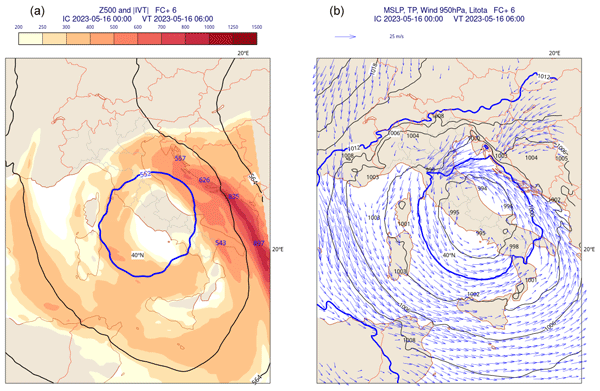
Joshua Dorrington, Marta Wenta, Federico Grazzini, Linus Magnusson, Frederic Vitart, and Christian M. Grams
Nat. Hazards Earth Syst. Sci., 24, 2995–3012, https://doi.org/10.5194/nhess-24-2995-2024, https://doi.org/10.5194/nhess-24-2995-2024, 2024
Short summary
Short summary
Extreme rainfall is the leading weather-related source of damages in Europe, but it is still difficult to predict on long timescales. A recent example of this was the devastating floods in the Italian region of Emiglia Romagna in May 2023. We present perspectives based on large-scale dynamical information that allows us to better understand and predict such events.
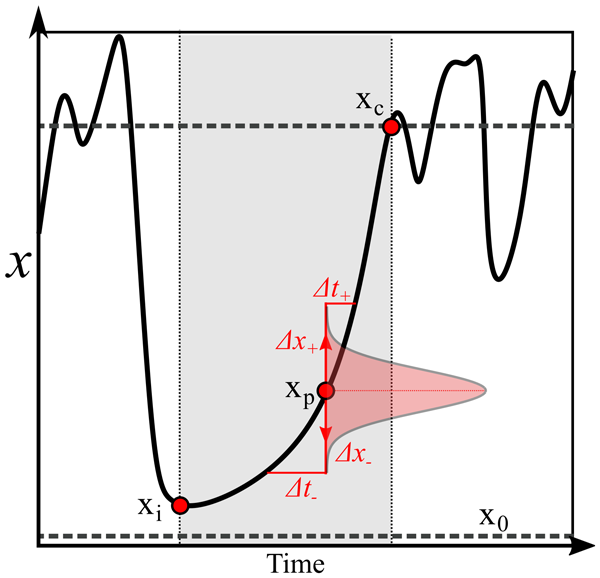
Joshua Dorrington and Tim Palmer
Nonlin. Processes Geophys., 30, 49–62, https://doi.org/10.5194/npg-30-49-2023, https://doi.org/10.5194/npg-30-49-2023, 2023
Short summary
Short summary
Atmospheric models often include random forcings, which aim to replicate the impact of processes too small to be resolved. Recent results in simple atmospheric models suggest that this random forcing can actually stabilise certain slow-varying aspects of the system, which could provide a path for resolving known errors in our models. We use randomly forced simulations of a
toychaotic system and theoretical arguments to explain why this strange effect occurs – at least in simple models.
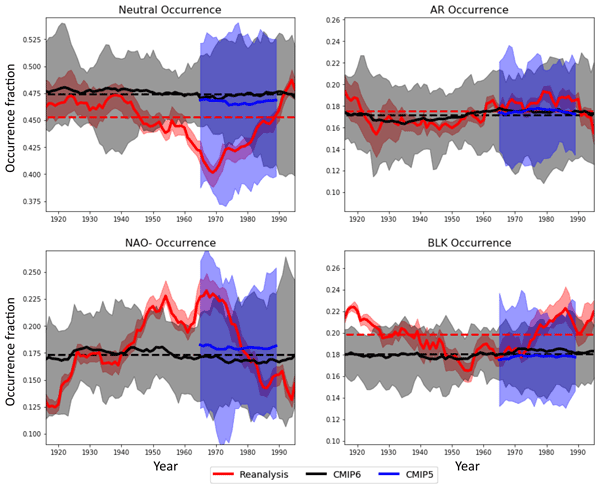
Joshua Dorrington, Kristian Strommen, and Federico Fabiano
Weather Clim. Dynam., 3, 505–533, https://doi.org/10.5194/wcd-3-505-2022, https://doi.org/10.5194/wcd-3-505-2022, 2022
Short summary
Short summary
We investigate how well current state-of-the-art climate models reproduce the wintertime weather of the North Atlantic and western Europe by studying how well different "regimes" of weather are captured. Historically, models have struggled to capture these regimes, making it hard to predict future changes in wintertime extreme weather. We show models can capture regimes if the right method is used, but they show biases, partially as a result of biases in jet speed and eddy strength.
Robin Guillaume-Castel, Camille Li, and Stefan Sobolowski
EGUsphere, https://doi.org/10.5194/egusphere-2026-3362, https://doi.org/10.5194/egusphere-2026-3362, 2026
Short summary
Short summary
Neural networks are increasingly used for weather and climate prediction, but their results are often difficult to interpret because they operate as ``black boxes''. We used explainable artificial intelligence to study how such a model predicts heavy rainfall in western Norway, where these events are driven by passing storms. We show that the model focuses on known storm features, aligning with established physical understanding.
Moetasim Ashfaq, Erika Coppola, Chris Lennard, Claas Teichmann, Deeksha Rastogi, Elias Massoud, Erasmo Buonomo, Eun-Soon Im, George Zittis, Jason P. Evans, Jesus Fernandez, Katherine J. Evans, Maria Leidinice da Silva, Marianna Adinolfi, Melissa Bukovsky, Rosmeri Porfirio da Rocha, Shabeh ul Hasson, Silvina A. Solman, Stefan Sobolowski, Sushant Das, Swen Brands, Tereza Cavazos, Thanh Ngo-Duc, and Xuejie Gao
EGUsphere, https://doi.org/10.5194/egusphere-2026-2649, https://doi.org/10.5194/egusphere-2026-2649, 2026
Short summary
Short summary
Producing reliable regional climate projections requires carefully selecting which global climate models drive them. We developed a transparent and reproducible framework to identify a balanced, representative subset of models for the Coordinated Regional Climate Downscaling Experiment, a major international effort to generate high-resolution climate projections worldwide. While designed for this initiative, the framework is broadly applicable to other models sub-selection efforts.
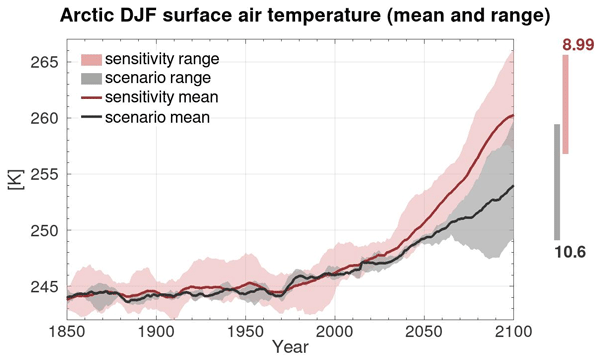
Lise Seland Graff, Jerry Tjiputra, Ada Gjermundsen, Andreas Born, Jens Boldingh Debernard, Heiko Goelzer, Yan-Chun He, Petra Margaretha Langebroek, Aleksi Nummelin, Dirk Olivié, Øyvind Seland, Trude Storelvmo, Mats Bentsen, Chuncheng Guo, Andrea Rosendahl, Dandan Tao, Thomas Toniazzo, Camille Li, Stephen Outten, and Michael Schulz
Earth Syst. Dynam., 16, 1671–1698, https://doi.org/10.5194/esd-16-1671-2025, https://doi.org/10.5194/esd-16-1671-2025, 2025
Short summary
Short summary
The magnitude of future Arctic amplification is highly uncertain. Using the Norwegian Earth System Model, we explore the effect of improving the representation of clouds, ocean eddies, the Greenland ice sheet, sea ice, and ozone on the projected Arctic winter warming in a coordinated experiment set. These improvements all lead to enhanced projected Arctic warming, with the largest changes found in the sea ice retreat regions and the largest uncertainty found on the Atlantic side.
Ling Zhang, Lu Li, Zhongshi Zhang, Joël Arnault, Stefan Sobolowski, Xiaoling Chen, Jianzhong Lu, Anthony Musili Mwanthi, Pratik Kad, Mohammed Abdullahi Hassan, Tanja Portele, Harald Kunstmann, and Zhengkang Zuo
Hydrol. Earth Syst. Sci., 29, 4109–4132, https://doi.org/10.5194/hess-29-4109-2025, https://doi.org/10.5194/hess-29-4109-2025, 2025
Short summary
Short summary
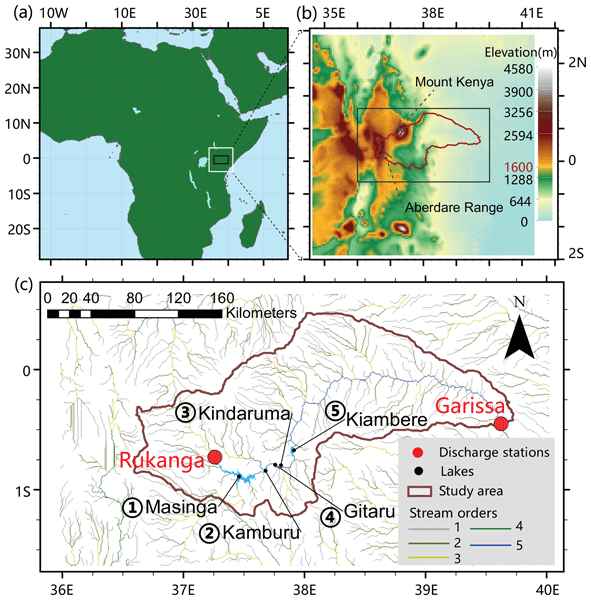
To address challenges related to unreliable hydrological simulations, we present an enhanced hydrological simulation with a refined climate model and a more comprehensive hydrological model. The model with the two parts outperforms that without, especially in migrating bias in peak flow and dry-season flow. Our findings highlight the enhanced hydrological simulation capability, with the refined climate and lake module contributing 24 % and 76 % improvement, respectively.
Joshua Dorrington, Marta Wenta, Federico Grazzini, Linus Magnusson, Frederic Vitart, and Christian M. Grams
Nat. Hazards Earth Syst. Sci., 24, 2995–3012, https://doi.org/10.5194/nhess-24-2995-2024, https://doi.org/10.5194/nhess-24-2995-2024, 2024
Short summary
Short summary
Extreme rainfall is the leading weather-related source of damages in Europe, but it is still difficult to predict on long timescales. A recent example of this was the devastating floods in the Italian region of Emiglia Romagna in May 2023. We present perspectives based on large-scale dynamical information that allows us to better understand and predict such events.
Peter Yu Feng Siew, Camille Li, Stefan Pieter Sobolowski, Etienne Dunn-Sigouin, and Mingfang Ting
Weather Clim. Dynam., 5, 985–996, https://doi.org/10.5194/wcd-5-985-2024, https://doi.org/10.5194/wcd-5-985-2024, 2024
Short summary
Short summary
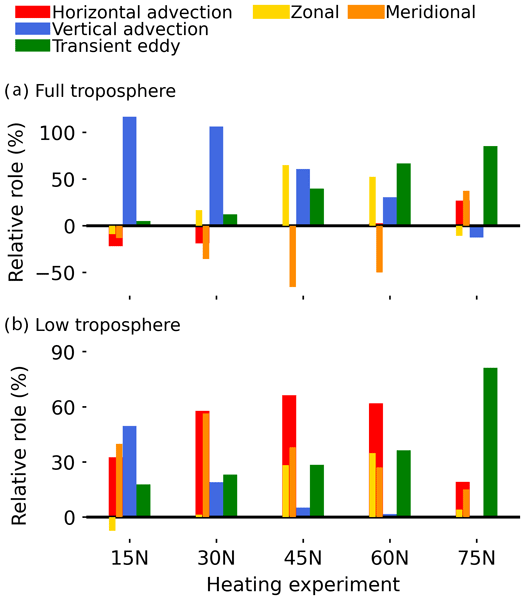
The atmospheric circulation response to surface heating at various latitudes was investigated within an idealized framework. We confirm previous results on the importance of temperature advection for balancing heating at lower latitudes. Further poleward, transient eddies become increasingly important, and eventually radiative cooling also contributes. This promotes amplified surface warming for high-latitude heating and has implications for links between sea ice loss and polar amplification.
Bjørg Risebrobakken, Mari F. Jensen, Helene R. Langehaug, Tor Eldevik, Anne Britt Sandø, Camille Li, Andreas Born, Erin Louise McClymont, Ulrich Salzmann, and Stijn De Schepper
Clim. Past, 19, 1101–1123, https://doi.org/10.5194/cp-19-1101-2023, https://doi.org/10.5194/cp-19-1101-2023, 2023
Short summary
Short summary
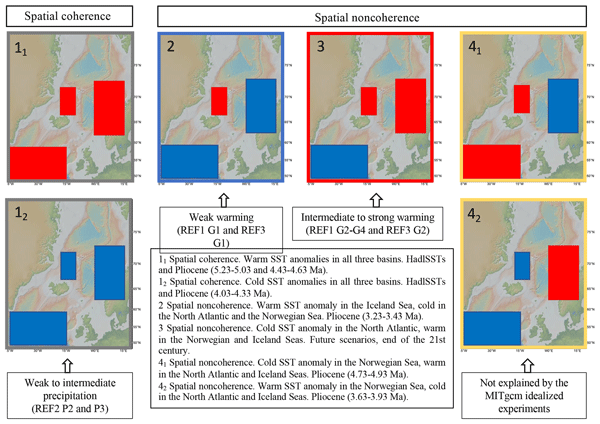
In the observational period, spatially coherent sea surface temperatures characterize the northern North Atlantic at multidecadal timescales. We show that spatially non-coherent temperature patterns are seen both in further projections and a past warm climate period with a CO2 level comparable to the future low-emission scenario. Buoyancy forcing is shown to be important for northern North Atlantic temperature patterns.
Maria Chara Karypidou, Stefan Pieter Sobolowski, Lorenzo Sangelantoni, Grigory Nikulin, and Eleni Katragkou
Geosci. Model Dev., 16, 1887–1908, https://doi.org/10.5194/gmd-16-1887-2023, https://doi.org/10.5194/gmd-16-1887-2023, 2023
Short summary
Short summary
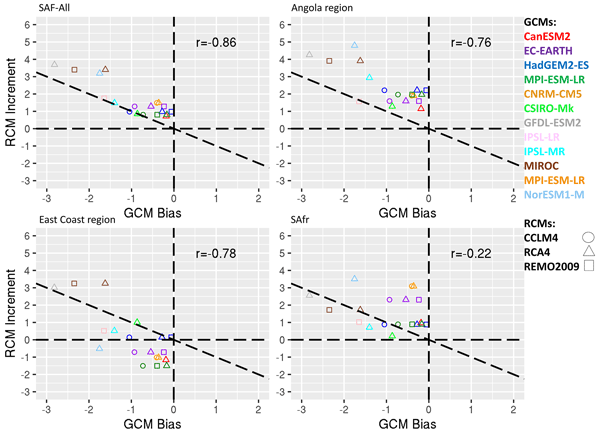
Southern Africa is listed among the climate change hotspots; hence, accurate climate change information is vital for the optimal preparedness of local communities. In this work we assess the degree to which regional climate models (RCMs) are influenced by the global climate models (GCMs) from which they receive their lateral boundary forcing. We find that although GCMs exert a strong impact on RCMs, RCMs are still able to display substantial improvement relative to the driving GCMs.
Joshua Dorrington and Tim Palmer
Nonlin. Processes Geophys., 30, 49–62, https://doi.org/10.5194/npg-30-49-2023, https://doi.org/10.5194/npg-30-49-2023, 2023
Short summary
Short summary
Atmospheric models often include random forcings, which aim to replicate the impact of processes too small to be resolved. Recent results in simple atmospheric models suggest that this random forcing can actually stabilise certain slow-varying aspects of the system, which could provide a path for resolving known errors in our models. We use randomly forced simulations of a
toychaotic system and theoretical arguments to explain why this strange effect occurs – at least in simple models.
Stephen Outten, Camille Li, Martin P. King, Lingling Suo, Peter Y. F. Siew, Hoffman Cheung, Richard Davy, Etienne Dunn-Sigouin, Tore Furevik, Shengping He, Erica Madonna, Stefan Sobolowski, Thomas Spengler, and Tim Woollings
Weather Clim. Dynam., 4, 95–114, https://doi.org/10.5194/wcd-4-95-2023, https://doi.org/10.5194/wcd-4-95-2023, 2023
Short summary
Short summary
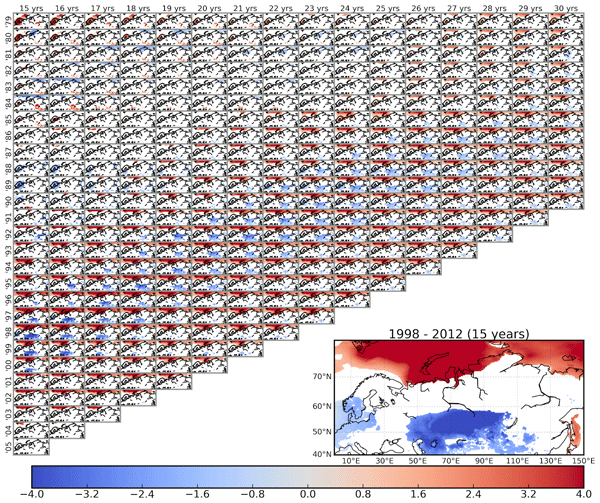
Strong disagreement exists in the scientific community over the role of Arctic sea ice in shaping wintertime Eurasian cooling. The observed Eurasian cooling can arise naturally without sea-ice loss but is expected to be a rare event. We propose a framework that incorporates sea-ice retreat and natural variability as contributing factors. A helpful analogy is of a dice roll that may result in cooling, warming, or anything in between, with sea-ice loss acting to load the dice in favour of cooling.
Tim Woollings, Camille Li, Marie Drouard, Etienne Dunn-Sigouin, Karim A. Elmestekawy, Momme Hell, Brian Hoskins, Cheikh Mbengue, Matthew Patterson, and Thomas Spengler
Weather Clim. Dynam., 4, 61–80, https://doi.org/10.5194/wcd-4-61-2023, https://doi.org/10.5194/wcd-4-61-2023, 2023
Short summary
Short summary
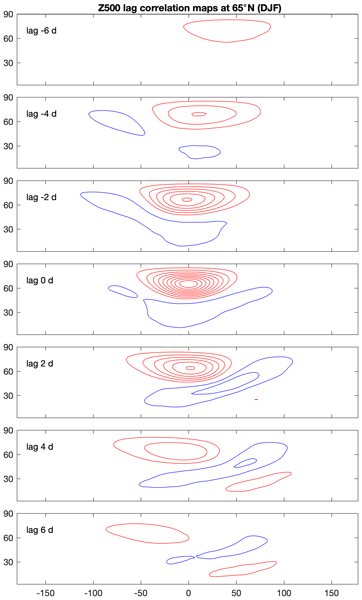
This paper investigates large-scale atmospheric variability in polar regions, specifically the balance between large-scale turbulence and Rossby wave activity. The polar regions are relatively more dominated by turbulence than lower latitudes, but Rossby waves are found to play a role and can even be triggered from high latitudes under certain conditions. Features such as cyclone lifetimes, high-latitude blocks, and annular modes are discussed from this perspective.
Maria Chara Karypidou, Eleni Katragkou, and Stefan Pieter Sobolowski
Geosci. Model Dev., 15, 3387–3404, https://doi.org/10.5194/gmd-15-3387-2022, https://doi.org/10.5194/gmd-15-3387-2022, 2022
Short summary
Short summary
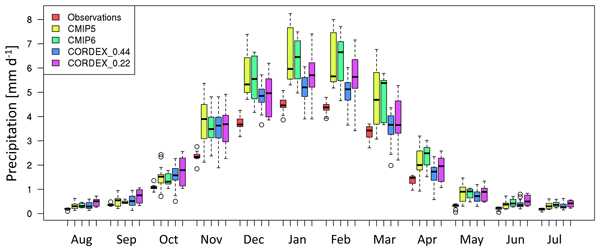
The region of southern Africa (SAF) is highly vulnerable to the impacts of climate change and is projected to experience severe precipitation shortages in the coming decades. Reliable climatic information is therefore necessary for the optimal adaptation of local communities. In this work we show that regional climate models are reliable tools for the simulation of precipitation over southern Africa. However, there is still a great need for the expansion and maintenance of observational data.
Joshua Dorrington, Kristian Strommen, and Federico Fabiano
Weather Clim. Dynam., 3, 505–533, https://doi.org/10.5194/wcd-3-505-2022, https://doi.org/10.5194/wcd-3-505-2022, 2022
Short summary
Short summary
We investigate how well current state-of-the-art climate models reproduce the wintertime weather of the North Atlantic and western Europe by studying how well different "regimes" of weather are captured. Historically, models have struggled to capture these regimes, making it hard to predict future changes in wintertime extreme weather. We show models can capture regimes if the right method is used, but they show biases, partially as a result of biases in jet speed and eddy strength.
Clio Michel, Erica Madonna, Clemens Spensberger, Camille Li, and Stephen Outten
Weather Clim. Dynam., 2, 1131–1148, https://doi.org/10.5194/wcd-2-1131-2021, https://doi.org/10.5194/wcd-2-1131-2021, 2021
Short summary
Short summary
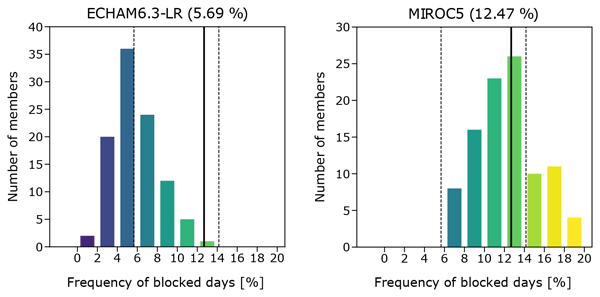
Climate models still struggle to correctly represent blocking frequency over the North Atlantic–European domain. This study makes use of five large ensembles of climate simulations and the ERA-Interim reanalyses to investigate the Greenland blocking frequency and one of its drivers, namely cyclonic Rossby wave breaking. We particularly try to understand the discrepancies between two specific models, out of the five, that behave differently.
Cited articles
Abdelmoaty, H. M., Papalexiou, S. M., Rajulapati, C. R., and AghaKouchak, A.: Biases Beyond the Mean in CMIP6 Extreme Precipitation: A Global Investigation, Earth's Future, 9, e2021EF002196, https://doi.org/10.1029/2021EF002196, 2021. a
Addor, N., Rohrer, M., Furrer, R., and Seibert, J.: Propagation of Biases in Climate Models from the Synoptic to the Regional Scale: Implications for Bias Adjustment, J. Geophys. Res.-Atmos., 121, 2075–2089, https://doi.org/10.1002/2015JD024040, 2016. a
Beck, H. E., Wood, E. F., Pan, M., Fisher, C. K., Miralles, D. G., van Dijk, A. I. J. M., McVicar, T. R., and Adler, R. F.: MSWEP V2 Global 3-Hourly 0.1° Precipitation: Methodology and Quantitative Assessment, B. Am. Meteorol. Soc., 100, 473–500, https://doi.org/10.1175/BAMS-D-17-0138.1, 2019. a, b
Brands, S.: Common Error Patterns in the Regional Atmospheric Circulation Simulated by the CMIP Multi-Model Ensemble, Geophys. Res. Lett., 49, e2022GL101 446, https://doi.org/10.1029/2022GL101446, 2022. a
Cassano, J. J., Uotila, P., Lynch, A. H., and Cassano, E. N.: Predicted Changes in Synoptic Forcing of Net Precipitation in Large Arctic River Basins during the 21st Century, J. Geophys. Res.-Biogeo., 112, G04S49, https://doi.org/10.1029/2006JG000332, 2007. a
Cattiaux, J., Douville, H., and Peings, Y.: European Temperatures in CMIP5: Origins of Present-Day Biases and Future Uncertainties, Clim. Dynam., 41, 2889–2907, https://doi.org/10.1007/s00382-013-1731-y, 2013. a
Chericoni, M., Fosser, G., Flaounas, E., Gaetani, M., and Anav, A.: Unravelling Drivers of the Future Mediterranean Precipitation Paradox during Cyclones, npj Climate and Atmospheric Science, 8, 260, https://doi.org/10.1038/s41612-025-01121-w, 2025. a
Copernicus Climate Change Service: ERA5 hourly data on single levels from 1940 to present, Copernicus Climate Change Service (C3S) Climate Data Store (CDS) [data set], https://doi.org/10.24381/cds.adbb2d47, 2023. a
Danabasoglu, G., Deser, C., Rodgers, K., and Timmermann, A.: CESM2 Large Ensemble, NSF National Center for Atmospheric Research [data set], https://doi.org/10.26024/kgmp-c556, 2020a. a
Danabasoglu, G., Lamarque, J.-F., Bacmeister, J., Bailey, D. A., DuVivier, A. K., Edwards, J., Emmons, L. K., Fasullo, J., Garcia, R., Gettelman, A., Hannay, C., Holland, M. M., Large, W. G., Lauritzen, P. H., Lawrence, D. M., Lenaerts, J. T. M., Lindsay, K., Lipscomb, W. H., Mills, M. J., Neale, R., Oleson, K. W., Otto-Bliesner, B., Phillips, A. S., Sacks, W., Tilmes, S., van Kampenhout, L., Vertenstein, M., Bertini, A., Dennis, J., Deser, C., Fischer, C., Fox-Kemper, B., Kay, J. E., Kinnison, D., Kushner, P. J., Larson, V. E., Long, M. C., Mickelson, S., Moore, J. K., Nienhouse, E., Polvani, L., Rasch, P. J., and Strand, W. G.: The Community Earth System Model Version 2 (CESM2), J. Adv. Model. Earth Sy., 12, e2019MS001916, https://doi.org/10.1029/2019MS001916, 2020b. a, b
Deser, C., Terray, L., and Phillips, A. S.: Forced and Internal Components of Winter Air Temperature Trends over North America during the past 50 Years: Mechanisms and Implications, J. Climate, 29, 2237–2258, https://doi.org/10.1175/JCLI-D-15-0304.1, 2016. a, b, c
Doane-Solomon, R., Woollings, T., and Simpson, I. R.: Dynamic Contributions to Recent Observed Wintertime Precipitation Trends in Mediterranean-Type Climate Regions, Geophys. Res. Lett., 52, e2024GL114258, https://doi.org/10.1029/2024GL114258, 2025. a, b
Donat, M. G., Delgado-Torres, C., De Luca, P., Mahmood, R., Ortega, P., and Doblas-Reyes, F. J.: How Credibly Do CMIP6 Simulations Capture Historical Mean and Extreme Precipitation Changes?, Geophys. Res. Lett., 50, e2022GL102466, https://doi.org/10.1029/2022GL102466, 2023. a, b, c
Dorrington, J., Strommen, K., Fabiano, F., and Molteni, F.: CMIP6 Models Trend Toward Less Persistent European Blocking Regimes in a Warming Climate, Geophys. Res. Lett., 49, e2022GL100811, https://doi.org/10.1029/2022GL100811, 2022. a
Dorrington, J., Grams, C., Grazzini, F., Magnusson, L., and Vitart, F.: Domino: A New Framework for the Automated Identification of Weather Event Precursors, Demonstrated for European Extreme Rainfall, Q. J. Roy. Meteor. Soc., 150, 776–795, https://doi.org/10.1002/qj.4622, 2024a (code available at: https://github.com/joshdorrington/domino, last access: 16 April 2026). a, b, c, d, e, f, g
Dorrington, J., Wenta, M., Grazzini, F., Magnusson, L., Vitart, F., and Grams, C. M.: Precursors and pathways: dynamically informed extreme event forecasting demonstrated on the historic Emilia-Romagna 2023 flood, Nat. Hazards Earth Syst. Sci., 24, 2995–3012, https://doi.org/10.5194/nhess-24-2995-2024, 2024b. a, b, c
Driouech, F., Déqué, M., and Sánchez-Gómez, E.: Weather Regimes – Moroccan Precipitation Link in a Regional Climate Change Simulation, Global Planet. Change, 72, 1–10, https://doi.org/10.1016/j.gloplacha.2010.03.004, 2010. a
Du, Y., Wang, D., Zhu, J., Wang, D., Qi, X., and Cai, J.: Comprehensive Assessment of CMIP5 and CMIP6 Models in Simulating and Projecting Precipitation over the Global Land, Int. J. Climatol., 42, 6859–6875, https://doi.org/10.1002/joc.7616, 2022. a
EEA: Economic Losses and Fatalities from Weather- and Climate-Related Events in Europe – European Environment Agency, https://www.eea.europa.eu/publications/economic-losses-and-fatalities-from (last access: 17 April 2026), 2022. a
Fischer, L. J., Bresch, D. N., Büeler, D., Grams, C. M., Noyelle, R., Röthlisberger, M., and Wernli, H.: How relevant are frequency changes of weather regimes for understanding climate change signals in surface precipitation in the North Atlantic–European sector? A conceptual analysis with CESM1 large ensemble simulations, Weather Clim. Dynam., 6, 1027–1043, https://doi.org/10.5194/wcd-6-1027-2025, 2025. a, b
Gerighausen, J., Oldham-Dorrington, J., Mockert, F., Osman, M., and Grams, C. M.: Understanding and Anticipating Anomalous Surface Impacts During Large-Scale Regimes, Meteorol. Appl., 32, e70099, https://doi.org/10.1002/met.70099, 2025. a
Grazzini, F., Fragkoulidis, G., Teubler, F., Wirth, V., and Craig, G. C.: Extreme Precipitation Events over Northern Italy. Part II: Dynamical Precursors, Q. J. Roy. Meteor. Soc., 147, 1237–1257, https://doi.org/10.1002/qj.3969, 2021. a
Guo, R., Deser, C., Terray, L., and Lehner, F.: Human Influence on Winter Precipitation Trends (1921–2015) over North America and Eurasia Revealed by Dynamical Adjustment, Geophys. Res. Lett., 46, 3426–3434, https://doi.org/10.1029/2018GL081316, 2019. a
Held, I. M. and Soden, B. J.: Robust Responses of the Hydrological Cycle to Global Warming, J. Climate, 19, 5686–5699, https://doi.org/10.1175/JCLI3990.1, 2006. a, b
Hersbach, H., Bell, B., Berrisford, P., Hirahara, S., Horányi, A., Muñoz-Sabater, J., Nicolas, J., Peubey, C., Radu, R., Schepers, D., Simmons, A., Soci, C., Abdalla, S., Abellan, X., Balsamo, G., Bechtold, P., Biavati, G., Bidlot, J., Bonavita, M., De Chiara, G., Dahlgren, P., Dee, D., Diamantakis, M., Dragani, R., Flemming, J., Forbes, R., Fuentes, M., Geer, A., Haimberger, L., Healy, S., Hogan, R. J., Hólm, E., Janisková, M., Keeley, S., Laloyaux, P., Lopez, P., Lupu, C., Radnoti, G., de Rosnay, P., Rozum, I., Vamborg, F., Villaume, S., and Thépaut, J.-N.: The ERA5 Global Reanalysis, Q. J. Roy. Meteor. Soc., 146, 1999–2049, https://doi.org/10.1002/qj.3803, 2020. a, b
Hewson, T. D. and Pillosu, F. M.: A Low-Cost Post-Processing Technique Improves Weather Forecasts around the World, Communications Earth & Environment, 2, 132, https://doi.org/10.1038/s43247-021-00185-9, 2021. a
Iversen, E. C., Hodnebrog, Ø., Seland Graff, L., Nygaard, B. E., and Iversen, T.: Future Winter Precipitation Decreases Associated With the North Atlantic Warming Hole and Reduced Convection, J. Geophys. Res.-Atmos., 128, e2022JD038374, https://doi.org/10.1029/2022JD038374, 2023. a, b
Konstali, K., Spengler, T., Spensberger, C., and Sorteberg, A.: Linking Future Precipitation Changes to Weather Features in CESM2-LE, J. Geophys. Res.-Atmos., 129, e2024JD041190, https://doi.org/10.1029/2024JD041190, 2024. a
Kuma, P., Bender, F. A.-M., and Jönsson, A. R.: Climate Model Code Genealogy and Its Relation to Climate Feedbacks and Sensitivity, J. Adv. Model. Earth Sy., 15, e2022MS003588, https://doi.org/10.1029/2022MS003588, 2023. a
Mann, M. E., Steinman, B. A., and Miller, S. K.: Absence of Internal Multidecadal and Interdecadal Oscillations in Climate Model Simulations, Nat. Commun., 11, 49, https://doi.org/10.1038/s41467-019-13823-w, 2020. a
Maraun, D.: Nonstationarities of Regional Climate Model Biases in European Seasonal Mean Temperature and Precipitation Sums, Geophys. Res. Lett., 39, https://doi.org/10.1029/2012GL051210, 2012. a, b
Maraun, D., Shepherd, T. G., Widmann, M., Zappa, G., Walton, D., Gutiérrez, J. M., Hagemann, S., Richter, I., Soares, P. M. M., Hall, A., and Mearns, L. O.: Towards Process-Informed Bias Correction of Climate Change Simulations, Nat. Clim. Change, 7, 764–773, https://doi.org/10.1038/nclimate3418, 2017. a
Meehl, G. A., Arblaster, J. M., Bates, S., Richter, J. H., Tebaldi, C., Gettelman, A., Medeiros, B., Bacmeister, J., DeRepentigny, P., Rosenbloom, N., Shields, C., Hu, A., Teng, H., Mills, M. J., and Strand, G.: Characteristics of Future Warmer Base States in CESM2, Earth and Space Science, 7, e2020EA001296, https://doi.org/10.1029/2020EA001296, 2020. a, b
Muñoz-Sabater, J., Dutra, E., Agustí-Panareda, A., Albergel, C., Arduini, G., Balsamo, G., Boussetta, S., Choulga, M., Harrigan, S., Hersbach, H., Martens, B., Miralles, D. G., Piles, M., Rodríguez-Fernández, N. J., Zsoter, E., Buontempo, C., and Thépaut, J.-N.: ERA5-Land: a state-of-the-art global reanalysis dataset for land applications, Earth Syst. Sci. Data, 13, 4349–4383, https://doi.org/10.5194/essd-13-4349-2021, 2021. a
O'Gorman, P. A. and Schneider, T.: The Physical Basis for Increases in Precipitation Extremes in Simulations of 21st-Century Climate Change, P. Natl. Acad. Sci. USA, 106, 14773–14777, https://doi.org/10.1073/pnas.0907610106, 2009. a
Olonscheck, D., Suarez-Gutierrez, L., Milinski, S., Beobide-Arsuaga, G., Baehr, J., Fröb, F., Ilyina, T., Kadow, C., Krieger, D., Li, H., Marotzke, J., Plésiat, É., Schupfner, M., Wachsmann, F., Wallberg, L., Wieners, K.-H., and Brune, S.: The New Max Planck Institute Grand Ensemble With CMIP6 Forcing and High-Frequency Model Output, J. Adv. Model. Earth Sy., 15, e2023MS003790, https://doi.org/10.1029/2023MS003790, 2023. a, b
O'Neill, B. C., Tebaldi, C., van Vuuren, D. P., Eyring, V., Friedlingstein, P., Hurtt, G., Knutti, R., Kriegler, E., Lamarque, J.-F., Lowe, J., Meehl, G. A., Moss, R., Riahi, K., and Sanderson, B. M.: The Scenario Model Intercomparison Project (ScenarioMIP) for CMIP6, Geosci. Model Dev., 9, 3461–3482, https://doi.org/10.5194/gmd-9-3461-2016, 2016. a
O'Neill, B. C., Kriegler, E., Ebi, K. L., Kemp-Benedict, E., Riahi, K., Rothman, D. S., van Ruijven, B. J., van Vuuren, D. P., Birkmann, J., Kok, K., Levy, M., and Solecki, W.: The Roads Ahead: Narratives for Shared Socioeconomic Pathways Describing World Futures in the 21st Century, Global Environmental Change, 42, 169–180, https://doi.org/10.1016/j.gloenvcha.2015.01.004, 2017. a
Pfahl, S., O'Gorman, P. A., and Fischer, E. M.: Understanding the Regional Pattern of Projected Future Changes in Extreme Precipitation, Nat. Clim. Change, 7, 423–427, https://doi.org/10.1038/nclimate3287, 2017. a, b
Respati, M. R., Dommenget, D., Segura, H., and Stassen, C.: Diagnosing Drivers of Tropical Precipitation Biases in Coupled Climate Model Simulations, Clim. Dynam., 62, 8691–8709, https://doi.org/10.1007/s00382-024-07355-3, 2024. a
Scafetta, N.: CMIP6 GCM Validation Based on ECS and TCR Ranking for 21st Century Temperature Projections and Risk Assessment, Atmosphere, 14, 345, https://doi.org/10.3390/atmos14020345, 2023. a
Scaife, A. A. and Smith, D.: A Signal-to-Noise Paradox in Climate Science, npj Climate and Atmospheric Science, 1, 28, https://doi.org/10.1038/s41612-018-0038-4, 2018. a
Shepherd, T. G.: Atmospheric Circulation as a Source of Uncertainty in Climate Change Projections, Nat. Geosci., 7, 703–708, https://doi.org/10.1038/ngeo2253, 2014. a
Simpson, I. R., Bacmeister, J., Neale, R. B., Hannay, C., Gettelman, A., Garcia, R. R., Lauritzen, P. H., Marsh, D. R., Mills, M. J., Medeiros, B., and Richter, J. H.: An Evaluation of the Large-Scale Atmospheric Circulation and Its Variability in CESM2 and Other CMIP Models, J. Geophys. Res.-Atmos., 125, e2020JD032835, https://doi.org/10.1029/2020JD032835, 2020. a, b, c
Sippel, S., Meinshausen, N., Merrifield, A., Lehner, F., Pendergrass, A. G., Fischer, E., and Knutti, R.: Uncovering the Forced Climate Response from a Single Ensemble Member Using Statistical Learning, J. Climate, 32, 5677–5699, https://doi.org/10.1175/JCLI-D-18-0882.1, 2019. a
Sobolowski, S., Somot, S., Fernandez, J., Evin, G., Brands, S., Maraun, D., Kotlarski, S., Jury, M., Benestad, R. E., Teichmann, C., Christensen, O. B., Bülow, K., Buonomo, E., Katragkou, E., Steger, C., Sørland, S., Nikulin, G., McSweeney, C., Dobler, A., Palmer, T., Wilcke, R., Boé, J., Brunner, L., Ribes, A., Qasmi, S., Nabat, P., Sevault, F., and Oudar, T.: GCM Selection and Ensemble Design: Best Practices and Recommendations from the EURO-CORDEX Community, B. Am. Meteorol. Soc., 106, E1834–E1850, https://doi.org/10.1175/BAMS-D-23-0189.1, 2025. a
Stendel, M., Francis, J., White, R., Williams, P. D., and Woollings, T.: Chapter 15 – The Jet Stream and Climate Change, in: Climate Change (Third Edition), edited by: Letcher, T. M., Elsevier, 327–357, https://doi.org/10.1016/B978-0-12-821575-3.00015-3, ISBN 978-0-12-821575-3, 2021. a
Terray, L.: A dynamical adjustment perspective on extreme event attribution, Weather Clim. Dynam., 2, 971–989, https://doi.org/10.5194/wcd-2-971-2021, 2021. a
Thompson, V.: Circulation Analogues Cannot Identify Changes in Rainfall Extremes, Environ. Res. Lett., 20, 121003, https://doi.org/10.1088/1748-9326/ae20a6, 2025. a
Vautard, R., Cattiaux, J., Happé, T., Singh, J., Bonnet, R., Cassou, C., Coumou, D., D'Andrea, F., Faranda, D., Fischer, E., Ribes, A., Sippel, S., and Yiou, P.: Heat Extremes in Western Europe Increasing Faster than Simulated Due to Atmospheric Circulation Trends, Nat. Commun., 14, 6803, https://doi.org/10.1038/s41467-023-42143-3, 2023. a
Virtanen, P., Gommers, R., Oliphant, T. E., Haberland, M., Reddy, T., Cournapeau, D., Burovski, E., Peterson, P., Weckesser, W., Bright, J., van der Walt, S. J., Brett, M., Wilson, J., Millman, K. J., Mayorov, N., Nelson, A. R. J., Jones, E., Kern, R., Larson, E., Carey, C. J., Polat, İ., Feng, Y., Moore, E. W., VanderPlas, J., Laxalde, D., Perktold, J., Cimrman, R., Henriksen, I., Quintero, E. A., Harris, C. R., Archibald, A. M., Ribeiro, A. H., Pedregosa, F., and van Mulbregt, P.: SciPy 1.0: Fundamental Algorithms for Scientific Computing in Python, Nat. Methods, 17, 261–272, https://doi.org/10.1038/s41592-019-0686-2, 2020. a
Zhu, D., Pfahl, S., Knutti, R., and Fischer, E. M.: Future Extreme Precipitation May Shift to Colder Seasons in Northern Mid- and High Latitudes, Communications Earth & Environment, 6, 657, https://doi.org/10.1038/s43247-025-02651-0, 2025. a
Short summary
The future of heavy precipitation in Europe is uncertain, and precipitation can be poorly represented in climate models. To understand model heavy precipitation better we break it into two steps. Firstly, we assess how frequently rainfall-favouring weather patterns occur. Secondly, we assess how often heavy precipitation occurs during those patterns. By doing so, we better understand model bias and forced changes, making current climate models more usable now and easier to improve going forward.
The future of heavy precipitation in Europe is uncertain, and precipitation can be poorly...


