
Articles | Volume 7, issue 2
https://doi.org/10.5194/wcd-7-681-2026
© Author(s) 2026. This work is distributed under
the Creative Commons Attribution 4.0 License.
the Creative Commons Attribution 4.0 License.
https://doi.org/10.5194/wcd-7-681-2026
© Author(s) 2026. This work is distributed under
the Creative Commons Attribution 4.0 License.
the Creative Commons Attribution 4.0 License.
Research article
| 
23 Apr 2026
Research article |
| 23 Apr 2026
| 23 Apr 2026
Persistent SST anomaly vs. dynamical ocean model in winter weather forecasts: Global Ensemble Prediction System versions 5 and 6 over the North Pacific and North Atlantic

Center for Western Weather and Water Extremes, Scripps Institution of Oceanography, University of California, San Diego, La Jolla, California, United States
Matthew R. Mazloff
Scripps Institution of Oceanography, University of California, San Diego, La Jolla, California, United States
Sarah T. Gille
Scripps Institution of Oceanography, University of California, San Diego, La Jolla, California, United States
Hai Lin
Meteorological Research Division, Environment and Climate Change Canada (ECCC), Dorval, Québec, Canada
K. Andrew Peterson
Meteorological Research Division, Environment and Climate Change Canada (ECCC), Dorval, Québec, Canada
Scripps Institution of Oceanography, University of California, San Diego, La Jolla, California, United States
Aneesh C. Subramanian
Department of Atmospheric and Oceanic Sciences, University of Colorado Boulder, Boulder, Colorado, United States
Luca Delle Monache
Center for Western Weather and Water Extremes, Scripps Institution of Oceanography, University of California, San Diego, La Jolla, California, United States
Related authors
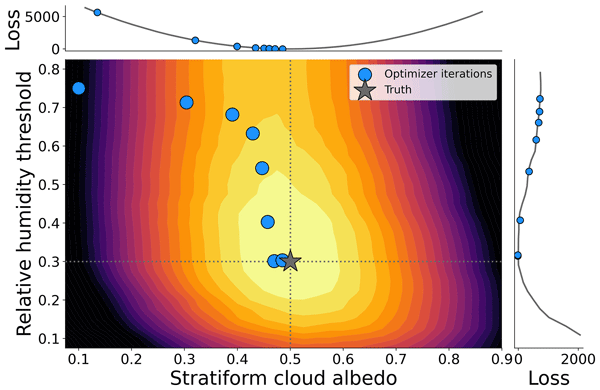
Ellen H. Davenport, J. Varan Madan, Rebecca Gjini, Jared Brzenski, Benjamin Crawford, Nick Ho, Tien-Yiao Hsu, Yueshan Liang, Zhixing Liu, Veeramakali Manivannan, Eric Pham, Rohith Vutukuru, Andrew I. L. Williams, Zhiqi Yang, Rose Yu, Nicholas J. Lutsko, Stephan Hoyer, and Duncan Watson-Parris
Geosci. Model Dev., 19, 6451–6466, https://doi.org/10.5194/gmd-19-6451-2026, https://doi.org/10.5194/gmd-19-6451-2026, 2026
Short summary
Short summary
We introduce version 1.1 of the JAX Circulation Model (JCM), an open-source atmosphere model. JCM is written in JAX, a framework for high-performance Python code that supports automatic differentiation (automated calculation of how sensitive any program output is to any input). JCM's differentiability and modular design make it easier to train, test, and combine physical-theory-based and data-driven model components, thus providing a flexible and modern platform to facilitate climate research.
Joseph K. Ansong, Brian K. Arbic, Romain Bourdalle-Badié, Clément Bricaud, Jérôme Chanut, Dimitris Menemenlis, Richard D. Ray, Michael Schindelegger, Alan J. Wallcraft, He Wang, Alistair J. Adcroft, Frédéric Briol, Maarten C. Buijsman, Loren Carrère, Eric P. Chassignet, Gerald Dibarboure, Robert W. Hallberg, Christopher N. Hill, Ariane Koch-Larrouy, Florent Lyard, Matthew R. Mazloff, An T. Nguyen, Nicolas Picot, Rui M. Ponte, and Jay F. Shriver
EGUsphere, https://doi.org/10.5194/egusphere-2026-5064, https://doi.org/10.5194/egusphere-2026-5064, 2026
This preprint is open for discussion and under review for Ocean Science (OS).
Short summary
Short summary
We assess how well four high-resolution global ocean models reproduce surface and internal tides compared with satellite observations. Some models produce internal tides that are too strong, but including energy loss over rough seafloor improves their accuracy. Longer model records and higher resolution also improve agreement with observations. We further identify errors in the tidal forcing of widely used MITgcm simulations that reduce the accuracy of their simulated tides.
Ellen H. Davenport, J. Varan Madan, Rebecca Gjini, Jared Brzenski, Benjamin Crawford, Nick Ho, Tien-Yiao Hsu, Yueshan Liang, Zhixing Liu, Veeramakali Manivannan, Eric Pham, Rohith Vutukuru, Andrew I. L. Williams, Zhiqi Yang, Rose Yu, Nicholas J. Lutsko, Stephan Hoyer, and Duncan Watson-Parris
Geosci. Model Dev., 19, 6451–6466, https://doi.org/10.5194/gmd-19-6451-2026, https://doi.org/10.5194/gmd-19-6451-2026, 2026
Short summary
Short summary
We introduce version 1.1 of the JAX Circulation Model (JCM), an open-source atmosphere model. JCM is written in JAX, a framework for high-performance Python code that supports automatic differentiation (automated calculation of how sensitive any program output is to any input). JCM's differentiability and modular design make it easier to train, test, and combine physical-theory-based and data-driven model components, thus providing a flexible and modern platform to facilitate climate research.
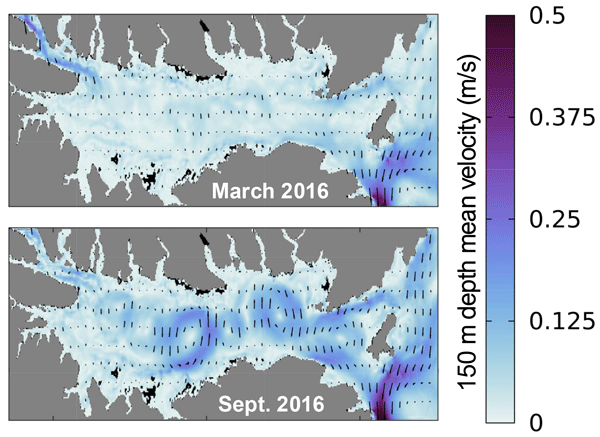
Tyler Pelle, Paul G. Myers, Andrew Hamilton, Matthew Mazloff, Krista M. Soderlund, Lucas Beem, Donald D. Blankenship, Cyril Grima, Feras Habbal, Mark Skidmore, and Jamin S. Greenbaum
Ocean Sci., 22, 187–208, https://doi.org/10.5194/os-22-187-2026, https://doi.org/10.5194/os-22-187-2026, 2026
Short summary
Short summary
Here, we develop and run a high-resolution ocean model of Jones Sound from 2003–2016 and characterize circulation into, out of, and within the sound as well as associated sea ice and productivity cycles. Atmospheric and ocean warming drives sea ice decline, which enhances biological productivity due to the increased light availability. These results highlight the utility of high-resolution models in simulating complex waterways and the need for sustained oceanographic measurements in the sound.
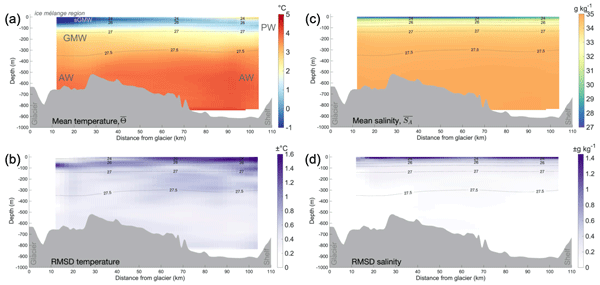
Aurora Roth, Fiamma Straneo, James Holte, Margaret Lindeman, and Matthew Mazloff
Earth Syst. Sci. Data, 17, 6025–6048, https://doi.org/10.5194/essd-17-6025-2025, https://doi.org/10.5194/essd-17-6025-2025, 2025
Short summary
Short summary
The fjords of Kalaallit Nunaat/Greenland play a critical role in our climate system and support thriving ecosystems that Greenlanders call home. As our climate warms, fjords are hotspots of change and more scientists are collecting data in fjords. These data need to be available, useable, and intuitive across a wide range of users – from scientists to local people. We provide an example of gridded transect data from Sermilik Fjord as a way to achieve this.
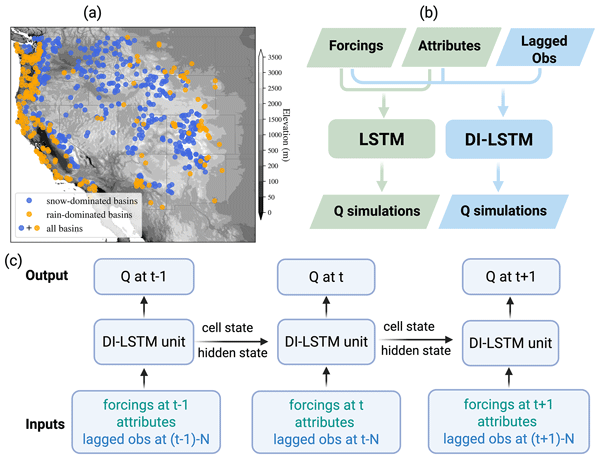
Yuan Yang, Ming Pan, Dapeng Feng, Mu Xiao, Taylor Dixon, Robert Hartman, Chaopeng Shen, Yalan Song, Agniv Sengupta, Luca Delle Monache, and F. Martin Ralph
Hydrol. Earth Syst. Sci., 29, 5453–5476, https://doi.org/10.5194/hess-29-5453-2025, https://doi.org/10.5194/hess-29-5453-2025, 2025
Short summary
Short summary
We explore a machine learning-based data integration method that integrates streamflow (Q) and snow water equivalent (SWE) to improve streamflow estimates at various lag times (1–10 d, 1–6 months) and timescales (daily and monthly) over Western US basins. Benefits rank as: integrating Q at the daily scale > Q at the monthly scale > SWE at the monthly scale > SWE at the daily scale. Results highlight the method’s potential for short- and long-term streamflow forecasting in the Western US.
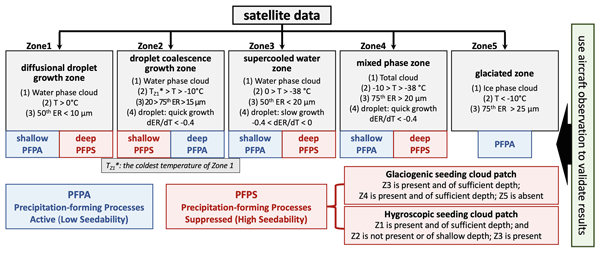
Zhenhai Zhang, Vesta Afzali Gorooh, Duncan Axisa, Chandrasekar Radhakrishnan, Eun Yeol Kim, Venkatachalam Chandrasekar, and Luca Delle Monache
Atmos. Meas. Tech., 18, 1981–2003, https://doi.org/10.5194/amt-18-1981-2025, https://doi.org/10.5194/amt-18-1981-2025, 2025
Short summary
Short summary
Water is a precious resource, and it is essential to monitor and predict the current and future occurrence of precipitation-producing clouds. We investigate the cloud characteristics related to precipitation using several cloud cases in the United Arab Emirates with data from aircraft measurements, satellite observations, and weather radar observations. This study provides scientific support for the development of an applicable framework to examine cloud precipitation processes.
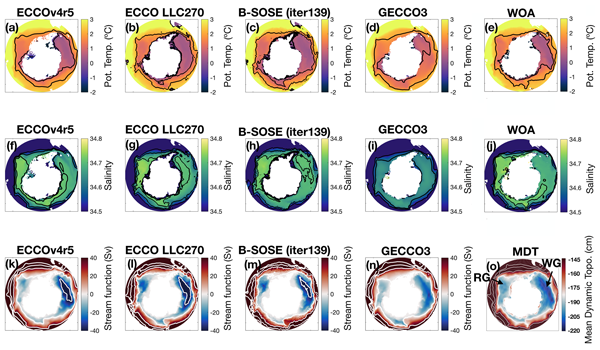
Yoshihiro Nakayama, Alena Malyarenko, Hong Zhang, Ou Wang, Matthis Auger, Yafei Nie, Ian Fenty, Matthew Mazloff, Armin Köhl, and Dimitris Menemenlis
Geosci. Model Dev., 17, 8613–8638, https://doi.org/10.5194/gmd-17-8613-2024, https://doi.org/10.5194/gmd-17-8613-2024, 2024
Short summary
Short summary
Global- and basin-scale ocean reanalyses are becoming easily accessible. However, such ocean reanalyses are optimized for their entire model domains and their ability to simulate the Southern Ocean requires evaluation. We conduct intercomparison analyses of Massachusetts Institute of Technology General Circulation Model (MITgcm)-based ocean reanalyses. They generally perform well for the open ocean, but open-ocean temporal variability and Antarctic continental shelves require improvements.
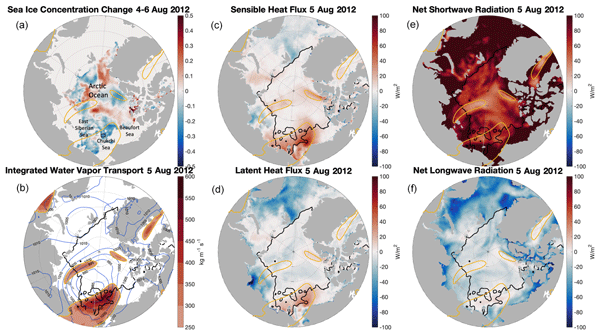
Linghan Li, Forest Cannon, Matthew R. Mazloff, Aneesh C. Subramanian, Anna M. Wilson, and Fred Martin Ralph
The Cryosphere, 18, 121–137, https://doi.org/10.5194/tc-18-121-2024, https://doi.org/10.5194/tc-18-121-2024, 2024
Short summary
Short summary
We investigate how the moisture transport through atmospheric rivers influences Arctic sea ice variations using hourly atmospheric ERA5 for 1981–2020 at 0.25° × 0.25° resolution. We show that individual atmospheric rivers initiate rapid sea ice decrease through surface heat flux and winds. We find that the rate of change in sea ice concentration has significant anticorrelation with moisture, northward wind and turbulent heat flux on weather timescales almost everywhere in the Arctic Ocean.
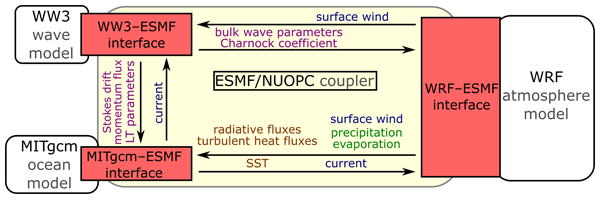
Rui Sun, Alison Cobb, Ana B. Villas Bôas, Sabique Langodan, Aneesh C. Subramanian, Matthew R. Mazloff, Bruce D. Cornuelle, Arthur J. Miller, Raju Pathak, and Ibrahim Hoteit
Geosci. Model Dev., 16, 3435–3458, https://doi.org/10.5194/gmd-16-3435-2023, https://doi.org/10.5194/gmd-16-3435-2023, 2023
Short summary
Short summary
In this work, we integrated the WAVEWATCH III model into the regional coupled model SKRIPS. We then performed a case study using the newly implemented model to study Tropical Cyclone Mekunu, which occurred in the Arabian Sea. We found that the coupled model better simulates the cyclone than the uncoupled model, but the impact of waves on the cyclone is not significant. However, the waves change the sea surface temperature and mixed layer, especially in the cold waves produced due to the cyclone.
Alena Malyarenko, Alexandra Gossart, Rui Sun, and Mario Krapp
Geosci. Model Dev., 16, 3355–3373, https://doi.org/10.5194/gmd-16-3355-2023, https://doi.org/10.5194/gmd-16-3355-2023, 2023
Short summary
Short summary
Simultaneous modelling of ocean, sea ice, and atmosphere in coupled models is critical for understanding all of the processes that happen in the Antarctic. Here we have developed a coupled model for the Ross Sea, P-SKRIPS, that conserves heat and mass between the ocean and sea ice model (MITgcm) and the atmosphere model (PWRF). We have shown that our developments reduce the model drift, which is important for long-term simulations. P-SKRIPS shows good results in modelling coastal polynyas.
David S. Trossman, Caitlin B. Whalen, Thomas W. N. Haine, Amy F. Waterhouse, An T. Nguyen, Arash Bigdeli, Matthew Mazloff, and Patrick Heimbach
Ocean Sci., 18, 729–759, https://doi.org/10.5194/os-18-729-2022, https://doi.org/10.5194/os-18-729-2022, 2022
Short summary
Short summary
How the ocean mixes is not yet adequately represented by models. There are many challenges with representing this mixing. A model that minimizes disagreements between observations and the model could be used to fill in the gaps from observations to better represent ocean mixing. But observations of ocean mixing have large uncertainties. Here, we show that ocean oxygen, which has relatively small uncertainties, and observations of ocean mixing provide information similar to the model.
Cited articles
Alkhalidi, M., Al-Dabbous, A., Al-Dabbous, S., and Alzaid, D.: Evaluating the accuracy of the ERA5 model in predicting wind speeds across coastal and offshore regions, J. Mar. Sci. Eng., 13, 149, https://doi.org/10.3390/jmse13010149, 2025. a
Alsepan, G. and Parfitt, R.: Air-sea heat flux gradients over the Gulf Stream lead the late winter North Atlantic Oscillation, Geophys. Res. Lett., 52, https://doi.org/10.1029/2025gl117228, 2025. a
An, B., Yu, Y., Hewitt, H., Wu, P., Furtado, K., Liu, H., Lin, P., Luan, Y., and Chen, K.: The benefits of high-resolution models in simulating the Kuroshio Extension and its long-term changes, Clim. Dyn., 61, 5407–5427, https://doi.org/10.1007/s00382-023-06862-z, 2023. a
Barsugli, J. J. and Battisti, D. S.: The basic effects of atmosphere–ocean thermal coupling on midlatitude variability, J. Atmos. Sci., 55, 477–493, https://doi.org/10.1175/1520-0469(1998)055<0477:tbeoao>2.0.co;2, 1998. a
Bernard, B., Madec, G., Penduff, T., Molines, J.-M., Treguier, A.-M., Le Sommer, J., Beckmann, A., Biastoch, A., Böning, C., Dengg, J., Derval, C., Durand, E., Gulev, S., Remy, E., Talandier, C., Theetten, S., Maltrud, M., McClean, J., and De Cuevas, B.: Impact of partial steps and momentum advection schemes in a global ocean circulation model at eddy-permitting resolution, Ocean Dyn., 56, 543–567, https://doi.org/10.1007/s10236-006-0082-1, 2006. a
Bishop, S. P., Justin Small, R., Bryan, F. O., and Tomas, R. A.: Scale Dependence of Midlatitude Air–Sea Interaction, J. Clim., 30, 8207–8221, https://doi.org/10.1175/JCLI-D-17-0159.1, 2017. a, b
Bloom, S. C., Takacs, L. L., da Silva, A. M., and Ledvina, D.: Data assimilation using incremental analysis updates, Mon. Weather Rev., 124, 1256–1271, https://doi.org/10.1175/1520-0493(1996)124<1256:dauiau>2.0.co;2, 1996. a
Booth, J. F., Thompson, L., Patoux, J., and Kelly, K. A.: Sensitivity of midlatitude storm intensification to perturbations in the sea surface temperature near the Gulf Stream, Mon. Weather Rev., 140, 1241–1256, https://doi.org/10.1175/mwr-d-11-00195.1, 2012. a
Brassington, G. B., Martin, M. J., Tolman, H. L., Akella, S., Balmeseda, M., Chambers, C. R. S., Chassignet, E., Cummings, J. A., Drillet, Y., Jansen, P. A. E. M., Laloyaux, P., Lea, D., Mehra, A., Mirouze, I., Ritchie, H., Samson, G., Sandery, P. A., Smith, G. C., Suarez, M., and Todling, R.: Progress and challenges in short- to medium-range coupled prediction, J. Oper. Oceanogr., 8, s239–s258, https://doi.org/10.1080/1755876x.2015.1049875, 2015. a
Buehner, M., McTaggart-Cowan, R., Beaulne, A., Charette, C., Garand, L., Heilliette, S., Lapalme, E., Laroche, S., Macpherson, S. R., Morneau, J., and Zadra, A.: Implementation of deterministic weather forecasting systems based on ensemble–variational data assimilation at Environment Canada. Part I: The global system, Mon. Weather Rev., 143, 2532–2559, https://doi.org/10.1175/mwr-d-14-00354.1, 2015. a
Cassou, C.: Intraseasonal interaction between the Madden-Julian Oscillation and the North Atlantic Oscillation, Nature, 455, 523–527, https://doi.org/10.1038/nature07286, 2008. a, b
Chakravorty, S., Czaja, A., Parfitt, R., and Dewar, W. K.: Tropospheric response to Gulf Stream intrinsic variability: A model ensemble approach, Geophys. Res. Lett., 51, https://doi.org/10.1029/2023gl107726, 2024. a
Chassignet, E. P. and Xu, X.: Impact of horizontal resolution (
Chen, T.-C., Collet, F., and Di Luca, A.: Evaluation of ERA5 precipitation and 10-m wind speed associated with extratropical cyclones using station data over North America, Int. J. Climatol., 44, 729–747, https://doi.org/10.1002/joc.8339, 2024. a, b
Côté, J., Desmarais, J.-G., Gravel, S., Méthot, A., Patoine, A., Roch, M., and Staniforth, A.: The operational CMC–MRB global environmental multiscale (GEM) model. Part II: Results, Mon. Weather Rev., 126, 1397–1418, https://doi.org/10.1175/1520-0493(1998)126<1397:tocmge>2.0.co;2, 1998a. a
Côté, J., Gravel, S., Méthot, A., Patoine, A., Roch, M., and Staniforth, A.: The operational CMC–MRB global environmental multiscale (GEM) model. Part I: Design considerations and formulation, Mon. Weather Rev., 126, 1373–1395, https://doi.org/10.1175/1520-0493(1998)126<1373:tocmge>2.0.co;2, 1998b. a
DeMott, C. A., Klingaman, N. P., and Woolnough, S. J.: Atmosphere-ocean coupled processes in the Madden-Julian oscillation, Rev. Geophys., 53, 1099–1154, https://doi.org/10.1002/2014RG000478, 2015. a
Deng, X., Gagnon, N., Houtekamer, P. L., Beauregard, S., Chouinard, S., Aider, R., Charron, M., Fontecilla, J. S., Frenette, R., and Lahlou, R.: Improvements to the Global Ensemble Prediction System (GEPS) from version 4.3.0 to version 5.0.0. Meteorological Service of Canada, Environment and Climate Change Canada, Environment Canada, Centre Météorologique Canadien, division du développement, Tech. rep., https://collaboration.cmc.ec.gc.ca/cmc/cmoi/product_guide/docs/tech_notes/technote_geps-500_e.pdf (last access: 22 April 2026), 2018. a, b
Fillion, L., Mitchell, H. L., Ritchie, H., and Staniforth, A.: The impact of a digital filter finalization technique in a global data assimilation system, Tellus A, 47, 304–323, https://doi.org/10.1034/j.1600-0870.1995.t01-2-00002.x, 1995. a
Gagnon, N., Deng, X.-X., Houtekamer, P., Beauregard, S., Erfani, A., Charron, M., Lahlou, R., and Marcoux, J.: Improvements to the global ensemble prediction system (GEPS) from version 3.1.1 to version 4.0.0. Meteorological service of Canada, environment and Climate Change Canada, environment Canada, centre météorologique canadien, division Du développement, Tech. Rep., https://collaboration.cmc.ec.gc.ca/cmc/cmoi/product_guide/docs/lib/technote_geps-400_20141118_e.pdf (last access: 22 April 2026), 2014. a
Gimeno, L., Nieto, R., Vázquez, M., and Lavers, D.: Atmospheric rivers: a mini-review, Front Earth Sci. Chin., 2, 2, https://doi.org/10.3389/feart.2014.00002, 2014. a, b
Girard, C., Plante, A., Desgagné, M., McTaggart-Cowan, R., Côté, J., Charron, M., Gravel, S., Lee, V., Patoine, A., Qaddouri, A., Roch, M., Spacek, L., Tanguay, M., Vaillancourt, P. A., and Zadra, A.: Staggered vertical discretization of the Canadian environmental multiscale (GEM) model using a coordinate of the log-hydrostatic-pressure type, Mon. Weather Rev., 142, 1183–1196, https://doi.org/10.1175/mwr-d-13-00255.1, 2014. a
Guan, B. and Waliser, D. E.: Detection of atmospheric rivers: Evaluation and application of an algorithm for global studies, J. Geophys. Res., 120, 12514–12535, https://doi.org/10.1002/2015jd024257, 2015. a
Hersbach, H., Bell, B., Berrisford, P., Hirahara, S., Horányi, A., Muñoz Sabater, J., Nicolas, J., Peubey, C., Radu, R., Schepers, D., Simmons, A., Soci, C., Abdalla, S., Abellan, X., Balsamo, G., Bechtold, P., Biavati, G., Bidlot, J., Bonavita, M., Chiara, G., Dahlgren, P., Dee, D., Diamantakis, M., Dragani, R., Flemming, J., Forbes, R., Fuentes, M., Geer, A., Haimberger, L., Healy, S., Hogan, R. J., Hólm, E., Janisková, M., Keeley, S., Laloyaux, P., Lopez, P., Lupu, C., Radnoti, G., Rosnay, P., Rozum, I., Vamborg, F., Villaume, S., and Jean-Noël Thépaut: The ERA5 global reanalysis, Q. J. Roy. Meteor. Soc., 146, 1999–2049, https://doi.org/10.1002/qj.3803, 2020. a
Higgins, T. B., Subramanian, A. C., Chapman, W. E., Lavers, D. A., and Winters, A. C.: Subseasonal Potential Predictability of Horizontal Water Vapor Transport and Precipitation Extremes in the North Pacific, Weather Forecast., 39, 833–846, https://doi.org/10.1175/WAF-D-23-0170.1, 2024. a
Honda, M., Nakamura, H., Ukita, J., Kousaka, I., and Takeuchi, K.: Interannual seesaw between the Aleutian and Icelandic lows. Part I: Seasonal dependence and life cycle, J. Clim., 14, 1029–1042, https://doi.org/10.1175/1520-0442(2001)014<1029:isbtaa>2.0.co;2, 2001. a, b
Hoskins, B. J. and Karoly, D. J.: The steady linear response of a spherical atmosphere to thermal and orographic forcing, J. Atmos. Sci., 38, 1179–1196, https://doi.org/10.1175/1520-0469(1981)038<1179:tslroa>2.0.co;2, 1981. a
Houtekamer, P. L., Mitchell, H. L., and Deng, X.: Model error representation in an operational ensemble Kalman filter, Mon. Weather Rev., 137, 2126–2143, https://doi.org/10.1175/2008mwr2737.1, 2009. a
Houtekamer, P. L., Deng, X., Mitchell, H. L., Baek, S.-J., and Gagnon, N.: Higher resolution in an operational ensemble Kalman filter, Mon. Weather Rev., 142, 1143–1162, https://doi.org/10.1175/mwr-d-13-00138.1, 2014. a
Houtekamer, P. L., Buehner, M., and De La Chevrotière, M.: Using the hybrid gain algorithm to sample data assimilation uncertainty, Q. J. R. Meteorol. Soc., 145, 35–56, https://doi.org/10.1002/qj.3426, 2019. a
Hsu, T.-Y.: Dataset to produce figures in the paper “Persistent SST Anomaly vs Dynamical Ocean Model in Winter Weather Forecasts: Global Ensemble Predictions System Versions 5 and 6 over the North Pacific and North Atlantic”, Zenodo [data set], https://doi.org/10.5281/zenodo.19362052, 2026a. a
Hsu, T.-Y.: meteorologytoday/paperfigures-airsea-cpl-ECCC: Release of v2.0 for publication (v2.0), Zenodo [code], https://doi.org/10.5281/zenodo.19560951, 2026b. a
Hsu, T.-Y., Mazloff, M. R., Gille, S. T., Freilich, M. A., Sun, R., and Cornuelle, B. D.: Response of sea surface temperature to atmospheric rivers, Nat. Commun., 15, 1–10, https://doi.org/10.1038/s41467-024-48486-9, 2024. a, b
Hunke, E. C.: Viscous–plastic sea ice dynamics with the EVP model: Linearization issues, J. Comput. Phys., 170, 18–38, https://doi.org/10.1006/jcph.2001.6710, 2001. a
Hunke, E. C., Lipscomb, W. H., Turner, A. K., Jeffery, N., and Elliott, S.: CICE: the Los Alamos Sea Ice Model Documentation and Software User's Manual Version 5.0 LA-CC-06-012, https://citeseerx.ist.psu.edu/document?repid=rep1&type=pdf&doi=5eca93a8fbc716474f8fd80c804319b630f90316 (last access: 30 March 2025), 2015. a
Karoly, D. J.: Rossby wave propagation in a barotropic atmosphere, Dyn. Atmos. Oceans, 7, 111–125, https://doi.org/10.1016/0377-0265(83)90013-1, 1983. a
Kiladis, G. N., Dias, J., Straub, K. H., Wheeler, M. C., Tulich, S. N., Kikuchi, K., Weickmann, K. M., and Ventrice, M. J.: A comparison of OLR and circulation-based indices for tracking the MJO, Mon. Weather Rev., 142, 1697–1715, https://doi.org/10.1175/mwr-d-13-00301.1, 2014. a
Kobashi, F., Doi, H., and Iwasaka, N.: Sea surface cooling induced by extratropical cyclones in the subtropical north pacific: Mechanism and interannual variability, J. Geophys. Res.-Oceans, 124, 2179–2195, https://doi.org/10.1029/2018jc014632, 2019. a, b
Li, G., Yu, Z., Li, Y., Yang, C., Gu, H., Zhang, J., and Huang, Y.: Interaction mechanism of global multiple ocean-atmosphere coupled modes and their impacts on South and East Asian Monsoon: A review, Glob. Planet. Change, 237, 104438, https://doi.org/10.1016/j.gloplacha.2024.104438, 2024. a, b
Lin, H., Brunet, G., and Derome, J.: An observed connection between the North Atlantic Oscillation and the Madden-Julian oscillation, J. Climate, 22, 364–380, https://doi.org/10.1175/2008JCLI2515.1, 2009. a
Lin, H., Gagnon, N., Beauregard, S., Muncaster, R., Markovic, M., Denis, B., and Charron, M.: GEPS-Based Monthly Prediction at the Canadian Meteorological Centre, Mon. Weather Rev., 144, 4867–4883, https://doi.org/10.1175/MWR-D-16-0138.1, 2016. a
Lin, H., Deng, X., Peterson, A., Fontecilla, J. S., Smith, G., and Muncaster, R.: Upgrade of the Global Ensemble Prediction System (GEPS) from version 5.0. 0 to version 6.0. 0. Meteorological Service of Canada, Environment and Climate Change Canada, Environment Canada, Centre Météorologique Canadien, division du développement, https://collaboration.cmc.ec.gc.ca/cmc/cmoi/product_guide/docs/tech_notes/technote_geps-600_e.pdf (last access: 22 April 2026), 2019. a, b, c, d
Lipscomb, W. H., Hunke, E. C., Maslowski, W., and Jakacki, J.: Ridging, strength, and stability in high-resolution sea ice models, J. Geophys. Res.-Oceans, 112, https://doi.org/10.1029/2005JC003355, 2007. a
Liu, X., Ma, X., Chang, P., Jia, Y., Fu, D., Xu, G., Wu, L., Saravanan, R., and Patricola, C. M.: Ocean fronts and eddies force atmospheric rivers and heavy precipitation in western North America, Nat. Commun., 12, 1268, https://doi.org/10.1038/s41467-021-21504-w, 2021. a
Madden, R. A. and Julian, P. R.: Detection of a 40–50 day oscillation in the zonal wind in the tropical pacific, J. Atmos. Sci., 28, 702–708, https://doi.org/10.1175/1520-0469(1971)028<0702:doadoi>2.0.co;2, 1971. a
Masunaga, R., Nakamura, H., Miyasaka, T., Nishii, K., and Tanimoto, Y.: Separation of climatological imprints of the Kuroshio Extension and Oyashio fronts on the wintertime atmospheric boundary layer: Their sensitivity to SST resolution prescribed for atmospheric reanalysis, J. Clim., 28, 1764–1787, https://doi.org/10.1175/jcli-d-14-00314.1, 2015. a
Molina, M. O., Gutiérrez, C., and Sánchez, E.: Comparison of ERA5 surface wind speed climatologies over Europe with observations from the HadISD dataset, Int. J. Climatol., 41, 4864–4878, https://doi.org/10.1002/joc.7103, 2021. a
Parfitt, R. and Kwon, Y.-O.: The modulation of Gulf Stream influence on the troposphere by the eddy-driven jet, J. Clim., 33, 4109–4120, https://doi.org/10.1175/jcli-d-19-0294.1, 2020. a
Pasquier, J. T., Pfahl, S., and Grams, C. M.: Modulation of atmospheric river occurrence and associated precipitation extremes in the North Atlantic region by European weather regimes, Geophys. Res. Lett., 46, 1014–1023, https://doi.org/10.1029/2018gl081194, 2019. a
Penny, S. G.: The hybrid local ensemble transform Kalman filter, Mon. Weather Rev., 142, 2139–2149, https://doi.org/10.1175/mwr-d-13-00131.1, 2014. a
Peterson, K. A., Smith, G. C., Lemieux, J.-F., Roy, F., Buehner, M., Caya, A., Houtekamer, P. L., Lin, H., Muncaster, R., Deng, X., Dupont, F., Gagnon, N., Hata, Y., Martinez, Y., Fontecilla, J. S., and Surcel-Colan, D.: Understanding sources of Northern Hemisphere uncertainty and forecast error in a medium-range coupled ensemble sea-ice prediction system, Q. J. Roy. Meteor. Soc., 148, 2877–2902, https://doi.org/10.1002/qj.4340, 2022. a
Polichtchouk, I., Mogensen, K. S., Sanabia, E. R., Jayne, S. R., Magnusson, L., Densmore, C. R., Hatfield, S., Hadade, I., Wedi, N., Anantharaj, V., Lopez, P., and Ekholm, A. K.: Effects of atmosphere and ocean horizontal model resolution on tropical cyclone and upper ocean response forecasts in four major hurricanes, Mon. Weather Rev., -1, https://doi.org/10.1175/mwr-d-24-0104.1, 2025. a
Qaddouri, A. and Lee, V.: The Canadian Global Environmental Multiscale model on the Yin-Yang grid system: Canadian GEM model on the Yin-Yang grid, Q. J. R. Meteorol. Soc., 137, 1913–1926, https://doi.org/10.1002/qj.873, 2011. a
Rainaud, R., Brossier, C. L., Ducrocq, V., and Giordani, H.: High-resolution air–sea coupling impact on two heavy precipitation events in the Western Mediterranean, Q. J. Roy. Meteor. Soc., 143, 2448–2462, https://doi.org/10.1002/qj.3098, 2017. a
Rayner, N. A., Parker, D. E., Horton, E. B., Folland, C. K., Alexander, L. V., Rowell, D. P., Kent, E. C., and Kaplan, A.: Global analyses of sea surface temperature, sea ice, and night marine air temperature since the late nineteenth century, J. Geophys. Res., 108, https://doi.org/10.1029/2002jd002670, 2003. a
Renault, L., Arsouze, T., Desbiolles, F., and Small, J.: Rectification effects of regional air-sea interactions over western boundary current on large-scale sea surface temperature and extra-tropical storm tracks, Sci. Rep., 14, 31771, https://doi.org/10.1038/s41598-024-82667-2, 2024. a, b
Roberts, M. J., Hewitt, H. T., Hyder, P., Ferreira, D., Josey, S. A., Mizielinski, M., and Shelly, A.: Impact of ocean resolution on coupled air-sea fluxes and large-scale climate, Geophys. Res. Lett., 43, https://doi.org/10.1002/2016gl070559, 2016. a
Rutz, J. J., James Steenburgh, W., and Martin Ralph, F.: Climatological Characteristics of Atmospheric Rivers and Their Inland Penetration over the Western United States, Mon. Weather Rev., 142, 905–921, https://doi.org/10.1175/MWR-D-13-00168.1, 2014. a, b
Sauvage, C., Seo, H., Clayson, C. A., and Edson, J. B.: Improving wave-based air-sea momentum flux parameterization in mixed seas, J. Geophys. Res.-Oceans, 128, https://doi.org/10.1029/2022jc019277, 2023. a
Savarin, A. and Chen, S. S.: Pathways to better prediction of the MJO: 2. Impacts of atmosphere-ocean coupling on the upper ocean and MJO propagation, J. Adv. Model. Earth Syst., 14, e2021MS002929, https://doi.org/10.1029/2021MS002929, 2022. a
Scaife, A. A., Comer, R. E., Dunstone, N. J., Knight, J. R., Smith, D. M., MacLachlan, C., Martin, N., Peterson, K. A., Rowlands, D., Carroll, E. B., Belcher, S., and Slingo, J.: Tropical rainfall, Rossby waves and regional winter climate predictions: Winter Teleconnections, Q. J. R. Meteorol. Soc., 143, 1–11, https://doi.org/10.1002/qj.2910, 2017. a
Seo, H., O'Neill, L. W., Bourassa, M. A., Czaja, A., Drushka, K., Edson, J. B., Fox-Kemper, B., Frenger, I., Gille, S. T., Kirtman, B. P., Minobe, S., Pendergrass, A. G., Renault, L., Roberts, M. J., Schneider, N., Justin Small, R., Stoffelen, A., and Wang, Q.: Ocean Mesoscale and Frontal-Scale Ocean–Atmosphere Interactions and Influence on Large-Scale Climate: A Review, J. Clim., 36, 1981–2013, https://doi.org/10.1175/JCLI-D-21-0982.1, 2023. a, b, c
Small, R. J., deSzoeke, S. P., Xie, S. P., O'Neill, L., Seo, H., Song, Q., Cornillon, P., Spall, M., and Minobe, S.: Air–sea interaction over ocean fronts and eddies, Dyn. Atmos. Oceans, 45, 274–319, https://doi.org/10.1016/j.dynatmoce.2008.01.001, 2008. a
Smith, G. C., Bélanger, J.-M., Roy, F., Pellerin, P., Ritchie, H., Onu, K., Roch, M., Zadra, A., Colan, D. S., Winter, B., Fontecilla, J.-S., and Deacu, D.: Impact of Coupling with an Ice–Ocean Model on Global Medium-Range NWP Forecast Skill, Mon. Weather Rev., 146, 1157–1180, https://doi.org/10.1175/MWR-D-17-0157.1, 2018. a, b
Stan, C., Straus, D. M., Frederiksen, J. S., Lin, H., Maloney, E. D., and Schumacher, C.: Review of tropical-extratropical teleconnections on intraseasonal time scales, Rev. Geophys., 55, 902–937, https://doi.org/10.1002/2016rg000538, 2017. a
Subramanian, A. C., Balmaseda, M. A., Centurioni, L., Chattopadhyay, R., Cornuelle, B. D., DeMott, C., Flatau, M., Fujii, Y., Giglio, D., Gille, S. T., Hamill, T. M., Hendon, H., Hoteit, I., Kumar, A., Lee, J.-H., Lucas, A. J., Mahadevan, A., Matsueda, M., Nam, S., Paturi, S., Penny, S. G., Rydbeck, A., Sun, R., Takaya, Y., Tandon, A., Todd, R. E., Vitart, F., Yuan, D., and Zhang, C.: Ocean Observations to Improve Our Understanding, Modeling, and Forecasting of Subseasonal-to-Seasonal Variability, Front. Mar. Sci., 6, https://doi.org/10.3389/fmars.2019.00427, 2019. a
Sun, R., Cobb, A., Villas Bôas, A. B., Langodan, S., Subramanian, A. C., Mazloff, M. R., Cornuelle, B. D., Miller, A. J., Pathak, R., and Hoteit, I.: Waves in SKRIPS: WAVEWATCH III coupling implementation and a case study of Tropical Cyclone Mekunu, Geosci. Model Dev., 16, 3435–3458, https://doi.org/10.5194/gmd-16-3435-2023, 2023. a
Vellinga, M., Copsey, D., Graham, T., Milton, S., and Johns, T.: Evaluating benefits of two-way ocean–atmosphere coupling for global NWP forecasts, Weather Forecast., 35, 2127–2144, https://doi.org/10.1175/waf-d-20-0035.1, 2020. a
Vitart, F., Buizza, R., Alonso Balmaseda, M., Balsamo, G., Bidlot, J.-R., Bonet, A., Fuentes, M., Hofstadler, A., Molteni, F., and Palmer, T. N.: The new VarEPS-monthly forecasting system: A first step towards seamless prediction, Q. J. Roy. Meteor. Soc., 134, 1789–1799, https://doi.org/10.1002/qj.322, 2008. a
Vitart, F., Ardilouze, C., Bonet, A., Brookshaw, A., Chen, M., Codorean, C., Déqué, M., Ferranti, L., Fucile, E., Fuentes, M., Hendon, H., Hodgson, J., Kang, H.-S., Kumar, A., Lin, H., Liu, G., Liu, X., Malguzzi, P., Mallas, I., Manoussakis, M., Mastrangelo, D., MacLachlan, C., McLean, P., Minami, A., Mladek, R., Nakazawa, T., Najm, S., Nie, Y., Rixen, M., Robertson, A. W., Ruti, P., Sun, C., Takaya, Y., Tolstykh, M., Venuti, F., Waliser, D., Woolnough, S., Wu, T., Won, D.-J., Xiao, H., Zaripov, R., and Zhang, L.: The Subseasonal to Seasonal (S2S) Prediction Project Database, Bull. Am. Meteorol. Soc., 98, 163–173, https://doi.org/10.1175/BAMS-D-16-0017.1, 2017. a, b
Waliser, D. and Guan, B.: Extreme winds and precipitation during landfall of atmospheric rivers, Nat. Geosci., 10, 179–183, https://doi.org/10.1038/ngeo2894, 2017. a
Wheeler, M. C. and Hendon, H. H.: An all-season real-time multivariate MJO index: Development of an index for monitoring and prediction, Mon. Weather Rev., 132, 1917–1932, https://doi.org/10.1175/1520-0493(2004)132<1917:aarmmi>2.0.co;2, 2004. a
Winters, A. C.: Subseasonal prediction of the state and evolution of the north pacific jet stream, J. Geophys. Res., 126, https://doi.org/10.1029/2021jd035094, 2021. a
Yao, L., Lu, J., Xia, X., Jing, W., and Liu, Y.: Evaluation of the ERA5 sea surface temperature around the Pacific and the Atlantic, IEEE Access, 9, 12067–12073, https://doi.org/10.1109/ACCESS.2021.3051642, 2021. a
Zhu, Y. and Newell, R. E.: Atmospheric rivers and bombs, Geophys. Res. Lett., 21, 1999–2002, https://doi.org/10.1029/94GL01710, 1994. a
Zuo, H., Balmaseda, M. A., and Mogensen, K.: The new eddy-permitting ORAP5 ocean reanalysis: description, evaluation and uncertainties in climate signals, Clim. Dyn., 49, 791–811, https://doi.org/10.1007/s00382-015-2675-1, 2017. a
Short summary
We examine the impact of replacing persistent sea surface temperature with a dynamical ocean model on 15 d weather forecasts over the North Pacific and Atlantic during wintertime. With the usage of an uncoupled atmospheric model, a coupled atmosphere-ocean model, and ERA5 for validation, we find that latent heat flux bias variance is reduced by 10 %–20 % in the Pacific. This improves forecasts of integrated vapor transport, enhancing the prediction of weather extremes in mid- to high latitudes.
We examine the impact of replacing persistent sea surface temperature with a dynamical ocean...


