
Articles | Volume 6, issue 4
https://doi.org/10.5194/wcd-6-1661-2025
© Author(s) 2025. This work is distributed under
the Creative Commons Attribution 4.0 License.
the Creative Commons Attribution 4.0 License.
https://doi.org/10.5194/wcd-6-1661-2025
© Author(s) 2025. This work is distributed under
the Creative Commons Attribution 4.0 License.
the Creative Commons Attribution 4.0 License.
Research article
| 
04 Dec 2025
Research article |
| 04 Dec 2025
| 04 Dec 2025
Signal, noise and skill in sub-seasonal forecasts: the role of teleconnections
Alexey Yu. Karpechko
CORRESPONDING AUTHOR

Finnish Meteorological Institute, Helsinki, 00101, Finland
Amy H. Butler
National Oceanic and Atmospheric Administration (NOAA) Chemical Sciences Laboratory, Boulder, CO, 80305, USA
Frederic Vitart
European Centre for Medium-range Weather Forecasts, Reading, RG2 9AX, UK
Publisher's note: on 12 May 2026, several references to equations in the text were corrected to align them with the corresponding equations in the article.
Related authors
Tereza Uhlíková, Timo Vihma, Alexey Yu Karpechko, and Petteri Uotila
The Cryosphere, 20, 4585–4604, https://doi.org/10.5194/tc-20-4585-2026, https://doi.org/10.5194/tc-20-4585-2026, 2026
Short summary
Short summary
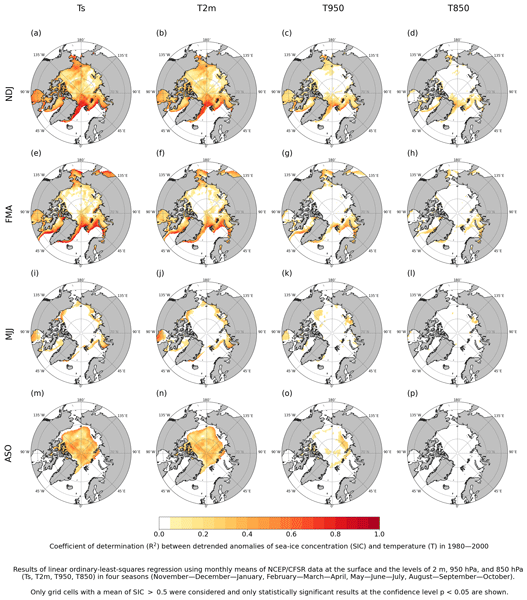
Understanding of the local effects of sea-ice concentration variations on the Arctic atmosphere is a prerequisite for assessing the role of Arctic sea-ice decline in the climate system, including its influence on mid-latitudes. In our study, using data from atmospheric reanalysis, we present how the relationships of sea-ice concentration, temperature, and specific humidity and their direction change depending on region and season over the Arctic.
Tereza Uhlíková, Timo Vihma, Alexey Yu Karpechko, and Petteri Uotila
The Cryosphere, 19, 1031–1046, https://doi.org/10.5194/tc-19-1031-2025, https://doi.org/10.5194/tc-19-1031-2025, 2025
Short summary
Short summary
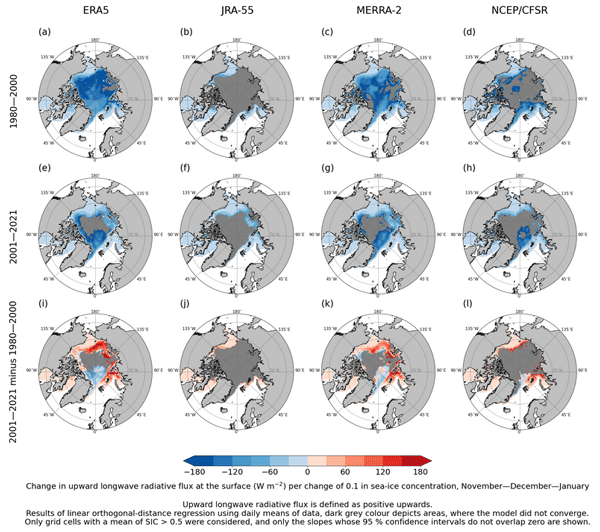
To better understand the local, regional, and global impacts of the recent rapid sea-ice decline in the Arctic, one of the key issues is to quantify the effects of sea-ice concentration on the surface radiative fluxes. We analyse these effects utilising four data sets called atmospheric reanalyses, and we evaluate uncertainties in these effects arising from inter-reanalysis differences in the sensitivity of the surface radiative fluxes to sea-ice concentration.
Chaim I. Garfinkel, Zachary D. Lawrence, Amy H. Butler, Etienne Dunn-Sigouin, Irene Erner, Alexey Y. Karpechko, Gerbrand Koren, Marta Abalos, Blanca Ayarzagüena, David Barriopedro, Natalia Calvo, Alvaro de la Cámara, Andrew Charlton-Perez, Judah Cohen, Daniela I. V. Domeisen, Javier García-Serrano, Neil P. Hindley, Martin Jucker, Hera Kim, Robert W. Lee, Simon H. Lee, Marisol Osman, Froila M. Palmeiro, Inna Polichtchouk, Jian Rao, Jadwiga H. Richter, Chen Schwartz, Seok-Woo Son, Masakazu Taguchi, Nicholas L. Tyrrell, Corwin J. Wright, and Rachel W.-Y. Wu
Weather Clim. Dynam., 6, 171–195, https://doi.org/10.5194/wcd-6-171-2025, https://doi.org/10.5194/wcd-6-171-2025, 2025
Short summary
Short summary
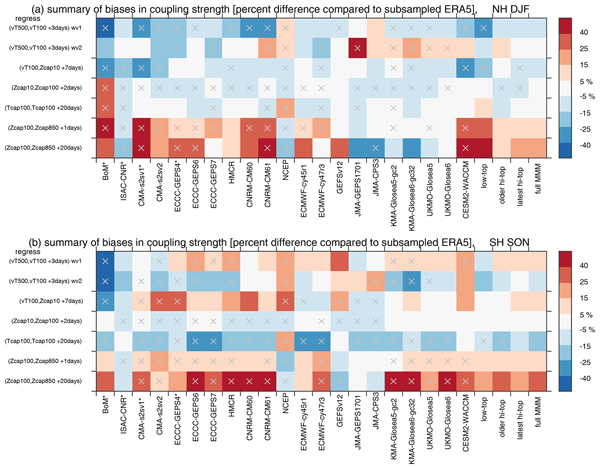
Variability in the extratropical stratosphere and troposphere is coupled, and because of the longer timescales characteristic of the stratosphere, this allows for a window of opportunity for surface prediction. This paper assesses whether models used for operational prediction capture these coupling processes accurately. We find that most processes are too weak; however downward coupling from the lower stratosphere to the near surface is too strong.
Xavier J. Levine, Ryan S. Williams, Gareth Marshall, Andrew Orr, Lise Seland Graff, Dörthe Handorf, Alexey Karpechko, Raphael Köhler, René R. Wijngaard, Nadine Johnston, Hanna Lee, Lars Nieradzik, and Priscilla A. Mooney
Earth Syst. Dynam., 15, 1161–1177, https://doi.org/10.5194/esd-15-1161-2024, https://doi.org/10.5194/esd-15-1161-2024, 2024
Short summary
Short summary
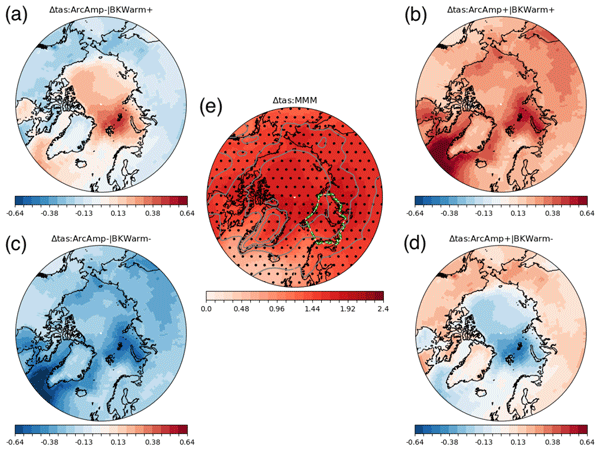
While the most recent climate projections agree that the Arctic is warming, differences remain in how much and in other climate variables such as precipitation. This presents a challenge for stakeholders who need to develop mitigation and adaptation strategies. We tackle this problem by using the storyline approach to generate four plausible and actionable realisations of end-of-century climate change for the Arctic, spanning its most likely range of variability.
Tereza Uhlíková, Timo Vihma, Alexey Yu Karpechko, and Petteri Uotila
The Cryosphere, 18, 957–976, https://doi.org/10.5194/tc-18-957-2024, https://doi.org/10.5194/tc-18-957-2024, 2024
Short summary
Short summary
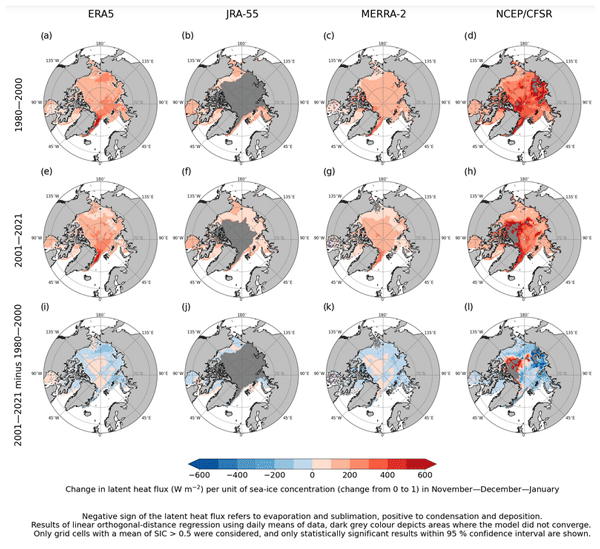
A prerequisite for understanding the local, regional, and hemispherical impacts of Arctic sea-ice decline on the atmosphere is to quantify the effects of sea-ice concentration (SIC) on the sensible and latent heat fluxes in the Arctic. We analyse these effects utilising four data sets called atmospheric reanalyses, and we evaluate uncertainties in these effects arising from inter-reanalysis differences in SIC and in the sensitivity of the latent and sensible heat fluxes to SIC.
Zachary D. Lawrence, Marta Abalos, Blanca Ayarzagüena, David Barriopedro, Amy H. Butler, Natalia Calvo, Alvaro de la Cámara, Andrew Charlton-Perez, Daniela I. V. Domeisen, Etienne Dunn-Sigouin, Javier García-Serrano, Chaim I. Garfinkel, Neil P. Hindley, Liwei Jia, Martin Jucker, Alexey Y. Karpechko, Hera Kim, Andrea L. Lang, Simon H. Lee, Pu Lin, Marisol Osman, Froila M. Palmeiro, Judith Perlwitz, Inna Polichtchouk, Jadwiga H. Richter, Chen Schwartz, Seok-Woo Son, Irene Erner, Masakazu Taguchi, Nicholas L. Tyrrell, Corwin J. Wright, and Rachel W.-Y. Wu
Weather Clim. Dynam., 3, 977–1001, https://doi.org/10.5194/wcd-3-977-2022, https://doi.org/10.5194/wcd-3-977-2022, 2022
Short summary
Short summary
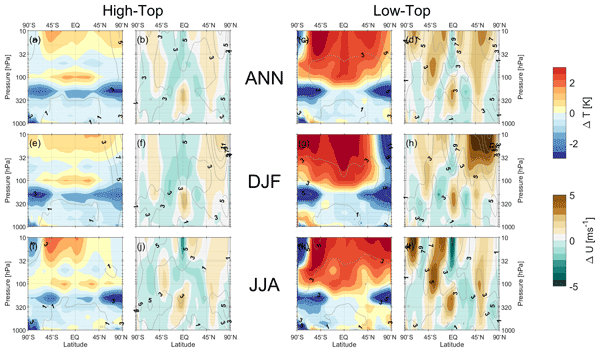
Forecast models that are used to predict weather often struggle to represent the Earth’s stratosphere. This may impact their ability to predict surface weather weeks in advance, on subseasonal-to-seasonal (S2S) timescales. We use data from many S2S forecast systems to characterize and compare the stratospheric biases present in such forecast models. These models have many similar stratospheric biases, but they tend to be worse in systems with low model tops located within the stratosphere.
Adam A. Scaife, Mark P. Baldwin, Amy H. Butler, Andrew J. Charlton-Perez, Daniela I. V. Domeisen, Chaim I. Garfinkel, Steven C. Hardiman, Peter Haynes, Alexey Yu Karpechko, Eun-Pa Lim, Shunsuke Noguchi, Judith Perlwitz, Lorenzo Polvani, Jadwiga H. Richter, John Scinocca, Michael Sigmond, Theodore G. Shepherd, Seok-Woo Son, and David W. J. Thompson
Atmos. Chem. Phys., 22, 2601–2623, https://doi.org/10.5194/acp-22-2601-2022, https://doi.org/10.5194/acp-22-2601-2022, 2022
Short summary
Short summary
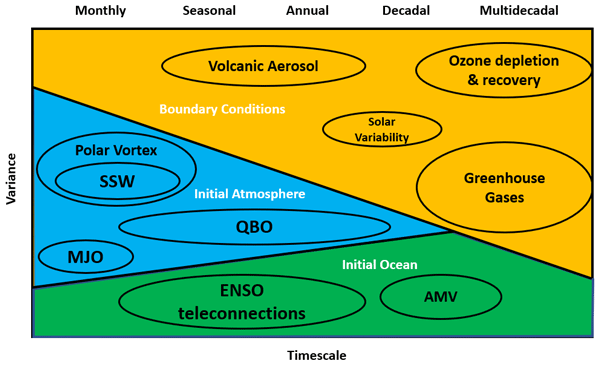
Great progress has been made in computer modelling and simulation of the whole climate system, including the stratosphere. Since the late 20th century we also gained a much clearer understanding of how the stratosphere interacts with the lower atmosphere. The latest generation of numerical prediction systems now explicitly represents the stratosphere and its interaction with surface climate, and here we review its role in long-range predictions and projections from weeks to decades ahead.
Nicholas L. Tyrrell, Juho M. Koskentausta, and Alexey Yu. Karpechko
Weather Clim. Dynam., 3, 45–58, https://doi.org/10.5194/wcd-3-45-2022, https://doi.org/10.5194/wcd-3-45-2022, 2022
Short summary
Short summary
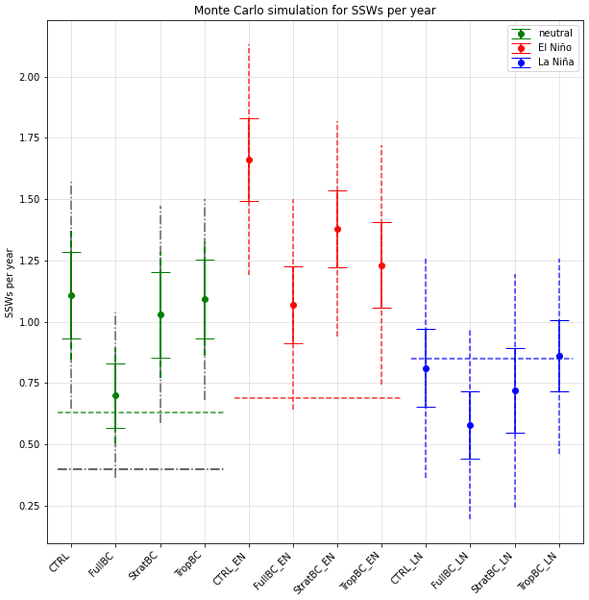
El Niño events are known to effect the variability of the wintertime stratospheric polar vortex. The observed relationship differs from what is seen in climate models. Climate models have errors in their average winds and temperature, and in this work we artificially reduce those errors to see how that changes the communication of El Niño events to the polar stratosphere. We find reducing errors improves stratospheric variability, but does not explain the differences with observations.
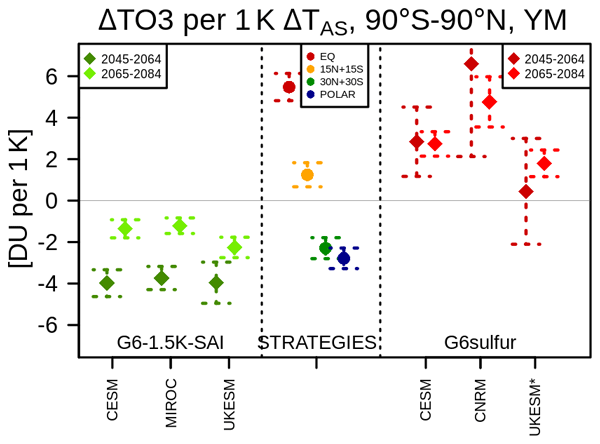
Ewa M. Bednarz, Amy H. Butler, James M. Haywood, Matthew Henry, Andy Jones, Ben Kravitz, Walker R. Lee, Douglas G. MacMartin, Amanda C. Maycock, Takashi Sekiya, Shingo Watanabe, and Daniele Visioni
Atmos. Chem. Phys., 26, 12751–12770, https://doi.org/10.5194/acp-26-12751-2026, https://doi.org/10.5194/acp-26-12751-2026, 2026
Short summary
Short summary
An assessment of the potential impacts of Stratospheric Aerosol Injection, a proposed method to offset global warming, on stratospheric ozone projections over the 21st century using the new multi-model GeoMIP (Geoengineering Model Intercomparison Project) G6-1.5K-SAI (Stratospheric Aerosol Injection) experiment. We discuss drivers of the responses, identify areas of model agreement and disagreement and sources of uncertainty. Our results highlight the need to assess any projected SAI impacts in wider strategy and scenario dimension using a multi-model framework.
Kexiang Feng, Jian Rao, Chaim I. Garfinkel, Amy H. Butler, Blanca Ayarzagüena, and Xiaoqi Zhang
EGUsphere, https://doi.org/10.5194/egusphere-2026-4971, https://doi.org/10.5194/egusphere-2026-4971, 2026
This preprint is open for discussion and under review for Weather and Climate Dynamics (WCD).
Short summary
Short summary
Sudden stratospheric warmings can influence weather at the Earth's surface, but the role of the upper atmosphere remains unclear. Using forecast models with different upper-atmosphere conditions, we find that the upper atmosphere actively affects the evolution of these events and their surface impacts. This highlights the importance of better representing the upper atmosphere to improve forecasts of sudden stratospheric warmings and their impacts.
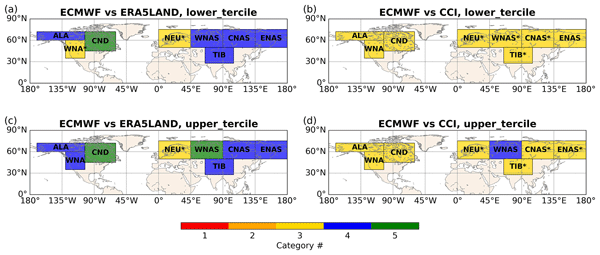
Ekaterina Vorobeva, Yvan Orsolini, Patricia de Rosnay, Jonathan Day, Retish Senan, Damien Decremer, and Frederic Vitart
The Cryosphere, 20, 4605–4618, https://doi.org/10.5194/tc-20-4605-2026, https://doi.org/10.5194/tc-20-4605-2026, 2026
Short summary
Short summary
How reliable are probabilistic seasonal snow forecasts in winter? Although they are routinely issued by operational prediction centres, their reliability has never been evaluated. We close this gap by analyzing 30 years of seasonal snow re-forecasts and evaluating them against two snow datasets. Our results provide comprehensive assessment of seasonal snow forecast reliability and offer new insights into their performance in different parts of the Northern Hemisphere.
Tereza Uhlíková, Timo Vihma, Alexey Yu Karpechko, and Petteri Uotila
The Cryosphere, 20, 4585–4604, https://doi.org/10.5194/tc-20-4585-2026, https://doi.org/10.5194/tc-20-4585-2026, 2026
Short summary
Short summary
Understanding of the local effects of sea-ice concentration variations on the Arctic atmosphere is a prerequisite for assessing the role of Arctic sea-ice decline in the climate system, including its influence on mid-latitudes. In our study, using data from atmospheric reanalysis, we present how the relationships of sea-ice concentration, temperature, and specific humidity and their direction change depending on region and season over the Arctic.
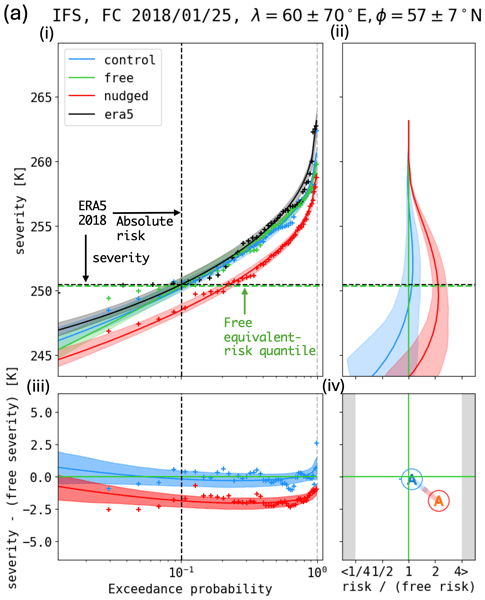
William J. M. Seviour, Justin Finkel, Philip Rupp, Regan Mudhar, Amy H. Butler, Chaim I. Garfinkel, Peter Hitchcock, Blanca Ayarzagüena, Dong-Chan Hong, Yu-Kyung Hyun, Hera Kim, Eun-Pa Lim, Daniel De Maeseneire, Gabriele Messori, Gerbrand Koren, Michael Sigmond, Isla R. Simpson, and Seok-Woo Son
Weather Clim. Dynam., 7, 1405–1423, https://doi.org/10.5194/wcd-7-1405-2026, https://doi.org/10.5194/wcd-7-1405-2026, 2026
Short summary
Short summary
Variability of the stratospheric polar vortex is thought to play a role in driving weather extremes, but quantifying this role for a given event has proved challenging. Using a new set of perturbed subseasonal forecast experiments from 7 modelling centres, we determine the stratospheric contribution to the risk and severity of three recent extreme weather events. The forecast-based methodology that we develop is applicable to understanding a range of other drivers of weather extremes.
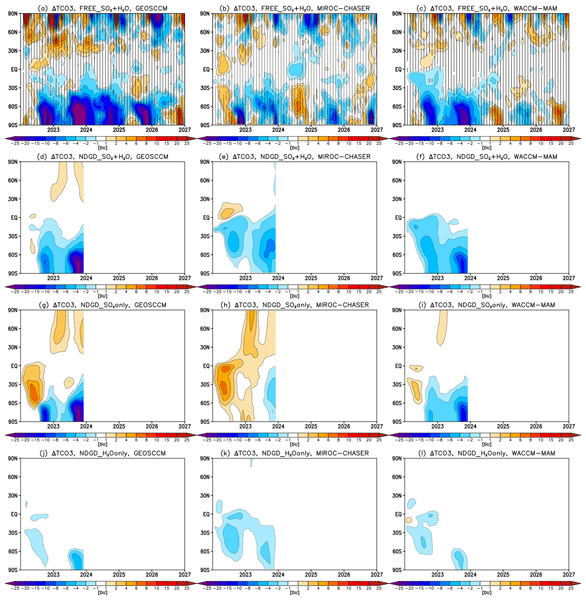
Ewa M. Bednarz, Valentina Aquila, Amy H. Butler, Peter Colarco, Eric Fleming, Freja F. Østerstrøm, David Plummer, Ilaria Quaglia, William Randel, Michelle L. Santee, Takashi Sekiya, Simone Tilmes, Xinyue Wang, Shingo Watanabe, Wandi Yu, Jun Zhang, Yunqian Zhu, and Zhihong Zhuo
Atmos. Chem. Phys., 26, 11355–11370, https://doi.org/10.5194/acp-26-11355-2026, https://doi.org/10.5194/acp-26-11355-2026, 2026
Short summary
Short summary
The 2022 Hunga eruption injected unprecedented quantities of water vapor into the stratosphere, alongside modest amounts of aerosol precursors. We assess its impacts on stratospheric ozone layer using a multi-model ensemble of chemistry-climate simulations. The results confirm the eruption's role in modulating SH (Southern Hemisphere) mid and high latitudes ozone abundances in the short term, and discuss the different chemical and dynamical processes driving those changes as well as the role of natural variability.
Dong-Chan Hong, Seok-Woo Son, Blanca Ayarzagüena, Amy H. Butler, Chaim I. Garfinkel, Peter Hitchcock, Yu-Kyung Hyun, and Jiankai Zhang
EGUsphere, https://doi.org/10.5194/egusphere-2026-2798, https://doi.org/10.5194/egusphere-2026-2798, 2026
Short summary
Short summary
This study investigates how Sudden Stratospheric Warming (SSW) influences surface climate. By comparing multi-model simulations, we isolated and quantified the role of SSWs. Results reveal that poleward mass transport during SSWs induces high pressure over the Arctic, driving changes in extratropical circulations. While SSWs alter the troposphere, chaotic internal weather variability can amplify or suppress their influence, explaining the differing surface impacts following SSWs.
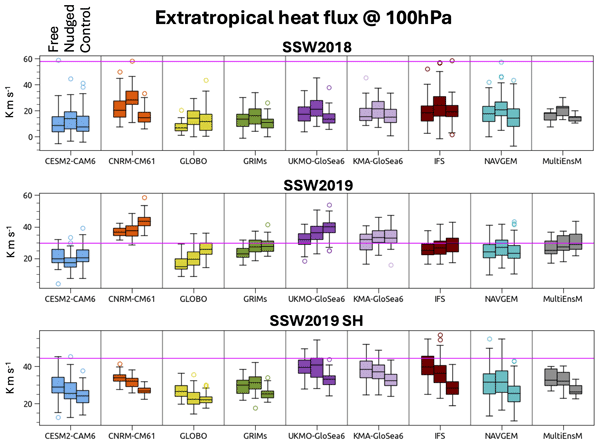
Blanca Ayarzagüena, Amy H. Butler, Peter Hitchcock, Chaim I. Garfinkel, Zac D. Lawrence, Wuhan Ning, Philip Rupp, Zheng Wu, Hilla Afargan-Gerstman, Natalia Calvo, Alvaro de la Cámara, Martin Jucker, Gerbrand Koren, Daniel De Maeseneire, Gloria L. Manney, Marisol Osman, Masakazu Taguchi, Cory Barton, Dong-Chan Hong, Yu-Kyung Hyun, Hera Kim, Jeff Knight, Piero Malguzzi, Daniele Mastrangelo, Jiyoung Oh, Inna Polichtchouk, Jadwiga H. Richter, Isla R. Simpson, Seok-Woo Son, Damien Specq, and Tim Stockdale
Weather Clim. Dynam., 7, 411–437, https://doi.org/10.5194/wcd-7-411-2026, https://doi.org/10.5194/wcd-7-411-2026, 2026
Short summary
Short summary
Sudden Stratospheric Warmings (SSWs) are known to follow a sustained wave dissipation in the stratosphere, which depends on both the tropospheric and stratospheric states. However, the relative role of each state is still unclear. Using a new set of subseasonal to seasonal forecasts, we show that the stratospheric state does not drastically affect the precursors of three recent SSWs, but modulates the stratospheric wave activity, with impacts depending on SSW features.
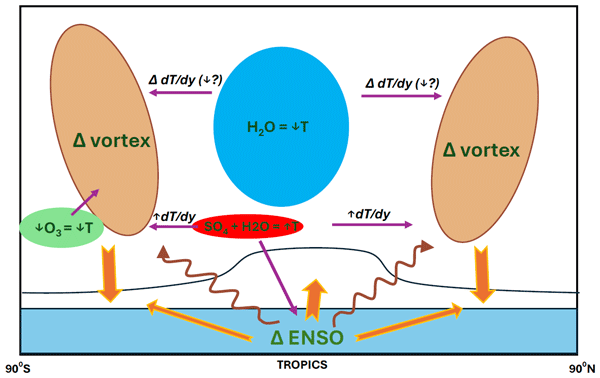
Ewa M. Bednarz, Amy H. Butler, Xinyue Wang, Zhihong Zhuo, Wandi Yu, Georgiy Stenchikov, Matthew Toohey, and Yunqian Zhu
Atmos. Chem. Phys., 26, 197–215, https://doi.org/10.5194/acp-26-197-2026, https://doi.org/10.5194/acp-26-197-2026, 2026
Short summary
Short summary
We investigate whether the 2022 Hunga eruption could affect surface climate via indirect pathways using large ensembles of Earth System Model simulations. These suggest that the eruption could have a non-negligible influence on regional surface climate, and we discuss the mechanisms via which such an influence could occur but also highlight that the forcing is relatively weak compared to natural climate variability which significantly hinders the detection of such impacts in the real world.
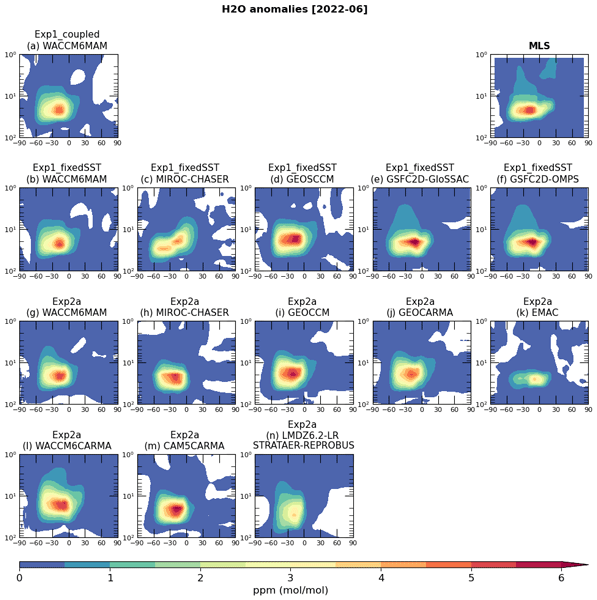
Yunqian Zhu, Hideharu Akiyoshi, Valentina Aquila, Elizabeth Asher, Ewa M. Bednarz, Slimane Bekki, Christoph Brühl, Amy H. Butler, Parker Case, Simon Chabrillat, Gabriel Chiodo, Margot Clyne, Peter R. Colarco, Sandip Dhomse, Lola Falletti, Eric Fleming, Ben Johnson, Andrin Jörimann, Mahesh Kovilakam, Gerbrand Koren, Ales Kuchar, Nicolas Lebas, Qing Liang, Cheng-Cheng Liu, Graham Mann, Michael Manyin, Marion Marchand, Olaf Morgenstern, Paul Newman, Luke D. Oman, Freja F. Østerstrøm, Yifeng Peng, David Plummer, Ilaria Quaglia, William Randel, Samuel Rémy, Takashi Sekiya, Stephen Steenrod, Timofei Sukhodolov, Simone Tilmes, Kostas Tsigaridis, Rei Ueyama, Daniele Visioni, Xinyue Wang, Shingo Watanabe, Yousuke Yamashita, Pengfei Yu, Wandi Yu, Jun Zhang, and Zhihong Zhuo
Geosci. Model Dev., 18, 5487–5512, https://doi.org/10.5194/gmd-18-5487-2025, https://doi.org/10.5194/gmd-18-5487-2025, 2025
Short summary
Short summary
To understand the climate impact of the 2022 Hunga volcanic eruption, we developed a climate model–observation comparison project. The paper describes the protocols and models that participate in the experiments. We designed several experiments to achieve our goals of this activity: (1) to evaluate the climate model performance and (2) to understand the Earth system responses to this eruption.
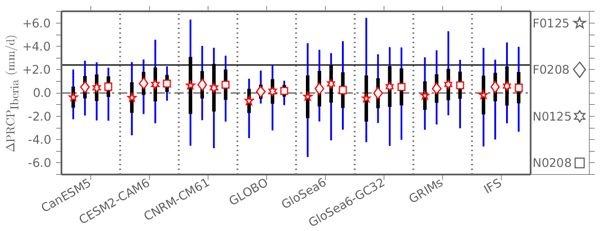
Ying Dai, Peter Hitchcock, Amy H. Butler, Chaim I. Garfinkel, and William J. M. Seviour
Weather Clim. Dynam., 6, 841–862, https://doi.org/10.5194/wcd-6-841-2025, https://doi.org/10.5194/wcd-6-841-2025, 2025
Short summary
Short summary
Using a new database of subseasonal to seasonal (S2S) forecasts, we find that with a successful forecast of the sudden stratospheric warming (SSW), S2S models can capture the European precipitation signals after the 2018 SSW several weeks in advance. The findings indicate that the stratosphere represents an important source of S2S predictability for precipitation over Europe and call for consideration of stratospheric variability in hydrological prediction at S2S timescales.
Tereza Uhlíková, Timo Vihma, Alexey Yu Karpechko, and Petteri Uotila
The Cryosphere, 19, 1031–1046, https://doi.org/10.5194/tc-19-1031-2025, https://doi.org/10.5194/tc-19-1031-2025, 2025
Short summary
Short summary
To better understand the local, regional, and global impacts of the recent rapid sea-ice decline in the Arctic, one of the key issues is to quantify the effects of sea-ice concentration on the surface radiative fluxes. We analyse these effects utilising four data sets called atmospheric reanalyses, and we evaluate uncertainties in these effects arising from inter-reanalysis differences in the sensitivity of the surface radiative fluxes to sea-ice concentration.
Chaim I. Garfinkel, Zachary D. Lawrence, Amy H. Butler, Etienne Dunn-Sigouin, Irene Erner, Alexey Y. Karpechko, Gerbrand Koren, Marta Abalos, Blanca Ayarzagüena, David Barriopedro, Natalia Calvo, Alvaro de la Cámara, Andrew Charlton-Perez, Judah Cohen, Daniela I. V. Domeisen, Javier García-Serrano, Neil P. Hindley, Martin Jucker, Hera Kim, Robert W. Lee, Simon H. Lee, Marisol Osman, Froila M. Palmeiro, Inna Polichtchouk, Jian Rao, Jadwiga H. Richter, Chen Schwartz, Seok-Woo Son, Masakazu Taguchi, Nicholas L. Tyrrell, Corwin J. Wright, and Rachel W.-Y. Wu
Weather Clim. Dynam., 6, 171–195, https://doi.org/10.5194/wcd-6-171-2025, https://doi.org/10.5194/wcd-6-171-2025, 2025
Short summary
Short summary
Variability in the extratropical stratosphere and troposphere is coupled, and because of the longer timescales characteristic of the stratosphere, this allows for a window of opportunity for surface prediction. This paper assesses whether models used for operational prediction capture these coupling processes accurately. We find that most processes are too weak; however downward coupling from the lower stratosphere to the near surface is too strong.
Thomas J. Ballinger, Kent Moore, Qinghua Ding, Amy H. Butler, James E. Overland, Richard L. Thoman, Ian Baxter, Zhe Li, and Edward Hanna
Weather Clim. Dynam., 5, 1473–1488, https://doi.org/10.5194/wcd-5-1473-2024, https://doi.org/10.5194/wcd-5-1473-2024, 2024
Short summary
Short summary
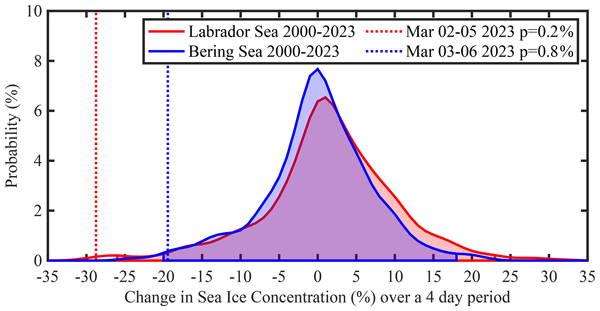
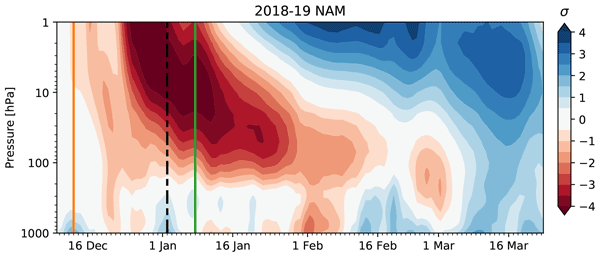
This study chronicles the meteorological conditions that led to the anomalous, tandem March 2023 ice melt event in the Labrador and Bering seas. A sudden stratospheric warming event initiated the development of an anticyclonic circulation pattern over the Greenland–Labrador region, while the La Niña background state supported ridging conditions over Alaska, both of which aided northward transport of warm, moist air and drove the concurrent sea ice melt extremes.
Joshua Dorrington, Marta Wenta, Federico Grazzini, Linus Magnusson, Frederic Vitart, and Christian M. Grams
Nat. Hazards Earth Syst. Sci., 24, 2995–3012, https://doi.org/10.5194/nhess-24-2995-2024, https://doi.org/10.5194/nhess-24-2995-2024, 2024
Short summary
Short summary
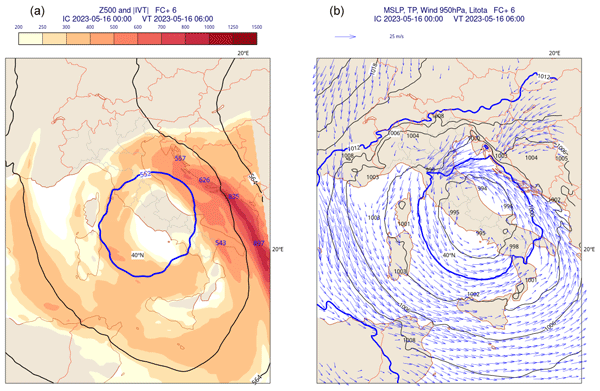
Extreme rainfall is the leading weather-related source of damages in Europe, but it is still difficult to predict on long timescales. A recent example of this was the devastating floods in the Italian region of Emiglia Romagna in May 2023. We present perspectives based on large-scale dynamical information that allows us to better understand and predict such events.
Xavier J. Levine, Ryan S. Williams, Gareth Marshall, Andrew Orr, Lise Seland Graff, Dörthe Handorf, Alexey Karpechko, Raphael Köhler, René R. Wijngaard, Nadine Johnston, Hanna Lee, Lars Nieradzik, and Priscilla A. Mooney
Earth Syst. Dynam., 15, 1161–1177, https://doi.org/10.5194/esd-15-1161-2024, https://doi.org/10.5194/esd-15-1161-2024, 2024
Short summary
Short summary
While the most recent climate projections agree that the Arctic is warming, differences remain in how much and in other climate variables such as precipitation. This presents a challenge for stakeholders who need to develop mitigation and adaptation strategies. We tackle this problem by using the storyline approach to generate four plausible and actionable realisations of end-of-century climate change for the Arctic, spanning its most likely range of variability.
Tereza Uhlíková, Timo Vihma, Alexey Yu Karpechko, and Petteri Uotila
The Cryosphere, 18, 957–976, https://doi.org/10.5194/tc-18-957-2024, https://doi.org/10.5194/tc-18-957-2024, 2024
Short summary
Short summary
A prerequisite for understanding the local, regional, and hemispherical impacts of Arctic sea-ice decline on the atmosphere is to quantify the effects of sea-ice concentration (SIC) on the sensible and latent heat fluxes in the Arctic. We analyse these effects utilising four data sets called atmospheric reanalyses, and we evaluate uncertainties in these effects arising from inter-reanalysis differences in SIC and in the sensitivity of the latent and sensible heat fluxes to SIC.
Ewa M. Bednarz, Amy H. Butler, Daniele Visioni, Yan Zhang, Ben Kravitz, and Douglas G. MacMartin
Atmos. Chem. Phys., 23, 13665–13684, https://doi.org/10.5194/acp-23-13665-2023, https://doi.org/10.5194/acp-23-13665-2023, 2023
Short summary
Short summary
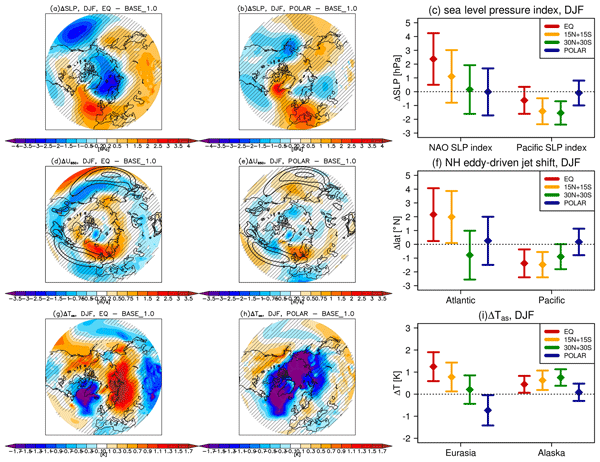
We use a state-of-the-art Earth system model and a set of stratospheric aerosol injection (SAI) strategies to achieve the same level of global mean surface cooling through different combinations of location and/or timing of the injection. We demonstrate that the choice of SAI strategy can lead to contrasting impacts on stratospheric and tropospheric temperatures, circulation, and chemistry (including stratospheric ozone), thereby leading to different impacts on regional surface climate.
Dillon Elsbury, Amy H. Butler, John R. Albers, Melissa L. Breeden, and Andrew O'Neil Langford
Atmos. Chem. Phys., 23, 5101–5117, https://doi.org/10.5194/acp-23-5101-2023, https://doi.org/10.5194/acp-23-5101-2023, 2023
Short summary
Short summary
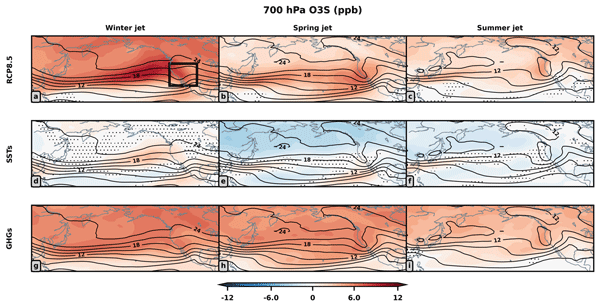
One of the global hotspots where stratosphere-to-troposphere transport (STT) of ozone takes place is over Pacific North America (PNA). However, we do not know how or if STT over PNA will change in response to climate change. Using climate model experiments forced with
worst-casescenario Representative Concentration Pathway 8.5 climate change, we find that changes in net chemical production and transport of ozone in the lower stratosphere increase STT of ozone over PNA in the future.
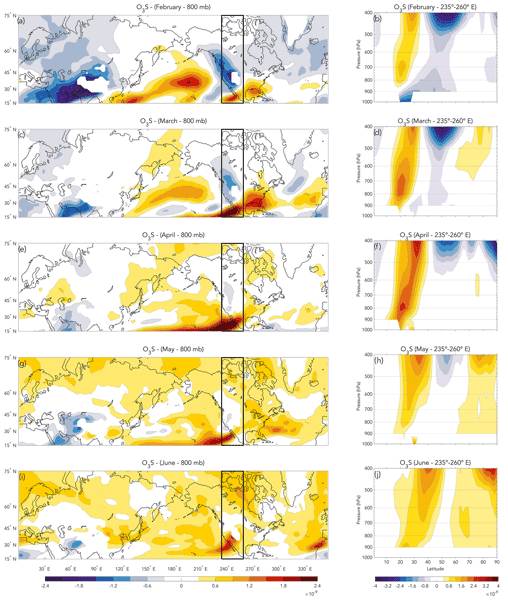
John R. Albers, Amy H. Butler, Andrew O. Langford, Dillon Elsbury, and Melissa L. Breeden
Atmos. Chem. Phys., 22, 13035–13048, https://doi.org/10.5194/acp-22-13035-2022, https://doi.org/10.5194/acp-22-13035-2022, 2022
Short summary
Short summary
Ozone transported from the stratosphere contributes to background ozone concentrations in the free troposphere and to surface ozone exceedance events that affect human health. The physical processes whereby the El Niño–Southern Oscillation (ENSO) modulates North American stratosphere-to-troposphere ozone transport during spring are documented, and the usefulness of ENSO for predicting ozone events that may cause exceedances in surface air quality standards are assessed.
Zachary D. Lawrence, Marta Abalos, Blanca Ayarzagüena, David Barriopedro, Amy H. Butler, Natalia Calvo, Alvaro de la Cámara, Andrew Charlton-Perez, Daniela I. V. Domeisen, Etienne Dunn-Sigouin, Javier García-Serrano, Chaim I. Garfinkel, Neil P. Hindley, Liwei Jia, Martin Jucker, Alexey Y. Karpechko, Hera Kim, Andrea L. Lang, Simon H. Lee, Pu Lin, Marisol Osman, Froila M. Palmeiro, Judith Perlwitz, Inna Polichtchouk, Jadwiga H. Richter, Chen Schwartz, Seok-Woo Son, Irene Erner, Masakazu Taguchi, Nicholas L. Tyrrell, Corwin J. Wright, and Rachel W.-Y. Wu
Weather Clim. Dynam., 3, 977–1001, https://doi.org/10.5194/wcd-3-977-2022, https://doi.org/10.5194/wcd-3-977-2022, 2022
Short summary
Short summary
Forecast models that are used to predict weather often struggle to represent the Earth’s stratosphere. This may impact their ability to predict surface weather weeks in advance, on subseasonal-to-seasonal (S2S) timescales. We use data from many S2S forecast systems to characterize and compare the stratospheric biases present in such forecast models. These models have many similar stratospheric biases, but they tend to be worse in systems with low model tops located within the stratosphere.
Peter Hitchcock, Amy Butler, Andrew Charlton-Perez, Chaim I. Garfinkel, Tim Stockdale, James Anstey, Dann Mitchell, Daniela I. V. Domeisen, Tongwen Wu, Yixiong Lu, Daniele Mastrangelo, Piero Malguzzi, Hai Lin, Ryan Muncaster, Bill Merryfield, Michael Sigmond, Baoqiang Xiang, Liwei Jia, Yu-Kyung Hyun, Jiyoung Oh, Damien Specq, Isla R. Simpson, Jadwiga H. Richter, Cory Barton, Jeff Knight, Eun-Pa Lim, and Harry Hendon
Geosci. Model Dev., 15, 5073–5092, https://doi.org/10.5194/gmd-15-5073-2022, https://doi.org/10.5194/gmd-15-5073-2022, 2022
Short summary
Short summary
This paper describes an experimental protocol focused on sudden stratospheric warmings to be carried out by subseasonal forecast modeling centers. These will allow for inter-model comparisons of these major disruptions to the stratospheric polar vortex and their impacts on the near-surface flow. The protocol will lead to new insights into the contribution of the stratosphere to subseasonal forecast skill and new approaches to the dynamical attribution of extreme events.
Shima Bahramvash Shams, Von P. Walden, James W. Hannigan, William J. Randel, Irina V. Petropavlovskikh, Amy H. Butler, and Alvaro de la Cámara
Atmos. Chem. Phys., 22, 5435–5458, https://doi.org/10.5194/acp-22-5435-2022, https://doi.org/10.5194/acp-22-5435-2022, 2022
Short summary
Short summary
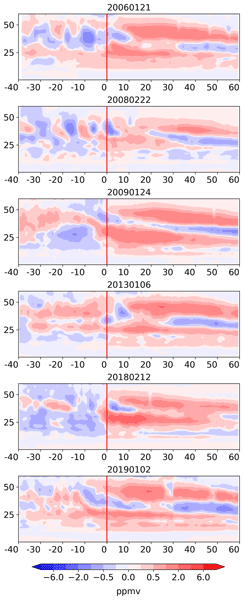
Large-scale atmospheric circulation has a strong influence on ozone in the Arctic, and certain anomalous dynamical events, such as sudden stratospheric warmings, cause dramatic alterations of the large-scale circulation. A reanalysis model is evaluated and then used to investigate the impact of sudden stratospheric warmings on mid-atmospheric ozone. Results show that the position of the cold jet stream over the Arctic before these events influences the variability of ozone.
Adam A. Scaife, Mark P. Baldwin, Amy H. Butler, Andrew J. Charlton-Perez, Daniela I. V. Domeisen, Chaim I. Garfinkel, Steven C. Hardiman, Peter Haynes, Alexey Yu Karpechko, Eun-Pa Lim, Shunsuke Noguchi, Judith Perlwitz, Lorenzo Polvani, Jadwiga H. Richter, John Scinocca, Michael Sigmond, Theodore G. Shepherd, Seok-Woo Son, and David W. J. Thompson
Atmos. Chem. Phys., 22, 2601–2623, https://doi.org/10.5194/acp-22-2601-2022, https://doi.org/10.5194/acp-22-2601-2022, 2022
Short summary
Short summary
Great progress has been made in computer modelling and simulation of the whole climate system, including the stratosphere. Since the late 20th century we also gained a much clearer understanding of how the stratosphere interacts with the lower atmosphere. The latest generation of numerical prediction systems now explicitly represents the stratosphere and its interaction with surface climate, and here we review its role in long-range predictions and projections from weeks to decades ahead.
Nicholas L. Tyrrell, Juho M. Koskentausta, and Alexey Yu. Karpechko
Weather Clim. Dynam., 3, 45–58, https://doi.org/10.5194/wcd-3-45-2022, https://doi.org/10.5194/wcd-3-45-2022, 2022
Short summary
Short summary
El Niño events are known to effect the variability of the wintertime stratospheric polar vortex. The observed relationship differs from what is seen in climate models. Climate models have errors in their average winds and temperature, and in this work we artificially reduce those errors to see how that changes the communication of El Niño events to the polar stratosphere. We find reducing errors improves stratospheric variability, but does not explain the differences with observations.
Cited articles
Afargan-Gerstman, H., Büeler, D., Wulff, C. O., Sprenger, M., and Domeisen, D. I. V.: Stratospheric influence on the winter North Atlantic storm track in subseasonal reforecasts, Weather Clim. Dynam., 5, 231–249, https://doi.org/10.5194/wcd-5-231-2024, 2024.
Albers, J. R. and Newman, M.: A priori identification of skillful extratropical subseasonal forecasts, Geophys. Res. Lett., 46, 12527–12536, https://doi.org/10.1029/2019GL085270, 2019.
Barker, T.: The relationship between spread and forecast error in extended-range forecasts, J. Climate, 4, 733–742, https://doi.org/10.1175/1520-0442(1991)004<0733:TRBSAF>2.0.CO;2, 1991.
Barnes, E. A., Samarasinghe, S. M., Ebert-Uphoff, I., and Furtado, J. C.: Tropospheric and stratospheric causal pathways between the MJO and NAO, J. Geophys. Res.-Atmos., 124, 9356–9371, https://doi.org/10.1029/2019JD031024, 2019.
Breeden, M. L., Albers, J. R., Butler, A. H., and Newman, M.: The Spring Minimum in Subseasonal 2-m Temperature Forecast Skill over North America, Mon. Weather Rev., 150, 2617–2628, https://doi.org/10.1175/MWR-D-22-0062.1, 2022
Butler, A. H., Arribas, A., Athanassiadou, M., Baehr, J., Calvo, N., Charlton-Perez, A., Déqué, M., Domeisen, D. I., Fröhlich, K., Hendon, H., Imada, Y., Ishii, M., Iza, M., Karpechko, A. Yu., Kumar, A., MacLachlan, C., Merryfield, W. J., Müller, W. A., O'Neill, A., Scaife, A. A., Scinocca, J., Sigmond, M., Stockdale, T. N., and Yasuda, T.: The climate-system historical forecast project: Do stratosphere-resolving models make better seasonal climate predictions in boreal winter?, Q. J. Roy. Meteor. Soc., 142, 1413–1427, https://doi.org/10.1002/qj.2743, 2016.
Butler, A., Charlton-Perez, A., Domeisen, D. I. V., Garfinkel, C., Gerber, E. P., Hitchcock, P., Karpechko, A. Y., Maycock, A. C., Sigmond, M., Simpson, I., and Son, S.-W.: Sub-seasonal Predictability and the Stratosphere, in: Sub-Seasonal to Seasonal Prediction, edited by: Robertson, A. W. and Vitart, F., Elsevier, Chapter 11, 223–241, ISBN 978-0-12-811714-9, https://doi.org/10.1016/B978-0-12-811714-9.00011-5, 2019.
Butler, A. H., Sjoberg, J. P., Seidel, D. J., and Rosenlof, K. H.: A sudden stratospheric warming compendium, Earth Syst. Sci. Data, 9, 63–76, https://doi.org/10.5194/essd-9-63-2017, 2017.
Chang, E. K., Lee, S., and Swanson, K. L.: Storm track dynamics, J. Climate, 15, 2163–2183, https://doi.org/10.1175/1520-0442(2002)015<02163:STD>2.0.CO;2, 2002.
Charlton-Perez, A. J., Bröcker, J., Karpechko, A. Y., Lee, S. H., Sigmond, M., and Simpson, I. R.: A minimal model to diagnose the contribution of the stratosphere to tropospheric forecast skill, J. Geophys. Res.-Atmospheres, 126, e2021JD035504, https://doi.org/10.1029/2021JD035504, 2021.
Copernicus Climate Change Service, Climate Data Store: ERA5 hourly data on pressure levels from 1940 to present, Copernicus Climate Change Service (C3S) Climate Data Store (CDS) [data set], https://doi.org/10.24381/cds.bd0915c6, 2023.
Dai, Y., Hitchcock, P., and Simpson, I.R.: Dynamics and impacts of the North Pacific eddy-driven jet response to sudden stratospheric warmings, J. Climate, 36, 865–884, https://doi.org/10.1175/JCLI-D-22-0300.1, 2023.
Domeisen, D. I. V., Butler, A. H., Charlton-Perez, A. J., Ayarzagüena, B., Baldwin, M. P., Dunn-Sigouin, E., Furtado, J. C., Garfinkel, C. I., Hitchcock, P., Karpechko, A. Y., Kim, H., Knight, J., Lang, A. L., Lim, E.-P., Marshall, A., Roff, G., Schwartz, C., Simpson, I. R., Son, S.-W., and Taguchi, M.: The Role of the Stratosphere in Subseasonal to Seasonal Prediction: 2. Predictability Arising From Stratosphere-Troposphere Coupling, J. Geophys. Res.-Atmos., 125, e2019JD030923, https://doi.org/10.1029/2019JD030923, 2020
Eade, R., Smith, D., Scaife, A., Wallace, E., Dunstone, N., Hermanson, L., and Robinson, N.: Do seasonal-to-decadal climate predictions underestimate the predictability of the real world?, Geophys. Res. Lett., 41, 5620–5628, https://doi.org/10.1002/2014GL061146, 2014.
Erner, I. and Karpechko, A. Y.: Factors influencing subseasonal predictability of northern Eurasian cold spells, Q. J. Roy. Meteor. Soc., 150, 2955–2975, https://doi.org/10.1002/qj.4744, 2024.
Erner, I., Karpechko, A. Yu., Kämäräinen, M. and Järvinen, H.: Stratosphere-troposphere coupling enhances subseasonal predictability of Northern Eurasian cold spells, Q. J. Roy. Meteor. Soc., 148, 2769–2783, https://doi.org/10.1002/qj.4335, 2022.
Ferranti, L., Magnusson, L., Vitart, F., and Richardson, D.S.: How far in advance can we predict changes in large-scale flow leading to severe cold conditions over Europe?, Q. J. Roy. Meteor. Soc., 144, 1788–1802, https://doi.org/10.1002/qj.3341, 2018.
Garfinkel, C. I., Knight, J., Taguchi, M., Schwartz, C., Cohen, J., Chen, W., Butler, A. H., and Domeisen, D. I.: Development of the signal-to-noise paradox in subseasonal forecasting models: When? Where? Why?, Q. J. Roy. Meteor. Soc., 150, 4417–4436, https://doi.org/10.1002/qj.4822, 2024.
Garfinkel, C. I., Lawrence, Z. D., Butler, A. H., Dunn-Sigouin, E., Erner, I., Karpechko, A. Y., Koren, G., Abalos, M., Ayarzagüena, B., Barriopedro, D., Calvo, N., de la Cámara, A., Charlton-Perez, A., Cohen, J., Domeisen, D. I. V., García-Serrano, J., Hindley, N. P., Jucker, M., Kim, H., Lee, R. W., Lee, S. H., Osman, M., Palmeiro, F. M., Polichtchouk, I., Rao, J., Richter, J. H., Schwartz, C., Son, S.-W., Taguchi, M., Tyrrell, N. L., Wright, C. J., and Wu, R. W.-Y.: A process-based evaluation of biases in extratropical stratosphere–troposphere coupling in subseasonal forecast systems, Weather Clim. Dynam., 6, 171–195, https://doi.org/10.5194/wcd-6-171-2025, 2025.
Hardiman, S. C., Dunstone, N. J., Scaife, A. A., Smith, D. M., Comer, R., Nie, Y., and Ren, H.-L.: Missing eddy feedback may explain weak signal-to-noise ratios in climate predictions, npj Climate Atmos. Sci., 5, 57, https://doi.org/10.1038/s41612-022-00280-4, 2022.
Hersbach, H., Bell, B., Berrisford, P., Hirahara, S., Horányi, A., Muñoz-Sabater, J., Nicolas, J., Peubey, C., Radu, R., Schepers, D., Simmons, A., Soci, C., Abdalla, S., Abellan, X., Balsamo, G., Bechtold, P., Biavati, G., Bidlot, J., Bonavita, M., De Chiara, G., Dahlgren, P., Dee, D., Diamantakis, M., Dragani, R., Flemming, J., Forbes, R., Fuentes, M., Geer, A., Haimberger, L., Healy, S., Hogan, R. J., Hólm, E., Janisková, M., Keeley, S., Laloyaux, P., Lopez, P., Lupu, C., Radnoti, G., de Rosnay, P., Rozum, I., Vamborg, F., Villaume, S., and Thépaut, J.-N.: The ERA5 global re-analysis, Q. J. Roy. Meteor. Soc., 146, 1999–2049, 2020.
Hitchcock, P., and Simpson, I. R.: The downward influence of stratospheric sudden warmings, J. Atmos. Sci., 71, 10, 3856–3876, https://doi.org/10.1175/JAS-D-14-0012.1, 2014.
Hitchcock, P., Butler, A., Charlton-Perez, A., Garfinkel, C. I., Stockdale, T., Anstey, J., Mitchell, D., Domeisen, D. I. V., Wu, T., Lu, Y., Mastrangelo, D., Malguzzi, P., Lin, H., Muncaster, R., Merryfield, B., Sigmond, M., Xiang, B., Jia, L., Hyun, Y.-K., Oh, J., Specq, D., Simpson, I. R., Richter, J. H., Barton, C., Knight, J., Lim, E.-P., and Hendon, H.: Stratospheric Nudging And Predictable Surface Impacts (SNAPSI): a protocol for investigating the role of stratospheric polar vortex disturbances in subseasonal to seasonal forecasts, Geosci. Model Dev., 15, 5073–5092, https://doi.org/10.5194/gmd-15-5073-2022, 2022.
Hopson, T. M.: Assessing the ensemble spread-error relationship, Mon. Weather Rev., 142, 1125–1142, https://doi.org/10.1175/MWR-D-12-00111.1, 2014.
Jung, T., Miller, M. J., and Palmer, T. N.: Diagnosing the origin of extended-range forecast error, Mon. Weather Rev., 138, 2434–2446, 2010a.
Jung, T., Palmer, T. N., Rodwell, M. J., and Serrar, S.: Understanding the anomalously cold European winter 2005/06 using relaxation experiments, Mon. Weather Rev., 138, 3157–3174, 2010b.
Karpechko, A. Y., Hitchcock, P., Peters, D. H. W., and Schneidereit, A.: Predictability of downward propagation of major sudden stratospheric warmings, Q. J. Roy. Meteor. Soc., 143, 1459–1470, https://doi.org/10.1002/qj.3017, 2017.
Karpechko, A. Y., Charlton-Perez, A., Balmaseda, M., Tyrrell, N., and Vitart, F.: Predicting sudden stratospheric warming 2018 and its climate impacts with a multimodel ensemble, Geophys. Res. Lett., 45, 13538–13546, https://doi.org/10.1029/2018GL081091, 2018.
Karpechko, A. Y., Vitart, F., Statnaia, I., Alonso-Balmaseda, M., Charlton-Perez, A., and Polichtchouk, I.: The tropical influence on sub-seasonal predictability of wintertime stratosphere and stratosphere-troposphere coupling, Q. J. Roy. Meteor. Soc., 150, 1357–1374, https://doi.org/10.1002/qj.4649, 2024.
Karpechko, A. Yu.: Data and python codes for the manuscript “Signal, noise and skill in sub-seasonal forecasts: the role of teleconnections” by Karpechko et al., Finnish Meteorological Institute [data set], https://doi.org/10.57707/FMI-B2SHARE.FC392EBDC5724265B4B7D6A98B149D48, 2025.
Kautz, L.-A., Polichtchouk, I., Birner, T., Garny, H., and Pinto, J. G.: Enhanced extended-range predictability of the 2018 late-winter Eurasian cold spell due to the stratosphere, Q. J. Roy. Meteor. Soc., 146, 1040–1055, https://doi.org/10.1002/qj.3724, 2020.
Kolstad, E. W., Lee, S. H., Butler, A. H., Domeisen, D. I. V., and Wulff, C. O.: Diverse surface signatures of stratospheric polar vortex anomalies, J. Geophys. Res.-Atmos., 127, e2022JD037422, https://doi.org/10.1029/2022JD037422, 2022.
Koster, R. D., Schubert, S. D., DeAngelis, A. M., Chang, Y., and Scaife, A. A.: Ocean–Land Teleconnections and Chaotic Atmospheric Variability, J. Climate, 38, 1535–1550, https://doi.org/10.1175/JCLI-D-23-0740.1, 2025.
Kumar, A., Peng, P., and Chen, M.: Is there a relationship between potential and actual skill?, Mon. Weather Rev., 142, 2220–2227, 2014.
Lee, S. H., Lawrence, Z. D., Butler, A. H., and Karpechko, A. Y.: Seasonal forecasts of the exceptional Northern Hemisphere winter of 2020, Geophys. Res. Lett., 47, e2020GL090328, https://doi.org/10.1029/2020GL090328, 2020.
Lin, H., Frederiksen, J. S., Straus, D. M., and Stan, C.: Tropical-extratropical interactions and teleconnections, edited by: Robertson, A. W. and Vitart, F., Sub-seasonal to seasonal prediction: The gap between weather and climate forecasting, Chapter 7, 143–164, Amsterdam, the Netherlands, Elsevier, https://doi.org/10.1016/B978-0-12-811714-9.00007-3, 2019.
Mariotti, A., Baggett, C., Barnes, E., Becker, E., Butler, A., Collins, D., Dirmeyer, P., Ferranti, L., Johnson, N., Jones, J., Kirtman, B., Lang, A., Molod, A., Newman, M., Robertson, A., Schubert, S., Waliser, D., and Albers, J.: Windows of opportunity for skillful forecasts subseasonal to seasonal and beyond, Bull. Amer. Meteor. Soc., 101, E608–E625, 2020.
Matthias, V. and Kretschmer, M.: The influence of stratospheric wave reflection on North American cold spells, Mon. Weather Rev., 148, 1675–1690, 2020.
Newman, M., Sardeshmukh, P. D., Winkler, C. R., and Whitaker, J. S.: A study of subseasonal predictability, Mon. Weather Rev., 131, 1715–1732, https://doi.org/10.1175//2558.1, 2003.
Pegion, K., DelSole, T., Becker, E., and Cicerone, T.: Assessing the fidelity of predictability estimates, Climate Dyn., 53, 7251–7265, https://doi.org/10.1007/s00382-017-3903-7, 2019.
Pegion, K. and Sardeshmukh, P. D.: Prospects for improving subseasonal predictions, Mon. Weather Rev., 139, 3648–3666, https://doi.org/10.1175/MWR-D-11-00004.1, 2011.
Rao, J. and Garfinkel, C. I.: The strong stratospheric polar vortex in March 2020 in sub-seasonal to seasonal models: Implications for empirical prediction of the low Arctic total ozone extreme, J. Geophys. Res.-Atmos., 126, e2020JD034190, https://doi.org/10.1029/2020JD034190, 2021.
Richter, J.H., Glanville, A. A., King, T., Kumar, S., Yeager, S. G., Davis, N. A., Duan, Y., Fowler, M. D., Jaye, A., Edwards, J., Caron, J. M., Dirmeyer, P. A., Danabasoglu, G., and Oleson, K.: Quantifying sources of subseasonal prediction skill in CESM2, npj Clim. Atmos. Sci., 7, https://doi.org/10.1038/s41612-024-00595-4, 2024.
Roberts, C., Balmaseda, M., Ferranti, L., and Vitart, F.: Euro-Atlantic weather regimes and their modulation by troposphere and stratosphere teleconnection pathways in ECMWF re-forecasts, Mon. Weather Rev., 151, 2779–2799, 2023.
Scaife, A. A. and Smith, D.: A signal-to-noise paradox in climate science, npj Clim. Atmos. Sci., 1, 28, https://doi.org/10.1038/s41612-018-0038-4, 2018.
Scaife, A. A., Arribas, A., Blockley, E., Brookshaw, A., Clark, R. T., Dunstone, N., Eade, R., Fereday, D., Folland, C. K., Gordon, M., Hermanson, L., Knight, J. R., Lea, D. J., MacLachlan, C., Maidens, A., Martin, M., Peterson, A. K., Smith, D., Vellinga, M., Wallace, E., Waters, J., and Williams, A.: Skillful longrange prediction of European and North American winters, Geophys. Res. Lett., 41, https://doi.org/10.1002/2014GL059637, 2014.
Siegert, S., Stephenson, D., Sansom, P., Scaife, A., Eade, R. and Arribas, A.: A Bayesian framework for verification and recalibration of ensemble forecasts: how uncertain is NAO predictability?, J. Climate, 29, 995–1012, 2016.
Sigmond, M., Scinocca, J. F., Kharin, V. V., and Shepherd, T. G.: Enhanced seasonal forecast skill following stratospheric sudden warmings, Nat. Geosci., 6, 98–102, https://doi.org/10.1038/ngeo1698, 2013.
Spaeth, J., Rupp, P., Garny, H., and Birner, T.: Stratospheric impact on subseasonal forecast uncertainty in the northern extratropics, Commun. Earth Environ., 5, 1–7, https://doi.org/10.1038/s43247-024-01292-z, 2024.
Stan, C., Zheng, C., Chang, E. K., Domeisen, D. I. V., Garfinkel, C. I., Jenney, A. M., Kim, H., Lim, Y., Lin, H., Robertson, A., Schwartz, C., Vitart, F., Wang, J., and Yadav, P.: Advances in the Prediction of MJO Teleconnections in the S2S Forecast Systems. Bull. Amer. Meteor. Soc., 103, 6, E1426–E1447, https://doi.org/10.1175/BAMS-D-21-0130.1, 2022.
Tripathi, O. P., Charlton-Perez, A., Sigmond, M., and Vitart, F.: Enhanced long-range forecast skill in boreal winter following stratospheric strong vortex conditions, Environ. Res. Lett., 10, 104007, https://doi.org/10.1088/1748-9326/10/10/104007, 2015.
Tang, Y., Lin, H., and Moore, A. M.: Measuring the potential predictability of ensemble climate predictions, J. Geophys. Res., 113, D04108, https://doi.org/10.1029/2007JD008804, 2008.
Vitart, F.: Evolution of ECMWF sub-seasonal forecast skill scores, Q. J. Roy. Meteor. Soc., 140, 1889–1899, https://doi.org/10.1002/qj.2256, 2014.
Vitart, F.: Madden–Julian oscillation prediction and teleconnections in the S2S database, Q. J. Roy. Meteor. Soc., 143, 2210–2220, https://doi.org/10.1002/qj.3079, 2017.
Vitart, F. and Balmaseda, M. A.: Sources of MJO teleconnection errors in the ECMWF extended-range forecasts, Q. J. Roy. Meteor. Soc., 150, 2028–2044, https://doi.org/10.1002/qj.4688, 2024.
Vitart, F., Ardilouze, C., Bonet, A., Brookshaw, A., Chen, M., Codorean, C., Déqué, M., Ferranti, L., Fucile, E., Fuentes, M., Hendon, H., Hodgson, J., Kang, H.-S., Kumar, A., Lin, H., Liu, G., Liu, X., Malguzzi, P., Mallas, I., Manoussakis, M., Mastrangelo, D., MacLachlan, C., McLean, P., Minami, A., Mladek, R., Nakazawa, T., Najm, S., Nie, Y., Rixen, M., Robertson, A. W., Ruti, P., Sun, C., Takaya, Y., Tolstykh, M., Venuti, F., Waliser, D., Woolnough, S., Wu, T., Won, D.-J., Xiao, H., Zaripov, R., and Zhang, L.: The Subseasonal to Seasonal (S2S) Prediction Project Database, B. Am. Meteorol. Soc., 98, 163–173, https://doi.org/10.1175/BAMS-D-16-0017.1, 2017.
Vitart, F., Robertson, A., Brookshaw, A., Caltabiano, N., Coelho, C., de Coning, E., Dirmeyer, P., Domeisen, D., Hirons, L., Kim, H., Lin, H., Kumar, A., Molod, A., Robbins, J., Segele, Z., Spillman, C., Stan, C., Takaya, Y., Woolnough, S., White, C., and Wu, T.: The WWRP/WCRP S2S Project and Its Achievements, Bull. Amer. Meteor. Soc., 106, E791–E808, https://doi.org/10.1175/BAMS-D-24-0047.1, 2025.
Weisheimer, A., Baker, L., Bröcker, J., Garfinkel, C., Hardiman, S., Hodson, D., Palmer, T., Robson, J., Scaife, A., Screen, J., Shepherd, T., Smith, D., and Sutton, R.: The signal-to-noise paradox in climate forecasts: revisiting our understanding and identifying future priorities, Bull. Amer. Meteor. Soc., 105, E651–E659, 2024.
Whitaker, J. S. and Loughe, A. F.: The relationship between ensemble spread and ensemble mean skill, Mon. Weather Rev., 126, 3292–3302, https://doi.org/10.1175/1520-0493(1998)126<3292:TRBESA>2.0.CO;2, 1998.
White, I., Garfinkel, C. I., Gerber, E. P., Jucker, M., Aquila, V., and Oman, L. D.: The downward influence of sudden stratospheric warmings: Association with tropospheric precursors, J. Climate, 32, 85–108, https://doi.org/10.1175/jcli-d-18-0053.1, 2019.
Download
Please read the editorial note first before accessing the article.
- Article
(19109 KB) - Full-text XML
-
Supplement
(9770 KB) - BibTeX
- EndNote
Short summary
We study how the knowledge of future tropical and stratospheric conditions could improve forecasts in winter remotely, via teleconnections, 3–6 weeks ahead. We find that the tropics improve forecasts of sea level pressure in subtropics, Europe, and North America. The stratosphere improves forecasts in high latitudes and Europe. Improvements are small for temperature and precipitation. Larger forecast ensembles than usually available for research are needed to predict teleconnection signals.
We study how the knowledge of future tropical and stratospheric conditions could improve...


