Articles | Volume 7, issue 3
https://doi.org/10.5194/wcd-7-1285-2026
© Author(s) 2026. This work is distributed under
the Creative Commons Attribution 4.0 License.
https://doi.org/10.5194/wcd-7-1285-2026
© Author(s) 2026. This work is distributed under
the Creative Commons Attribution 4.0 License.
Synoptic climatology of extratropical transition of tropical cyclones over the Southern Hemisphere

Australian Research Council Centre of Excellence for the Weather of the 21st Century and School of Earth, Atmosphere and Environment, Monash University, Clayton, Victoria, Australia
Elizabeth A. Ritchie
Australian Research Council Centre of Excellence for the Weather of the 21st Century and School of Earth, Atmosphere and Environment, Monash University, Clayton, Victoria, Australia
Neil J. Holbrook
Australian Research Council Centre of Excellence for the Weather of the 21st Century and Institute for Marine and Antarctic Studies, University of Tasmania, Hobart, Tasmania, Australia
Related authors
Linyuan Sun, Andréa S. Taschetto, Shayne McGregor, Lisa V. Alexander, and Chenhui Jin
EGUsphere, https://doi.org/10.5194/egusphere-2026-3344, https://doi.org/10.5194/egusphere-2026-3344, 2026
This preprint is open for discussion and under review for Weather and Climate Dynamics (WCD).
Short summary
Short summary
The El Niño-Southern Oscillation strongly affects Australia’s rainfall, but its impacts on Australian extratropical cyclones are difficult to detect. By focusing on days when ENSO-related teleconnection patterns were established, we identified clearer changes in cyclone activity over the Tasman Sea, with more frequent cyclones during La Niña and fewer during El Niño. These results provide new insights into how large-scale climate modes influence regional weather systems.
Lara S. Richards, Yi Huang, Michael A. Barnes, Chenhui Jin, Fadhlil R. Muhammad, Daniel P. Harrison, and Steven T. Siems
EGUsphere, https://doi.org/10.5194/egusphere-2026-2114, https://doi.org/10.5194/egusphere-2026-2114, 2026
This preprint is open for discussion and under review for Weather and Climate Dynamics (WCD).
Short summary
Short summary
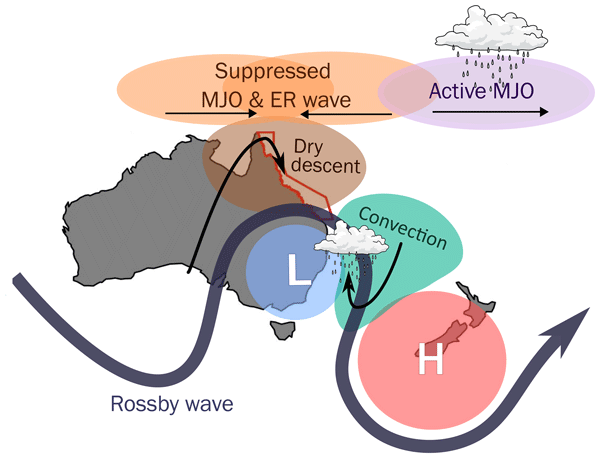
The doldrums are regions of light winds and relatively clear skies found in the tropics. They often occur during severe coral bleaching events on the Great Barrier Reef yet remain poorly understood. This study examines why the doldrums form and persist, identifying how both tropical and extratropical weather systems align to first form the doldrums and that the stalling of these weather systems prolongs the doldrums persistence.
Linyuan Sun, Andréa S. Taschetto, Shayne McGregor, Lisa V. Alexander, and Chenhui Jin
EGUsphere, https://doi.org/10.5194/egusphere-2026-3344, https://doi.org/10.5194/egusphere-2026-3344, 2026
This preprint is open for discussion and under review for Weather and Climate Dynamics (WCD).
Short summary
Short summary
The El Niño-Southern Oscillation strongly affects Australia’s rainfall, but its impacts on Australian extratropical cyclones are difficult to detect. By focusing on days when ENSO-related teleconnection patterns were established, we identified clearer changes in cyclone activity over the Tasman Sea, with more frequent cyclones during La Niña and fewer during El Niño. These results provide new insights into how large-scale climate modes influence regional weather systems.
Lara S. Richards, Yi Huang, Michael A. Barnes, Chenhui Jin, Fadhlil R. Muhammad, Daniel P. Harrison, and Steven T. Siems
EGUsphere, https://doi.org/10.5194/egusphere-2026-2114, https://doi.org/10.5194/egusphere-2026-2114, 2026
This preprint is open for discussion and under review for Weather and Climate Dynamics (WCD).
Short summary
Short summary
The doldrums are regions of light winds and relatively clear skies found in the tropics. They often occur during severe coral bleaching events on the Great Barrier Reef yet remain poorly understood. This study examines why the doldrums form and persist, identifying how both tropical and extratropical weather systems align to first form the doldrums and that the stalling of these weather systems prolongs the doldrums persistence.
John A. Reilly, Christopher C. Chapman, Courtney Quinn, Jules B. Kajtar, Ashley J. Barnes, and Neil J. Holbrook
Geosci. Model Dev., 19, 3853–3873, https://doi.org/10.5194/gmd-19-3853-2026, https://doi.org/10.5194/gmd-19-3853-2026, 2026
Short summary
Short summary
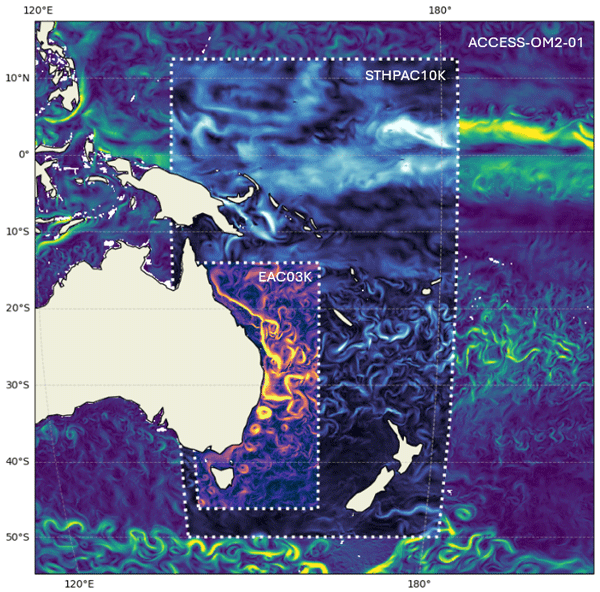
Recent advancements in regional ocean modelling allow higher resolution simulations providing improved estimates of the large-scale ocean state, while also revealing new insights into the fine-scale processes connecting the open ocean to the continental shelf seas. Our study highlights the importance of increased model resolution in regions of the ocean that are particularly turbulent while in quasi-stable circulation regions (e.g., jets), the current state-of-the-art global models do suffice.
Shilpa Lal, Sophie Cravatte, Christophe Menkes, Jed Macdonald, Romain Le Gendre, Ines Mangolte, Cyril Dutheil, Neil J. Holbrook, and Simon Nicol
Ocean Sci., 22, 1023–1049, https://doi.org/10.5194/os-22-1023-2026, https://doi.org/10.5194/os-22-1023-2026, 2026
Short summary
Short summary
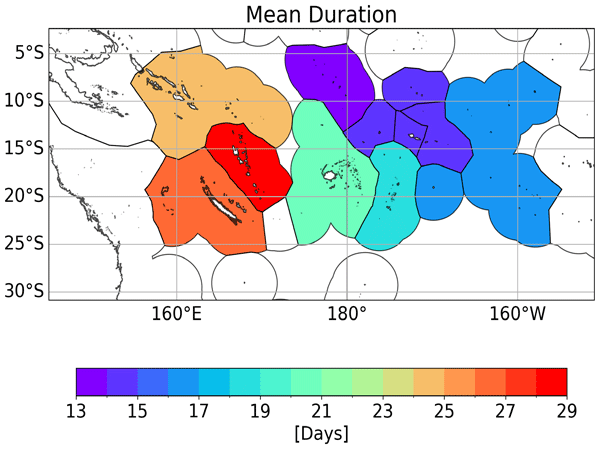
This paper characterizes historical (1981–2023) marine heatwaves in the tropical southwestern Pacific, where they pose a challenge for marine resource dependent Islands. Heatwaves are distinguished as a function of their spatial extent, signature at the coast, and seasonality, to allow a better understanding of their impacts on ecosystems. Marine heatwaves are getting longer and more frequent, with greater spatial extents. Our results aim to inform the Pacific Islands on their vulnerability.
Cited articles
Archambault, H. M., Bosart, L. F., Keyser, D., and Cordeira, J. M.: A Climatological Analysis of the Extratropical Flow Response to Recurving Western North Pacific Tropical Cyclones, Mon. Weather Rev., 141, 2325–2346, https://doi.org/10.1175/MWR-D-12-00257.1, 2013. a
Archambault, H. M., Keyser, D., Bosart, L. F., Davis, C. A., and Cordeira, J. M.: A Composite Perspective of the Extratropical Flow Response to Recurving Western North Pacific Tropical Cyclones, Mon. Weather Rev., 143, 1122–1141, https://doi.org/10.1175/MWR-D-14-00270.1, 2015. a
Ascenso, G., Ficchì, A., Giuliani, M., Scoccimarro, E., and Castelletti, A.: Downscaling, bias correction, and spatial adjustment of extreme tropical cyclone rainfall in ERA5 using deep learning, Weather and Climate Extremes, 46, 100724, https://doi.org/10.1016/j.wace.2024.100724, 2024. a
Atallah, E., Bosart, L. F., and Aiyyer, A. R.: Precipitation Distribution Associated with Landfalling Tropical Cyclones over the Eastern United States, Mon. Weather Rev., 135, 2185–2206, https://doi.org/10.1175/MWR3382.1, 2007. a, b, c
Atallah, E. H. and Bosart, L. F.: The Extratropical Transition and Precipitation Distribution of Hurricane Floyd (1999), Mon. Weather Rev., 131, 1063–1081, https://doi.org/10.1175/1520-0493(2003)131<1063:TETAPD>2.0.CO;2, 2003. a
Bosart, L. F. and Dean, D. B.: The Agnes Rainstorm of June 1972: Surface Feature Evolution Culminating in Inland Storm Redevelopment, Weather Forecast., 6, 515–537, https://doi.org/10.1175/1520-0434(1991)006<0515:TAROJS>2.0.CO;2, 1991. a
Chen, G.: A Comparison of precipitation distribution of two landfalling tropical cyclones during the extratropical transition, Adv. Atmos. Sci., 28, 1390–1404, https://doi.org/10.1007/s00376-011-0148-y, 2011. a, b, c
Dare, R. A. and Davidson, N. E.: Characteristics of Tropical Cyclones in the Australian Region, Mon. Weather Rev., 132, 3049–3065, https://doi.org/10.1175/MWR2834.1, 2004. a
Davies, D. L. and Bouldin, D. W.: A Cluster Separation Measure, IEEE T. Pattern Anal., PAMI-1, 224–227, https://doi.org/10.1109/TPAMI.1979.4766909, 1979. a
Demirci, O., Tyo, J. S., and Ritchie, E. A.: Spatial and Spatiotemporal Projection Pursuit Techniques to Predict the Extratropical Transition of Tropical Cyclones, IEEE T. Geosci. Remote, 45, 418–425, https://doi.org/10.1109/TGRS.2006.882251, 2007. a, b, c
Dulac, W., Cattiaux, J., Chauvin, F., Bourdin, S., and Fromang, S.: Assessing the representation of tropical cyclones in ERA5 with the CNRM tracker, Clim. Dynam., 62, 223–238, https://doi.org/10.1007/s00382-023-06902-8, 2024. a
Emanuel, K. A.: The Maximum Intensity of Hurricanes, J. Atmos. Sci., 45, 1143–1155, https://doi.org/10.1175/1520-0469(1988)045<1143:TMIOH>2.0.CO;2, 1988. a
Evans, C. and Hart, R. E.: Analysis of the Wind Field Evolution Associated with the Extratropical Transition of Bonnie (1998), Mon. Weather Rev., 136, 2047–2065, https://doi.org/10.1175/2007MWR2051.1, 2008. a
Evans, C., Wood, K. M., Aberson, S. D., Archambault, H. M., Milrad, S. M., Bosart, L. F., Corbosiero, K. L., Davis, C. A., Dias Pinto, J. R., Doyle, J., Fogarty, C., Galarneau, T. J., Grams, C. M., Griffin, K. S., Gyakum, J., Hart, R. E., Kitabatake, N., Lentink, H. S., McTaggart-Cowan, R., Perrie, W., Quinting, J. F. D., Reynolds, C. A., Riemer, M., Ritchie, E. A., Sun, Y., and Zhang, F.: The Extratropical Transition of Tropical Cyclones. Part I: Cyclone Evolution and Direct Impacts, Mon. Weather Rev., 145, 4317–4344, https://doi.org/10.1175/MWR-D-17-0027.1, 2017. a, b, c, d, e
Evans, J. L. and Hart, R. E.: Objective Indicators of the Life Cycle Evolution of Extratropical Transition for Atlantic Tropical Cyclones, Mon. Weather Rev., 131, 909–925, https://doi.org/10.1175/1520-0493(2003)131<0909:OIOTLC>2.0.CO;2, 2003. a, b, c, d
Gray, W. M.: Global view of the origin of tropical disturbances and storms, Mon. Weather Rev., 96, 669–700, https://doi.org/10.1175/1520-0493(1968)096<0669:GVOTOO>2.0.CO;2, 1968. a
Harr, P. A. and Elsberry, R. L.: Extratropical Transition of Tropical Cyclones over the Western North Pacific. Part I: Evolution of Structural Characteristics during the Transition Process, Mon. Weather Rev., 128, 2613–2633, https://doi.org/10.1175/1520-0493(2000)128<2613:ETOTCO>2.0.CO;2, 2000. a, b, c
Harr, P. A., Elsberry, R. L., and Hogan, T. F.: Extratropical Transition of Tropical Cyclones over the Western North Pacific. Part II: The Impact of Midlatitude Circulation Characteristics, Mon. Weather Rev., 128, 2634–2653, https://doi.org/10.1175/1520-0493(2000)128<2634:etotco>2.0.co;2, 2000. a
Hart, R. E.: A Cyclone Phase Space Derived from Thermal Wind and Thermal Asymmetry, Mon. Weather Rev., 131, 585–616, https://doi.org/10.1175/1520-0493(2003)131<0585:ACPSDF>2.0.CO;2, 2003. a, b, c, d
Hersbach, H., Bell, B., Berrisford, P., Hirahara, S., Horányi, A., Muñoz-Sabater, J., Nicolas, J., Peubey, C., Radu, R., Schepers, D., Simmons, A., Soci, C., Abdalla, S., Abellan, X., Balsamo, G., Bechtold, P., Biavati, G., Bidlot, J., Bonavita, M., De Chiara, G., Dahlgren, P., Dee, D., Diamantakis, M., Dragani, R., Flemming, J., Forbes, R., Fuentes, M., Geer, A., Haimberger, L., Healy, S., Hogan, R. J., Hólm, E., Janisková, M., Keeley, S., Laloyaux, P., Lopez, P., Lupu, C., Radnoti, G., de Rosnay, P., Rozum, I., Vamborg, F., Villaume, S., and Thépaut, J.-N.: The ERA5 global reanalysis, Q. J. Roy. Meteor. Soc., 146, 1999–2049, https://doi.org/10.1002/qj.3803, 2020. a
Jones, S. C., Harr, P. A., Abraham, J., Bosart, L. F., Bowyer, P. J., Evans, J. L., Hanley, D. E., Hanstrum, B. N., Hart, R. E., Lalaurette, F., Sinclair, M. R., Smith, R. K., and Thorncroft, C.: The Extratropical Transition of Tropical Cyclones: Forecast Challenges, Current Understanding, and Future Directions, Weather Forecast., 18, 1052–1092, https://doi.org/10.1175/1520-0434(2003)018<1052:TETOTC>2.0.CO;2, 2003. a, b, c, d, e, f
Keller, J. H., Grams, C. M., Riemer, M., Archambault, H. M., Bosart, L., Doyle, J. D., Evans, J. L., Galarneau, T. J., Griffin, K., Harr, P. A., Kitabatake, N., McTaggart-Cowan, R., Pantillon, F., Quinting, J. F., Reynolds, C. A., Ritchie, E. A., Torn, R. D., and Zhang, F.: The Extratropical Transition of Tropical Cyclones. Part II: Interaction with the Midlatitude Flow, Downstream Impacts, and Implications for Predictability, Mon. Weather Rev., 147, 1077–1106, https://doi.org/10.1175/MWR-D-17-0329.1, 2019. a, b, c, d
Klein, P. M., Harr, P. A., and Elsberry, R. L.: Extratropical Transition of Western North Pacific Tropical Cyclones: An Overview and Conceptual Model of the Transformation Stage, Weather Forecast., 15, 373–395, https://doi.org/10.1175/1520-0434(2000)015<0373:ETOWNP>2.0.CO;2, 2000. a, b, c
Knapp, K. R., Kruk, M. C., Levinson, D. H., Diamond, H. J., and Neumann, C. J.: The International Best Track Archive for Climate Stewardship (IBTrACS): Unifying Tropical Cyclone Data, B. Am. Meteorol. Soc., 91, 363–376, https://doi.org/10.1175/2009BAMS2755.1, 2010. a
Kofron, D. E., Ritchie, E. A., and Tyo, J. S.: Determination of a Consistent Time for the Extratropical Transition of Tropical Cyclones. Part I: Examination of Existing Methods for Finding “ET Time”, Mon. Weather Rev., 138, 4328–4343, https://doi.org/10.1175/2010MWR3180.1, 2010a. a, b
Kofron, D. E., Ritchie, E. A., and Tyo, J. S.: Determination of a Consistent Time for the Extratropical Transition of Tropical Cyclones. Part II: Potential Vorticity Metrics, Mon. Weather Rev., 138, 4344–4361, https://doi.org/10.1175/2010MWR3181.1, 2010b. a
Madonna, E., Wernli, H., Joos, H., and Martius, O.: Warm Conveyor Belts in the ERA-Interim Dataset (1979–2010). Part I: climatology and potential vorticity evolution, J. Climate, 27, 3–26, https://doi.org/10.1175/JCLI-D-12-00720.1, 2014. a
Matyas, C. J.: Processes Influencing Rain-Field Growth and Decay after Tropical Cyclone Landfall in the United States, J. Appl. Meteorol. Clim., 52, 1085–1096, https://doi.org/10.1175/JAMC-D-12-0153.1, 2013. a
National Computational Infrastructure (NCI): ERA5 Replicated Datasets, NCI [data set], https://doi.org/10.25914/5f48874388857, 2020. a
O'Brien, L. and Reeder, M. J.: Southern Hemisphere summertime Rossby waves and weather in the Australian region: Southern Hemisphere Summertime Rossby Waves, Q. J. Roy. Meteor. Soc., 143, 2374–2388, https://doi.org/10.1002/qj.3090, 2017. a
Orlanski, I. and Sheldon, J. P.: Stages in the energetics of baroclinic systems, Tellus A, 47, 605–628, https://doi.org/10.1034/j.1600-0870.1995.00108.x, 1995. a
Parker, T. J., Berry, G. J., and Reeder, M. J.: The influence of tropical cyclones on heat waves in Southeastern Australia, Geophys. Res. Lett., 40, 6264–6270, https://doi.org/10.1002/2013GL058257, 2013. a
Quinting, J. F. and Jones, S. C.: On the Impact of Tropical Cyclones on Rossby Wave Packets: A Climatological Perspective, Mon. Weather Rev., 144, 2021–2048, https://doi.org/10.1175/MWR-D-14-00298.1, 2016. a, b, c
Quinting, J. F., Bell, M. M., Harr, P. A., and Jones, S. C.: Structural Characteristics of T-PARC Typhoon Sinlaku during Its Extratropical Transition, Mon. Weather Rev., 142, 1945–1961, https://doi.org/10.1175/MWR-D-13-00306.1, 2014. a, b, c
Raveh-Rubin, S.: Dry Intrusions: Lagrangian Climatology and Dynamical Impact on the Planetary Boundary Layer, J. Climate, 30, 6661–6682, https://doi.org/10.1175/JCLI-D-16-0782.1, 2017. a
Riemer, M. and Jones, S. C.: The downstream impact of tropical cyclones on a developing baroclinic wave in idealized scenarios of extratropical transition, Q. J. Roy. Meteor. Soc., 136, 617–637, https://doi.org/10.1002/qj.605, 2010. a
Ritchie, E. A. and Elsberry, R. L.: Simulations of the Transformation Stage of the Extratropical Transition of Tropical Cyclones, Mon. Weather Rev., 129, 1462–1480, https://doi.org/10.1175/1520-0493(2001)129<1462:SOTTSO>2.0.CO;2, 2001. a, b, c, d
Rousseeuw, P. J.: Silhouettes: A graphical aid to the interpretation and validation of cluster analysis, J. Comput. Appl. Math., 20, 53–65, https://doi.org/10.1016/0377-0427(87)90125-7, 1987. a
Steinfeld, D. and Pfhal, S.: The role of latent heating in atmospheric blocking dynamics: a global climatology, Clim. Dynam., 53, 6159–6180, https://doi.org/10.1007/s00382-019-04919-6, 2019. a
Stoelinga, M. T.: A Potential Vorticity-Based Study of the Role of Diabatic Heating and Friction in a Numerically Simulated Baroclinic Cyclone, Mon. Weather Rev., 124, 849–874, https://doi.org/10.1175/1520-0493(1996)124<0849:APVBSO>2.0.CO;2, 1996. a
Teubler, F. and Riemer, M.: Potential-vorticity dynamics of troughs and ridges within Rossby wave packets during a 40-year reanalysis period, Weather Clim. Dynam., 2, 535–559, https://doi.org/10.5194/wcd-2-535-2021, 2021. a
Ullrich, P. A. and Zarzycki, C. M.: TempestExtremes: a framework for scale-insensitive pointwise feature tracking on unstructured grids, Geosci. Model Dev., 10, 1069–1090, https://doi.org/10.5194/gmd-10-1069-2017, 2017. a, b
Ullrich, P. A., Zarzycki, C. M., McClenny, E. E., Pinheiro, M. C., Stansfield, A. M., and Reed, K. A.: TempestExtremes v2.1: a community framework for feature detection, tracking, and analysis in large datasets, Geosci. Model Dev., 14, 5023–5048, https://doi.org/10.5194/gmd-14-5023-2021, 2021. a, b
Zarzycki, C. M. and Ullrich, P. A.: Assessing sensitivities in algorithmic detection of tropical cyclones in climate data, Geophys. Res. Lett., 44, 1141–1149, https://doi.org/10.1002/2016GL071606, 2017. a, b
Zarzycki, C. M., Thatcher, D. R., and Jablonowski, C.: Objective tropical cyclone extratropical transition detection in high-resolution reanalysis and climate model data, J. Adv. Model. Earth Sy., 9, 130–148, https://doi.org/10.1002/2016MS000775, 2017. a, b
Short summary
Tropical cyclones that move into the midlatitudes become extratropical cyclones, so-called extratropical transition. In this study, we detected transition events in the Southern Hemisphere based on the model data. We found that weather patterns during the transition are different from case to case. In some cases, strong tropical cyclones interact with the midlatitude flow and lead to great changes in weather nearby.
Tropical cyclones that move into the midlatitudes become extratropical cyclones, so-called...