
Articles | Volume 7, issue 1
https://doi.org/10.5194/wcd-7-17-2026
© Author(s) 2026. This work is distributed under
the Creative Commons Attribution 4.0 License.
the Creative Commons Attribution 4.0 License.
https://doi.org/10.5194/wcd-7-17-2026
© Author(s) 2026. This work is distributed under
the Creative Commons Attribution 4.0 License.
the Creative Commons Attribution 4.0 License.
Research article
| 
06 Jan 2026
Research article |
| 06 Jan 2026
| 06 Jan 2026
Properties and characteristics of atmospheric deserts over Europe: a first statistical analysis

Department of Atmospheric and Cryospheric Sciences, Universität Innsbruck, Innsbruck, Austria
Achim Zeileis
Department of Statistics, Universität Innsbruck, Innsbruck, Austria
Isabell Stucke
Department of Atmospheric and Cryospheric Sciences, Universität Innsbruck, Innsbruck, Austria
Reto Stauffer
Department of Statistics & Digital Science Center, Universität Innsbruck, Innsbruck, Austria
Georg J. Mayr
Department of Atmospheric and Cryospheric Sciences, Universität Innsbruck, Innsbruck, Austria
Related authors
Fiona Fix-Hewitt, Achim Zeileis, Isabell Stucke, Reto Stauffer, and Georg J. Mayr
EGUsphere, https://doi.org/10.5194/egusphere-2026-2350, https://doi.org/10.5194/egusphere-2026-2350, 2026
Short summary
Short summary
Atmospheric deserts are a generalisation of the well-known concept of elevated mixed layers. They occur frequently over Europe and can modify atmospheric profiles. That can have implications for the local weather. We therefore investigate if unusually warm temperatures, thunderstorms, and dust events occur more frequently when atmospheric deserts are present over Europe. Indeed, all of the mentioned extreme weather events are more likely given that atmospheric desert air is present.
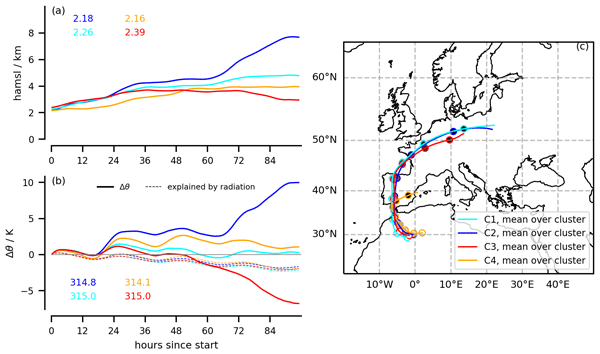
Fiona Fix, Georg Mayr, Achim Zeileis, Isabell Stucke, and Reto Stauffer
Weather Clim. Dynam., 5, 1545–1560, https://doi.org/10.5194/wcd-5-1545-2024, https://doi.org/10.5194/wcd-5-1545-2024, 2024
Short summary
Short summary
Atmospheric deserts (ADs) are air masses that are transported away from hot, dry regions. Our study introduces this new concept. ADs can suppress or boost thunderstorms and potentially contribute to the formation of heat waves, which makes them relevant for forecasting extreme events. Using a novel detection method, we follow an AD directly from North Africa to Europe for a case in June 2022, allowing us to analyse the air mass at any time and investigate how it is modified along the way.
Fiona Fix-Hewitt, Achim Zeileis, Isabell Stucke, Reto Stauffer, and Georg J. Mayr
EGUsphere, https://doi.org/10.5194/egusphere-2026-2350, https://doi.org/10.5194/egusphere-2026-2350, 2026
Short summary
Short summary
Atmospheric deserts are a generalisation of the well-known concept of elevated mixed layers. They occur frequently over Europe and can modify atmospheric profiles. That can have implications for the local weather. We therefore investigate if unusually warm temperatures, thunderstorms, and dust events occur more frequently when atmospheric deserts are present over Europe. Indeed, all of the mentioned extreme weather events are more likely given that atmospheric desert air is present.
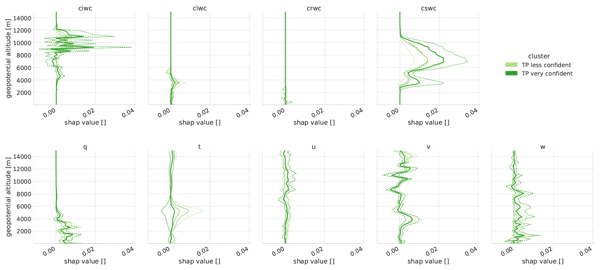
Gregor Ehrensperger, Thorsten Simon, Georg J. Mayr, and Tobias Hell
Geosci. Model Dev., 18, 1141–1153, https://doi.org/10.5194/gmd-18-1141-2025, https://doi.org/10.5194/gmd-18-1141-2025, 2025
Short summary
Short summary
As lightning is a brief and localized event, it is not explicitly resolved in atmospheric models. Instead, expert-based auxiliary descriptions are used to assess it. This study explores how AI can improve our understanding of lightning without relying on traditional expert knowledge. We reveal that AI independently identified the key factors known to experts as essential for lightning in the Alps region. This shows how knowledge discovery could be sped up in areas with limited expert knowledge.
Fiona Fix, Georg Mayr, Achim Zeileis, Isabell Stucke, and Reto Stauffer
Weather Clim. Dynam., 5, 1545–1560, https://doi.org/10.5194/wcd-5-1545-2024, https://doi.org/10.5194/wcd-5-1545-2024, 2024
Short summary
Short summary
Atmospheric deserts (ADs) are air masses that are transported away from hot, dry regions. Our study introduces this new concept. ADs can suppress or boost thunderstorms and potentially contribute to the formation of heat waves, which makes them relevant for forecasting extreme events. Using a novel detection method, we follow an AD directly from North Africa to Europe for a case in June 2022, allowing us to analyse the air mass at any time and investigate how it is modified along the way.
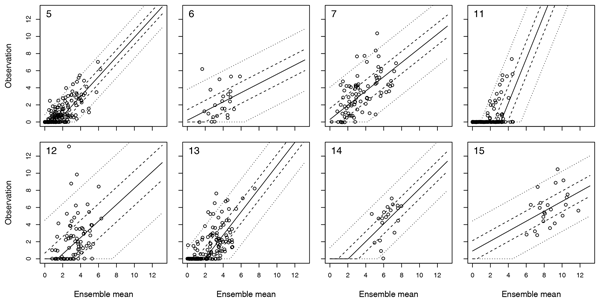
Thomas Muschinski, Georg J. Mayr, Achim Zeileis, and Thorsten Simon
Nonlin. Processes Geophys., 30, 503–514, https://doi.org/10.5194/npg-30-503-2023, https://doi.org/10.5194/npg-30-503-2023, 2023
Short summary
Short summary
Statistical post-processing is necessary to generate probabilistic forecasts from physical numerical weather prediction models. To allow for more flexibility, there has been a shift in post-processing away from traditional parametric regression models towards modern machine learning methods. By fusing these two approaches, we developed model output statistics random forests, a new post-processing method that is highly flexible but at the same time also very robust and easy to interpret.
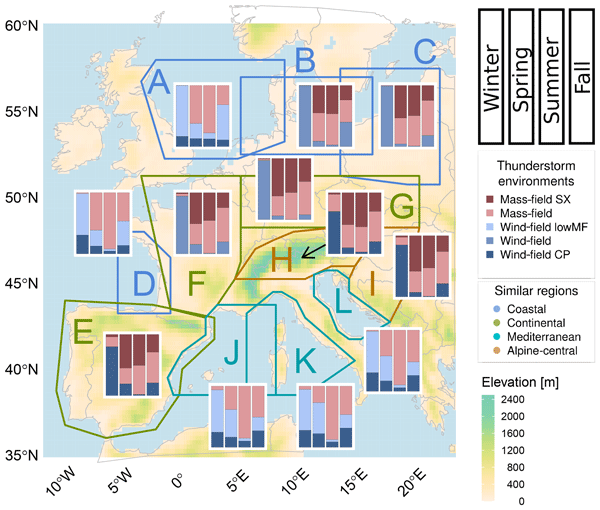
Deborah Morgenstern, Isabell Stucke, Georg J. Mayr, Achim Zeileis, and Thorsten Simon
Weather Clim. Dynam., 4, 489–509, https://doi.org/10.5194/wcd-4-489-2023, https://doi.org/10.5194/wcd-4-489-2023, 2023
Short summary
Short summary
Two thunderstorm environments are described for Europe: mass-field thunderstorms, which occur mostly in summer, over land, and under similar meteorological conditions, and wind-field thunderstorms, which occur mostly in winter, over the sea, and under more diverse meteorological conditions. Our descriptions are independent of static thresholds and help to understand why thunderstorms in unfavorable seasons for lightning pose a particular risk to tall infrastructure such as wind turbines.
Thomas Muschinski, Moritz N. Lang, Georg J. Mayr, Jakob W. Messner, Achim Zeileis, and Thorsten Simon
Wind Energ. Sci., 7, 2393–2405, https://doi.org/10.5194/wes-7-2393-2022, https://doi.org/10.5194/wes-7-2393-2022, 2022
Short summary
Short summary
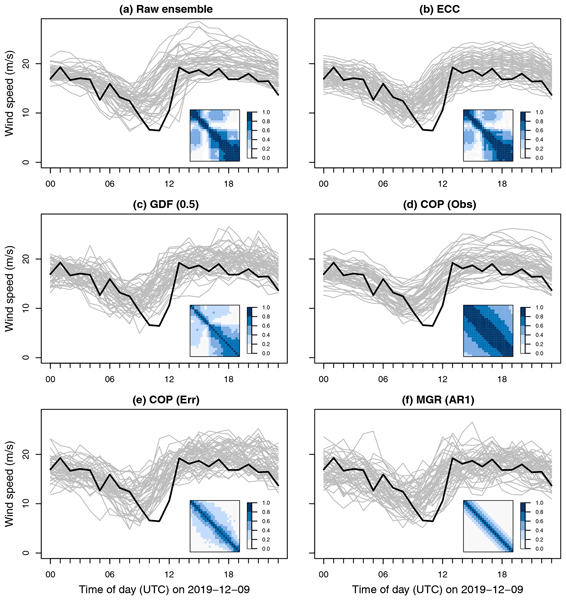
The power generated by offshore wind farms can vary greatly within a couple of hours, and failing to anticipate these ramp events can lead to costly imbalances in the electrical grid. A novel multivariate Gaussian regression model helps us to forecast not just the means and variances of the next day's hourly wind speeds, but also their corresponding correlations. This information is used to generate more realistic scenarios of power production and accurate estimates for ramp probabilities.
Deborah Morgenstern, Isabell Stucke, Thorsten Simon, Georg J. Mayr, and Achim Zeileis
Weather Clim. Dynam., 3, 361–375, https://doi.org/10.5194/wcd-3-361-2022, https://doi.org/10.5194/wcd-3-361-2022, 2022
Short summary
Short summary
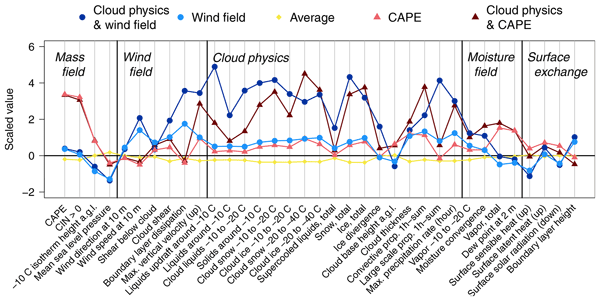
Wintertime lightning in central Europe is rare but has a large damage potential for tall structures such as wind turbines. We use a data-driven approach to explain why it even occurs when the meteorological processes causing thunderstorms in summer are absent. In summer, with strong solar input, thunderclouds have a large vertical extent, whereas in winter, thunderclouds are shallower in the vertical but tilted and elongated in the horizontal by strong winds that increase with altitude.
Cited articles
Andrews, M. S., Gensini, V. A., Haberlie, A. M., Ashley, W. S., Michaelis, A. C., and Taszarek, M.: Climatology of the Elevated Mixed Layer over the Contiguous United States and Northern Mexico Using ERA5: 1979–2021, Journal of Climate, 37, 1833–1851, https://doi.org/10.1175/JCLI-D-23-0517.1, 2024. a, b, c
Banacos, P. C. and Ekster, M. L.: The Association of the Elevated Mixed Layer with Significant Severe Weather Events in the Northeastern United States, Weather and Forecasting, 25, 1082–1102, https://doi.org/10.1175/2010WAF2222363.1, 2010. a
Carlson, T. N., Benjamin, S. G., and Forbes, G. S.: Elevated Mixed Layers in the Regional Severe Storm Environment: Conceptual Model and Case Studies, Monthly Weather Review, 111, 1453–1473, https://doi.org/10.1175/1520-0493(1983)111<1453:EMLITR>2.0.CO;2, 1983. a, b
Cordeira, J. M., Metz, N. D., Howarth, M. E., and Galarneau, T. J.: Multiscale upstream and in situ precursors to the elevated mixed layer and high-impact weather over the Midwest United States, Weather and Forecasting, 32, 905–923, https://doi.org/10.1175/WAF-D-16-0122.1, 2017. a, b, c
Cos, P., Olmo, M., Campos, D., Marcos-Matamoros, R., Palma, L., Ángel G Muñoz, and Doblas-Reyes, F. J.: Saharan warm-air intrusions in the western Mediterranean: identification, impacts on temperature extremes, and large-scale mechanisms, Weather and Climate Dynamics, 6, 609–626, https://doi.org/10.5194/wcd-6-609-2025, 2025. a, b
Dahl, J. M. and Fischer, J.: The origin of western European warm-season prefrontal convergence lines, Weather and Forecasting, 31, 1417–1431, https://doi.org/10.1175/WAF-D-15-0161.1, 2016. a, b
de Villiers, M. P.: Europe extreme heat 22–26 July 2019: was it caused by subsidence or advection?, Weather, 75, 228–235, https://doi.org/10.1002/wea.3717, 2020. a
Dezfuli, A., Bosilovich, M. G., and Barahona, D.: A Dusty Atmospheric River Brings Floods to the Middle East, Geophysical Research Letters, 48, https://doi.org/10.1029/2021GL095441, 2021. a
European Centre for Medium-Range Weather Forecasts: IFS Documentation CY41R2 – Part IV: Physical Processes, vol. 4, European Centre for Medium-Range Weather Forecasts, https://doi.org/10.21957/tr5rv27xu, 2016. a
Farrell, R. J. and Carlson, T. N.: Evidence for the Role of the Lid and Underrunning in an Outbreak of Tornadic Thunderstorms, Monthly Weather Review, 117, 857–871, https://doi.org/10.1175/1520-0493(1989)117<0857:EFTROT>2.0.CO;2, 1989. a
Fix-Hewitt, F.: Code used in preparation of the manuscript “Properties and Characteristics of Atmospheric Deserts over Europe: A First Statistical Analysis” by Fix-Hewitt et. al., Weather and Climate Dynamics, Zenodo [code], https://doi.org/10.5281/zenodo.17485142, 2025. a
Francis, D., Fonseca, R., Nelli, N., Bozkurt, D., Picard, G., and Guan, B.: Atmospheric rivers drive exceptional Saharan dust transport towards Europe, Atmospheric Research, 266, 105959, https://doi.org/10.1016/J.ATMOSRES.2021.105959, 2022. a
Fromm, M., Kablick, G., and Caffrey, P.: Dust-infused baroclinic cyclone storm clouds: The evidence, meteorology, and some implications, Geophysical Research Letters, 43, 12643–12650, https://doi.org/10.1002/2016GL071801, 2016. a
Garcia-Carreras, L., Parker, D. J., Marsham, J. H., Rosenberg, P. D., Brooks, I. M., Lock, A. P., Marenco, F., Mcquaid, J. B., and Hobby, M.: The turbulent structure and diurnal growth of the Saharan atmospheric boundary layer, Journal of the Atmospheric Sciences, 72, 693–713, https://doi.org/10.1175/JAS-D-13-0384.1, 2015. a
Guo, J., Zhang, J., Yang, K., Liao, H., Zhang, S., Huang, K., Lv, Y., Shao, J., Yu, T., Tong, B., Li, J., Su, T., Yim, S. H. L., Stoffelen, A., Zhai, P., and Xu, X.: Investigation of near-global daytime boundary layer height using high-resolution radiosondes: first results and comparison with ERA5, MERRA-2, JRA-55, and NCEP-2 reanalyses, Atmospheric Chemistry and Physics, 21, 17079–17097, https://doi.org/10.5194/acp-21-17079-2021, 2021. a, b
Helmert, J., Heinold, B., Tegen, I., Hellmuth, O., and Wendisch, M.: On the direct and semidirect effects of Saharan dust over Europe: A modeling study, Journal of Geophysical Research: Atmospheres, 112, https://doi.org/10.1029/2006JD007444, 2007. a
Hermes, K., Quinting, J., Grams, C. M., Hoose, C., and Hoshyaripour, G. A.: Impact of Saharan dust outbreaks on short-range weather forecast errors in Europe, Quarterly Journal of the Royal Meteorological Society, 150, 1704–1723, https://doi.org/10.1002/QJ.4666, 2024. a, b, c
Hersbach, H., Bell, B., Berrisford, P., Hirahara, S., Horányi, A., Muñoz-Sabater, J., Nicolas, J., Peubey, C., Radu, R., Schepers, D., Simmons, A., Soci, C., Abdalla, S., Abellan, X., Balsamo, G., Bechtold, P., Biavati, G., Bidlot, J., Bonavita, M., Chiara, G. D., Dahlgren, P., Dee, D., Diamantakis, M., Dragani, R., Flemming, J., Forbes, R., Fuentes, M., Geer, A., Haimberger, L., Healy, S., Hogan, R. J., Hólm, E., Janisková, M., Keeley, S., Laloyaux, P., Lopez, P., Lupu, C., Radnoti, G., de Rosnay, P., Rozum, I., Vamborg, F., Villaume, S., and Thépaut, J. N.: The ERA5 global reanalysis, Quarterly Journal of the Royal Meteorological Society, 146, 1999–2049, https://doi.org/10.1002/qj.3803, 2020. a, b, c
Hersbach, H., Bell, B., Berrisford, P., Biavati, G., Horányi, A., Sabater, J. M., Nicolas, J., Peubey, C., R., R., Rozum, I., Schepers, D., Simmons, A., Soci, C., Dee, D., and Thépaut, J.-N.: ERA5 hourly data on single levels from 1940 to present, Copernicus Climate Change Service (C3S) Climate Data Store (CDS) [data set], https://doi.org/10.24381/cds.adbb2d47, 2023. a
Keune, J., Schumacher, D. L., and Miralles, D. G.: A unified framework to estimate the origins of atmospheric moisture and heat using Lagrangian models, Geoscientific Model Development, 15, 1875–1898, https://doi.org/10.5194/gmd-15-1875-2022, 2022. a
Keyser, D. and Carlson, T. N.: Transverse Ageostrophic Circulations Associated with Elevated Mixed Layers, Monthly Weather Review, 112, 2465–2478, https://doi.org/10.1175/1520-0493(1984)112<2465:TACAWE>2.0.CO;2, 1984. a, b
Lanicci, J. M. and Warner, T. T.: A Synoptic Climatology of the Elevated Mixed-Layer Inversion over the Southern Great Plains in Spring. Part I: Structure, Dynamics, and Seasonal Evolution, Weather and Forecasting, 6, 181–197, https://doi.org/10.1175/1520-0434(1991)006<0181:ASCOTE>2.0.CO;2, 1991a. a, b
Lewis, M. W. and Gray, S. L.: Categorisation of synoptic environments associated with mesoscale convective systems over the UK, Atmospheric Research, 97, 194–213, https://doi.org/10.1016/J.ATMOSRES.2010.04.001, 2010. a
MacQueen, J.: Some methods for classification and analysis of multivariate observations, Vol. 1, 281–297, 14 Edn., https://books.google.at/books?hl=de&lr=&id=IC4Ku_7dBFUC&oi=fnd&pg=PA281&dq=MacQueen,+J.:+Some+Methods+for+Classification+and+Analy-+sis+of+MultiVariate+Observations,&ots=nQVfFYNdsO&sig=c-Q0jlu5eVf-0HADehKAHo2Zt4A#v=onepage&q&f=false (last access: 5 January 2026), 1967. a
Madonna, F., Summa, D., Girolamo, P. D., Marra, F., Wang, Y., and Rosoldi, M.: Assessment of Trends and Uncertainties in the Atmospheric Boundary Layer Height Estimated Using Radiosounding Observations over Europe, Atmosphere 2021, Vol. 12, p. 301, https://doi.org/10.3390/ATMOS12030301, 2021. a
Oertel, A., Pickl, M., Quinting, J. F., Hauser, S., Wandel, J., Magnusson, L., Balmaseda, M., Vitart, F., and Grams, C. M.: Everything Hits at Once: How Remote Rainfall Matters for the Prediction of the 2021 North American Heat Wave, Geophysical Research Letters, 50, e2022GL100958, https://doi.org/10.1029/2022GL100958, 2023. a
Ribeiro, B. Z. and Bosart, L. F.: Elevated mixed layers and associated severe thunderstorm environments in South and North America, Monthly Weather Review, 146, 3–28, https://doi.org/10.1175/MWR-D-17-0121.1, 2018. a
Rostási, A., Topa, B. A., Gresina, F., Weiszburg, T. G., Gelencsér, A., and Varga, G.: Saharan Dust Deposition in Central Europe in 2016 – A Representative Year of the Increased North African Dust Removal Over the Last Decade, Frontiers in Earth Science, 10, https://doi.org/10.3389/FEART.2022.869902, 2022. a
Rotach, M. W., Gohm, A., Lang, M. N., Leukauf, D., Stiperski, I., and Wagner, J. S.: On the vertical exchange of heat, mass, and momentum over complex, mountainous terrain, Frontiers in Earth Sciences, 3, 1–14, https://doi.org/10.3389/FEART.2015.00076, 2015. a
Rotach, M. W., Stiperski, I., Fuhrer, O., Goger, B., Gohm, A., Obleitner, F., Rau, G., Sfyri, E., and Vergrgeiner, J.: Investigating Exchange Processes over Complex Topography: The Innsbruck Box (i-Box), Bulletin of the American Meteorological Society, 98, 787–805, https://doi.org/10.1175/BAMS-D-15-00246.1, 2017. a
Schultz, D. M., Herrerías‐Azcué, F., Lowe, D., Kirshbaum, D. J., and Young, M. V.: Rethinking the Spanish plume: An airstream analysis challenges the canonical conceptual model, Quarterly Journal of the Royal Meteorological Society, 151, https://doi.org/10.1002/QJ.5070, 2025a. a, b, c, d
Schultz, D. M., Young, M. V., and Kirshbaum, D. J.: The “Spanish Plume” Elevated Mixed Layer: Review of its Use and Misuse within the Scientific Literature, Monthly Weather Review, 153, https://doi.org/10.1175/MWR-D-24-0139.1, 2025b. a, b, c, d
Schulzweida, U.: CDO User Guide, Zenodo, https://doi.org/10.5281/zenodo.10020800, 2023. a
Seifert, A., Bachmann, V., Filipitsch, F., Förstner, J., Grams, C. M., Hoshyaripour, G. A., Quinting, J., Rohde, A., Vogel, H., Wagner, A., and Vogel, B.: Aerosol–cloud–radiation interaction during Saharan dust episodes: the dusty cirrus puzzle, Atmospheric Chemistry and Physics, 23, 6409–6430, https://doi.org/10.5194/acp-23-6409-2023, 2023. a, b, c
Sibley, A.: Thunderstorms from a Spanish Plume event on 28 June 2011, Weather, 67, 143–146, https://doi.org/10.1002/wea.1928, 2012. a
Sprenger, M. and Wernli, H.: The LAGRANTO Lagrangian analysis tool – version 2.0, Geoscientific Model Development, 8, 2569–2586, https://doi.org/10.5194/gmd-8-2569-2015, 2015. a, b, c
Stohl, A., Haimberger, L., Scheele, M. P., and Wernli, H.: An intercomparison of results from three trajectory models, Meteorological Applications, 8, 127–135, https://doi.org/10.1017/S1350482701002018, 2001. a
van der Does, M., Knippertz, P., Zschenderlein, P., Harrison, R. G., and Stuut, J.-B. W.: The mysterious long-range transport of giant mineral dust particles, Science Advances, 4, eaau2768, https://doi.org/10.1126/sciadv.aau2768, 2018. a
Varga, G., Kovács, J., and Újvári, G.: Analysis of Saharan dust intrusions into the Carpathian Basin (Central Europe) over the period of 1979–2011, Global and Planetary Change, 100, 333–342, https://doi.org/10.1016/J.GLOPLACHA.2012.11.007, 2013. a
Wei, Y., Sun, Y., Ma, Y., Tan, Y., Ren, X., Peng, K., Yang, S., Lin, Z., Zhou, X., Ren, Y., Ahmed, M., Tian, Y., and Xin, J.: Deviations of Boundary Layer Height and Meteorological Parameters Between Ground-Based Remote Sensing and ERA5 over the Complex Terrain of the Mongolian Plateau, Remote Sensing, 17, 393, https://doi.org/10.3390/RS17030393, 2025. a
Short summary
Atmospheric deserts are air masses from the boundary layer of desert regions. This study tracked them from North Africa to Europe during a two-year period (May 2022–April 2024). They can occur up to 60 % of the time, and can span large parts of Europe. They typically last about a day, and can alter the atmosphere throughout the free troposphere. On its way from Africa the air either rises and may become even warmer and drier, or it stays at mid-altitudes and cools, or retains its properties.
Atmospheric deserts are air masses from the boundary layer of desert regions. This study tracked...


