
Articles | Volume 7, issue 3
https://doi.org/10.5194/wcd-7-1853-2026
© Author(s) 2026. This work is distributed under
the Creative Commons Attribution 4.0 License.
the Creative Commons Attribution 4.0 License.
https://doi.org/10.5194/wcd-7-1853-2026
© Author(s) 2026. This work is distributed under
the Creative Commons Attribution 4.0 License.
the Creative Commons Attribution 4.0 License.
Research article
| 
28 Sep 2026
Research article |
| 28 Sep 2026
| 28 Sep 2026
Dynamics of the Asian Summer Monsoon Anticyclone: insights from potential vorticity tendency diagnostics
Ninghui Li
Department of Earth System Science, Ministry of Education Key Laboratory for Earth System Modeling, Tsinghua University, Beijing 100084, China
Jonathon S. Wright
CORRESPONDING AUTHOR

Department of Earth System Science, Ministry of Education Key Laboratory for Earth System Modeling, Tsinghua University, Beijing 100084, China
Philip Rupp
Meteorological Institute Munich, Ludwig-Maximilian University Munich, Munich 80333, Germany
Alison Ming
Department of Applied Mathematics and Theoretical Physics, University of Cambridge, Cambridge CB3 0WA, United Kingdom
Shenglong Zhang
Department of Earth System Science, Ministry of Education Key Laboratory for Earth System Modeling, Tsinghua University, Beijing 100084, China
Jie Gao
CORRESPONDING AUTHOR
Laoshan Laboratory, Qingdao 266237, China
Related authors
Shenglong Zhang, Jiao Chen, Jonathon S. Wright, Sean M. Davis, Jie Gao, Paul Konopka, Ninghui Li, Mengqian Lu, Susann Tegtmeier, Xiaolu Yan, Guang J. Zhang, and Nuanliang Zhu
Atmos. Chem. Phys., 25, 10109–10139, https://doi.org/10.5194/acp-25-10109-2025, https://doi.org/10.5194/acp-25-10109-2025, 2025
Short summary
Short summary
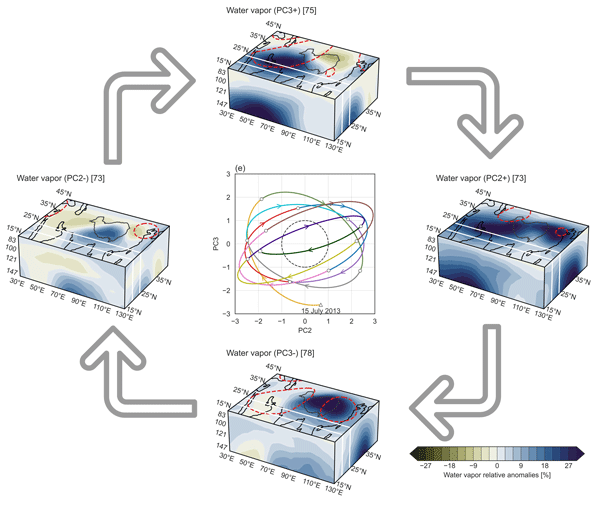
Swirling above summer storms, the Asian monsoon anticyclone functions as both gateway and gatekeeper to moisture entering the stratosphere. Although well monitored from space since 2005, many details of the anticyclone and the air that flows through it remain mysterious. Reanalyses, which combine model output and observations, may help to address how and why but only if they reliably capture the what and where of water vapor variations. Current reanalyses are beginning to meet these criteria.
William J. M. Seviour, Justin Finkel, Philip Rupp, Regan Mudhar, Amy H. Butler, Chaim I. Garfinkel, Peter Hitchcock, Blanca Ayarzagüena, Dong-Chan Hong, Yu-Kyung Hyun, Hera Kim, Eun-Pa Lim, Daniel De Maeseneire, Gabriele Messori, Gerbrand Koren, Michael Sigmond, Isla R. Simpson, and Seok-Woo Son
Weather Clim. Dynam., 7, 1405–1423, https://doi.org/10.5194/wcd-7-1405-2026, https://doi.org/10.5194/wcd-7-1405-2026, 2026
Short summary
Short summary
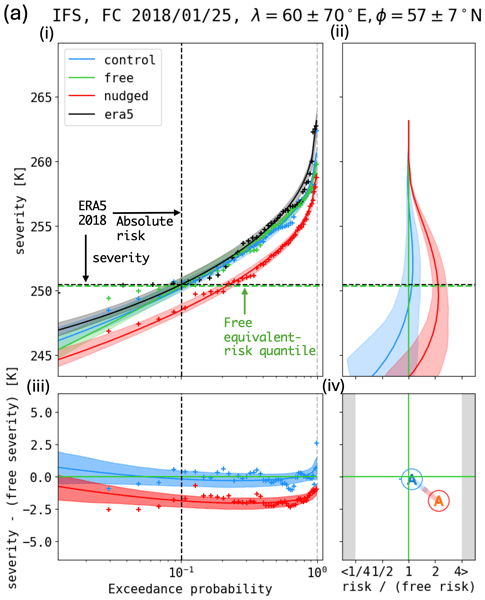
Variability of the stratospheric polar vortex is thought to play a role in driving weather extremes, but quantifying this role for a given event has proved challenging. Using a new set of perturbed subseasonal forecast experiments from 7 modelling centres, we determine the stratospheric contribution to the risk and severity of three recent extreme weather events. The forecast-based methodology that we develop is applicable to understanding a range of other drivers of weather extremes.
Chaim I. Garfinkel, David Avisar, Wenjuan Huo, Ales Kuchar, Shoshiro Minobe, Scott Osprey, Katharina Perny, and Jonathon S. Wright
EGUsphere, https://doi.org/10.5194/egusphere-2026-3738, https://doi.org/10.5194/egusphere-2026-3738, 2026
Short summary
Short summary
Whether tropical volcanic eruptions lead to a circulation response in winter is still unclear. We re-evaluate this effect using large ensembles from eight separate models with only one time-varying external forcing: volcanic aerosols. We find that 75 % of models simulate the previously proposed effect, but that the signal requires at least 30 eruptions before it emerges robustly from the noise. Furthermore, we demonstrate that the El Niño signal differs from natural El Niño events.
Chaim I. Garfinkel, David Avisar, Scott M. Osprey, Doug Smith, Jian Rao, and Jonathon S. Wright
Weather Clim. Dynam., 7, 1133–1152, https://doi.org/10.5194/wcd-7-1133-2026, https://doi.org/10.5194/wcd-7-1133-2026, 2026
Short summary
Short summary
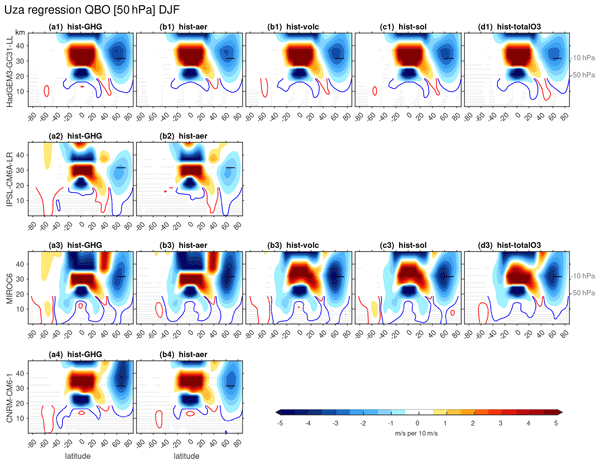
The Quasi-biennial Oscillation (QBO) dominates variability in the tropical stratosphere, & it impacts surface climate in several parts of the world. However, climate models have been shown to systematically under-estimate the influence of the QBO. Here, we re-evaluate this finding using much larger ensemble sizes than have been previously available based on four separate models. We find that the models are comparatively more successful in capturing QBO influences than reported by previous work.
Sheena Loeffel, Philip Rupp, Selina Kiefer, Joaquim G. Pinto, Thomas Birner, and Hella Garny
Weather Clim. Dynam., 7, 895–913, https://doi.org/10.5194/wcd-7-895-2026, https://doi.org/10.5194/wcd-7-895-2026, 2026
Short summary
Short summary
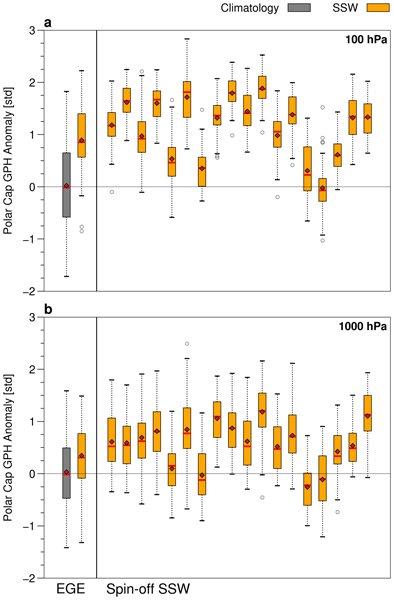
We use a dedicated simulation setup to shed light on the question whether, and why, some sudden stratospheric warming events are more likely than others to develop a surface response. We find that the propensity for downward coupling is unique to each event, and that from day one, the chance of a lower-stratospheric response can be predicted – a key step toward anticipating the surface response, moving beyond 'random' surface outcomes to quantified likelihoods of the ensuing surface response.
Philip Rupp, Jonas Spaeth, and Thomas Birner
Weather Clim. Dynam., 7, 767–785, https://doi.org/10.5194/wcd-7-767-2026, https://doi.org/10.5194/wcd-7-767-2026, 2026
Short summary
Short summary
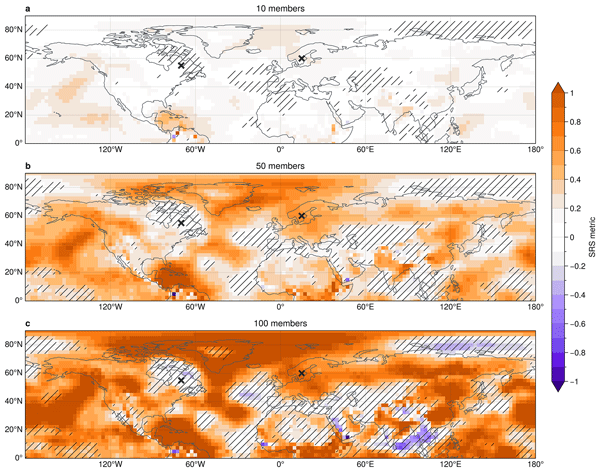
Weather forecasts several weeks ahead are uncertain, but this uncertainty itself can change depending on large-scale atmospheric conditions. We present a new way to measure how well forecasts capture these changes in uncertainty. Our results show that reliability of uncertainty varies strongly with region and is linked to slow, predictable patterns in the atmosphere. These findings help identify periods when forecasts are more trustworthy.
Mian Chin, Jonathon S. Wright, Huisheng Bian, Qian Tan, Xiaohua Pan, Toshihiko Takemura, Hitoshi Matsui, Kostas Tsigaridis, Susanne Bauer, Paul Ginoux, Yiran Peng, Zengyuan Guo, Suvarna Fadnavis, Anton Laakso, John P. Burrows, Ghassan Taha, Jayanta Kar, Alexei Rozanov, Carlo Arosio, Landon Rieger, and Adam Bourassa
Atmos. Chem. Phys., 26, 6035–6059, https://doi.org/10.5194/acp-26-6035-2026, https://doi.org/10.5194/acp-26-6035-2026, 2026
Short summary
Short summary
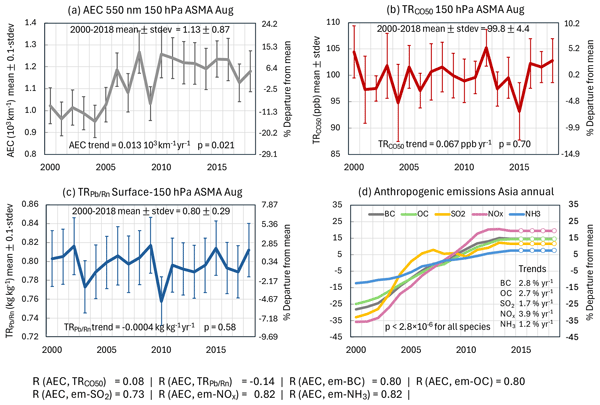
Aerosols in the upper troposphere influence weather and climate. The Asian summer monsoon efficiently transports surface pollutants upward, shaping aerosol amounts and variability in the upper troposphere. Using multiple global models, this study finds a summertime increase in upper-tropospheric aerosols at 1.2 % per year from 2000 to 2018 over Asia, consistent with rising pollutant emissions in Asia, while year-to-year changes are mainly driven by climate variability affecting monsoon dynamics.
Blanca Ayarzagüena, Amy H. Butler, Peter Hitchcock, Chaim I. Garfinkel, Zac D. Lawrence, Wuhan Ning, Philip Rupp, Zheng Wu, Hilla Afargan-Gerstman, Natalia Calvo, Alvaro de la Cámara, Martin Jucker, Gerbrand Koren, Daniel De Maeseneire, Gloria L. Manney, Marisol Osman, Masakazu Taguchi, Cory Barton, Dong-Chan Hong, Yu-Kyung Hyun, Hera Kim, Jeff Knight, Piero Malguzzi, Daniele Mastrangelo, Jiyoung Oh, Inna Polichtchouk, Jadwiga H. Richter, Isla R. Simpson, Seok-Woo Son, Damien Specq, and Tim Stockdale
Weather Clim. Dynam., 7, 411–437, https://doi.org/10.5194/wcd-7-411-2026, https://doi.org/10.5194/wcd-7-411-2026, 2026
Short summary
Short summary
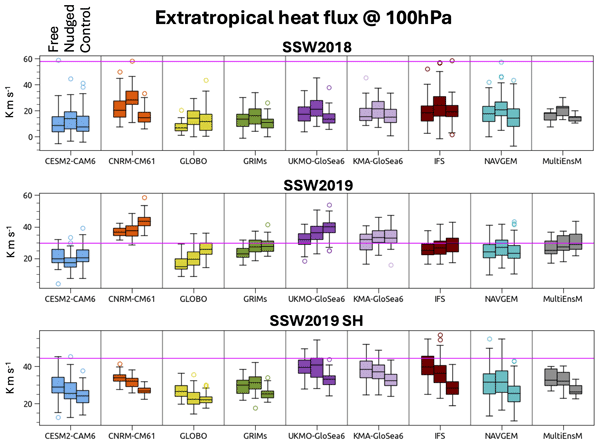
Sudden Stratospheric Warmings (SSWs) are known to follow a sustained wave dissipation in the stratosphere, which depends on both the tropospheric and stratospheric states. However, the relative role of each state is still unclear. Using a new set of subseasonal to seasonal forecasts, we show that the stratospheric state does not drastically affect the precursors of three recent SSWs, but modulates the stratospheric wave activity, with impacts depending on SSW features.
Clara Orbe, Alison Ming, Gabriel Chiodo, Michael Prather, Mohamadou Diallo, Qi Tang, Andreas Chrysanthou, Hiroaki Naoe, Xin Zhou, Irina Thaler, Dillon Elsbury, Ewa Bednarz, Jonathon S. Wright, Aaron Match, Shingo Watanabe, James Anstey, Tobias Kerzenmacher, Stefan Versick, Marion Marchand, Feng Li, and James Keeble
Geosci. Model Dev., 19, 773–794, https://doi.org/10.5194/gmd-19-773-2026, https://doi.org/10.5194/gmd-19-773-2026, 2026
Short summary
Short summary
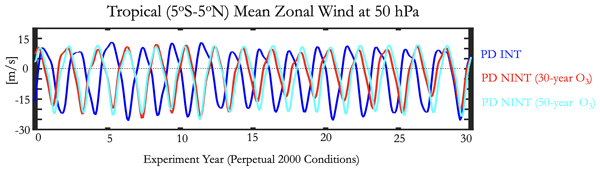
The quasi-biennial oscillation (QBO) is the main source of wind fluctuations in the tropical stratosphere, which can couple to surface climate. However, models do a poor job of simulating the QBO in the lower stratosphere, for reasons that remain unclear. One possibility is that models do not completely represent how ozone influences the QBO-associated wind variations. Here we propose a multi-model framework for assessing how ozone influences the QBO in recent past and future climates.
Philip Rupp, Liliana Vázquez Fernández, William J. M. Seviour, and Thomas Birner
EGUsphere, https://doi.org/10.5194/egusphere-2025-4587, https://doi.org/10.5194/egusphere-2025-4587, 2025
Short summary
Short summary
This study examines mortality impacts of sudden stratospheric warming events (SSWs). SSWs persistently increase the chance for cold spells in Northern Europe, but their direct socio-economic effects remain poorly quantified. Using ensemble simulations of the 2018 SSW and mortality records, we attribute ca. 750 deaths in the UK and 250 in the Nordics to this event. The strongest impacts emerge from the combination of post-SSW cold anomalies and heightened mortality sensitivity to these anomalies.
Shenglong Zhang, Jiao Chen, Jonathon S. Wright, Sean M. Davis, Jie Gao, Paul Konopka, Ninghui Li, Mengqian Lu, Susann Tegtmeier, Xiaolu Yan, Guang J. Zhang, and Nuanliang Zhu
Atmos. Chem. Phys., 25, 10109–10139, https://doi.org/10.5194/acp-25-10109-2025, https://doi.org/10.5194/acp-25-10109-2025, 2025
Short summary
Short summary
Swirling above summer storms, the Asian monsoon anticyclone functions as both gateway and gatekeeper to moisture entering the stratosphere. Although well monitored from space since 2005, many details of the anticyclone and the air that flows through it remain mysterious. Reanalyses, which combine model output and observations, may help to address how and why but only if they reliably capture the what and where of water vapor variations. Current reanalyses are beginning to meet these criteria.
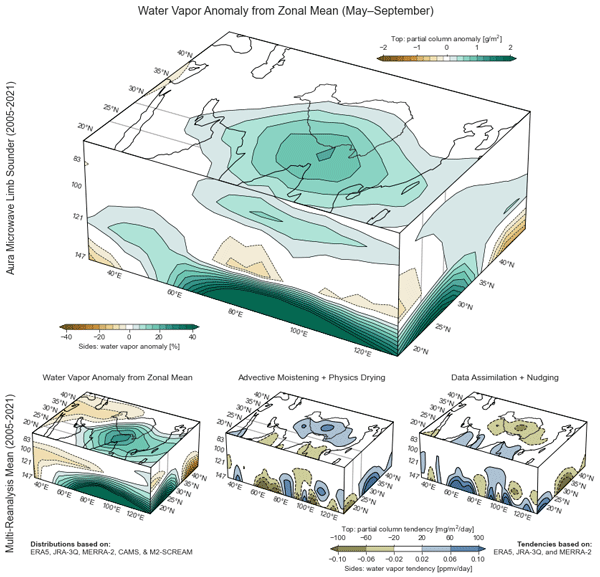
Jonathon S. Wright, Shenglong Zhang, Jiao Chen, Sean M. Davis, Paul Konopka, Mengqian Lu, Xiaolu Yan, and Guang J. Zhang
Atmos. Chem. Phys., 25, 9617–9643, https://doi.org/10.5194/acp-25-9617-2025, https://doi.org/10.5194/acp-25-9617-2025, 2025
Short summary
Short summary
Atmospheric reanalysis products reconstruct past states of the atmosphere. These products are often used to study winds and temperatures in the upper-level monsoon circulation, but their ability to reproduce composition fields like water vapor and ozone has been questionable at best. Here we report clear signs of improvement in both consistency across reanalyses and agreement with satellite observations, outline limitations, and suggest steps to further enhance the usefulness of these fields.
Jie Gao, Yi Huang, Jonathon S. Wright, Ke Li, Tao Geng, and Qiurun Yu
Geosci. Model Dev., 18, 2569–2586, https://doi.org/10.5194/gmd-18-2569-2025, https://doi.org/10.5194/gmd-18-2569-2025, 2025
Short summary
Short summary
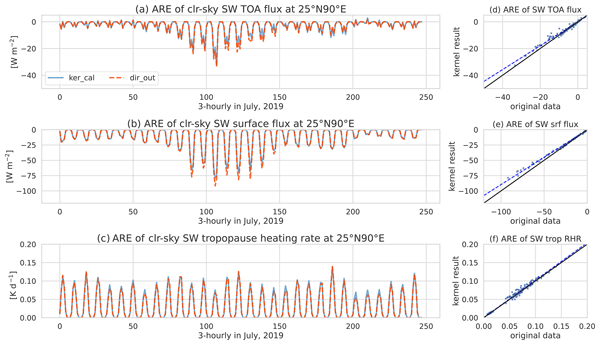
The aerosol in the upper troposphere and stratosphere is highly variable, and its radiative effect is poorly understood. To estimate this effect, the radiative kernel is constructed and applied. The results show that the kernels can reproduce aerosol radiative effects and are expected to simulate stratospheric aerosol radiative effects. This approach reduces computational expense, is consistent with radiative model calculations, and can be applied to atmospheric models with speed requirements.
Philip Rupp, Jonas Spaeth, Hilla Afargan-Gerstman, Dominik Büeler, Michael Sprenger, and Thomas Birner
Weather Clim. Dynam., 5, 1287–1298, https://doi.org/10.5194/wcd-5-1287-2024, https://doi.org/10.5194/wcd-5-1287-2024, 2024
Short summary
Short summary
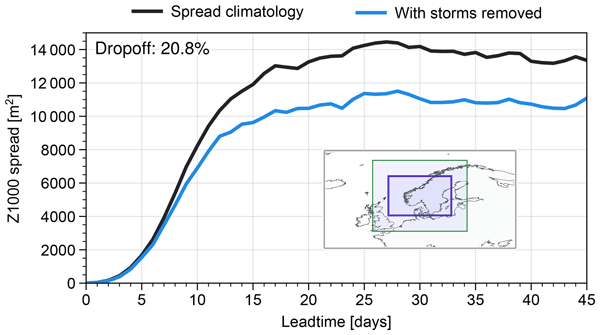
We quantify the occurrence of strong synoptic storms as contributing about 20 % to the uncertainty of subseasonal geopotential height forecasts over northern Europe. We further show that North Atlantic storms are less frequent, weaker and shifted southward following sudden stratospheric warming events, leading to a reduction in northern European forecast uncertainty.
Masatomo Fujiwara, Patrick Martineau, Jonathon S. Wright, Marta Abalos, Petr Šácha, Yoshio Kawatani, Sean M. Davis, Thomas Birner, and Beatriz M. Monge-Sanz
Atmos. Chem. Phys., 24, 7873–7898, https://doi.org/10.5194/acp-24-7873-2024, https://doi.org/10.5194/acp-24-7873-2024, 2024
Short summary
Short summary
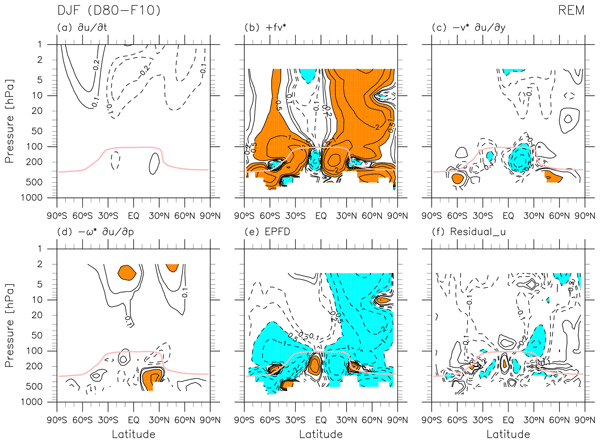
A climatology of the major variables and terms of the transformed Eulerian-mean (TEM) momentum and thermodynamic equations from four global atmospheric reanalyses is evaluated. The spread among reanalysis TEM momentum balance terms is around 10 % in Northern Hemisphere winter and up to 50 % in Southern Hemisphere winter. The largest uncertainties in the thermodynamic equation (about 50 %) are in the vertical advection, which does not show a structure consistent with the differences in heating.
Zizhan Hu, Yiran Peng, Mengke Zhu, and Jonathon S. Wright
EGUsphere, https://doi.org/10.5194/egusphere-2024-828, https://doi.org/10.5194/egusphere-2024-828, 2024
Preprint archived
Short summary
Short summary
Clouds and precipitation are among the most difficult features of the climate system to simulate. Water isotopes provide valuable information about how clouds and precipitation develop and evolve, but most models that simulate water isotopes cannot resolve individual clouds. Here we introduce a new isotope-enabled model, iPyCLES, that simulates liquid and ice clouds on scales of 10 to 100 meters. This model can help to translate isotopic observations into constraints for larger-scale models.
Felix Jäger, Philip Rupp, and Thomas Birner
Weather Clim. Dynam., 4, 49–60, https://doi.org/10.5194/wcd-4-49-2023, https://doi.org/10.5194/wcd-4-49-2023, 2023
Short summary
Short summary
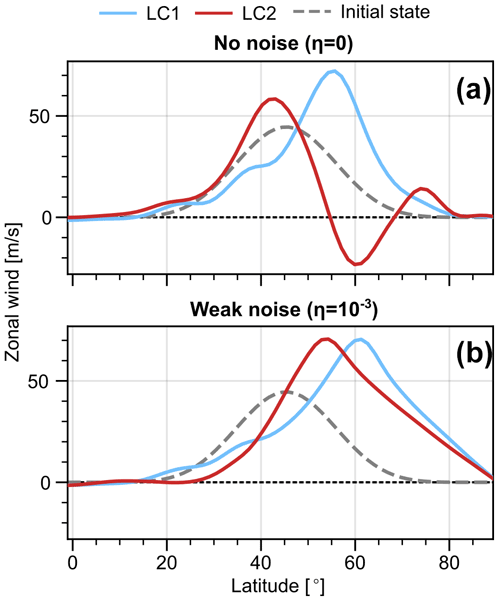
Mid-latitude weather is dominated by the growth, breaking and decay of baroclinic waves and associated jet shifts. A way to study this process is via idealised life-cycle simulations, which are often classified as LC1 (anticyclonic breaking, poleward shift) or LC2 (cyclonic breaking, equatorward shift), depending on details of the initial state. We show that all systems exhibit predominantly anticyclonic character and poleward net shifts if multiple wave modes are allowed to grow simultaneously.
William J. Randel, Fei Wu, Alison Ming, and Peter Hitchcock
Atmos. Chem. Phys., 21, 18531–18542, https://doi.org/10.5194/acp-21-18531-2021, https://doi.org/10.5194/acp-21-18531-2021, 2021
Short summary
Short summary
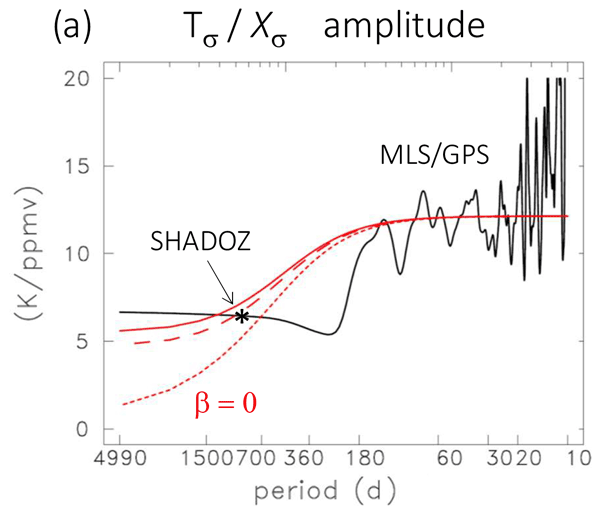
Balloon and satellite observations show strong coupling between large-scale ozone and temperature fields in the tropical lower stratosphere, spanning timescales of days to years. We present a simple interpretation of this behavior based on an idealized model of transport by the tropical stratospheric circulation, and good quantitative agreement with observations demonstrates that this is a useful simplification. The results provide simple understanding of observed atmospheric behavior.
Cited articles
Amemiya, A.: Dynamics of the quasi-biweekly variability of the Asian monsoon anticyclone, PhD thesis, The University of Tokyo, https://doi.org/10.15083/0002001522, 2018. a
Amemiya, A. and Sato, K.: A Two-Dimensional Dynamical Model for the Subseasonal Variability of the Asian Monsoon Anticyclone, J. Atmos. Sci., 75, 3597–3612, https://doi.org/10.1175/JAS-D-17-0208.1, 2018. a, b, c
Andrew, D. G., Holton, J. R., and Leovy, C. B.: Middle atmosphere dynamics, Academic Press Inc., Orlando, FL, https://www.osti.gov/biblio/5936274 (last access: 19 September 2026), 1986. a
Bak, J., Kim, J., Koo, J.-H., Pan, L. L., Ryoo, J.-M., Newman, P. A., Franchin, A., Liu, X., Abad, G. G., Lee, H.-J., Jeon, W., and Kim, C.-H.: An Integrated Analysis of Ozone and Carbon Monoxide Over the Western Pacific Using Satellite and Aircraft Measurements During the ACCLIP Summer Campaign 2022, J. Geophys. Res.-Atmos., 130, https://doi.org/10.1029/2024jd042771, 2025. a
Bian, J., Li, D., Bai, Z., Li, Q., Lyu, D., and Zhou, X.: Transport of Asian surface pollutants to the global stratosphere from the Tibetan Plateau region during the Asian summer monsoon, Natl. Sci. Rev., 7, 516–533, https://doi.org/10.1093/nsr/nwaa005, 2020. a
Charney, J. G.: On the scale of atmospheric motions, Geofysiske Publikasjoner, 17, 1–17, 1948. a
Enomoto, T.: Interannual Variability of the Bonin High Associated with the Propagation of Rossby Waves along the Asian Jet, J. Meteorol. Soc. Jpn., Ser. II, 82, 1019–1034, https://doi.org/10.2151/jmsj.2004.1019, 2004. a
Enomoto, T., Hoskins, B. J., and Matsuda, Y.: The formation mechanism of the Bonin high in August, Q. J. Roy. Meteor. Soc., 129, 157–178, https://doi.org/10.1256/qj.01.211, 2003. a
Ertel, H.: Ein neuer hydrodynamischer Wirbelsatz, Meteorol. Z., 59, 271–281, 1942. a
Fairlie, T. D., Vernier, J.-P., Natarajan, M., and Bedka, K. M.: Dispersion of the Nabro volcanic plume and its relation to the Asian summer monsoon, Atmos. Chem. Phys., 14, 7045–7057, https://doi.org/10.5194/acp-14-7045-2014, 2014. a
Fu, R., Hu, Y., Wright, J. S., Jiang, J. H., Dickinson, R. E., Chen, M., Filipiak, M., Read, W. G., Waters, J. W., and Wu, D. L.: Short circuit of water vapor and polluted air to the global stratosphere by convective transport over the Tibetan Plateau, P. Natl. Acad. Sci. USA, 103, 5664–5669, https://doi.org/10.1073/pnas.0601584103, 2006. a
Fujiwara, M., Wright, J. S., Manney, G. L., Gray, L. J., Anstey, J., Birner, T., Davis, S., Gerber, E. P., Harvey, V. L., Hegglin, M. I., Homeyer, C. R., Knox, J. A., Krüger, K., Lambert, A., Long, C. S., Martineau, P., Molod, A., Monge-Sanz, B. M., Santee, M. L., Tegtmeier, S., Chabrillat, S., Tan, D. G. H., Jackson, D. R., Polavarapu, S., Compo, G. P., Dragani, R., Ebisuzaki, W., Harada, Y., Kobayashi, C., McCarty, W., Onogi, K., Pawson, S., Simmons, A., Wargan, K., Whitaker, J. S., and Zou, C.-Z.: Introduction to the SPARC Reanalysis Intercomparison Project (S-RIP) and overview of the reanalysis systems, Atmos. Chem. Phys., 17, 1417–1452, https://doi.org/10.5194/acp-17-1417-2017, 2017. a
Gelaro, R., McCarty, W., Suárez, M. J., Todling, R., Molod, A., Takacs, L., Randles, C. A., Darmenov, A., Bosilovich, M. G., Reichle, R., Wargan, K., Coy, L., Cullather, R., Draper, C., Akella, S., Buchard, V., Conaty, A., Silva, A. M. D., Gu, W., Kim, G.-K., Koster, R., Lucchesi, R., Merkova, D., Nielsen, J. E., Partyka, G., Pawson, S., Putman, W., Rienecker, M., Schubert, S. D., Sienkiewicz, M., and Zhao, B.: The Modern-Era Retrospective Analysis for Research and Applications, Version 2 (MERRA-2), J. Climate, 30, 5419–5454, https://doi.org/10.1175/JCLI-D-16-0758.1, 2017. a, b
GMAO: MERRA-2 inst3_3d_asm_Nv: 3d,3-Hourly,Instantaneous,Model-Level,Assimilation,Assimilated Meteorological Fields V5.12.4, Goddard Earth Sciences Data and Information Services Center (GES DISC) [data set], https://doi.org/10.5067/WWQSXQ8IVFW8, 2015a. a
GMAO: MERRA-2 tavg3_3d_tdt_Np: 3d,3-Hourly,Time-Averaged,Pressure-Level,Assimilation,Temperature Tendencies V5.12.4, Goddard Earth Sciences Data and Information Services Center (GES DISC) [data set], https://doi.org/10.5067/9NCR9DDDOPFI, 2015b. a
Hersbach, H., Bell, B., Berrisford, P., Hirahara, S., Horányi, A., Muñoz‐Sabater, J., Nicolas, J., Peubey, C., Radu, R., Schepers, D., Simmons, A., Soci, C., Abdalla, S., Abellan, X., Balsamo, G., Bechtold, P., Biavati, G., Bidlot, J., Bonavita, M., De Chiara, G., Dahlgren, P., Dee, D., Diamantakis, M., Dragani, R., Flemming, J., Forbes, R., Fuentes, M., Geer, A., Haimberger, L., Healy, S., Hogan, R., Hólm, E., Janisková, M., Keeley, S., Laloyaux, P., Lopez, P., Lupu, C., Radnoti, G., de Rosnay, P., Rozum, I., Vamborg, F., Villaume, S., and Thépaut, J.-N.: Complete ERA5 from 1940: Fifth generation of ECMWF atmospheric reanalyses of the global climate, Copernicus Climate Change Service (C3S) Climate Data Store (CDS) [data set], https://doi.org/10.24381/cds.143582cf, 2017. a
Hersbach, H., Bell, B., Berrisford, P., Hirahara, S., Horányi, A., Muñoz-Sabater, J., Nicolas, J., Peubey, C., Radu, R., Schepers, D., Simmons, A., Soci, C., Abdalla, S., Abellan, X., Balsamo, G., Bechtold, P., Biavati, G., Bidlot, J., Bonavita, M., De Chiara, G., Dahlgren, P., Dee, D., Diamantakis, M., Dragani, R., Flemming, J., Forbes, R., Fuentes, M., Geer, A., Haimberger, L., Healy, S., Hogan, R. J., Hólm, E., Janisková, M., Keeley, S., Laloyaux, P., Lopez, P., Lupu, C., Radnoti, G., de Rosnay, P., Rozum, I., Vamborg, F., Villaume, S., and Thépaut, J.-N.: The ERA5 global reanalysis, Q. J. Roy. Meteor. Soc., Society, 146, 1999–2049, https://doi.org/10.1002/qj.3803, 2020. a, b
Hersbach, H., Bell, B., Berrisford, P., Biavati, G., Horányi, A., Muñoz Sabater, J., Nicolas, J., Peubey, C., Radu, R., Rozum, I., Schepers, D., Simmons, A., Soci, C., Dee, D., and Thépaut, J.-N.: ERA5 hourly data on pressure levels from 1940 to present, Copernicus Climate Change Service (C3S) Climate Data Store (CDS) [data set], https://doi.org/10.24381/cds.bd0915c6, 2023. a
Honomichl, S. B. and Pan, L. L.: Transport From the Asian Summer Monsoon Anticyclone Over the Western Pacific, J. Geophys. Res.-Atmos., 125, e2019JD032094, https://doi.org/10.1029/2019JD032094, 2020. a, b, c
Hoskins, B. J. and Rodwell, M. J.: A Model of the Asian Summer Monsoon. Part I: The Global Scale, J. Atmos. Sci., 52, 1329–1340, https://doi.org/10.1175/1520-0469(1995)052<1329:AMOTAS>2.0.CO;2, 1995. a
Hoskins, B. J., McIntyre, M. E., and Robertson, A. W.: On the use and significance of isentropic potential vorticity maps, Q. J. Roy. Meteor. Soc., 111, 877–946, https://doi.org/10.1002/qj.49711147002, 1985. a, b
Hsu, H.-H., Terng, C.-T., and Chen, C.-T.: Evolution of Large-Scale Circulation and Heating during the First Transition of Asian Summer Monsoon, J. Climate, 12, 793–810, https://doi.org/10.1175/1520-0442(1999)012<0793:EOLSCA>2.0.CO;2, 1999. a
JMA: The Japanese Reanalysis for Three Quarters of a Century, Data Integration and Analysis System (DIAS) [data set], https://doi.org/10.20783/DIAS.645, 2022. a
JMA: The Japanese Reanalysis for Three Quarters of a Century (JRA-3Q), NSF National Center for Atmospheric Research [data set], https://doi.org/10.5065/AVTZ-1H78, 2023. a
Kachula, O., Vogel, B., Günther, G., and Müller, R.: An optimization-based approach to track the Asian summer monsoon anticyclone across daily and interannual variability, Atmos. Chem. Phys., 25, 15171–15195, https://doi.org/10.5194/acp-25-15171-2025, 2025. a
Kang, J. M. and Son, S.-W.: Development Processes of the Explosive Cyclones over the Northwest Pacific: Potential Vorticity Tendency Inversion, J. Atmos. Sci., 78, 1913–1930, https://doi.org/10.1175/JAS-D-20-0151.1, 2021. a
Kosaka, Y., Kobayashi, S., Harada, Y., Kobayashi, C., Naoe, H., Yoshimoto, K., Harada, M., Goto, N., Chiba, J., Miyaoka, K., Sekiguchi, R., Deushi, M., Kamahori, H., Nakaegawa, T., Tanaka, T. Y., Tokuhiro, T., Sato, Y., Matsushita, Y., and Onogi, K.: The JRA-3Q Reanalysis, J. Meteorol. Soc. Jpn., Ser. II, 102, 49–109, https://doi.org/10.2151/jmsj.2024-004, 2024. a, b
LinHo and Wang, B.: The Time–Space Structure of the Asian–Pacific Summer Monsoon: A Fast Annual Cycle View, J. Climate, 15, 2001–2019, https://doi.org/10.1175/1520-0442(2002)015<2001:TTSSOT>2.0.CO;2, 2002. a, b
Lorensen, W. E.: History of the Marching Cubes Algorithm, IEEE Comput. Graph., 40, 8–15, https://doi.org/10.1109/MCG.2020.2971284, 2020. a
Martineau, P., Wright, J. S., Zhu, N., and Fujiwara, M.: Zonal-mean data set of global atmospheric reanalyses on pressure levels, Earth Syst. Sci. Data, 10, 1925–1941, https://doi.org/10.5194/essd-10-1925-2018, 2018. a
Nützel, M., Brinkop, S., Dameris, M., Garny, H., Jöckel, P., Pan, L. L., and Park, M.: Climatology and variability of air mass transport from the boundary layer to the Asian monsoon anticyclone, Atmos. Chem. Phys., 22, 15659–15683, https://doi.org/10.5194/acp-22-15659-2022, 2022. a
Pan, L. L., Kinnison, D., Liang, Q., Chin, M., Santee, M. L., Flemming, J., Smith, W. P., Honomichl, S. B., Bresch, J. F., Lait, L. R., Zhu, Y., Tilmes, S., Colarco, P. R., Warner, J., Vuvan, A., Clerbaux, C., Atlas, E. L., Newman, P. A., Thornberry, T., Randel, W. J., and Toon, O. B.: A Multimodel Investigation of Asian Summer Monsoon UTLS Transport Over the Western Pacific, J. Geophys. Res.-Atmos., 127, e2022JD037511, https://doi.org/10.1029/2022JD037511, 2022. a, b
Ploeger, F., Gottschling, C., Griessbach, S., Grooß, J.-U., Guenther, G., Konopka, P., Müller, R., Riese, M., Stroh, F., Tao, M., Ungermann, J., Vogel, B., and von Hobe, M.: A potential vorticity-based determination of the transport barrier in the Asian summer monsoon anticyclone, Atmos. Chem. Phys., 15, 13145–13159, https://doi.org/10.5194/acp-15-13145-2015, 2015. a, b, c
Qian, Y., Zhang, Q., Yao, Y., and Zhang, X.: Seasonal variation and heat preference of the south asia high, Adv. Atmos. Sci., 19, 821–836, https://doi.org/10.1007/s00376-002-0047-3, 2002. a, b
Qie, K., Tian, W., Bian, J., Xie, F., and Li, D.: Weakened Asian summer monsoon anticyclone related to increased anthropogenic aerosol emissions in recent decades, npj Climate and Atmospheric Science, 8, 140, https://doi.org/10.1038/s41612-025-01026-8, 2025. a
Qie, X., Wu, X., Yuan, T., Bian, J., and Lu, D.: Comprehensive pattern of deep convective systems over the Tibetan Plateau–South Asian monsoon region based on TRMM data, J. Climate, 27, 6612–6626, https://doi.org/10.1175/JCLI-D-14-00076.1, 2014. a
Randel, W. J. and Park, M.: Deep convective influence on the Asian summer monsoon anticyclone and associated tracer variability observed with Atmospheric Infrared Sounder (AIRS), J. Geophys. Res.-Atmos., 111, https://doi.org/10.1029/2005JD006490, 2006. a, b
Ren, R., Zhu, C., and Cai, M.: Linking quasi-biweekly variability of the South Asian high to atmospheric heating over Tibetan Plateau in summer, Clim. Dynam., 53, 3419–3429, https://doi.org/10.1007/s00382-019-04713-4, 2019. a
Rupp, P. M. and Haynes, P. H.: Spatio-temporal stability analysis applied to monsoon anticyclone flow, Q. J. Roy. Meteor. Soc., 146, 1861–1879, https://doi.org/10.1002/qj.3771, 2020. a, b
Rupp, P. and Haynes, P.: Zonal scale and temporal variability of the Asian monsoon anticyclone in an idealised numerical model, Weather Clim. Dynam., 2, 413–431, https://doi.org/10.5194/wcd-2-413-2021, 2021. a, b
Santee, M. L., Manney, G. L., Livesey, N. J., Schwartz, M. J., Neu, J. L., and Read, W. G.: A comprehensive overview of the climatological composition of the Asian summer monsoon anticyclone based on 10 years of Aura Microwave Limb Sounder measurements, J. Geophys. Res.-Atmos., 122, 5491–5514, https://doi.org/10.1002/2016JD026408, 2017. a, b, c
Tamarin, T. and Kaspi, Y.: The Poleward Motion of Extratropical Cyclones from a Potential Vorticity Tendency Analysis, J. Atmos. Sci., 73, 1687–1707, https://doi.org/10.1175/JAS-D-15-0168.1, 2016. a, b
Tegtmeier, S., Krüger, K., Birner, T., Davis, N. A., Davis, S., Fujiwara, M., Homeyer, C. R., Ivanciu, I., Kim, Y.-H., Legras, B., Manney, G. L., Nishimoto, E., Nützel, M., Kedzierski, R. P., Wang, J. S., Wang, T., and Wright, J. S.: Chapter 8: Tropical Tropopause Layer, in: SPARC Report No. 10, WCRP Report 6/2021, edited by: Fujiwara, M., Manney, G., Gray, L., and Wright, J. S., SPARC, Munich, 309–389, https://doi.org/10.17874/800DEE57D13, 2022. a
Tweedy, O., Oman, L. D., Waugh, D. W., Schoeberl, M. R., Douglass, A. R., and Li, F.: Response of the upper-level monsoon anticyclones and ozone to abrupt CO2 changes, J. Geophys. Res.-Atmos., 126, e2021JD034903, https://doi.org/10.1029/2021jd034903, 2021. a, b
Vernier, J. P., Fairlie, T. D., Natarajan, M., Wienhold, F. G., Bian, J., Martinsson, B. G., Crumeyrolle, S., Thomason, L. W., and Bedka, K. M.: Increase in upper tropospheric and lower stratospheric aerosol levels and its potential connection with Asian pollution, J. Geophys. Res.-Atmos., 120, 1608–1619, https://doi.org/10.1002/2014JD022372, 2015. a
Wang, X., Randel, W., Pan, L., Wu, Y., and Zhang, P.: Transient Behavior of the Asian Summer Monsoon Anticyclone Associated With Eastward Eddy Shedding, J. Geophys. Res.-Atmos., 127, e2021JD036090, https://doi.org/10.1029/2021JD036090, 2022. a, b
Wei, W., Zhang, R., Wen, M., Rong, X., and Li, T.: Impact of Indian summer monsoon on the South Asian High and its influence on summer rainfall over China, Clim. Dynam., 43, 1257–1269, https://doi.org/10.1007/s00382-013-1938-y, 2014. a, b
Wright, J. S. and Fueglistaler, S.: Large differences in reanalyses of diabatic heating in the tropical upper troposphere and lower stratosphere, Atmos. Chem. Phys., 13, 9565–9576, https://doi.org/10.5194/acp-13-9565-2013, 2013. a
Wright, J. S., Sun, X., Konopka, P., Krüger, K., Legras, B., Molod, A. M., Tegtmeier, S., Zhang, G. J., and Zhao, X.: Differences in tropical high clouds among reanalyses: origins and radiative impacts, Atmos. Chem. Phys., 20, 8989–9030, https://doi.org/10.5194/acp-20-8989-2020, 2020. a, b
Wright, J. S., Zhang, S., Chen, J., Davis, S. M., Konopka, P., Lu, M., Yan, X., and Zhang, G. J.: Evaluating reanalysis representations of climatological trace gas distributions in the Asian monsoon tropopause layer, Atmos. Chem. Phys., 25, 9617–9643, https://doi.org/10.5194/acp-25-9617-2025, 2025. a, b, c
Wu, R. and Wang, B.: Multi-stage onset of the summer monsoon over the western North Pacific, Clim. Dynam., 17, 277–289, https://doi.org/10.1007/s003820000118, 2001. a
Xue, X., Chen, W., and Hou, S.: The long-term variation in the South Asia High intensity measured by 150-hPa eddy geopotential height, Meteorol. Atmos. Phys., 132, 833–844, https://doi.org/10.1007/s00703-020-00723-8, 2020. a
Yan, R.-C., Bian, J.-C., and Fan, Q.-J.: The Impact of the South Asia High Bimodality on the Chemical Composition of the Upper Troposphere and Lower Stratosphere, Atmospheric and Oceanic Science Letters, 4, 229–234, https://doi.org/10.1080/16742834.2011.11446934, 2011. a, b
Yan, X., Konopka, P., Ploeger, F., Tao, M., Müller, R., Santee, M. L., Bian, J., and Riese, M.: El Niño Southern Oscillation influence on the Asian summer monsoon anticyclone, Atmos. Chem. Phys., 18, 8079–8096, https://doi.org/10.5194/acp-18-8079-2018, 2018. a, b
Zarrin, A., Ghaemi, H., Azadi, M., and Farajzadeh, M.: The spatial pattern of summertime subtropical anticyclones over Asia and Africa: A climatological review, Int. J. Climatol., 30, 159–173, https://doi.org/10.1002/joc.1879, 2010. a
Zhang, D., Huang, Y., Zhou, B., and Wang, H.: Is There Interdecadal Variation in the South Asian High?, J. Climate, 34, 8089–8103, https://doi.org/10.1175/JCLI-D-21-0059.1, 2021. a
Zhang, S., Chen, J., Wright, J. S., Davis, S. M., Gao, J., Konopka, P., Li, N., Lu, M., Tegtmeier, S., Yan, X., Zhang, G. J., and Zhu, N.: Covariability of dynamics and composition in the Asian monsoon tropopause layer from satellite observations and reanalysis products, Atmos. Chem. Phys., 25, 10109–10139, https://doi.org/10.5194/acp-25-10109-2025, 2025. a, b, c
Zhou, N., Yu, Y., and Qian, Y.: Simulations of the 100-hPa South Asian High and precipitation over East Asia with IPCC coupled GCMs, Adv. Atmos. Sci., 23, 375–390, https://doi.org/10.1007/s00376-006-0375-9, 2006. a, b
Short summary
This study examines how the Asian Summer Monsoon Anticyclone changes during summer. It usually has three main centers over the Iranian Plateau, Tibetan Plateau, and western Pacific. Its movement is mainly controlled by winds, while atmospheric heating influences its strength and development.
This study examines how the Asian Summer Monsoon Anticyclone changes during summer. It usually...


