Articles | Volume 7, issue 1
https://doi.org/10.5194/wcd-7-297-2026
© Author(s) 2026. This work is distributed under
the Creative Commons Attribution 4.0 License.
https://doi.org/10.5194/wcd-7-297-2026
© Author(s) 2026. This work is distributed under
the Creative Commons Attribution 4.0 License.
Rossby wave resonance for idealized jets on a beta-plane: towards a better understanding of the meridional wave structure

Institute for Atmospheric Physics, Johannes Gutenberg University Mainz, Becherweg 21, 55128 Mainz, Germany
Nili Harnik
Porter School of the Environment and Earth Sciences, Tel Aviv University, Tel Aviv, Israel
Related authors
Amelie Mayer and Volkmar Wirth
Weather Clim. Dynam., 6, 131–150, https://doi.org/10.5194/wcd-6-131-2025, https://doi.org/10.5194/wcd-6-131-2025, 2025
Short summary
Short summary
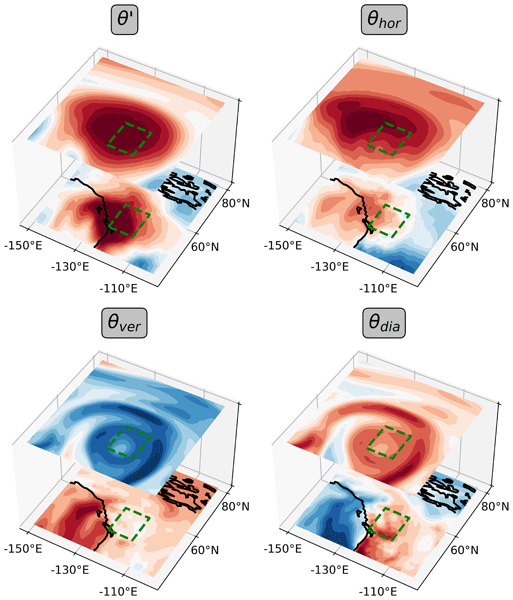
Although heatwaves are among the most dangerous weather-related hazards, their underlying mechanisms are not fully understood. Here, we investigate the formation of heatwaves in an air-parcel-based framework and distinguish the contributions from horizontal transport, vertical transport, and diabatic heating. We show that the results obtained depend profoundly on whether one compares the absolute contributions of the individual terms or, instead, their anomalies relative to climatology.
Antonio Segalini, Jacopo Riboldi, Volkmar Wirth, and Gabriele Messori
Weather Clim. Dynam., 5, 997–1012, https://doi.org/10.5194/wcd-5-997-2024, https://doi.org/10.5194/wcd-5-997-2024, 2024
Short summary
Short summary
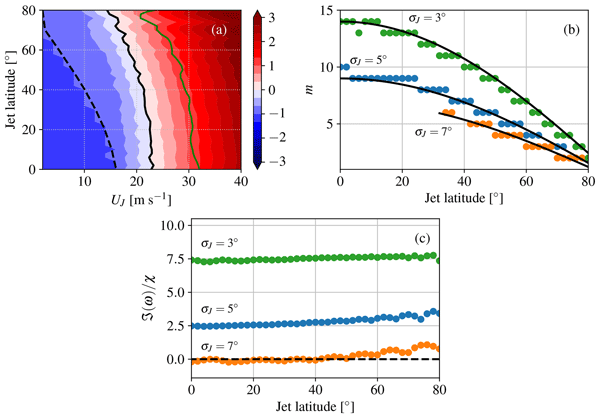
Planetary Rossby waves are created by topography and evolve in time. In this work, an analytical solution of this classical problem is proposed under the approximation of linear wave dynamics. The theory is able to describe reasonably well the evolution of the perturbation and compares well with full nonlinear simulations. Several relevant cases with single and double zonal jets are assessed with the theoretical framework
Franziska Teubler, Michael Riemer, Christopher Polster, Christian M. Grams, Seraphine Hauser, and Volkmar Wirth
Weather Clim. Dynam., 4, 265–285, https://doi.org/10.5194/wcd-4-265-2023, https://doi.org/10.5194/wcd-4-265-2023, 2023
Short summary
Short summary
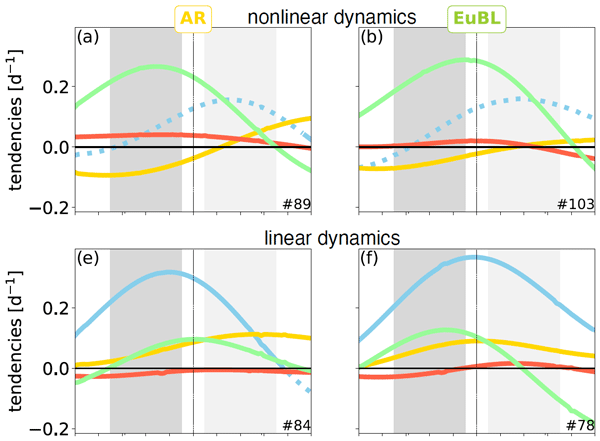
Weather regimes govern an important part of the sub-seasonal variability of the mid-latitude circulation. The year-round dynamics of blocked regimes in the Atlantic European region are investigated in over 40 years of data. We show that the dynamics between the regimes are on average very similar. Within the regimes, the main variability – starting from the characteristics of dynamical processes alone – dominates and transcends the variability in season and types of transitions.
Sohan Suresan, Nili Harnik, and Rodrigo Caballero
Weather Clim. Dynam., 6, 789–806, https://doi.org/10.5194/wcd-6-789-2025, https://doi.org/10.5194/wcd-6-789-2025, 2025
Short summary
Short summary
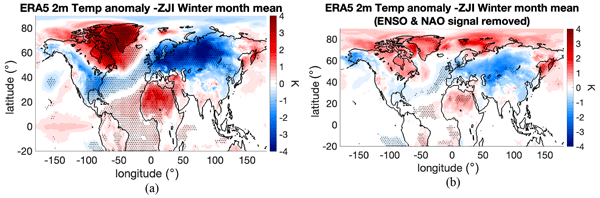
This study is an exploration of how extreme winter weather events across the Northern Hemisphere are influenced by the rare merging of the Atlantic and African jets, beyond such typical factors as the North Atlantic Oscillation (NAO) and El Niño–Southern Oscillation (ENSO). We identify unique surface signals and changes in cyclone paths associated with such persistent winter jets merging over the Atlantic, offering insights into these extreme winter weather patterns.
Amelie Mayer and Volkmar Wirth
Weather Clim. Dynam., 6, 131–150, https://doi.org/10.5194/wcd-6-131-2025, https://doi.org/10.5194/wcd-6-131-2025, 2025
Short summary
Short summary
Although heatwaves are among the most dangerous weather-related hazards, their underlying mechanisms are not fully understood. Here, we investigate the formation of heatwaves in an air-parcel-based framework and distinguish the contributions from horizontal transport, vertical transport, and diabatic heating. We show that the results obtained depend profoundly on whether one compares the absolute contributions of the individual terms or, instead, their anomalies relative to climatology.
Dor Sandler, Hadas Saaroni, Baruch Ziv, Talia Tamarin-Brodsky, and Nili Harnik
Weather Clim. Dynam., 5, 1103–1116, https://doi.org/10.5194/wcd-5-1103-2024, https://doi.org/10.5194/wcd-5-1103-2024, 2024
Short summary
Short summary
The North Atlantic region serves as a source of moisture and energy for Mediterranean storms. Its impact over the Levant region remains an open question due to its smaller weather systems and their longer distance from the ocean. We find an optimal circulation pattern which allows North Atlantic influence to reach farther into the eastern Mediterranean, thus making storms stronger and rainier. This may be relevant for future Mediterranean climate, which is projected to become much drier.
Antonio Segalini, Jacopo Riboldi, Volkmar Wirth, and Gabriele Messori
Weather Clim. Dynam., 5, 997–1012, https://doi.org/10.5194/wcd-5-997-2024, https://doi.org/10.5194/wcd-5-997-2024, 2024
Short summary
Short summary
Planetary Rossby waves are created by topography and evolve in time. In this work, an analytical solution of this classical problem is proposed under the approximation of linear wave dynamics. The theory is able to describe reasonably well the evolution of the perturbation and compares well with full nonlinear simulations. Several relevant cases with single and double zonal jets are assessed with the theoretical framework
Talia Tamarin-Brodsky and Nili Harnik
Weather Clim. Dynam., 5, 87–108, https://doi.org/10.5194/wcd-5-87-2024, https://doi.org/10.5194/wcd-5-87-2024, 2024
Short summary
Short summary
Synoptic waves in the atmosphere tend to follow a typical Rossby wave lifecycle, involving a linear growth stage followed by nonlinear and irreversible Rossby wave breaking (RWB). Here we take a new approach to study RWB events and their fundamental relation to weather systems by combining a storm-tracking technique and an RWB detection algorithm. The synoptic-scale dynamics leading to RWB is then examined by analyzing time evolution composites of cyclones and anticyclones during RWB events.
Franziska Teubler, Michael Riemer, Christopher Polster, Christian M. Grams, Seraphine Hauser, and Volkmar Wirth
Weather Clim. Dynam., 4, 265–285, https://doi.org/10.5194/wcd-4-265-2023, https://doi.org/10.5194/wcd-4-265-2023, 2023
Short summary
Short summary
Weather regimes govern an important part of the sub-seasonal variability of the mid-latitude circulation. The year-round dynamics of blocked regimes in the Atlantic European region are investigated in over 40 years of data. We show that the dynamics between the regimes are on average very similar. Within the regimes, the main variability – starting from the characteristics of dynamical processes alone – dominates and transcends the variability in season and types of transitions.
Gabriele Messori, Nili Harnik, Erica Madonna, Orli Lachmy, and Davide Faranda
Earth Syst. Dynam., 12, 233–251, https://doi.org/10.5194/esd-12-233-2021, https://doi.org/10.5194/esd-12-233-2021, 2021
Short summary
Short summary
Atmospheric jets are a key component of the climate system and of our everyday lives. Indeed, they affect human activities by influencing the weather in many mid-latitude regions. However, we still lack a complete understanding of their dynamical properties. In this study, we try to relate the understanding gained in idealized computer simulations of the jets to our knowledge from observations of the real atmosphere.
Cited articles
Charney, F. G. and DeVore, J. G.: Multiple Flow Equilibria in the Atmosphere and Blocking, J. Atmos. Sci., 36, 1205–1216, https://doi.org/10.1175/1520-0469(1979)036<1205:MFEITA>2.0.CO;2, 1979. a, b
Coumou, D., Petoukhov, V., Rahmstorf, S., Petri, S., and Schellnhuber, H. J.: Quasi-resonant circulation regimes and hemispheric synchronization of extreme weather in boreal summer, Proceedings of the National Academy of Sciences, 34, 12331–12336, 2014. a
Davies, H. C.: Weather chains during the 2013/2014 winter and their significance for seasonal prediction, Nature Geoscience, 8, 833–837, https://doi.org/10.1038/NGEO2561, 2015. a
Fragkoulidis, G. and Wirth, V.: Local Rossby Wave Packet Amplitude, Phase Speed, and Group Velocity: Seasonal Variability and their Role in Temperature Extremes, J. Climate, 33, 8767–8787, https://doi.org/10.1175/JCLI-D-19-0377.1, 2020. a, b
He, Y., Zhu, X., Sheng, Z., and He, M.: Resonant Waves Play an Important Role in the Increasing Heat Waves in Northern Hemisphere Mid-Latitudes Under Global Warming, Geophys. Res. Lett., https://doi.org/10.1029/2023GL104839, 2023. a
Hoskins, B. J. and Karoly, D. J.: The Steady Linear Response of a Spherical Atmosphere to Thermal and Orographic Forcing, J. Atmos. Sci., 38, 1179–1196, 1981. a
Kornhuber, K., Petoukhov, V., Karoly, D., Petri, S., Rahmstorf, S., and Coumou, D.: Summertime Planetary Wave Resonance in the Northern and Southern Hemispheres, J. Climate, 30, 6133–6150, 2017a. a
Kornhuber, K., Petoukhov, V., Petri, S., Rahmstorf, S., and Coumou, D.: Evidence for wave resonance as a key mechanism for generating high-amplitude quasi-stationary waves in boreal summer, Climate Dynamics, 49, 1961–1979, https://doi.org/10.1007/s00382-016-3399-6, 2017b. a, b, c, d
Kornhuber, K., Osprey, S., Coumou, D., Petri, S., Petoukhov, V., Rahmstorf, S., and Gray, L.: Extreme weather events in early Summer 2018 connected by a recurrent hemispheric wave-7 pattern, Environmental Research Letters, 14, 054002, https://doi.org/10.1088/1748-9326/ab13bf, 2019. a, b
Kornhuber, K., Coumou, D., Vogel, E., Lesk, C., Donges, J. F., Lehmann, J., and Horton, R. M.: Amplified Rossby waves enhance risk of concurrent heatwaves in major breadbasket regions, Nature Climate Change, 10, 48–53, https://doi.org/10.1038/s41558-019-0637-z, 2020. a
Kundu, P. K.: Fluid Mechanics, Academic Press, 638 pp., ISBN 9780124287709, 1990. a
Li, X., Mann, M., Wehner, M. F., Rahmstorf, S., Petri, S., Christiansen, S., and Carillo, J.: Role of atmospheric resonance and land–atmosphere feedbacks as a precursor to the June 2021 Pacific Northwest Heat Dome event, Proceedings of the National Academy of Sciences, 121, https://doi.org/10.1073/pnas.2315330121, 2024. a
Li, X., Mann, M. E., Wehner, M. F., and Christiansen, S.: Increased frequency of planetary wave resonance events over the past half-century, Proceedings of the National Academy of Sciences, https://doi.org/10.1073/pnas.2504482122, 2025. a
Mann, M. E., Rahmstorf, S., Kornhuber, K., Steinman, B. A., Miller, S. K., and Coumou, D.: Influence of Anthropogenic Climate Change on Planetary Wave Resonance and Extreme Weather Events, Scientific Reports, 7, 1–10, https://doi.org/10.1038/srep45242, 2017. a, b
Manola, I., Selten, F., de Vries, H., and Hazeleger, W.: “Waveguidability” of idealized jets, J. Geophys. Res., 118, 10432–10440, https://doi.org/10.1002/jgrd.50758, 2013. a, b, c
Matsuno, T.: Vertical propagation of stationary planetary waves in the winter Northern Hemisphere, J. Atmos. Sci., 27, 871–883, 1970. a
Pedlosky, J.: Geophysical Fluid Dynamics, Springer, 2nd edn., 710 pp., ISBN 9781468400717, 1987. a
Petoukhov, V., Petri, S., Rahmstorf, S., Coumou, D., Kornhuber, K., and Schellnhuber, H. J.: Role of quasiresonant planetary wave dynamics in recent boreal spring-to-autumn extreme events, Proceedings of the National Academy of Sciences, 113, 6862–6867, 2016. a
Stadtherr, L., Coumou, D., Petoukhov, V., Petri, S., and Rahmstorf, S.: Record Balkan floods of 2014 linked to planetary wave resonance, Sci. Adv., 2, e1501428, 10.1126/sciadv.1501428, 2016. a
White, R. H., Kornhuber, K., Martius, O., and Wirth, V.: From Atmospheric Waves to Heatwaves: A Waveguide Perspective for Understanding and Predicting Concurrent, Persistent and Extreme Extratropical Weather, Bull. Am. Meteorol. Soc., https://doi.org/10.1175/BAMS-D-21-0170.1, 2022. a
Wirth, V.: Waveguidability of idealized midlatitude jets and the limitations of ray tracing theory, Weather Clim. Dynam., 1, 111–125, https://doi.org/10.5194/wcd-1-111-2020, 2020. a, b, c, d
Short summary
It has been suggested that resonant amplification of Rossby waves along a circumglobal jet may be responsible for the occurrence of extreme weather. Given that the recent literature has produced some conflicting results, the current paper revisits the issue with a particular focus on the meridional structure of the wave. It is found that generally no more than one zonal wavenumber can be expected to be associated with resonance.
It has been suggested that resonant amplification of Rossby waves along a circumglobal jet may...