
Articles | Volume 7, issue 1
https://doi.org/10.5194/wcd-7-37-2026
© Author(s) 2026. This work is distributed under
the Creative Commons Attribution 4.0 License.
the Creative Commons Attribution 4.0 License.
https://doi.org/10.5194/wcd-7-37-2026
© Author(s) 2026. This work is distributed under
the Creative Commons Attribution 4.0 License.
the Creative Commons Attribution 4.0 License.
Research article
| 
06 Jan 2026
Research article |
| 06 Jan 2026
| 06 Jan 2026
Tropical cyclone intensification and extratropical transition under alternate climate conditions: a case study of Hurricane Ophelia (2017)
Marjolein Ribberink
CORRESPONDING AUTHOR

Institute for Environmental Studies, Vrije Universiteit Amsterdam, De Boelelaan 1111, 1081 HV Amsterdam, the Netherlands
Royal Netherlands Meteorological Institute, Utrechtseweg 297, 3731 GA De Bilt, the Netherlands
Hylke de Vries
Royal Netherlands Meteorological Institute, Utrechtseweg 297, 3731 GA De Bilt, the Netherlands
Nadia Bloemendaal
Institute for Environmental Studies, Vrije Universiteit Amsterdam, De Boelelaan 1111, 1081 HV Amsterdam, the Netherlands
Royal Netherlands Meteorological Institute, Utrechtseweg 297, 3731 GA De Bilt, the Netherlands
Michiel Baatsen
Institute for Marine and Atmospheric Research, Utrecht University, Heidelberglaan 8, 3584 CS Utrecht, the Netherlands
Erik van Meijgaard
Royal Netherlands Meteorological Institute, Utrechtseweg 297, 3731 GA De Bilt, the Netherlands
Related authors
No articles found.
Meike de Nooij, Jasper de Jong, Michiel L. J. Baatsen, and Claudia Elisabeth Wieners
EGUsphere, https://doi.org/10.5194/egusphere-2026-4133, https://doi.org/10.5194/egusphere-2026-4133, 2026
This preprint is open for discussion and under review for Earth System Dynamics (ESD).
Short summary
Short summary
Winter storms outside the tropics dominate extreme wind and precipitation events in the so-called storm track regions. Under global warming, storm tracks can shift location. In general, wind extremes in storm tracks become less frequent under global warming, but precipitation extremes more frequent. Stratospheric Aerosol Injection (SA), a possible tool to artificially reduce global warming, reverts the overall trend on extremes, but not perfectly: regional shifts remain.
Daniel J. Lunt, Nicky M. Wright, Bram Vaes, Ulrich Salzmann, James W. B. Rae, Thomas Hickler, David K. Hutchinson, Julia Brugger, Jiang Zhu, Sebastian Steinig, A. Nele Meckler, Gordon N. Inglis, David Evans, Agatha M. de Boer, Bette L. Otto-Bliesner, Natalie Burls, Yurui Zhang, Appy Sluijs, Tammo Reichgelt, Igor Niezgodzki, Katrin Meissner, Jean-Baptiste Ladant, Fanni D. Kelemen, Matthew Huber, David R. Greenwood, Mattias Green, Flavia Boscolo-Galazzo, Manuel Tobias Blau, and Michiel Baatsen
Geosci. Model Dev., 19, 6143–6166, https://doi.org/10.5194/gmd-19-6143-2026, https://doi.org/10.5194/gmd-19-6143-2026, 2026
Short summary
Short summary
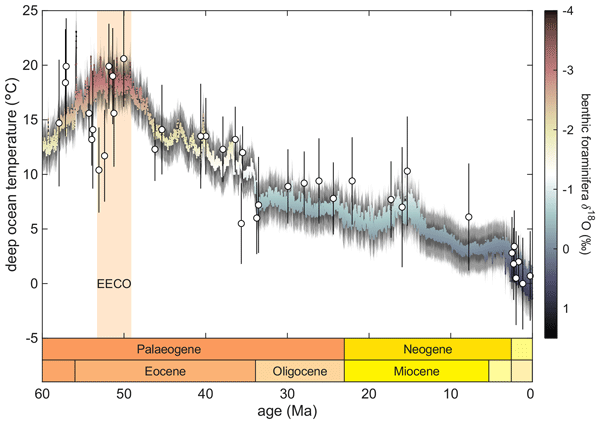
The early Eocene, about 50 million years ago, was a super-warm period of Earth's history, with high concentrations of carbon dioxide in the atmosphere. Here, we provide a framework and experimental design for climate modellers to carry out a coordinated project, simulating this period. This is the second phase of this project, and here we provide updated maps of the Earth's mountains and ocean floor, and vegetation, to enable more accurate modelling.
Aniket Mitra, Steven Goderis, Niels J. de Winter, Michiel Baatsen, Béatrice A. Ledésert, Guillaume Dupont-Nivet, Philippe Claeys, and Inigo A. Müller
EGUsphere, https://doi.org/10.5194/egusphere-2026-1393, https://doi.org/10.5194/egusphere-2026-1393, 2026
Preprint archived
Short summary
Short summary
South Asian Monsoon affects more than 2 billion people and regional biodiversity but may be vulnerable to rising CO2. This study reconstructs seasonally resolved climate at ~38 Ma, linked to early monsoon development, using oyster shells from western India and climate modelling. Results show year-round high temperature with weak seasonality and rainfall extending beyond summer into post-monsoon and winter months. Regional seasonality of tropical climate was likely influenced by palaeogeography.
Daniëlle Bintanja, Hylke de Vries, and Karin van der Wiel
EGUsphere, https://doi.org/10.5194/egusphere-2026-517, https://doi.org/10.5194/egusphere-2026-517, 2026
Short summary
Short summary
We present a method to separate uncertainties from global and regional climate processes within the Hawkins & Sutton (2009) framework, partitioning sources of uncertainty in future climate projections. This helps interpret sources of uncertainty in future climate projections and informs adaptation planning. Focusing on regional projections reduces total uncertainty, highlighting the value of isolating regional uncertainties when developing regional climate information.
Jasper de Jong, Daniel Pflüger, Simone Lingbeek, Claudia E. Wieners, Michiel L. J. Baatsen, and René R. Wijngaard
Geosci. Model Dev., 18, 8679–8702, https://doi.org/10.5194/gmd-18-8679-2025, https://doi.org/10.5194/gmd-18-8679-2025, 2025
Short summary
Short summary
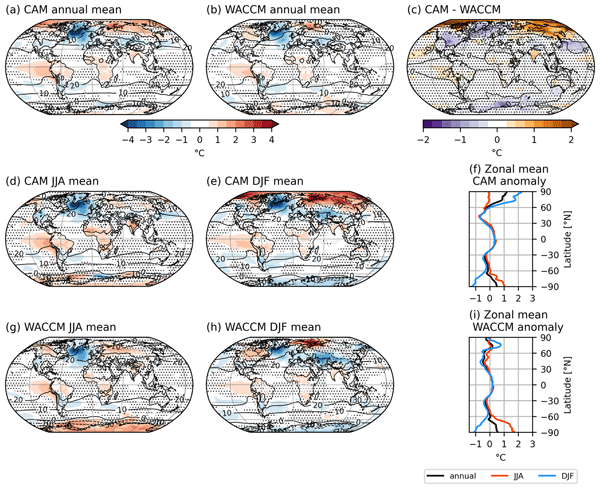
Injection of reflective sulfate aerosols high in the atmosphere is a proposed method to mitigate global warming. Climate simulations with injection are more expensive than standard future projections. We propose a method that dynamically scales the forcing fields based on pre-existing full-complexity data. This opens up possibilities for ensemble generation, new scenarios and higher resolution runs. We show that our method works for multiple model versions, injection scenarios and resolutions.
Sophie Kaashoek, Žiga Malek, Nadia Bloemendaal, and Marleen C. de Ruiter
Nat. Hazards Earth Syst. Sci., 25, 1963–1974, https://doi.org/10.5194/nhess-25-1963-2025, https://doi.org/10.5194/nhess-25-1963-2025, 2025
Short summary
Short summary
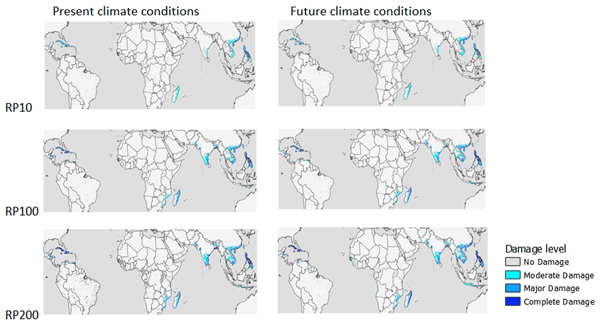
Tropical storms are expected to get stronger all over the world, and this will have a big impact on people, buildings and important activities like growing bananas. Already, in different parts of the world, banana farms are being hurt by these storms, which makes banana prices go up and affects the people who grow them. We are not sure how these storms will affect bananas everywhere in the future. We assessed what happened to banana farms during storms in different parts of the world.
Jonna van Mourik, Hylke de Vries, and Michiel Baatsen
Weather Clim. Dynam., 6, 413–429, https://doi.org/10.5194/wcd-6-413-2025, https://doi.org/10.5194/wcd-6-413-2025, 2025
Short summary
Short summary
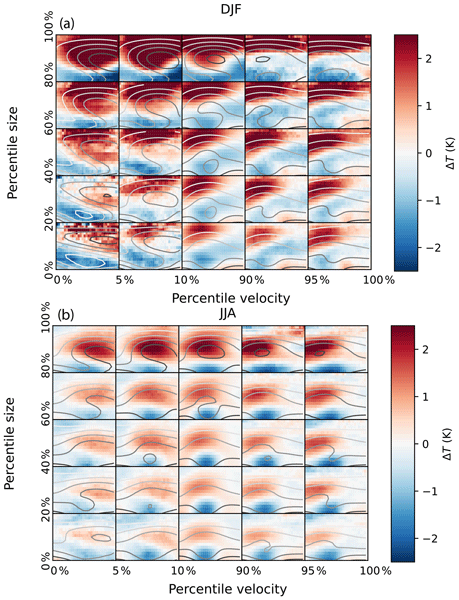
Atmospheric blocking events are quasi-stationary high-pressure areas with large influences on our weather. In this study, we show the wide variety of zonal velocities possible for atmospheric blocking under the most used blocking indices. These include not only stationary blocks, but also eastward- and westward-moving blocks. These respective moving blocks are found to have different characteristics in size and location and have different impacts on our surface temperatures.
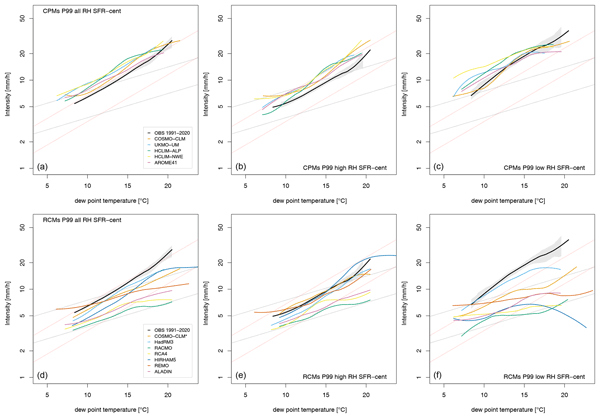
Geert Lenderink, Nikolina Ban, Erwan Brisson, Ségolène Berthou, Virginia Edith Cortés-Hernández, Elizabeth Kendon, Hayley J. Fowler, and Hylke de Vries
Hydrol. Earth Syst. Sci., 29, 1201–1220, https://doi.org/10.5194/hess-29-1201-2025, https://doi.org/10.5194/hess-29-1201-2025, 2025
Short summary
Short summary
Future extreme rainfall events are influenced by changes in both absolute and relative humidity. The impact of increasing absolute humidity is reasonably well understood, but the role of relative humidity decreases over land remains largely unknown. Using hourly observations from France and the Netherlands, we find that lower relative humidity generally leads to more intense rainfall extremes. This relation is only captured well in recently developed convection-permitting climate models.
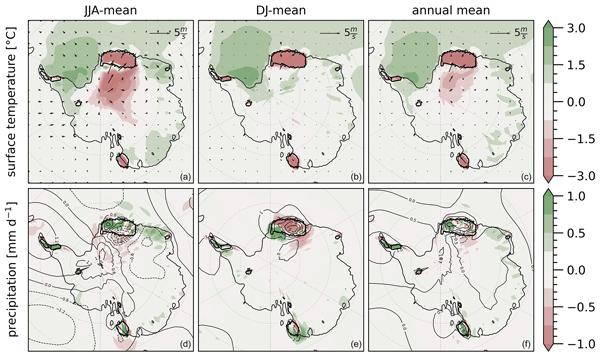
Dennis H. A. Vermeulen, Michiel L. J. Baatsen, and Anna S. von der Heydt
Clim. Past, 21, 95–114, https://doi.org/10.5194/cp-21-95-2025, https://doi.org/10.5194/cp-21-95-2025, 2025
Short summary
Short summary
Late Eocene summers, 34 million years ago, were hot on Antarctica, with temperatures up to 30 °C. We also know that during this period the first Antarctic ice sheet formed. Since climate models do not show the transition from this warm climate to ice sheet formation accurately, we imposed regional ice sheets onto the continent in a realistic climate and show that these ice sheets do not melt away. This suggests that the initiation of ice sheet growth might have happened during warmer periods.
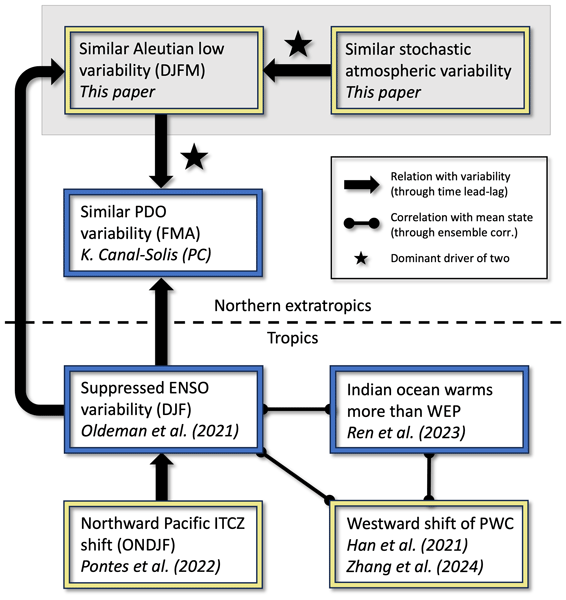
Arthur Merlijn Oldeman, Michiel L. J. Baatsen, Anna S. von der Heydt, Frank M. Selten, and Henk A. Dijkstra
Earth Syst. Dynam., 15, 1037–1054, https://doi.org/10.5194/esd-15-1037-2024, https://doi.org/10.5194/esd-15-1037-2024, 2024
Short summary
Short summary
We might be able to constrain uncertainty in future climate projections by investigating variations in the climate of the past. In this study, we investigate the interactions of climate variability between the tropical Pacific (El Niño) and the North Pacific in a warm past climate – the mid-Pliocene, a period roughly 3 million years ago. Using model simulations, we find that, although the variability in El Niño was reduced, the variability in the North Pacific atmosphere was not.
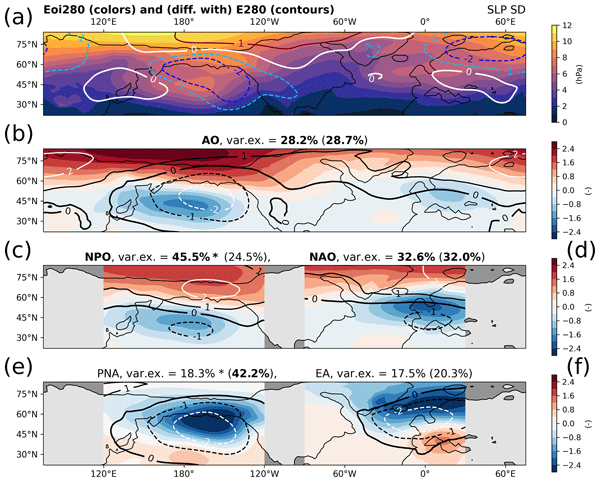
Arthur Merlijn Oldeman, Michiel L. J. Baatsen, Anna S. von der Heydt, Aarnout J. van Delden, and Henk A. Dijkstra
Weather Clim. Dynam., 5, 395–417, https://doi.org/10.5194/wcd-5-395-2024, https://doi.org/10.5194/wcd-5-395-2024, 2024
Short summary
Short summary
The mid-Pliocene, a geological period around 3 million years ago, is sometimes considered the best analogue for near-future climate. It saw similar CO2 concentrations to the present-day but also a slightly different geography. In this study, we use climate model simulations and find that the Northern Hemisphere winter responds very differently to increased CO2 or to the mid-Pliocene geography. Our results weaken the potential of the mid-Pliocene as a future climate analogue.
Michiel Baatsen, Peter Bijl, Anna von der Heydt, Appy Sluijs, and Henk Dijkstra
Clim. Past, 20, 77–90, https://doi.org/10.5194/cp-20-77-2024, https://doi.org/10.5194/cp-20-77-2024, 2024
Short summary
Short summary
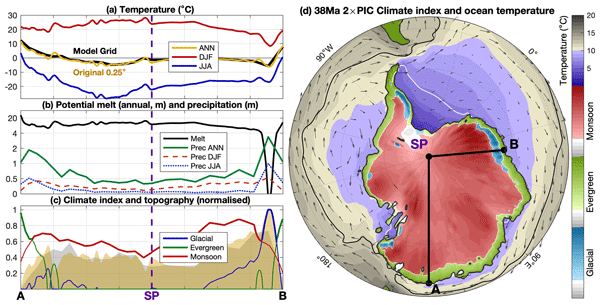
This work introduces the possibility and consequences of monsoons on Antarctica in the warm Eocene climate. We suggest that such a monsoonal climate can be important to understand conditions in Antarctica prior to large-scale glaciation. We can explain seemingly contradictory indications of ice and vegetation on the continent through regional variability. In addition, we provide a new mechanism through which most of Antarctica remained ice-free through a wide range of global climatic changes.
Xin Ren, Daniel J. Lunt, Erica Hendy, Anna von der Heydt, Ayako Abe-Ouchi, Bette Otto-Bliesner, Charles J. R. Williams, Christian Stepanek, Chuncheng Guo, Deepak Chandan, Gerrit Lohmann, Julia C. Tindall, Linda E. Sohl, Mark A. Chandler, Masa Kageyama, Michiel L. J. Baatsen, Ning Tan, Qiong Zhang, Ran Feng, Stephen Hunter, Wing-Le Chan, W. Richard Peltier, Xiangyu Li, Youichi Kamae, Zhongshi Zhang, and Alan M. Haywood
Clim. Past, 19, 2053–2077, https://doi.org/10.5194/cp-19-2053-2023, https://doi.org/10.5194/cp-19-2053-2023, 2023
Short summary
Short summary
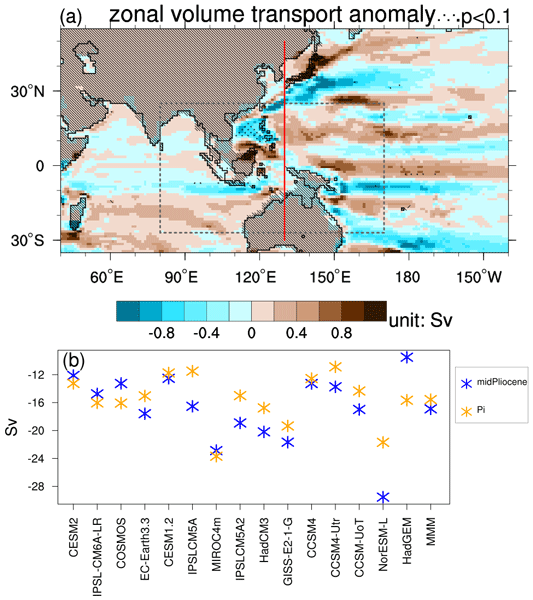
We investigate the Maritime Continent climate in the mid-Piacenzian warm period and find it is warmer and wetter and the sea surface salinity is lower compared with preindustrial period. Besides, the fresh and warm water transfer through the Maritime Continent was stronger. In order to avoid undue influence from closely related models in the multimodel results, we introduce a new metric, the multi-cluster mean, which could reveal spatial signals that are not captured by the multimodel mean.
Jasper de Jong, Michiel L. J. Baatsen, and Aarnout J. van Delden
EGUsphere, https://doi.org/10.5194/egusphere-2023-1259, https://doi.org/10.5194/egusphere-2023-1259, 2023
Preprint archived
Short summary
Short summary
Tropical cyclones often embed a ring-shaped vorticity tower, instead of a centre maximum. Inspired to identify mechanisms in the conservation of such a vorticity structure, we examined the vorticity budget in a simulation of hurricane Irma (2017) near lifetime-peak intensity. Hurricane Irma persisted as a category five hurricane for three consecutive days. We find that vertical exchange of momentum by diabatic heating compensates the advective vorticity loss and eddy activity plays a minor role.
Melissa Wood, Ivan D. Haigh, Quan Quan Le, Hung Nghia Nguyen, Hoang Ba Tran, Stephen E. Darby, Robert Marsh, Nikolaos Skliris, Joël J.-M. Hirschi, Robert J. Nicholls, and Nadia Bloemendaal
Nat. Hazards Earth Syst. Sci., 23, 2475–2504, https://doi.org/10.5194/nhess-23-2475-2023, https://doi.org/10.5194/nhess-23-2475-2023, 2023
Short summary
Short summary
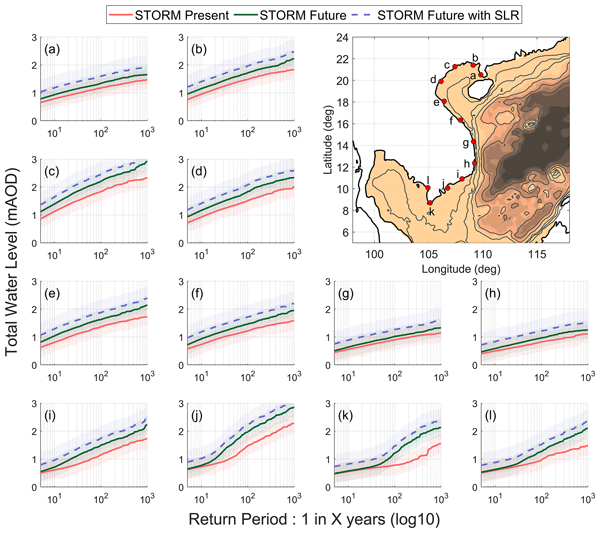
We used a novel database of simulated tropical cyclone tracks to explore whether typhoon-induced storm surges present a future flood risk to low-lying coastal communities around the South China Sea. We found that future climate change is likely to change tropical cyclone behaviour to an extent that this increases the severity and frequency of storm surges to Vietnam, southern China, and Thailand. Consequently, coastal flood defences need to be reviewed for resilience against this future hazard.
Emma E. Aalbers, Erik van Meijgaard, Geert Lenderink, Hylke de Vries, and Bart J. J. M. van den Hurk
Nat. Hazards Earth Syst. Sci., 23, 1921–1946, https://doi.org/10.5194/nhess-23-1921-2023, https://doi.org/10.5194/nhess-23-1921-2023, 2023
Short summary
Short summary
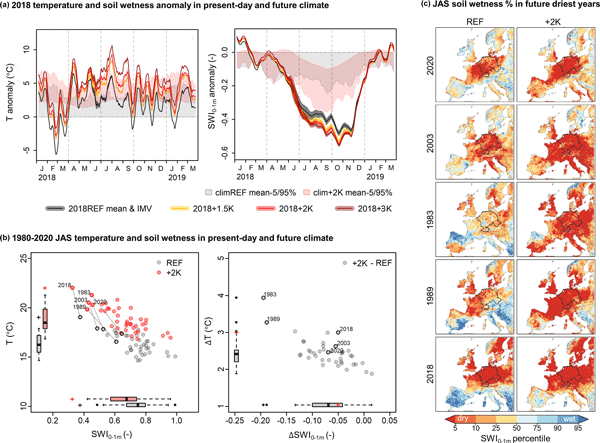
To examine the impact of global warming on west-central European droughts, we have constructed future analogues of recent summers. Extreme droughts like 2018 further intensify, and the local temperature rise is much larger than in most summers. Years that went hardly noticed in the present-day climate may emerge as very dry and hot in a warmer world. The changes can be directly linked to real-world events, which makes the results very tangible and hence useful for climate change communication.
Julia E. Weiffenbach, Michiel L. J. Baatsen, Henk A. Dijkstra, Anna S. von der Heydt, Ayako Abe-Ouchi, Esther C. Brady, Wing-Le Chan, Deepak Chandan, Mark A. Chandler, Camille Contoux, Ran Feng, Chuncheng Guo, Zixuan Han, Alan M. Haywood, Qiang Li, Xiangyu Li, Gerrit Lohmann, Daniel J. Lunt, Kerim H. Nisancioglu, Bette L. Otto-Bliesner, W. Richard Peltier, Gilles Ramstein, Linda E. Sohl, Christian Stepanek, Ning Tan, Julia C. Tindall, Charles J. R. Williams, Qiong Zhang, and Zhongshi Zhang
Clim. Past, 19, 61–85, https://doi.org/10.5194/cp-19-61-2023, https://doi.org/10.5194/cp-19-61-2023, 2023
Short summary
Short summary
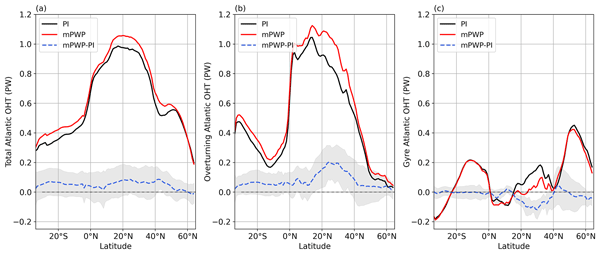
We study the behavior of the Atlantic Meridional Overturning Circulation (AMOC) in the mid-Pliocene. The mid-Pliocene was about 3 million years ago and had a similar CO2 concentration to today. We show that the stronger AMOC during this period relates to changes in geography and that this has a significant influence on ocean temperatures and heat transported northwards by the Atlantic Ocean. Understanding the behavior of the mid-Pliocene AMOC can help us to learn more about our future climate.
Michiel L. J. Baatsen, Anna S. von der Heydt, Michael A. Kliphuis, Arthur M. Oldeman, and Julia E. Weiffenbach
Clim. Past, 18, 657–679, https://doi.org/10.5194/cp-18-657-2022, https://doi.org/10.5194/cp-18-657-2022, 2022
Short summary
Short summary
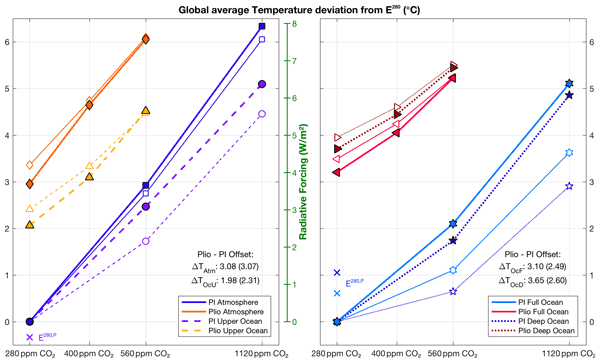
The Pliocene was a period during which atmospheric CO2 was similar to today (i.e. ~ 400 ppm). We present the results of model simulations carried out within the Pliocene Model Intercomparison Project Phase 2 (PlioMIP2) using the CESM 1.0.5. We find a climate that is much warmer than today, with augmented polar warming, increased precipitation, and strongly reduced sea ice cover. In addition, several leading modes of variability in temperature show an altered behaviour.
Wim C. de Rooy, Pier Siebesma, Peter Baas, Geert Lenderink, Stephan R. de Roode, Hylke de Vries, Erik van Meijgaard, Jan Fokke Meirink, Sander Tijm, and Bram van 't Veen
Geosci. Model Dev., 15, 1513–1543, https://doi.org/10.5194/gmd-15-1513-2022, https://doi.org/10.5194/gmd-15-1513-2022, 2022
Short summary
Short summary
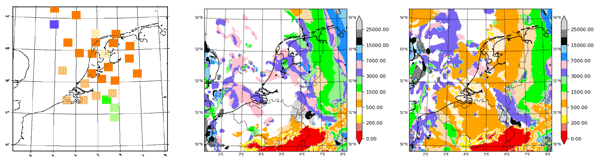
This paper describes a comprehensive model update to the boundary layer schemes. Because the involved parameterisations are all built on widely applied frameworks, the here-described modifications are applicable to many NWP and climate models. The model update contains substantial modifications to the cloud, turbulence, and convection schemes and leads to a substantial improvement of several aspects of the model, especially low cloud forecasts.
Zixuan Han, Qiong Zhang, Qiang Li, Ran Feng, Alan M. Haywood, Julia C. Tindall, Stephen J. Hunter, Bette L. Otto-Bliesner, Esther C. Brady, Nan Rosenbloom, Zhongshi Zhang, Xiangyu Li, Chuncheng Guo, Kerim H. Nisancioglu, Christian Stepanek, Gerrit Lohmann, Linda E. Sohl, Mark A. Chandler, Ning Tan, Gilles Ramstein, Michiel L. J. Baatsen, Anna S. von der Heydt, Deepak Chandan, W. Richard Peltier, Charles J. R. Williams, Daniel J. Lunt, Jianbo Cheng, Qin Wen, and Natalie J. Burls
Clim. Past, 17, 2537–2558, https://doi.org/10.5194/cp-17-2537-2021, https://doi.org/10.5194/cp-17-2537-2021, 2021
Short summary
Short summary
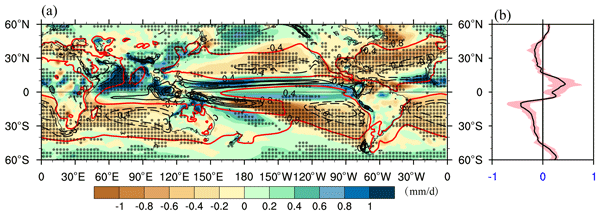
Understanding the potential processes responsible for large-scale hydrological cycle changes in a warmer climate is of great importance. Our study implies that an imbalance in interhemispheric atmospheric energy during the mid-Pliocene could have led to changes in the dynamic effect, offsetting the thermodynamic effect and, hence, altering mid-Pliocene hydroclimate cycling. Moreover, a robust westward shift in the Pacific Walker circulation can moisten the northern Indian Ocean.
Arthur M. Oldeman, Michiel L. J. Baatsen, Anna S. von der Heydt, Henk A. Dijkstra, Julia C. Tindall, Ayako Abe-Ouchi, Alice R. Booth, Esther C. Brady, Wing-Le Chan, Deepak Chandan, Mark A. Chandler, Camille Contoux, Ran Feng, Chuncheng Guo, Alan M. Haywood, Stephen J. Hunter, Youichi Kamae, Qiang Li, Xiangyu Li, Gerrit Lohmann, Daniel J. Lunt, Kerim H. Nisancioglu, Bette L. Otto-Bliesner, W. Richard Peltier, Gabriel M. Pontes, Gilles Ramstein, Linda E. Sohl, Christian Stepanek, Ning Tan, Qiong Zhang, Zhongshi Zhang, Ilana Wainer, and Charles J. R. Williams
Clim. Past, 17, 2427–2450, https://doi.org/10.5194/cp-17-2427-2021, https://doi.org/10.5194/cp-17-2427-2021, 2021
Short summary
Short summary
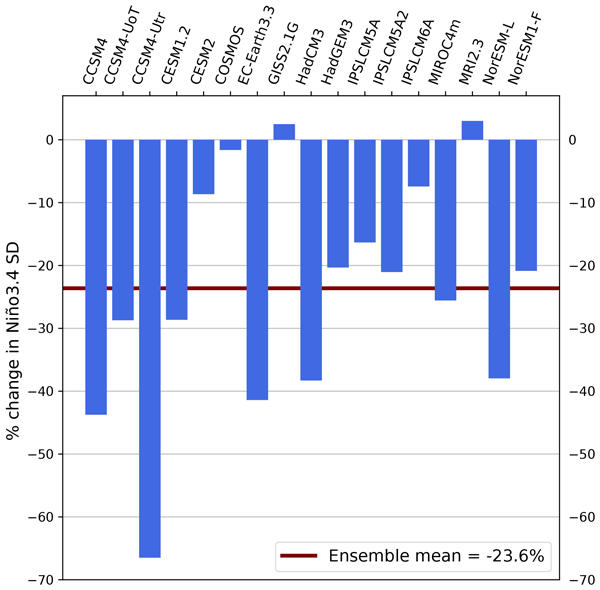
In this work, we have studied the behaviour of El Niño events in the mid-Pliocene, a period of around 3 million years ago, using a collection of 17 climate models. It is an interesting period to study, as it saw similar atmospheric carbon dioxide levels to the present day. We find that the El Niño events were less strong in the mid-Pliocene simulations, when compared to pre-industrial climate. Our results could help to interpret El Niño behaviour in future climate projections.
Cited articles
Arnott, J. M., Evans, J. L., and Chiaromonte, F.: Characterization of extratropical transition using cluster analysis, Mon. Weather Rev., 132, 2916–2937, https://doi.org/10.1175/MWR2836.1, 2004. a
Atallah, E. H. and Bosart, L. F.: The extratropical transition and precipitation distribution of Hurricane Floyd (1999), Mon. Weather Rev., 131, 1063–1081, https://doi.org/10.1175/1520-0493(2003)131<1063:TETAPD>2.0.CO;2, 2003. a
Baker, A. J., Vannière, B., and Vidale, P. L.: On the realism of tropical cyclone intensification in global storm-resolving climate models, Geophys. Res. Lett., 51, e2024GL109841, https://doi.org/10.1029/2024GL109841, 2024. a
Barnes, E. A. and Polvani, L.: Response of the midlatitude jets, and of their variability, to increased greenhouse gases in the CMIP5 models, J. Climate, 26, 7117–7135, https://doi.org/10.1175/JCLI-D-12-00536.1, 2013. a
Belušić, D., de Vries, H., Dobler, A., Landgren, O., Lind, P., Lindstedt, D., Pedersen, R. A., Sánchez-Perrino, J. C., Toivonen, E., van Ulft, B., Wang, F., Andrae, U., Batrak, Y., Kjellström, E., Lenderink, G., Nikulin, G., Pietikäinen, J.-P., Rodríguez-Camino, E., Samuelsson, P., van Meijgaard, E., and Wu, M.: HCLIM38: a flexible regional climate model applicable for different climate zones from coarse to convection-permitting scales, Geosci. Model Dev., 13, 1311–1333, https://doi.org/10.5194/gmd-13-1311-2020, 2020. a
Bieli, M., Camargo, S. J., Sobel, A. H., Evans, J. L., and Hall, T.: A global climatology of extratropical transition. Part I: Characteristics across basins, J. Climate, 32, 3557–3582, https://doi.org/10.1175/JCLI-D-17-0518.1, 2019. a
Bieli, M., Sobel, A. H., Camargo, S. J., Murakami, H., and Vecchi, G. A.: Application of the cyclone phase space to extratropical transition in a global climate model, J. Adv. Model. Earth Sy., 12, e2019MS001878, https://doi.org/10.1029/2019MS001878, 2020. a
Bloemendaal, N., Muis, S., Haarsma, R. J., Verlaan, M., Irazoqui Apecechea, M., de Moel, H., Ward, P. J., and Aerts, J. C. J. H.: Global modeling of tropical cyclone storm surges using high-resolution forecasts, Clim. Dynam., 52, 5031–5044, https://doi.org/10.1007/s00382-018-4430-x, 2019. a
Bond, N. A., Cronin, M. F., and Garvert, M.: Atmospheric sensitivity to SST near the Kuroshio extension during the extratropical transition of Typhoon Tokage, Mon. Weather Rev., 138, 2644–2663, https://doi.org/10.1175/2010MWR3198.1, 2010. a
Bourdin, S., Fromang, S., Caubel, A., Ghattas, J., Meurdesoif, Y., and Dubos, T.: Tropical cyclones in global high-resolution simulations using the IPSL model, Clim. Dynam., 62, 4343–4368, https://doi.org/10.1007/s00382-024-07138-w, 2024. a
Carr, L. E. and Elsberry, R. L.: Models of tropical cyclone wind distribution and beta-effect propagation for application to tropical cyclone track forecasting, Mon. Weather Rev., 125, 3190–3209, https://doi.org/10.1175/1520-0493(1997)125<3190:MOTCWD>2.0.CO;2, 1997. a
Colman, R. A. and McAvaney, B. J.: A study of general circulation model climate feedbacks determined from perturbed sea surface temperature experiments, J. Geophys. Res.-Atmos., 102, 19383–19402, https://doi.org/10.1029/97JD00206, 1997. a
Dekker, M. M., Haarsma, R. J., de Vries, H., Baatsen, M., and van Delden, A. J.: Characteristics and development of European cyclones with tropical origin in reanalysis data, Clim. Dynam., 50, 445–455, https://doi.org/10.1007/s00382-017-3619-8, 2018. a, b
DeMaria, M.: Tropical cyclone motion in a nondivergent barotropic model, Mon. Weather Rev., 113, 1199–1210, https://doi.org/10.1175/1520-0493(1985)113<1199:TCMIAN>2.0.CO;2, 1985. a
Dullaart, J. C. M., de Vries, H., Bloemendaal, N., Aerts, J. C. J. H., and Muis, S.: Improving our understanding of future tropical cyclone intensities in the Caribbean using a high-resolution regional climate model, Sci. Rep.-UK, 14, 6108, https://doi.org/10.1038/s41598-023-49685-y, 2024. a, b, c
Evans, C. and Hart, R. E.: Analysis of the wind field evolution associated with the extratropical transition of Bonnie (1998), Mon. Weather Rev., 136, 2047–2065, https://doi.org/10.1175/2007MWR2051.1, 2008. a
Evans, C., Wood, K. M., Aberson, S. D., Archambault, H. M., Milrad, S. M., Bosart, L. F., Corbosiero, K. L., Davis, C. A., Pinto, J. R. D., Doyle, J., Fogarty, C., Galarneau, T. J., Grams, C. M., Griffin, K. S., Gyakum, J., Hart, R. E., Kitabatake, N., Lentink, H. S., McTaggart-Cowan, R., Perrie, W., Quinting, J. F. D., Reynolds, C. A., Riemer, M., Ritchie, E. A., Sun, Y., and Zhang, F.: The extratropical transition of tropical cyclones. Part I: Cyclone evolution and direct impacts, Mon. Weather Rev., https://doi.org/10.1175/MWR-D-17-0027.1, 2017. a, b
Feser, F., Barcikowska, M., Haeseler, S., Lefebvre, C., Schubert-Frisius, M., Stendel, M., von Storch, H., and Zahn, M.: 11. Hurricane Gonzalo and its extratropical transition to a strong European storm, B. Am. Meteorol. Soc., 96, S51–S55, 2015. a
Galarneau, T. J., Davis, C. A., and Shapiro, M. A.: Intensification of Hurricane Sandy (2012) through extratropical warm core seclusion, Mon. Weather Rev., 141, 4296–4321, https://doi.org/10.1175/MWR-D-13-00181.1, 2013. a
Grønås, S.: The seclusion intensification of the New Year's Day Storm 1992, Tellus A, 47, 733–746, https://doi.org/10.1034/j.1600-0870.1995.00116.x, 1995. a
Haarsma, R. J., Hazeleger, W., Severijns, C., de Vries, H., Sterl, A., Bintanja, R., van Oldenborgh, G. J., and van den Brink, H. W.: More hurricanes to hit Western Europe due to global warming, Geophys. Res. Lett., 40, 1783–1788, https://doi.org/10.1002/grl.50360, 2013. a, b, c, d
Harper, B. A., Kepert, J. D., and Ginger, J. D.: Guidelines for Converting between Various Wind Averaging Periods in Tropical Cyclone Conditions, Tech. Rep. WMO/TD-No. 1555, World Meteorological Organization, https://library.wmo.int/idurl/4/48652 (last access: 17 July 2025), 2010. a
Hart, R. E. and Evans, J. L.: A climatology of the extratropical transition of Atlantic tropical cyclones, J. Climate, 14, 546–564, https://doi.org/10.1175/1520-0442(2001)014<0546:ACOTET>2.0.CO;2, 2001. a, b, c
Held, I. M. and Soden, B. J.: Water vapor feedback and global warming, Annu. Rev. Energ. Env., 25, 441–475, https://doi.org/10.1146/annurev.energy.25.1.441, 2000. a
Held, I. M. and Soden, B. J.: Robust responses of the hydrological cycle to global warming, J. Climate, 19, 5686–5699, https://doi.org/10.1175/JCLI3990.1, 2006. a
Hersbach, H., Bell, B., Berrisford, P., Hirahara, S., Horányi, A., Muñoz-Sabater, J., Nicolas, J., Peubey, C., Radu, R., Schepers, D., Simmons, A., Soci, C., Abdalla, S., Abellan, X., Balsamo, G., Bechtold, P., Biavati, G., Bidlot, J., Bonavita, M., De Chiara, G., Dahlgren, P., Dee, D., Diamantakis, M., Dragani, R., Flemming, J., Forbes, R., Fuentes, M., Geer, A., Haimberger, L., Healy, S., Hogan, R. J., Hólm, E., Janisková, M., Keeley, S., Laloyaux, P., Lopez, P., Lupu, C., Radnoti, G., de Rosnay, P., Rozum, I., Vamborg, F., Villaume, S., and Thépaut, J.-N.: The ERA5 global reanalysis, Q. J. Roy. Meteor. Soc., 146, 1999–2049, https://doi.org/10.1002/qj.3803, 2020. a
Jones, E., Parfitt, R., and Wing, A. A.: Development of frontal boundaries during the extratropical transition of tropical cyclones, Q. J. Roy. Meteor. Soc., 150, 995–1011, https://doi.org/10.1002/qj.4633, 2024. a
Jones, S. C., Harr, P. A., Abraham, J., Bosart, L. F., Bowyer, P. J., Evans, J. L., Hanley, D. E., Hanstrum, B. N., Hart, R. E., Lalaurette, F., Sinclair, M. R., Smith, R. K., and Thorncroft, C.: The extratropical transition of tropical cyclones: forecast challenges, current understanding, and future directions, Weather Forecast., 18, 1052–1092, https://doi.org/10.1175/1520-0434(2003)018<1052:TETOTC>2.0.CO;2, 2003. a, b
Jung, C. and Lackmann, G. M.: Extratropical transition of Hurricane Irene (2011) in a changing climate, J. Climate, 32, 4847–4871, https://doi.org/10.1175/JCLI-D-18-0558.1, 2019. a, b
Jung, C. and Lackmann, G. M.: The response of extratropical transition of tropical cyclones to climate change: quasi-idealized numerical experiments, J. Climate, 34, 4361–4381, https://doi.org/10.1175/JCLI-D-20-0543.1, 2021. a
Jung, C. and Lackmann, G. M.: Changes in tropical cyclones undergoing extratropical transition in a warming climate: quasi-idealized numerical experiments of North Atlantic landfalling events, Geophys. Res. Lett., 50, e2022GL101963, https://doi.org/10.1029/2022GL101963, 2023. a
Kaplan, J. and DeMaria, M.: Large-scale characteristics of rapidly intensifying tropical cyclones in the North Atlantic basin, Weather Forecast., 18, 1093–1108, https://doi.org/10.1175/1520-0434(2003)018<1093:LCORIT>2.0.CO;2, 2003. a
Kitabatake, N.: Climatology of extratropical transition of tropical cyclones in the western North Pacific defined by using cyclone phase space, Journal of the Meteorological Society of Japan. Ser. II, 89, 309–325, https://doi.org/10.2151/jmsj.2011-402, 2011. a
Knapp, K. R., Kruk, M. C., Levinson, D. H., Diamond, H. J., and Neumann, C. J.: The international best track archive for climate stewardship (IBTrACS): unifying tropical cyclone data, B. Am. Meteorol. Soc., 91, 363–376, https://doi.org/10.1175/2009BAMS2755.1, 2010. a
Kofron, D. E., Ritchie, E. A., and Tyo, J. S.: Determination of a consistent time for the extratropical transition of tropical cyclones. Part I: Examination of existing methods for finding “ET Time”, Mon. Weather Rev., 138, 4328–4343, https://doi.org/10.1175/2010MWR3180.1, 2010. a
Liu, M., Vecchi, G. A., Smith, J. A., and Murakami, H.: The present-day simulation and twenty-first-century projection of the climatology of extratropical transition in the North Atlantic, J. Climate, 30, 2739–2756, https://doi.org/10.1175/JCLI-D-16-0352.1, 2017. a, b
Liu, M., Yang, L., Smith, J. A., and Vecchi, G. A.: Response of extreme rainfall for landfalling tropical cyclones undergoing extratropical transition to projected climate change: Hurricane Irene (2011), Earths Future, 8, e2019EF001360, https://doi.org/10.1029/2019EF001360, 2020. a
Lopez, H., Lee, S.-K., West, R., Kim, D., Foltz, G. R., Alaka, G. J., and Murakami, H.: Projected increase in the frequency of extremely active Atlantic hurricane seasons, Science Advances, 10, eadq7856, https://doi.org/10.1126/sciadv.adq7856, 2024. a
Luu, L. N., van Meijgaard, E., Philip, S. Y., Kew, S. F., de Baar, J. H. S., and Stepek, A.: Impact of surface roughness changes on surface wind speed over Western Europe: a study with the regional climate model RACMO, J. Geophys. Res.-Atmos., 128, e2022JD038426, https://doi.org/10.1029/2022JD038426, 2023. a
Majumdar, S. J., Magnusson, L., Bechtold, P., Bidlot, J. R., and Doyle, J. D.: Advanced tropical cyclone prediction using the experimental global ECMWF and operational regional COAMPS-TC systems, Mon. Weather Rev., 151, 2029–2048, https://doi.org/10.1175/MWR-D-22-0236.1, 2023. a
Manabe, S. and Stouffer, R. J.: Sensitivity of a global climate model to an increase of CO2 concentration in the atmosphere, J. Geophys. Res.-Oceans, 85, 5529–5554, https://doi.org/10.1029/JC085iC10p05529, 1980. a
McTaggart-Cowan, R., Gyakum, J. R., and Yau, M. K.: The impact of tropical remnants on extratropical cyclogenesis: case study of Hurricanes Danielle and Earl (1998), Mon. Weather Rev., 132, 1933–1951, https://doi.org/10.1175/1520-0493(2004)132<1933:TIOTRO>2.0.CO;2, 2004. a
Michaelis, A. C. and Lackmann, G. M.: Climatological changes in the extratropical transition of tropical cyclones in high-resolution global simulations, J. Climate, 32, 8733–8753, https://doi.org/10.1175/JCLI-D-19-0259.1, 2019. a, b
Michaelis, A. C. and Lackmann, G. M.: Storm-scale dynamical changes of extratropical transition events in present-day and future high-resolution global simulations, J. Climate, 34, 5037–5062, https://doi.org/10.1175/JCLI-D-20-0472.1, 2021. a
Moore, P.: Storm Ophelia, Tech. rep., Met Éireann, https://www.met.ie/cms/assets/uploads/2018/10/Ophelia-1.pdf (last access: 12 January 2025), 2018. a
Murakami, H., Vecchi, G. A., Underwood, S., Delworth, T. L., Wittenberg, A. T., Anderson, W. G., Chen, J.-H., Gudgel, R. G., Harris, L. M., Lin, S.-J., and Zeng, F.: Simulation and prediction of category 4 and 5 hurricanes in the high-resolution GFDL HiFLOR coupled climate model, J. Climate, https://doi.org/10.1175/JCLI-D-15-0216.1, 2015. a
National Centers for Environmental Prediction, National Weather Service, NOAA, U.S. Department of Commerce: NCEP GFS 0.25 Degree Global Forecast Grids Historical Archive, https://doi.org/10.5065/D65D8PWK, 2015. a
NDFEM: Review Report on Severe Weather Events 2017–2018, Tech. rep., https://assets.gov.ie/static/documents/review-report-on-severe-weather-events-2017-2018.pdf (last access: 19 December 2024), 2019. a
Noël, B., van de Berg, W. J., van Meijgaard, E., Kuipers Munneke, P., van de Wal, R. S. W., and van den Broeke, M. R.: Evaluation of the updated regional climate model RACMO2.3: summer snowfall impact on the Greenland Ice Sheet, The Cryosphere, 9, 1831–1844, https://doi.org/10.5194/tc-9-1831-2015, 2015. a
Quitián-Hernández, L., González-Alemán, J. J., Santos-Muñoz, D., Fernández-González, S., Valero, F., and Martín, M. L.: Subtropical cyclone formation via warm seclusion development: the importance of surface fluxes, J. Geophys. Res.-Atmos., 125, e2019JD031526, https://doi.org/10.1029/2019JD031526, 2020. a
Radu, R., Toumi, R., and Phau, J.: Influence of atmospheric and sea surface temperature on the size of Hurricane Catarina, Q. J. Roy. Meteor. Soc., 140, 1778–1784, https://doi.org/10.1002/qj.2232, 2014. a, b
Rantanen, M., Räisänen, J., Sinclair, V. A., Lento, J., and Järvinen, H.: The extratropical transition of Hurricane Ophelia (2017) as diagnosed with a generalized omega equation and vorticity equation, Tellus A, 72, 1–26, https://doi.org/10.1080/16000870.2020.1721215, 2020. a, b, c
Ren, D., Lynch, M., Leslie, L. M., and Lemarshall, J.: Sensitivity of tropical cyclone tracks and intensity to ocean surface temperature: four cases in four different basins, Tellus A, 66, 24212, https://doi.org/10.3402/tellusa.v66.24212, 2014. a
Ritchie, E. A. and Elsberry, R. L.: Simulations of the extratropical transition of tropical cyclones: phasing between the upper-level trough and tropical cyclones, Mon. Weather Rev., 135, 862–876, https://doi.org/10.1175/MWR3303.1, 2007. a
Roberts, M. J., Vidale, P. L., Mizielinski, M. S., Demory, M.-E., Schiemann, R., Strachan, J., Hodges, K., Bell, R., and Camp, J.: Tropical cyclones in the UPSCALE ensemble of high-resolution global climate models, J. Climate, https://doi.org/10.1175/JCLI-D-14-00131.1, 2015. a
Saarinen, S.: IFS Documentation CY33R1 – Part I: Observation Processing, https://doi.org/10.21957/bj0w7aul, 2004. a
Sainsbury, E. M., Schiemann, R. K. H., Hodges, K. I., Baker, A. J., Shaffrey, L. C., and Bhatia, K. T.: Why do some post-tropical cyclones impact Europe?, Mon. Weather Rev., 150, 2553–2571, https://doi.org/10.1175/MWR-D-22-0111.1, 2022. a, b
San-Miguel-Ayanz, J., Oom, D., Artes, T., Viegas, D., Fernandes, P., Faivre, N., Freire, S., Moore, P., Rego, F., and Castellnou, M.: Forest Fires in Portugal in 2017, in: Science for Disaster Risk Management 2020: Acting today, protecting tomorrow, edited by: Casajus Valles, A., Marin Ferrer, M., Poljansek, K., and Clark, I., Publications Office of the European Union, Luxembourg, 411–430, https://doi.org/10.2760/438998, 2021. a
Sarro, G. and Evans, C.: An updated investigation of post-transformation intensity, structural, and duration extremes for extratropically transitioning North Atlantic tropical cyclones, Mon. Weather Rev., https://doi.org/10.1175/MWR-D-22-0088.1, 2022. a, b, c, d
Serreze, M. C., Barrett, A. P., Stroeve, J. C., Kindig, D. N., and Holland, M. M.: The emergence of surface-based Arctic amplification, The Cryosphere, 3, 11–19, https://doi.org/10.5194/tc-3-11-2009, 2009. a
Shapiro, M. A. and Keyser, D.: Fronts, jet streams and the tropopause, in: Extratropical Cyclones: The Erik Palmén Memorial Volume, edited by: Newton, C. W. and Holopainen, E. O., American Meteorological Society, Boston, MA, https://doi.org/10.1007/978-1-944970-33-8_10, 167–191, 1990. a
Simpson: The hurricane disaster—potential scale, Weatherwise, 27, 169–186, https://doi.org/10.1080/00431672.1974.9931702, 1974. a, b
Smith, A. B.: U.S. Billion-dollar Weather and Climate Disasters, 1980–Present (NCEI Accession 0209268), NOAA National Centers for Environmental Information [data set], https://doi.org/10.25921/STKW-7W73, 2020. a
Smith, R. B.: A hurricane beta-drift law, Journal of the Atmopsheric Sciences, 50, 3213–3215, https://doi.org/10.1175/1520-0469(1993)050<3213:AHBDL>2.0.CO;2, 1993. a, b, c
Stendel, M., Francis, J., White, R., Williams, P. D., and Woollings, T.: The jet stream and climate change, in: Climate Change, Elsevier, https://doi.org/10.1016/B978-0-12-821575-3.00015-3, 327–357, 2021. a
Studholme, J., Hodges, K. I., and Brierley, C. M.: Objective determination of the extratropical transition of tropical cyclones in the Northern Hemisphere, Tellus A: Dynamic Meteorology and Oceanography, 67, 24474, https://doi.org/10.3402/tellusa.v67.24474, 2015. a, b
Sun, Y., Zhong, Z., Li, T., Yi, L., and Shen, Y.: The slowdown tends to be greater for stronger tropical cyclones, J. Climate, 34, 5741–5751, https://doi.org/10.1175/JCLI-D-20-0449.1, 2021. a, b
Taylor, K. E., Stouffer, R. J., and Meehl, G. A.: An overview of CMIP5 and the experiment design, B. Am. Meteorol. Soc., 93, 485–498, https://doi.org/10.1175/BAMS-D-11-00094.1, 2012. a
Thorncroft, C. and Jones, S. C.: The extratropical transitions of Hurricanes Felix and Iris in 1995, Mon. Weather Rev., 128, 947–972, https://doi.org/10.1175/1520-0493(2000)128<0947:TETOHF>2.0.CO;2, 2000. a
Wood, K. M. and Ritchie, E. A.: A 40-year climatology of extratropical transition in the eastern North Pacific, J. Climate, 27, 5999–6015, https://doi.org/10.1175/JCLI-D-13-00645.1, 2014. a
Yamada, Y., Satoh, M., Sugi, M., Kodama, C., Noda, A. T., Nakano, M., and Nasuno, T.: Response of tropical cyclone activity and structure to global warming in a high-resolution global nonhydrostatic model, J. Climate, https://doi.org/10.1175/JCLI-D-17-0068.1, 2017. a
Zarzycki, C. M., Thatcher, D. R., and Jablonowski, C.: Objective tropical cyclone extratropical transition detection in high-resolution reanalysis and climate model data, J. Adv. Model. Earth Sy., 9, 130–148, https://doi.org/10.1002/2016MS000775, 2017. a
Short summary
Hurricane Ophelia of October 2017 is a rare example of a strong post-tropical cyclone impacting Europe, an event that is expected to occur more frequently as our climate warms. This study examines the changes in structure, behaviour, and extratropical transition of Hurricane Ophelia under alternate climate forcing using a regional model. We find that in warmer climates the storm becomes stronger, larger, and maintains the characteristics of a tropical cyclone for longer than in cooler climates.
Hurricane Ophelia of October 2017 is a rare example of a strong post-tropical cyclone impacting...


