
Articles | Volume 7, issue 2
https://doi.org/10.5194/wcd-7-825-2026
© Author(s) 2026. This work is distributed under
the Creative Commons Attribution 4.0 License.
the Creative Commons Attribution 4.0 License.
https://doi.org/10.5194/wcd-7-825-2026
© Author(s) 2026. This work is distributed under
the Creative Commons Attribution 4.0 License.
the Creative Commons Attribution 4.0 License.
Research article
| 
20 May 2026
Research article |
| 20 May 2026
| 20 May 2026
Cold spells induced by slow-moving and amplified large-scale ridge and trough

Department of Physics and Technology, UiT – The Arctic University of Norway, Tromsø, Norway
Rune Grand Graversen
Department of Physics and Technology, UiT – The Arctic University of Norway, Tromsø, Norway
Norwegian Meteorological Institute, Tromsø, Norway
Johannes Patrick Stoll
Norwegian Meteorological Institute, Tromsø, Norway
Jakub Petříček
Department of Physics and Technology, UiT – The Arctic University of Norway, Tromsø, Norway
Related authors
No articles found.
Kristoffer Kvist, Eirik Mikal Samuelsen, and Rune Grand Graversen
EGUsphere, https://doi.org/10.5194/egusphere-2026-6079, https://doi.org/10.5194/egusphere-2026-6079, 2026
This preprint is open for discussion and under review for Atmospheric Chemistry and Physics (ACP).
Short summary
Short summary
Ice forms in clouds on rare airborne particles, which affects how clouds reflect sunlight and produce rain. We compiled 110,000 measurements of these particles from 59 field campaigns worldwide and developed a method to compare campaigns that sampled the air differently. Concentrations differ ten-thousandfold between regions but only threefold at one site, vary on time scales from days to seasons, and are dominated by organic material, not mineral dust. The data help test climate models.
Kai-Uwe Eiselt and Rune Grand Graversen
The Cryosphere, 20, 1867–1893, https://doi.org/10.5194/tc-20-1867-2026, https://doi.org/10.5194/tc-20-1867-2026, 2026
Short summary
Short summary
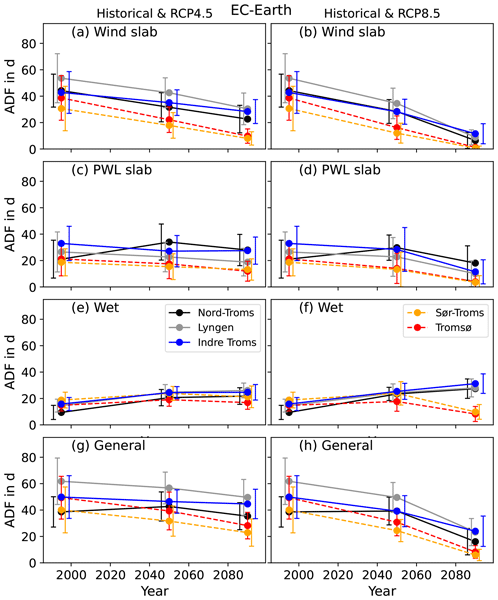
We train machine-learning models to predict avalanche problems from meteorological and snow-cover data in northern Norway. A major part of the work is the estimation of avalanche-problem changes throughout the 21st century based on future climate projections. We find that while the avalanche danger generally declines towards 2100, the avalanche characteristics will likely change, meaning fewer dry but more wet avalanches, having potential implications for the avalanche-danger forecast quality.
Valerio Lembo, Gabriele Messori, Davide Faranda, Vera Melinda Galfi, Rune Grand Graversen, and Flavio Emanuele Pons
Weather Clim. Dynam., 7, 453–473, https://doi.org/10.5194/wcd-7-453-2026, https://doi.org/10.5194/wcd-7-453-2026, 2026
Short summary
Short summary
Hemispheric heatwaves have fundamental implications for ecosystems and societies. They are studied together with large-scale atmospheric dynamics, through the lens of poleward heat transports by planetary-scale waves. Extremely weak transports of heat towards the North Pole are found to be associated with hemispheric heatwaves in the Northern Hemisphere mid-latitudes. Therefore, we conclude that heat transports are a possible indicator and a precursor of concurrent hemispheric heatwaves.
Ziying Yang, Jiping Liu, Mirong Song, Yongyun Hu, Qinghua Yang, Ke Fan, Rune Grand Graversen, and Lu Zhou
The Cryosphere, 19, 6381–6402, https://doi.org/10.5194/tc-19-6381-2025, https://doi.org/10.5194/tc-19-6381-2025, 2025
Short summary
Short summary
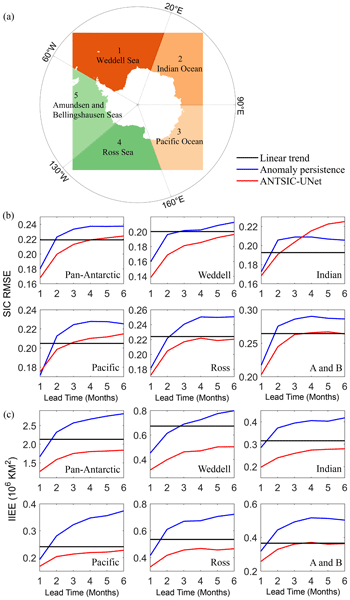
Antarctic sea ice has changed rapidly in recent years. Here we developed a deep learning model trained by multiple climate variables for extended seasonal Antarctic sea ice prediction. Our model shows high predictive skills up to 6 months in advance, particularly in predicting extreme events. It also shows skillful predictions at the sea ice edge and year-to-year sea ice changes. Variable importance analyses suggest what variables are more important for prediction at different lead times.
Kai-Uwe Eiselt and Rune Grand Graversen
The Cryosphere, 19, 1849–1871, https://doi.org/10.5194/tc-19-1849-2025, https://doi.org/10.5194/tc-19-1849-2025, 2025
Short summary
Short summary
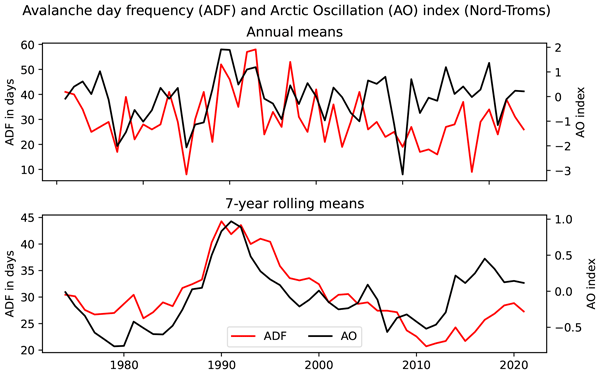
In this study we optimise and train a random forest model to predict avalanche danger in northern Norway based on meteorological reanalysis data. The model performance is at the low end compared to recent similar studies. A hindcast of the frequency of avalanche days (based on the avalanche-danger level) is performed from 1970 to 2024, and a correlation is found with the Arctic Oscillation. This has potential implications for longer-term avalanche predictability.

Colin G. Jones, Fanny Adloff, Ben B. B. Booth, Peter M. Cox, Veronika Eyring, Pierre Friedlingstein, Katja Frieler, Helene T. Hewitt, Hazel A. Jeffery, Sylvie Joussaume, Torben Koenigk, Bryan N. Lawrence, Eleanor O'Rourke, Malcolm J. Roberts, Benjamin M. Sanderson, Roland Séférian, Samuel Somot, Pier Luigi Vidale, Detlef van Vuuren, Mario Acosta, Mats Bentsen, Raffaele Bernardello, Richard Betts, Ed Blockley, Julien Boé, Tom Bracegirdle, Pascale Braconnot, Victor Brovkin, Carlo Buontempo, Francisco Doblas-Reyes, Markus Donat, Italo Epicoco, Pete Falloon, Sandro Fiore, Thomas Frölicher, Neven S. Fučkar, Matthew J. Gidden, Helge F. Goessling, Rune Grand Graversen, Silvio Gualdi, José M. Gutiérrez, Tatiana Ilyina, Daniela Jacob, Chris D. Jones, Martin Juckes, Elizabeth Kendon, Erik Kjellström, Reto Knutti, Jason Lowe, Matthew Mizielinski, Paola Nassisi, Michael Obersteiner, Pierre Regnier, Romain Roehrig, David Salas y Mélia, Carl-Friedrich Schleussner, Michael Schulz, Enrico Scoccimarro, Laurent Terray, Hannes Thiemann, Richard A. Wood, Shuting Yang, and Sönke Zaehle
Earth Syst. Dynam., 15, 1319–1351, https://doi.org/10.5194/esd-15-1319-2024, https://doi.org/10.5194/esd-15-1319-2024, 2024
Short summary
Short summary
We propose a number of priority areas for the international climate research community to address over the coming decade. Advances in these areas will both increase our understanding of past and future Earth system change, including the societal and environmental impacts of this change, and deliver significantly improved scientific support to international climate policy, such as future IPCC assessments and the UNFCCC Global Stocktake.

Patrick Johannes Stoll, Rune Grand Graversen, and Gabriele Messori
Weather Clim. Dynam., 4, 1–17, https://doi.org/10.5194/wcd-4-1-2023, https://doi.org/10.5194/wcd-4-1-2023, 2023
Short summary
Short summary
The atmosphere is in motion and hereby transporting warm, cold, moist, and dry air to different climate zones. In this study, we investigate how this transport of energy organises in different manners. Outside the tropics, atmospheric waves of sizes between 2000 and 8000 km, which we perceive as cyclones from the surface, transport most of the energy and moisture poleward. In the winter, large-scale weather situations become very important for transporting energy into the polar regions.

Alena Dekhtyareva, Mark Hermanson, Anna Nikulina, Ove Hermansen, Tove Svendby, Kim Holmén, and Rune Grand Graversen
Atmos. Chem. Phys., 22, 11631–11656, https://doi.org/10.5194/acp-22-11631-2022, https://doi.org/10.5194/acp-22-11631-2022, 2022
Short summary
Short summary
Despite decades of industrial activity in Svalbard, there is no continuous air pollution monitoring in the region’s settlements except Ny-Ålesund. The NOx and O3 observations from the three-station network have been compared for the first time in this study. It has been shown how the large-scale weather regimes control the synoptic meteorological conditions and determine the atmospheric long-range transport pathways and efficiency of local air pollution dispersion.
Valerio Lembo, Federico Fabiano, Vera Melinda Galfi, Rune Grand Graversen, Valerio Lucarini, and Gabriele Messori
Weather Clim. Dynam., 3, 1037–1062, https://doi.org/10.5194/wcd-3-1037-2022, https://doi.org/10.5194/wcd-3-1037-2022, 2022
Short summary
Short summary
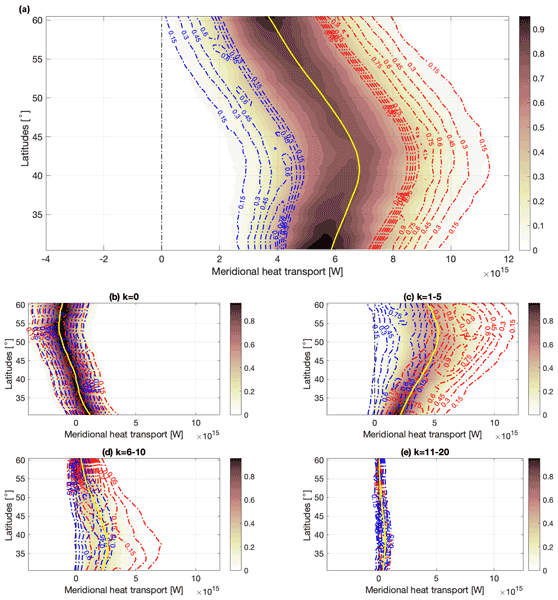
Eddies in mid-latitudes characterize the exchange of heat between the tropics and the poles. This exchange is largely uneven, with a few extreme events bearing most of the heat transported across latitudes in a season. It is thus important to understand what the dynamical mechanisms are behind these events. Here, we identify recurrent weather regime patterns associated with extreme transports, and we identify scales of mid-latitudinal eddies that are mostly responsible for the transport.
Patrick Johannes Stoll
Weather Clim. Dynam., 3, 483–504, https://doi.org/10.5194/wcd-3-483-2022, https://doi.org/10.5194/wcd-3-483-2022, 2022
Short summary
Short summary
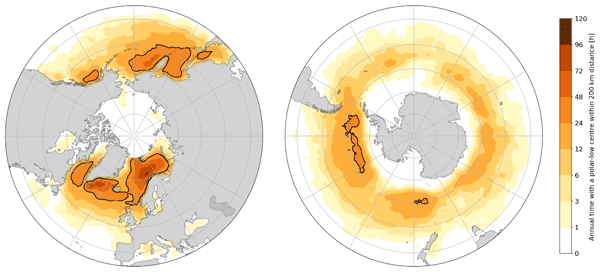
Polar lows are small but intense cyclones and constitute one of the major natural hazards in the polar regions. To be aware of when and where polar lows occur, this study maps polar lows globally by utilizing new atmospheric datasets. Polar lows develop in all marine areas adjacent to sea ice or cold landmasses, mainly in the winter half year. The highest frequency appears in the Nordic Seas. Further, it is found that polar lows are rather similar in the different ocean sub-basins.
Cited articles
Babaei, M., Graversen, R. G., Stoll, J. P., and Petříček, J.: Cold spells induced by slow and amplified atmospheric waves (codes), Version v1, Zenodo [code], https://doi.org/10.5281/zenodo.16761349, 2025. a
Barnes, E. A.: Revisiting the evidence linking Arctic amplification to extreme weather in midlatitudes, Geophys. Res. Lett., 40, 4734–4739, https://doi.org/10.1002/grl.50880, 2013. a, b, c
Barnes, M. A., King, M., Reeder, M., and Jakob, C.: The dynamics of slow-moving coherent cyclonic potential vorticity anomalies and their links to heavy rainfall over the eastern seaboard of Australia, Q. J. Roy. Meteor. Soc., 149, 2233–2251, https://doi.org/10.1002/qj.4503, 2023. a
Barriopedro, D., García-Herrera, R., Lupo, A. R., and Hernández, E.: A Climatology of Northern Hemisphere Blocking, J. Climate., 19, 1042–1063, https://doi.org/10.1175/JCLI3678.1, 2006. a
Bieli, M., Pfahl, S., and Wernli, H.: A Lagrangian investigation of hot and cold temperature extremes in Europe, Q. J. Roy. Meteor. Soc., 141, 98–108, https://doi.org/10.1002/qj.2339, 2015. a
Blackmon, M. L., Lee, Y.-H., Wallace, J. M., and Hsu, H.: Time Variation of 500 mb Height Fluctuations with Long, Intermediate and Short Time Scales as Deduced from Lag-Correlation Statistics, J. Atmos. Sci., 41, 981–991, https://doi.org/10.1175/1520-0469(1984)041<0981:TVOMHF>2.0.CO;2, 1984. a
Blackport, R., Fyfe, J. C., and Screen, J. A.: Arctic change reduces risk of cold extremes, Science, 375, 729–729, https://doi.org/10.1126/science.abn2414, 2022. a
Blackport, R., Sigmond, M., and Screen, J. A.: Models and observations agree on fewer and milder midlatitude cold extremes even over recent decades of rapid Arctic warming, Sci. Adv., 10, eadp1346, https://doi.org/10.1126/sciadv.adp1346, 2024. a
Buehler, T., Raible, C. C., and Stocker, T. F.: The relationship of winter season North Atlantic blocking frequencies to extreme cold or dry spells in the ERA-40, Tellus A, 63, 174–187, 2011. a
Cattiaux, J., Peings, Y., Saint‐Martin, D., Trou‐Kechout, N., and Vavrus, S. J.: Sinuosity of midlatitude atmospheric flow in a warming world, Geophys. Res. Lett., 43, 8259–8268, https://doi.org/10.1002/2016GL070309, 2016. a, b, c
Chen, G., Lu, J., Burrows, D. A., and Leung, L. R.: Local finite‐amplitude wave activity as an objective diagnostic of midlatitude extreme weather, Geophys. Res. Lett., 42, https://doi.org/10.1002/2015GL066959, 2015. a
Chen, X. and Luo, D.: Arctic sea ice decline and continental cold anomalies: Upstream and downstream effects of Greenland blocking, Geophys. Res. Lett., 44, 3411–3419, https://doi.org/10.1002/2016GL072387, 2017. a
Cohen, J., Screen, J. A., Furtado, J. C., Barlow, M., Whittleston, D., Coumou, D., and Jones, J.: Recent Arctic amplification and extreme mid-latitude weather, Nat. Geosci., 7, 627–637, https://doi.org/10.1038/ngeo2234, 2014. a
Cohen, J., Pfeiffer, K., and Francis, J. A.: Warm Arctic episodes linked with increased frequency of extreme winter weather in the United States, Nat. Commun., 9, 869, https://doi.org/10.1038/s41467-018-02992-9, 2018. a
Cohen, J., Agel, L., Barlow, M., Garfinkel, C. I., and White, I.: Linking Arctic variability and change with extreme winter weather in the United States, Science, 373, 1116–1121, https://doi.org/10.1126/science.abi9167, 2021. a
Cohen, J., Francis, J. A., and Pfeiffer, K.: Anomalous Arctic warming linked with severe winter weather in Northern Hemisphere continents, Commun. Earth Environ., 5, 557, https://doi.org/10.1038/s43247-024-01720-0, 2024. a
Copernicus Climate Change Service, Climate Data Store: ERA5 hourly data on pressure levels from 1940 to present, Copernicus Climate Change Service (C3S) Climate Data Store (CDS) [data set], https://doi.org/10.24381/cds.bd0915c6, 2023a. a
Copernicus Climate Change Service, Climate Data Store: ERA5 hourly data on single levels from 1940 to present, Copernicus Climate Change Service (C3S) Climate Data Store (CDS) [data set], https://doi.org/10.24381/cds.adbb2d47, 2023b. a
Coumou, D., Petoukhov, V., Rahmstorf, S., Petri, S., and Schellnhuber, H. J.: Quasi-resonant circulation regimes and hemispheric synchronization of extreme weather in boreal summer, P. Natl. Acad. Sci. USA, 111, 12331–12336, https://doi.org/10.1073/pnas.1412797111, 2014. a
Coumou, D., Lehmann, J., and Beckmann, J.: The weakening summer circulation in the Northern Hemisphere mid-latitudes, Science, 348, 324–327, https://doi.org/10.1126/science.1261768, 2015. a
Domeisen, D. I. V., Martius, O., and Jiménez-Esteve, B.: Rossby Wave Propagation into the Northern Hemisphere Stratosphere: The Role of Zonal Phase Speed, Geophys. Res. Lett., 45, 2064–2071, https://doi.org/10.1002/2017GL076886, 2018. a
Fischer, E. M., Sippel, S., and Knutti, R.: Increasing probability of record-shattering climate extremes, Nat. Clim. Change, 11, 689–695, https://doi.org/10.1038/s41558-021-01092-9, 2021. a
Fragkoulidis, G.: Decadal variability and trends in extratropical Rossby wave packet amplitude, phase, and phase speed, Weather Clim. Dynam., 3, 1381–1398, https://doi.org/10.5194/wcd-3-1381-2022, 2022. a
Fragkoulidis, G., Wirth, V., Bossmann, P., and Fink, A. H.: Linking Northern Hemisphere temperature extremes to Rossby wave packets, Q. J. Roy. Meteor. Soc., 144, 553–566, https://doi.org/10.1002/qj.3228, 2018. a, b, c
Geen, R., Thomson, S. I., Screen, J. A., Blackport, R., Lewis, N. T., Mudhar, R., Seviour, W. J. M., and Vallis, G. K.: An Explanation for the Metric Dependence of the Midlatitude Jet‐Waviness Change in Response to Polar Warming, Geophys. Res. Lett., 50, e2023GL105132, https://doi.org/10.1029/2023GL105132, 2023. a, b, c
Graversen, R. G., White, R. H., and Vihma, T.: Enhanced weather persistence due to amplified Arctic warming, Commun. Earth Environ., 6, https://doi.org/10.1038/s43247-025-03050-1, 2025. a
Hanna, E. and Cropper, T. E.: North Atlantic Oscillation, in: Oxford Research Encyclopedia of Climate Science, edited by: von Storch, H., Oxford University Press, https://doi.org/10.1093/acrefore/9780190228620.013.22, 2017. a
Harnik, N., Messori, G., Caballero, R., and Feldstein, S. B.: The Circumglobal North American wave pattern and its relation to cold events in eastern North America, Geophys. Res. Lett., 43, 11015–11023, https://doi.org/10.1002/2016GL070760, 2016. a
Hassanzadeh, P., Kuang, Z., and Farrell, B. F.: Responses of midlatitude blocks and wave amplitude to changes in the meridional temperature gradient in an idealized dry GCM, Geophys. Res. Lett., 41, 5223–5232, https://doi.org/10.1002/2014GL060764, 2014. a, b
Hersbach, H., Bell, B., Berrisford, P., Hirahara, S., Horányi, A., Muñoz-Sabater, J., Nicolas, J., Peubey, C., Radu, R., Schepers, D., Simmons, A., Soci, C., Abdalla, S., Abellan, X., Balsamo, G., Bechtold, P., Biavati, G., Bidlot, J., Bonavita, M., De Chiara, G., Dahlgren, P., Dee, D., Diamantakis, M., Dragani, R., Flemming, J., Forbes, R., Fuentes, M., Geer, A., Haimberger, L., Healy, S., Hogan, R. J., Hólm, E., Janisková, M., Keeley, S., Laloyaux, P., Lopez, P., Lupu, C., Radnoti, G., de Rosnay, P., Rozum, I., Vamborg, F., Villaume, S., and Thépaut, J.-N.: The ERA5 global reanalysis, Q. J. Roy. Meteor. Soc., 146, 1999–2049, https://doi.org/10.1002/qj.3803, 2020. a
Hoskins, B. and Woollings, T.: Persistent Extratropical Regimes and Climate Extremes, Curr. Climate Change Rep., 1, 115–124, https://doi.org/10.1007/s40641-015-0020-8, 2015. a
Hoskins, B. J., McIntyre, M. E., and Robertson, A. W.: On the use and significance of isentropic potential vorticity maps, Q. J. Roy. Meteor. Soc., 111, 877–946, https://doi.org/10.1002/qj.49711147002, 1985. a
Jolly, E., d’Andrea, F., Rivière, G., and Fromang, S.: Linking Warm Arctic Winters, Rossby Waves, and Cold Spells: An Idealized Numerical Study, J. Atmos. Sci., 78, 2783–2799, https://doi.org/10.1175/JAS-D-20-0088.1, 2021. a, b, c
Kautz, L.-A., Martius, O., Pfahl, S., Pinto, J. G., Ramos, A. M., Sousa, P. M., and Woollings, T.: Atmospheric blocking and weather extremes over the Euro-Atlantic sector – a review, Weather Clim. Dynam., 3, 305–336, https://doi.org/10.5194/wcd-3-305-2022, 2022. a
Kornhuber, K., Petoukhov, V., Petri, S., Rahmstorf, S., and Coumou, D.: Evidence for wave resonance as a key mechanism for generating high-amplitude quasi-stationary waves in boreal summer, Clim. Dynam., 49, 1961–1979, https://doi.org/10.1007/s00382-016-3399-6, 2017. a
Kornhuber, K., Osprey, S., Coumou, D., Petri, S., Petoukhov, V., Rahmstorf, S., and Gray, L.: Extreme weather events in early summer 2018 connected by a recurrent hemispheric wave-7 pattern, Environ. Res. Lett., 14, 054002, https://doi.org/10.1088/1748-9326/ab13bf, 2019. a
Mayer, A.: A New Global Lagrangian Analysis of Near-Surface Temperature Extremes, Geophys. Res. Lett., 52, e2025GL116696, https://doi.org/10.1029/2025GL116696, 2025. a
Morlot, M., Russo, S., Feyen, L., and Formetta, G.: Trends in heat and cold wave risks for the Italian Trentino-Alto Adige region from 1980 to 2018, Nat. Hazards Earth Syst. Sci., 23, 2593–2606, https://doi.org/10.5194/nhess-23-2593-2023, 2023. a
Nakamura, N. and Huang, C. S.: Atmospheric blocking as a traffic jam in the jet stream, Science, 361, 42–47, https://doi.org/10.1126/science.aat0721, 2018. a
Petoukhov, V., Rahmstorf, S., Petri, S., and Schellnhuber, H. J.: Quasiresonant amplification of planetary waves and recent Northern Hemisphere weather extremes, P. Natl. Acad. Sci. USA, 110, 5336–5341, https://doi.org/10.1073/pnas.1222000110, 2013. a, b, c
Pfahl, S.: Characterising the relationship between weather extremes in Europe and synoptic circulation features, Nat. Hazards Earth Syst. Sci., 14, 1461–1475, https://doi.org/10.5194/nhess-14-1461-2014, 2014. a
Pfleiderer, P. and Coumou, D.: Quantification of temperature persistence over the Northern Hemisphere land-area, Clim. Dynam., 51, 627–637, https://doi.org/10.1007/s00382-017-3945-x, 2018. a
Randel, W. J. and Held, I. M.: Phase Speed Spectra of Transient Eddy Fluxes and Critical Layer Absorption, J. Atmos. Sci., 48, 688–697, https://doi.org/10.1175/1520-0469(1991)048<0688:PSSOTE>2.0.CO;2, 1991. a
Reid, K. J., Barnes, M. A., Gillett, Z. E., Parker, T., Udy, D. G., Ayat, H., Boschat, G., Bowden, A., Grosfeld, N. H., King, A. D., Richardson, D., Shao, Y., Teckentrup, L., Trewin, B., Hope, P., Zhou, L., Borowiak, A. R., Holgate, C. M., and Isphording, R. N.: A Multiscale Evaluation of the Wet 2022 in Eastern Australia, J. Climate, 38, 909–929, https://doi.org/10.1175/JCLI-D-24-0224.1, 2025. a
Ribes, A., Robin, A., Tessiot, A., and Cattiaux, J.: Recent Extreme Cold Waves are Likely Not to Happen Again This Century, B. Am. Meteorol. Soc., 106, E1759–E1771, https://doi.org/10.1175/BAMS-D-24-0013.1, 2025. a
Riboldi, J., Lott, F., D'Andrea, F., and Rivière, G.: On the Linkage Between Rossby Wave Phase Speed, Atmospheric Blocking, and Arctic Amplification, Geophys. Res. Lett., 47, e2020GL087796, https://doi.org/10.1029/2020GL087796, 2020. a, b, c
Röthlisberger, M. and Papritz, L.: A Global Quantification of the Physical Processes Leading to Near-Surface Cold Extremes, Geophys. Res. Lett., 50, e2022GL101670, https://doi.org/10.1029/2022GL101670, 2023. a, b
Röthlisberger, M., Pfahl, S., and Martius, O.: Regional‐scale jet waviness modulates the occurrence of midlatitude weather extremes, Geophys. Res. Lett., 43, 10989–10997, https://doi.org/10.1002/2016GL070944, 2016. a, b
Röthlisberger, M., Frossard, L., Bosart, L. F., Keyser, D., and Martius, O.: Recurrent Synoptic-Scale Rossby Wave Patterns and Their Effect on the Persistence of Cold and Hot Spells, J. Climate, 32, 3207–3226, https://doi.org/10.1175/JCLI-D-18-0664.1, 2019. a
Schemm, S., Rüdisühli, S., and Sprenger, M.: The life cycle of upper-level troughs and ridges: a novel detection method, climatologies and Lagrangian characteristics, Weather Clim. Dynam., 1, 459–479, https://doi.org/10.5194/wcd-1-459-2020, 2020. a, b, c, d
Screen, J. A. and Simmonds, I.: Exploring links between Arctic amplification and mid‐latitude weather, Geophys. Res. Lett., 40, 959–964, https://doi.org/10.1002/grl.50174, 2013. a
Screen, J. A. and Simmonds, I.: Amplified mid-latitude planetary waves favour particular regional weather extremes, Nat. Clim. Change, 4, 704–709, https://doi.org/10.1038/nclimate2271, 2014. a, b
Seneviratne, S. I., Zhang, X., Adnan, M., Badi, W., Dereczynski, C., Luca, A. D., Ghosh, S., Iskandar, I., Kossin, J., Lewis, S., Otto, F., Pinto, I., Satoh, M., Vicente-Serrano, S. M., Wehner, M., Zhou, B., and Allan, R.: Weather and climate extreme events in a changing climate, in: Climate Change 2021 – The Physical Science Basis: Working Group I Contribution to the Sixth Assessment Report of the Intergovernmental Panel on Climate Change, edited by: Masson-Delmotte, V. P., Zhai, A., Pirani, S. L., and Connors, C., Cambridge University Press, Cambridge, UK, 1513–1766, https://doi.org/10.1017/9781009157896.013, 2021. a, b, c
Simmons, A. J. and Hoskins, B. J.: The Downstream and Upstream Development of Unstable Baroclinic Waves, J. Atmos. Sci., 36, 1239–1254, https://doi.org/10.1175/1520-0469(1979)036<1239:TDAUDO>2.0.CO;2, 1979. a
Stendel, M., Francis, J., White, R., Williams, P. D., and Woollings, T.: Chapter 15 – The jet stream and climate change, in: Climate Change, 3rd edn., edited by Letcher, T. M., Elsevier, 327–357, https://doi.org/10.1016/B978-0-12-821575-3.00015-3, 2021. a
Takaya, K. and Nakamura, H.: A Formulation of a Phase-Independent Wave-Activity Flux for Stationary and Migratory Quasigeostrophic Eddies on a Zonally Varying Basic Flow, J. Atmos. Sci., 58, 608–627, https://doi.org/10.1175/1520-0469(2001)058<0608:AFOAPI>2.0.CO;2, 2001. a
Teng, H. and Branstator, G.: Amplification of Waveguide Teleconnections in the Boreal Summer, Curr. Clim. Change Rep., 5, 421–432, https://doi.org/10.1007/s40641-019-00150-x, 2019. a
Tomassini, L., Gerber, E. P., Baldwin, M. P., Bunzel, F., and Giorgetta, M.: The role of stratosphere‐troposphere coupling in the occurrence of extreme winter cold spells over northern Europe, J. Adv. Model. Earth Sy., 4, https://doi.org/10.1029/2012MS000177, 2012. a
Trigo, R. M., Trigo, I. F., DaCamara, C. C., and Osborn, T. J.: Climate impact of the European winter blocking episodes from the NCEP/NCAR Reanalyses, Clim. Dynam., 23, 17–28, https://doi.org/10.1007/s00382-004-0410-4, 2004. a
Tuel, A. and Martius, O.: Persistent warm and cold spells in the Northern Hemisphere extratropics: regionalisation, synoptic-scale dynamics and temperature budget, Weather Clim. Dynam., 5, 263–292, https://doi.org/10.5194/wcd-5-263-2024, 2024. a, b
van Mourik, J., de Vries, H., and Baatsen, M.: On the movement of atmospheric blocking systems and the associated temperature responses, Weather Clim. Dynam., 6, 413–429, https://doi.org/10.5194/wcd-6-413-2025, 2025. a
Vihma, T., Graversen, R., Chen, L., Handorf, D., Skific, N., Francis, J. A., Tyrrell, N., Hall, R., Hanna, E., Uotila, P., Dethloff, K., Karpechko, A. Y., Björnsson, H., and Overland, J. E.: Effects of the tropospheric large‐scale circulation on European winter temperatures during the period of amplified Arctic warming, Int. J. Climatol., 40, 509–529, https://doi.org/10.1002/joc.6225, 2020. a
Vries, A. J. d., Wicker, W., Fragkoulidis, G., Rudeva, I., Rivoire, P., Russo, E., Casselman, J. W., Yadav, P., Pilon, R., Afargan-Gerstman, H., Nangombe, S., Hart, N. C. G., and Domeisen, D. I. V.: Extreme weather in the Southern Hemisphere in early 2022, B. Am. Meteorol. Soc., BAMS-D-23-0141.1, https://doi.org/10.1175/BAMS-D-23-0141.1, 2025. a
White, R. H., Kornhuber, K., Martius, O., and Wirth, V.: From Atmospheric Waves to Heatwaves: A Waveguide Perspective for Understanding and Predicting Concurrent, Persistent, and Extreme Extratropical Weather, B. Am. Meteorol. Soc., 103, E923–E935, https://doi.org/10.1175/BAMS-D-21-0170.1, 2022. a
Wicker, W., Harnik, N., Pyrina, M., and Domeisen, D. I.: Heatwave location changes in relation to Rossby wave phase speed, Geophys. Res. Lett., 51, e2024GL108159, https://doi.org/10.1029/2024GL108159, 2024. a
Wicker, W., Russo, E., and Domeisen, D. I. V.: A poleward storm track shift reduces mid-latitude heatwave frequency: insights from an idealized atmospheric model, Weather Clim. Dynam., 6, 965–979, https://doi.org/10.5194/wcd-6-965-2025, 2025. a
Xie, Z., Black, R. X., and Deng, Y.: The structure and large-scale organization of extreme cold waves over the conterminous United States, Clim. Dynam., 49, 4075–4088, https://doi.org/10.1007/s00382-017-3564-6, 2017. a
Xu, G., Broadman, E., Dorado-Liñán, I., Klippel, L., Meko, M., Büntgen, U., De Mil, T., Esper, J., Gunnarson, B., Hartl, C., Krusic, P. J., Linderholm, H. W., Ljungqvist, F. C., Ludlow, F., Panayotov, M., Seim, A., Wilson, R., Zamora-Reyes, D., and Trouet, V.: Jet stream controls on European climate and agriculture since 1300 CE, Nature, 634, 600–608, https://doi.org/10.1038/s41586-024-07985-x, 2024. a
Yao, Y., Luo, D., Dai, A., and Simmonds, I.: Increased Quasi Stationarity and Persistence of Winter Ural Blocking and Eurasian Extreme Cold Events in Response to Arctic Warming. Part I: Insights from Observational Analyses, J. Climate, 30, 3549–3568, https://doi.org/10.1175/JCLI-D-16-0261.1, 2017. a
Zschenderlein, P., Fragkoulidis, G., Fink, A. H., and Wirth, V.: Large‐scale Rossby wave and synoptic‐scale dynamic analyses of the unusually late 2016 heatwave over Europe, Weather, 73, 275–283, https://doi.org/10.1002/wea.3278, 2018. a
Short summary
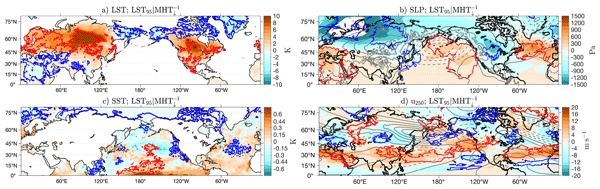
Extreme weather events have historically caused major challenges for humanity. Yet, our understanding of the mechanisms that contribute to their formation remains unclear. Our study provides evidence that locally amplified and slow-moving Rossby waves are responsible for the formation of extreme cold spells. These findings are obtained based on two novel metrics assessing the amplitude and speed of ridges and troughs separately at all longitudes around latitude circles.
Extreme weather events have historically caused major challenges for humanity. Yet, our...


