
Articles | Volume 7, issue 1
https://doi.org/10.5194/wcd-7-185-2026
© Author(s) 2026. This work is distributed under
the Creative Commons Attribution 4.0 License.
the Creative Commons Attribution 4.0 License.
https://doi.org/10.5194/wcd-7-185-2026
© Author(s) 2026. This work is distributed under
the Creative Commons Attribution 4.0 License.
the Creative Commons Attribution 4.0 License.
Research article
| 
22 Jan 2026
Research article |
| 22 Jan 2026
| 22 Jan 2026
Projected climate change in Fennoscandia – and its relation to ensemble spread and global trends
Gustav Strandberg
CORRESPONDING AUTHOR

Rossby Centre, Swedish Meteorological and Hydrological Institute, Norrköping, 601 76, Sweden
Centre for Climate Science and Policy Research, Linköping University, Linköping, 581 83, Sweden
August Thomasson
Rossby Centre, Swedish Meteorological and Hydrological Institute, Norrköping, 601 76, Sweden
Department of Physics, Lund University, Lund, 223 64, Sweden
Lars Bärring
Rossby Centre, Swedish Meteorological and Hydrological Institute, Norrköping, 601 76, Sweden
Erik Kjellström
Rossby Centre, Swedish Meteorological and Hydrological Institute, Norrköping, 601 76, Sweden
Michael Sahlin
Rossby Centre, Swedish Meteorological and Hydrological Institute, Norrköping, 601 76, Sweden
Renate Anna Irma Wilcke
Rossby Centre, Swedish Meteorological and Hydrological Institute, Norrköping, 601 76, Sweden
Grigory Nikulin
Rossby Centre, Swedish Meteorological and Hydrological Institute, Norrköping, 601 76, Sweden
Related authors
Peter Berg, Thomas Bosshard, Denica Bozhinova, Lars Bärring, Joakim Löw, Carolina Nilsson, Gustav Strandberg, Johan Södling, Johan Thuresson, Renate Wilcke, and Wei Yang
Geosci. Model Dev., 17, 8173–8179, https://doi.org/10.5194/gmd-17-8173-2024, https://doi.org/10.5194/gmd-17-8173-2024, 2024
Short summary
Short summary
When bias adjusting climate model data using quantile mapping, one needs to prescribe what to do at the tails of the distribution, where a larger data range is likely encountered outside of the calibration period. The end result is highly dependent on the method used. We show that, to avoid discontinuities in the time series, one needs to exclude data in the calibration range to also activate the extrapolation functionality in that time period.
Gustav Strandberg, Jie Chen, Ralph Fyfe, Erik Kjellström, Johan Lindström, Anneli Poska, Qiong Zhang, and Marie-José Gaillard
Clim. Past, 19, 1507–1530, https://doi.org/10.5194/cp-19-1507-2023, https://doi.org/10.5194/cp-19-1507-2023, 2023
Short summary
Short summary
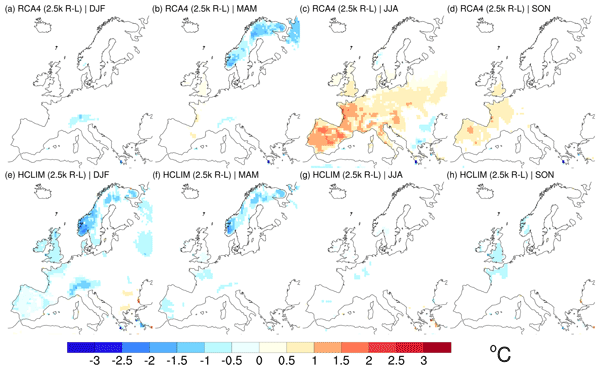
The impact of land use and land cover change (LULCC) on the climate around 2500 years ago is studied using reconstructions and models. The results suggest that LULCC impacted the climate in parts of Europe. Reconstructed LULCC shows up to 1.5 °C higher temperature in parts of Europe in some seasons. This relatively strong response implies that anthropogenic LULCC that had occurred by the late prehistoric period may have already affected the European climate by 2500 years ago.
Anne Sophie Daloz, Clemens Schwingshackl, Priscilla Mooney, Susanna Strada, Diana Rechid, Edouard L. Davin, Eleni Katragkou, Nathalie de Noblet-Ducoudré, Michal Belda, Tomas Halenka, Marcus Breil, Rita M. Cardoso, Peter Hoffmann, Daniela C. A. Lima, Ronny Meier, Pedro M. M. Soares, Giannis Sofiadis, Gustav Strandberg, Merja H. Toelle, and Marianne T. Lund
The Cryosphere, 16, 2403–2419, https://doi.org/10.5194/tc-16-2403-2022, https://doi.org/10.5194/tc-16-2403-2022, 2022
Short summary
Short summary
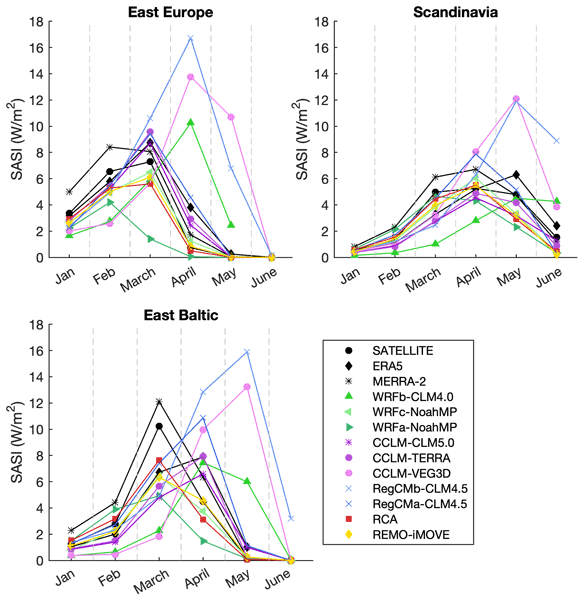
Snow plays a major role in the regulation of the Earth's surface temperature. Together with climate change, rising temperatures are already altering snow in many ways. In this context, it is crucial to better understand the ability of climate models to represent snow and snow processes. This work focuses on Europe and shows that the melting season in spring still represents a challenge for climate models and that more work is needed to accurately simulate snow–atmosphere interactions.
Priscilla A. Mooney, Diana Rechid, Edouard L. Davin, Eleni Katragkou, Natalie de Noblet-Ducoudré, Marcus Breil, Rita M. Cardoso, Anne Sophie Daloz, Peter Hoffmann, Daniela C. A. Lima, Ronny Meier, Pedro M. M. Soares, Giannis Sofiadis, Susanna Strada, Gustav Strandberg, Merja H. Toelle, and Marianne T. Lund
The Cryosphere, 16, 1383–1397, https://doi.org/10.5194/tc-16-1383-2022, https://doi.org/10.5194/tc-16-1383-2022, 2022
Short summary
Short summary
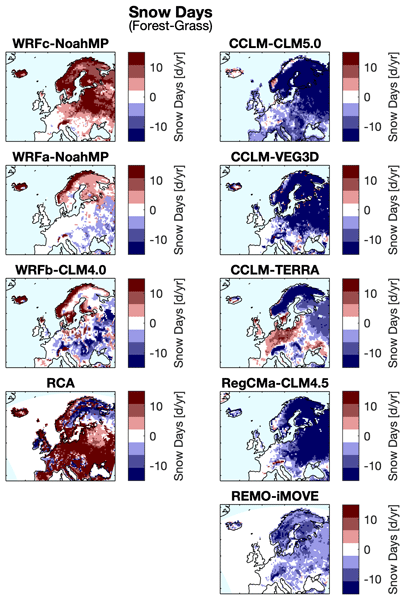
We use multiple regional climate models to show that afforestation in sub-polar and alpine regions reduces the radiative impact of snow albedo on the atmosphere, reduces snow cover, and delays the start of the snowmelt season. This is important for local communities that are highly reliant on snowpack for water resources and winter tourism. However, models disagree on the amount of change particularly when snow is melting. This shows that more research is needed on snow–vegetation interactions.
Wenche Aas, Thérèse Salameh, Robert Wegener, Heidi Hellén, Jean-Luc Jaffrezo, Pontus Roldin, Elisabeth Alonso-Blanco, Andres Alastuey, Crist Amelynck, Jgor Arduini, Benjamin Bergmans, Marie Bertrand, Agnes Borbon, Efstratios Bourtsoukidis, Laetitia Bouvier, David Butterfield, Iris Buxbaum, Darius Ceburnis, Anja Claude, Augustin Colette, Aurélie Colomb, Sophie Darfeuil, James Dernie, Maximilien Desservettaz, Elías Díaz-Ramiro, Marvin Dufresne, René Dubus, Mario Duval, Marie Dury, Anna Font, Kirsten N. Fossum, Evelyn Freney, Gotzon Gangoiti, Yao Ge, Maria Carmen Gomez, Francisco J. Gómez-Moreno, Marie Gohy, Valérie Gros, Paul Hamer, Bryan Hellack, Hartmut Herrmann, Robert Holla, Adéla Holubová, Niels R. Jensen, Tuija Jokinen, Matthew Jones, Uwe Käfer, Lukas Kesper, Dieter Klemp, Dagmar Kubistin, Angela Marinoni, Martina Mazzini, Vy Ngoc Thuy Dinh, Jurgita Ovadnevaite, Tuukka Petäjä, Miguel Portillo-Estrada, Jitka Přívozníková, Jean-Philippe Putaud, Stefan Reimann, Laura Renzi, Veronique Riffault, Stuart Ritchie, Chris Robins, Begoña Artíñano Rodríguez de Torres, Laurent Poulain, Julian Rüdiger, Agnieszka Sanocka, Estibaliz Saez de Camara Oleaga, Niels Schoon, Roger Seco, Ivan Simmons, Leïla Simon, David Simpson, Sverre Solberg, Emmanuel Tison, August Thomasson, Svetlana Tsyro, Marsailidh Twigg, Toni Tykkä, Bert Verreyken, Ågot Watne, Katie Williams, Ana Maria Yáñez-Serrano, Karen Yeung, Ilona Ylivinkka, and Karl Espen Yttri
Atmos. Chem. Phys., 26, 8717–8751, https://doi.org/10.5194/acp-26-8717-2026, https://doi.org/10.5194/acp-26-8717-2026, 2026
Short summary
Short summary
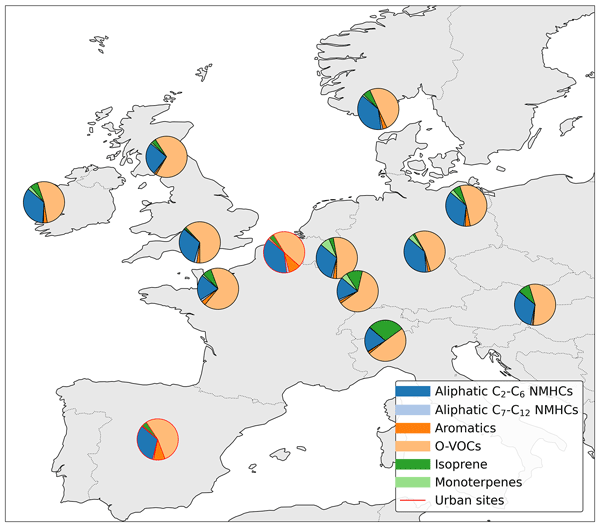
A one-week intensive measurement campaign during the 2022 European heatwave included monitoring of ozone, volatile organic compounds, aerosol chemical composition, and organic tracers to investigate air pollution sources. Results showed that emissions from vegetation and human activities contributed to peaks in ozone and secondary organic aerosol particles. Differences between measurements and model simulations underline the need for better characterization of sources and formation pathways.
Sandra Andersson, Maria Norman, Tomas Landelius, Patrik Samuelsson, Semjon Schimanke, Maida Zahid, and Lars Bärring
Earth Syst. Sci. Data Discuss., https://doi.org/10.5194/essd-2025-804, https://doi.org/10.5194/essd-2025-804, 2026
Preprint under review for ESSD
Short summary
Short summary
This study introduces SMHIGridClim, a high-resolution gridded climatology for Fennoscandia, covering the period from 1961 to 2018. It provides detailed climate data, including temperature, humidity, precipitation, and snow depth at a 2.5 km resolution. The dataset is created by combining observations from multiple meteorological institutes with reanalysis data. The study highlights the benefits of SMHIGridClim, making it a valuable resource for climate research in the Nordic region.
August Thomasson, Pontus Roldin, Nick Schutgens, Babitha George, Hugo Denier van der Gon, Guillaume Monteil, and Marko Scholze
EGUsphere, https://doi.org/10.5194/egusphere-2025-1568, https://doi.org/10.5194/egusphere-2025-1568, 2025
Short summary
Short summary
We present top-down black carbon emissions estimates in Europe based on surface observations of concentrations at 24 rural sites from 2021. The annual emissions are 411 ± 10 Gg, overall 18 % higher compared to a traditional bottom-up estimate. Emissions are higher in for instance eastern Europe and the Iberian peninsula but lower in Poland and Italy. Validation with independent observations show overall better match and the uncertainties are reduced.
Abhay Devasthale, Sandra Andersson, Erik Engström, Frank Kaspar, Jörg Trentmann, Anke Duguay-Tetzlaff, Jan Fokke Meirink, Erik Kjellström, Tomas Landelius, Manu Anna Thomas, and Karl-Göran Karlsson
Earth Syst. Dynam., 16, 1169–1182, https://doi.org/10.5194/esd-16-1169-2025, https://doi.org/10.5194/esd-16-1169-2025, 2025
Short summary
Short summary
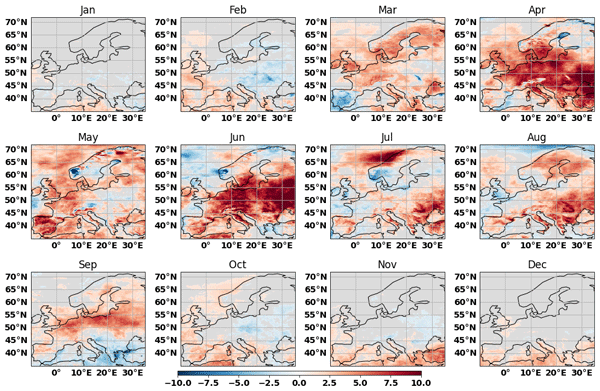
By compositing trends in multiple climate variables, this study presents emerging regimes that are relevant for solar energy applications. It is shown that the favourable conditions for exploiting solar energy are emerging during spring and early summer. The study also underscores the increasingly important role of clouds in regulating surface solar radiation as the aerosol concentrations are decreasing over Europe and the societal value of satellite-based climate monitoring.
Peter Berg, Thomas Bosshard, Denica Bozhinova, Lars Bärring, Joakim Löw, Carolina Nilsson, Gustav Strandberg, Johan Södling, Johan Thuresson, Renate Wilcke, and Wei Yang
Geosci. Model Dev., 17, 8173–8179, https://doi.org/10.5194/gmd-17-8173-2024, https://doi.org/10.5194/gmd-17-8173-2024, 2024
Short summary
Short summary
When bias adjusting climate model data using quantile mapping, one needs to prescribe what to do at the tails of the distribution, where a larger data range is likely encountered outside of the calibration period. The end result is highly dependent on the method used. We show that, to avoid discontinuities in the time series, one needs to exclude data in the calibration range to also activate the extrapolation functionality in that time period.

Colin G. Jones, Fanny Adloff, Ben B. B. Booth, Peter M. Cox, Veronika Eyring, Pierre Friedlingstein, Katja Frieler, Helene T. Hewitt, Hazel A. Jeffery, Sylvie Joussaume, Torben Koenigk, Bryan N. Lawrence, Eleanor O'Rourke, Malcolm J. Roberts, Benjamin M. Sanderson, Roland Séférian, Samuel Somot, Pier Luigi Vidale, Detlef van Vuuren, Mario Acosta, Mats Bentsen, Raffaele Bernardello, Richard Betts, Ed Blockley, Julien Boé, Tom Bracegirdle, Pascale Braconnot, Victor Brovkin, Carlo Buontempo, Francisco Doblas-Reyes, Markus Donat, Italo Epicoco, Pete Falloon, Sandro Fiore, Thomas Frölicher, Neven S. Fučkar, Matthew J. Gidden, Helge F. Goessling, Rune Grand Graversen, Silvio Gualdi, José M. Gutiérrez, Tatiana Ilyina, Daniela Jacob, Chris D. Jones, Martin Juckes, Elizabeth Kendon, Erik Kjellström, Reto Knutti, Jason Lowe, Matthew Mizielinski, Paola Nassisi, Michael Obersteiner, Pierre Regnier, Romain Roehrig, David Salas y Mélia, Carl-Friedrich Schleussner, Michael Schulz, Enrico Scoccimarro, Laurent Terray, Hannes Thiemann, Richard A. Wood, Shuting Yang, and Sönke Zaehle
Earth Syst. Dynam., 15, 1319–1351, https://doi.org/10.5194/esd-15-1319-2024, https://doi.org/10.5194/esd-15-1319-2024, 2024
Short summary
Short summary
We propose a number of priority areas for the international climate research community to address over the coming decade. Advances in these areas will both increase our understanding of past and future Earth system change, including the societal and environmental impacts of this change, and deliver significantly improved scientific support to international climate policy, such as future IPCC assessments and the UNFCCC Global Stocktake.
Erik Holmgren and Erik Kjellström
Nat. Hazards Earth Syst. Sci., 24, 2875–2893, https://doi.org/10.5194/nhess-24-2875-2024, https://doi.org/10.5194/nhess-24-2875-2024, 2024
Short summary
Short summary
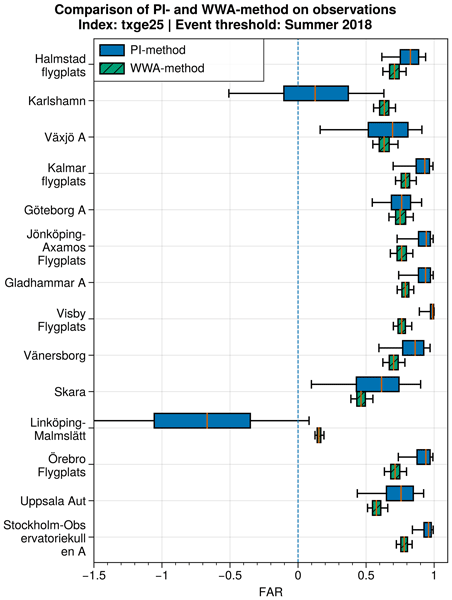
Associating extreme weather events with changes in the climate remains difficult. We have explored two ways these relationships can be investigated: one using a more common method and one relying solely on long-running records of meteorological observations.
Our results show that while both methods lead to similar conclusions for two recent weather events in Sweden, the commonly used method risks underestimating the strength of the connection between the event and changes to the climate.
Fredrik Lagergren, Robert G. Björk, Camilla Andersson, Danijel Belušić, Mats P. Björkman, Erik Kjellström, Petter Lind, David Lindstedt, Tinja Olenius, Håkan Pleijel, Gunhild Rosqvist, and Paul A. Miller
Biogeosciences, 21, 1093–1116, https://doi.org/10.5194/bg-21-1093-2024, https://doi.org/10.5194/bg-21-1093-2024, 2024
Short summary
Short summary
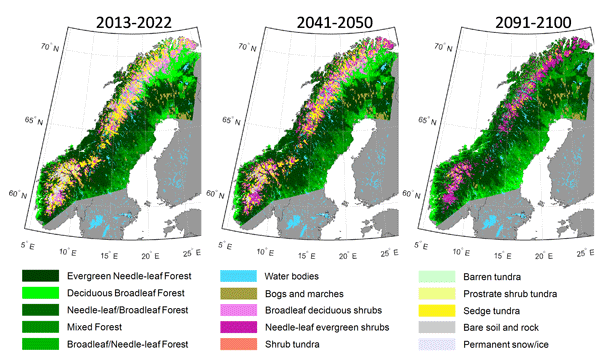
The Fennoscandian boreal and mountain regions harbour a wide range of ecosystems sensitive to climate change. A new, highly resolved high-emission climate scenario enabled modelling of the vegetation development in this region at high resolution for the 21st century. The results show dramatic south to north and low- to high-altitude shifts of vegetation zones, especially for the open tundra environments, which will have large implications for nature conservation, reindeer husbandry and forestry.
Gustav Strandberg, Jie Chen, Ralph Fyfe, Erik Kjellström, Johan Lindström, Anneli Poska, Qiong Zhang, and Marie-José Gaillard
Clim. Past, 19, 1507–1530, https://doi.org/10.5194/cp-19-1507-2023, https://doi.org/10.5194/cp-19-1507-2023, 2023
Short summary
Short summary
The impact of land use and land cover change (LULCC) on the climate around 2500 years ago is studied using reconstructions and models. The results suggest that LULCC impacted the climate in parts of Europe. Reconstructed LULCC shows up to 1.5 °C higher temperature in parts of Europe in some seasons. This relatively strong response implies that anthropogenic LULCC that had occurred by the late prehistoric period may have already affected the European climate by 2500 years ago.
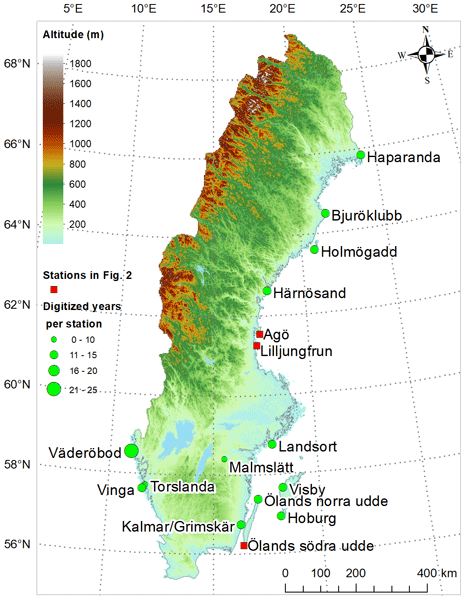
John Erik Engström, Lennart Wern, Sverker Hellström, Erik Kjellström, Chunlüe Zhou, Deliang Chen, and Cesar Azorin-Molina
Earth Syst. Sci. Data, 15, 2259–2277, https://doi.org/10.5194/essd-15-2259-2023, https://doi.org/10.5194/essd-15-2259-2023, 2023
Short summary
Short summary
Newly digitized wind speed observations provide data from the time period from around 1920 to the present, enveloping one full century of wind measurements. The results of this work enable the investigation of the historical variability and trends in surface wind speed in Sweden for
the last century.
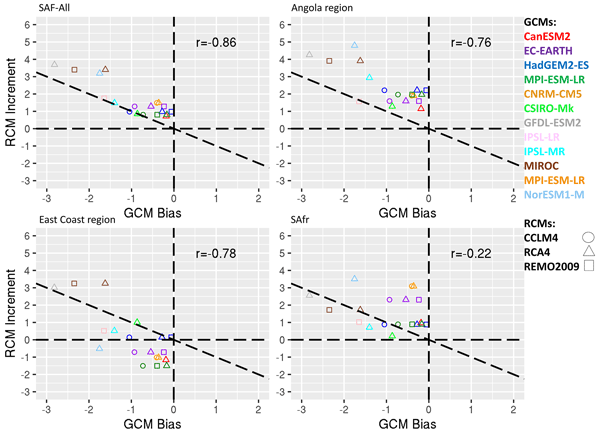
Maria Chara Karypidou, Stefan Pieter Sobolowski, Lorenzo Sangelantoni, Grigory Nikulin, and Eleni Katragkou
Geosci. Model Dev., 16, 1887–1908, https://doi.org/10.5194/gmd-16-1887-2023, https://doi.org/10.5194/gmd-16-1887-2023, 2023
Short summary
Short summary
Southern Africa is listed among the climate change hotspots; hence, accurate climate change information is vital for the optimal preparedness of local communities. In this work we assess the degree to which regional climate models (RCMs) are influenced by the global climate models (GCMs) from which they receive their lateral boundary forcing. We find that although GCMs exert a strong impact on RCMs, RCMs are still able to display substantial improvement relative to the driving GCMs.
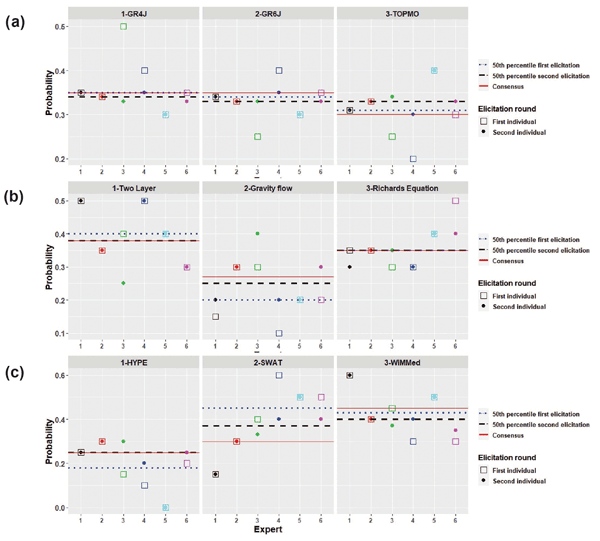
Eva Sebok, Hans Jørgen Henriksen, Ernesto Pastén-Zapata, Peter Berg, Guillaume Thirel, Anthony Lemoine, Andrea Lira-Loarca, Christiana Photiadou, Rafael Pimentel, Paul Royer-Gaspard, Erik Kjellström, Jens Hesselbjerg Christensen, Jean Philippe Vidal, Philippe Lucas-Picher, Markus G. Donat, Giovanni Besio, María José Polo, Simon Stisen, Yvan Caballero, Ilias G. Pechlivanidis, Lars Troldborg, and Jens Christian Refsgaard
Hydrol. Earth Syst. Sci., 26, 5605–5625, https://doi.org/10.5194/hess-26-5605-2022, https://doi.org/10.5194/hess-26-5605-2022, 2022
Short summary
Short summary
Hydrological models projecting the impact of changing climate carry a lot of uncertainty. Thus, these models usually have a multitude of simulations using different future climate data. This study used the subjective opinion of experts to assess which climate and hydrological models are the most likely to correctly predict climate impacts, thereby easing the computational burden. The experts could select more likely hydrological models, while the climate models were deemed equally probable.
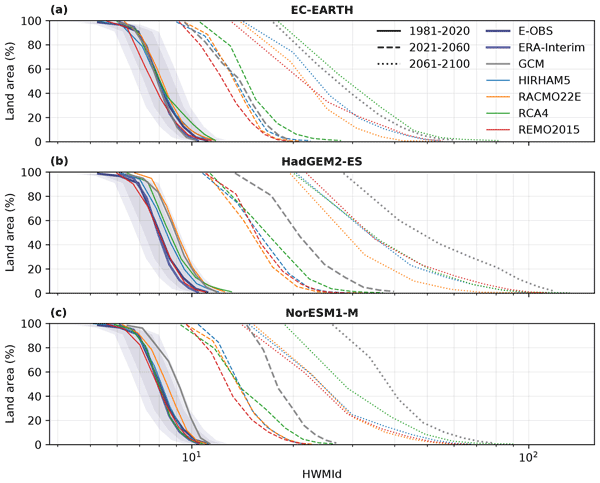
Changgui Lin, Erik Kjellström, Renate Anna Irma Wilcke, and Deliang Chen
Earth Syst. Dynam., 13, 1197–1214, https://doi.org/10.5194/esd-13-1197-2022, https://doi.org/10.5194/esd-13-1197-2022, 2022
Short summary
Short summary
This study endorses RCMs' added value on the driving GCMs in representing observed heat wave magnitudes. The future increase of heat wave magnitudes projected by GCMs is attenuated when downscaled by RCMs. Within the downscaling, uncertainties can be attributed almost equally to choice of RCMs and to the driving data associated with different GCMs. Uncertainties of GCMs in simulating heat wave magnitudes are transformed by RCMs in a complex manner rather than simply inherited.
Anne Sophie Daloz, Clemens Schwingshackl, Priscilla Mooney, Susanna Strada, Diana Rechid, Edouard L. Davin, Eleni Katragkou, Nathalie de Noblet-Ducoudré, Michal Belda, Tomas Halenka, Marcus Breil, Rita M. Cardoso, Peter Hoffmann, Daniela C. A. Lima, Ronny Meier, Pedro M. M. Soares, Giannis Sofiadis, Gustav Strandberg, Merja H. Toelle, and Marianne T. Lund
The Cryosphere, 16, 2403–2419, https://doi.org/10.5194/tc-16-2403-2022, https://doi.org/10.5194/tc-16-2403-2022, 2022
Short summary
Short summary
Snow plays a major role in the regulation of the Earth's surface temperature. Together with climate change, rising temperatures are already altering snow in many ways. In this context, it is crucial to better understand the ability of climate models to represent snow and snow processes. This work focuses on Europe and shows that the melting season in spring still represents a challenge for climate models and that more work is needed to accurately simulate snow–atmosphere interactions.
Priscilla A. Mooney, Diana Rechid, Edouard L. Davin, Eleni Katragkou, Natalie de Noblet-Ducoudré, Marcus Breil, Rita M. Cardoso, Anne Sophie Daloz, Peter Hoffmann, Daniela C. A. Lima, Ronny Meier, Pedro M. M. Soares, Giannis Sofiadis, Susanna Strada, Gustav Strandberg, Merja H. Toelle, and Marianne T. Lund
The Cryosphere, 16, 1383–1397, https://doi.org/10.5194/tc-16-1383-2022, https://doi.org/10.5194/tc-16-1383-2022, 2022
Short summary
Short summary
We use multiple regional climate models to show that afforestation in sub-polar and alpine regions reduces the radiative impact of snow albedo on the atmosphere, reduces snow cover, and delays the start of the snowmelt season. This is important for local communities that are highly reliant on snowpack for water resources and winter tourism. However, models disagree on the amount of change particularly when snow is melting. This shows that more research is needed on snow–vegetation interactions.
H. E. Markus Meier, Madline Kniebusch, Christian Dieterich, Matthias Gröger, Eduardo Zorita, Ragnar Elmgren, Kai Myrberg, Markus P. Ahola, Alena Bartosova, Erik Bonsdorff, Florian Börgel, Rene Capell, Ida Carlén, Thomas Carlund, Jacob Carstensen, Ole B. Christensen, Volker Dierschke, Claudia Frauen, Morten Frederiksen, Elie Gaget, Anders Galatius, Jari J. Haapala, Antti Halkka, Gustaf Hugelius, Birgit Hünicke, Jaak Jaagus, Mart Jüssi, Jukka Käyhkö, Nina Kirchner, Erik Kjellström, Karol Kulinski, Andreas Lehmann, Göran Lindström, Wilhelm May, Paul A. Miller, Volker Mohrholz, Bärbel Müller-Karulis, Diego Pavón-Jordán, Markus Quante, Marcus Reckermann, Anna Rutgersson, Oleg P. Savchuk, Martin Stendel, Laura Tuomi, Markku Viitasalo, Ralf Weisse, and Wenyan Zhang
Earth Syst. Dynam., 13, 457–593, https://doi.org/10.5194/esd-13-457-2022, https://doi.org/10.5194/esd-13-457-2022, 2022
Short summary
Short summary
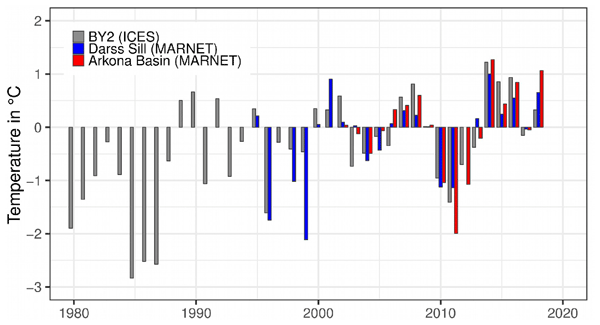
Based on the Baltic Earth Assessment Reports of this thematic issue in Earth System Dynamics and recent peer-reviewed literature, current knowledge about the effects of global warming on past and future changes in the climate of the Baltic Sea region is summarised and assessed. The study is an update of the Second Assessment of Climate Change (BACC II) published in 2015 and focuses on the atmosphere, land, cryosphere, ocean, sediments, and the terrestrial and marine biosphere.
Erika Médus, Emma D. Thomassen, Danijel Belušić, Petter Lind, Peter Berg, Jens H. Christensen, Ole B. Christensen, Andreas Dobler, Erik Kjellström, Jonas Olsson, and Wei Yang
Nat. Hazards Earth Syst. Sci., 22, 693–711, https://doi.org/10.5194/nhess-22-693-2022, https://doi.org/10.5194/nhess-22-693-2022, 2022
Short summary
Short summary
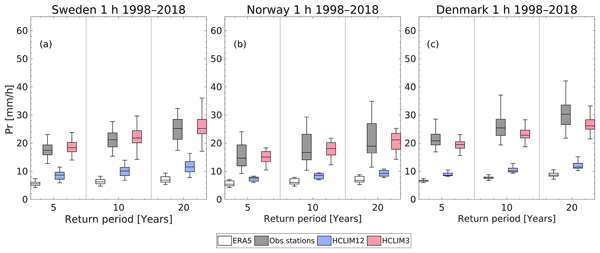
We evaluate the skill of a regional climate model, HARMONIE-Climate, to capture the present-day characteristics of heavy precipitation in the Nordic region and investigate the added value provided by a convection-permitting model version. The higher model resolution improves the representation of hourly heavy- and extreme-precipitation events and their diurnal cycle. The results indicate the benefits of convection-permitting models for constructing climate change projections over the region.
Anna Rutgersson, Erik Kjellström, Jari Haapala, Martin Stendel, Irina Danilovich, Martin Drews, Kirsti Jylhä, Pentti Kujala, Xiaoli Guo Larsén, Kirsten Halsnæs, Ilari Lehtonen, Anna Luomaranta, Erik Nilsson, Taru Olsson, Jani Särkkä, Laura Tuomi, and Norbert Wasmund
Earth Syst. Dynam., 13, 251–301, https://doi.org/10.5194/esd-13-251-2022, https://doi.org/10.5194/esd-13-251-2022, 2022
Short summary
Short summary
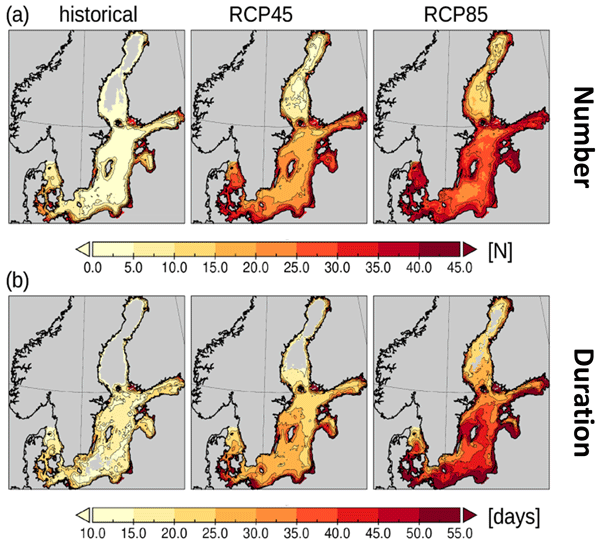
A natural hazard is a naturally occurring extreme event with a negative effect on people, society, or the environment; major events in the study area include wind storms, extreme waves, high and low sea level, ice ridging, heavy precipitation, sea-effect snowfall, river floods, heat waves, ice seasons, and drought. In the future, an increase in sea level, extreme precipitation, heat waves, and phytoplankton blooms is expected, and a decrease in cold spells and severe ice winters is anticipated.
H. E. Markus Meier, Christian Dieterich, Matthias Gröger, Cyril Dutheil, Florian Börgel, Kseniia Safonova, Ole B. Christensen, and Erik Kjellström
Earth Syst. Dynam., 13, 159–199, https://doi.org/10.5194/esd-13-159-2022, https://doi.org/10.5194/esd-13-159-2022, 2022
Short summary
Short summary
In addition to environmental pressures such as eutrophication, overfishing and contaminants, climate change is believed to have an important impact on the marine environment in the future, and marine management should consider the related risks. Hence, we have compared and assessed available scenario simulations for the Baltic Sea and found considerable uncertainties of the projections caused by the underlying assumptions and model biases, in particular for the water and biogeochemical cycles.
Ole Bøssing Christensen, Erik Kjellström, Christian Dieterich, Matthias Gröger, and Hans Eberhard Markus Meier
Earth Syst. Dynam., 13, 133–157, https://doi.org/10.5194/esd-13-133-2022, https://doi.org/10.5194/esd-13-133-2022, 2022
Short summary
Short summary
The Baltic Sea Region is very sensitive to climate change, whose impacts could easily exacerbate biodiversity stress from society and eutrophication of the Baltic Sea. Therefore, there has been a focus on estimations of future climate change and its impacts in recent research. Models show a strong warming, in particular in the north in winter. Precipitation is projected to increase in the whole region apart from the south during summer. New results improve estimates of future climate change.
Marcus Reckermann, Anders Omstedt, Tarmo Soomere, Juris Aigars, Naveed Akhtar, Magdalena Bełdowska, Jacek Bełdowski, Tom Cronin, Michał Czub, Margit Eero, Kari Petri Hyytiäinen, Jukka-Pekka Jalkanen, Anders Kiessling, Erik Kjellström, Karol Kuliński, Xiaoli Guo Larsén, Michelle McCrackin, H. E. Markus Meier, Sonja Oberbeckmann, Kevin Parnell, Cristian Pons-Seres de Brauwer, Anneli Poska, Jarkko Saarinen, Beata Szymczycha, Emma Undeman, Anders Wörman, and Eduardo Zorita
Earth Syst. Dynam., 13, 1–80, https://doi.org/10.5194/esd-13-1-2022, https://doi.org/10.5194/esd-13-1-2022, 2022
Short summary
Short summary
As part of the Baltic Earth Assessment Reports (BEAR), we present an inventory and discussion of different human-induced factors and processes affecting the environment of the Baltic Sea region and their interrelations. Some are naturally occurring and modified by human activities, others are completely human-induced, and they are all interrelated to different degrees. The findings from this study can largely be transferred to other comparable marginal and coastal seas in the world.
Cited articles
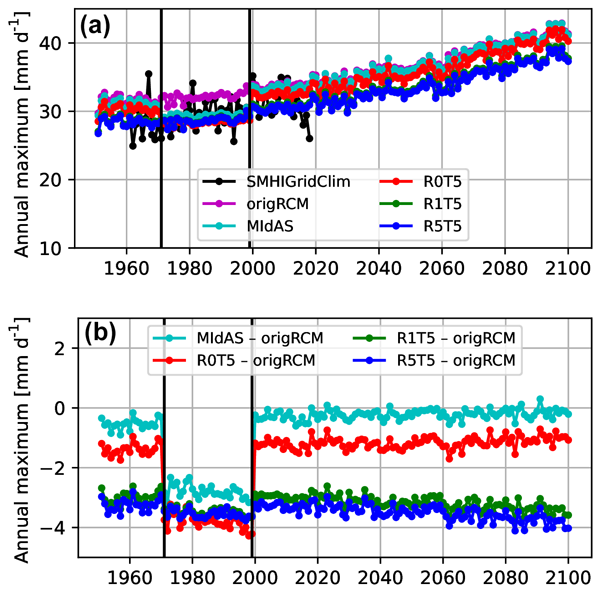
Andersson, S., Bärring, L., Landelius, T., Samuelsson, P., and Schimanke, S.: SMHI Gridded Climatology, Report Meteorology and Climatology No. 118, 2021, SMHI, Norrköping, Sweden, https://www.smhi.se/publikationer-fran-smhi/sok-publikationer/2021-11-21-smhi-gridded-climatology (last access: 20 January 2026), 2021.
Bärring, L. and Strandberg, G.: Does the projected pathway to global warming targets matter? Environ. Res. Lett. 13, https://doi.org/10.1088/1748-9326/aa9f72, 2018.
Bärring, L., Zimmermann, K., Löw, J., and Nilsson, C.: Climix, Conda-forge [code], https://climix.readthedocs.io/ (last access: 20 January 2026), 2024.
Berg, P., Bosshard, T., Yang, W., and Zimmermann, K.: MIdASv0.2.1 – MultI-scale bias AdjuStment, Geosci. Model Dev., 15, 6165–6180, https://doi.org/10.5194/gmd-15-6165-2022, 2022.
Boé, J., Somot, S., Corre, L., and Nabat, P.: Large discrepancies in summer climate change over Europe as projected by global and regional climate models: causes and consequences, Clim. Dyn. 54 2981–3002, https://doi.org/10.1007/s00382-020-05153-1, 2020.
Christensen, O. B. and Kjellström, E.: Partitioning uncertainty components of mean climate and climate change in a large ensemble of european regional climate model projections, Clim. Dyn., 54, 4293–4308, 2020.
Christensen, O. B. and Kjellström, E.: Filling the matrix: an ANOVA-based method to emulate regional climate model simulations for equally-weighted properties of ensembles of opportunity, Clim. Dyn., 58, 2371–2385, 2021.
Christensen, O. B., Kjellström, E., Dieterich, C., Gröger, M., and Meier, H. E. M.: Atmospheric regional climate projections for the Baltic Sea region until 2100, Earth Syst. Dynam., 13, 133–157, https://doi.org/10.5194/esd-13-133-2022, 2022.
Copernicus Climate Change Service (C3S): European State of the Climate 2023, Summary, Copernicus Climate Change Service, https://doi.org/10.24381/bs9v-8c66, 2024.
Coppola, E., Nogherotto, R., Ciarlo', J. M., Giorgi, F., van Meijgaard, E., Kadygrov, N., Iles, C., Corre, L., Sandstad, M., Somot, S., Nabat, P., Vautard, R., Levavasseur, G., Schwingshackl, C., Jana Sillmann, J., Kjellström, E., Nikulin, G., Aalbers, E., Lenderink, G., Christensen, O. B., Boberg, F., Lund Sørland, S., Demory, M.-E., Bülow, K., Teichmann, C., Warrach-Sagi, K., and Wulfmeyer, V.: Assessment of the European climate projections as simulated by the large EURO-CORDEX regional climate model ensemble, J. Geophys. Res.: Atmospheres, 126, e2019JD032356, https://doi.org/10.1029/2019JD032356, 2021.
Déqué, M., Somot, S., Sanchez-Gomez, E., Goodess, C. M., Jacob, D., Lenderink, G., and Christensen, O. B.: The spread amongst ENSEMBLES regional scenarios: regional climate models, driving general circulation models and interannual variability, Climate Dynamics, 38, 951–964, https://doi.org/10.1007/s00382-011-1053-x, 2012.
Evin, G., Somot, S., and Hingray, B.: Balanced estimate and uncertainty assessment of European climate change using the large EURO-CORDEX regional climate model ensemble, Earth Syst. Dynam., 12, 1543–1569, https://doi.org/10.5194/esd-12-1543-2021, 2021.
Forster, P. M., Smith, C., Walsh, T., Lamb, W. F., Lamboll, R., Hall, B., Hauser, M., Ribes, A., Rosen, D., Gillett, N. P., Palmer, M. D., Rogelj, J., von Schuckmann, K., Trewin, B., Allen, M., Andrew, R., Betts, R. A., Borger, A., Boyer, T., Broersma, J. A., Buontempo, C., Burgess, S., Cagnazzo, C., Cheng, L., Friedlingstein, P., Gettelman, A., Gütschow, J., Ishii, M., Jenkins, S., Lan, X., Morice, C., Mühle, J., Kadow, C., Kennedy, J., Killick, R. E., Krummel, P. B., Minx, J. C., Myhre, G., Naik, V., Peters, G. P., Pirani, A., Pongratz, J., Schleussner, C.-F., Seneviratne, S. I., Szopa, S., Thorne, P., Kovilakam, M. V. M., Majamäki, E., Jalkanen, J.-P., van Marle, M., Hoesly, R. M., Rohde, R., Schumacher, D., van der Werf, G., Vose, R., Zickfeld, K., Zhang, X., Masson-Delmotte, V., and Zhai, P.: Indicators of Global Climate Change 2023: annual update of key indicators of the state of the climate system and human influence, Earth Syst. Sci. Data, 16, 2625–2658, https://doi.org/10.5194/essd-16-2625-2024, 2024.
Gobiet, A., Suklitsch, M., and Heinrich, G.: The effect of empirical-statistical correction of intensity-dependent model errors on the temperature climate change signal, Hydrol. Earth Syst. Sci., 19, 4055–4066, https://doi.org/10.5194/hess-19-4055-2015, 2015.
Hausfather, Z. and Peters, G. P.: RCP8.5 is a problematic scenario for near-term emissions, Proc. Natl. Acad. Sci. USA, 117, 27791–27792, https://doi.org/10.1073/pnas.2017124117, 2020.
IPCC: Summary for Policymakers, in: Climate Change 2021: The Physical Science Basis. Contribution of Working Group I to the Sixth Assessment Report of the Intergovernmental Panel on Climate Change, edited by: Masson-Delmotte, V., Zhai, P., Pirani, A., Connors, S. L., Péan, C., Berger, S., Caud, N., Chen, Y., Goldfarb, L., Gomis, M. I., Huang, M., Leitzell, K., Lonnoy, E., Matthews, J. B. R., Maycock, T. K., Waterfield, T., Yelekçi, O., Yu, R., and Zhou, B., Cambridge University Press, Cambridge, United Kingdom and New York, NY, USA, 3–32, https://doi.org/10.1017/9781009157896.001, 2021.
IPCC: Summary for Policymakers, in: Climate Change 2022: Impacts, Adaptation, and Vulnerability. Contribution of Working Group II to the Sixth Assessment Report of the Intergovernmental Panel on Climate Change, edited by: Pörtner, H.-O., Roberts, D. C., Tignor, M., Poloczanska, E. S., Mintenbeck, K., Alegría, A., Craig, M., Langsdorf, S., Löschke, S., Möller, V., Okem, A., and Rama, B., Cambridge University Press, Cambridge, UK and New York, NY, USA, 3–33, https://doi.org/10.1017/9781009325844.001, 2022.
Iturbide, M., Fernández, J., Gutiérrez, J. M., Pirani, A., Huard, D., Al Khourdajie, A., Baño-Medina, J., Bedia, J., Casanueva, A., Cimadevilla, E., Cofiño, A. S., De Felice, M., Diez-Sierra, J. García-Díez, M., Goldie, J., Herrera, D. A., Herrera, S., Manzanas, R., Milovac, J., Radhakrishnan, A., San-Martín, D., Spinuso, A., Thyng, K. M., Trenham, C., and Yelekçi, Ö.: Implementation of FAIR principles in the IPCC: the WGI AR6 Atlas repository, Scientific Data, 629, 2052–4463, https://doi.org/10.1038/s41597-022-01739-y, 2022.
Jacob, D., Petersen, J., Eggert, B., Alias, A., Christensen, O. B., Bouwer, L. M., Braun, A., Colette, A., Déqué, M., Georgievski, G., Georgopoulou, E., Gobiet, A., Menut, L., Nikulin, G., Haensler, A., Hempelmann, N., Jones, C., Keuler, K., Kovats, S., Kröner, N., Kotlarski, S., Kriegsmann, A., Martin, E., van Meijgaard, E., Moseley, C., Pfeifer, S., Preuschmann, S., Radermacher, C., Radtke, K., Rechid, D., Rounsevell, M., Samuelsson, P., Somot, S., Soussana, J.-F., Teichmann, C., Valentini, R., Vautard, R., Weber, B., and Pascal Yiou, P.: EURO-CORDEX: new high-resolution climate change projections for European impact research, Reg. Environ. Change, 14, 563–578, 2014.
Katragkou, E., Sobolowski, S. P., Teichmann, C., Solmon, F., Pavlidis, V., Rechid, D., Hoffmann, P., Fernandez, J., Nikulin, G., and D. Jacob, D.: Delivering an Improved Framework for the New Generation of CMIP6-Driven EURO-CORDEX Regional Climate Simulations, Bull. Amer. Meteor. Soc., 105, E962–E974, https://doi.org/10.1175/BAMS-D-23-0131.1, 2024.
Kjellström, E., Bärring, L., Nikulin, G., Nilsson, C., Persson, N., and Strandberg, G.: Production and use of regional climate model projections – A Swedish perspective on building climate services, Clim. Serv., 2–3, 15–29, https://doi.org/10.1016/j.cliser.2016.06.004, 2016.
Kjellström, E., Nikulin, G., Strandberg, G., Christensen, O. B., Jacob, D., Keuler, K., Lenderink, G., van Meijgaard, E., Schär, C., Somot, S., Sørland, S. L., Teichmann, C., and Vautard, R.: European climate change at global mean temperature increases of 1.5 and 2 °C above pre-industrial conditions as simulated by the EURO-CORDEX regional climate models, Earth Syst. Dynam., 9, 459–478, https://doi.org/10.5194/esd-9-459-2018, 2018.
Lind, P., Belušić, D., Christensen, O. B., Dobler, A., Kjellström, E., Landgren, O., Lindstedt, D., Matte, D., Pedersen, R. A., Toivonen, E., and Wang, F.: Benefits and added value of convection-permitting climate modeling over Fenno-Scandinavia, Climate Dynamics, 55, 1893–1912, https://doi.org/10.1007/s00382-020-05359-3, 2020.
Maher, N., Lehner, F., and Marotzke, J.: Quantifying the role of internal variability in the temperature we expect to observe in the coming decades, Environmental Research Letters, 15, https://doi.org/10.1088/1748-9326/ab7d02, 2020.
Maher, N., Power, S. B., and Marotzke, J.: More accurate quantification of model-to-model agreement in externally forced climatic responses over the coming century, Nat. Commun., 12, 788, https://doi.org/10.1038/s41467-020-20635-w, 2021.
Maule, C. F., Mendlik, T., and Christensen, O. B.: IMPACT2C – Quantifying projected impacts under 2 °C warming Climate Services, 7, 2405–8807, https://doi.org/10.1016/j.cliser.2016.07.002, 2017.
Olsson, J., Berg, P., and Kawamura, A.: Impact of RCM spatial resolution on the reproduction of local, subdaily precipitation, J. Hydrometeorol., 16, 534–547, 2015.
Pendergrass, A. G., Lehner, F., Sanderson, B. M., and Xu, Y.: Does extreme precipitation intensity depend on the emissions scenario?, Geophys. Res.Lett., 42, 8767–8774, https://doi.org/10.1002/2015GL065854, 2015.
Prein, A. F., Langhans, W., Fosser, G., Ferrone, A., Ban, N., Goergen, K., Keller, M., Tölle, M., Gutjahr, O., Feser, F., Brisson, E., Kollet, S., Schmidli, J., van Lipzig, N. P. M., and Leung, R.: A review on regional convection-permitting climate modeling: Demonstrations, prospects, and challenges, Rev. Geophys., 53, 323–361, 2015.
Press, S. J.: Applied Multivariate Analysis, Holt, Rinehart and Winston, 521 pp., ISBN 9780030829390, 1972.
Ranasinghe, R., Ruane, A. C., Vautard, R., Arnell, N., Coppola, E., Cruz, F. A., Dessai, S., Islam, A. S., Rahimi, M., Ruiz Carrascal, D., Sillmann, J., Sylla, M. B., Tebaldi, C., Wang, W., and Zaaboul, R.: Climate Change Information for Regional Impact and for Risk Assessment, in: Climate Change 2021: The Physical Science Basis. Contribution of Working Group I to the Sixth Assessment Report of the Intergovernmental Panel on Climate Change, edited by: Masson-Delmotte, V., Zhai, P., Pirani, A., Connors, S. L., Péan, C., Berger, S., Caud, N., Chen, Y., Goldfarb, L., Gomis, M. I., Huang, M., Leitzell, K., Lonnoy, E., Matthews, J. B. R., Maycock, T. K., Waterfield, T., Yelekçi, O., Yu, R., and Zhou, B., Cambridge University Press, Cambridge, United Kingdom and New York, NY, USA, 1767–1926, https://doi.org/10.1017/9781009157896.014, 2021.
Rummukainen, M.: Added value in regional climate modeling, Wire Clim. Change, 7, 145–59, 2016.
Schimanke, S., Joelsson, M., Andersson, S., Carlund, T., Wern, L., Hellström, S., and Kjellström, E.: Observerad klimatförändring i Sverige, 1860–2021 SMHI Climatol. Rep. 69 89, https://www.smhi.se/publikationer-fran-smhi/sok-publikationer/2022-11-20-observerad-klimatforandring-i-sverige-1860-2021 (last access: 20 January 2026), 2022.
Schumacher, D. L., Singh, J., Hauser, M., Fischer, E. M., Wild, M., and Seneviratne, S. I.: Exacerbated summer European warming not captured by climate models neglecting long-term aerosol changes, Communications Earth & Environment, 5, 182, https://doi.org/10.1038/s43247-024-01332-8, 2024.
Schwalm, C. R., Glendon, S., and Duffy, P. B.: Reply to Hausfather and Peters: RCP8.5 is neither problematic nor misleading, Proc. Natl. Acad. Sci. USA, 117, 27793–27794, https://doi.org/10.1073/pnas.2018008117, 2020.
SMHI: https://www.smhi.se/en/climate/tools-and-inspiration/climate-change-scenario/climate-change-scenario-tool/, last access: 10 July 2025.
Sobolowski, S., Somot, S., Fernandez, J., Evin, G., Brands, S., Maraun, D., Kotlarski, S., Jury, M., Benestad, R. E., Teichmann, C., Christensen, O. B., Bülow, K., Buonomo, E., Katragkou, E., Steger, C., Sørland, S., Nikulin, G., McSweeney, C., Dobler, A., Palmer, T., Wilcke, R., Boé, J., Brunner, L., Ribes, A., Qasmi, S., Nabat, P., Sevault, F., and Oudar, T.: GCM Selection and Ensemble Design: Best Practices and Recommendations from the EURO-CORDEX Community, Bull. Amer. Meteor. Soc., 106, E1834–E1850, https://doi.org/10.1175/BAMS-D-23-0189.1, 2025.
Sørland, S. L., Schär, C., Lüthi, D., and Kjellström, E.: Bias patterns and climate change signals in GCM-RCM model chains, Environmental Research Letters, 13, 074017, https://doi.org/10.1088/1748-9326/aacc77, 2018.
Strandberg, G. and Lind, P.: The importance of horizontal model resolution on simulated precipitation in Europe – from global to regional models, Weather Clim. Dynam., 2, 181–204, https://doi.org/10.5194/wcd-2-181-2021, 2021.
Strandberg, G., Andersson, B., and Berlin A.: Plant pathogen infection risk and climate change in the Nordic and Baltic countries, Environ. Res. Commun., 6, 031008, https://doi.org/10.1088/2515-7620/ad352a, 2024a.
Strandberg, G., Blomqvist, P., Fransson, N., Göransson, L., Hansson, J., Hellsten, S., Kjellström, E., Lin, C., Löfblad, E., Montin, S., Nyholm, E., Sandgren, A., Unger, T., Walter, V., and Westerberg, J.: Bespoke climate indicators for the Swedish energy sector – a stakeholder focused approach, Climate Services, 34, 100486, https://doi.org/10.1016/j.cliser.2024.100486, 2024b.
Taranu, I. S., Somot, S., Alias, A., Boé, J., and Delire, C.: Mechanisms behind large-scale inconsistencies between regional and global climate model-based projections over Europe, Climate Dynamics, 60, 3813–3838, https://doi.org/10.1007/s00382-022-06540-6, 2023.
Taylor, K. E., Stouffer, R. J., and Meehl, G. A.: An overview of CMIP5 and the experiment design, Bull. Am. Meteorol. Soc., 93, 485–98, 2012.
Themeßl, M. J., Gobiet, A., and Heinrich, G.: Empirical-statistical downscaling and error correction of regional climate models and its impact on the climate change signal, Climatic Change, 112, 449–468, https://doi.org/10.1007/s10584-011-0224-4, 2011.
Tuel, A. and Eltahir, E. A. B.: Mechanisms of European Summer Drying under Climate Change, J. Climate, 34, 8913–8931, https://doi.org/10.1175/JCLI-D-20-0968.1, 2021.
Tukey, J. W.: Comparing Individual Means in the Analysis of Variance, Biometrics, JSTOR, 5, 99–114, https://www.jstor.org/stable/3001913 (last access: 5 September 2023), 1949.
UNFCCC: The Paris Agreement, United Nations Framework Convention on Climate Change, http://unfccc.int/paris_agreement/items/9485.php (last access: 20 January 2026), 2015.
Vautard, R., Kadygrov, N., Iles, C., Boberg, F., Buonomo, E., Bülow, K., Coppola, E., Lola Corre, L., van Meijgaard, E., Nogherotto, R., Sandstad, M., Schwingshackl, C., Somot, S., Aalbers, E., Christensen, O. B., Ciarlo, J. M., Demory, M.-E., Giorgi, F., Jacob, D., Jones, R. G., Keuler, K., Kjellström, E., Lenderink, G., Levavasseur, G., Nikulin, G., Sillmann, J., Solidoro, C., Lund Sørland, S., Steger, C., Teichmann, C., Warrach-Sagi, K., and Wulfmeyer, V.: Evaluation of the large EURO-CORDEX regional climate model ensemble, J. Geophys. Res., 126, e2019JD032344, https://doi.org/10.1029/2019JD032344, 2020.
von Trentini, F., Leduc, M., and Ludwig, R.: Assessing natural variability in RCM signals: comparison of a multi model EURO-CORDEX ensemble with a 50-member single model large ensemble, Clim. Dyn., 53, 1963–1979, https://doi.org/10.1007/s00382-019-04755-8, 2019.
Wilcke, R. A. I., Mendlik, T., and Gobiet, A.: Multi-variable error correction of regional climate models, Climatic Change, 120, 871–887, https://doi.org/10.1007/s10584-013-0845-x, 2013.
WMO: WMO Guidelines on the Calculation of Climate Normals, WMO-No. 1203, ISBN 978-92-63-11203-3, https://library.wmo.int/viewer/55797?medianame=1203_en (last access: 2 July 2025), 2017.
WMO: State of the global climate 2022, WMO-No. 1316 55, ISBN 978-92-63-11316-0, https://library.wmo.int/records/item/66214-state-of-the-global-climate-2022 (last access: 18 February 2025), 2023.
Short summary
The need for information about climate change is ever increasing. Therefore, it is important to have knowledge about climate change, along with an understanding of the uncertainties of climate model ensembles. Here, climate change in Sweden and neighbouring countries and its relation to global warming is described. Global warming results in higher temperature, more warm days and fewer cold days. The local and global warming suggest that climate change in Sweden may currently be at its fastest.
The need for information about climate change is ever increasing. Therefore, it is important to...


