
Articles | Volume 7, issue 4
https://doi.org/10.5194/wcd-7-2015-2026
© Author(s) 2026. This work is distributed under
the Creative Commons Attribution 4.0 License.
the Creative Commons Attribution 4.0 License.
https://doi.org/10.5194/wcd-7-2015-2026
© Author(s) 2026. This work is distributed under
the Creative Commons Attribution 4.0 License.
the Creative Commons Attribution 4.0 License.
Research article
| 
14 Oct 2026
Research article |
| 14 Oct 2026
| 14 Oct 2026
The dual effect of urban areas on supercell storms

Department of Physics and Astronomy, Alma Mater Studiorum, University of Bologna, Bologna, Italy
School of Meteorology, University of Oklahoma, Norman, Oklahoma, United States
U.S. National Science Foundation, National Center of Atmospheric Research, Boulder, Colorado, United States
Christopher Rozoff
U.S. National Science Foundation, National Center of Atmospheric Research, Boulder, Colorado, United States
Andrea Zonato
CIMA Foundation, Savona, Italy
Stefano Alessandrini
U.S. National Science Foundation, National Center of Atmospheric Research, Boulder, Colorado, United States
Silvana Di Sabatino
Department of Physics and Astronomy, Alma Mater Studiorum, University of Bologna, Bologna, Italy
Related authors

Mario Marcello Miglietta, Elenio Avolio, Alessandro Bracci, Massimiliano Burlando, Francesco Cairo, Federico Canepa, Vincenzo Capozzi, Sebastiano Carpentari, Federico Cassola, Alessandro Ceppi, Silvio Davolio, Francesco De Martin, Giorgio Doglioni, Costanza Di Felice Fabrizi, Luca Di Liberto, Francesco Domenichini, Stefano Federico, Massimo Enrico Ferrario, Federico Grazzini, Antonio Iengo, Sante Laviola, Agostino Manzato, Paolo Paganini, Antonio Parodi, Alessandro Pavan, Andrea Piazza, Arturo Pucillo, Giovanni Ravezzani, Francesco Sioni, Barbara Turato, Gianfranco Vulpiani, Marco Zanatta, and Dino Zardi
Nat. Hazards Earth Syst. Sci., 26, 3395–3415, https://doi.org/10.5194/nhess-26-3395-2026, https://doi.org/10.5194/nhess-26-3395-2026, 2026
Short summary
Short summary
This paper represents a summary of the contribution that the Italian meteorological community is willing to provide to the forthcoming European field campaign on Thunderstorm Intensification from Mountains to plains, planned in 2028–2030. Critical issues regard both the available instrumentation and the accuracy of numerical models. These limitations, in the context of climate change making severe convective episodes more frequent, make the need for a dedicated field campaign urgent.
Andrea Zonato, Harsh G. Kamath, Naveen Sudharsan, Luca Monaco, Jonas Kittner, Luise Wolf, Matthias Demuzere, Ariane Middel, Benjamin Bechtel, and Massimo Milelli
Geosci. Model Dev., 19, 7389–7413, https://doi.org/10.5194/gmd-19-7389-2026, https://doi.org/10.5194/gmd-19-7389-2026, 2026
Short summary
Short summary
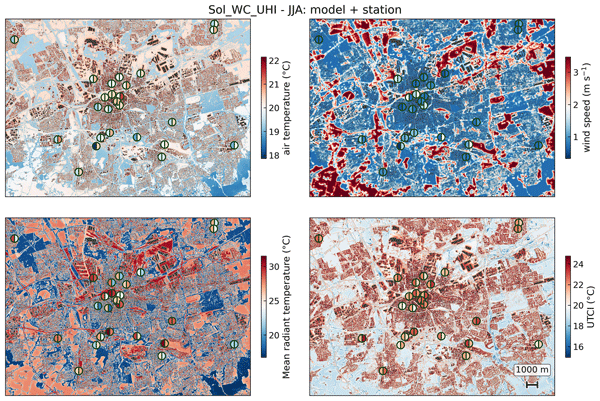
Cities need fast, reliable heat-stress maps to plan cooling measures and protect people. We built an automated workflow that gathers global public data, runs an outdoor comfort model much faster on graphics processing units, and adds simple corrections for wind and night-time warming. Tested in Dortmund against many sensors, errors fell from about ten to under three °C.
Mario Marcello Miglietta, Elenio Avolio, Alessandro Bracci, Massimiliano Burlando, Francesco Cairo, Federico Canepa, Vincenzo Capozzi, Sebastiano Carpentari, Federico Cassola, Alessandro Ceppi, Silvio Davolio, Francesco De Martin, Giorgio Doglioni, Costanza Di Felice Fabrizi, Luca Di Liberto, Francesco Domenichini, Stefano Federico, Massimo Enrico Ferrario, Federico Grazzini, Antonio Iengo, Sante Laviola, Agostino Manzato, Paolo Paganini, Antonio Parodi, Alessandro Pavan, Andrea Piazza, Arturo Pucillo, Giovanni Ravezzani, Francesco Sioni, Barbara Turato, Gianfranco Vulpiani, Marco Zanatta, and Dino Zardi
Nat. Hazards Earth Syst. Sci., 26, 3395–3415, https://doi.org/10.5194/nhess-26-3395-2026, https://doi.org/10.5194/nhess-26-3395-2026, 2026
Short summary
Short summary
This paper represents a summary of the contribution that the Italian meteorological community is willing to provide to the forthcoming European field campaign on Thunderstorm Intensification from Mountains to plains, planned in 2028–2030. Critical issues regard both the available instrumentation and the accuracy of numerical models. These limitations, in the context of climate change making severe convective episodes more frequent, make the need for a dedicated field campaign urgent.
Alireza Saeedi, Maria Martinez Mendoza, Eric Scott Krayenhoff, James Voogt, Andrea Zonato, Sylvie Leroyer, and Claudia Wagner-Riddle
EGUsphere, https://doi.org/10.5194/egusphere-2026-984, https://doi.org/10.5194/egusphere-2026-984, 2026
Short summary
Short summary
Green roofs can help cool cities, but models must represent how heat and water move through soil and plants correctly. We improved the green roof part of the WRF multi-layer weather model by adding more realistic descriptions of evaporation, heat storage, and plant water uptake. When tested against real measurements from a roof in London, Ontario, Canada, the updated model more accurately matched observed ground heat and latent heat fluxes.
Gianluca Pappaccogli, Andrea Zonato, Alberto Martilli, Riccardo Buccolieri, and Piero Lionello
Geosci. Model Dev., 18, 7129–7145, https://doi.org/10.5194/gmd-18-7129-2025, https://doi.org/10.5194/gmd-18-7129-2025, 2025
Short summary
Short summary
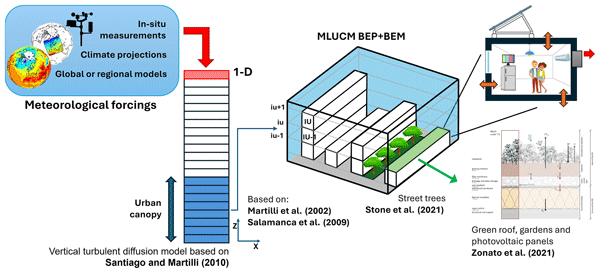
We present a multilayer urban model, named MLUCM BEP+BEM, able to represent detailed urban geometry and vegetation, while simulating their interactions and feedback with the atmosphere. Its accuracy and low computational cost make it ideal for offline climate projections assessing urban impacts under various emission scenarios. Its features enable analysis of urban overheating, energy demand, thermal comfort, and evaluation of strategies like green/cool roofs and photovoltaic panels.
Rajesh Kumar, Piyush Bhardwaj, Cenlin He, Jennifer Boehnert, Forrest Lacey, Stefano Alessandrini, Kevin Sampson, Matthew Casali, Scott Swerdlin, Olga Wilhelmi, Gabriele G. Pfister, Benjamin Gaubert, and Helen Worden
Earth Syst. Sci. Data, 17, 1807–1834, https://doi.org/10.5194/essd-17-1807-2025, https://doi.org/10.5194/essd-17-1807-2025, 2025
Short summary
Short summary
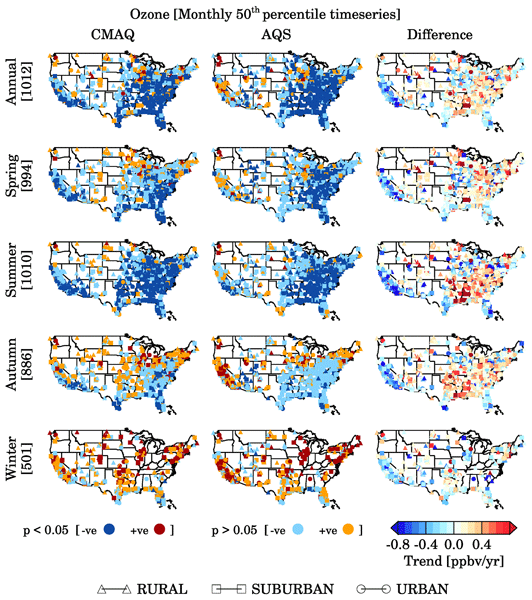
We have created a 14-year hourly air quality dataset at 12 km resolution by combining satellite observations of atmospheric composition with air quality models over the contiguous United States (CONUS). The dataset has been found to reproduce key observed features of air quality over the CONUS. To enable easy visualization and interpretation of county-level air quality measures and trends by stakeholders, an ArcGIS air quality dashboard has also been developed.
Enrico Ferrero, Bianca Tenti, and Stefano Alessandrini
Adv. Sci. Res., 21, 19–25, https://doi.org/10.5194/asr-21-19-2024, https://doi.org/10.5194/asr-21-19-2024, 2024
Short summary
Short summary
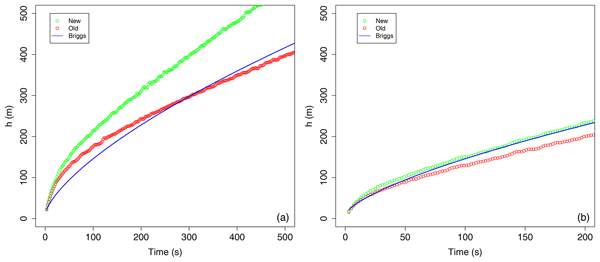
A new plume rise scheme based on heat transport by particles was presented: the entrainment is simulated by the mixing of two fluids (air and plume particles) with different temperatures and the resulting temperature is given by Richmann's law. The new algorithm is compared with the one that is currently included in SPRAY-WEB by Alessandrini et al. (2013). The new scheme seems to behave better when the ambient wind speeds are higher, but the asymptotic behavior is correct even with lower speeds.
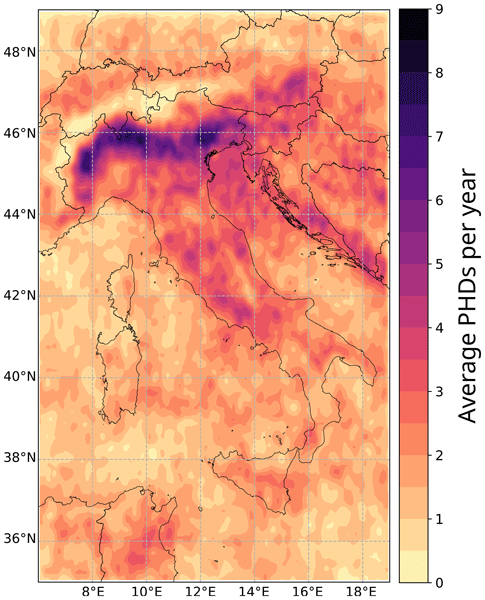
Antonio Giordani, Michael Kunz, Kristopher M. Bedka, Heinz Jürgen Punge, Tiziana Paccagnella, Valentina Pavan, Ines M. L. Cerenzia, and Silvana Di Sabatino
Nat. Hazards Earth Syst. Sci., 24, 2331–2357, https://doi.org/10.5194/nhess-24-2331-2024, https://doi.org/10.5194/nhess-24-2331-2024, 2024
Short summary
Short summary
To improve the challenging representation of hazardous hailstorms, a proxy for hail frequency based on satellite detections, convective parameters from high-resolution reanalysis, and crowd-sourced reports is tested and presented. Hail likelihood peaks in mid-summer at 15:00 UTC over northern Italy and shows improved agreement with observations compared to previous estimates. By separating ambient signatures based on hail severity, enhanced appropriateness for large-hail occurrence is found.
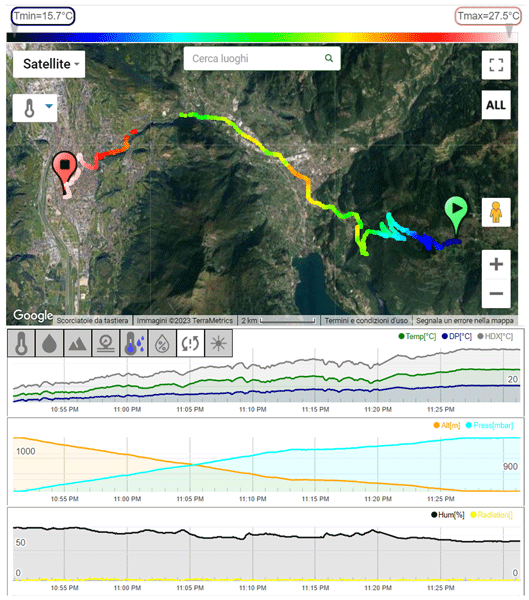
Francesco Barbano, Erika Brattich, Carlo Cintolesi, Abdul Ghafoor Nizamani, Silvana Di Sabatino, Massimo Milelli, Esther E. M. Peerlings, Sjoerd Polder, Gert-Jan Steeneveld, and Antonio Parodi
Atmos. Meas. Tech., 17, 3255–3278, https://doi.org/10.5194/amt-17-3255-2024, https://doi.org/10.5194/amt-17-3255-2024, 2024
Short summary
Short summary
The characterization of the urban microclimate starts with atmospheric monitoring using a dense array of sensors to capture the spatial variations induced by the different morphology, land cover, and presence of vegetation. To provide a new sensor for this scope, this paper evaluates the outdoor performance of a commercial mobile sensor. The results mark the sensor's ability to capture the same atmospheric variability as the reference, making it a valid solution for atmospheric monitoring.
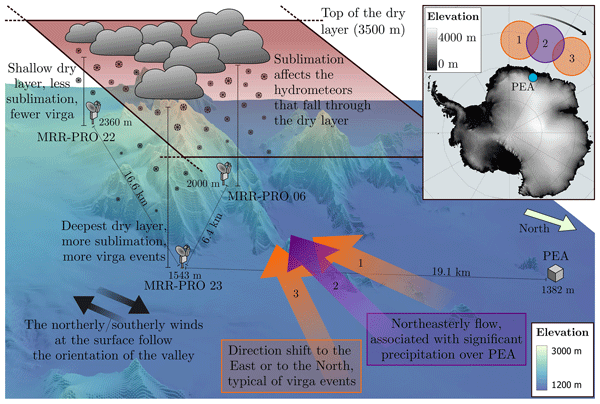
Alfonso Ferrone, Étienne Vignon, Andrea Zonato, and Alexis Berne
The Cryosphere, 17, 4937–4956, https://doi.org/10.5194/tc-17-4937-2023, https://doi.org/10.5194/tc-17-4937-2023, 2023
Short summary
Short summary
In austral summer 2019/2020, three K-band Doppler profilers were deployed across the Sør Rondane Mountains, south of the Belgian base Princess Elisabeth Antarctica. Their measurements, along with atmospheric simulations and reanalyses, have been used to study the spatial variability in precipitation over the region, as well as investigate the interaction between the complex terrain and the typical flow associated with precipitating systems.

Ditsuhi Iskandaryan, Silvana Di Sabatino, Francisco Ramos, and Sergio Trilles
AGILE GIScience Ser., 3, 6, https://doi.org/10.5194/agile-giss-3-6-2022, https://doi.org/10.5194/agile-giss-3-6-2022, 2022
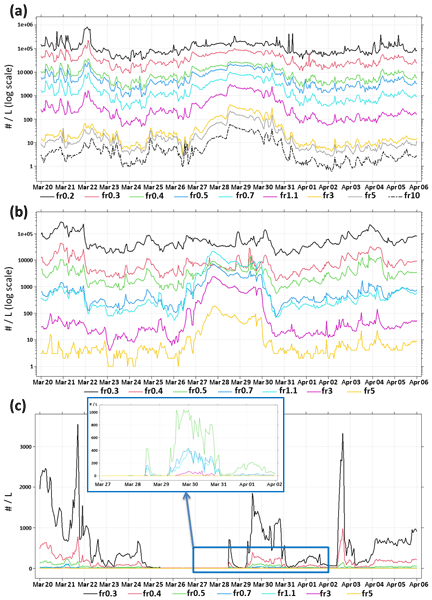
Laura Tositti, Erika Brattich, Claudio Cassardo, Pietro Morozzi, Alessandro Bracci, Angela Marinoni, Silvana Di Sabatino, Federico Porcù, and Alessandro Zappi
Atmos. Chem. Phys., 22, 4047–4073, https://doi.org/10.5194/acp-22-4047-2022, https://doi.org/10.5194/acp-22-4047-2022, 2022
Short summary
Short summary
We present a thorough investigation of an anomalous transport of mineral dust over a region renowned for excess airborne particulate matter, the Italian Po Valley, which occurred in late March 2021. Both the origin of this dust outbreak, which was localized in central Asia (i.e., the so-called Aralkum Desert), and the upstream synoptic conditions, investigated here in extreme detail using multiple integrated observations including in situ measurements and remote sensing, were atypical.
Nicola Bodini, Weiming Hu, Mike Optis, Guido Cervone, and Stefano Alessandrini
Wind Energ. Sci., 6, 1363–1377, https://doi.org/10.5194/wes-6-1363-2021, https://doi.org/10.5194/wes-6-1363-2021, 2021
Short summary
Short summary
We develop two machine-learning-based approaches to temporally extrapolate uncertainty in hub-height wind speed modeled by a numerical weather prediction model. We test our approaches in the California Outer Continental Shelf, where a significant offshore wind energy development is currently being planned, and we find that both provide accurate results.
Cited articles
Andrews, M. S., Gensini, V. A., Haberlie, A. M., Ashley, W. S., Michaelis, A. C., and Taszarek, M.: Climatology of the Elevated Mixed Layer over the Contiguous United States and Northern Mexico Using ERA5: 1979–2021, J. Climate, 37, 1833–1851, https://doi.org/10.1175/JCLI-D-23-0517.1, 2024. a
Argüeso, D., Di Luca, A., and Evans, J. P.: Precipitation over urban areas in the western Maritime Continent using a convection-permitting model, Clim. Dynam., 47, 1143–1159, 2016. a
Basara, J. B., Hall Jr., P. K., Schroeder, A. J., Illston, B. G., and Nemunaitis, K. L.: Diurnal cycle of the Oklahoma City urban heat island, J. Geophys. Res.-Atmos., 113, D20109, https://doi.org/10.1029/2008JD010311, 2008. a
Berner, J., Shutts, G., Leutbecher, M., and Palmer, T.: A spectral stochastic kinetic energy backscatter scheme and its impact on flow-dependent predictability in the ECMWF ensemble prediction system, J. Atmos. Sci., 66, 603–626, https://doi.org/10.1175/2008JAS2677.1, 2009. a
Bornstein, R. and LeRoy, M.: Urban barrier effects on convective and frontal thunderstorms, in: Extended Abstracts, Fourth Conf. on Mesoscale Processes, Boulder, CO, 25–29 June 1990, American Meteorological Society, Boston, MA, 120–121, 1990. a
Bornstein, R. and Lin, Q.: Urban heat islands and summertime convective thunderstorms in Atlanta: Three case studies, Atmos. Environ., 34, 507–516, https://doi.org/10.1016/S1352-2310(99)00374-X, 2000. a
Bougeault, P. and Lacarrere, P.: Parameterization of orography-induced turbulence in a mesobeta–scale model, Mon. Weather Rev., 117, 1872–1890, https://doi.org/10.1175/1520-0493(1989)117<1872:POOITI>2.0.CO;2, 1989. a
Boyer, C. H., Keeler, J. M., and Rakoczy, B. C.: An Idealized Parameter Study of Destabilization and Convection Initiation in Coastal Regions. Part I: Calm or Offshore Synoptic-Scale Flow, J. Atmos. Sci., 82, 519–539, https://doi.org/10.1175/JAS-D-23-0180.1, 2025. a
Britter, R. E. and Hanna, S. R.: Flow and dispersion in urban areas, Annu. Rev. Fluid Mech., 35, 469–496, https://doi.org/10.1146/annurev.fluid.35.101101.161147, 2003. a
Changnon, S. A. and Ackerman, B.: Summary of METROMEX, Volume 1: Weather anomalies and impacts, Bulletin (Illinois State Water Survey), no. 62, 240 pp., https://www.ideals.illinois.edu/items/103902 (last access: 12 October 2026), 1977. a
Ching, J., Mills, G., Bechtel, B., See, L., Feddema, J., Wang, X., Ren, C., Brousse, O., Martilli, A., Neophytou, M., Mouzourides, P., Stewart, I., Hanna, A., Ng, E., Foley, M., Alexander, P., Aliaga, D., Niyogi, D., Shreevastava, A., Bhalachandran, P., Masson, V., Hidalgo, J., Fung, J., Andrade, M., Baklanov, A., Dai, W. , Milcinski, G., Demuzere, M., Brunsell, N., Pesaresi, M., Miao, S., Mu, Q., Chen, F., and Theeuwes, N.: WUDAPT: An urban weather, climate, and environmental modeling infrastructure for the anthropocene, B. Am. Meteorol. Soc., 99, 1907–1924, 2018. a
Coffer, B. E., Parker, M. D., Peters, J. M., and Wade, A. R.: Supercell Low-Level Mesocyclones: Origins of Inflow and Vorticity, Mon. Weather Rev., 151, 2205–2232, https://doi.org/10.1175/MWR-D-22-0269.1, 2023. a
Dahl, J. M. L. and Fischer, J.: The Origin of Western European Warm-Season Prefrontal Convergence Lines, Weather Forecast., 31, 1417–1431, https://doi.org/10.1175/WAF-D-15-0161.1, 2016. a
De Martin, F.: Idealized simulations urban storms, Version v1.1, Zenodo [code], https://doi.org/10.5281/zenodo.23111214, 2026. a
Dou, J., Wang, Y., Bornstein, R., and Miao, S.: Observed Spatial Characteristics of Beijing Urban Climate Impacts on Summer Thunderstorms, J. Appl. Meteorol. Clim., 54, 94–105, https://doi.org/10.1175/JAMC-D-13-0355.1, 2015. a, b
Dou, J., Bornstein, R., Sun, J., and Miao, S.: Impacts of urban heat island intensities on a bifurcating thunderstorm over Beijing, Urban Climate, 55, 101955, https://doi.org/10.1016/j.uclim.2024.101955, 2024. a, b
Dudhia, J.: Numerical Study of Convection Observed during the Winter Monsoon Experiment Using a Mesoscale Two-Dimensional Model, J. Atmos. Sci., 46, 3077–3107, https://doi.org/10.1175/1520-0469(1989)046<3077:NSOCOD>2.0.CO;2, 1989. a
Emanuel, K.: On the Physics of High CAPE, J. Atmos. Sci., 80, 2669–2683, https://doi.org/10.1175/JAS-D-23-0060.1, 2023. a, b
Fan, J., Zhang, Y., Li, Z., Hu, J., and Rosenfeld, D.: Urbanization-induced land and aerosol impacts on sea-breeze circulation and convective precipitation, Atmos. Chem. Phys., 20, 14163–14182, https://doi.org/10.5194/acp-20-14163-2020, 2020. a, b
Fan, J., Wang, J., and Lin, Y.: Urbanization may enhance tornado potential: A single case report, Frontiers in Earth Science, 11, 1148506, https://doi.org/10.3389/feart.2023.1148506, 2023. a
Forster, A., Augros, C., and Masson, V.: Urban influence on convective precipitation in the Paris region: Hectometric ensemble simulations in a case study, Q. J. Roy. Meteor. Soc., 150, 3028–3051, https://doi.org/10.1002/qj.4749, 2024. a
Hao, L., Sun, G., Huang, X., Tang, R., Jin, K., Lai, Y., Chen, D., Zhang, Y., Zhou, D., Yang, Z.-L., Wang, L., Dong, G., and Li, W.: Urbanization alters atmospheric dryness through land evapotranspiration, npj Climate and Atmospheric Science, 6, 149, https://doi.org/10.1038/s41612-023-00479-z, 2023. a
Heimann, D. and Kurz, M.: The Munich hailstorm of July 12, 1984: a discussion of the synoptic situation, Beiträge zur Physik der Atmosphäre, 58, 528–544, 1985. a
Holley, D. M., Dorling, S. R., Steele, C. J., and Earl, N.: A climatology of convective available potential energy in Great Britain, Int. J. Climatol., 34, 3811–3824, https://doi.org/10.1002/joc.3976, 2014. a
Homeyer, C. R., Bunkers, M. J., Allen, J. T., and Murphy, A. M.: United States Supercell Storms and Their Severity: A 14-yr Radar-Based Climatology, J. Appl. Meteorol. Clim., J. Appl. Meteor. Climatol., 64, 959–970, https://doi.org/10.1175/JAMC-D-24-0185.1, 2025. a
Hong, S.-Y., Noh, Y., and Dudhia, J.: A New Vertical Diffusion Package with an Explicit Treatment of Entrainment Processes, Mon. Weather Rev., 134, 2318–2341, https://doi.org/10.1175/MWR3199.1, 2006. a
Huang, X. and Song, J.: Urban moisture and dry islands: spatiotemporal variation patterns and mechanisms of urban air humidity changes across the globe, Environ. Res. Lett., 18, 103003, https://doi.org/10.1088/1748-9326/acf7d7, 2023. a, b, c
Janjić, Z. I.: The step-mountain eta coordinate model: Further developments of the convection, viscous sublayer, and turbulence closure schemes, Mon. Weather Rev., 122, 927–945, https://doi.org/10.1175/1520-0493(1994)122<0927:TSMECM>2.0.CO;2, 1994. a
Jiménez, P. A., Dudhia, J., González-Rouco, J. F., Navarro, J., Montávez, J. P., and García-Bustamante, E.: A Revised Scheme for the WRF Surface Layer Formulation, Mon. Weather Rev., 140, 898–918, https://doi.org/10.1175/MWR-D-11-00056.1, 2012. a
Kamath, H. G., Singh, M., Malviya, N., Martilli, A., He, L., Aliaga, D., He, C., Chen, F., Magruder, L. A., Yang, Z.-L., and Niyogi, D.: GLObal Building heights for Urban Studies (UT-GLOBUS) for city-and street-scale urban simulations: development and first applications, Scientific Data, 11, 886, https://doi.org/10.1038/s41597-024-03719-w, 2024. a
Kawabata, T., Saya, A., Nishi, A., Seino, N., Hayashi, S., Ito, J., Ikuta, Y., and Seko, H.: Simulating a Thunderstorm using a High-Resolution Ensemble and an Urban Canopy Model: A Test Case for RDP Paris, SOLA, 21, 397–403, https://doi.org/10.2151/sola.2025-048, 2025. a
Kingfield, D. M., Calhoun, K. M., de Beurs, K. M., and Henebry, G. M.: Effects of city size on thunderstorm evolution revealed through a multiradar climatology of the central United States, J. Appl. Meteorol. Clim., 57, 295–317, https://doi.org/10.1175/JAMC-D-16-0341.1, 2018. a, b
Lin, Y., Min, Q., Zhuang, G., Wang, Z., Gong, W., and Li, R.: Spatial features of rain frequency change and pollution and associated aerosols, Atmos. Chem. Phys., 11, 7715–7726, https://doi.org/10.5194/acp-11-7715-2011, 2011. a
Lin, Y., Fan, J., Jeong, J.-H., Zhang, Y., Homeyer, C. R., and Wang, J.: Urbanization-induced land and aerosol impacts on storm propagation and hail characteristics, J. Atmos. Sci., 78, 925–947, https://doi.org/10.1175/JAS-D-20-0106.1, 2021. a, b, c, d
Liu, J. and Niyogi, D.: Meta-analysis of urbanization impact on rainfall modification, Scientific Reports, 9, 7301, https://doi.org/10.1038/s41598-019-42494-2, 2019. a, b
Lorenz, J. M., Kronenberg, R., Bernhofer, C., and Niyogi, D.: Urban rainfall modification: Observational climatology over Berlin, Germany, J. Geophys. Res.-Atmos., 124, 731–746, https://doi.org/10.1029/2018JD028858, 2019. a, b
Luan, Q., Cao, Q., Huang, L., Liu, Y., and Wang, F.: Identification of the urban dry islands effect in Beijing: Evidence from satellite and ground observations, Remote Sensing, 14, 809, https://doi.org/10.3390/rs14040809, 2022. a, b, c
Luo, Z., Liu, J., Zhang, Y., Zhou, J., Shao, W., Yu, Y., and Jia, R.: Seasonal variation of dry and wet islands in Beijing considering urban artificial water dissipation, npj Climate and Atmospheric Science, 4, 58, https://doi.org/10.1016/j.jhydrol.2021.126618, 2021a. a, b
Luo, Z., Liu, J., Zhang, Y., Zhou, J., Yu, Y., and Jia, R.: Spatiotemporal characteristics of urban dry/wet islands in China following rapid urbanization, J. Hydrol., 601, 126618, https://doi.org/10.1016/j.jhydrol.2021.126618, 2021b. a
Manzato, A., Serafin, S., Miglietta, M. M., Kirshbaum, D., and Schulz, W.: A pan-Alpine climatology of lightning and convective initiation, Mon. Weather Rev., 150, 2213–2230, https://doi.org/10.1175/MWR-D-21-0149.1, 2022. a
Markowski, P. M. and Dotzek, N.: A numerical study of the effects of orography on supercells, Atmos. Res., 100, 457–478, https://doi.org/10.1016/j.atmosres.2010.12.027, 2011. a, b, c
Martilli, A., Clappier, A., and Rotach, M. W.: An urban surface exchange parameterisation for mesoscale models, Bound.-Lay. Meteorol., 104, 261–304, https://doi.org/10.1023/A:1016099921195, 2002. a, b
Meili, N., Paschalis, A., Manoli, G., and Fatichi, S.: Diurnal and seasonal patterns of global urban dry islands, Environ. Res. Lett., 17, 054044, https://doi.org/10.1088/1748-9326/ac68f8, 2022. a, b, c, d
Mlawer, E. J., Taubman, S. J., Brown, P. D., Iacono, M. J., and Clough, S. A.: Radiative transfer for inhomogeneous atmospheres: RRTM, a validated correlated-k model for the longwave, J. Geophys. Res.-Atmos., 102, 16663–16682, https://doi.org/10.1029/97JD00237, 1997. a
Moraglia, G., Pryor, S., and Crippa, P.: Quantifying the impacts of an urban area on clouds and precipitation patterns: A modeling perspective, J. Geophys. Res.-Atmos., 129, e2024JD041402, https://doi.org/10.1029/2024JD041402, 2024. a
Morrison, H., Thompson, G., and Tatarskii, V.: Impact of Cloud Microphysics on the Development of Trailing Stratiform Precipitation in a Simulated Squall Line: Comparison of One- and Two-Moment Schemes, Mon. Weather Rev., 137, 991–1007, https://doi.org/10.1175/2008MWR2556.1, 2009. a
Naylor, J.: Idealized simulations of city-storm interactions in a two-dimensional framework, Atmosphere, 11, 707, https://doi.org/10.3390/atmos11070707, 2020. a
Naylor, J. and Mulholland, J.: The impact of vertical wind shear on the outcome of interactions between squall lines and cities, J. Geophys. Res.-Atmos., 128, e2022JD037237, https://doi.org/10.1029/2022JD037237, 2023. a, b
Naylor, J., Berry, M. E., and Gosney, E. G.: Idealized Simulations of a Supercell Interacting with an Urban Area, Meteorology, 3, 97–113, https://doi.org/10.3390/meteorology3010005, 2024. a, b
NCAR: Weather Research and Forecasting (WRF) Model, version 4.6.0, NCAR/UCAR [code], https://doi.org/10.5065/D6MK6B4K, 2026. a
Niu, G.-Y., Yang, Z.-L., Mitchell, K. E., Chen, F., Ek, M. B., Barlage, M., Kumar, A., Manning, K., Niyogi, D., Rosero, E., Tewari, M., and Xia, Y.: The community Noah land surface model with multiparameterization options (Noah-MP): 1. Model description and evaluation with local-scale measurements, J. Geophys. Res.-Atmos., 116, https://doi.org/10.1029/2010JD015139, 2011. a
Nowotarski, C. J., Markowski, P. M., Richardson, Y. P., and Bryan, G. H.: Properties of a Simulated Convective Boundary Layer in an Idealized Supercell Thunderstorm Environment, Mon. Weather Rev., 142, 3955–3976, https://doi.org/10.1175/MWR-D-13-00349.1, 2014. a
Oke, T. R.: The energetic basis of the urban heat island, Q. J. Roy. Meteor. Soc., 108, 1–24, https://doi.org/10.1002/qj.49710845502, 1982. a
Oke, T. R.: The urban energy balance, Prog. Phys. Geog., 12, 471–508, 1988. a
Pappaccogli, G., Giovannini, L., Zardi, D., and Martilli, A.: Sensitivity analysis of urban microclimatic conditions and building energy consumption on urban parameters by means of idealized numerical simulations, Urban Climate, 34, 100677, https://doi.org/10.1016/j.uclim.2020.100677, 2020. a
Platonov, V., Varentsov, M., Yarinich, Y. I., Shikhov, A., and Chernokulsky, A.: A large mid-latitude city intensifies severe convective events: Evidence from long-term high-resolution simulations, Urban Climate, 54, 101837, https://doi.org/10.1016/j.uclim.2024.101837, 2024. a
Romine, G. S., Schwartz, C. S., Berner, J., Fossell, K. R., Snyder, C., Anderson, J. L., and Weisman, M. L.: Representing forecast error in a convection-permitting ensemble system, Mon. Weather Rev., 142, 4519–4541, https://doi.org/10.1175/MWR-D-14-00100.1, 2014. a
Rotunno, R. and Klemp, J. B.: The influence of the shear-induced pressure gradient on thunderstorm motion, Mon. Weather Rev., 110, 136–151, https://doi.org/10.1175/1520-0493(1982)110<0136:TIOTSI>2.0.CO;2, 1982. a
Rozoff, C. M., Cotton, W. R., and Adegoke, J. O.: Simulation of St. Louis, Missouri, land use impacts on thunderstorms, J. Appl. Meteorol. Clim., 42, 716–738, https://doi.org/10.1175/1520-0450(2003)042<0716:SOSLML>2.0.CO;2, 2003. a, b
Rozoff, C. M., Nolan, D. S., Bryan, G. H., Hendricks, E. A., and Knievel, J. C.: Large-eddy simulations of the tropical cyclone boundary layer at landfall in an idealized urban environment, J. Appl. Meteorol. Clim., 62, 1457–1478, https://doi.org/10.1175/JAMC-D-23-0024.1, 2023. a
Sabatino, S. D., Barbano, F., Brattich, E., and Pulvirenti, B.: The multiple-scale nature of urban heat island and its footprint on air quality in real urban environment, Atmosphere, 11, 1186, https://doi.org/10.3390/atmos11111186, 2020. a
Salamanca, F., Krpo, A., Martilli, A., and Clappier, A.: A new building energy model coupled with an urban canopy parameterization for urban climate simulations – part I. formulation, verification, and sensitivity analysis of the model, Theor. Appl. Climatol., 99, 331–344, https://doi.org/10.1007/s00704-009-0142-9, 2010. a
Seino, N., Oda, R., Sugawara, H., and Aoyagi, T.: Observations and simulations of the mesoscale environment in TOMACS urban heavy rain events, J. Meteorol. Soc. Jpn., Ser. II, 96A, 221–245, https://doi.org/10.2151/jmsj.2018-029, 2018. a
Shen, Y. and Yang, L.: Divergent urban signatures in rainfall anomalies explained by pre-storm environment contrast, Geophys. Res. Lett., 50, e2022GL101658, https://doi.org/10.1029/2022GL101658, 2023. a, b, c
Shepherd, J. M.: Impacts of urbanization on precipitation and storms: Physical insights and vulnerabilities, Climate Vulnerability, 5, 109–125, https://doi.org/10.1016/B978-0-12-384703-4.00503-7, 2013. a
Shepherd, J. M., Pierce, H., and Negri, A. J.: Rainfall modification by major urban areas: Observations from spaceborne rain radar on the TRMM satellite, J. Appl. Meteorol., 41, 689–701, https://doi.org/10.1175/1520-0450(2002)041<0689:RMBMUA>2.0.CO;2, 2002. a
Skamarock, W. C., Klemp, J. B., Dudhia, J., Gill, D. O., Liu, Z., Berner, J., Wang, W., Powers, J. G., Duda, M. G., Barker, D. M., and Huang, X.-Y.: A description of the advanced research WRF version 4, NCAR tech. note ncar/tn–556+str, 145 pp., https://doi.org/10.5065/1dfh-6p97, 2019. a, b
Swain, M., Peña, J. C., Bornstein, R. D., and González-Cruz, J. E.: Coastal and anthropogenic heat impacts on PBL processes during extreme summer thunderstorm precipitation in New York City, Urban Climate, 62, 102534, https://doi.org/10.1016/j.uclim.2025.102534, 2025. a
Terwey, W. D. and Rozoff, C. M.: Objective convective updraft identification and tracking: Part 1. Structure and thermodynamics of convection in the rainband regions of two hurricane simulations, J. Geophys. Res.-Atmos., 119, 6470–6496, https://doi.org/10.1002/2013JD020904, 2014. a, b
Thielen, J. and Gadian, A.: Influence of topography and urban heat island effects on the outbreak of convective storms under unstable meteorological conditions: a numerical study, Meteorol. Appl., 4, 139–149, https://doi.org/10.1017/S1350482797000303, 1997. a
Torelló-Sentelles, H., Koukoula, M., Villarini, G., Marra, F., and Peleg, N.: When storms slow down: urban effects on rainfall accumulation and flood hazard, npj Natural Hazards, 2, 106, https://doi.org/10.1038/s44304-025-00158-4, 2025. a, b
Tuckman, P. and Emanuel, K.: Origins of Extreme CAPE around the World, J. Geophys. Res.-Atmos., 129, e2024JD041833, https://doi.org/10.1029/2024JD041833, 2024. a
Virtanen, P., Gommers, R., Oliphant, T. E., Haberland, M., Reddy, T., Cournapeau, D., Burovski, E., Peterson, P., Weckesser, W., Bright, J., van der Walt, S. J., Brett, M., Wilson, J., Millman, K. J., Mayorov, N., Nelson, A. R. J., Jones, E., Kern, R., Larson, E., Carey, C. J., Polat, İ., Feng, Y., Moore, E. W., VanderPlas, J., Laxalde, D., Perktold, J., Cimrman, R., Henriksen, I., Quintero, E. A., Harris, C. R., Archibald, A. M., Ribeiro, A. H., Pedregosa, F., van Mulbregt, P., and SciPy 1.0 Contributors: SciPy 1.0: Fundamental Algorithms for Scientific Computing in Python, Nat. Methods, 17, 261–272, https://doi.org/10.1038/s41592-019-0686-2, 2020. a
Wang, J., Feng, J., Yan, Z., Hu, Y., and Jia, G.: Nested high-resolution modeling of the impact of urbanization on regional climate in three vast urban agglomerations in China, J. Geophys. Res.-Atmos., 117, https://doi.org/10.1029/2012JD018226, 2012. a, b
Wang, Z., Song, J., Chan, P. W., and Li, Y.: The urban moisture island phenomenon and its mechanisms in a high-rise high-density city, Int. J. Climatol., 41, E150–E170, https://doi.org/10.1002/joc.6672, 2021. a
Weisman, M. L. and Klemp, J. B.: The dependence of numerically simulated convective storms on vertical wind shear and buoyancy, Mon. Weather Rev., 110, 504–520, https://doi.org/10.1175/1520-0493(1982)110<0504:TDONSC>2.0.CO;2, 1982. a, b
Wurman, J., Alexander, C., Robinson, P., and Richardson, Y.: Low-level winds in tornadoes and potential catastrophic tornado impacts in urban areas, B. Am. Meteorol. Soc., 88, 31–46, https://doi.org/10.1175/BAMS-88-1-31, 2007. a
Yang, L., Tian, F., Smith, J. A., and Hu, H.: Urban signatures in the spatial clustering of summer heavy rainfall events over the Beijing metropolitan region, J. Geophys. Res.-Atmos., 119, 1203–1217, https://doi.org/10.1002/2013JD020762, 2014. a, b
Yang, L., Li, Q., Yuan, H., Niu, Z., and Wang, L.: Impacts of urban canopy on two convective storms with contrasting synoptic conditions over Nanjing, China, J. Geophys. Res.-Atmos., 126, e2020JD034509, https://doi.org/10.1029/2020JD034509, 2021a. a, b
Yang, L., Ni, G., Tian, F., and Niyogi, D.: Urbanization Exacerbated Rainfall Over European Suburbs Under a Warming Climate, Geophys. Res. Lett., 48, e2021GL095987, https://doi.org/10.1029/2021GL095987, 2021b. a, b, c
Yang, L., Yang, Y., Shen, Y., Yang, J., Zheng, G., Smith, J., and Niyogi, D.: Urban development pattern’s influence on extreme rainfall occurrences, Nat. Commun., 15, 3997, https://doi.org/10.1038/s41467-024-48533-5, 2024. a
Yang, Z.-L., Niu, G.-Y., Mitchell, K. E., Chen, F., Ek, M. B., Barlage, M., Longuevergne, L., Manning, K., Niyogi, D., Tewari, M., and Xia, Y.: The community Noah land surface model with multiparameterization options (Noah-MP): 2. Evaluation over global river basins, J. Geophys. Res.-Atmos., 116, https://doi.org/10.1029/2010JD015140, 2011. a
Zhang, Y., Miao, S., Dai, Y., and Bornstein, R.: Numerical simulation of urban land surface effects on summer convective rainfall under different UHI intensity in Beijing, J. Geophys. Res.-Atmos., 122, 7851–7868, https://doi.org/10.1002/2017JD026614, 2017. a
Zhang, Z., He, C., Chen, F., Miguez-Macho, G., Liu, C., and Rasmussen, R.: US Corn Belt enhances regional precipitation recycling, P. Natl. Acad. Sci. USA, 122, e2402656121, https://doi.org/10.1073/pnas.2402656121, 2025. a
Zhou, B., Simon, J. S., and Chow, F. K.: The convective boundary layer in the terra incognita, J. Atmos. Sci., 71, 2545–2563, 2014. a
Zhou, B., Rybski, D., and Kropp, J. P.: The role of city size and urban form in the surface urban heat island, Scientific reports, 7, 4791, https://doi.org/10.1038/s41598-017-04242-2, 2017. a
Zonato, A., Martilli, A., Gutierrez, E., Chen, F., He, C., Barlage, M., Zardi, D., and Giovannini, L.: Exploring the effects of rooftop mitigation strategies on urban temperatures and energy consumption, J. Geophys. Res.-Atmos., 126, e2021JD035002, https://doi.org/10.1029/2021JD035002, 2021. a, b, c, d, e
Short summary
Most convective storm losses occur in urban areas, raising the question of whether cities can intensify severe storms, such as supercells. We found that cities can weaken an approaching supercell by reducing low-level moisture, but can also trigger a new one downwind. More urban vegetation reduces city effects on storm evolution, while building height has little impact. This conceptual model improves understanding of supercell–city interactions and supports advances in early warning systems.
Most convective storm losses occur in urban areas, raising the question of whether cities can...


