Articles | Volume 7, issue 4
https://doi.org/10.5194/wcd-7-2171-2026
© Author(s) 2026. This work is distributed under
the Creative Commons Attribution 4.0 License.
https://doi.org/10.5194/wcd-7-2171-2026
© Author(s) 2026. This work is distributed under
the Creative Commons Attribution 4.0 License.
The moisture mode-to-gravity wave spectrum as a framework to define tropical weather systems

Muhamad Reyhan Respati
CORRESPONDING AUTHOR
ARC Centre of Excellence for the Weather of the 21st Century, Monash University, Melbourne, Victoria, 3800, Australia
School of Earth, Atmosphere, and Environment, Monash University, Melbourne, Victoria, 3800, Australia
Department of Geophysics and Meteorology, IPB University, Bogor, West Java, 16680, Indonesia
Martin S. Singh
ARC Centre of Excellence for the Weather of the 21st Century, Monash University, Melbourne, Victoria, 3800, Australia
School of Earth, Atmosphere, and Environment, Monash University, Melbourne, Victoria, 3800, Australia
Christian Jakob
ARC Centre of Excellence for the Weather of the 21st Century, Monash University, Melbourne, Victoria, 3800, Australia
School of Earth, Atmosphere, and Environment, Monash University, Melbourne, Victoria, 3800, Australia
Related authors
No articles found.
Dongqi Lin, Martin S. Singh, Yi-Xian Li, and Annabel J. Bowden
EGUsphere, https://doi.org/10.5194/egusphere-2026-4291, https://doi.org/10.5194/egusphere-2026-4291, 2026
Short summary
Short summary
Heavy tropical rainfall can occur in two different ways: as intense local downpours or as deluges spread across a wide area. Using 20 years of radar observations from Darwin, Australia, and a simple theoretical model, we show that these two forms of heavy rain occur in different atmospheric conditions. This helps to better understand the spatial characteristics of rainfall and provides a way to better assess weather and climate models.
Benjamin Hernandez, Martin S. Singh, Takanobu Yamaguchi, Graham Feingold, and Franziska Glassmeier
Atmos. Chem. Phys., 26, 9337–9356, https://doi.org/10.5194/acp-26-9337-2026, https://doi.org/10.5194/acp-26-9337-2026, 2026
Short summary
Short summary
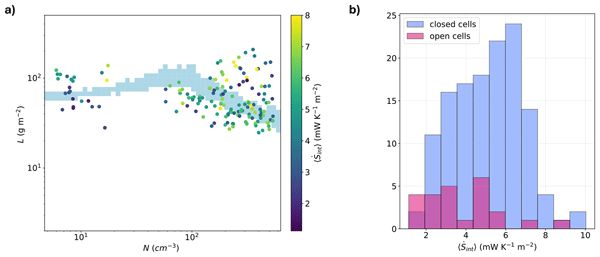
Using detailed numerical simulations, we quantify how stratocumulus cloud decks dissipate energy and produce entropy. We find that entropy production is dominated by irreversible moist processes and is much smaller than in deeper convective clouds. As a result, stratocumulus are remarkably inefficient at converting available energy into atmospheric motions.
Corey Robinson, Sugata Narsey, Bethan White, Chermelle Engel, Paul Gregory, and Christian Jakob
EGUsphere, https://doi.org/10.5194/egusphere-2026-3451, https://doi.org/10.5194/egusphere-2026-3451, 2026
Short summary
Short summary
Heavy rainfall can occur when tropical moisture is transported into the higher latitudes. We analyse a case study of a cyclone near New Zealand in January 2018 in which both the tropics and extratropics affect each other, leading to severe wind and rainfall. A key finding is that the strength of both the cyclone and the downstream anticyclone are strongly linked to the heat produced within clouds.
Lucinda A. Palmer and Martin S. Singh
Weather Clim. Dynam., 6, 1565–1582, https://doi.org/10.5194/wcd-6-1565-2025, https://doi.org/10.5194/wcd-6-1565-2025, 2025
Short summary
Short summary
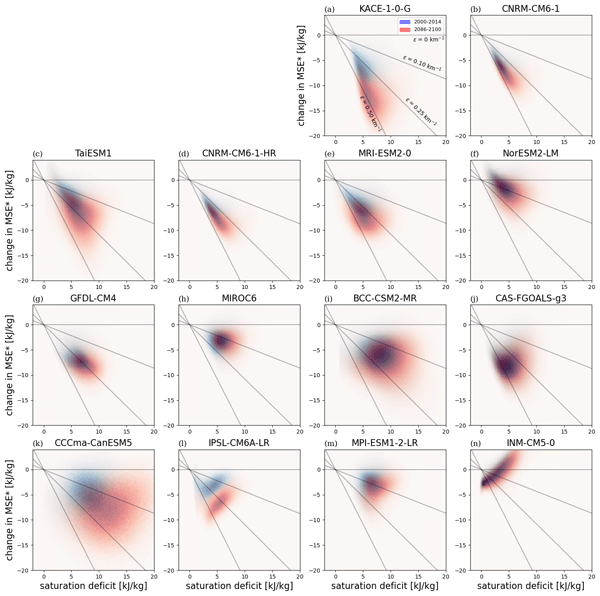
This study investigates the relationship between stability and humidity in the tropical troposphere in global climate models. We develop a method for quantifying the relationship and find varying relationships that are similar or even opposite to observations. We theorise that measures of intense thunderstorms and humid heatwaves are influenced by the stability-humidity relationship. Models that have a relationship like observations project greater increases in these measures under warming.
Corey Robinson, Sugata Narsey, Christian Jakob, and Hanh Nguyen
Weather Clim. Dynam., 6, 369–385, https://doi.org/10.5194/wcd-6-369-2025, https://doi.org/10.5194/wcd-6-369-2025, 2025
Short summary
Short summary
Rainfall in the tropics is strongly related to the amount of moisture in the atmosphere. In this work, we examine a measure of moisture called the “moist margin”, which describes a transition between rainy and clear regions of the tropics. We show that movement of the moist margin is often related to a variety of weather systems. Cases where tropical moisture moves far poleward are often related to low-pressure systems or large-scale waves in the extratropics.
Franciscus Liqui Lung, Christian Jakob, A. Pier Siebesma, and Fredrik Jansson
Geosci. Model Dev., 17, 4053–4076, https://doi.org/10.5194/gmd-17-4053-2024, https://doi.org/10.5194/gmd-17-4053-2024, 2024
Short summary
Short summary
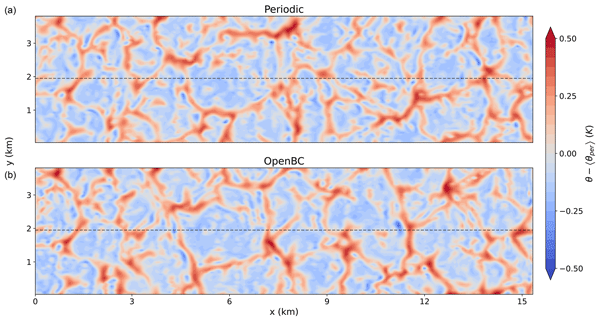
Traditionally, high-resolution atmospheric models employ periodic boundary conditions, which limit simulations to domains without horizontal variations. In this research open boundary conditions are developed to replace the periodic boundary conditions. The implementation is tested in a controlled setup, and the results show minimal disturbances. Using these boundary conditions, high-resolution models can be forced by a coarser model to study atmospheric phenomena in realistic background states.
Bjorn Stevens, Stefan Adami, Tariq Ali, Hartwig Anzt, Zafer Aslan, Sabine Attinger, Jaana Bäck, Johanna Baehr, Peter Bauer, Natacha Bernier, Bob Bishop, Hendryk Bockelmann, Sandrine Bony, Guy Brasseur, David N. Bresch, Sean Breyer, Gilbert Brunet, Pier Luigi Buttigieg, Junji Cao, Christelle Castet, Yafang Cheng, Ayantika Dey Choudhury, Deborah Coen, Susanne Crewell, Atish Dabholkar, Qing Dai, Francisco Doblas-Reyes, Dale Durran, Ayoub El Gaidi, Charlie Ewen, Eleftheria Exarchou, Veronika Eyring, Florencia Falkinhoff, David Farrell, Piers M. Forster, Ariane Frassoni, Claudia Frauen, Oliver Fuhrer, Shahzad Gani, Edwin Gerber, Debra Goldfarb, Jens Grieger, Nicolas Gruber, Wilco Hazeleger, Rolf Herken, Chris Hewitt, Torsten Hoefler, Huang-Hsiung Hsu, Daniela Jacob, Alexandra Jahn, Christian Jakob, Thomas Jung, Christopher Kadow, In-Sik Kang, Sarah Kang, Karthik Kashinath, Katharina Kleinen-von Königslöw, Daniel Klocke, Uta Kloenne, Milan Klöwer, Chihiro Kodama, Stefan Kollet, Tobias Kölling, Jenni Kontkanen, Steve Kopp, Michal Koran, Markku Kulmala, Hanna Lappalainen, Fakhria Latifi, Bryan Lawrence, June Yi Lee, Quentin Lejeun, Christian Lessig, Chao Li, Thomas Lippert, Jürg Luterbacher, Pekka Manninen, Jochem Marotzke, Satoshi Matsouoka, Charlotte Merchant, Peter Messmer, Gero Michel, Kristel Michielsen, Tomoki Miyakawa, Jens Müller, Ramsha Munir, Sandeep Narayanasetti, Ousmane Ndiaye, Carlos Nobre, Achim Oberg, Riko Oki, Tuba Özkan-Haller, Tim Palmer, Stan Posey, Andreas Prein, Odessa Primus, Mike Pritchard, Julie Pullen, Dian Putrasahan, Johannes Quaas, Krishnan Raghavan, Venkatachalam Ramaswamy, Markus Rapp, Florian Rauser, Markus Reichstein, Aromar Revi, Sonakshi Saluja, Masaki Satoh, Vera Schemann, Sebastian Schemm, Christina Schnadt Poberaj, Thomas Schulthess, Cath Senior, Jagadish Shukla, Manmeet Singh, Julia Slingo, Adam Sobel, Silvina Solman, Jenna Spitzer, Philip Stier, Thomas Stocker, Sarah Strock, Hang Su, Petteri Taalas, John Taylor, Susann Tegtmeier, Georg Teutsch, Adrian Tompkins, Uwe Ulbrich, Pier-Luigi Vidale, Chien-Ming Wu, Hao Xu, Najibullah Zaki, Laure Zanna, Tianjun Zhou, and Florian Ziemen
Earth Syst. Sci. Data, 16, 2113–2122, https://doi.org/10.5194/essd-16-2113-2024, https://doi.org/10.5194/essd-16-2113-2024, 2024
Short summary
Short summary
To manage Earth in the Anthropocene, new tools, new institutions, and new forms of international cooperation will be required. Earth Virtualization Engines is proposed as an international federation of centers of excellence to empower all people to respond to the immense and urgent challenges posed by climate change.
Cited articles
Adames, Á. F. and Kim, D.: The MJO as a Dispersive, Convectively Coupled Moisture Wave: Theory and Observations, J. Atmos. Sci., 73, 913–941, https://doi.org/10.1175/JAS-D-15-0170.1, 2016. a, b
Adames, Á. F. and Maloney, E. D.: Moisture Mode Theory's Contribution to Advances in our Understanding of the Madden-Julian Oscillation and Other Tropical Disturbances, Curr. Clim. Change Rep., 7, 72–85, https://doi.org/10.1007/s40641-021-00172-4, 2021. a
Adames, Á. F. and Ming, Y.: Interactions between Water Vapor and Potential Vorticity in Synoptic-Scale Monsoonal Disturbances: Moisture Vortex Instability, J. Atmos. Sci., 75, 2083–2106, https://doi.org/10.1175/JAS-D-17-0310.1, 2018. a, b, c
Ahmed, F.: The MJO on the Equatorial Beta Plane: An Eastward-Propagating Rossby Wave Induced by Meridional Moisture Advection, J. Atmos. Sci., 78, 3115–3135, https://doi.org/10.1175/JAS-D-21-0071.1, 2021. a
Ahmed, F. and Neelin, J. D.: Reverse Engineering the Tropical Precipitation–Buoyancy Relationship, J. Atmos. Sci., 75, 1587–1608, https://doi.org/10.1175/JAS-D-17-0333.1, 2018. a
Aiyyer, A., Mekonnen, A., and Schreck, C. J.: Projection of Tropical Cyclones on Wavenumber–Frequency-Filtered Equatorial Waves, J. Climate, 25, 3653–3658, https://doi.org/10.1175/JCLI-D-11-00451.1, 2012. a, b
Back, L. E. and Bretherton, C. S.: Geographic variability in the export of moist static energy and vertical motion profiles in the tropical Pacific, Geophys. Res. Lett., 33, https://doi.org/10.1029/2006GL026672, 2006. a
Bernardez, M. and Back, L.: Integrating Thermodynamic and Dynamic Views on the Control of the Top-Heaviness of Convection in the Pacific ITCZ With Weak Temperature Gradient Simulations, J. Adv. Model. Earth Syst., 16, e2022MS003455, https://doi.org/10.1029/2022MS003455, 2024. a
Berry, G., Reeder, M. J., and Jakob, C.: A global climatology of atmospheric fronts, Geophys. Res. Lett., 38, https://doi.org/10.1029/2010GL046451, 2011. a
Biswas, S., Sukhatme, J., and Gayen, B.: Impact of background conditions on the structure and propagation of the boreal summer quasi-biweekly oscillation, Q. J. Roy. Meteorol. Soc., e70267, https://doi.org/10.1002/qj.70267, 2026. a, b
Bolin, B.: Numerical Forecasting with the Barotropic Model, Tellus, https://doi.org/10.3402/tellusa.v7i1.8770, 1955. a, b, c
Borger, C., Beirle, S., and Wagner, T.: Analysis of global trends of total column water vapour from multiple years of OMI observations, Atmos. Chem. Phys., 22, 10603–10621, https://doi.org/10.5194/acp-22-10603-2022, 2022. a
Chadwick, R., Boutle, I., and Martin, G.: Spatial Patterns of Precipitation Change in CMIP5: Why the Rich Do Not Get Richer in the Tropics, J. Climate, 26, 3803–3822, https://doi.org/10.1175/JCLI-D-12-00543.1, 2013. a
Charney, J.: The Use of the Primitive Equations of Motion in Numerical Prediction, Tellus, https://doi.org/10.3402/tellusa.v7i1.8772, 1955. a, b, c
Chen, S. S. and Houze Jr, R. A.: Diurnal variation and life-cycle of deep convective systems over the tropical pacific warm pool, Q. J. Roy. Meteorol. Soc., 123, 357–388, https://doi.org/10.1002/qj.49712353806, 1997. a
Chikira, M.: Eastward-Propagating Intraseasonal Oscillation Represented by Chikira–Sugiyama Cumulus Parameterization. Part II: Understanding Moisture Variation under Weak Temperature Gradient Balance, J. Atmos. Sci., 71, 615–639, https://doi.org/10.1175/JAS-D-13-038.1, 2014. a
Copernicus Climate Change Service (C3S): Complete ERA5 Global Atmospheric Reanalysis, Copernicus Climate Change Service (C3S) Climate Data Store (CDS) [data set], https://doi.org/10.24381/cds.143582cf, 2023. a
Dowdy, A. J. and Catto, J. L.: Extreme weather caused by concurrent cyclone, front and thunderstorm occurrences, Sci. Rep., 7, 40359, https://doi.org/10.1038/srep40359, 2017. a, b
Feng, X., Yang, G.-Y., Hodges, K. I., and Methven, J.: Equatorial waves as useful precursors to tropical cyclone occurrence and intensification, Nat. Commun., 14, 511, https://doi.org/10.1038/s41467-023-36055-5, 2023. a
Frank, W. M. and Roundy, P. E.: The Role of Tropical Waves in Tropical Cyclogenesis, Mon. Weather Rev., 134, 2397–2417, https://doi.org/10.1175/MWR3204.1, 2006. a
Gonzalez, P. L. M., Howard, E., Ferrett, S., Frame, T. H. A., Martínez-Alvarado, O., Methven, J., and Woolnough, S. J.: Weather patterns in Southeast Asia: Enhancing high-impact weather subseasonal forecast skill, Q. J. Roy. Meteorol. Soc., 149, 19–39, https://doi.org/10.1002/qj.4378, 2023. a
Haertel, P. T. and Kiladis, G. N.: Dynamics of 2-Day Equatorial Waves, J. Atmos. Sci., 61, 2707–2721, https://doi.org/10.1175/JAS3352.1, 2004. a
Heikenfeld, M., Marinescu, P. J., Christensen, M., Watson-Parris, D., Senf, F., van den Heever, S. C., and Stier, P.: tobac 1.2: towards a flexible framework for tracking and analysis of clouds in diverse datasets, Geosci. Model Dev., 12, 4551–4570, https://doi.org/10.5194/gmd-12-4551-2019, 2019. a
Hersbach, H., Bell, B., Berrisford, P., Hirahara, S., Horányi, A., Muñoz-Sabater, J., Nicolas, J., Peubey, C., Radu, R., Schepers, D., Simmons, A., Soci, C., Abdalla, S., Abellan, X., Balsamo, G., Bechtold, P., Biavati, G., Bidlot, J., Bonavita, M., De Chiara, G., Dahlgren, P., Dee, D., Diamantakis, M., Dragani, R., Flemming, J., Forbes, R., Fuentes, M., Geer, A., Haimberger, L., Healy, S., Hogan, R. J., Hólm, E., Janisková, M., Keeley, S., Laloyaux, P., Lopez, P., Lupu, C., Radnoti, G., de Rosnay, P., Rozum, I., Vamborg, F., Villaume, S., and Thépaut, J.-N.: The ERA5 global reanalysis, Q. J. Roy. Meteorol. Soc., 146, 1999–2049, https://doi.org/10.1002/qj.3803, 2020. a
Hewson, T. D.: Objective fronts, Meteorol. Appl., 5, 37–65, https://doi.org/10.1017/S1350482798000553, 1998. a
Huffman, G. J., Bolvin, D. T., Braithwaite, D., Hsu, K.-L., Joyce, R. J., Kidd, C., Nelkin, E. J., Sorooshian, S., Stocker, E. F., Tan, J., Wolff, D. B., and Xie, P.: Integrated Multi-satellite Retrievals for the Global Precipitation Measurement (GPM) Mission (IMERG), pp. 343–353, Springer International Publishing, Cham, ISBN 978-3-030-24568-9, https://doi.org/10.1007/978-3-030-24568-9_19, 2020. a, b
Inoue, K., Adames, Á. F., and Yasunaga, K.: Vertical Velocity Profiles in Convectively Coupled Equatorial Waves and MJO: New Diagnoses of Vertical Velocity Profiles in the Wavenumber–Frequency Domain, J. Atmos. Sci., 77, 2139–2162, https://doi.org/10.1175/JAS-D-19-0209.1, 2020. a, b
Jin, C., Reeder, M. J., Gallant, A. J. E., Parker, T., and Sprenger, M.: Changes in Weather Systems during Anomalously Wet and Dry Years in Southeastern Australia, J. Climate, 37, 1131–1153, https://doi.org/10.1175/JCLI-D-23-0305.1, 2024. a
Kiladis, G. N. and Wheeler, M.: Horizontal and vertical structure of observed tropospheric equatorial Rossby waves, J. Geophys. Res.-Atmos., 100, 22981–22997, https://doi.org/10.1029/95JD02415, 1995. a
Kiladis, G. N., Wheeler, M. C., Haertel, P. T., Straub, K. H., and Roundy, P. E.: Convectively coupled equatorial waves, Rev. Geophys., 47, https://doi.org/10.1029/2008RG000266, 2009. a, b
Knapp, K. R., Kruk, M. C., Levinson, D. H., Diamond, H. J., and Neumann, C. J.: The International Best Track Archive for Climate Stewardship (IBTrACS): Unifying Tropical Cyclone Data, B. Am. Meteorol. Soc., 91, 363–376, https://doi.org/10.1175/2009BAMS2755.1, 2010. a
Liebmann, B., Hendon, H. H., and Glick, J. D.: On the Generation of Two-Day Convective Disturbances Across the Western Equatorial Pacific, J. Meteorol. Soc. JPN II, 75, 939–946, https://doi.org/10.2151/jmsj1965.75.4_939, 1997. a
Lubis, S. W. and Jacobi, C.: The modulating influence of convectively coupled equatorial waves (CCEWs) on the variability of tropical precipitation, Int. J. Climatol., 35, 1465–1483, https://doi.org/10.1002/joc.4069, 2015. a, b
Madonna, E., Wernli, H., Joos, H., and Martius, O.: Warm Conveyor Belts in the ERA-Interim Dataset (1979–2010). Part I: Climatology and Potential Vorticity Evolution, J. Climate, 27, 3–26, https://doi.org/10.1175/JCLI-D-12-00720.1, 2014. a
Mapes, B., Tulich, S., Lin, J., and Zuidema, P.: The mesoscale convection life cycle: Building block or prototype for large-scale tropical waves?, Dynam. Atmos. Ocean., 42, 3–29, https://doi.org/10.1016/j.dynatmoce.2006.03.003, 2006. a
Mapes, B. E., Chung, E. S., Hannah, W. M., Masunaga, H., Wimmers, A. J., and Velden, C. S.: The Meandering Margin of the Meteorological Moist Tropics, Geophys. Res. Lett., 45, 1177–1184, https://doi.org/10.1002/2017GL076440, 2018. a, b
Matsuno, T.: Quasi-Geostrophic Motions in the Equatorial Area, J. Meteorol. Soc. JPN II, 44, 25–43, https://doi.org/10.2151/jmsj1965.44.1_25, 1966. a
Matthews, A. J.: A vorticity budget for theoretical and convectively coupled equatorial Rossby waves: Dynamical propagation and growth mechanisms, Q. J. Roy. Meteorol. Soc., 151, e4917, https://doi.org/10.1002/qj.4917, 2025. a
Mayta, V. C. and Adames, Á. F.: Moist Thermodynamics of Convectively Coupled Waves over the Western Hemisphere, J. Climate, 36, 2765–2780, https://doi.org/10.1175/JCLI-D-22-0435.1, 2023. a
Mayta, V. C. and Adames Corraliza, Á. F.: Is the Madden-Julian Oscillation a Moisture Mode?, Geophys. Res. Lett., 50, e2023GL103002, https://doi.org/10.1029/2023GL103002, 2023. a
Mayta, V. C., Adames, Á. F., and Ahmed, F.: Westward-Propagating Moisture Mode Over the Tropical Western Hemisphere, Geophys. Res. Lett., 49, e2022GL097799, https://doi.org/10.1029/2022GL097799, 2022. a
Monteiro, J. M. and Sukhatme, J.: Quasi-geostrophic dynamics in the presence of moisture gradients, Q. J. Roy. Meteorol. Soc., 142, 187–195, https://doi.org/10.1002/qj.2644, 2016. a
Murray, R. J. and Simmonds, I.: A numerical scheme for tracking cyclone centres from digital data Part I: development and operation of the scheme, Aust. Meteorol. Mag., 39, 155–166, https://doi.org/10.1071/ES91020, 1991. a
Pepler, A. S., Dowdy, A. J., and Hope, P.: The differing role of weather systems in southern Australian rainfall between 1979–1996 and 1997–2015, Clim. Dynam., 56, 2289–2302, https://doi.org/10.1007/s00382-020-05588-6, 2021. a
Prein, A. F., Mooney, P. A., and Done, J. M.: The Multi-Scale Interactions of Atmospheric Phenomenon in Mean and Extreme Precipitation, Earth's Future, 11, e2023EF003534, https://doi.org/10.1029/2023EF003534, 2023. a
Raymond, D. J. and Fuchs, Ž.: Convectively coupled gravity and moisture modes in a simple atmospheric model, Tellus B, https://doi.org/10.1111/j.1600-0870.2007.00268.x, 2007. a, b, c
Respati, M. R.: m-reyhan-respati/trop-wx-sys-characs: trop-wx-sys-characs (Version v1.0), Zenodo [code], https://doi.org/10.5281/zenodo.23906712, 2026. a
Robinson, C. M., Narsey, S., and Jakob, C.: Synoptic Variability in the Tropical Oceanic Moist Margin, J. Geophys. Res.-Atmos., 129, e2024JD040814, https://doi.org/10.1029/2024JD040814, 2024. a, b
Schumacher, R. S. and Rasmussen, K. L.: The formation, character and changing nature of mesoscale convective systems, Nat. Rev. Earth Environ., 1, 300–314, https://doi.org/10.1038/s43017-020-0057-7, 2020. a
Si, W., Liu, H., Zhang, X., and Zhang, M.: Double Intertropical Convergence Zones in Coupled Ocean-Atmosphere Models: Progress in CMIP6, Geophys. Res. Lett., 48, e2021GL094779, https://doi.org/10.1029/2021GL094779, 2021. a
Sobel, A. and Maloney, E.: Moisture Modes and the Eastward Propagation of the MJO, J. Atmos. Sci., 70, 187–192, https://doi.org/10.1175/JAS-D-12-0189.1, 2013. a
Sobel, A. H. and Bretherton, C. S.: Modeling Tropical Precipitation in a Single Column, J. Climate, 13, 4378–4392, https://doi.org/10.1175/1520-0442(2000)013<4378:MTPIAS>2.0.CO;2, 2000. a
Sobel, A. H., Nilsson, J., and Polvani, L. M.: The Weak Temperature Gradient Approximation and Balanced Tropical Moisture Waves, J. Atmos. Sci., 58, 3650–3665, https://doi.org/10.1175/1520-0469(2001)058<3650:TWTGAA>2.0.CO;2, 2001. a
Sokolowsky, G. A., Freeman, S. W., Jones, W. K., Kukulies, J., Senf, F., Marinescu, P. J., Heikenfeld, M., Brunner, K. N., Bruning, E. C., Collis, S. M., Jackson, R. C., Leung, G. R., Pfeifer, N., Raut, B. A., Saleeby, S. M., Stier, P., and van den Heever, S. C.: tobac v1.5: introducing fast 3D tracking, splits and mergers, and other enhancements for identifying and analysing meteorological phenomena, Geosci. Model Dev., 17, 5309–5330, https://doi.org/10.5194/gmd-17-5309-2024, 2024. a
Sprenger, M., Fragkoulidis, G., Binder, H., Croci-Maspoli, M., Graf, P., Grams, C. M., Knippertz, P., Madonna, E., Schemm, S., Škerlak, B., and Wernli, H.: Global Climatologies of Eulerian and Lagrangian Flow Features based on ERA-Interim, B. Am. Meteorol. Soc., 98, 1739–1748, https://doi.org/10.1175/BAMS-D-15-00299.1, 2017. a
Suhas, D. L., Sukhatme, J., and Harnik, N.: Dry and moist atmospheric circulation with uniform sea-surface temperature, Q. J. Roy. Meteorol. Soc., 148, 35–56, https://doi.org/10.1002/qj.4191, 2022. a
Takayabu, Y. N.: Large-Scale Cloud Disturbances Associated with Equatorial Waves, J. Meteorol. Soc. JPN II, 72, 433–449, https://doi.org/10.2151/jmsj1965.72.3_433, 1994a. a
Takayabu, Y. N.: Large-Scale Cloud Disturbances Associated with Equatorial Waves, J. Meteorol. Soc. JPN II, 72, 451–465, https://doi.org/10.2151/jmsj1965.72.3_451, 1994b. a
Takayabu, Y. N., Lau, K.-M., and Sui, C.-H.: Observation of a Quasi-2-Day Wave during TOGA COARE, Mon. Weather Rev., 124, 1892–1913, https://doi.org/10.1175/1520-0493(1996)124<1892:OOAQDW>2.0.CO;2, 1996. a
tobac Community, Brunner, K., Freeman, S. W., Jones, W. K., Kukulies, J., Senf, F., Bruning, E., Stier, P., van den Heever, S. C., Heikenfeld, M., Marinescu, P. J., Collis, S. M., Lettl, K., Pfeifer, N., Raut, B. A., Zhang, X., and Ziegner, F.: tobac - Tracking and Object-based Analysis of Clouds, Zenodo, https://doi.org/10.5281/zenodo.18012838, 2025. a
Trenberth, K. E., Fasullo, J., and Smith, L.: Trends and variability in column-integrated atmospheric water vapor, Clim. Dynam., 24, 741–758, https://doi.org/10.1007/s00382-005-0017-4, 2005. a
Tsai, W.-M., Duan, S., O’Brien, T. A., Catto, J. L., Ullrich, P. A., Zhou, Y., Leung, L. R., Feng, Z., Boos, W. R., Suhas, D. L., Ahmed, F., and Neelin, J. D.: Co-Occurring Atmospheric Features and Their Contributions to Precipitation Extremes, J. Geophys. Res.-Atmos., 130, e2024JD041687, https://doi.org/10.1029/2024JD041687, 2025. a
Utsumi, N., Kim, H., Kanae, S., and Oki, T.: Relative contributions of weather systems to mean and extreme global precipitation, J. Geophys. Res.-Atmos., 122, 152–167, https://doi.org/10.1002/2016JD025222, 2017. a
Wang, S. and Sobel, A. H.: A Unified Moisture Mode Theory for the Madden–Julian Oscillation and the Boreal Summer Intraseasonal Oscillation, J. Climate, 35, 1267–1291, https://doi.org/10.1175/JCLI-D-21-0361.1, 2022. a
Wernli, H. and Schwierz, C.: Surface Cyclones in the ERA-40 Dataset (1958–2001). Part I: Novel Identification Method and Global Climatology, J. Atmos. Sci., 63, 2486–2507, https://doi.org/10.1175/JAS3766.1, 2006. a
Wernli, H. and Sprenger, M.: Identification and ERA-15 Climatology of Potential Vorticity Streamers and Cutoffs near the Extratropical Tropopause, J. Atmos. Sci., 64, 1569–1586, https://doi.org/10.1175/JAS3912.1, 2007. a
Wheeler, M. and Kiladis, G. N.: Convectively Coupled Equatorial Waves: Analysis of Clouds and Temperature in the Wavenumber–Frequency Domain, J. Atmos. Sci., 56, 374–399, https://doi.org/10.1175/1520-0469(1999)056<0374:CCEWAO>2.0.CO;2, 1999. a, b, c
Zhang, C.: Madden-Julian Oscillation, Rev. Geophys., 43, https://doi.org/10.1029/2004RG000158, 2005. a
Zhang, C., Adames, A. F., Khouider, B., Wang, B., and Yang, D.: Four Theories of the Madden-Julian Oscillation, Rev. Geophys., 58, e2019RG000685, https://doi.org/10.1029/2019RG000685, 2020. a
Zhang, Y. and Rossow, W. B.: Global Radiative Flux Profile Data Set: Revised and Extended, J. Geophys. Res.-Atmos., 128, e2022JD037340, https://doi.org/10.1029/2022JD037340, 2023. a
Zhao, M.: A Study of AR-, TS-, and MCS-Associated Precipitation and Extreme Precipitation in Present and Warmer Climates, J. Climate, 35, 479–497, https://doi.org/10.1175/JCLI-D-21-0145.1, 2022. a
Short summary
Unlike in the extratropics, there is no standard way to classify tropical weather systems. We introduce a new classification based on how fast a system moves and the relative importance of moisture and buoyancy in its driving mechanisms. We find that systems for which moisture is a key driver contribute up to 75 % of extreme rainfall in certain areas. This new model provides a much-needed "roadmap" for scientists to understand how tropical dynamics and rainfall are connected across the globe.
Unlike in the extratropics, there is no standard way to classify tropical weather systems. We...
Altmetrics
Final-revised paper
Preprint