
Articles | Volume 7, issue 1
https://doi.org/10.5194/wcd-7-453-2026
© Author(s) 2026. This work is distributed under
the Creative Commons Attribution 4.0 License.
the Creative Commons Attribution 4.0 License.
https://doi.org/10.5194/wcd-7-453-2026
© Author(s) 2026. This work is distributed under
the Creative Commons Attribution 4.0 License.
the Creative Commons Attribution 4.0 License.
Research article
| 
06 Mar 2026
Research article |
| 06 Mar 2026
| 06 Mar 2026
Concurrent heat waves and their linkage to large-scale meridional heat transports through planetary-scale waves

Istituto di Scienze dell'Atmosfera e del Clima, Consiglio Nazionale delle Ricerche (CNR-ISAC), Rome, Italy
Gabriele Messori
Department of Earth Sciences, Uppsala University, Uppsala, Sweden
Swedish Centre for Impacts of Climate Extremes (climes), Uppsala University, Uppsala, Sweden
Department of Meteorology, Stockholm University, Stockholm, Sweden
Davide Faranda
Laboratoire des Sciences du Climat et de l’Environnement, UMR 8212 CEA-CNRS-UVSQ, Université Paris-Saclay & IPSL, CEA Saclay, l’Orme des Merisiers, 91191, Gif-sur-Yvette, France
London Mathematical Laboratory, 8 Margravine Gardens, London, W6 8RH, UK
Laboratoire de Météorologie Dynamique/IPSL, Ecole Normale Supérieure, PSL Research University, Sorbonne Université, Ecole Polytechnique, IP Paris, CNRS, Paris, France
Vera Melinda Galfi
Institute for Environmental Studies, Vrije Universiteit Amsterdam, Amsterdam, the Netherlands
Rune Grand Graversen
Department of Physics and Technology, University of Tromsø, Tromsø, Norway
Norwegian Meteorological Institute, Tromsø, Norway
Flavio Emanuele Pons
Laboratoire des Sciences du Climat et de l’Environnement, UMR 8212 CEA-CNRS-UVSQ, Université Paris-Saclay & IPSL, CEA Saclay, l’Orme des Merisiers, 91191, Gif-sur-Yvette, France
Science Partners, Paris, France
Related authors
Forrest M. Hoffman, Birgit Hassler, Ranjini Swaminathan, Jared Lewis, Bouwe Andela, Nathan Collier, Dóra Hegedűs, Jiwoo Lee, Charlotte Pascoe, Mika Pflüger, Martina Stockhause, Paul Ullrich, Min Xu, Lisa Bock, Felicity Chun, Bettina K. Gier, Douglas I. Kelley, Axel Lauer, Julien Lenhardt, Manuel Schlund, Mohanan G. Sreeush, Katja Weigel, Ed Blockley, Rebecca Beadling, Romain Beucher, Demiso D. Dugassa, Valerio Lembo, Jianhua Lu, Swen Brands, Jerry Tjiputra, Elizaveta Malinina, Brian Medeiros, Enrico Scoccimarro, Jeremy Walton, Phil Kershaw, André Lanfer Marquez, Malcolm J. Roberts, Eleanor O'Rourke, Beth Dingley, Briony Turner, Helene Hewitt, and John P. Dunne
Geosci. Model Dev., 19, 7415–7455, https://doi.org/10.5194/gmd-19-7415-2026, https://doi.org/10.5194/gmd-19-7415-2026, 2026
Short summary
Short summary
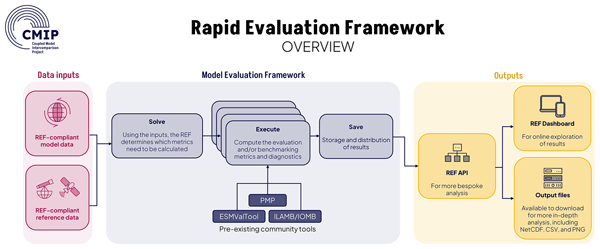
The Rapid Evaluation Framework (REF) is a community-driven platform for benchmarking and performance assessment of Earth system models. Built upon four disparate community evaluation tools, the REF is designed to provide model-data comparisons for the Assessment Fast Track for the Seventh Phase of the Coupled Model Intercomparison Project. The REF will be run at the Earth System Grid Federation to enable model devleopers and scientists to quickly identify model biases and performance issues.
Didier Swingedouw, Laura Jackson, Aixue Hu, Anastasia Romanou, Nicole C. Laureanti, Wilbert Weijer, Sina Loriani, Bette Otto-Bliesner, Ayako Abe-Ouchi, Lucas Almeida, Alessio Bellucci, Reyk Börner, Gokhan Danabasoglu, Donovan P. Dennis, Marion Devilliers, Sybren Drijfhout, Jonathan Donges, Friederike Fröb, Thomas L. Frölicher, Guillaume Gastineau, Heiko Goelzer, Chuncheng Guo, Urs Hofmann, Anna Höse, Colin Jones, Torben Koenigk, Ann Kristin Klose, Valerio Lembo, Jose Licon-Salaiz, Ken Mankoff, Virna Meccia, Irina Melnikova, Oliver Mehling, Laurie Menviel, Juliette Mignot, Jon I. Robson, Gavin A. Schmidt, Robin Smith, Yuchen Sun, Irene Trombini, Matteo Willeit, Richard Wood, Fanghua Wu, Lin Zhaohui, and Ricarda Winkelmann
EGUsphere, https://doi.org/10.5194/egusphere-2026-1698, https://doi.org/10.5194/egusphere-2026-1698, 2026
Short summary
Short summary
This study presents a plan for climate model experiments to better understand how changes in freshwater in the North Atlantic affect major ocean currents. We designed coordinated simulations to test their response to warming, added freshwater, and possible recovery after weakening. Comparing results across models and past climate evidence helps improve confidence in projections and assess risks of large ocean circulation changes.
Federico Fabiano, Paolo Davini, Virna L. Meccia, Giuseppe Zappa, Alessio Bellucci, Valerio Lembo, Katinka Bellomo, and Susanna Corti
Earth Syst. Dynam., 15, 527–546, https://doi.org/10.5194/esd-15-527-2024, https://doi.org/10.5194/esd-15-527-2024, 2024
Short summary
Short summary
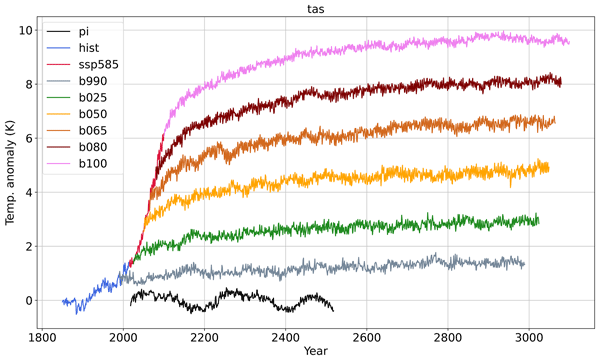
Even after the concentration of greenhouse gases is stabilized, the climate will continue to adapt, seeking a new equilibrium. We study this long-term stabilization through a set of 1000-year simulations, obtained by suddenly "freezing" the atmospheric composition at different levels. If frozen at the current state, global warming surpasses 3° in the long term with our model. We then study how climate impacts will change after various centuries and how the deep ocean will warm.

Vera Melinda Galfi, Tommaso Alberti, Lesley De Cruz, Christian L. E. Franzke, and Valerio Lembo
Nonlin. Processes Geophys., 31, 185–193, https://doi.org/10.5194/npg-31-185-2024, https://doi.org/10.5194/npg-31-185-2024, 2024
Short summary
Short summary
In the online seminar series "Perspectives on climate sciences: from historical developments to future frontiers" (2020–2021), well-known and established scientists from several fields – including mathematics, physics, climate science and ecology – presented their perspectives on the evolution of climate science and on relevant scientific concepts. In this paper, we first give an overview of the content of the seminar series, and then we introduce the written contributions to this special issue.
Valerio Lembo, Federico Fabiano, Vera Melinda Galfi, Rune Grand Graversen, Valerio Lucarini, and Gabriele Messori
Weather Clim. Dynam., 3, 1037–1062, https://doi.org/10.5194/wcd-3-1037-2022, https://doi.org/10.5194/wcd-3-1037-2022, 2022
Short summary
Short summary
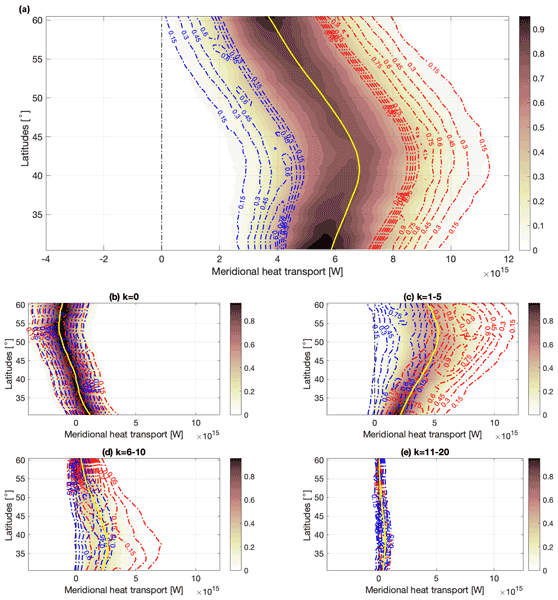
Eddies in mid-latitudes characterize the exchange of heat between the tropics and the poles. This exchange is largely uneven, with a few extreme events bearing most of the heat transported across latitudes in a season. It is thus important to understand what the dynamical mechanisms are behind these events. Here, we identify recurrent weather regime patterns associated with extreme transports, and we identify scales of mid-latitudinal eddies that are mostly responsible for the transport.
Faranak Tootoonchi, Giulia Vico, Gabriele Messori, Ankur Dixit, and Flavio Lehner
EGUsphere, https://doi.org/10.5194/egusphere-2026-6127, https://doi.org/10.5194/egusphere-2026-6127, 2026
This preprint is open for discussion and under review for Biogeosciences (BG).
Short summary
Short summary
Under climate change, winter crops are beneficial, but across Northern Europe, it is unclear whether their cultivation opportunities increase by easing temperature limitations or rather decrease through exposure to harmful winter conditions. We evaluated future changes in climatic indicators relevant for winter crops in Nordic Europe and found that while warmer temperatures can be beneficial, crop production can be challenged without adaptations.
Kristoffer Kvist, Eirik Mikal Samuelsen, and Rune Grand Graversen
EGUsphere, https://doi.org/10.5194/egusphere-2026-6079, https://doi.org/10.5194/egusphere-2026-6079, 2026
This preprint is open for discussion and under review for Atmospheric Chemistry and Physics (ACP).
Short summary
Short summary
Ice forms in clouds on rare airborne particles, which affects how clouds reflect sunlight and produce rain. We compiled 110,000 measurements of these particles from 59 field campaigns worldwide and developed a method to compare campaigns that sampled the air differently. Concentrations differ ten-thousandfold between regions but only threefold at one site, vary on time scales from days to seasons, and are dominated by organic material, not mineral dust. The data help test climate models.
Greta Cazzaniga, Anastasia Akakpo-Numado, Patrick Brockmann, Adrien Burq, Mathieu Vrac, and Davide Faranda
Nat. Hazards Earth Syst. Sci., 26, 4741–4752, https://doi.org/10.5194/nhess-26-4741-2026, https://doi.org/10.5194/nhess-26-4741-2026, 2026
Short summary
Short summary
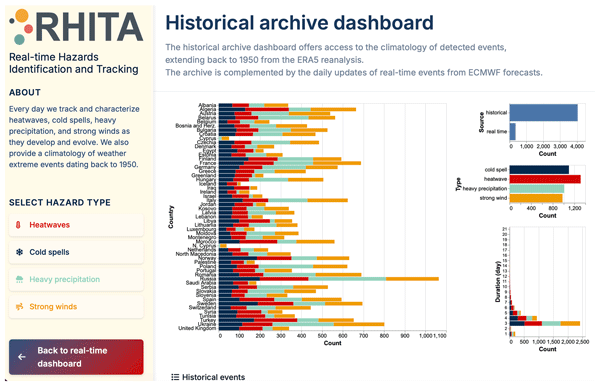
Extreme weather events are becoming more frequent and severe, creating a strong need for rapid and reliable information. We developed an open tool that automatically detects and tracks heatwaves, cold spells, heavy rain, and strong winds across Europe, both in real time and in past decades. By comparing current events with long historical records, the tool shows how unusual an event is and reveals clear increases in heatwaves, while other hazards show more mixed changes.
Kai Kornhuber, Emanuele Bevacqua, Mariana Madruga de Brito, Wiebke S. Jäger, Pauline Rivoire, Cassandra D. W. Rogers, Fabiola Banfi, Fulden Batibeniz, James Carruthers, Carlo De Michele, Silvia De Angeli, Cristina Deidda, Marleen C. de Ruiter, Andreas H. Fink, Henrique M. D. Goulart, Katharina Küpfer, Patrick Ludwig, Douglas Maraun, Gabriele Messori, Shruti Nath, Fiachra O'Loughlin, Joaquim G. Pinto, Benjamin Poschlod, Alexandre M. Ramos, Colin Raymond, Andreia F. S. Ribeiro, Deepti Singh, Laura Suarez Gutierrez, Philip J. Ward, and Christopher J. White
Nat. Hazards Earth Syst. Sci., 26, 4309–4334, https://doi.org/10.5194/nhess-26-4309-2026, https://doi.org/10.5194/nhess-26-4309-2026, 2026
Short summary
Short summary
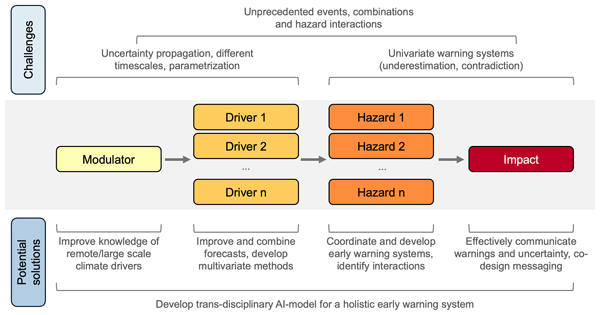
Impacts from extreme weather events may become more severe due to increased likelihood of compounding events under global warming, which challenge present day climate modelling and forecasting capacities. In this perspective we reflect on the usability of compound event research to bridge the gap between academic research and real-world applications.
Aleksa Stanković, Rodrigo Caballero, and Gabriele Messori
Weather Clim. Dynam., 7, 1507–1523, https://doi.org/10.5194/wcd-7-1507-2026, https://doi.org/10.5194/wcd-7-1507-2026, 2026
Short summary
Short summary
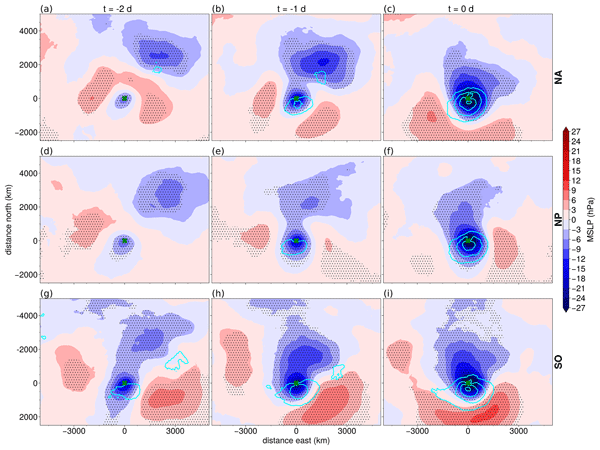
Most storms occur over ocean where they cause strong surface winds. The storms are strongest over the North Atlantic, North Pacific and Southern Ocean. In each of these basins, the storms that cause the strongest surface winds develop similarly. These storms typically develop together with another, previously existing storm. At the same time, extreme winds are stronger in some basins than in others. Our analysis points that if the storms develop faster, they, on average, cause stronger winds.
Adrien Burq, Jean Jouhaud, Victor Xing, Victor Bouvier, Vincent Forcadell, Mateusz Taszarek, Mathieu Vrac, and Davide Faranda
EGUsphere, https://doi.org/10.5194/egusphere-2026-4363, https://doi.org/10.5194/egusphere-2026-4363, 2026
Short summary
Short summary
Lightning is a small-scale process that climate and weather models cannot compute exactly, so it must be approximated. Here we build a deep learning model that predicts lightning across a whole region at once, using inputs from the whole region, and compare it to models that predict each pixel separately. Using this larger-scale information proves beneficial: our model outperforms the single-pixel ones. We also identify the spatial scale and the environmental predictors that matter most.
William J. M. Seviour, Justin Finkel, Philip Rupp, Regan Mudhar, Amy H. Butler, Chaim I. Garfinkel, Peter Hitchcock, Blanca Ayarzagüena, Dong-Chan Hong, Yu-Kyung Hyun, Hera Kim, Eun-Pa Lim, Daniel De Maeseneire, Gabriele Messori, Gerbrand Koren, Michael Sigmond, Isla R. Simpson, and Seok-Woo Son
Weather Clim. Dynam., 7, 1405–1423, https://doi.org/10.5194/wcd-7-1405-2026, https://doi.org/10.5194/wcd-7-1405-2026, 2026
Short summary
Short summary
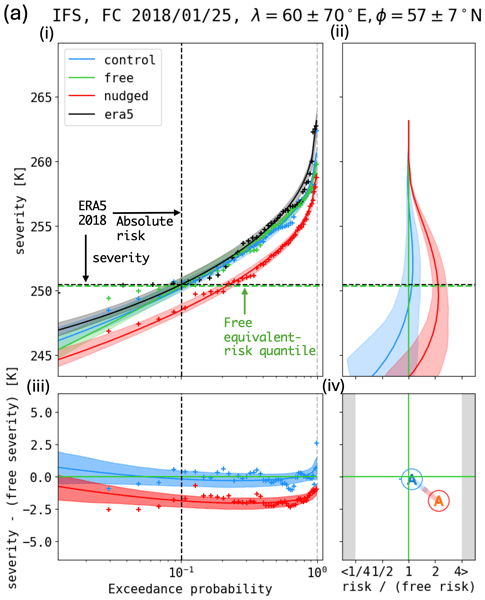
Variability of the stratospheric polar vortex is thought to play a role in driving weather extremes, but quantifying this role for a given event has proved challenging. Using a new set of perturbed subseasonal forecast experiments from 7 modelling centres, we determine the stratospheric contribution to the risk and severity of three recent extreme weather events. The forecast-based methodology that we develop is applicable to understanding a range of other drivers of weather extremes.
Forrest M. Hoffman, Birgit Hassler, Ranjini Swaminathan, Jared Lewis, Bouwe Andela, Nathan Collier, Dóra Hegedűs, Jiwoo Lee, Charlotte Pascoe, Mika Pflüger, Martina Stockhause, Paul Ullrich, Min Xu, Lisa Bock, Felicity Chun, Bettina K. Gier, Douglas I. Kelley, Axel Lauer, Julien Lenhardt, Manuel Schlund, Mohanan G. Sreeush, Katja Weigel, Ed Blockley, Rebecca Beadling, Romain Beucher, Demiso D. Dugassa, Valerio Lembo, Jianhua Lu, Swen Brands, Jerry Tjiputra, Elizaveta Malinina, Brian Medeiros, Enrico Scoccimarro, Jeremy Walton, Phil Kershaw, André Lanfer Marquez, Malcolm J. Roberts, Eleanor O'Rourke, Beth Dingley, Briony Turner, Helene Hewitt, and John P. Dunne
Geosci. Model Dev., 19, 7415–7455, https://doi.org/10.5194/gmd-19-7415-2026, https://doi.org/10.5194/gmd-19-7415-2026, 2026
Short summary
Short summary
The Rapid Evaluation Framework (REF) is a community-driven platform for benchmarking and performance assessment of Earth system models. Built upon four disparate community evaluation tools, the REF is designed to provide model-data comparisons for the Assessment Fast Track for the Seventh Phase of the Coupled Model Intercomparison Project. The REF will be run at the Earth System Grid Federation to enable model devleopers and scientists to quickly identify model biases and performance issues.
Meriem Krouma and Gabriele Messori
Geosci. Model Dev., 19, 6663–6685, https://doi.org/10.5194/gmd-19-6663-2026, https://doi.org/10.5194/gmd-19-6663-2026, 2026
Short summary
Short summary
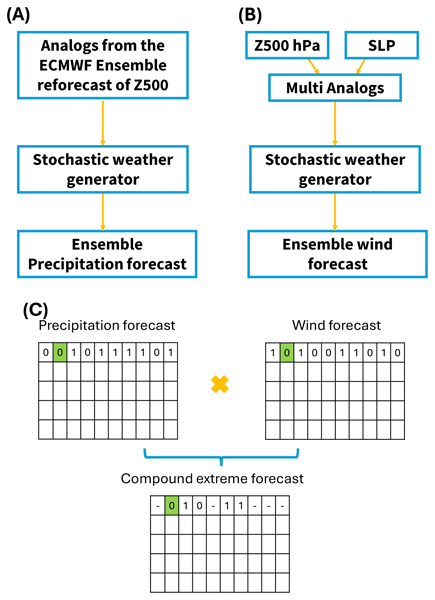
We present two forecasting methods for extreme precipitation and extreme wind in Europe, using stochastic weather generators and past atmospheric patterns. One targets precipitation via weather model reforecasts; the other predicts wind from large-scale patterns. Both outperform standard weather models up to 10 d ahead, offering improved accuracy for both individual and compound extreme events.
Aditya N. Mishra, Gabriele Messori, Lukas Riedel, Athul Rasheeda Satheesh, and Joaquim Pinto
EGUsphere, https://doi.org/10.5194/egusphere-2026-3099, https://doi.org/10.5194/egusphere-2026-3099, 2026
Short summary
Short summary
Windstorms cause billions in damage across Europe every year. In this work, we tune an existing windstorm damage model against new reliable insurance data from Europe. We found that the mathematical method used in the process strongly shapes which storms the model handles best. Our results give scientists and insurers clearer guidance on choosing the right approach when building windstorm risk models, ultimately helping society better prepare for costly extreme weather.
Ines Dillerup, Gabriele Messori, Alexander Lemburg, Sebastian Buschow, and Joaquim G. Pinto
EGUsphere, https://doi.org/10.5194/egusphere-2026-2453, https://doi.org/10.5194/egusphere-2026-2453, 2026
Short summary
Short summary
We study recurrent heatwaves in Europe from 1950–2023 at complementary spatial scales: single locations, larger connected heatwave regions (objects), and continent-wide. Recurrent heatwaves are hotter and linked to drier soils at object and continental scales, but not locally. Objects with strong local heatwave recurrence last longer and are linked to the European blocking weather pattern in June-August. Continental recurrence is distinct from both hot summers and strong local recurrence.
Tom Dörffel, Natalia Mikula, Lisa Schielicke, Theresa Kiszler, Davide Faranda, Berengere Dubrulle, and Nikki Vercauteren
EGUsphere, https://doi.org/10.5194/egusphere-2026-2918, https://doi.org/10.5194/egusphere-2026-2918, 2026
Short summary
Short summary
We investigate how two different indicators related to measures of energy transfer can be used to assess the dynamics of tropical cyclones. One indicator is based on the energy redistribution across length-scales and the other one is based on more fundamental thermodynamic principles. This research demonstrates the potential of these indicators of being used as predictors for the intensity change of tropical cyclones even in under-resolved simulations.

Ni Li, Wim Thiery, Shorouq Zahra, Mariana Madruga de Brito, Koffi Worou, Murathan Kurfalı, Seppe Lampe, Paul Muñoz, Clare Flynn, Camila Trigoso, Joakim Nivre, Jakob Zscheischler, and Gabriele Messori
Nat. Hazards Earth Syst. Sci., 26, 2609–2636, https://doi.org/10.5194/nhess-26-2609-2026, https://doi.org/10.5194/nhess-26-2609-2026, 2026
Short summary
Short summary
Climate extremes threaten society and ecosystems, making impact understanding critical. Wikimpacts 1.0 provides an automated pipeline processing Wikipedia texts with underexploited information on climate impacts, yielding comprehensive socio-economic impact data for 2726 climate events from 1034–2024. It offers broader storm-related impacts and finer spatial resolution than established databases, showcasing natural language processing's potential to advance climate impact data.
Michael Konrad Schutte, Leonardo Olivetti, Flavio Maria Emanuele Pons, and Gabriele Messori
EGUsphere, https://doi.org/10.5194/egusphere-2026-2203, https://doi.org/10.5194/egusphere-2026-2203, 2026
Short summary
Short summary
When testing whether signals on maps are statistically meaningful, scientists must account for multiple testing. Otherwise, some results may appear significant purely by chance. We show that the widely used false discovery rate correction can be misleading: simply changing the geographic region analyzed can make the same data appear far more statistically significant, even though nothing has changed. We recommend transparent reporting and using region-wide averages instead of point-wise testing.
Morteza Babaei, Rune Grand Graversen, Johannes Patrick Stoll, and Jakub Petříček
Weather Clim. Dynam., 7, 825–841, https://doi.org/10.5194/wcd-7-825-2026, https://doi.org/10.5194/wcd-7-825-2026, 2026
Short summary
Short summary
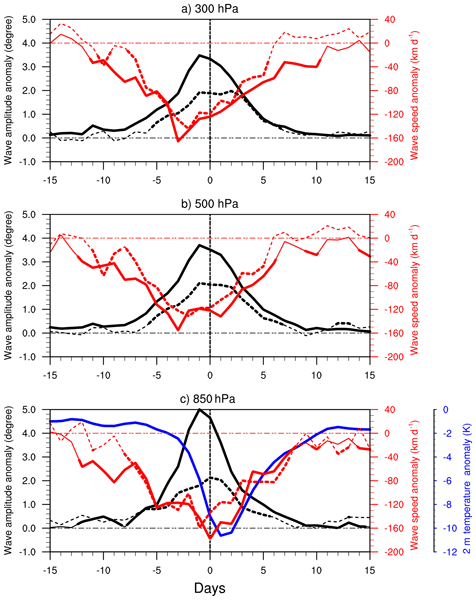
Extreme weather events have historically caused major challenges for humanity. Yet, our understanding of the mechanisms that contribute to their formation remains unclear. Our study provides evidence that locally amplified and slow-moving Rossby waves are responsible for the formation of extreme cold spells. These findings are obtained based on two novel metrics assessing the amplitude and speed of ridges and troughs separately at all longitudes around latitude circles.
Florian Börgel, Itzel Ruvalcaba Baroni, Leonie Barghorn, Leonard Borchert, Bronwyn Cahill, Cyril Dutheil, Leonie Esters, Małgorzata Falarz, Helena L. Filipsson, Matthias Gröger, Jari Hänninen, Magnus Hieronymus, Erko Jakobson, Mehdi Pasha Karami, Karol Kuliński, Taavi Liblik, H. E. Markus Meier, Gabriele Messori, Lev Naumov, Thomas Neumann, Piia Post, Gregor Rehder, Anna Rutgersson, and Georg Sebastian Voelker
Earth Syst. Dynam., 17, 415–450, https://doi.org/10.5194/esd-17-415-2026, https://doi.org/10.5194/esd-17-415-2026, 2026
Short summary
Short summary
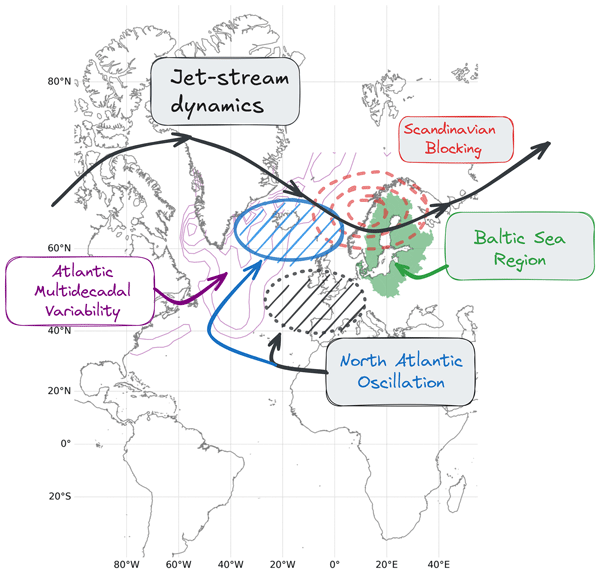
This review explains how weather patterns, guided by the polar jet stream, influence the Baltic Sea’s climate and ecosystem. It covers the North Atlantic Oscillation, blocking events and other processes and discusses how they affect temperature, rainfall, and storms from days to decades. These shifts then impact oxygen levels, productivity, and acidification in the Baltic Sea. Physical links are fairly well known, but biogeochemical pathways remain uncertain.
Clara Naldesi, Nathalie Bertrand, Davide Faranda, and Mathieu Vrac
EGUsphere, https://doi.org/10.5194/egusphere-2026-1466, https://doi.org/10.5194/egusphere-2026-1466, 2026
Short summary
Short summary
The public increasingly needs to know whether and how climate change influences specific extreme events. ClimaMeter is a scientific tool designed to address this demand. This paper reviews the ClimaMeter methodology, focusing on how it estimates the relative roles of natural variability and climate change. We propose a more flexible and general approach within the same framework, enabling a more nuanced assessment of natural variability.
Didier Swingedouw, Laura Jackson, Aixue Hu, Anastasia Romanou, Nicole C. Laureanti, Wilbert Weijer, Sina Loriani, Bette Otto-Bliesner, Ayako Abe-Ouchi, Lucas Almeida, Alessio Bellucci, Reyk Börner, Gokhan Danabasoglu, Donovan P. Dennis, Marion Devilliers, Sybren Drijfhout, Jonathan Donges, Friederike Fröb, Thomas L. Frölicher, Guillaume Gastineau, Heiko Goelzer, Chuncheng Guo, Urs Hofmann, Anna Höse, Colin Jones, Torben Koenigk, Ann Kristin Klose, Valerio Lembo, Jose Licon-Salaiz, Ken Mankoff, Virna Meccia, Irina Melnikova, Oliver Mehling, Laurie Menviel, Juliette Mignot, Jon I. Robson, Gavin A. Schmidt, Robin Smith, Yuchen Sun, Irene Trombini, Matteo Willeit, Richard Wood, Fanghua Wu, Lin Zhaohui, and Ricarda Winkelmann
EGUsphere, https://doi.org/10.5194/egusphere-2026-1698, https://doi.org/10.5194/egusphere-2026-1698, 2026
Short summary
Short summary
This study presents a plan for climate model experiments to better understand how changes in freshwater in the North Atlantic affect major ocean currents. We designed coordinated simulations to test their response to warming, added freshwater, and possible recovery after weakening. Comparing results across models and past climate evidence helps improve confidence in projections and assess risks of large ocean circulation changes.
Kai-Uwe Eiselt and Rune Grand Graversen
The Cryosphere, 20, 1867–1893, https://doi.org/10.5194/tc-20-1867-2026, https://doi.org/10.5194/tc-20-1867-2026, 2026
Short summary
Short summary
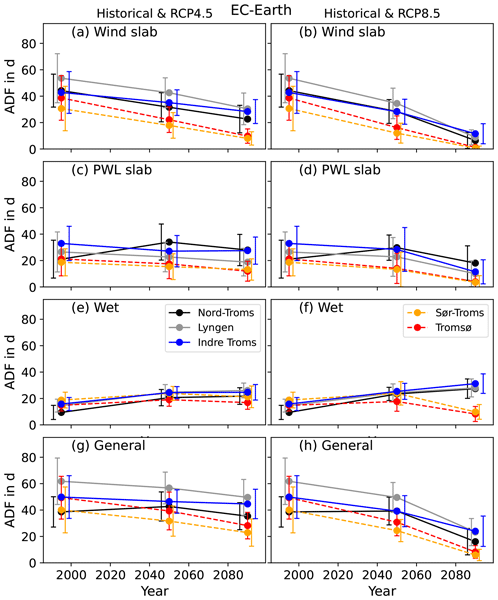
We train machine-learning models to predict avalanche problems from meteorological and snow-cover data in northern Norway. A major part of the work is the estimation of avalanche-problem changes throughout the 21st century based on future climate projections. We find that while the avalanche danger generally declines towards 2100, the avalanche characteristics will likely change, meaning fewer dry but more wet avalanches, having potential implications for the avalanche-danger forecast quality.
Tommaso Alberti, Davide Faranda, Mohamed Foudad, Erika Coppola, Lia Rapella, Rachel Burbidge, Miguel A. C. Teixeira, and Paul Williams
EGUsphere, https://doi.org/10.5194/egusphere-2026-1178, https://doi.org/10.5194/egusphere-2026-1178, 2026
Short summary
Short summary
We developed TurboMeter to study whether climate change is making airplane turbulence stronger. By comparing current atmospheric conditions with similar past situations, we find that most turbulence events in 2024 were intensified by human-caused climate change, especially over the North Atlantic, East Asia, and the United States. This work shows that climate change is already affecting flight safety and highlights the need for climate-informed planning in aviation.
Davide Faranda, Lucas Taligrot, Pascal Yiou, and Nada Caud
Geosci. Commun., 9, 115–125, https://doi.org/10.5194/gc-9-115-2026, https://doi.org/10.5194/gc-9-115-2026, 2026
Short summary
Short summary
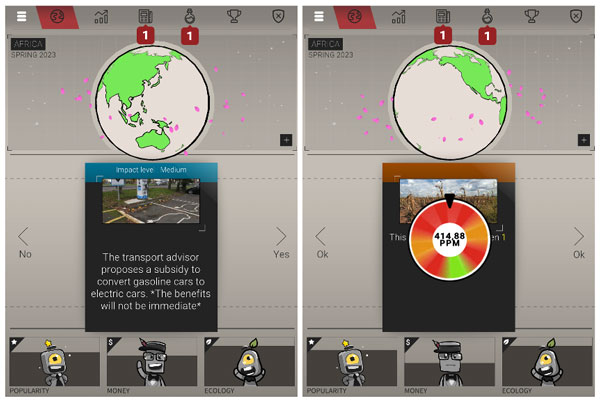
We developed a free online game called ClimarisQ to help people better understand climate change and extreme weather. By playing the game, users learn how decisions about the environment, money, and public opinion affect future risks. We studied how players reacted and found that the game makes climate issues easier to grasp and encourages discussion. This shows that interactive tools like games can support learning and action on climate and environmental challenges.
Gabriele Messori, Emily Boyd, Joakim Nivre, and Elena Raffetti
Earth Syst. Dynam., 17, 199–208, https://doi.org/10.5194/esd-17-199-2026, https://doi.org/10.5194/esd-17-199-2026, 2026
Short summary
Short summary
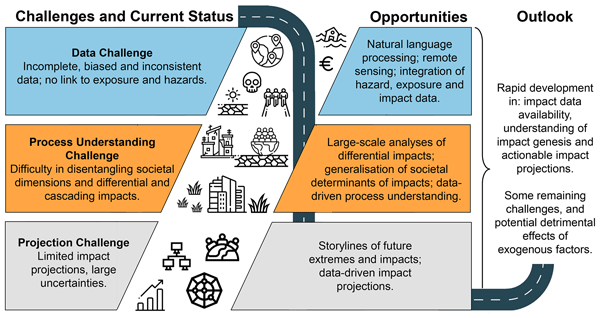
Understanding impacts of climate extremes is very important for society and the economy. We identify three challenges restricting this understanding: limited availability and quality of impact data, difficulties in understanding why given impacts occur and lack of reliable projections of future impacts. We also identify key opportunities, including newly released datasets, recent methodological and technical advances and interdisciplinary collaborations between the social and natural sciences.
Alok Kumar Samantaray and Gabriele Messori
Earth Syst. Sci. Data Discuss., https://doi.org/10.5194/essd-2025-646, https://doi.org/10.5194/essd-2025-646, 2026
Revised manuscript under review for ESSD
Short summary
Short summary
We present a global dataset that links drought events to human and economic exposure and impacts. Using a two-step approach, we first cluster drought events from precipitation and temperature records to track their severity and extent, and then connect them to population and Gross Domestic Product exposure and to impacts reported in disaster databases. The dataset supports risk planning and mitigation efforts.
Davide Faranda, Thibault Guinaldo, Francisco Pastor, Tommaso Alberti, and Samira Khodayar
EGUsphere, https://hal.science/hal-05289765v1, https://hal.science/hal-05289765v1, 2026
Short summary
Short summary
The Mediterranean Sea experienced a record-breaking heatwave in summer 2025. We compared this event to similar patterns from past decades to see how a warmer climate changed its strength. We found that today's warmer background added about 1.5 °C to the sea surface, making the heatwave far more intense and widespread. This shows how climate change is turning ordinary weather patterns into extreme events, with major impacts on marine life, coastal communities, and economies.
Ziying Yang, Jiping Liu, Mirong Song, Yongyun Hu, Qinghua Yang, Ke Fan, Rune Grand Graversen, and Lu Zhou
The Cryosphere, 19, 6381–6402, https://doi.org/10.5194/tc-19-6381-2025, https://doi.org/10.5194/tc-19-6381-2025, 2025
Short summary
Short summary
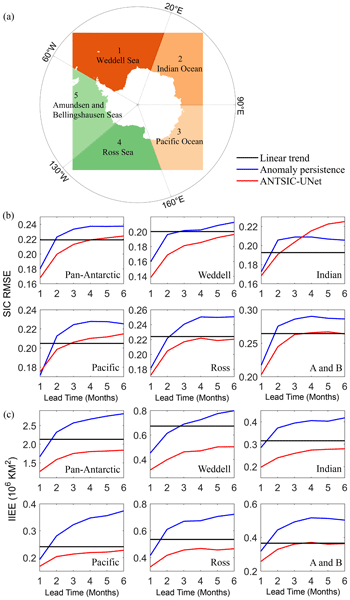
Antarctic sea ice has changed rapidly in recent years. Here we developed a deep learning model trained by multiple climate variables for extended seasonal Antarctic sea ice prediction. Our model shows high predictive skills up to 6 months in advance, particularly in predicting extreme events. It also shows skillful predictions at the sea ice edge and year-to-year sea ice changes. Variable importance analyses suggest what variables are more important for prediction at different lead times.
Pradeebane Vaittinada Ayar, Stella Bourdin, Davide Faranda, and Mathieu Vrac
Nat. Hazards Earth Syst. Sci., 25, 4655–4672, https://doi.org/10.5194/nhess-25-4655-2025, https://doi.org/10.5194/nhess-25-4655-2025, 2025
Short summary
Short summary
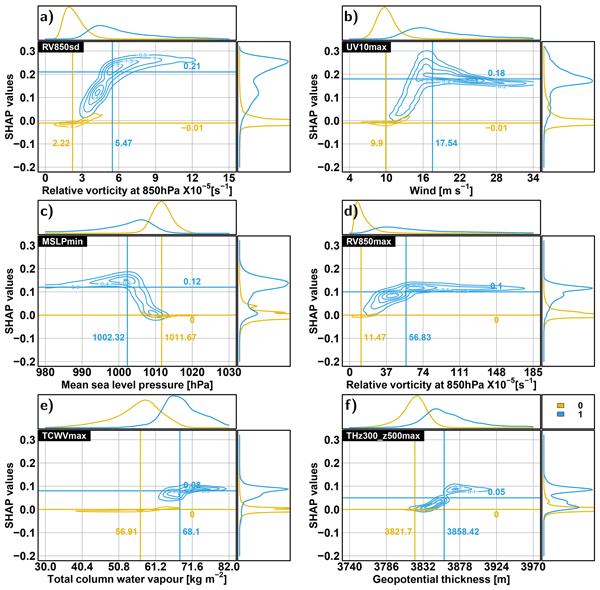
Tracking tropical cyclones (TCs) remains a matter of interest for investigating observed and simulated tropical cyclones. In this study, Random Forest (RF), a machine learning approach, is considered to track TCs. RF associates the TC occurrence or absence with different atmospheric configurations. Compared to trackers found in the literature, it shows similar performance for tracking TCs, better control over false alarms, more flexibility, and reveals key variables for TCs' detection.
Sara Lindersson and Gabriele Messori
Earth Syst. Sci. Data, 17, 6379–6403, https://doi.org/10.5194/essd-17-6379-2025, https://doi.org/10.5194/essd-17-6379-2025, 2025
Short summary
Short summary
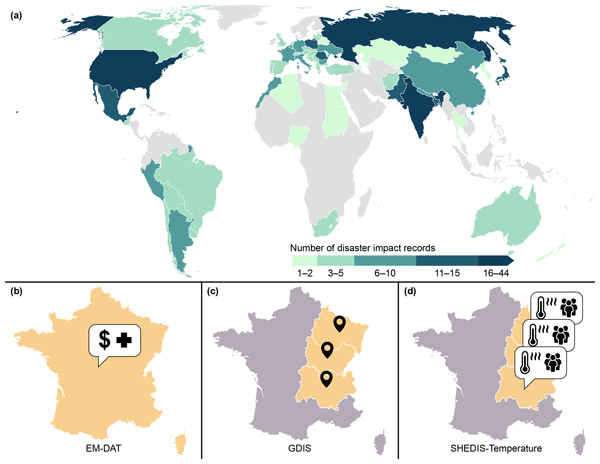
The study of past temperature-related disasters requires information on socioeconomic impacts, hazard intensity and human exposure. This is often lacking in current disaster databases. Our dataset fills this gap by integrating impact records with information on disaster locations, high-resolution meteorological data, and population estimates. Covering 382 disasters in 71 countries (1979–2018), this dataset enables deeper analyses of heat-related risk and vulnerabilities.
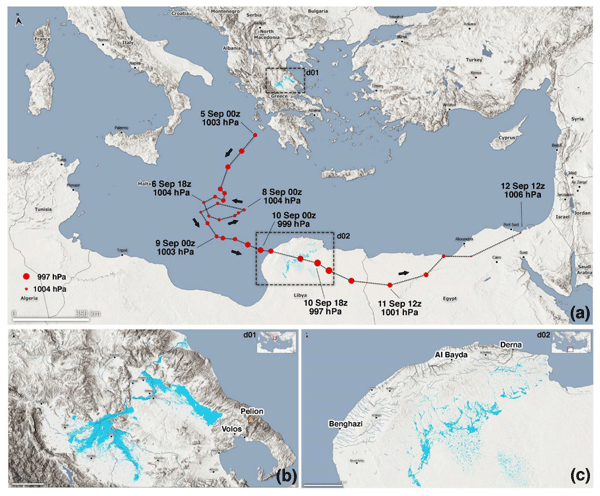
Emmanouil Flaounas, Stavros Dafis, Silvio Davolio, Davide Faranda, Christian Ferrarin, Katharina Hartmuth, Assaf Hochman, Aristeidis Koutroulis, Samira Khodayar, Mario Marcello Miglietta, Florian Pantillon, Platon Patlakas, Michael Sprenger, and Iris Thurnherr
Weather Clim. Dynam., 6, 1515–1538, https://doi.org/10.5194/wcd-6-1515-2025, https://doi.org/10.5194/wcd-6-1515-2025, 2025
Short summary
Short summary
Storm Daniel (2023) is one of the most catastrophic storms ever documented in the Mediterranean. Our results highlight the different dynamics and therefore the different predictability skill of precipitation, its extremes and impacts that have been produced in Greece and Libya, the two most affected countries. Our approach concerns an analysis of the storm by articulating dynamics, weather prediction, hydrological and oceanographic implications, climate extremes, and attribution theory.
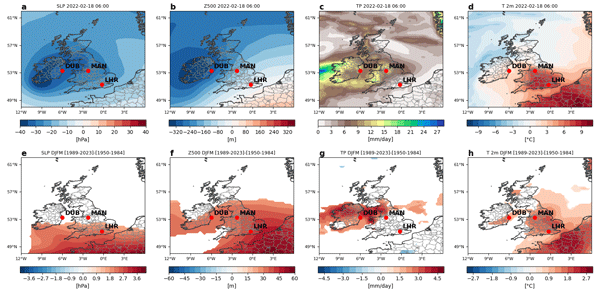
Lia Rapella, Tommaso Alberti, Davide Faranda, and Philippe Drobinski
Weather Clim. Dynam., 6, 1339–1363, https://doi.org/10.5194/wcd-6-1339-2025, https://doi.org/10.5194/wcd-6-1339-2025, 2025
Short summary
Short summary
Extreme weather events pose increasing challenges for aviation, including flight disruptions and infrastructure damage. This study examines the influence of anthropogenic climate change on four recent major storms across Europe, the USA, and East Asia. Our research underscores the growing intensity of extreme storms, driven by human-induced climate change, stressing the need to adapt aviation strategies to an increasingly hazardous environment.
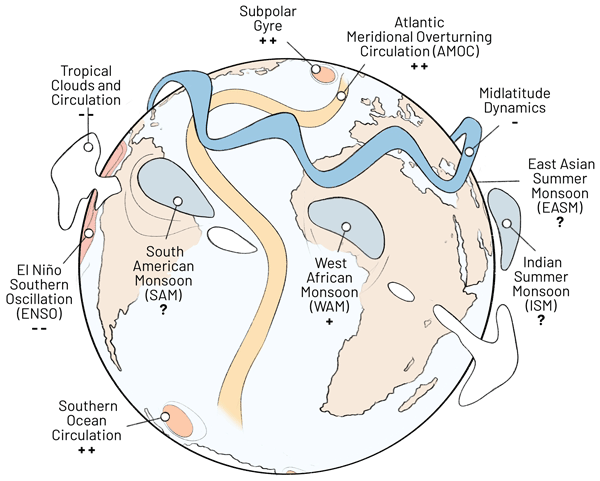
Sina Loriani, Yevgeny Aksenov, David I. Armstrong McKay, Govindasamy Bala, Andreas Born, Cristiano Mazur Chiessi, Henk A. Dijkstra, Jonathan F. Donges, Sybren Drijfhout, Matthew H. England, Alexey V. Fedorov, Laura C. Jackson, Kai Kornhuber, Gabriele Messori, Francesco S. R. Pausata, Stefanie Rynders, Jean-Baptiste Sallée, Bablu Sinha, Steven C. Sherwood, Didier Swingedouw, and Thejna Tharammal
Earth Syst. Dynam., 16, 1611–1653, https://doi.org/10.5194/esd-16-1611-2025, https://doi.org/10.5194/esd-16-1611-2025, 2025
Short summary
Short summary
In this work, we draw on palaeo-records, observations, and modelling studies to review tipping points in the ocean overturning circulations, monsoon systems, and global atmospheric circulations. We find indications for tipping in the ocean overturning circulations and the West African monsoon, with potentially severe impacts on the Earth system and humans. Tipping in the other considered systems is regarded as conceivable but is currently not sufficiently supported by evidence.
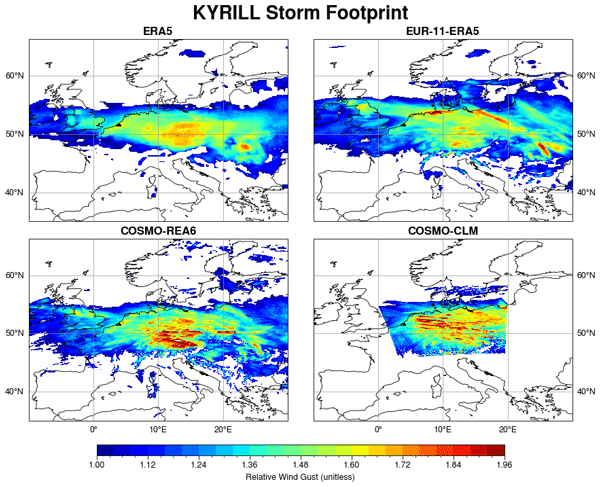
Clare M. Flynn, Julia Moemken, Joaquim G. Pinto, Michael K. Schutte, and Gabriele Messori
Earth Syst. Sci. Data, 17, 4431–4453, https://doi.org/10.5194/essd-17-4431-2025, https://doi.org/10.5194/essd-17-4431-2025, 2025
Short summary
Short summary
We created a new, publicly available, database of the top 50 most extreme European winter windstorms from each of four different meteorological input data sets covering the years 1995–2015. We found variability in all aspects of our database, from which storms were included in the top 50 storms for each input to the storms' spatial variability. We urge users of our database to consider the storms as identified from two or more input sources within our database where possible.
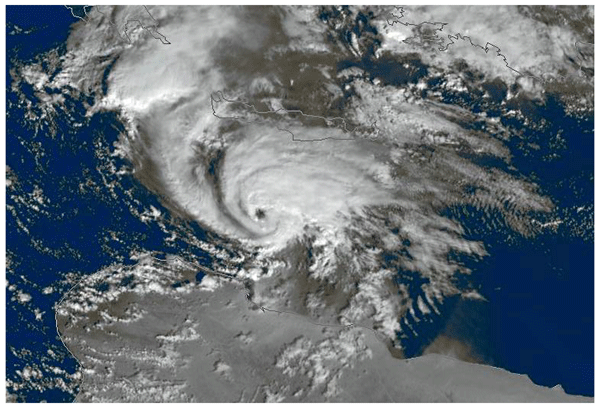
Kerry Emanuel, Tommaso Alberti, Stella Bourdin, Suzana J. Camargo, Davide Faranda, Emmanouil Flaounas, Juan Jesus Gonzalez-Aleman, Chia-Ying Lee, Mario Marcello Miglietta, Claudia Pasquero, Alice Portal, Hamish Ramsay, Marco Reale, and Romualdo Romero
Weather Clim. Dynam., 6, 901–926, https://doi.org/10.5194/wcd-6-901-2025, https://doi.org/10.5194/wcd-6-901-2025, 2025
Short summary
Short summary
Storms strongly resembling hurricanes are sometimes observed to form well outside the tropics, even in polar latitudes. They behave capriciously, developing very rapidly and then dying just as quickly. We show that strong dynamical processes in the atmosphere can sometimes cause it to become much colder locally than the underlying ocean, creating the conditions for hurricanes to form but only over small areas and for short times. We call the resulting storms "CYCLOPs".
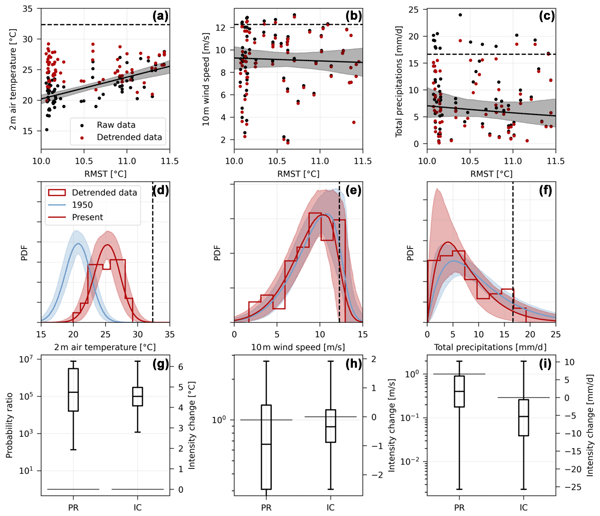
Robin Noyelle, Davide Faranda, Yoann Robin, Mathieu Vrac, and Pascal Yiou
Weather Clim. Dynam., 6, 817–839, https://doi.org/10.5194/wcd-6-817-2025, https://doi.org/10.5194/wcd-6-817-2025, 2025
Short summary
Short summary
Properties of extreme meteorological and climatological events are changing under human-caused climate change. Extreme event attribution methods seek to estimate the contribution of global warming in the probability and intensity changes of extreme events. Here we propose a procedure to estimate these quantities for the flow analogue method, which compares the observed event to similar events in the past.
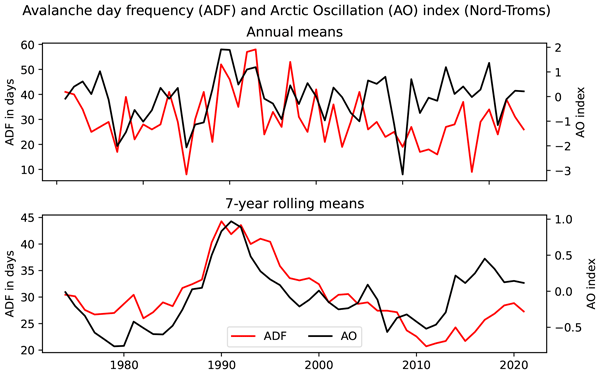
Kai-Uwe Eiselt and Rune Grand Graversen
The Cryosphere, 19, 1849–1871, https://doi.org/10.5194/tc-19-1849-2025, https://doi.org/10.5194/tc-19-1849-2025, 2025
Short summary
Short summary
In this study we optimise and train a random forest model to predict avalanche danger in northern Norway based on meteorological reanalysis data. The model performance is at the low end compared to recent similar studies. A hindcast of the frequency of avalanche days (based on the avalanche-danger level) is performed from 1970 to 2024, and a correlation is found with the Arctic Oscillation. This has potential implications for longer-term avalanche predictability.
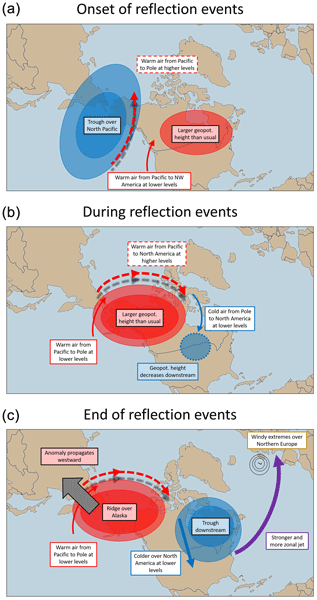
Michael K. Schutte, Alice Portal, Simon H. Lee, and Gabriele Messori
Weather Clim. Dynam., 6, 521–548, https://doi.org/10.5194/wcd-6-521-2025, https://doi.org/10.5194/wcd-6-521-2025, 2025
Short summary
Short summary
Large-scale motions in the atmosphere, namely atmospheric waves, greatly impact the weather that we experience at the Earth's surface. Here we investigate how waves in the troposphere (the lower 10 km of the atmosphere) and the stratosphere (above the troposphere) interact to affect surface weather. We find that tropospheric waves that are reflected back down by the stratosphere change weather patterns and temperatures in North America. These changes can indirectly affect the weather in Europe.
Ferran Lopez-Marti, Mireia Ginesta, Davide Faranda, Anna Rutgersson, Pascal Yiou, Lichuan Wu, and Gabriele Messori
Earth Syst. Dynam., 16, 169–187, https://doi.org/10.5194/esd-16-169-2025, https://doi.org/10.5194/esd-16-169-2025, 2025
Short summary
Short summary
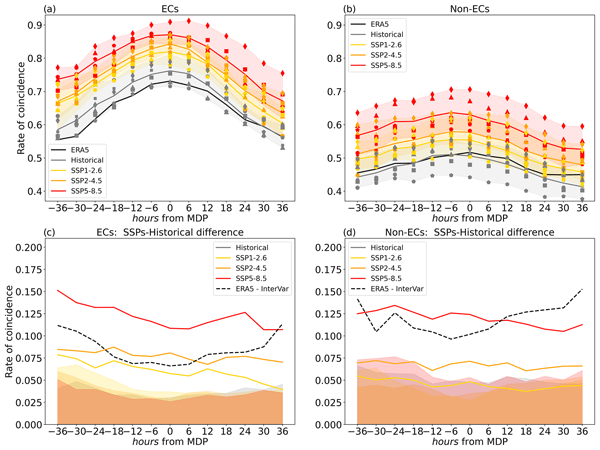
Explosive cyclones and atmospheric rivers are two main drivers of extreme weather in Europe. In this study, we investigate their joint changes in future climates over the North Atlantic. Our results show that both the concurrence of these events and the intensity of atmospheric rivers increase by the end of the century across different future scenarios. Furthermore, explosive cyclones associated with atmospheric rivers last longer and are deeper than those without atmospheric rivers.
Leonardo Olivetti and Gabriele Messori
Geosci. Model Dev., 17, 7915–7962, https://doi.org/10.5194/gmd-17-7915-2024, https://doi.org/10.5194/gmd-17-7915-2024, 2024
Short summary
Short summary
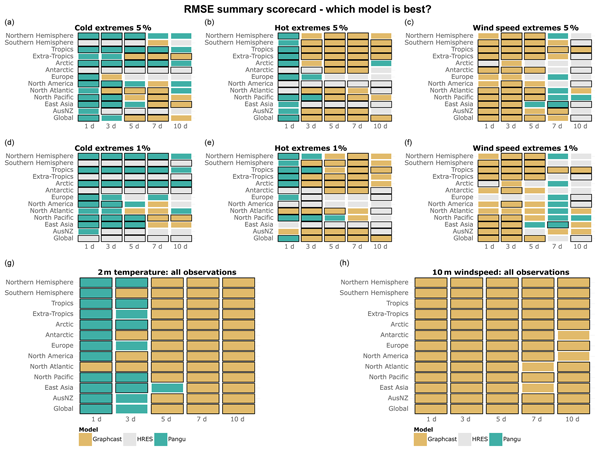
Data-driven models are becoming a viable alternative to physics-based models for weather forecasting up to 15 d into the future. However, it is unclear whether they are as reliable as physics-based models when forecasting weather extremes. We evaluate their performance in forecasting near-surface cold, hot, and windy extremes globally. We find that data-driven models can compete with physics-based models and that the choice of the best model mainly depends on the region and type of extreme.

Colin G. Jones, Fanny Adloff, Ben B. B. Booth, Peter M. Cox, Veronika Eyring, Pierre Friedlingstein, Katja Frieler, Helene T. Hewitt, Hazel A. Jeffery, Sylvie Joussaume, Torben Koenigk, Bryan N. Lawrence, Eleanor O'Rourke, Malcolm J. Roberts, Benjamin M. Sanderson, Roland Séférian, Samuel Somot, Pier Luigi Vidale, Detlef van Vuuren, Mario Acosta, Mats Bentsen, Raffaele Bernardello, Richard Betts, Ed Blockley, Julien Boé, Tom Bracegirdle, Pascale Braconnot, Victor Brovkin, Carlo Buontempo, Francisco Doblas-Reyes, Markus Donat, Italo Epicoco, Pete Falloon, Sandro Fiore, Thomas Frölicher, Neven S. Fučkar, Matthew J. Gidden, Helge F. Goessling, Rune Grand Graversen, Silvio Gualdi, José M. Gutiérrez, Tatiana Ilyina, Daniela Jacob, Chris D. Jones, Martin Juckes, Elizabeth Kendon, Erik Kjellström, Reto Knutti, Jason Lowe, Matthew Mizielinski, Paola Nassisi, Michael Obersteiner, Pierre Regnier, Romain Roehrig, David Salas y Mélia, Carl-Friedrich Schleussner, Michael Schulz, Enrico Scoccimarro, Laurent Terray, Hannes Thiemann, Richard A. Wood, Shuting Yang, and Sönke Zaehle
Earth Syst. Dynam., 15, 1319–1351, https://doi.org/10.5194/esd-15-1319-2024, https://doi.org/10.5194/esd-15-1319-2024, 2024
Short summary
Short summary
We propose a number of priority areas for the international climate research community to address over the coming decade. Advances in these areas will both increase our understanding of past and future Earth system change, including the societal and environmental impacts of this change, and deliver significantly improved scientific support to international climate policy, such as future IPCC assessments and the UNFCCC Global Stocktake.
Gabriele Messori, Antonio Segalini, and Alexandre M. Ramos
Earth Syst. Dynam., 15, 1207–1225, https://doi.org/10.5194/esd-15-1207-2024, https://doi.org/10.5194/esd-15-1207-2024, 2024
Short summary
Short summary
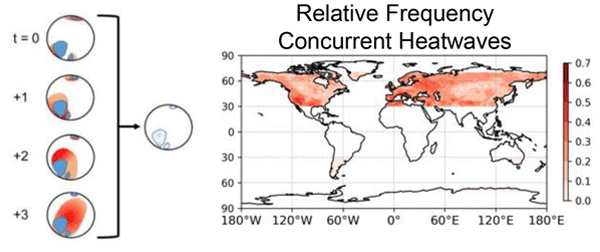
Simultaneous heatwaves or cold spells in remote geographical regions have potentially far-reaching impacts on society and the environment. Despite this, we have little knowledge of when and where these extreme events have occurred in the past decades. In this paper, we present a summary of past simultaneous heatwaves or cold spells and provide a computer program to enable other researchers to study them.
Marco Gaetani, Gabriele Messori, Francesco S. R. Pausata, Shivangi Tiwari, M. Carmen Alvarez Castro, and Qiong Zhang
Clim. Past, 20, 1735–1759, https://doi.org/10.5194/cp-20-1735-2024, https://doi.org/10.5194/cp-20-1735-2024, 2024
Short summary
Short summary
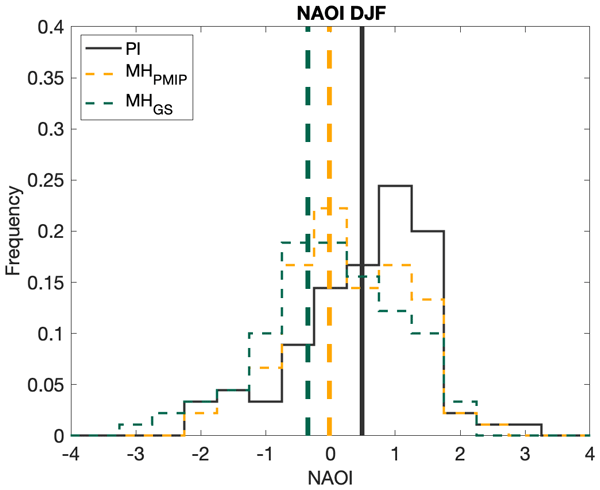
Palaeoclimate reconstructions suggest that, around 6000 years ago, a greening of the Sahara took place, accompanied by climate changes in the Northern Hemisphere at middle to high latitudes. In this study, a climate model is used to investigate how this drastic environmental change in the Sahara impacted remote regions. Specifically, climate simulations reveal significant modifications in atmospheric circulation over the North Atlantic, affecting North American and European climates.
Antonio Segalini, Jacopo Riboldi, Volkmar Wirth, and Gabriele Messori
Weather Clim. Dynam., 5, 997–1012, https://doi.org/10.5194/wcd-5-997-2024, https://doi.org/10.5194/wcd-5-997-2024, 2024
Short summary
Short summary
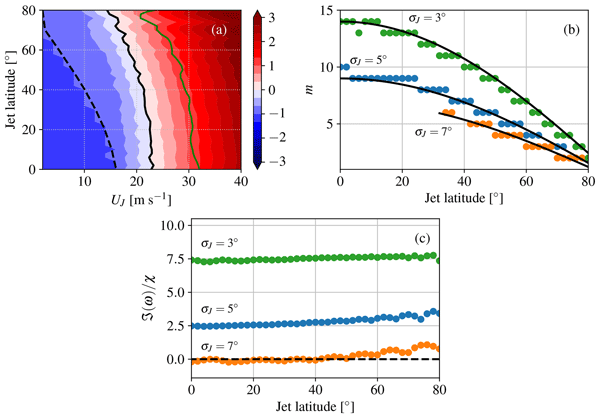
Planetary Rossby waves are created by topography and evolve in time. In this work, an analytical solution of this classical problem is proposed under the approximation of linear wave dynamics. The theory is able to describe reasonably well the evolution of the perturbation and compares well with full nonlinear simulations. Several relevant cases with single and double zonal jets are assessed with the theoretical framework
Davide Faranda, Gabriele Messori, Erika Coppola, Tommaso Alberti, Mathieu Vrac, Flavio Pons, Pascal Yiou, Marion Saint Lu, Andreia N. S. Hisi, Patrick Brockmann, Stavros Dafis, Gianmarco Mengaldo, and Robert Vautard
Weather Clim. Dynam., 5, 959–983, https://doi.org/10.5194/wcd-5-959-2024, https://doi.org/10.5194/wcd-5-959-2024, 2024
Short summary
Short summary
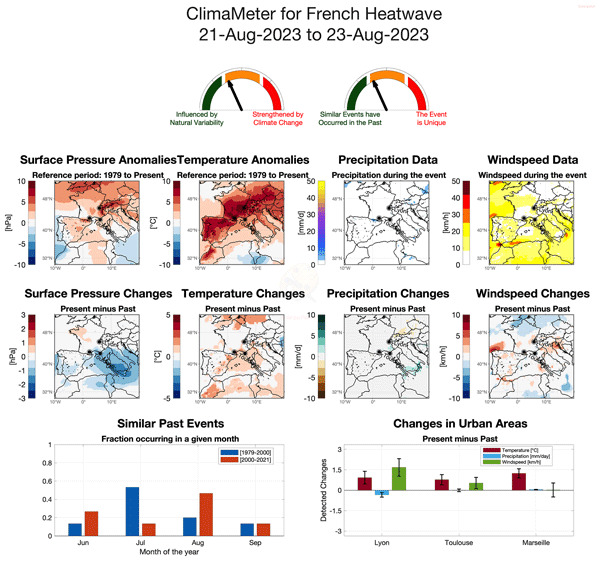
We introduce ClimaMeter, a tool offering real-time insights into extreme-weather events. Our tool unveils how climate change and natural variability affect these events, affecting communities worldwide. Our research equips policymakers and the public with essential knowledge, fostering informed decisions and enhancing climate resilience. We analysed two distinct events, showcasing ClimaMeter's global relevance.
Aleksa Stanković, Gabriele Messori, Joaquim G. Pinto, and Rodrigo Caballero
Weather Clim. Dynam., 5, 821–837, https://doi.org/10.5194/wcd-5-821-2024, https://doi.org/10.5194/wcd-5-821-2024, 2024
Short summary
Short summary
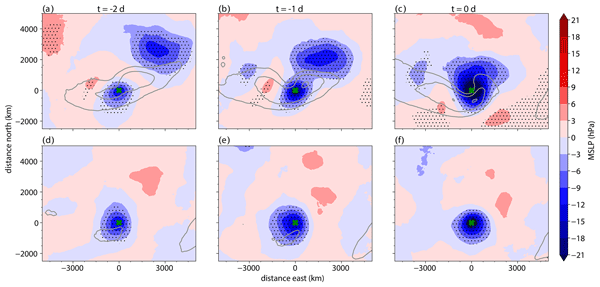
The article studies extreme winds near the surface over the North Atlantic Ocean. These winds are caused by storms that pass through this region. The strongest storms that have occurred in the winters from 1950–2020 are studied in detail and compared to weaker but still strong storms. The analysis shows that the storms associated with the strongest winds are preceded by another older storm that travelled through the same region and made the conditions suitable for development of extreme winds.
Federico Fabiano, Paolo Davini, Virna L. Meccia, Giuseppe Zappa, Alessio Bellucci, Valerio Lembo, Katinka Bellomo, and Susanna Corti
Earth Syst. Dynam., 15, 527–546, https://doi.org/10.5194/esd-15-527-2024, https://doi.org/10.5194/esd-15-527-2024, 2024
Short summary
Short summary
Even after the concentration of greenhouse gases is stabilized, the climate will continue to adapt, seeking a new equilibrium. We study this long-term stabilization through a set of 1000-year simulations, obtained by suddenly "freezing" the atmospheric composition at different levels. If frozen at the current state, global warming surpasses 3° in the long term with our model. We then study how climate impacts will change after various centuries and how the deep ocean will warm.
Derrick Muheki, Axel A. J. Deijns, Emanuele Bevacqua, Gabriele Messori, Jakob Zscheischler, and Wim Thiery
Earth Syst. Dynam., 15, 429–466, https://doi.org/10.5194/esd-15-429-2024, https://doi.org/10.5194/esd-15-429-2024, 2024
Short summary
Short summary
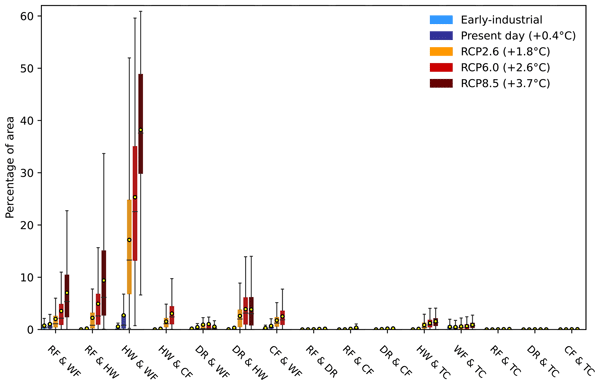
Climate change affects the interaction, dependence, and joint occurrence of climate extremes. Here we investigate the joint occurrence of pairs of river floods, droughts, heatwaves, crop failures, wildfires, and tropical cyclones in East Africa under past and future climate conditions. Our results show that, across all future warming scenarios, the frequency and spatial extent of these co-occurring extremes will increase in this region, particularly in areas close to the Nile and Congo rivers.
Vera Melinda Galfi, Tommaso Alberti, Lesley De Cruz, Christian L. E. Franzke, and Valerio Lembo
Nonlin. Processes Geophys., 31, 185–193, https://doi.org/10.5194/npg-31-185-2024, https://doi.org/10.5194/npg-31-185-2024, 2024
Short summary
Short summary
In the online seminar series "Perspectives on climate sciences: from historical developments to future frontiers" (2020–2021), well-known and established scientists from several fields – including mathematics, physics, climate science and ecology – presented their perspectives on the evolution of climate science and on relevant scientific concepts. In this paper, we first give an overview of the content of the seminar series, and then we introduce the written contributions to this special issue.
Lucas Fery and Davide Faranda
Weather Clim. Dynam., 5, 439–461, https://doi.org/10.5194/wcd-5-439-2024, https://doi.org/10.5194/wcd-5-439-2024, 2024
Short summary
Short summary
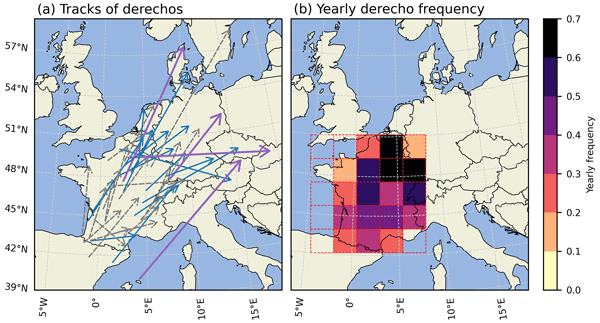
In this study, we analyse warm-season derechos – a type of severe convective windstorm – in France between 2000 and 2022, identifying 38 events. We compare their frequency and features with other countries. We also examine changes in the associated large-scale patterns. We find that convective instability has increased in southern Europe. However, the attribution of these changes to natural climate variability, human-induced climate change or a combination of both remains unclear.
Leonardo Olivetti and Gabriele Messori
Geosci. Model Dev., 17, 2347–2358, https://doi.org/10.5194/gmd-17-2347-2024, https://doi.org/10.5194/gmd-17-2347-2024, 2024
Short summary
Short summary
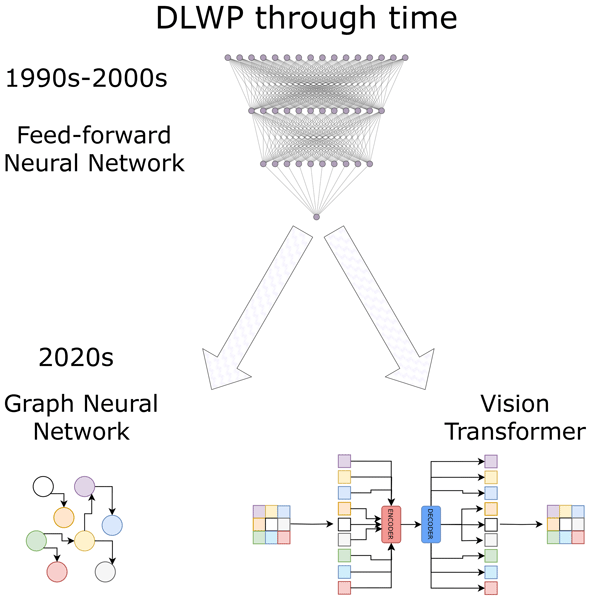
In the last decades, weather forecasting up to 15 d into the future has been dominated by physics-based numerical models. Recently, deep learning models have challenged this paradigm. However, the latter models may struggle when forecasting weather extremes. In this article, we argue for deep learning models specifically designed to handle extreme events, and we propose a foundational framework to develop such models.
Emma Holmberg, Gabriele Messori, Rodrigo Caballero, and Davide Faranda
Earth Syst. Dynam., 14, 737–765, https://doi.org/10.5194/esd-14-737-2023, https://doi.org/10.5194/esd-14-737-2023, 2023
Short summary
Short summary
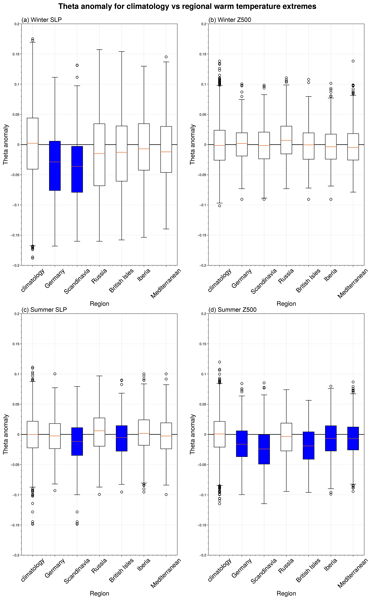
We analyse the duration of large-scale patterns of air movement in the atmosphere, referred to as persistence, and whether unusually persistent patterns favour warm-temperature extremes in Europe. We see no clear relationship between summertime heatwaves and unusually persistent patterns. This suggests that heatwaves do not necessarily require the continued flow of warm air over a region and that local effects could be important for their occurrence.
Axel Kleidon, Gabriele Messori, Somnath Baidya Roy, Ira Didenkulova, and Ning Zeng
Earth Syst. Dynam., 14, 241–242, https://doi.org/10.5194/esd-14-241-2023, https://doi.org/10.5194/esd-14-241-2023, 2023

Patrick Johannes Stoll, Rune Grand Graversen, and Gabriele Messori
Weather Clim. Dynam., 4, 1–17, https://doi.org/10.5194/wcd-4-1-2023, https://doi.org/10.5194/wcd-4-1-2023, 2023
Short summary
Short summary
The atmosphere is in motion and hereby transporting warm, cold, moist, and dry air to different climate zones. In this study, we investigate how this transport of energy organises in different manners. Outside the tropics, atmospheric waves of sizes between 2000 and 8000 km, which we perceive as cyclones from the surface, transport most of the energy and moisture poleward. In the winter, large-scale weather situations become very important for transporting energy into the polar regions.
Davide Faranda, Stella Bourdin, Mireia Ginesta, Meriem Krouma, Robin Noyelle, Flavio Pons, Pascal Yiou, and Gabriele Messori
Weather Clim. Dynam., 3, 1311–1340, https://doi.org/10.5194/wcd-3-1311-2022, https://doi.org/10.5194/wcd-3-1311-2022, 2022
Short summary
Short summary
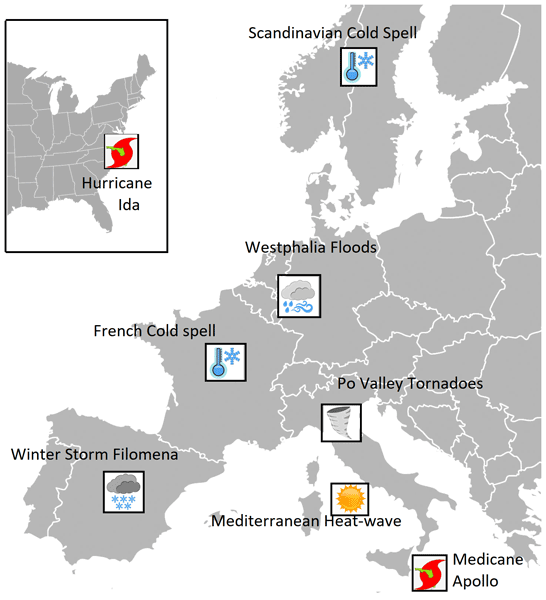
We analyze the atmospheric circulation leading to impactful extreme events for the calendar year 2021 such as the Storm Filomena, Westphalia floods, Hurricane Ida and Medicane Apollo. For some of the events, we find that climate change has contributed to their occurrence or enhanced their intensity; for other events, we find that they are unprecedented. Our approach underscores the importance of considering changes in the atmospheric circulation when performing attribution studies.
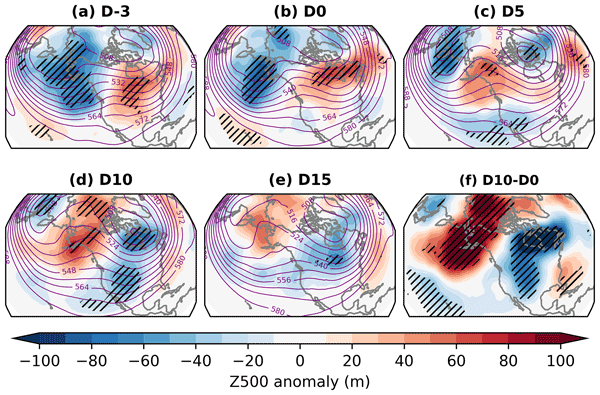
Gabriele Messori, Marlene Kretschmer, Simon H. Lee, and Vivien Wendt
Weather Clim. Dynam., 3, 1215–1236, https://doi.org/10.5194/wcd-3-1215-2022, https://doi.org/10.5194/wcd-3-1215-2022, 2022
Short summary
Short summary
Over 10 km above the ground, there is a region of the atmosphere called the stratosphere. While there is very little air in the stratosphere itself, its interactions with the lower parts of the atmosphere – where we live – can affect the weather. Here we study a specific example of such an interaction, whereby processes occurring at the boundary of the stratosphere can lead to a continent-wide drop in temperatures in North America during winter.

Alena Dekhtyareva, Mark Hermanson, Anna Nikulina, Ove Hermansen, Tove Svendby, Kim Holmén, and Rune Grand Graversen
Atmos. Chem. Phys., 22, 11631–11656, https://doi.org/10.5194/acp-22-11631-2022, https://doi.org/10.5194/acp-22-11631-2022, 2022
Short summary
Short summary
Despite decades of industrial activity in Svalbard, there is no continuous air pollution monitoring in the region’s settlements except Ny-Ålesund. The NOx and O3 observations from the three-station network have been compared for the first time in this study. It has been shown how the large-scale weather regimes control the synoptic meteorological conditions and determine the atmospheric long-range transport pathways and efficiency of local air pollution dispersion.
Valerio Lembo, Federico Fabiano, Vera Melinda Galfi, Rune Grand Graversen, Valerio Lucarini, and Gabriele Messori
Weather Clim. Dynam., 3, 1037–1062, https://doi.org/10.5194/wcd-3-1037-2022, https://doi.org/10.5194/wcd-3-1037-2022, 2022
Short summary
Short summary
Eddies in mid-latitudes characterize the exchange of heat between the tropics and the poles. This exchange is largely uneven, with a few extreme events bearing most of the heat transported across latitudes in a season. It is thus important to understand what the dynamical mechanisms are behind these events. Here, we identify recurrent weather regime patterns associated with extreme transports, and we identify scales of mid-latitudinal eddies that are mostly responsible for the transport.
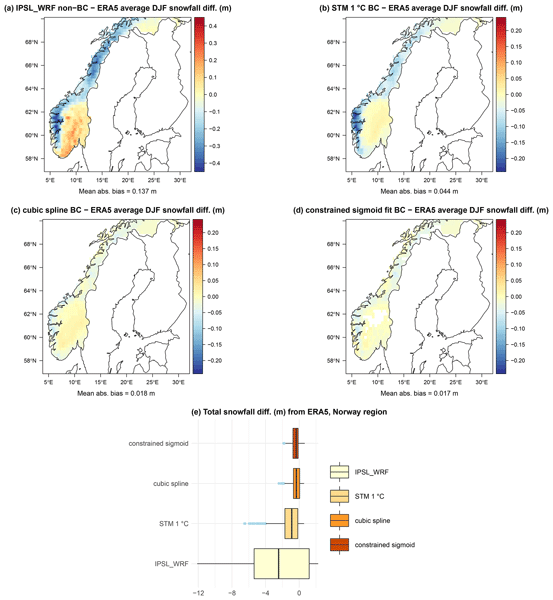
Flavio Maria Emanuele Pons and Davide Faranda
Adv. Stat. Clim. Meteorol. Oceanogr., 8, 155–186, https://doi.org/10.5194/ascmo-8-155-2022, https://doi.org/10.5194/ascmo-8-155-2022, 2022
Short summary
Short summary
The objective motivating this study is the assessment of the impacts of winter climate extremes, which requires accurate simulation of snowfall. However, climate simulation models contain physical approximations, which result in biases that must be corrected using past data as a reference. We show how to exploit simulated temperature and precipitation to estimate snowfall from already bias-corrected variables, without requiring the elaboration of complex, multivariate bias adjustment techniques.
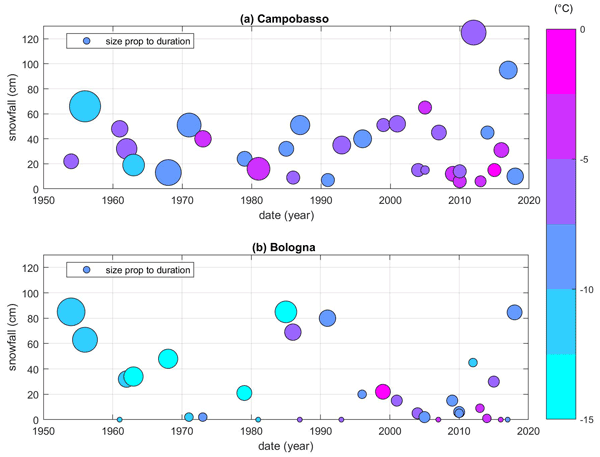
Miriam D'Errico, Flavio Pons, Pascal Yiou, Soulivanh Tao, Cesare Nardini, Frank Lunkeit, and Davide Faranda
Earth Syst. Dynam., 13, 961–992, https://doi.org/10.5194/esd-13-961-2022, https://doi.org/10.5194/esd-13-961-2022, 2022
Short summary
Short summary
Climate change is already affecting weather extremes. In a warming climate, we will expect the cold spells to decrease in frequency and intensity. Our analysis shows that the frequency of circulation patterns leading to snowy cold-spell events over Italy will not decrease under business-as-usual emission scenarios, although the associated events may not lead to cold conditions in the warmer scenarios.
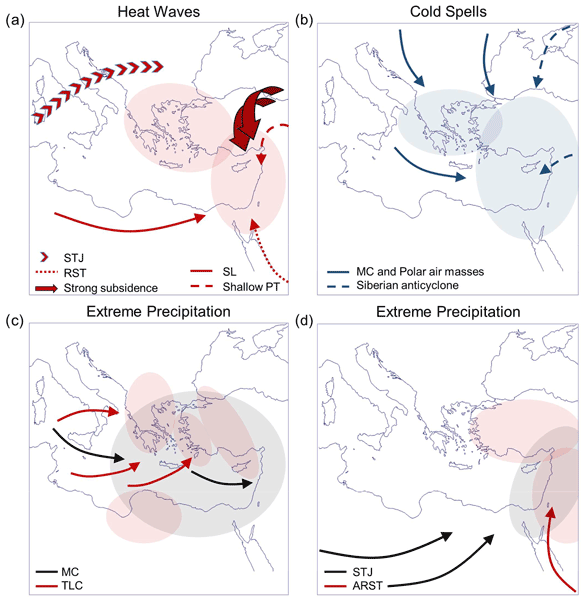
Assaf Hochman, Francesco Marra, Gabriele Messori, Joaquim G. Pinto, Shira Raveh-Rubin, Yizhak Yosef, and Georgios Zittis
Earth Syst. Dynam., 13, 749–777, https://doi.org/10.5194/esd-13-749-2022, https://doi.org/10.5194/esd-13-749-2022, 2022
Short summary
Short summary
Gaining a complete understanding of extreme weather, from its physical drivers to its impacts on society, is important in supporting future risk reduction and adaptation measures. Here, we provide a review of the available scientific literature, knowledge gaps and key open questions in the study of extreme weather events over the vulnerable eastern Mediterranean region.
Bérengère Dubrulle, François Daviaud, Davide Faranda, Louis Marié, and Brice Saint-Michel
Nonlin. Processes Geophys., 29, 17–35, https://doi.org/10.5194/npg-29-17-2022, https://doi.org/10.5194/npg-29-17-2022, 2022
Short summary
Short summary
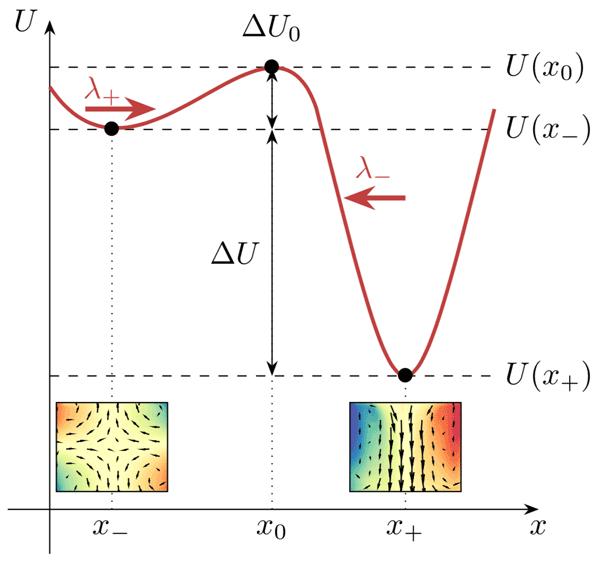
Present climate models discuss climate change but show no sign of bifurcation in the future. Is this because there is none or because they are in essence too simplified to be able to capture them? To get elements of an answer, we ran a laboratory experiment and discovered that the answer is not so simple.
Cited articles
Bartusek, S., Kornhuber, K., and Ting, M.: 2021 North American heatwave amplified by climate change-driven nonlinear interactions, Nat. Clim. Change, 12, 1143–1150, 2022. a
Benjamini, Y. and Hochberg, Y.: Controlling the false discovery rate: a practical and powerful approach to multiple testing, J. R. Stat. Soc. B, 57, 289–300, 1995. a
Benjamini, Y. and Yekutieli, D.: The control of the false discovery rate in multiple testing under dependency, Ann. Stat., 1165–1188, https://doi.org/10.1214/aos/1013699998, 2001. a
Bieli, M., Pfahl, S., and Wernli, H.: A Lagrangian investigation of hot and cold temperature extremes in Europe, Q. J. Roy. Meteor. Soc., 141, 98–108, https://doi.org/10.1002/qj.2339, 2015. a
Black, E., Blackburn, M., Harrison, G., Hoskins, B., and Methven, J.: Factors contributing to the summer 2003 European heatwave, Weather, 59, 217–223, https://doi.org/10.1256/wea.74.04, 2004. a
Chapman, C. C., Monselesan, D. P., Risbey, J. S., Hannachi, A., Lucarini, V., and Matear, R.: The Typicality of Regimes Associated with Northern Hemisphere Heatwaves, J. Climate, 38, 3729–3750, https://doi.org/10.1175/JCLI-D-24-0548.1, 2025. a, b, c
Chen, G., Lu, J., Burrows, D. A., and Leung, L. R.: Local finite-amplitude wave activity as an objective diagnostic of midlatitude extreme weather, Geophys. Res. Lett., 42, 10–952, 2015. a
Christidis, N., Jones, G. S., and Stott, P. A.: Dramatically increasing chance of extremely hot summers since the 2003 European heatwave, Nat. Clim. Change, 5, 46–50, 2015. a
Coles, S., Bawa, J., Trenner, L., and Dorazio, P.: An introduction to statistical modeling of extreme values, vol. 208, Springer, https://doi.org/10.1007/978-1-4471-3675-0, 2001. a, b
Cortés, J., Mahecha, M., Reichstein, M., and Brenning, A.: Accounting for multiple testing in the analysis of spatio-temporal environmental data, Environ. Ecol. Stat., 27, 293–318, 2020. a
Coughlan de Perez, E., Arrighi, J., and Marunye, J.: Challenging the universality of heatwave definitions: gridded temperature discrepancies across climate regions, Climatic Change, 176, 167, https://doi.org/10.1007/s10584-023-03641-x, 2023. a
Davini, P., Cagnazzo, C., Gualdi, S., and Navarra, A.: Bidimensional Diagnostics, Variability, and Trends of Northern Hemisphere Blocking, J. Climate, 25, 6496–6509, https://doi.org/10.1175/JCLI-D-12-00032.1, 2012. a, b, c, d
Dorrington, J. and Strommen, K. J.: Jet Speed Variability Obscures Euro-Atlantic Regime Structure, Geophys. Res. Lett., 47, e2020GL087907, https://doi.org/10.1029/2020GL087907, 2020. a
Dorrington, J., Strommen, K., and Fabiano, F.: Quantifying climate model representation of the wintertime Euro-Atlantic circulation using geopotential-jet regimes, Weather Clim. Dynam., 3, 505–533, https://doi.org/10.5194/wcd-3-505-2022, 2022. a
Duchon, C. E.: Lanczos Filtering in One and Two Dimensions, J. Appl. Meteorol. Clim., 18, 1016–1022, https://doi.org/10.1175/1520-0450(1979)018<1016:LFIOAT>2.0.CO;2, 1979. a
Ester, M., Kriegel, H.-P., Sander, J., and Xu, X.: A density-based algorithm for discovering clusters in large spatial databases with noise, in: Proceedings of the Second International Conference on Knowledge Discovery and Data Mining, KDD'96, AAAI Press, 226–231, https://api.semanticscholar.org/CorpusID:355163 (last access: 4 March 2026), 1996. a
Fabiano, F., Meccia, V. L., Davini, P., Ghinassi, P., and Corti, S.: A regime view of future atmospheric circulation changes in northern mid-latitudes, Weather Clim. Dynam., 2, 163–180, https://doi.org/10.5194/wcd-2-163-2021, 2021. a
Faranda, D., Messori, G., Alberti, T., Alvarez-Castro, C., Caby, T., Cavicchia, L., Coppola, E., Donner, R. V., Dubrulle, B., Galfi, V. M., Holmberg, E., Lembo, V., Noyelle, R., Yiou, P., Spagnolo, B., Valenti, D., Vaienti, S., and Wormell, C.: Statistical physics and dynamical systems perspectives on geophysical extreme events, Phys. Rev. E, 110, 041001, https://doi.org/10.1103/PhysRevE.110.041001, 2024. a, b
Ferro, C. A. and Segers, J.: Inference for clusters of extreme values, J. R. Stat. Soc. B, 65, 545–556, 2003. a
Folland, C. K., Knight, J., Linderholm, H. W., Fereday, D., Ineson, S., and Hurrell, J. W.: The Summer North Atlantic Oscillation: Past, Present, and Future, J. Climate, 22, 1082–1103, https://doi.org/10.1175/2008JCLI2459.1, 2009. a
Galfi, V. M. and Messori, G.: Persistent anomalies of the North Atlantic jet stream and associated surface extremes over Europe, Environ. Res. Lett., 18, 024017, https://doi.org/10.1088/1748-9326/acaedf, 2023. a
Galfi, V. M., Bódai, T., and Lucarini, V.: Convergence of Extreme Value Statistics in a Two-Layer Quasi-Geostrophic Atmospheric Model, Complexity, 2017, 5340858, https://doi.org/10.1155/2017/5340858, 2017. a
Gaupp, F., Hall, J., Hochrainer-Stigler, S., and Dadson, S.: Changing risks of simultaneous global breadbasket failure, Nat. Clim. Change, 10, 54–57, 2020. a
Gilleland, E. and Katz, R. W.: extRemes 2.0: An Extreme Value Analysis Package in R, J. Stat. Softw., 72, 1–39, https://doi.org/10.18637/jss.v072.i08, 2016. a
Grams, C. M. and Archambault, H. M.: The key role of diabatic outflow in amplifying the midlatitude flow: A representative case study of weather systems surrounding western North Pacific extratropical transition, Mon. Weather Rev., 144, 3847–3869, 2016. a
Graversen, R. G. and Burtu, M.: Arctic amplification enhanced by latent energy transport of atmospheric planetary waves, Q. J. Roy. Meteor. Soc., 142, 2046–2054, https://doi.org/10.1002/qj.2802, 2016. a, b
Hauser, S., Teubler, F., Riemer, M., Knippertz, P., and Grams, C. M.: Life cycle dynamics of Greenland blocking from a potential vorticity perspective, Weather Clim. Dynam., 5, 633–658, https://doi.org/10.5194/wcd-5-633-2024, 2024. a, b
Heffernan, J. E.: ismev: An Introduction to Statistical Modeling of Extreme Values, r package version 1.43, CRAN [code], https://CRAN.R-project.org/package=ismev (last access: 15 March 2021), 2025. a
Hersbach, H., Bell, B., Berrisford, P., Hirahara, S., Horányi, A., Muñoz-Sabater, J., Nicolas, J., Peubey, C., Radu, R., Schepers, D., Simmons, A., Soci, C., Abdalla, S., Abellan, X., Balsamo, G., Bechtold, P., Biavati, G., Bidlot, J., Bonavita, M., De Chiara, G., Dahlgren, P., Dee, D., Diamantakis, M., Dragani, R., Flemming, J., Forbes, R., Fuentes, M., Geer, A., Haimberger, L., Healy, S., Hogan, R. J., Hólm, E., Janisková, M., Keeley, S., Laloyaux, P., Lopez, P., Lupu, C., Radnoti, G., de Rosnay, P., Rozum, I., Vamborg, F., Villaume, S., and Thépaut, J. N.: The ERA5 global reanalysis, Q. J. Roy. Meteor. Soc., 146, 1999–2049, https://doi.org/10.1002/qj.3803, 2020. a, b
Holmberg, E., Messori, G., Caballero, R., and Faranda, D.: The link between European warm-temperature extremes and atmospheric persistence, Earth Syst. Dynam., 14, 737–765, https://doi.org/10.5194/esd-14-737-2023, 2023. a
Huang, C. S. Y. and Nakamura, N.: Local Finite-Amplitude Wave Activity as a Diagnostic of Anomalous Weather Events, J. Atmos. Sci., 73, 211–229, https://doi.org/10.1175/JAS-D-15-0194.1, 2016. a
Krüger, J., Kjellsson, J., Kedzierski, R. P., and Claus, M.: Connecting North Atlantic SST variability to European heat events over the past decades, Tellus A, 75, 358–374, 2023. a
Kumar, V., Yoden, S., and Hitchman, M. H.: QBO and ENSO Effects on the Mean Meridional Circulation, Polar Vortex, Subtropical Westerly Jets, and Wave Patterns During Boreal Winter, J. Geophys. Res.-Atmos., 127, e2022JD036691, https://doi.org/10.1029/2022JD036691, 2022. a
Lembo, V., Fabiano, F., Galfi, V. M., Graversen, R. G., Lucarini, V., and Messori, G.: Meridional-energy-transport extremes and the general circulation of Northern Hemisphere mid-latitudes: dominant weather regimes and preferred zonal wavenumbers, Weather Clim. Dynam., 3, 1037–1062, https://doi.org/10.5194/wcd-3-1037-2022, 2022. a, b, c, d, e, f, g, h, i, j, k, l, m, n, o
Lembo, V., Bordoni, S., Bevacqua, E., Domeisen, D. I. V., Franzke, C. L. E., Galfi, V. M., Garfinkel, C. I., Grams, C. M., Hochman, A., Jha, R., Kornhuber, K., Kwasniok, F., Lucarini, V., Messori, G., Pappert, D., Perez-Fernandez, I., Riboldi, J., Russo, E., Shaw, T. A., Strigunova, I., Strnad, F., Yiou, P., and Zagar, N.: Dynamics, Statistics, and Predictability of Rossby Waves, Heat Waves, and Spatially Compounding Extreme Events, B. Am. Meteorol. Soc., 105, E2283–E2293, https://doi.org/10.1175/BAMS-D-24-0145.1, 2024. a
Liang, M., Czaja, A., Graversen, R., and Tailleux, R.: Poleward energy transport: is the standard definition physically relevant at all time scales?, Clim. Dynam., 50, 1785–1797, 2018. a
Lucarini, V., Melinda Galfi, V., Riboldi, J., and Messori, G.: Typicality of the 2021 Western North America summer heatwave, Environ. Res. Lett., 18, 015004, https://doi.org/10.1088/1748-9326/acab77, 2023. a
Messori, G. and Czaja, A.: On the sporadic nature of meridional heat transport by transient eddies, Q. J. Roy. Meteor. Soc., 139, 999–1008, 2013. a
Messori, G. and Czaja, A.: Some considerations on the spectral features of meridional heat transport by transient eddies, Q. J. Roy. Meteor. Soc., 140, 1377–1386, 2014. a
Messori, G. and Czaja, A.: On local and zonal pulses of atmospheric heat transport in reanalysis data, Q. J. Roy. Meteor. Soc., 141, 2376–2389, 2015. a
Messori, G., Geen, R., and Czaja, A.: On the Spatial and Temporal Variability of Atmospheric Heat Transport in a Hierarchy of Models, J. Atmos. Sci., 74, 2163–2189, https://doi.org/10.1175/JAS-D-16-0360.1, 2017. a, b
Messori, G., Segalini, A., and Ramos, A. M.: Climatology and trends of concurrent temperature extremes in the global extratropics, Earth Syst. Dynam., 15, 1207–1225, https://doi.org/10.5194/esd-15-1207-2024, 2024. a
Mills, E.: Insurance in a Climate of Change, Science, 309, 1040–1044, https://doi.org/10.1126/science.1112121, 2005. a
Osborne, J. M., Collins, M., Screen, J. A., Thomson, S. I., and Dunstone, N.: The North Atlantic as a Driver of Summer Atmospheric Circulation, J. Climate, 33, 7335–7351, https://doi.org/10.1175/JCLI-D-19-0423.1, 2020. a
Parker, T., Woollings, T., Weisheimer, A., O'Reilly, C., Baker, L., and Shaffrey, L.: Seasonal Predictability of the Winter North Atlantic Oscillation From a Jet Stream Perspective, Geophys. Res. Lett., 46, 10159–10167, https://doi.org/10.1029/2019GL084402, 2019. a
Petoukhov, V., Rahmstorf, S., Petri, S., and Schellnhuber, H. J.: Quasiresonant amplification of planetary waves and recent Northern Hemisphere weather extremes, P. Natl. Acad. Sci. USA, 110, 5336–5341, https://doi.org/10.1073/pnas.1222000110, 2013. a, b, c
Pickands III, J.: Statistical Inference Using Extreme Order Statistics, Ann. Stat., 3, 119–131, https://doi.org/10.1214/aos/1176343003, 1975. a
Radinović, D. and Ćurić, M.: Criteria for heat and cold wave duration indexes, Theor. Appl. Climatol., 107, 505–510, https://doi.org/10.1007/s00704-011-0495-8, 2012. a
Röthlisberger, M., Martius, O., and Wernli, H.: An algorithm for identifying the initiation of synoptic-scale Rossby waves on potential vorticity waveguides, Q. J. Roy. Meteor. Soc., 142, 889–900, https://doi.org/10.1002/qj.2690, 2016a. a
Röthlisberger, M., Pfahl, S., and Martius, O.: Regional-scale jet waviness modulates the occurrence of midlatitude weather extremes, Geophys. Res. Lett., 43, 10989–10997, https://doi.org/10.1002/2016GL070944, 2016b. a
Röthlisberger, M., Frossard, L., Bosart, L. F., Keyser, D., and Martius, O.: Recurrent Synoptic-Scale Rossby Wave Patterns and Their Effect on the Persistence of Cold and Hot Spells, J. Climate, 32, 3207–3226, https://doi.org/10.1175/JCLI-D-18-0664.1, 2019. a
Schaller, N., Sillmann, J., Anstey, J., Fischer, E. M., Grams, C. M., and Russo, S.: Influence of blocking on Northern European and Western Russian heatwaves in large climate model ensembles, Environ. Res. Letters, 13, 054015, https://doi.org/10.1088/1748-9326/aaba55, 2018. a
Scherrer, S. C., Croci-Maspoli, M., Schwierz, C., and Appenzeller, C.: Two-dimensional indices of atmospheric blocking and their statistical relationship with winter climate patterns in the Euro-Atlantic region, Int. J. Climatol., 26, 233–250, 2006. a
Segalini, A., Riboldi, J., Wirth, V., and Messori, G.: A linear assessment of barotropic Rossby wave propagation in different background flow configurations, Weather Clim. Dynam., 5, 997–1012, https://doi.org/10.5194/wcd-5-997-2024, 2024. a
Slonosky, V. and Yiou, P.: Does the NAO index represent zonal flow? The influence of the NAO on North Atlantic surface temperature, Clim. Dynam., 19, 17–30, 2002. a
Solomon, S.: Climate change 2007-the physical science basis: Working group I contribution to the fourth assessment report of the IPCC, vol. 4, Cambridge University Press, ISBN 978 0521 88009-1, 2007. a
Spensberger, C., Madonna, E., Boettcher, M., Grams, C. M., Papritz, L., Quinting, J. F., Röthlisberger, M., Sprenger, M., and Zschenderlein, P.: Dynamics of concurrent and sequential Central European and Scandinavian heatwaves, Q. J. Roy. Meteor. Soc., 146, 2998–3013, 2020. a
Strigunova, I., Blender, R., Lunkeit, F., and Žagar, N.: Signatures of Eurasian heat waves in global Rossby wave spectra, Weather Clim. Dynam., 3, 1399–1414, https://doi.org/10.5194/wcd-3-1399-2022, 2022. a
Swanson, K. L. and Pierrehumbert, R. T.: Lower-tropospheric heat transport in the Pacific storm track, J. Atmos. Sci., 54, 1533–1543, 1997. a
Thomson, S. I. and Vallis, G. K.: Atmospheric Response to SST Anomalies. Part II: Background-State Dependence, Teleconnections, and Local Effects in Summer, J. Atmos. Sci., 75, 4125–4138, https://doi.org/10.1175/JAS-D-17-0298.1, 2018. a
Tibaldi, S. and Molteni, F.: On the operational predictability of blocking, Tellus A, 42, 343–365, https://doi.org/10.1034/j.1600-0870.1990.t01-2-00003.x, 1990. a
Tigchelaar, M., Battisti, D. S., Naylor, R. L., and Ray, D. K.: Future warming increases probability of globally synchronized maize production shocks, P. Natl. Acad. Sci. USA, 115, 6644–6649, https://doi.org/10.1073/pnas.1718031115, 2018. a
Tuel, A. and Martius, O.: Persistent warm and cold spells in the Northern Hemisphere extratropics: regionalisation, synoptic-scale dynamics and temperature budget, Weather Clim. Dynam., 5, 263–292, https://doi.org/10.5194/wcd-5-263-2024, 2024. a, b
Van Loon, S. and Thompson, D. W. J.: Comparing Local Versus Hemispheric Perspectives of Extreme Heat Events, Geophys. Res. Lett., 50, e2023GL105246, https://doi.org/10.1029/2023GL105246, 2023. a
Vogel, M. M., Zscheischler, J., Wartenburger, R., Dee, D., and Seneviratne, S. I.: Concurrent 2018 Hot Extremes Across Northern Hemisphere Due to Human-Induced Climate Change, Earth's Future, 7, 692–703, https://doi.org/10.1029/2019EF001189, 2019. a, b
Watanabe, M., Kimoto, M., Nitta, T., and Kachi, M.: A Comparison of Decadal Climate Oscillations in the North Atlantic Detected in Observations and a Coupled GCM, J. Climate, 12, 2920–2940, https://doi.org/10.1175/1520-0442(1999)012<2920:ACODCO>2.0.CO;2, 1999. a
White, R. H., Kornhuber, K., Martius, O., and Wirth, V.: From Atmospheric Waves to Heatwaves: A Waveguide Perspective for Understanding and Predicting Concurrent, Persistent, and Extreme Extratropical Weather, B. Am. Meteorol. Soc., 103, E923–E935, https://doi.org/10.1175/BAMS-D-21-0170.1, 2022. a
White, R. H., Anderson, S., Booth, J. F., Braich, G., Draeger, C., Fei, C., Harley, C. D. G., Henderson, S. B., Jakob, M., Lau, C.-A., Mareshet Admasu, L., Narinesingh, V., Rodell, C., Roocroft, E., Weinberger, K. R., and West, G.: The unprecedented Pacific Northwest heatwave of June 2021, Nat. Commun., 14, 727, https://doi.org/10.1038/s41467-023-36289-3, 2023. a
Wirth, V.: Waveguidability of idealized midlatitude jets and the limitations of ray tracing theory, Weather Clim. Dynam., 1, 111–125, https://doi.org/10.5194/wcd-1-111-2020, 2020. a
Wirth, V. and Polster, C.: The Problem of Diagnosing Jet Waveguidability in the Presence of Large-Amplitude Eddies, J. Atmos. Sci., 78, 3137–3151, https://doi.org/10.1175/JAS-D-20-0292.1, 2021. a, b
Wirth, V., Riemer, M., Chang, E. K. M., and Martius, O.: Rossby Wave Packets on the Midlatitude Waveguide – A Review, Mon. Weather Rev., 146, 1965– 2001, https://doi.org/10.1175/MWR-D-16-0483.1, 2018. a
Woollings, T., Barriopedro, D., Methven, J., Son, S.-W., Martius, O., Harvey, B., Sillmann, J., Lupo, A. R., and Seneviratne, S.: Blocking and its response to climate change, Current Climate Change Reports, 4, 287–300, 2018. a
Yu, B., Lin, H., Mo, R., and Li, G.: A physical analysis of summertime North American heatwaves, Clim. Dynam., 61, 1551–1565, 2023. a
Yu, H., Cheng, S., Huang, J., Hu, Z., Wu, H., and Wang, X.: Seasonal phase change of the North Atlantic Tripole Sea surface temperature predicted by air-sea coupling, npj Climate and Atmospheric Science, 7, 322, https://doi.org/10.1038/s41612-024-00882-0, 2024. a
Short summary
Hemispheric heatwaves have fundamental implications for ecosystems and societies. They are studied together with large-scale atmospheric dynamics, through the lens of poleward heat transports by planetary-scale waves. Extremely weak transports of heat towards the North Pole are found to be associated with hemispheric heatwaves in the Northern Hemisphere mid-latitudes. Therefore, we conclude that heat transports are a possible indicator and a precursor of concurrent hemispheric heatwaves.
Hemispheric heatwaves have fundamental implications for ecosystems and societies. They are...


