
Articles | Volume 7, issue 2
https://doi.org/10.5194/wcd-7-937-2026
© Author(s) 2026. This work is distributed under
the Creative Commons Attribution 4.0 License.
the Creative Commons Attribution 4.0 License.
https://doi.org/10.5194/wcd-7-937-2026
© Author(s) 2026. This work is distributed under
the Creative Commons Attribution 4.0 License.
the Creative Commons Attribution 4.0 License.
Research article
| 
15 Jun 2026
Research article |
| 15 Jun 2026
| 15 Jun 2026
A quasi-Lagrangian perspective on the role of dry and moist processes in the formation of blocked North Atlantic–European weather regimes
Seraphine Hauser
CORRESPONDING AUTHOR

Institute of Meteorology and Climate Research (IMKTRO), Department Troposphere Research, Karlsruhe Institute of Technology (KIT), Karlsruhe, Germany
Institute for Atmospheric and Climate Science, ETH Zurich, Zurich, Switzerland
Franziska Teubler
Institute for Atmospheric Physics, Johannes Gutenberg-University Mainz, Mainz, Germany
Michael Riemer
Institute for Atmospheric Physics, Johannes Gutenberg-University Mainz, Mainz, Germany
Christian M. Grams
Institute of Meteorology and Climate Research (IMKTRO), Department Troposphere Research, Karlsruhe Institute of Technology (KIT), Karlsruhe, Germany
Federal Institute of Meteorology and Climatology, MeteoSwiss, Zurich-Flughafen, Switzerland
Related authors
Seraphine Hauser, Lukas Papritz, and Heini Wernli
EGUsphere, https://doi.org/10.5194/egusphere-2026-5124, https://doi.org/10.5194/egusphere-2026-5124, 2026
This preprint is open for discussion and under review for Weather and Climate Dynamics (WCD).
Short summary
Short summary
This study analyses the sensitivity of numerical simulations of Storm Éowyn in January 2025 with respect to model resolution, initialisation time, and latent heating. High resolution is crucial to capture the structure and intensity of the cyclone, and the severe wind hazards that affected parts of the British Isles. In simulations with artificially reduced latent heating, the cyclone becomes less intense, and shifts northward compared to the control simulation, missing the British Isles.
Sven Voigt, Hanin Binder, Seraphine Hauser, and Heini Wernli
EGUsphere, https://doi.org/10.5194/egusphere-2026-4755, https://doi.org/10.5194/egusphere-2026-4755, 2026
This preprint is open for discussion and under review for Weather and Climate Dynamics (WCD).
Short summary
Short summary
This study uses 75 years of reanalysis data to identify extreme hazard cyclones, defined as systems accumulating a high number of extreme precipitation or surface wind events along their tracks. Globally, these cyclones form in the tropics and undergo extratropical transition. When restricting the analysis to the extratropical North Atlantic, they form at lower latitudes, are deeper, longer-lived, larger in cyclone area, and more rapidly intensifying relative to average extratropical cyclones.
Seraphine Hauser, Franziska Teubler, Michael Riemer, Peter Knippertz, and Christian M. Grams
Weather Clim. Dynam., 5, 633–658, https://doi.org/10.5194/wcd-5-633-2024, https://doi.org/10.5194/wcd-5-633-2024, 2024
Short summary
Short summary
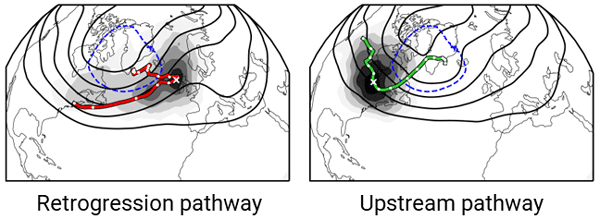
Blocking over Greenland has substantial impacts on the weather and climate in mid- and high latitudes. This study applies a quasi-Lagrangian thinking on the dynamics of Greenland blocking and reveals two pathways of anticyclonic anomalies linked to the block. Moist processes were found to play a dominant role in the formation and maintenance of blocking. This emphasizes the necessity of the correct representation of moist processes in weather and climate models to realistically depict blocking.
Seraphine Hauser, Franziska Teubler, Michael Riemer, Peter Knippertz, and Christian M. Grams
Weather Clim. Dynam., 4, 399–425, https://doi.org/10.5194/wcd-4-399-2023, https://doi.org/10.5194/wcd-4-399-2023, 2023
Short summary
Short summary
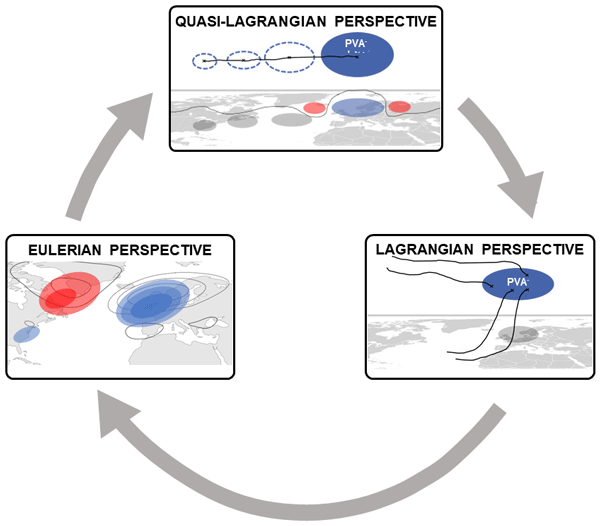
Blocking describes a flow configuration in the midlatitudes where stationary high-pressure systems block the propagation of weather systems. This study combines three individual perspectives that capture the dynamics and importance of various processes in the formation of a major blocking in 2016 from a weather regime perspective. In future work, this framework will enable a holistic view of the dynamics and the role of moist processes in different life cycle stages of blocked weather regimes.
Franziska Teubler, Michael Riemer, Christopher Polster, Christian M. Grams, Seraphine Hauser, and Volkmar Wirth
Weather Clim. Dynam., 4, 265–285, https://doi.org/10.5194/wcd-4-265-2023, https://doi.org/10.5194/wcd-4-265-2023, 2023
Short summary
Short summary
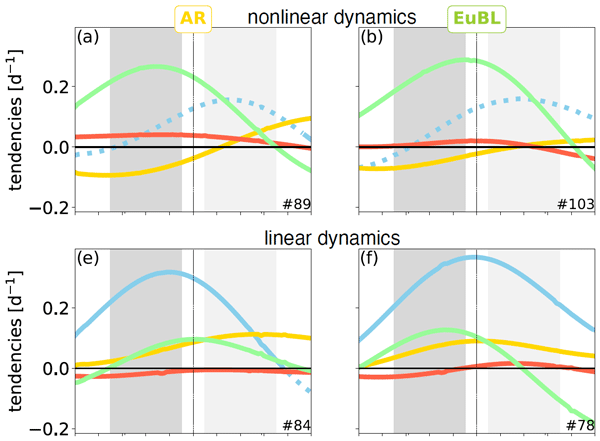
Weather regimes govern an important part of the sub-seasonal variability of the mid-latitude circulation. The year-round dynamics of blocked regimes in the Atlantic European region are investigated in over 40 years of data. We show that the dynamics between the regimes are on average very similar. Within the regimes, the main variability – starting from the characteristics of dynamical processes alone – dominates and transcends the variability in season and types of transitions.
Seraphine Hauser, Lukas Papritz, and Heini Wernli
EGUsphere, https://doi.org/10.5194/egusphere-2026-5124, https://doi.org/10.5194/egusphere-2026-5124, 2026
This preprint is open for discussion and under review for Weather and Climate Dynamics (WCD).
Short summary
Short summary
This study analyses the sensitivity of numerical simulations of Storm Éowyn in January 2025 with respect to model resolution, initialisation time, and latent heating. High resolution is crucial to capture the structure and intensity of the cyclone, and the severe wind hazards that affected parts of the British Isles. In simulations with artificially reduced latent heating, the cyclone becomes less intense, and shifts northward compared to the control simulation, missing the British Isles.
Christian M. Grams
Weather Clim. Dynam., 7, 1641–1680, https://doi.org/10.5194/wcd-7-1641-2026, https://doi.org/10.5194/wcd-7-1641-2026, 2026
Short summary
Short summary
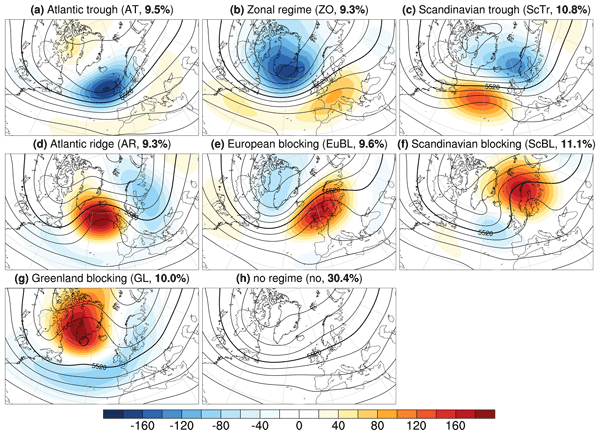
The study discusses key characteristics, impact on surface weather, and trends of year-round North Atlantic European weather regimes for 1950–2024. Novel insight is gained in inter-annual variability and recent trends in regime occurrence. Regimes are important because they affect weather in Europe for several days to a few weeks and enable weather forecasts several weeks ahead. Regimes also affect extremes, such as heat waves. Data is published at Zenodo (https://doi.org/10.5281/zenodo.17080145).
Sven Voigt, Hanin Binder, Seraphine Hauser, and Heini Wernli
EGUsphere, https://doi.org/10.5194/egusphere-2026-4755, https://doi.org/10.5194/egusphere-2026-4755, 2026
This preprint is open for discussion and under review for Weather and Climate Dynamics (WCD).
Short summary
Short summary
This study uses 75 years of reanalysis data to identify extreme hazard cyclones, defined as systems accumulating a high number of extreme precipitation or surface wind events along their tracks. Globally, these cyclones form in the tropics and undergo extratropical transition. When restricting the analysis to the extratropical North Atlantic, they form at lower latitudes, are deeper, longer-lived, larger in cyclone area, and more rapidly intensifying relative to average extratropical cyclones.
Michael Riemer and Lorenz Gölz
EGUsphere, https://doi.org/10.5194/egusphere-2026-3447, https://doi.org/10.5194/egusphere-2026-3447, 2026
Short summary
Short summary
Rossby waves shape midlatitude weather, and their “envelope”—broad zones of amplified wave amplitude—has long been assumed more predictable than individual troughs and ridges. We test this idea and find no such advantage. Predictability of the envelope and of the troughs and ridges are governed by the same processes. Enhanced predictability is associated with spatial coherence of high wave amplitude, presumably facilitated by strong jet-waveguides, not with the envelope itself.
Luise J. Fischer, David N. Bresch, Dominik Büeler, Christian M. Grams, Robin Noyelle, Matthias Röthlisberger, and Heini Wernli
Weather Clim. Dynam., 6, 1027–1043, https://doi.org/10.5194/wcd-6-1027-2025, https://doi.org/10.5194/wcd-6-1027-2025, 2025
Short summary
Short summary
Atmospheric flows over the North Atlantic can be meaningfully classified into weather regimes, and climate simulations suggest that the regime frequencies might change in the future. We provide a quantitative framework that helps assess whether these regime frequency changes are relevant to understanding climate change signals in precipitation. At least in our example application, in most regions, regime frequency changes explain little of the projected precipitation changes.
Annie Y.-Y. Chang, Shaun Harrigan, Maria-Helena Ramos, Massimiliano Zappa, Christian M. Grams, Daniela I. V. Domeisen, and Konrad Bogner
EGUsphere, https://doi.org/10.5194/egusphere-2025-3411, https://doi.org/10.5194/egusphere-2025-3411, 2025
Short summary
Short summary
This study presents a machine learning-aided hybrid forecasting framework to improve early warnings of low flows in the European Alps. It combines weather regime information, streamflow observations, and model simulations (EFAS). Even using only weather regime data improves predictions over climatology, while integrating different data sources yields the best result, emphasizing the value of integrating diverse data sources.
Marc Federer, Lukas Papritz, Michael Sprenger, and Christian M. Grams
Weather Clim. Dynam., 6, 211–230, https://doi.org/10.5194/wcd-6-211-2025, https://doi.org/10.5194/wcd-6-211-2025, 2025
Short summary
Short summary
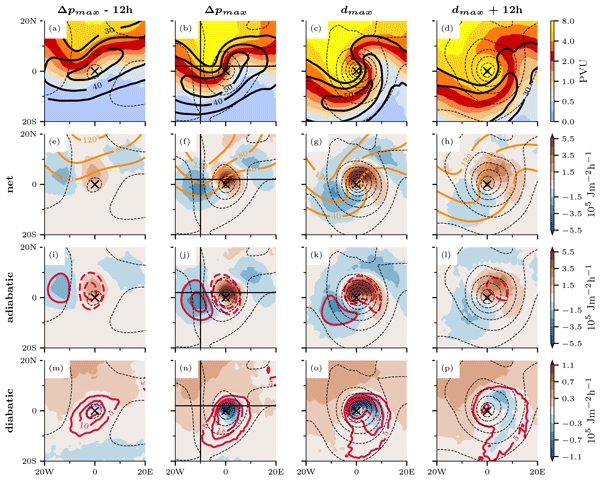
Although extratropical cyclones in the North Atlantic are among the most impactful midlatitude weather systems, their intensification is not entirely understood. Here, we explore how individual cyclones convert available potential energy (APE) into kinetic energy and relate these conversions to the synoptic development of the cyclones. By combining potential vorticity thinking with a local APE framework, we offer a novel perspective on established concepts in dynamic meteorology.
Svenja Christ, Marta Wenta, Christian M. Grams, and Annika Oertel
Weather Clim. Dynam., 6, 17–42, https://doi.org/10.5194/wcd-6-17-2025, https://doi.org/10.5194/wcd-6-17-2025, 2025
Short summary
Short summary
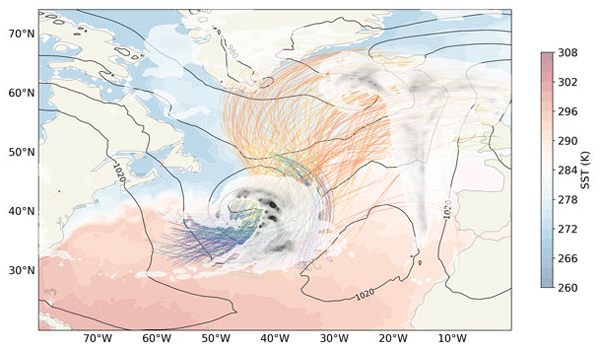
The detailed representation of sea surface temperature (SST) in numerical models is important for the prediction of atmospheric blocking in the North Atlantic. Yet the underlying physical processes are not fully understood. Using SST sensitivity experiments for a case study, we identify a physical pathway through which SST in the Gulf Stream region is linked to the downstream upper-level flow evolution in the North Atlantic.
Joshua Dorrington, Marta Wenta, Federico Grazzini, Linus Magnusson, Frederic Vitart, and Christian M. Grams
Nat. Hazards Earth Syst. Sci., 24, 2995–3012, https://doi.org/10.5194/nhess-24-2995-2024, https://doi.org/10.5194/nhess-24-2995-2024, 2024
Short summary
Short summary
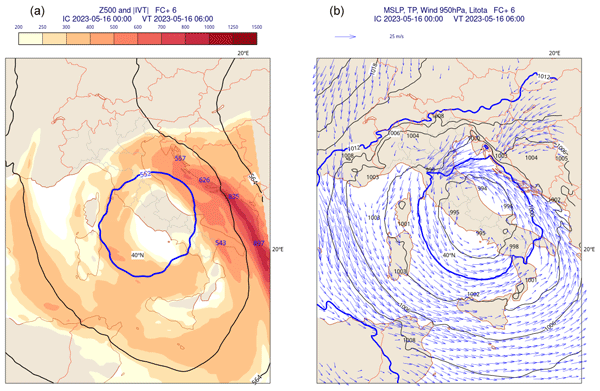
Extreme rainfall is the leading weather-related source of damages in Europe, but it is still difficult to predict on long timescales. A recent example of this was the devastating floods in the Italian region of Emiglia Romagna in May 2023. We present perspectives based on large-scale dynamical information that allows us to better understand and predict such events.
Moritz Deinhard and Christian M. Grams
Weather Clim. Dynam., 5, 927–942, https://doi.org/10.5194/wcd-5-927-2024, https://doi.org/10.5194/wcd-5-927-2024, 2024
Short summary
Short summary
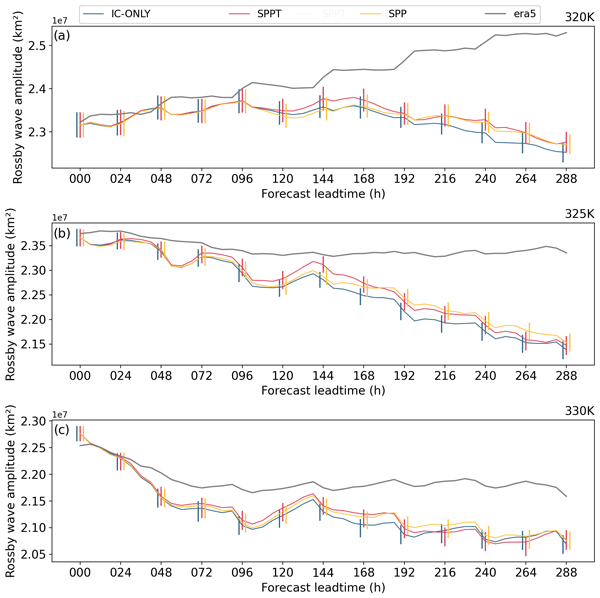
Stochastic perturbations are an established technique to represent model uncertainties in numerical weather prediction. While such schemes are beneficial for the forecast skill, they can also change the mean state of the model. We analyse how different schemes modulate rapidly ascending airstreams and whether the changes to such weather systems are projected onto larger scales. We thereby provide a process-oriented perspective on how perturbations affect the model climate.
Christoph Fischer, Andreas H. Fink, Elmar Schömer, Marc Rautenhaus, and Michael Riemer
Geosci. Model Dev., 17, 4213–4228, https://doi.org/10.5194/gmd-17-4213-2024, https://doi.org/10.5194/gmd-17-4213-2024, 2024
Short summary
Short summary
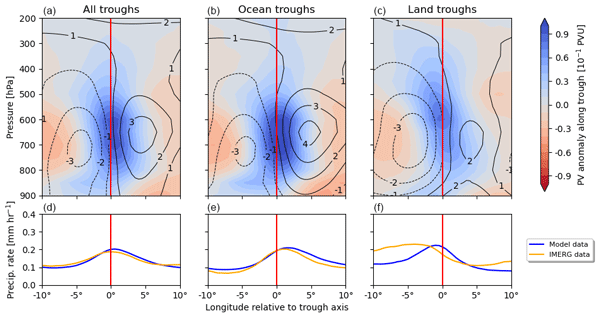
This study presents a method for identifying and tracking 3-D potential vorticity structures within African easterly waves (AEWs). Each identified structure is characterized by descriptors, including its 3-D position and orientation, which have been validated through composite comparisons. A trough-centric perspective on the descriptors reveals the evolution and distinct characteristics of AEWs. These descriptors serve as valuable statistical inputs for the study of AEW-related phenomena.
Seraphine Hauser, Franziska Teubler, Michael Riemer, Peter Knippertz, and Christian M. Grams
Weather Clim. Dynam., 5, 633–658, https://doi.org/10.5194/wcd-5-633-2024, https://doi.org/10.5194/wcd-5-633-2024, 2024
Short summary
Short summary
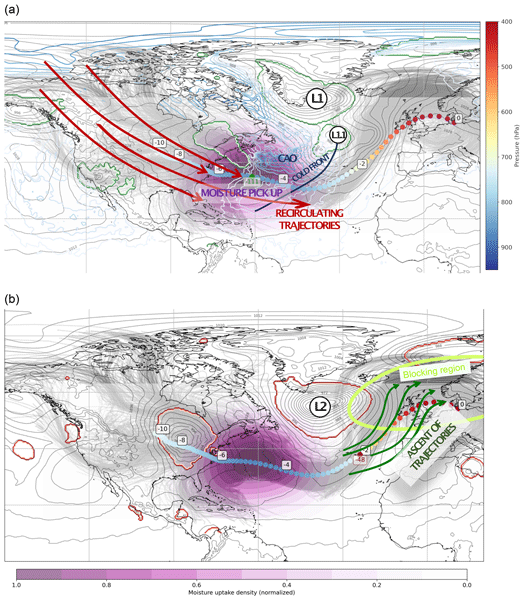
Blocking over Greenland has substantial impacts on the weather and climate in mid- and high latitudes. This study applies a quasi-Lagrangian thinking on the dynamics of Greenland blocking and reveals two pathways of anticyclonic anomalies linked to the block. Moist processes were found to play a dominant role in the formation and maintenance of blocking. This emphasizes the necessity of the correct representation of moist processes in weather and climate models to realistically depict blocking.
Marta Wenta, Christian M. Grams, Lukas Papritz, and Marc Federer
Weather Clim. Dynam., 5, 181–209, https://doi.org/10.5194/wcd-5-181-2024, https://doi.org/10.5194/wcd-5-181-2024, 2024
Short summary
Short summary
Our study links air–sea interactions over the Gulf Stream to an atmospheric block in February 2019. We found that over 23 % of air masses that were lifted into the block by cyclones interacted with the Gulf Stream. As cyclones pass over the Gulf Stream, they cause intense surface evaporation events, preconditioning the environment for the development of cyclones. This implies that air–sea interactions over the Gulf Stream affect the large-scale dynamics in the North Atlantic–European region.
Julian F. Quinting, Christian M. Grams, Edmund Kar-Man Chang, Stephan Pfahl, and Heini Wernli
Weather Clim. Dynam., 5, 65–85, https://doi.org/10.5194/wcd-5-65-2024, https://doi.org/10.5194/wcd-5-65-2024, 2024
Short summary
Short summary
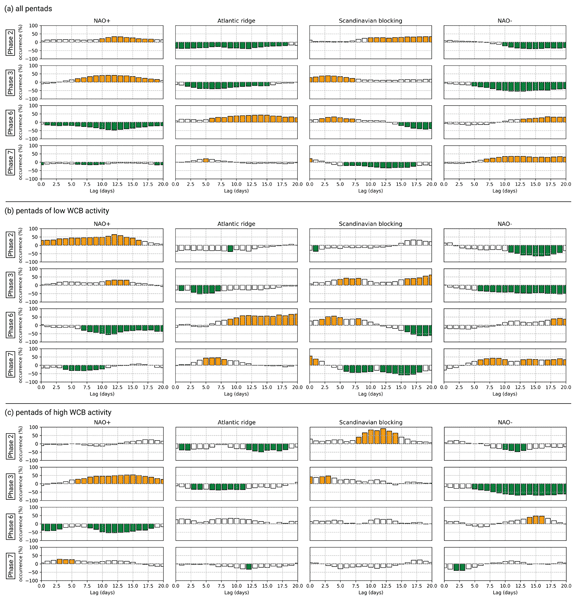
Research in the last few decades has revealed that rapidly ascending airstreams in extratropical cyclones have an important effect on the evolution of downstream weather and predictability. In this study, we show that the occurrence of these airstreams over the North Pacific is modulated by tropical convection. Depending on the modulation, known atmospheric circulation patterns evolve quite differently, which may affect extended-range predictions in the Atlantic–European region.
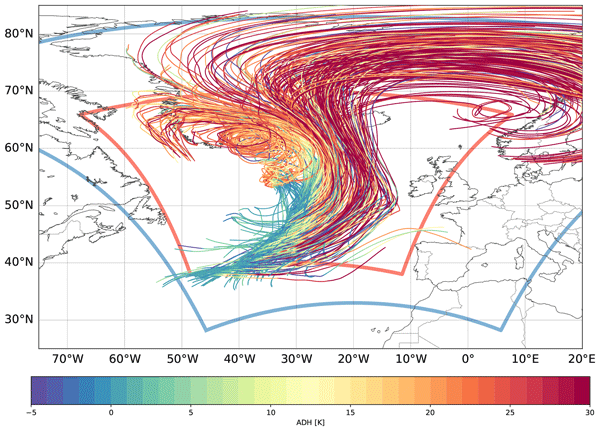
Annika Oertel, Annette K. Miltenberger, Christian M. Grams, and Corinna Hoose
Atmos. Chem. Phys., 23, 8553–8581, https://doi.org/10.5194/acp-23-8553-2023, https://doi.org/10.5194/acp-23-8553-2023, 2023
Short summary
Short summary
Warm conveyor belts (WCBs) are cloud- and precipitation-producing airstreams in extratropical cyclones that are important for the large-scale flow and cloud radiative forcing. We analyze cloud formation processes during WCB ascent in a two-moment microphysics scheme. Quantification of individual diabatic heating rates shows the importance of condensation, vapor deposition, rain evaporation, melting, and cloud-top radiative cooling for total heating and WCB-related potential vorticity structure.
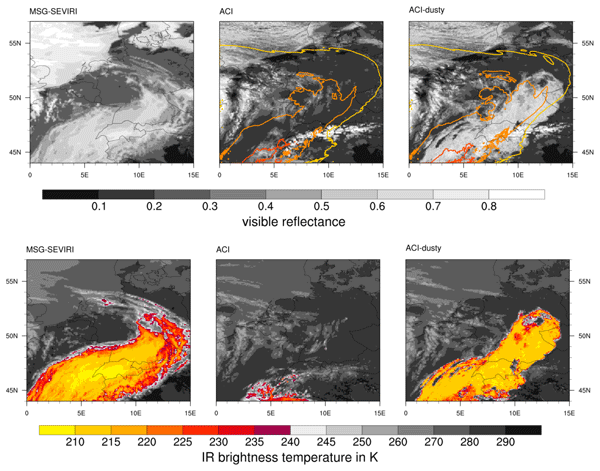
Axel Seifert, Vanessa Bachmann, Florian Filipitsch, Jochen Förstner, Christian M. Grams, Gholam Ali Hoshyaripour, Julian Quinting, Anika Rohde, Heike Vogel, Annette Wagner, and Bernhard Vogel
Atmos. Chem. Phys., 23, 6409–6430, https://doi.org/10.5194/acp-23-6409-2023, https://doi.org/10.5194/acp-23-6409-2023, 2023
Short summary
Short summary
We investigate how mineral dust can lead to the formation of cirrus clouds. Dusty cirrus clouds lead to a reduction in solar radiation at the surface and, hence, a reduced photovoltaic power generation. Current weather prediction systems are not able to predict this interaction between mineral dust and cirrus clouds. We have developed a new physical description of the formation of dusty cirrus clouds. Overall we can show a considerable improvement in the forecast quality of clouds and radiation.
Seraphine Hauser, Franziska Teubler, Michael Riemer, Peter Knippertz, and Christian M. Grams
Weather Clim. Dynam., 4, 399–425, https://doi.org/10.5194/wcd-4-399-2023, https://doi.org/10.5194/wcd-4-399-2023, 2023
Short summary
Short summary
Blocking describes a flow configuration in the midlatitudes where stationary high-pressure systems block the propagation of weather systems. This study combines three individual perspectives that capture the dynamics and importance of various processes in the formation of a major blocking in 2016 from a weather regime perspective. In future work, this framework will enable a holistic view of the dynamics and the role of moist processes in different life cycle stages of blocked weather regimes.
Franziska Teubler, Michael Riemer, Christopher Polster, Christian M. Grams, Seraphine Hauser, and Volkmar Wirth
Weather Clim. Dynam., 4, 265–285, https://doi.org/10.5194/wcd-4-265-2023, https://doi.org/10.5194/wcd-4-265-2023, 2023
Short summary
Short summary
Weather regimes govern an important part of the sub-seasonal variability of the mid-latitude circulation. The year-round dynamics of blocked regimes in the Atlantic European region are investigated in over 40 years of data. We show that the dynamics between the regimes are on average very similar. Within the regimes, the main variability – starting from the characteristics of dynamical processes alone – dominates and transcends the variability in season and types of transitions.
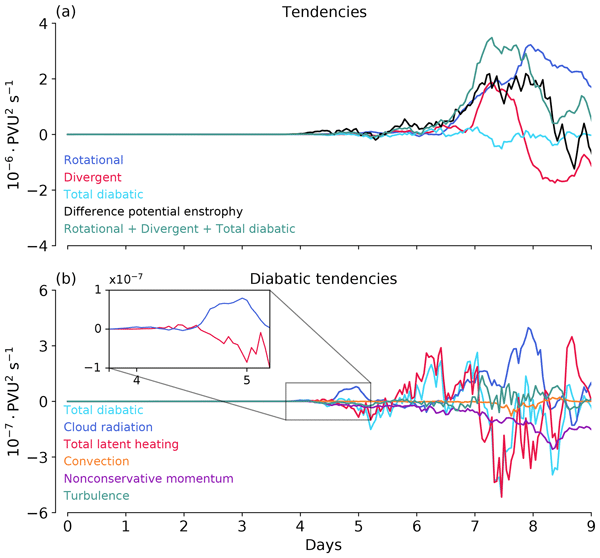
Behrooz Keshtgar, Aiko Voigt, Corinna Hoose, Michael Riemer, and Bernhard Mayer
Weather Clim. Dynam., 4, 115–132, https://doi.org/10.5194/wcd-4-115-2023, https://doi.org/10.5194/wcd-4-115-2023, 2023
Short summary
Short summary
Forecasting extratropical cyclones is challenging due to many physical factors influencing their behavior. One such factor is the impact of heating and cooling of the atmosphere by the interaction between clouds and radiation. In this study, we show that cloud-radiative heating (CRH) increases the intensity of an idealized cyclone and affects its predictability. We find that CRH affects the cyclone mostly via increasing latent heat release and subsequent changes in the synoptic circulation.
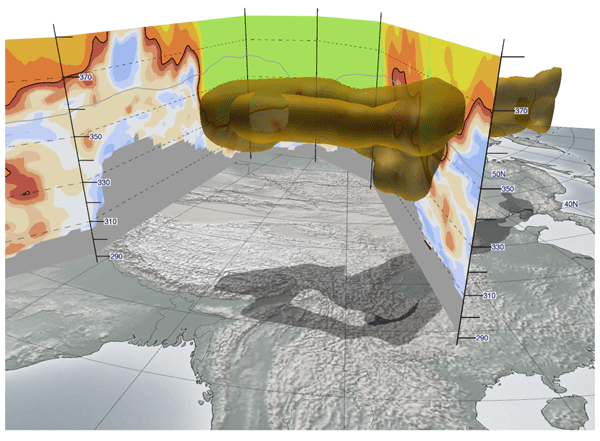
Christoph Fischer, Andreas H. Fink, Elmar Schömer, Roderick van der Linden, Michael Maier-Gerber, Marc Rautenhaus, and Michael Riemer
Geosci. Model Dev., 15, 4447–4468, https://doi.org/10.5194/gmd-15-4447-2022, https://doi.org/10.5194/gmd-15-4447-2022, 2022
Short summary
Short summary
Potential vorticity (PV) analysis plays a central role in studying atmospheric dynamics. For example, anomalies in the PV field near the tropopause are linked to extreme weather events. In this study, an objective strategy to identify these anomalies is presented and evaluated. As a novel concept, it can be applied to three-dimensional (3-D) data sets. Supported by 3-D visualizations, we illustrate advantages of this new analysis over existing studies along a case study.
Edgar Dolores-Tesillos, Franziska Teubler, and Stephan Pfahl
Weather Clim. Dynam., 3, 429–448, https://doi.org/10.5194/wcd-3-429-2022, https://doi.org/10.5194/wcd-3-429-2022, 2022
Short summary
Short summary
Strong winds caused by extratropical cyclones represent a costly hazard for European countries. Here, based on CESM-LENS coupled climate simulations, we show that future changes of such strong winds are characterized by an increased magnitude and extended footprint southeast of the cyclone center. This intensification is related to a combination of increased diabatic heating and changes in upper-level wave dynamics.
Julian F. Quinting and Christian M. Grams
Geosci. Model Dev., 15, 715–730, https://doi.org/10.5194/gmd-15-715-2022, https://doi.org/10.5194/gmd-15-715-2022, 2022
Short summary
Short summary
Physical processes in weather systems importantly affect the midlatitude large-scale circulation. This study introduces an artificial-intelligence-based framework which allows the identification of an important weather system – the so-called warm conveyor belt (WCB) – at comparably low computational costs and from data at low spatial and temporal resolution. The framework thus newly enables the systematic investigation of WCBs in large data sets such as climate model projections.
Julian F. Quinting, Christian M. Grams, Annika Oertel, and Moritz Pickl
Geosci. Model Dev., 15, 731–744, https://doi.org/10.5194/gmd-15-731-2022, https://doi.org/10.5194/gmd-15-731-2022, 2022
Short summary
Short summary
This study applies novel artificial-intelligence-based models that allow the identification of one specific weather system which affects the midlatitude circulation. We show that the models yield similar results as their trajectory-based counterpart, which requires data at higher spatiotemporal resolution and is computationally more expensive. Overall, we aim to show how deep learning methods can be used efficiently to support process understanding of biases in weather prediction models.
Cited articles
Austin, J. F.: The blocking of middle latitude westerly winds by planetary waves, Q. J. Roy. Meteor. Soc., 106, 327–350, https://doi.org/10.1002/qj.49710644807, 1980. a
Büeler, D., Ferranti, L., Magnusson, L., Quinting, J. F., and Grams, C. M.: Year-round sub-seasonal forecast skill for Atlantic–European weather regimes, Q. J. Roy. Meteor. Soc., 147, 4283–4309, https://doi.org/10.1002/qj.4178, 2021. a, b, c, d
Chagnon, J. M., Gray, S. L., and Methven, J.: Diabatic processes modifying potential vorticity in a North Atlantic cyclone, Q. J. Roy. Meteor. Soc., 139, 1270–1282, https://doi.org/10.1002/qj.2037, 2013. a
Croci-Maspoli, M., Schwierz, C., and Davies, H. C.: A multifaceted climatology of atmospheric blocking and its recent linear trend, J. Climate, 20, 633–649, https://doi.org/10.1175/JCLI4029.1, 2007. a
Davini, P. and D'Andrea, F.: Northern Hemisphere atmospheric blocking representation in global climate models: twenty years of improvements?, J. Climate, 29, 8823–8840, https://doi.org/10.1175/JCLI-D-16-0242.1, 2016. a, b
Davis, C. A.: Piecewise potential vorticity inversion, J. Atmos. Sci., 49, 1397–1411, https://doi.org/10.1175/1520-0469(1992)049<1397:PPVI>2.0.CO;2, 1992. a
Davis, C. A. and Emanuel, K. A.: Potential vorticity diagnostics of cyclogenesis, Mon. Weather Rev., 119, 1929–1953, https://doi.org/10.1175/1520-0493(1991)119<1929:PVDOC>2.0.CO;2, 1991. a
Dee, D. P., Uppala, S. M., Simmons, A. J., Berrisford, P., Poli, P., Kobayashi, S., Andrae, U., Balmaseda, M. A., Balsamo, G., Bauer, P., Bechtold, P., Beljaars, A. C. M., van de Berg, L., Bidlot, J., Bormann, N., Delsol, C., Dragani, R., Fuentes, M., Geer, A. J., Haimberger, L., Healy, S. B., Hersbach, H., Hólm, E. V., Isaksen, L., Kållberg, P., Köhler, M., Matricardi, M., McNally, A. P., Monge-Sanz, B. M., Morcrette, J.-J., Park, B.-K., Peubey, C., de Rosnay, P., Tavolato, C., Thépaut, J.-N., and Vitart, F.: The ERA-interim reanalysis: configuration and performance of the data assimilation system, Q. J. Roy. Meteor. Soc., 137, 553–597, https://doi.org/10.1002/qj.828, 2011. a
Deshmukh, V., Rivière, G., Fromang, S., and Saint-Lu, M.: How does a dry general circulation model represent atmospheric blocking?, J. Atmos. Sci., 82, 283–300, https://doi.org/10.1175/JAS-D-24-0048.1, 2025. a, b
Dolores-Tesillos, E., Martius, O., and Quinting, J.: On the role of moist and dry processes in atmospheric blocking biases in the Euro-Atlantic region in CMIP6, Weather Clim. Dynam., 6, 471–487, https://doi.org/10.5194/wcd-6-471-2025, 2025. a
Drouard, M. and Woollings, T.: Contrasting mechanisms of summer blocking over western Eurasia, Geophys. Res. Lett., 45, 12,040–12,048, https://doi.org/10.1029/2018GL079894, 2018. a
Drouard, M., Woollings, T., Sexton, D. M. H., and McSweeney, C. F.: Dynamical differences between short and long blocks in the Northern Hemisphere, J. Geophys. Res.-Atmos., 126, e2020JD034082, https://doi.org/10.1029/2020JD034082, 2021. a, b, c
Duchon, C. E.: Lanczos filtering in one and two dimensions, J. Appl. Meteorol., 18, 1016–1022, https://doi.org/10.1175/1520-0450(1979)018<1016:LFIOAT>2.0.CO;2, 1979. a
Ertel, H.: Ein neuer hydrodynamischer Erhaltungssatz, Naturwissenschaften, 30, 543–544, https://doi.org/10.1007/BF01475602, 1942. a
Faranda, D., Masato, G., Moloney, N., Sato, Y., Daviaud, F., Dubrulle, B., and Yiou, P.: The switching between zonal and blocked mid-latitude atmospheric circulation: a dynamical system perspective, Clim. Dynam., 47, 1587–1599, https://doi.org/10.1007/s00382-015-2921-6, 2016. a
Feldstein, S. B.: Fundamental mechanisms of the growth and decay of the PNA teleconnection pattern, Q. J. Roy. Meteor. Soc., 128, 775–796, https://doi.org/10.1256/0035900021643683, 2002. a
Ferranti, L., Corti, S., and Janousek, M.: Flow-dependent verification of the ECMWF ensemble over the Euro-Atlantic sector, Q. J. Roy. Meteor. Soc., 141, 916–924, https://doi.org/10.1002/qj.2411, 2015. a, b
Grams, C. M.: A life cycle definition of year-round weather regimes in the North Atlantic European region, EGUsphere [preprint], https://doi.org/10.5194/egusphere-2025-6385, 2026. a, b, c
Grams, C. M., Wernli, H., Böttcher, M., Čampa, J., Corsmeier, U., Jones, S. C., Keller, J. H., Lenz, C.-J., and Wiegand, L.: The key role of diabatic processes in modifying the upper-tropospheric wave guide: a North Atlantic case-study, Q. J. Roy. Meteor. Soc., 137, 2174–2193, https://doi.org/10.1002/qj.891, 2011. a
Grams, C. M., Hauser, S., and Büeler, D.: Year-round North Atlantic-European Weather Regimes in ERA5 reanalyses, Zenodo [code], https://doi.org/10.5281/zenodo.17080146, 2025. a
Grose, W. L. and Hoskins, B. J.: On the influence of orography on large-scale atmospheric flow, J. Atmos. Sci., 36, 223–234, https://doi.org/10.1175/1520-0469(1979)036<0223:OTIOOO>2.0.CO;2, 1979. a
Hauser, S., Teubler, F., Riemer, M., Knippertz, P., and Grams, C. M.: Towards a holistic understanding of blocked regime dynamics through a combination of complementary diagnostic perspectives, Weather Clim. Dynam., 4, 399–425, https://doi.org/10.5194/wcd-4-399-2023, 2023. a, b, c, d, e, f, g, h, i, j
Hauser, S., Teubler, F., Riemer, M., Knippertz, P., and Grams, C. M.: Tracks of negative upper-tropospheric PV anomalies (PVAs−) over the Northern Hemisphere in ERA5 reanalysis (1979-2021), KITopen [data set], https://doi.org/10.35097/nncxPGLAaaDgVKIW, 2024a. a, b
Heitmann, K., Sprenger, M., Binder, H., Wernli, H., and Joos, H.: Warm conveyor belt characteristics and impacts along the life cycle of extratropical cyclones: case studies and climatological analysis based on ERA5, Weather Clim. Dynam., 5, 537–557, https://doi.org/10.5194/wcd-5-537-2024, 2024. a
Henderson, S. A., Maloney, E. D., and Barnes, E. A.: The influence of the Madden-Julian oscillation on Northern Hemisphere winter blocking, J. Climate, 29, 4597–4616, https://doi.org/10.1175/JCLI-D-15-0502.1, 2016. a
Hersbach, H., Bell, B., Berrisford, P., Hirahara, S., Horányi, A., Muñoz‐Sabater, J., Nicolas, J., Peubey, C., Radu, R., Schepers, D., Simmons, A., Soci, C., Abdalla, S., Abellan, X., Balsamo, G., Bechtold, P., Biavati, G., Bidlot, J., Bonavita, M., De Chiara, G., Dahlgren, P., Dee, D., Diamantakis, M., Dragani, R., Flemming, J., Forbes, R., Fuentes, M., Geer, A., Haimberger, L., Healy, S., Hogan, R.J., Hólm, E., Janisková, M., Keeley, S., Laloyaux, P., Lopez, P., Lupu, C., Radnoti, G., de Rosnay, P., Rozum, I., Vamborg, F., Villaume, S., and Thépaut, J.-N.: Complete ERA5 from 1940: Fifth generation of ECMWF atmospheric reanalyses of the global climate, Copernicus Climate Change Service (C3S) Data Store (CDS) [data set], https://doi.org/10.24381/cds.143582cf, 2017. a
Hersbach, H., Bell, B., Berrisford, P., Hirahara, S., Horányi, A., Muñoz-Sabater, J., Nicolas, J., Peubey, C., Radu, R., Schepers, D., Simmons, A., Soci, C., Abdalla, S., Abellan, X., Balsamo, G., Bechtold, P., Biavati, G., Bidlot, J., Bonavita, M., De Chiara, G., Dahlgren, P., Dee, D., Diamantakis, M., Dragani, R., Flemming, J., Forbes, R., Fuentes, M., Geer, A., Haimberger, L., Healy, S., Hogan, R. J., Hólm, E., Janisková, M., Keeley, S., Laloyaux, P., Lopez, P., Lupu, C., Radnoti, G., de Rosnay, P., Rozum, I., Vamborg, F., Villaume, S., and Thépaut, J.-N.: The ERA5 global reanalysis, Q. J. Roy. Meteor. Soc., 146, 1999–2049, https://doi.org/10.1002/qj.3803, 2020. a
Hochman, A., Messori, G., Quinting, J. F., Pinto, J. G., and Grams, C. M.: Do Atlantic-European weather regimes physically exist?, Geophys. Res. Lett., 48, e2021GL095574, https://doi.org/10.1029/2021GL095574, 2021. a
Hoskins, B. J., McIntyre, M. E., and Robertson, A. W.: On the use and significance of isentropic potential vorticity maps, Q. J. Roy. Meteor. Soc., 111, 877–946, https://doi.org/10.1002/qj.49711147002, 1985. a, b
Kautz, L.-A., Martius, O., Pfahl, S., Pinto, J. G., Ramos, A. M., Sousa, P. M., and Woollings, T.: Atmospheric blocking and weather extremes over the Euro-Atlantic sector – a review, Weather Clim. Dynam., 3, 305–336, https://doi.org/10.5194/wcd-3-305-2022, 2022. a
Lejenäs, H. and Økland, H.: Characteristics of northern hemisphere blocking as determined from a long time series of observational data, Tellus A, 35, 350, https://doi.org/10.3402/tellusa.v35i5.11446, 1983. a
Liu, Z. and Wang, L.: Blocking diversity causes distinct roles of diabatic heating in the Northern Hemisphere, Nat. Commun., 16, 5613, https://doi.org/10.1038/s41467-025-60811-4, 2025. a
Lubis, S. W., Harrop, B. E., Lu, J., Leung, L. R., Chen, Z., Huang, C. S. Y., and Omrani, N.-E.: Cloud radiative effects significantly increase wintertime atmospheric blocking in the Euro-Atlantic sector, Nat. Commun., 16, 9763, https://doi.org/10.1038/s41467-025-64672-9, 2025. a
Luo, D., Cha, J., Zhong, L., and Dai, A.: A nonlinear multiscale interaction model for atmospheric blocking: the eddy-blocking matching mechanism, Q. J. Roy. Meteor. Soc., 140, 1785–1808, https://doi.org/10.1002/qj.2337, 2014. a
Maddison, J. W., Catto, J. L., Hanna, E., Luu, L. N., and Screen, J. A.: Missing increase in summer Greenland blocking in climate models, Geophys. Res. Lett., 51, e2024GL108505, https://doi.org/10.1029/2024GL108505, 2024. a
Madonna, E., Wernli, H., Joos, H., and Martius, O.: Warm conveyor belts in the ERA-interim dataset (1979–2010). Part I: Climatology and potential vorticity evolution, J. Climate, 27, 3–26, https://doi.org/10.1175/JCLI-D-12-00720.1, 2014. a, b, c, d
Martineau, P., Nakamura, H., Yamamoto, A., and Kosaka, Y.: Baroclinic blocking, Geophys. Res. Lett., 49, e2022GL097791, https://doi.org/10.1029/2022GL097791, 2022. a
Michel, C. and Rivière, G.: The link between rossby wave breakings and weather regime transitions, J. Atmos. Sci., 68, 1730–1748, https://doi.org/10.1175/2011JAS3635.1, 2011. a, b, c, d
Michelangeli, P.-A., Vautard, R., and Legras, B.: Weather regimes: recurrence and quasi stationarity, J. Atmos. Sci., 52, 1237–1256, https://doi.org/10.1175/1520-0469(1995)052<1237:WRRAQS>2.0.CO;2, 1995. a
Miller, D. E. and Wang, Z.: Northern Hemisphere winter blocking: differing onset mechanisms across regions, J. Atmos. Sci., 79, 1291–1309, https://doi.org/10.1175/JAS-D-21-0104.1, 2022. a
Moncrieff, M. W., Waliser, D. E., and Caughey, J.: Progress and direction in tropical convection research: YOTC International Science Symposium, B. Am. Meteorol. Soc., 93, ES65–ES69, https://doi.org/10.1175/BAMS-D-11-00253.1, 2012. a
Nakamura, H. and Wallace, J. M.: Observed changes in baroclinic wave activity during the life cycles of low-frequency circulation anomalies, J. Atmos. Sci., 47, 1100–1116, https://doi.org/10.1175/1520-0469(1990)047<1100:OCIBWA>2.0.CO;2, 1990. a
Nakamura, H. and Wallace, J. M.: Synoptic behavior of baroclinic eddies during the blocking onset, Mon. Weather Rev., 121, 1892–1903, https://doi.org/10.1175/1520-0493(1993)121<1892:SBOBED>2.0.CO;2, 1993. a
Nakamura, N. and Huang, C. S.: Atmospheric blocking as a traffic jam in the jet stream, Science, 361, 42–47, https://doi.org/10.1126/science.aat0721, 2018. a
Orlanski, I. and Sheldon, J. P.: Stages in the energetics of baroclinic systems, Tellus, 47, 605–628, https://doi.org/10.1034/j.1600-0870.1995.00108.x, 1995. a
Osman, M., Beerli, R., Büeler, D., and Grams, C. M.: Multi-model assessment of sub-seasonal predictive skill for year-round Atlantic–European weather regimes, Q. J. Roy. Meteor. Soc., 149, 2386–2408, https://doi.org/10.1002/qj.4512, 2023. a, b
Petoukhov, V., Rahmstorf, S., Petri, S., and Schellnhuber, H. J.: Quasiresonant amplification of planetary waves and recent Northern Hemisphere weather extremes, P. Natl. Acad. Sci. USA, 110, 5336–5341, https://doi.org/10.1073/pnas.1222000110, 2013. a
Pfahl, S., Schwierz, C., Croci-Maspoli, M., Grams, C. M., and Wernli, H.: Importance of latent heat release in ascending air streams for atmospheric blocking, Nat. Geosci., 8, 610–614, https://doi.org/10.1038/ngeo2487, 2015. a, b, c, d
Pinheiro, M. C., Ullrich, P. A., and Grotjahn, R.: Atmospheric blocking and intercomparison of objective detection methods: flow field characteristics, Clim. Dynam., 53, 4189–4216, https://doi.org/10.1007/s00382-019-04782-5, 2019. a
Polster, C. and Wirth, V.: The onset of a blocking event as a “traffic jam”: characterization with ensemble sensitivity analysis, J. Atmos. Sci., 80, 1681–1699, https://doi.org/10.1175/JAS-D-21-0312.1, 2023. a
Quinting, J. F. and Grams, C. M.: Toward a systematic evaluation of warm conveyor belts in numerical weather prediction and climate models. Part I: Predictor selection and logistic regression model, J. Atmos. Sci., 78, 1465–1485, https://doi.org/10.1175/JAS-D-20-0139.1, 2021. a
Quinting, J. F. and Grams, C. M.: EuLerian Identification of ascending AirStreams (ELIAS 2.0) in numerical weather prediction and climate models – Part 1: Development of deep learning model, Geosci. Model Dev., 15, 715–730, https://doi.org/10.5194/gmd-15-715-2022, 2022. a
Quinting, J. F. and Vitart, F.: Representation of synoptic-scale Rossby wave packets and blocking in the S2S prediction project database, Geophys. Res. Lett., 46, 1070–1078, https://doi.org/10.1029/2018GL081381, 2019. a, b
Quinting, J. F., Grams, C. M., Oertel, A., and Pickl, M.: EuLerian Identification of ascending AirStreams (ELIAS 2.0) in numerical weather prediction and climate models – Part 2: Model application to different datasets, Geosci. Model Dev., 15, 731–744, https://doi.org/10.5194/gmd-15-731-2022, 2022. a
Rex, D. F.: Blocking action in the middle troposphere and its effect upon regional climate, Tellus, 2, 196–211, https://doi.org/10.1111/j.2153-3490.1950.tb00331.x, 1950. a
Riemer, M. and Jones, S. C.: Interaction of a tropical cyclone with a high amplitude, midlatitude wave pattern: waviness analysis, trough deformation and track bifurcation, Q. J. Roy. Meteor. Soc., 140, 1362–1376, https://doi.org/10.1002/qj.2221, 2014. a
Riemer, M., Baumgart, M., and Eiermann, S.: Cyclogenesis downstream of extratropical transition analyzed by Q-vector partitioning based on flow geometry, J. Atmos. Sci., 71, 4204–4220, https://doi.org/10.1175/JAS-D-14-0023.1, 2014. a
Röthlisberger, M., Martius, O., and Wernli, H.: Northern Hemisphere Rossby wave initiation events on the extratropical jet–a climatological analysis, J. Climate, 31, 743–760, https://doi.org/10.1175/JCLI-D-17-0346.1, 2018. a
Schwierz, C., Croci-Maspoli, M., and Davies, H. C.: Perspicacious indicators of atmospheric blocking, Geophys. Res. Lett., 31, https://doi.org/10.1029/2003GL019341, 2004. a, b
Shutts, G. J.: The propagation of eddies in diffluent jetstreams: eddy vorticity forcing of `blocking' flow fields, Q. J. Roy. Meteor. Soc., 109, 737–761, https://doi.org/10.1002/qj.49710946204, 1983. a
Steinfeld, D., Boettcher, M., Forbes, R., and Pfahl, S.: The sensitivity of atmospheric blocking to upstream latent heating – numerical experiments, Weather Clim. Dynam., 1, 405–426, https://doi.org/10.5194/wcd-1-405-2020, 2020. a, b
Suitters, C. C., Martínez-Alvarado, O., Hodges, K. I., Schiemann, R. K. H., and Ackerley, D.: Transient anticyclonic eddies and their relationship to atmospheric block persistence, Weather Clim. Dynam., 4, 683–700, https://doi.org/10.5194/wcd-4-683-2023, 2023. a, b
Sumner, E. J.: A study of blocking in the Atlantic-European of the northern hemisphere, Q. J. Roy. Meteor. Soc., 80, 402–416, https://doi.org/10.1002/qj.49708034510, 1954. a
Vautard, R.: Multiple weather regimes over the North Atlantic: analysis of precursors and successors, Mon. Weather Rev., 118, 2056–2081, https://doi.org/10.1175/1520-0493(1990)118<2056:MWROTN>2.0.CO;2, 1990. a, b, c, d
Vishnupriya, S., Sprenger, M., Joos, H., and Wernli, H.: The interaction of warm conveyor belt outflows with the upper-level waveguide: a four-type climatological classification, Weather Clim. Dynam., 6, 1195–1219, https://doi.org/10.5194/wcd-6-1195-2025, 2025. a
Wandel, J., Büeler, D., Knippertz, P., Quinting, J. F., and Grams, C. M.: Why moist dynamic processes matter for the sub-seasonal prediction of atmospheric blocking over Europe, J. Geophys. Res.-Atmos., 129, e2023JD039791, https://doi.org/10.1029/2023JD039791, 2024. a, b
Wang, L., Lu, J., Breeden, M. L., Chen, G., Henderson, S. A., Narinesingh, V., Simpson, I. R., Woollings, T., Hu, Y., and Lubis, S. W.: Gaps and ways forward in atmospheric blocking and extreme weather research, Nat. Commun., 17, 2873, https://doi.org/10.1038/s41467-026-70487-z, 2026. a
Wernli, H.: A Lagrangian-based analysis of extratropical cyclones. II: A detailed case-study, Q. J. Roy. Meteor. Soc., 123, 1677–1706, https://doi.org/10.1002/qj.49712354211, 1997. a
Wirth, V., Riemer, M., Chang, E. K., and Martius, O.: Rossby wave packets on the midlatitude waveguide-a review, Mon. Weather Rev., 146, 1965–2001, https://doi.org/10.1175/MWR-D-16-0483.1, 2018. a
Woollings, T., Barriopedro, D., Methven, J., Son, S. W., Martius, O., Harvey, B., Sillmann, J., Lupo, A. R., and Seneviratne, S.: Blocking and its response to climate change, Current Climate Change Reports, 4, 287–300, https://doi.org/10.1007/s40641-018-0108-z, 2018. a
Yamazaki, A. and Itoh, H.: Selective absorption mechanism for the maintenance of blocking, Geophys. Res. Lett., 36, 4–7, https://doi.org/10.1029/2008GL036770, 2009. a
Short summary
The relative roles of dry and moist processes in blocking formation are still not well understood, especially across different blocking types and regions. Using a potential vorticity framework, we study the evolution of large-scale anticyclonic circulation anomalies that are linked to four distinct blocking patterns. We find that the development of anomaly amplitude is shaped mainly by their pathway, which determines the balance between dry and moist contributions, rather than the blocking type.
The relative roles of dry and moist processes in blocking formation are still not well...


