Articles | Volume 6, issue 4
https://doi.org/10.5194/wcd-6-1629-2025
© Author(s) 2025. This work is distributed under
the Creative Commons Attribution 4.0 License.
https://doi.org/10.5194/wcd-6-1629-2025
© Author(s) 2025. This work is distributed under
the Creative Commons Attribution 4.0 License.
Equatorial wave circulation associated with subseasonal convective variability over the subtropical western North Pacific in boreal summer

Peishan Chen
CORRESPONDING AUTHOR
State Key Laboratory of Earth System Numerical Modeling and Application, Institute of Atmospheric Physics, Chinese Academy of Sciences, Beijing 100029, China
College of Earth and Planetary Sciences, University of Chinese Academy of Sciences, Beijing 100049, China
Meteorological Institute, Center for Earth System Research and Sustainability, Department of Earth System Sciences, University of Hamburg, 20144 Hamburg, Germany
Katharina M. Holube
Meteorological Institute, Center for Earth System Research and Sustainability, Department of Earth System Sciences, University of Hamburg, 20144 Hamburg, Germany
Frank Lunkeit
Meteorological Institute, Center for Earth System Research and Sustainability, Department of Earth System Sciences, University of Hamburg, 20144 Hamburg, Germany
Nedjeljka Žagar
Meteorological Institute, Center for Earth System Research and Sustainability, Department of Earth System Sciences, University of Hamburg, 20144 Hamburg, Germany
Yuan-Bing Zhao
Meteorological Institute, Center for Earth System Research and Sustainability, Department of Earth System Sciences, University of Hamburg, 20144 Hamburg, Germany
Riyu Lu
State Key Laboratory of Earth System Numerical Modeling and Application, Institute of Atmospheric Physics, Chinese Academy of Sciences, Beijing 100029, China
College of Earth and Planetary Sciences, University of Chinese Academy of Sciences, Beijing 100049, China
Related authors
No articles found.
Iana Strigunova, Frank Lunkeit, Nedjeljka Žagar, and Damjan Jelić
Weather Clim. Dynam., 6, 1283–1297, https://doi.org/10.5194/wcd-6-1283-2025, https://doi.org/10.5194/wcd-6-1283-2025, 2025
Short summary
Short summary
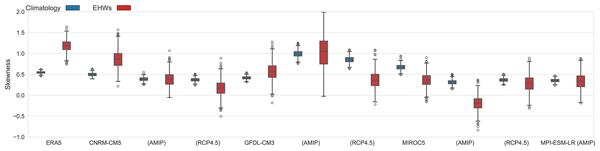
Our study builds on previous research by examining how climate models simulate the large-scale Rossby wave circulation during present-day Eurasian heat waves (EHWs) and how it alters in the future. We find no increase in future frequency for EHWs defined with respect to the simulated mean climate. The models capture the averaged atmospheric circulation during EHWs but struggle with daily variability. Our results highlight the need for improvements to enhance predictions of extreme weather.
Rémy Asselot, Philip B. Holden, Frank Lunkeit, and Inga Hense
Earth Syst. Dynam., 15, 875–891, https://doi.org/10.5194/esd-15-875-2024, https://doi.org/10.5194/esd-15-875-2024, 2024
Short summary
Short summary
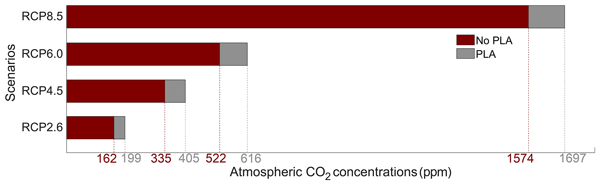
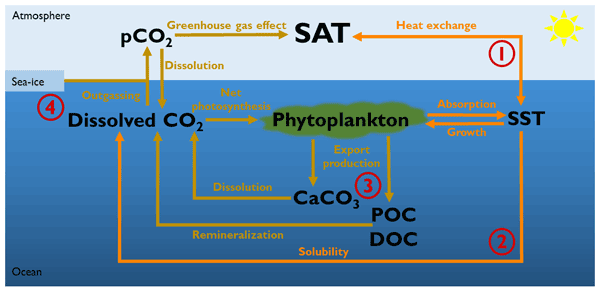
Phytoplankton are tiny oceanic algae able to absorb the light penetrating the ocean. The light absorbed by these organisms is re-emitted as heat in the surrounding environment, a process commonly called phytoplankton light absorption (PLA). As a consequence, PLA increases the oceanic temperature. We studied this mechanism with a climate model under different climate scenarios. We show that phytoplankton light absorption is reduced under strong warming scenarios, limiting oceanic warming.
Yuan-Bing Zhao, Nedjeljka Žagar, Frank Lunkeit, and Richard Blender
Weather Clim. Dynam., 4, 833–852, https://doi.org/10.5194/wcd-4-833-2023, https://doi.org/10.5194/wcd-4-833-2023, 2023
Short summary
Short summary
Coupled climate models have significant biases in the tropical Indian Ocean (TIO) sea surface temperature (SST). Our study shows that the TIO SST biases can affect the simulated global atmospheric circulation and its spatio-temporal variability on large scales. The response of the spatial variability is related to the amplitude or phase of the circulation bias, depending on the flow regime and spatial scale, while the response of the interannual variability depends on the sign of the SST bias.
Iana Strigunova, Richard Blender, Frank Lunkeit, and Nedjeljka Žagar
Weather Clim. Dynam., 3, 1399–1414, https://doi.org/10.5194/wcd-3-1399-2022, https://doi.org/10.5194/wcd-3-1399-2022, 2022
Short summary
Short summary
We show that the Eurasian heat waves (HWs) have signatures in the global circulation. We present changes in the probability density functions (PDFs) of energy anomalies in the zonal-mean state and in the Rossby waves at different zonal scales in relation to the changes in intramonthly variability. The skewness of the PDF of planetary-scale Rossby waves is shown to increase during HWs, while their intramonthly variability is reduced, a process referred to as blocking.
Matic Pikovnik, Žiga Zaplotnik, Lina Boljka, and Nedjeljka Žagar
Weather Clim. Dynam., 3, 625–644, https://doi.org/10.5194/wcd-3-625-2022, https://doi.org/10.5194/wcd-3-625-2022, 2022
Short summary
Short summary
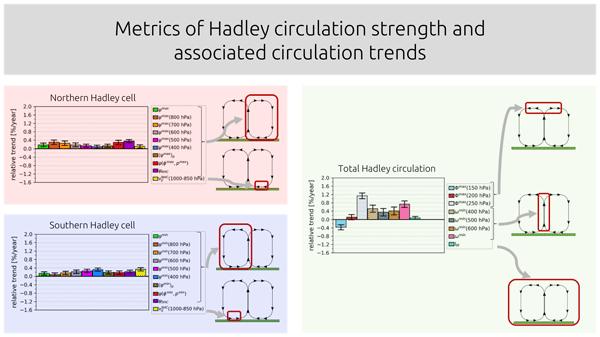
Potential future changes in the Hadley cells (HCs), either to their strength or their meridional extent, will profoundly impact the global distribution of precipitation. Therefore, to objectively evaluate and inter-compare past and future changes in the overall HC strength between different studies, a unified metric is required. The study proposes two new metrics, which alleviate the spatial inhomogeneities of the HC strength trend.
Miriam D'Errico, Flavio Pons, Pascal Yiou, Soulivanh Tao, Cesare Nardini, Frank Lunkeit, and Davide Faranda
Earth Syst. Dynam., 13, 961–992, https://doi.org/10.5194/esd-13-961-2022, https://doi.org/10.5194/esd-13-961-2022, 2022
Short summary
Short summary
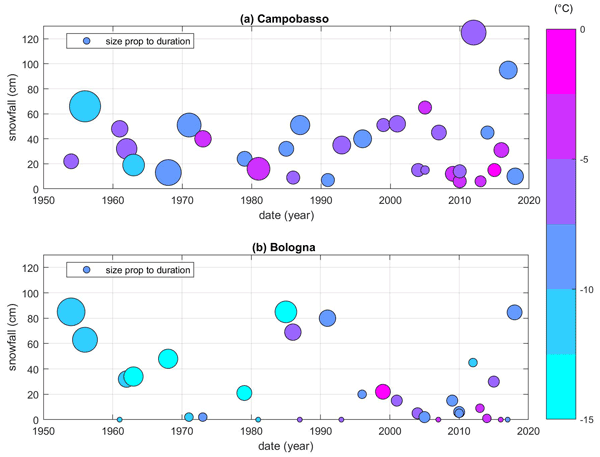
Climate change is already affecting weather extremes. In a warming climate, we will expect the cold spells to decrease in frequency and intensity. Our analysis shows that the frequency of circulation patterns leading to snowy cold-spell events over Italy will not decrease under business-as-usual emission scenarios, although the associated events may not lead to cold conditions in the warmer scenarios.
Katharina M. Holube, Tobias Zolles, and Andreas Born
The Cryosphere, 16, 315–331, https://doi.org/10.5194/tc-16-315-2022, https://doi.org/10.5194/tc-16-315-2022, 2022
Short summary
Short summary
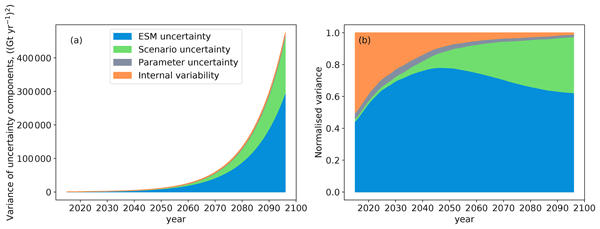
We simulated the surface mass balance of the Greenland Ice Sheet in the 21st century by forcing a snow model with the output of many Earth system models and four greenhouse gas emission scenarios. We quantify the contribution to uncertainty in surface mass balance of these two factors and the choice of parameters of the snow model. The results show that the differences between Earth system models are the main source of uncertainty. This effect is localised mostly near the equilibrium line.
Rémy Asselot, Frank Lunkeit, Philip B. Holden, and Inga Hense
Biogeosciences, 19, 223–239, https://doi.org/10.5194/bg-19-223-2022, https://doi.org/10.5194/bg-19-223-2022, 2022
Short summary
Short summary
Previous studies show that phytoplankton light absorption can warm the atmosphere, but how this warming occurs is still unknown. We compare the importance of air–sea heat versus CO2 flux in the phytoplankton-induced atmospheric warming and determine the main driver. To shed light on this research question, we conduct simulations with a climate model of intermediate complexity. We show that phytoplankton mainly warms the atmosphere by increasing the air–sea CO2 flux.
Rémy Asselot, Frank Lunkeit, Philip Holden, and Inga Hense
Earth Syst. Dynam. Discuss., https://doi.org/10.5194/esd-2021-91, https://doi.org/10.5194/esd-2021-91, 2021
Revised manuscript not accepted
Short summary
Short summary
Phytoplankton absorbing light can influence the climate system but its future effect on the climate is still unclear. We use a climate model to investigate the role of phytoplankton light absorption under global warming. We find out that the effect of phytoplankton light absorption is smaller under a high greenhouse gas emissions compared to reduced and intermediate greenhouse gas emissions. Additionally, we show that phytoplankton light absorption is an important mechanism for the carbon cycle.
Cited articles
Bellon, G. and Reboredo, B.: Scale Sensitivity of the Gill Circulation. Part II: Off-Equatorial Case, J. Atmos. Sci., 79, 19–30, https://doi.org/10.1175/JAS-D-21-0068.1, 2022. a
Boyd, J. P.: Dynamics of the Equatorial Ocean, Springer-Verlag GmbH Germany, https://doi.org/10.1007/978-3-662-55476-0, 2018. a, b
Chatterjee, P. and Goswami, B. N.: Structure, genesis and scale selection of the tropical quasi-biweekly mode, Q. J. Roy. Meteor. Soc., 130, 1171–1194, https://doi.org/10.1256/qj.03.133, 2004. a, b, c, d
Chen, G. and Sui, C.-H.: Characteristics and origin of quasi-biweekly oscillation over the western North Pacific during boreal summer, J. Geophys. Res.-Atmos., 115, https://doi.org/10.1029/2009JD013389, 2010. a, b
Chen, P. and Lu, R.: The Summer Atmospheric Convection Variability over the Tropical Western North Pacific Independent of and Dependent on the Preceding Winter ENSO, J. Climate, 36, 8695–8711, https://doi.org/10.1175/JCLI-D-23-0037.1, 2023. a, b, c
Di Capua, G., Runge, J., Donner, R. V., van den Hurk, B., Turner, A. G., Vellore, R., Krishnan, R., and Coumou, D.: Dominant patterns of interaction between the tropics and mid-latitudes in boreal summer: causal relationships and the role of timescales, Weather Clim. Dynam., 1, 519–539, https://doi.org/10.5194/wcd-1-519-2020, 2020. a
Feng, T., Yang, X.-Q., Yu, J.-Y., and Huang, R.: Convective Coupling in Tropical-Depression-Type Waves. Part I: Rainfall Characteristics and Moisture Structure, J. Atmos. Sci., 77, 3407–3422, https://doi.org/10.1175/JAS-D-19-0172.1, 2020a. a
Feng, T., Yu, J.-Y., Yang, X.-Q., and Huang, R.: Convective Coupling in Tropical-Depression-Type Waves. Part II: Moisture and Moist Static Energy Budgets, J. Atmos. Sci., 77, 3423–3440, https://doi.org/10.1175/JAS-D-19-0173.1, 2020b. a
Ferrett, S., Yang, G.-Y., Woolnough, S. J., Methven, J., Hodges, K., and Holloway, C. E.: Linking extreme precipitation in Southeast Asia to equatorial waves, Q. J. Roy. Meteor. Soc., 146, 665–684, https://doi.org/10.1002/qj.3699, 2019. a
Ferrett, S., Methven, J., Woolnough, S. J., Yang, G.-Y., Holloway, C. E., and Wolf, G.: Hybrid Dynamical–Statistical Forecasts of the Risk of Rainfall in Southeast Asia Dependent on Equatorial Waves, Mon. Weather Rev., 151, 2139–2152, https://doi.org/10.1175/MWR-D-22-0300.1, 2023. a
Goyal, R., Jucker, M., Sen, G., Gupta, A. S., Hendon, H. H., and England, M. H.: Zonal wave 3 pattern in the Southern Hemisphere generated by tropical convection, Nat. Geosci., 14, 732–738, https://doi.org/10.1038/s41561-021-00811-3, 2021. a
Hersbach, H., Bell, B., Berrisford, P., Hirahara, S., Horányi, A., Muñoz-Sabater, J., Nicolas, J., Peubey, C., Radu, R., Schepers, D., Simmons, A., Soci, C., Abdalla, S., Abellan, X., Balsamo, G., Bechtold, P., Biavati, G., Bidlot, J., Bonavita, M., De Chiara, G., Dahlgren, P., Dee, D., Diamantakis, M., Dragani, R., Flemming, J., Forbes, R., Fuentes, M., Geer, A., Haimberger, L., Healy, S., Hogan, R. J., Hólm, E., Janisková, M., Keeley, S., Laloyaux, P., Lopez, P., Lupu, C., Radnoti, G., de Rosnay, P., Rozum, I., Vamborg. F., Villaume, S., and Thépaut, J.-N.: The ERA5 global reanalysis, Q. J. Roy. Meteor. Soc., 146, 1999–2049 [data set], https://doi.org/10.1002/qj.3803, 2020. a, b
Holube, K. M., Lunkeit, F., Vasylkevych, S., and Žagar, N.: Energy budget of the equatorial Kelvin wave: Comparing dynamical and diabatic sources, ESS Open Archive, https://doi.org/10.22541/essoar.174776017.78570412/v1, 2025. a, b
Huang, R. and Sun, F.: Impacts of the Tropical Western Pacific on the East Asian Summer Monsoon, J. Meteorol. Soc. Jpn. Ser. II, 70, 243–256, https://doi.org/10.2151/jmsj1965.70.1B_243, 1992. a, b, c, d
Jia, X. and Yang, S.: Impact of the quasi-biweekly oscillation over the western North Pacific on East Asian subtropical monsoon during early summer, J. Geophy. Res.-Atmos., 118, 4421–4434, https://doi.org/10.1002/jgrd.50422, 2013. a
Kikuchi, K. and Wang, B.: Global Perspective of the Quasi-Biweekly Oscillation, J. Clim., 22, 1340–1359, https://doi.org/10.1175/2008JCLI2368.1, 2009. a
Kobayashi, C., Maeda, S., Ito, A., Matsushita, Y., and Takano, K.: Relation between SSTs and Predictability of Seasonal Mean Precipitation over the Western Tropical Pacific, J. Meteorol. Soc. Jpn. Ser. II, 83, 919–929, https://doi.org/10.2151/jmsj.83.919, 2005. a
Kosaka, Y. and Nakamura, H.: Structure and dynamics of the summertime Pacific–Japan teleconnection pattern, Q. J. Roy. Meteor. Soc., 132, 2009–2030, https://doi.org/10.1256/qj.05.204, 2006. a, b, c
Kosaka, Y. and Nakamura, H.: Mechanisms of Meridional Teleconnection Observed between a Summer Monsoon System and a Subtropical Anticyclone. Part I: The Pacific–Japan Pattern, J. Climate, 23, 5085–5108, https://doi.org/10.1175/2010JCLI3413.1, 2010. a
Kubota, H., Shirooka, R., Hamada, J.-I., and Syamsudin, F.: Interannual Rainfall Variability over the Eastern Maritime Continent, J. Meteorol. Soc. Jpn., 89A, 111–122, https://doi.org/10.2151/jmsj.2011-A07, 2011. a
Lau, K.-M., Kim, K.-M., and Yang, S.: Dynamical and Boundary Forcing Characteristics of Regional Components of the Asian Summer Monsoon, J. Climate, 13, 2461–2482, https://doi.org/10.1175/1520-0442(2000)013<2461:DABFCO>2.0.CO;2, 2000. a
Li, C. and Li, S.: Interannual Seesaw between the Somali and the Australian Cross-Equatorial Flows and its Connection to the East Asian Summer Monsoon, J. Climate, 27, 3966–3981, https://doi.org/10.1175/JCLI-D-13-00288.1, 2014. a
Li, K., He, Q., Yang, Y., and Yu, W.: Equatorial Moisture Dynamics of the Quasi‐Biweekly Oscillation in the Tropical Northwestern Pacific during Boreal Summer, Geophys. Res. Lett., 47, e2020GL090929, https://doi.org/10.1029/2020GL090929, 2020. a
Li, S., Park, S., Lee, J. Y., Ha, K. J., Park, M. K., Jo, C. O., Oh, H., Muhle, J., Kim, K. R., Montzka, S. A., O'Doherty, S., Krummel, P. B., Atlas, E., Miller, B. R., Moore, F., Weiss, R. F., and Wofsy, S. C.: Chemical evidence of inter-hemispheric air mass intrusion into the Northern Hemisphere mid-latitudes, Sci. Rep., 8, 4669, https://doi.org/10.1038/s41598-018-22266-0, 2018. a
Li, X., Gollan, G., Greatbatch, R. J., and Lu, R.: Impact of the MJO on the interannual variation of the Pacific–Japan mode of the East Asian summer monsoon, Clim. Dynam., 52, 3489–3501, https://doi.org/10.1007/s00382-018-4328-7, 2019. a
Liebmann, B. and Smith, C. A.: Description of a complete (interpolated) outgoing longwave radiation dataset, B. Am. Meteorol. Soc., 77, 1274–1278 [data set], https://doi.org/10.1175/1520-0477-77.6.1274, 1996. a
Lin, H.: Global Extratropical Response to Diabatic Heating Variability of the Asian Summer Monsoon, J. Atmos. Sci., 66, 2697–2713, https://doi.org/10.1175/2009JAS3008.1, 2009. a, b
Liu, F., Huang, G., and Yan, M.: Role of SST meridional structure in coupling the Kelvin and Rossby waves of the intraseasonal oscillation, Theor. Appl. Climatol., 121, 623–629, https://doi.org/10.1007/s00704-014-1266-0, 2015. a
Longuet-Higgins, M. S.: Eigenfunctions of Laplaces tidal equations over a sphere, Philos. T. Roy. Soc. A, 262, 511–607, https://doi.org/10.1098/rsta.1968.0003, 1968. a
Lu, R. and Dong, B.: Westward Extension of North Pacific Subtropical High in Summer, J. Meteorol. Soc. Jpn. Ser. II, 79, 1229–1241, https://doi.org/10.2151/jmsj.79.1229, 2001. a, b, c, d
Neduhal, V., Žagar, N., Lunkeit, F., Polichtchouk, I., and Zaplotnik, V.: Decomposition of the Horizontal Wind Divergence Associated With the Rossby, Mixed Rossby-Gravity, Inertia-Gravity, and Kelvin Waves on the Sphere, J. Geophy. Res.-Atmos., 129, e2023JD040427, https://doi.org/10.1029/2023JD040427, 2024. a
Nitta, T.: Long-term variations of cloud amount in the western Pacific region, J. Meteorol. Soc. Jpn., 64, 373–390, https://doi.org/10.2151/jmsj1965.64.3_373, 1986. a
Pedlosky, J.: A study of the time dependent ocean circulation, J. Atmos. Sci., 22, 267–272, 1965. a
Quinting, J. F., Grams, C. M., Chang, E. K.-M., Pfahl, S., and Wernli, H.: Warm conveyor belt activity over the Pacific: modulation by the Madden–Julian Oscillation and impact on tropical–extratropical teleconnections, Weather Clim. Dynam., 5, 65–85, https://doi.org/10.5194/wcd-5-65-2024, 2024. a
Reboredo, B. and Bellon, G.: Scale Sensitivity of the Gill Circulation. Part I: Equatorial Case, J. Atmos. Sci., 79, 3–17, https://doi.org/10.1175/JAS-D-21-0067.1, 2022. a
Schubert, W. H., Silvers, L. G., Masarik, M. T., and Gonzalez, A. O.: A Filtered Model of Tropical Wave Motions, J. Adv. Model. Earth Sy., 1, 3, https://doi.org/10.3894/JAMES.2009.1.3, 2009. a
Straub, K. H. and Kiladis, G. N.: Interactions between the Boreal Summer Intraseasonal Oscillation and Higher-Frequency Tropical Wave Activity, Mon. Weather Rev., 131, 945–960, https://doi.org/10.1175/1520-0493(2003)131<0945:IBTBSI>2.0.CO;2, 2003. a
Sun, Y. and Tan, B.: A new subseasonal atmospheric teleconnection bridging tropical deep convection over the western North Pacific and Antarctic weather, Atmos. Sci. Lett., 23, e1115, https://doi.org/10.1002/asl.1115, 2022. a, b, c
Sun, Y., Chen, G., and Tan, B.: Formation and maintenance mechanisms of the Pacific-Japan pattern as an intraseasonal variability mode, Clim. Dynam., 57, 2971–2994, https://doi.org/10.1007/s00382-021-05851-4, 2021. a, b, c, d
Swarztrauber, P. N. and Kasahara, A.: The vector harmonic analysis of Laplace tidal equations, SIAM J. Sci. Stat. Comp., 6, 464–491, https://doi.org/10.1137/0906033, 1985. a, b
Teruya, A. S. W., Raphaldini, B., Raupp, C. F. M., Peixoto, P. S., Mayta, V. C., and Silva-Dias, P. L.: Data-driven modeling of equatorial atmospheric waves: The role of moisture and nonlinearity on global-scale instabilities and propagation speeds, Chaos, 34, https://doi.org/10.1063/5.0201716, 2024. a
Wang, B., Wu, R., and Lau, K.-M.: Interannual Variability of the Asian Summer Monsoon: Contrasts between the Indian and the Western North Pacific–East Asian Monsoons, J. Climate, 14, 4073–4090, https://doi.org/10.1175/1520-0442(2001)014<4073:IVOTAS>2.0.CO;2, 2001. a, b, c
Wang, J., Wen, Z., Wu, R., Guo, Y., and Chen, Z.: The mechanism of growth of the low-frequency East Asia–Pacific teleconnection and the triggering role of tropical intraseasonal oscillation, Clim. Dynam., 46, 3965–3977, https://doi.org/10.1007/s00382-015-2815-7, 2016. a, b
Wu, Z., Battisti, D. S., and Sarachik, E. S.: Rayleigh Friction, Newtonian Cooling, and the Linear Response to Steady Tropical Heating, J. Atmos. Sci., 57, 1937–1957, https://doi.org/10.1175/1520-0469(2000)057<1937:RFNCAT>2.0.CO;2, 2000. a
Xue, F. and Fan, F.: Role of Local Air-Sea Interaction in a Significant Correlation of Convective Activity in the Western Pacific Warm Pool between June and August, J. Meteorol. Soc. Jpn. Ser. II, 97, 995–1008, https://doi.org/10.2151/jmsj.2019-054, 2019. a
Žagar, N. and Franzke, C. L. E.: Systematic decomposition of MJO into balanced and inertio-gravity modes, Geophys. Res. Lett., 42, 6829–6835, 2015. a
Žagar, N. and Tribbia, J., E.: Modal View Of Atmospheric Variability: Applications Of Normal-Mode Function Decomposition in Weather and Climate Research, Springer Nature, https://doi.org/10.1007/978-3-030-60963-4, 2020. a
Žagar, N., Tribbia, J., Anderson, J. L., and Raeder, K.: Uncertainties of estimates of inertio-gravity energy in the atmosphere. Part I: intercomparison of four analysis datasets, Mon. Weather Rev., 137, 3837–3857, 2009. a
Žagar, N., Kasahara, A., Terasaki, K., Tribbia, J., and Tanaka, H.: Normal-mode function representation of global 3-D data sets: open-access software for the atmospheric research community, Geosci. Model Dev., 8, 1169–1195, https://doi.org/10.5194/gmd-8-1169-2015, 2015. a
Žagar, N., Lunkeit, F., Sielmann, F., and Xiao, W.: Three-Dimensional Structure of the Equatorial Kelvin Wave: Vertical Structure Functions, Equivalent Depths, and Frequency and Wavenumber Spectra, J. Climate, 35, 2209–2230, https://doi.org/10.1175/JCLI-D-21-0342.1, 2022. a
Žagar, N., Neduhal, V., Vasylkevych, S., Ž. Zaplotnik, and Tanaka, H.: Decomposition of vertical velocity and its zonal wavenumber kinetic energy spectra in the hydrostatic atmosphere, J. Atmos. Sci., 80, 2747–2767, 2023. a
Zhao, S., Li, J., Li, Y., Jin, F.-F., and Zheng, J.: Interhemispheric influence of Indo-Pacific convection oscillation on Southern Hemisphere rainfall through southward propagation of Rossby waves, Clim. Dynam., 52, 3203–3221, https://doi.org/10.1007/s00382-018-4324-y, 2019. a, b
Zhao, X., Lu, R., Dong, B., Hong, X., Liu, J., and Sun, J.: Tropical Anomalies Associated with the Interannual Variability of the Cross-Equatorial Flows over the Maritime Continent in Boreal Summer, J. Climate, 35, 5591–5603, https://doi.org/10.1175/JCLI-D-21-0764.1, 2022. a, b
Zhu, Y., Wen, Z., Guo, Y., Chen, R., Li, X., and Qiao, Y.: The characteristics and possible growth mechanisms of the quasi-biweekly Pacific-Japan teleconnection in Boreal Summer, Clim. Dynam., 55, 3363–3380, https://doi.org/10.1007/s00382-020-05448-3, 2020. a, b, c
Short summary
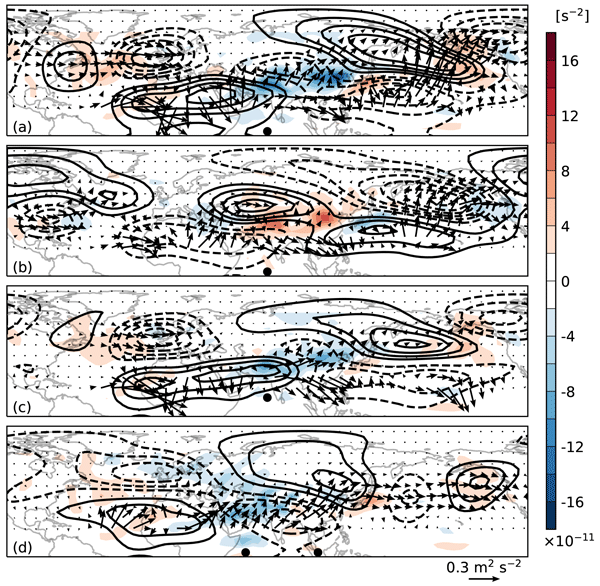
We analyze the equatorial wave circulation associated with the subtropical western North Pacific (SWNP) convection. Results show that Rossby and Kelvin waves resemble the Gill solution–enhance the equatorward side of the SWNP anticyclone/cyclone together, while mixed Rossby-gravity (MRG) and inertia-gravity (IG) waves dominate the cross-equatorial flow. Following peak convection, IG waves complement Rossby waves to link the SWNP convection and extratropical circulation during austral winter.
We analyze the equatorial wave circulation associated with the subtropical western North Pacific...