
the Creative Commons Attribution 4.0 License.
the Creative Commons Attribution 4.0 License.
 | 04 Sep 2026
Towards understanding the interannual variability of hail in Switzerland

Monika Feldmann
Katharina Schröer
Cornelia Schwierz
Olivia Martius
Hailstorms are among the most damaging natural hazards in Switzerland, yet the large-scale processes governing their interannual variability remain poorly understood, limiting the potential for early prediction and risk preparedness. Using a 64-year reconstruction of past hail days (1959–2022) and ERA5 reanalysis data, we identify the dominant atmospheric, oceanic, and land-surface patterns associated with particularly active hail seasons north and south of the Swiss Alps.
In both regions, active hail seasons are associated with recurrent large-scale circulation anomalies, characterized by a zonally or meridionally oriented Euro-Atlantic wave train, together with seasonally preconditioned background states in sea-surface temperatures, near-surface temperature, and the mid-tropospheric circulation. These conditions promote repeated occurrences of hail-favorable environments with warm and moist boundary layers, enhanced instability, and moderate convective inhibition. The identified patterns differ significantly from those in hail-sparse seasons and exhibit distinct regional differences: north of the Alps, moisture supply is linked primarily to Atlantic influences and continental evaporation, and the strongest seasonal-scale anomalies occur in temperature, indicating a predominantly temperature-limited regime. South of the Alps, hail activity is associated with frequent elevated dry-layer conditions and a stronger contribution from Mediterranean moisture, occurring in a generally more convection-favorable environment with weaker seasonal-scale anomalies. We further find wintertime precursors of active hail seasons, including continental cooling and Pacific SST anomalies resembling a positive Pacific Decadal Oscillation phase, pointing to low-frequency preconditioning through large-scale teleconnection pathways. Together, these results identify consistent circulation regimes and precursor signals that could underpin (sub-)seasonal hail prediction in Switzerland and Central Europe.
- Article
(30048 KB) - Full-text XML
-
Supplement
(52167 KB) - BibTeX
- EndNote


Severe convective storms were the most damaging natural hazard globally in 2023 (Gallagher Re, 2023) and future hail-related losses are projected to increase, as both the severity and frequency of hailstorms in Switzerland are expected to rise under climate change (Thurnherr et al., 2025; Brennan et al., 2025; Schmid et al., 2025). Despite the growing relevance of hailstorms, critical knowledge gaps remain. While previous research has largely focused on long-term trends, much less attention has been paid to the climate variability that governs year-to-year fluctuations in hailstorm activity (Tippett et al., 2015). Understanding this interannual variability is crucial for improving seasonal forecasts and supporting risk mitigation, particularly for the (re-) insurance and agricultural sectors. The recent multidecadal reconstruction of hail day occurrences in Switzerland (1959–2022) by Wilhelm et al. (2024) enables long-term analyses of interannual variability for the first time, overcoming the limitations of sparse long-term observational hail datasets that have previously hampered such studies in Switzerland (Martius et al., 2018).
Systematic analyses of other seasonal climate extremes, such as precipitation, temperature, and moisture conditions, have shown that extreme seasons are influenced both by local processes and by persistent large-scale circulation and slowly varying land–ocean boundary conditions (Röthlisberger et al., 2021; Boettcher et al., 2023; Hermann et al., 2024). Building on this perspective, we investigate the factors regulating hail frequency on seasonal timescales. Hail formation involves multiscale processes, from microphysical growth mechanisms, to mesoscale triggers of convective initiation, to synoptic-scale circulation patterns that establish and maintain the broader storm environment (e.g., Doswell, 1987; Kumjian et al., 2021). Within Doswell’s classical framework, severe convective storms form when the necessary ingredients for deep moist convection (instability, moisture, lift, and for organized storms vertical wind shear) coincide in space and time and are organized by mesoscale and synoptic forcing mechanisms (Doswell, 1987). In the Alpine region, these interactions are further modulated by complex terrain, which creates air mass boundaries, influences boundary-layer circulations, and affects convective initiation pathways. For example, the convergence of nocturnal katabatic (downslope) flows may induce convective initiation on the southern side of the Alps, while daytime hailstorms frequently initiate over the foothills and propagate toward higher elevations (Nisi et al., 2020). In addition, katabatic flows associated with downdrafts can trigger new hailstorms (Trefalt et al., 2018), and mountain valleys with lakes can modify low-level moisture and channel storm inflow, thereby supporting more frequent supercell development (Feldmann et al., 2024).
Although strong diurnal heating can occasionally erode CIN and trigger isolated convection, most deep convection requires mesoscale lifting mechanisms such as boundary-layer convergence, orographic ascent, or thermally driven local circulations (Doswell, 1987; Punge and Kunz, 2016; Fluck et al., 2021). Large-scale ascent associated with synoptic systems can weaken the capping inversion, but vertical velocities of only a few cm s−1 are generally insufficient to initiate convection without mesoscale support (Doswell, 1987; Markowski and Richardson, 2010). In the Alps, differential heating between valleys and slopes generates valley-breeze and mountain-plain circulations that produce low-level convergence along ridges and crests, promoting afternoon lifting (Gladich et al., 2011). This commonly serves as a trigger for convective initiation (CI) in the Prealpine foothills, where hail frequency is highest (Nisi et al., 2018).
While mesoscale processes provide the localized lift needed for CI, large-scale dynamics shape the thermodynamic and kinematic environment in which convection develops. Synoptic systems modulate temperature advection, moisture transport, lapse rates, flow direction and vertical wind shear, all of which determine whether a mesoscale trigger leads to shallow convection, deep moist convection, or organized hailstorms. The most widespread and intense convective outbreaks occur when mesoscale initiation mechanisms operate within a synoptic environment already favorable for deep convection (Doswell, 1987; Markowski and Richardson, 2010).
In Central Europe hailstorms frequently develop ahead of upper-level troughs, where enhanced vertical wind shear and differential positive vorticity advection (i.e., increasing positive vorticity advection with height) support deep convection (Mohr et al., 2020; Feldmann et al., 2025). In northern Switzerland, hailstorms often accompany pre-frontal environments ahead of westerly or northwesterly cold fronts (Schemm et al., 2016; Kunz et al., 2020). In southern Switzerland and northern Italy, major hail events have been linked to southwesterly flow downstream of Scandinavian or British Isles low-pressure systems, which transport high-Θe (equivalent potential temperature) air from the Mediterranean into the Alps and generate shear profiles favorable for supercells (Manzato et al., 2015, 2020; De Martin et al., 2025; Feldmann et al., 2025). Cold fronts and pre-frontal environments to the west and north of the Alps also play an important role in these regions (Nisi et al., 2016; Schemm et al., 2016). In addition, atmospheric blocking over the North Atlantic, Scandinavia, and the Baltic Sea can enhance hail frequency by maintaining persistent large-scale circulation patterns that favor the advection of warm, moist, and unstable air into Central Europe while inhibiting the eastward progression of weather systems (Mohr et al., 2019, 2020; Barras et al., 2021). Such long-lived circulation regimes have been associated with serially clustered hail occurrence in Switzerland (Barras et al., 2021) and more than half of radar-based potential hail tracks in Germany over the last 2 decades (Mohr et al., 2026). Furthermore, blocking has been shown to increase the frequency of upstream PV cutoffs, providing mesoscale forcing for convective initiation (Mohr et al., 2020).
On subseasonal to seasonal timescales, hail variability has been linked to large-scale modes of variability and their associated teleconnections. These modes offer potential for (sub-)seasonal predictive skill due to their low-frequency variability (Dowdy, 2016). Teleconnections between remote climate forcing and severe storm frequency have been extensively studied in the United States (Barrett and Gensini, 2013; Lee et al., 2013; Thompson and Roundy, 2013; Allen et al., 2015; Tippett et al., 2015; Dowdy, 2016; Gensini and Marinaro, 2016; Molina et al., 2016; Cook et al., 2017; Allen et al., 2018; Baggett et al., 2018; Gensini and Allen, 2018; Tippett, 2018; Trapp and Hoogewind, 2018; Miller et al., 2022), where the El Niño–Southern Oscillation (ENSO) and Madden–Julian Oscillation (MJO) are key modulators of severe weather on seasonal and subseasonal timescales.
For Europe, instead, the North Atlantic Oscillation (NAO), Arctic Oscillation (AO), East Atlantic (EA), and Scandinavian (SCAND) patterns have been identified as key modulators of thunderstorm and hailstorm variability on seasonal and yearly timescales (Giaiotti et al., 2003; Piper and Kunz, 2017; Piper et al., 2019; Augenstein et al., 2025). While the influence of the NAO on convective activity appears to be complex and regionally dependent, positive phases of the EA and SCAND patterns have consistently been associated with storm-favorable circulation and thermodynamic conditions across parts of Central Europe (Piper and Kunz, 2017; Piper et al., 2019; Augenstein et al., 2025).
Persistent surface anomalies, which are strongly modulated by atmospheric circulation, also contribute to hailstorm frequency variability. Positive summer sea surface temperature (SST) anomalies in the Bay of Biscay or the Mediterranean have been linked to enhanced convective activity over western Europe (Piper et al., 2019). Augenstein (2025) further report intensified thunderstorm activity across much of central Europe during positive Mediterranean SST anomalies in combination with Scandinavian blocking. Additionally, reduced Arctic sea ice can modify meridional temperature gradients and jet stream configurations, thereby influencing the occurrence of extreme weather (Francis and Vavrus, 2012; Kretschmer et al., 2016). Soil moisture can influence near surface weather on weekly to monthly timescales (Van Den Hurk et al., 2012). Strong soil moisture gradients can generate mesoscale circulations, enhance low-level convergence, and even modify vertical wind shear through strengthened temperature gradients (Taylor et al., 2011; Liu et al., 2022; Barton et al., 2025).
All of these potential influences on hail frequency highlight the strong coupling between the atmosphere, ocean, and land surface, and underscore the role of dynamical processes in shaping convective environments. In weather and climate models, small perturbations in the large-scale flow can amplify downstream (Grams et al., 2018), cascading into substantial differences in convective environments. Improving our understanding of how hail-favorable conditions are generated, maintained, and modulated by mesoscale and synoptic dynamics is therefore essential for reducing uncertainties in process understanding, forecasting, and also for climate projections. Despite growing recognition of the diverse drivers of interannual hail variability, region-specific studies remain scarce. To address this gap, we investigate a range of atmospheric, oceanic, and land-surface conditions across multiple timescales to better understand the interannual variability of hail in Switzerland. Specifically, we address the following questions:
-
What large-scale and local atmospheric, oceanic, and land-surface conditions are associated with active hail seasons in Switzerland?
-
How do these conditions differ between northern and southern Switzerland?
-
How do seasonal mean conditions during active hail seasons compare with the conditions on hail and non-hail days within those seasons?
-
Which precursor signals are associated with active hail seasons?
The remainder of this paper is structured as follows. Section 2 describes the datasets, followed by the methodology in Sect. 3. Results are presented in Sect. 4 and discussed in Sect. 5. Conclusions are provided in Sect. 6.
2.1 Hail day time series
Since systematic hail observations are not available before 2002 in Switzerland, we use the recently developed hail day reconstruction by Wilhelm et al. (2024). This dataset provides a binary time series indicating daily hail occurrence for two study areas, north and south of the Alps within the Swiss radar domain, which also includes parts of southern France, southern Germany, and northern Italy, during the hail-prone months (April–September) from 1959 to 2022 (Fig. 1). For simplicity, these two study areas are hereafter referred to as northern and southern Switzerland, respectively. To reconstruct past hail events, Wilhelm et al. (2024) applied an ensemble statistical model that combines a radar-based hail proxy with ERA5-derived environmental predictors. For further details, see Wilhelm et al. (2024).
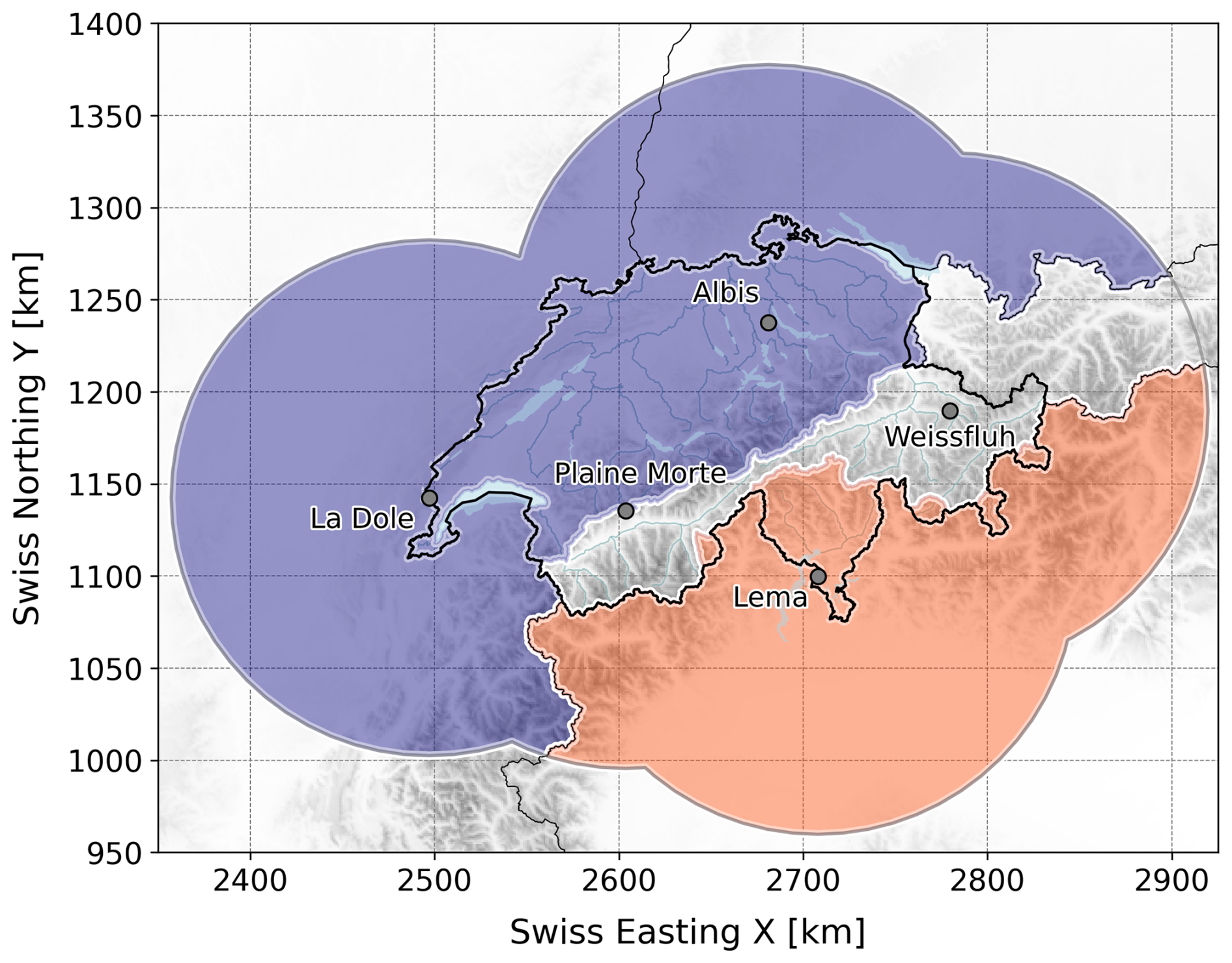
Figure 1The shading indicates the two study areas north of the Alps (blue) and south of the Alps (orange). The areas are within a 140 km radius of the five MeteoSwiss weather radars (black circles) overlaid on a digital elevation map (gray shading). Digital elevation map © Federal Office of Topography Swisstopo.
2.2 ERA5 data
We use ERA5 reanalysis data (Hersbach et al., 2020) to study atmospheric, oceanic, and land-surface variables, using hourly data from 1959 to 2022 at a 0.5° × 0.5° grid resolution, including pressure-level, single-level, and land-surface variables. A list of variables and a short description can be found in Table A3. Daily anomalies are calculated for all ERA5 variables with respect to a climatological mean and standard deviation estimated from moving windows, following Pfleiderer et al. (2019) and Tuel and Martius (2024). To reduce the influence of long-term thermodynamic trends (e.g., warming-driven increases in instability), daily anomalies are calculated with respect to a mean and standard deviation estimated from an 8-year moving window, following Pfleiderer et al. (2019) and Tuel and Martius (2024). Additionally, a 30 d moving window centered on each calendar day is used to remove the seasonal cycle. This approach retains low-frequency climate variability, thereby allowing the analysis to focus on circulation-related effects.
Blocking frequencies were computed from 6-hourly ERA5 potential vorticity (PV) fields using the contour-tracking tool ConTrack, developed by Steinfeld (2021) building on the approach of Schwierz et al. (2004). Potential vorticity (PV) cutoffs and PV streamers are identified following the definitions of Wernli and Sprenger (2007) and Sprenger et al. (2017), and tracked with the algorithm described by Kaderli (2024) using the same 6-hourly ERA5 PV fields. The detection procedure delineates cutoff cyclones and streamers by tracing the 2-PVU contour on five isentropic levels between 330 and 350 K. Daily frequencies are then computed, whereby a grid point is classified as having a cutoff or streamer if a detection occurs on any of the five levels. To investigate the recurrence and strength of synoptic patterns we compute the R metric as introduced in Röthlisberger et al. (2019) for the 500 and 300 hPa meridional wind. R is calculated for the latitudes 35–65 and 40–70° N for north and south respectively. High R values indicate a high recurrence of the 500 and 300 hPa large-scale flow.
2.3 Modes of variability time series
To assess potential large-scale atmospheric influences on hail activity, we analyze relevant northern hemispheric modes of variability, including monthly time series of the Arctic Oscillation (AO), East Atlantic (EA) pattern, East Atlantic/Western Russia (EAWR) pattern, East Pacific/North Pacific (EPNP) pattern, El Niño–Southern Oscillation (ENSO), North Atlantic Oscillation (NAO), Polar/Eurasia (POLEUR) pattern, Scandinavian (SCAND) pattern, and West Pacific (WP) pattern. These indices are obtained from the Climate Prediction Center of the U.S. National Oceanic and Atmospheric Administration (NOAA) and are computed from NCEP-NCAR1 reanalysis data following Richman (1986) and Barnston and Livezey (1987). To quantify relationships between these large-scale atmospheric patterns and regional hail activity, we calculate correlations between the monthly and annually aggregated hail day time series and each mode of variability (see Figs. A1 and A2). Correlations are computed over various temporal periods, including seasonal (i.e., DJF, MAM, JJA, SON), annual, monthly, and preceding periods (i.e., the cold season before the hail season and the previous year's SON).
3.1 Identifying active hail seasons
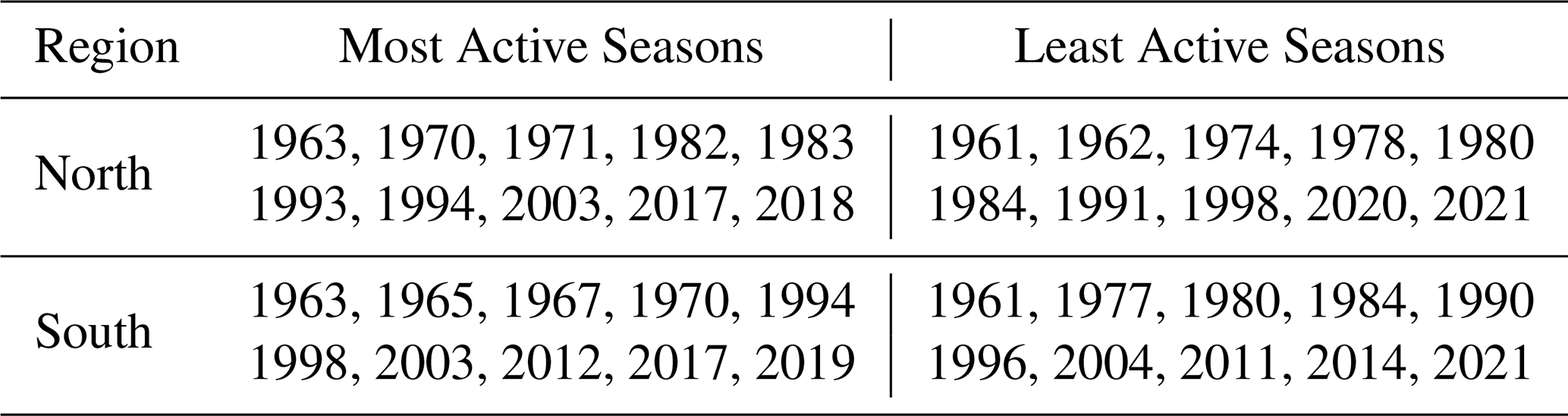
The reconstructed hail day time series from Wilhelm et al. (2024) forms the basis for identifying the years with a high and low hail activity in each study region. To isolate interannual variability and avoid bias toward recent decades, we first remove the long-term positive trend by linearly detrending the annual hail day time series (see Fig. 9 in Wilhelm et al., 2024). We then select the ten most and least active hail seasons in both the northern and southern regions which correspond to the 15 % least and most active seasons of the investigation period (Table 1). The two regions share five of the ten most active seasons (1963, 1970, 1994, 2003, 2017) and four of the ten least active seasons (1961, 1980, 1984, 2021). Notably, although 2021 is widely recognized as an exceptional hail year in Switzerland, it is classified among the least active hail seasons because the season was dominated by only a few exceptionally severe hail outbreaks rather than frequent hail days. The distinction between hailstorm severity and seasonal hail-day frequency of 2021 is consistent with the findings of Schulte-Fischedick et al. (2026). In both regions, hail days during the most active seasons are not confined to a single month but occur repeatedly throughout the peak convective period (June–August), with few additional events at the beginning and end of the hail season (April, May, September; see Appendix Fig. A6).
Table 1The ten most and least active hail seasons (from the detrended series) in the northern and southern study regions, sorted chronologically.
3.2 Anomaly composites
To investigate the large-scale atmospheric, oceanic, and land-surface conditions associated with active hail seasons, we compute daily anomalies for selected ERA5 variables (see Table A3) across the Northern Hemisphere. Anomalies are calculated relative to a mean and standard deviation estimated from a 30 day, 8-year moving window, following Pfleiderer et al. (2019) and Tuel and Martius (2024). We then calculate composite mean fields for two time windows: (i) the full hail season (April–September) and (ii) the preceding cold season (October–March), to identify potential precursors. Hail-season composites are computed over all days in April–September, rather than only hail days, to capture the background conditions that favor frequent hailstorm formation, rather than the instantaneous environment during individual events. Cold-season composites are likewise computed over all days in October–March. All composites are calculated separately for the ten most active hail seasons in the northern and southern regions. Hail-season composites are shown in Figs. 2, 4, 5, and 7, while cold-season composites are presented in Figs. 11, 12, and A3. Additional time windows were tested (e.g., monthly composites, the peak hail season (JJA), the preceding DJF, and adjacent years), but these did not provide further insight, indicating that the relevant signals are captured within the selected periods. Statistical significance is assessed using a two-sided bootstrap test (1000 samples), comparing composites of the most active and inactive seasons against the 5th and 95th percentile thresholds of randomly sampled means.
Note that the full analysis was also conducted for the ten least active hail seasons. These exhibit largely opposing significant patterns compared to active seasons, indicating that the associated large-scale conditions differ between active and inactive hail seasons. While not discussed in detail to maintain brevity and focus, these contrasting signals are climatologically plausible and support the robustness of the identified relationships. Corresponding additional figures are provided in the Supplement.
To assess differences between these seasonal background conditions and event-scale environments, we additionally compute anomalies separately for hail days and non-hail days. Specifically, Figs. 8 and 9 present composites for five subsets: (1) all non-hail days (1959–2022), (2) non-hail days during the ten most active hail seasons, (3) all hail days (1959–2022), (4) hail days during the ten most active seasons, and (5) the seasonal mean over all days in April–September during the ten most active seasons. This comparison allows us to disentangle the environmental conditions on hail days from the broader seasonal background preconditioning during active hail seasons.
This section presents the key atmospheric, oceanic, and land-surface patterns during active hail seasons in northern and southern Switzerland.
4.1 Northern Switzerland
4.1.1 Large-scale conditions
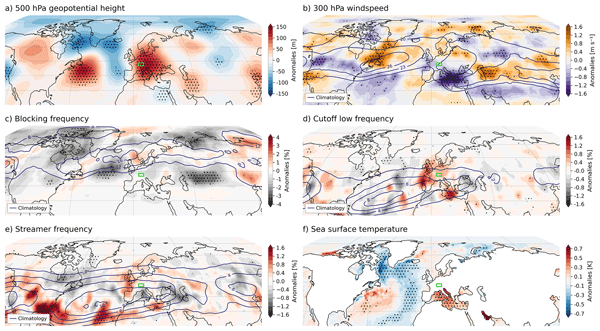
To provide an overview of the large-scale circulation and synoptic environment during the most active hail seasons in northern Switzerland, we first analyze composites of 500 hPa geopotential height (Z500), 300 hPa wind speed, blocking, cutoff and streamer frequency, as well as SST for the entire hail season (Fig. 2). During active hail seasons, the Z500 composites reveal a pronounced upper-level anomaly pattern across the North Atlantic-European sector (Fig. 2a). The alternating positive and negative geopotential height anomalies point to the recurrent occurrence of a zonally oriented Rossby wave train with a ridge–trough–ridge configuration, consisting of positive anomalies over the western Atlantic, a NNW–SSE-oriented negative anomaly over the eastern Atlantic and positive anomalies over Central Europe. Because these are seasonal-mean anomalies, they should not be interpreted as a single persistent synoptic configuration. Instead, they may reflect either persistent circulation anomalies or the repeated re-establishment of similar flow patterns, as examined below using the R-metric. Northern Switzerland lies on the western flank of the positive Z500 anomaly over Central Europe, where the 850 hPa flow is predominantly southerly (shown in Fig. 4d).
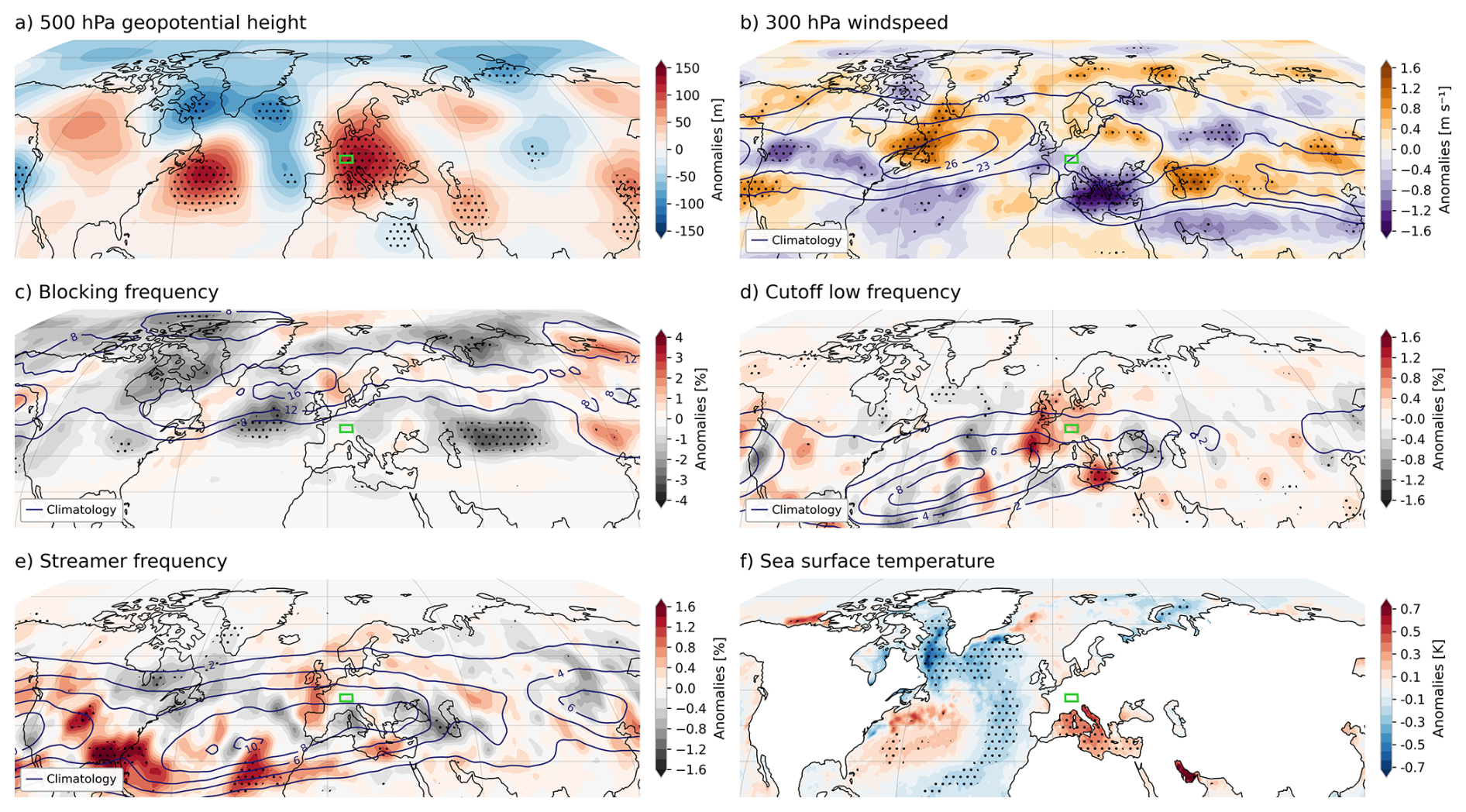
Figure 2Mean anomalies of large-scale atmospheric and oceanic variables during the ten most active hail seasons in northern Switzerland. (a) geopotential height at 500 hPa, (b) 300 hPa wind speed with mean climatology contours in black, (c) blocking frequency with mean climatology contours in darkblue, (d) cutoff low frequency with mean climatology contours in darkblue, (e) streamer frequency with mean climatology contours in darkblue, (f) SST. Stippling indicates areas statistically significant at the 95 % confidence level. The green box marks the study region in northern Switzerland.
In individual synoptic situations, the western flank of a ridge ahead of an approaching trough is a dynamically active transition zone, commonly associated with large-scale ascent driven by differential vorticity advection and temperature advection, which promotes destabilization and supports convective development once a mesoscale trigger is present (Doswell, 1987; Doswell and Bosart, 2001). Together with the enhanced deep-layer vertical wind shear typically associated with this synoptic configuration, these conditions create an environment conducive to hail-producing convection (Doswell and Bosart, 2001; Allen et al., 2020). Composites of 500 hPa vertical velocity confirm the presence of large-scale ascent in this region (not shown). The potential vorticity anomaly pattern closely mirrors that of Z500, with negative PV anomalies collocated with positive geopotential height anomalies and positive PV anomalies associated with troughs (Appendix Fig. A1).
To determine whether the seasonal anomaly pattern during active hail seasons reflects persistent circulation anomalies or the repeated occurrence of similar synoptic configurations, we examine the recurrence (R-metric) of the 500 hPa meridional wind between 35 and 65° N throughout the year (Fig. 3). The R-metric represents the recurrence of similar large-scale flow patterns on subseasonal timescales. Significant positive R anomalies are present across most of the hail season over the study area and Central Europe, indicating that during active hail seasons, similar large-scale ridge–trough configurations are repeatedly re-established rather than maintained as a single persistent circulation anomaly. During mid-summer (July), recurrence is also significantly enhanced downstream of the study area, suggesting frequent re-establishment of anticyclonic flow over Central Europe rather than a single quasi-stationary anticyclone, consistent with the negative blocking anomalies (Fig. 2c). Recurrence is also significantly increased near the beginning and end of the hail season over the North Atlantic and North America.
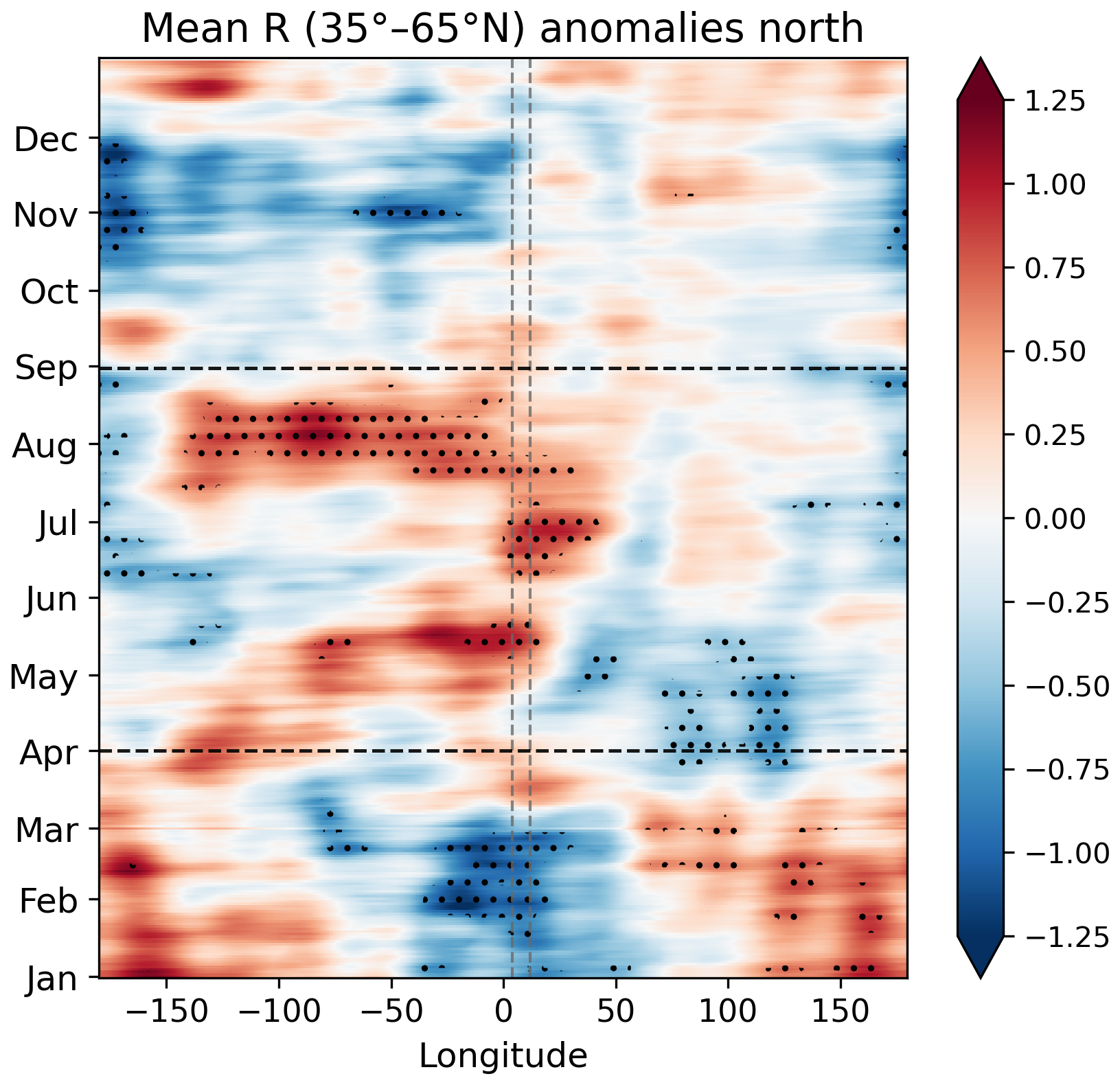
Figure 3Mean anomalies of the R-metric of 500 hPa meridional wind (averaged between 35 and 65° N) for the ten most active hail seasons in northern Switzerland. Red colors denote enhanced recurrence, and blue colors indicate reduced recurrence relative to climatology. Stippling marks areas statistically significant at the 95 % confidence level. The grey vertical dashed lines highlight the longitudinal sector of the study region, and the black horizontal dashed lines indicate the beginning and end of the Swiss hail season.
The alternating positive–negative–positive Z500 anomaly pattern exhibits a pronounced meridional extent, associated with a northward-displaced upper level jet over the Atlantic and locally larger than average 300 hPa wind speeds south of Greenland and over the western Atlantic, while windspeeds are reduced over the Mediterranean, consistent with a weakened subtropical jet there (Fig. 2b). Blocking frequency anomalies are negative over most of North America, the Atlantic, Europe and East Asia, and positive only over parts of Scandinavia, although not significant (Fig. 2c). The negative anomalies are significant west of the British Isles and over Russia, consistent with the negative Z500 anomalies. Cutoff and PV-streamer frequencies exhibit generally small anomalies, with locally significant positive values for cutoffs over the Bay of Biscay and the British Isles, slightly downstream of the eastern Atlantic trough, as well as over the Mediterranean (Fig. 2d,e). Negative anomalies are found south of Greenland, but all deviations remain below ±1.5 %.
SST anomalies broadly follow the upper-level circulation, with positive values in the western Atlantic and Mediterranean and negative values in the eastern Atlantic and the Labrador Sea (Fig. 2f). The strongest positive SST anomalies occur in the northern Mediterranean. Previous studies have shown that SST variability can modulate severe convective activity by affecting boundary-layer specific humidity and mixed-layer CAPE, both on global scales (Cheng et al., 2022) or regionally over the US by changes in the Gulf of Mexico SSTs (Molina et al., 2016). Sea-ice cover anomalies display positive anomalies in the Labrador Sea and negative anomalies east of Greenland (see Appendix Fig. A2). The sea ice cover anomalies could either arise from, and/or reinforce the underlying SST-driven thermal contrasts.
Overall, these large-scale anomaly patterns indicate that hail-active seasons are characterized not by a single persistent circulation anomaly, but by the repeated re-establishment of a synoptic configuration favorable for hail formation. The recurrent ridge–trough–ridge Rossby wave train promotes southerly warm and moist air advection into northern Switzerland, while repeated upstream trough passages provide dynamical forcing for ascent and convective initiation. Positive SST anomalies in the Mediterranean and the Bay of Biscay may further enhance lower-tropospheric moisture availability. Together, these factors establish a favorable large-scale background state for recurrent hail-producing convection.
4.1.2 Local thermodynamic and land surface conditions
Following Doswell (1987), the favorable large-scale circulation described above must establish a local thermodynamic environment conducive to hail formation, characterized by sufficient instability and moisture availability. Figure 4 shows composite anomalies of key thermodynamic and stability indicators during the active hail seasons. A positive temperature anomaly is located underneath the positive anomaly over Central and Eastern Europe, both at the surface and at 850 hPa (Fig. 4a, b). The surface temperature anomaly over land is almost twice as large as the anomaly over the Mediterranean. Near-surface and lower-tropospheric specific humidity anomalies are positive over the study area, southern and Central Europe and the Mediterranean (Fig. 4c, d). Over the Mediterranean the 850 hPa specific humidity anomalies are smaller compared to the surface anomalies and are not statistically significant (Fig. 4d).
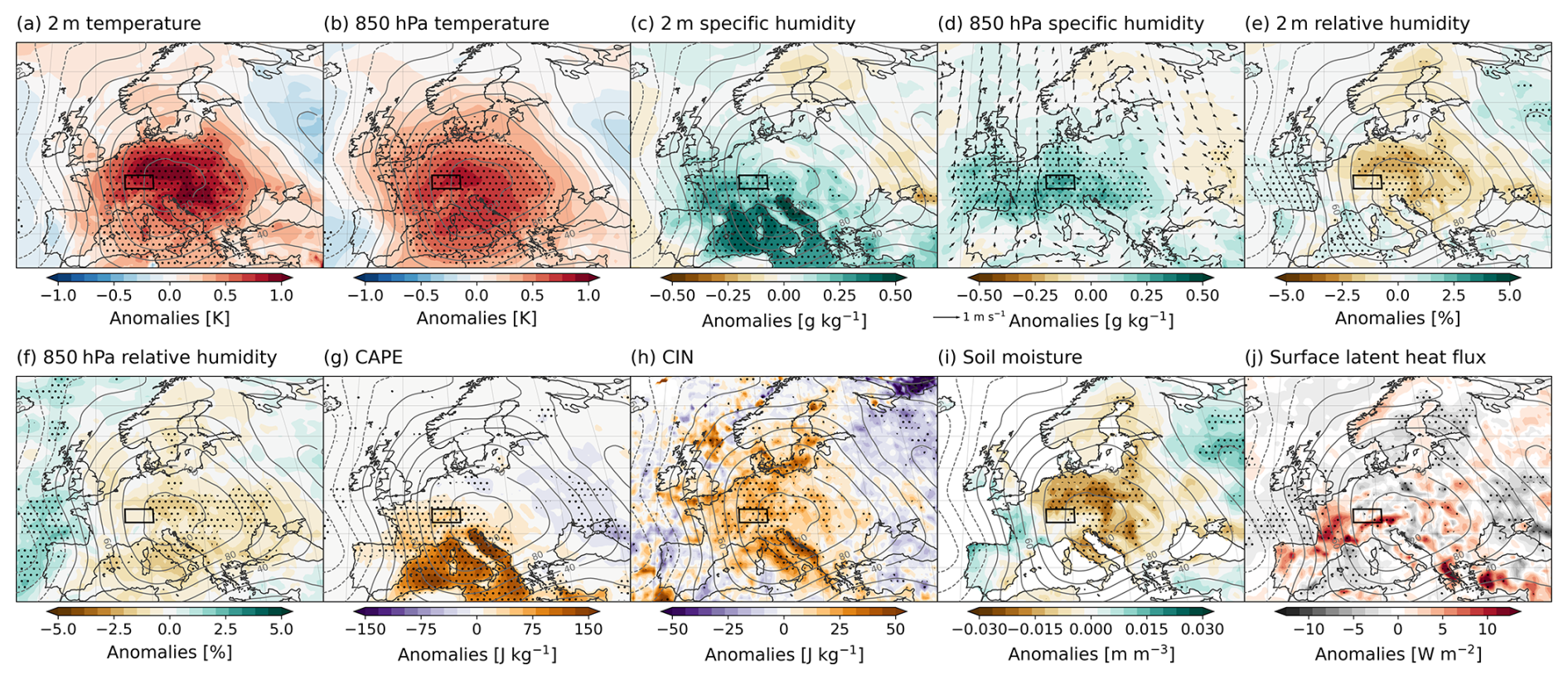
Figure 4Mean anomalies of near-surface and lower-tropospheric thermodynamic and land-surface variables during the ten most active hail seasons in northern Switzerland. Shown are (a, b) temperature at 2 m and 850 hPa, (c, d) specific humidity at 2 m and 850 hPa, (e, f) relative humidity at 2 m and 850 hPa, (g) convective available potential energy, (h) convective inhibition, (i) soil moisture and (j) surface latent heat flux. Positive values in panel (j) indicate enhanced upward latent heat flux from the surface to the atmosphere compared to the climatology (opposite to ERA5 convention). Black contours show 500 hPa geopotential height anomalies at 20 m intervals, the arrows in panel (d) indicate 850 hPa wind direction and speed. Stippling indicates statistical significance at the 95 % confidence level. The black box marks the study area in northern Switzerland.
Relative humidity anomalies at 2 m and 850 hPa are slightly negative and not significant over the study area, but show significant negative values across much of Central and Eastern Europe despite the larger than average specific humidity values (Fig. 4e, f). This contrast in the sign of specific versus relative humidity anomalies is consistent with the strong positive temperature anomalies, which increase the saturation vapor pressure. As a result, relative humidity decreases despite the increase in absolute moisture, indicating an enhanced vapor pressure deficit.
The resulting warm and moist conditions at the surface and in the lower to mid troposphere are consistent with a favorable vertical thermodynamic profile that promotes enhanced instability, contributing to above-average CAPE and supporting the strong updrafts required for hail growth. Accordingly, CAPE anomalies are strongly positive over southern Central Europe and the Mediterranean (Fig. 4g). CIN anomalies are positive across Central Europe, the study area, and the Adriatic (Fig. 4h), consistent with the positive dependence of both CAPE and CIN on temperature (Emanuel, 2023). Moderate CIN can suppress premature convective initiation, allowing instability to accumulate and favoring more isolated, organized storms once sufficient lifting is present, whereas excessive CIN may inhibit convection. Together with favorable deep-layer vertical wind shear associated with the synoptic configuration, large CAPE and moderate CIN can promote organized, long-lived storms such as supercells, whose sustained strong updrafts provide favorable conditions for large-hail growth (Allen et al., 2020; Lin and Kumjian, 2022).
Towards the western edge of the upper-level ridge (i.e. over the Pyrenees and Iberian Peninsula) CIN anomalies are weaker and become partly negative (not statistically significant). This could stem from the locally increased 2m specific humidity there, which, together with the positive temperature anomalies lead to reduced CIN and simultaneously increased CAPE. Over Portugal weakened subsidence warming or a local replacement by large-scale ascent associated with approaching troughs or fronts could also contribute to the reduced CIN.
In the study area, soil-moisture anomalies are generally weak and not statistically significant. However, a pronounced west-east soil-moisture gradient extends across the surrounding region, with wetter-than-average conditions upstream over western France and significant dry anomalies downstream toward eastern Europe (Fig. 4i). The dry region over Eastern Europe coincides with strong positive surface-temperature anomalies, consistent with land–atmosphere feedback processes. Surface latent heat flux anomalies over the study area are generally weak and not statistically significant. In contrast, significant positive latent heat flux anomalies occur over the Alps despite the absence of a clear soil-moisture signal, indicating enhanced surface evaporation and thus increased moisture uptake by the atmosphere (absolute latent heat fluxes remain positive, i.e., evaporation dominates; not shown). However, the interpretation of surface flux anomalies over the Alps requires particular caution in ERA5 given the complex topography and associated uncertainties. Further positive latent heat flux anomalies are found over the Iberian Peninsula and France, coinciding with wetter-than-average soil moisture conditions, although these anomalies are not statistically significant. Negative latent heat flux anomalies occur over the Mediterranean (significant) and across much of Germany and eastern Europe (not significant), consistent with reduced evaporation.
4.1.3 Summary north
In summary, active hail seasons north of the Alps are characterized by a pronounced mid-/upper-level, zonally oriented positive–negative–positive Z500 anomaly pattern over the Atlantic and Central Europe, associated with amplified meridional flow over the study area, a northwardly displaced jet over the Atlantic and a weakened subtropical jet over the Mediterranean. Recurrent flow conditions upstream and over Europe provide repeated large-scale forcing in the form of troughs upstream of western Europe during the season. The large-scale forcing meets favorable local thermodynamic conditions, including positive temperature and specific humidity anomalies over northern Switzerland and positive Mediterranean SST anomalies. The combination allows for the formation of warm and moist but unsaturated boundary layers and a favorable vertical thermodynamic structure, resulting in enhanced CAPE and moderate CIN. Moisture supply is linked primarily to evaporation from adjacent continental regions with wetter than average soils or to Atlantic influences. Together these conditions create a setting favorable for repeated hailstorm occurrence in northern Switzerland.
4.2 Southern Switzerland
4.2.1 Large-scale conditions
Although northern and southern Switzerland are geographically close, the Alps constitute a climatic divide that separates distinct air-mass influences and flow regimes. As a result, the large-scale environments associated with active hail seasons differ substantially between the two regions. To investigate these contrasts, we now focus on southern Switzerland and analyze composites of Z500, 300 hPa wind speed, blocking, cutoff and streamer frequency, as well as SST anomalies for the entire hail season (Fig. 5).
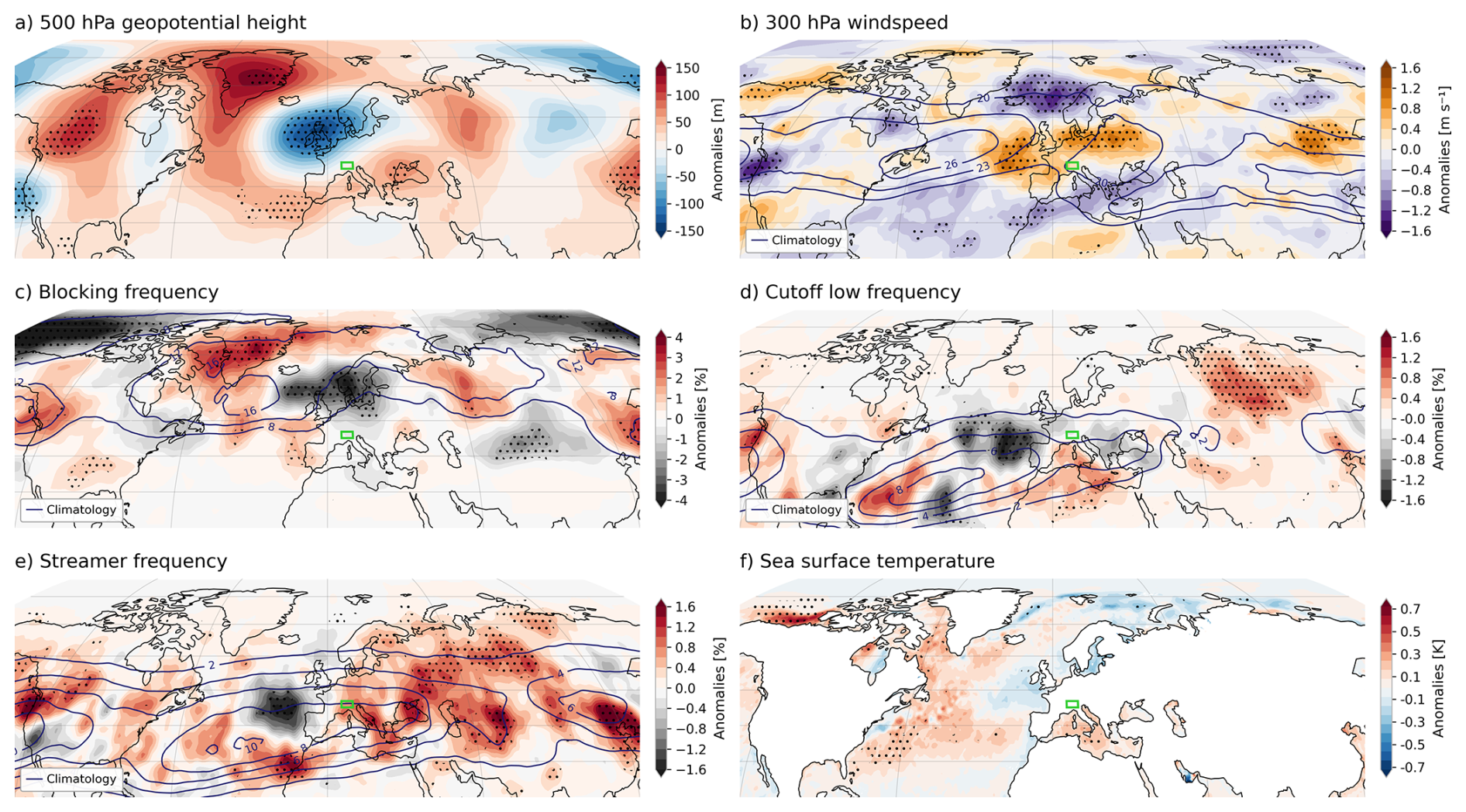
Figure 5Mean anomalies of large-scale atmospheric and oceanic variables during the ten most active hail seasons in southern Switzerland. (a) Geopotential height at 500 hPa, (b) 300 hPa wind speed with the climatology as black contours, (d) blocking frequency with mean climatology contours in darkblue, (e) cutoff low frequency with mean climatology contours in darkblue, (f) streamer frequency with mean climatology contours in darkblue, (g) SST. Stippling indicates areas statistically significant at the 95 % confidence level. The green box marks the study region in southern Switzerland.
The 500 hPa geopotential height anomaly composites reveal a pronounced meridionally oriented wave pattern of positive and negative geopotential height anomalies over the North Atlantic sector (Fig. 5a). These anomalies represent the recurrent occurrence of a synoptic configuration characterized by an extensive ridge over the northwestern Atlantic and Greenland, a southwest–northeast-oriented trough centered over the British Isles and northern Europe, and positive geopotential height anomalies south and southeast of the trough over the Mediterranean and southern Europe. This synoptic configuration is associated with pronounced southwesterly flow across Central Europe and an eastward extension of the upper-level jet over northern Europe and the eastern Atlantic (Fig. 5b). Southern Switzerland lies within the transition zone between the cyclonic and anticyclonic upper-level anomalies, where the associated synoptic configuration typically favors large-scale ascent, consistent with vertical velocity anomalies (not shown). The Greenland and North Atlantic positive geopotential height anomalies coincide with strong positive blocking frequency anomalies, indicating the frequent occurrence of anticyclonic flow in this sector (Fig. 5c). The low frequency of stratospheric PV streamers and cutoff lows near the British Isles suggests that the trough remains embedded in the midlatitude westerly flow rather than evolving into an isolated cutoff (Fig. 5d, e). This configuration facilitates coherent downstream Rossby wave propagation. In contrast, a positive PV streamer anomaly exists along the west coast of North Africa, within a region of climatologically positive geopotential height, and suggests that an anomalously large fraction of PV streamers extend unusually far south.
To assess the temporal persistence of these circulation patterns, we again examine mean R-metric anomalies of the 500 hPa meridional wind between 40 and 70° N as a measure of subseasonal recurrence (Fig. 6). Peak hail day frequency in southern Switzerland occurs in July and August. Significant positive R anomalies are found mainly from mid-July to September, predominantly upstream over the North Atlantic, reflecting the repeated occurrence of similar large-scale flow configurations, potentially linked to recurrent wave breaking upstream and downstream of the Greenland blocking anticyclone.
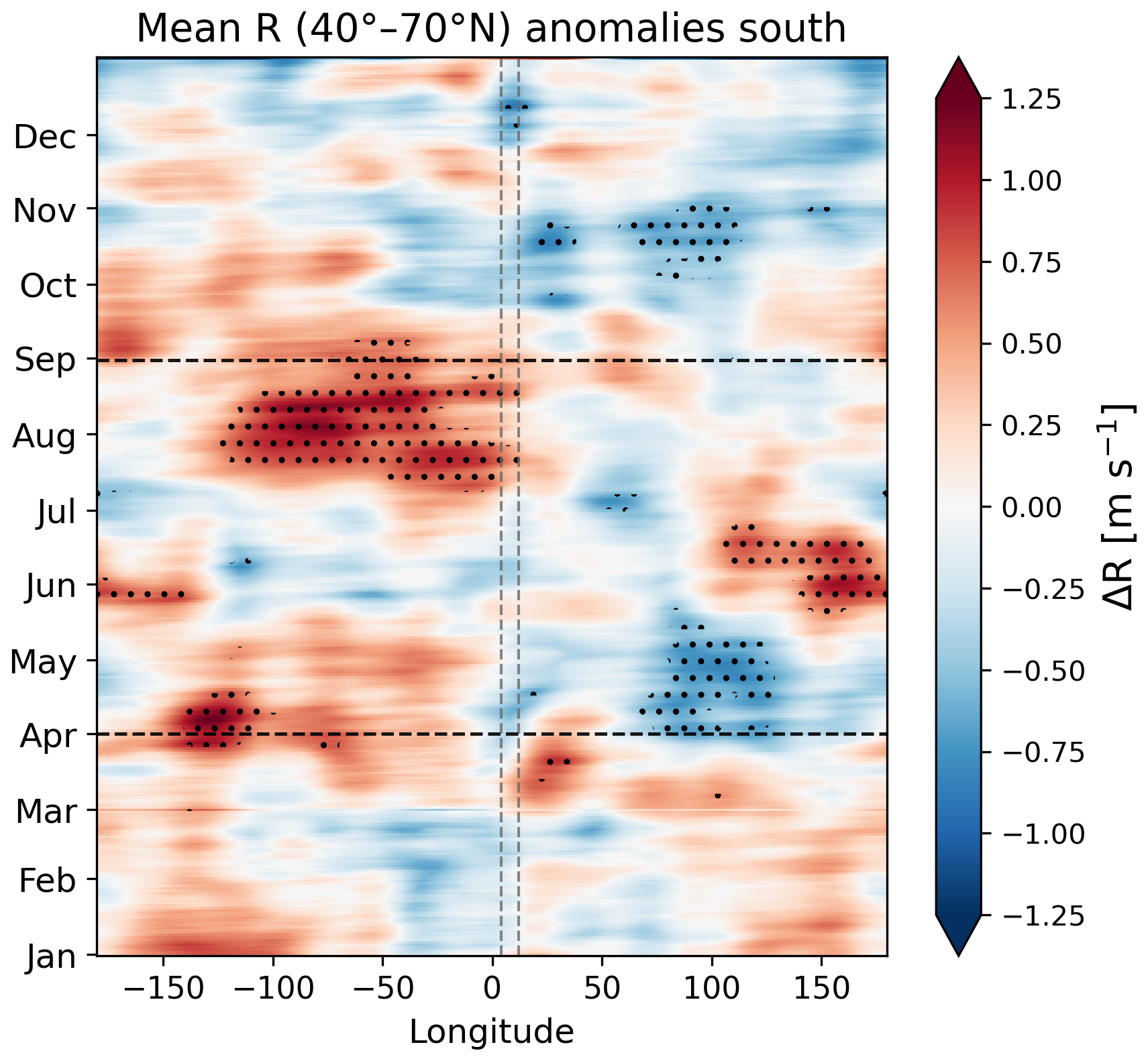
Figure 6Mean anomalies of the R-metric of 500 hPa meridional wind (averaged between 40 and 70° N) for the ten most active hail seasons in southern Switzerland. The R-metric represents the spatial recurrence of similar large-scale flow patterns. Red colors denote enhanced recurrence, and blue colors indicate reduced recurrence relative to climatology. Stippling marks areas statistically significant at the 95 % confidence level. The grey vertical dashed lines highlight the longitudinal sector of the study region, and the black horizontal dashed lines indicate the beginning and end of the Swiss hail season.
SST anomalies are weaker than in the composites for northern Switzerland, and fewer regions exhibit statistically significant signals (Fig. 5f). The SST pattern broadly mirrors the upper-level circulation, with significant positive anomalies in the western North Atlantic, the Labrador Sea, the Beaufort Sea, and localized areas of the Mediterranean. Negative SST anomalies occur around the British Isles but are not statistically significant. Together, these oceanic anomalies are consistent with the large-scale circulation pattern and contribute to the background state that modulates surface and lower-tropospheric conditions over southern Europe.
4.2.2 Thermodynamic and land-surface conditions
Composite anomalies of key near-surface and lower-tropospheric variables during active hail seasons south of the Alps are shown in Fig. 7. A positive temperature anomaly extends across southern Europe both at 2 m and at 850 hPa (Fig. 7a, b), consistent with the positive Z500 anomalies over the Mediterranean identified in Fig. 5a. The southern Switzerland domain lies north of the significantly positive temperature anomalies, in an area with neither significant positive nor significant negative temperature anomalies. Negative temperature anomalies dominate over Scandinavia and the British Isles (only significant at the surface). This dipole pattern creates a strong horizontal temperature gradient (Fig. 7a, b). Specific- and relative-humidity anomalies show a vertical contrast between the surface and the lower troposphere (Fig. 7c, e and d, f). At 2 m, specific humidity anomalies are positive over the Mediterranean Sea but negative over the Iberian peninsula, indicating a moist marine boundary layer next to drier continental air (Fig. 7c). Over southern Switzerland the 2 m specific moisture anomalies are positive but not significant. At 850 hPa, specific humidity anomalies are negative across the western Mediterranean Sea, indicating a dry layer aloft above the moist surface air (Fig. 7d). Combined with positive temperature anomalies, this leads to reduced relative humidity over the Iberian Peninsula in both layers (Fig. 7a, b and e, f). There are no significant relative humidity anomalies directly over southern Switzerland. The southwesterly flow at 850 hPa suggests the advection of warm, relatively dry air from the Iberian Peninsula toward southern Switzerland, potentially establishing a dry elevated layer repeatedly throughout the season (Fig. 7d). CAPE over southern Switzerland is marginally higher compared to the climatology (Fig. 7g). In this area, the climatological CAPE values are already high, similar as over the Mediterranean. CIN anomalies over southern Switzerland are significantly positive (Fig. 7h). This combination can support intense convection once forced ascent (either orographic or synoptic) erodes the capping inversion.
Soil-moisture anomalies exhibit a pronounced north-south gradient that closely mirrors the Z500 and temperature anomaly patterns (Fig. 7i). Regions with positive temperature anomalies correspond to negative soil-moisture anomalies, indicating warm and dry conditions over southern Europe and the Mediterranean dominating during the season. There are no significant soil moisture anomalies locally in the study area. Significant surface latent heat flux anomalies are found over the Iberian Peninsula, Italy, and parts of southern Germany, where negative anomalies indicate reduced upward fluxes, despite evaporation remaining positive in absolute terms (Fig. 7j). In contrast, the Mediterranean Sea exhibits localized positive latent heat flux anomalies, indicating enhanced evaporation and suggesting that the Mediterranean acts as a more important moisture source for the atmosphere than local land-surface evaporation during hail-active seasons.
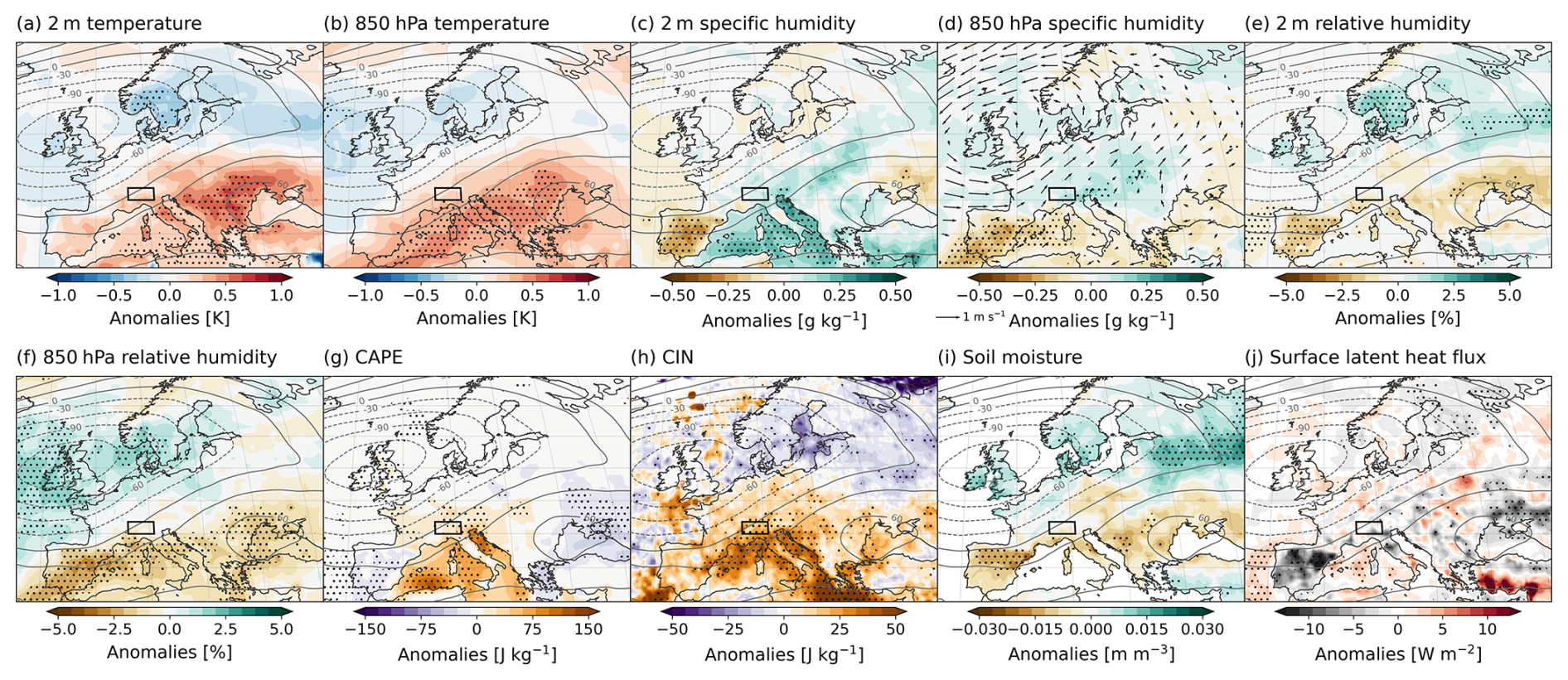
Figure 7Mean anomalies of near-surface and lower-tropospheric thermodynamic and land-surface variables during the ten most active hail seasons in southern Switzerland. Shown are (a, b) temperature at 2 m and 850 hPa, (c, d) specific humidity at 2 m and 850 hPa, (e, f) relative humidity at 2 m and 850 hPa, (g) convective available potential energy, (h) convective inhibition, (i) soil moisture and (j) surface latent heat flux. Positive values in panel (j) indicate enhanced upward latent heat flux from the surface to the atmosphere compared to the climatology (opposite to ERA5 convention). Black contours show 500 hPa geopotential height anomalies at 30 m intervals, the arrows in panel (d) indicate 850 hPa wind direction and speed. Stippling indicates statistical significance at the 95 % confidence level. The black box marks the study area in southern Switzerland.
4.2.3 Summary south
In summary, active hail seasons south of the Alps are associated with a large-scale dipole pattern, featuring enhanced blocking and high pressure over Greenland, low pressure over the British Isles, and high pressure across southern Europe and the Mediterranean. This configuration is associated with southwesterly flow over Central Europe, accompanied by sharp horizontal temperature and soil moisture gradients. At the surface, conditions are typically moist over the Mediterranean but drier over adjacent continental regions, while the lower troposphere over the western Mediterranean contains an elevated dry layer likely advected from the Iberian Peninsula leading to moderately high CIN anomalies in the study area and the Mediterranean. Repeated wave breaking downstream of the Greenland block favors recurrent trough development north of the Alps, which may exert downstream influences on convective initiation and organization south of the Alpine crest trough quasi-geostrophic forcing and (pre-)frontal environments. Compared to northern Switzerland local anomalies in the south are weaker in temperature, humidity and CAPE, suggesting that the southern domain is generally more predisposed to convection. Nevertheless, positive Mediterranean SST anomalies could support enhanced moisture transport toward southern Switzerland, further promoting hail activity.
A central question in interpreting the previous seasonal composites is the extent to which the seasonal-mean anomalies are shaped by the environments on hail days themselves, as opposed to reflecting a seasonal “background state”. Unlike the R-metric, which assesses whether the seasonal circulation anomalies result from persistent or recurrent synoptic configurations, the following analysis examines whether the seasonal anomalies are primarily determined by hail-day environments or by the seasonal background conditions. This distinction helps identify which variables primarily reflect seasonal preconditioning and which are mainly associated with event-scale hail-day environments.
To answer this, we compare five sets of anomaly fields for northern and southern Switzerland (Figs. 8 and 9): (i) the mean over all non-hail days during 1959–2022 (row 1), (ii) the mean over non-hail days occurring within the ten most active hail seasons (row 2), (iii) the mean over all hail days during 1959–2022 (row 3), (iv) the mean over hail days within the ten most active hail seasons (row 4), and (v) the seasonal-mean anomalies of the ten most active hail seasons (row 5). Interpreting the comparisons between rows relies on two key relationships. Variables that already differ between the two non-hail day composites (rows 1 and 2) indicate seasonal preconditioning during active hail seasons. In contrast, variables that become substantially more anomalous on hail days (rows 3 and 4) than on non-hail days (rows 1 and 2) primarily reflect event-scale hail-day environments.
5.1 Northern Switzerland
Figure 8 shows that for northern Switzerland, the hail day composites (rows 3 and 4) exhibit a coherent ridge–trough configuration over Europe accompanied by warm near-surface temperatures, enhanced low-level moisture, elevated CAPE, and moderate CIN, which are features that closely resemble those found in the seasonal-mean composites (row 5). As expected, the magnitudes of the seasonal-mean anomalies are substantially weaker than those of the hail day-only composites, reflecting the inclusion of non-hail days that either display weaker anomalies or anomalies of opposite sign (row 1 and 2). This contrast is particularly evident when comparing the two non-hail day composites. The composite of all non-hail days (row 1) exhibits anomaly patterns that are largely opposite to those observed on hail days (rows 3 and 4) and in the seasonal means (row 5), including negative Z500 anomalies over Central and Eastern Europe, weakly negative Mediterranean SST anomalies, and negative anomalies in 2 m temperature, 850 hPa specific humidity, CAPE, and CIN over most of Central Europe; conditions that are generally unfavorable for convective storm development. In contrast, when restricting the composites of non-hail days to the most active hail seasons (row 2), the anomaly patterns more closely resemble those of the hail day and seasonal-mean composites (rows 3, 4, 5), particularly in Z500, SST and 2 m temperature. Z500 anomalies are positive over Europe, Mediterranean SSTs and surface temperature anomalies are predominantly positive across much of the continent, consistent with a background state conducive to hailstorm development (Fig. 8g,h,i). By contrast CAPE and CIN anomalies remain negative (Fig. 8k,l). Notably, the two non-hail day composites (rows 1 and 2) differ in sign primarily for Z500, SST, and surface temperature, while they remain similar for CAPE, CIN, and 850 hPa specific humidity. This indicates that large-scale circulation, SST, and surface temperature are already anomalous during non-hail days of active seasons, suggesting that they characterize the seasonal background state rather than conditions unique to hail days. In contrast, CAPE, CIN, and 850 hPa specific humidity remain similar between the two non-hail day composites but become substantially more anomalous on hail days, indicating that they primarily characterize event-scale hail-day environments rather than persistent seasonal preconditioning.
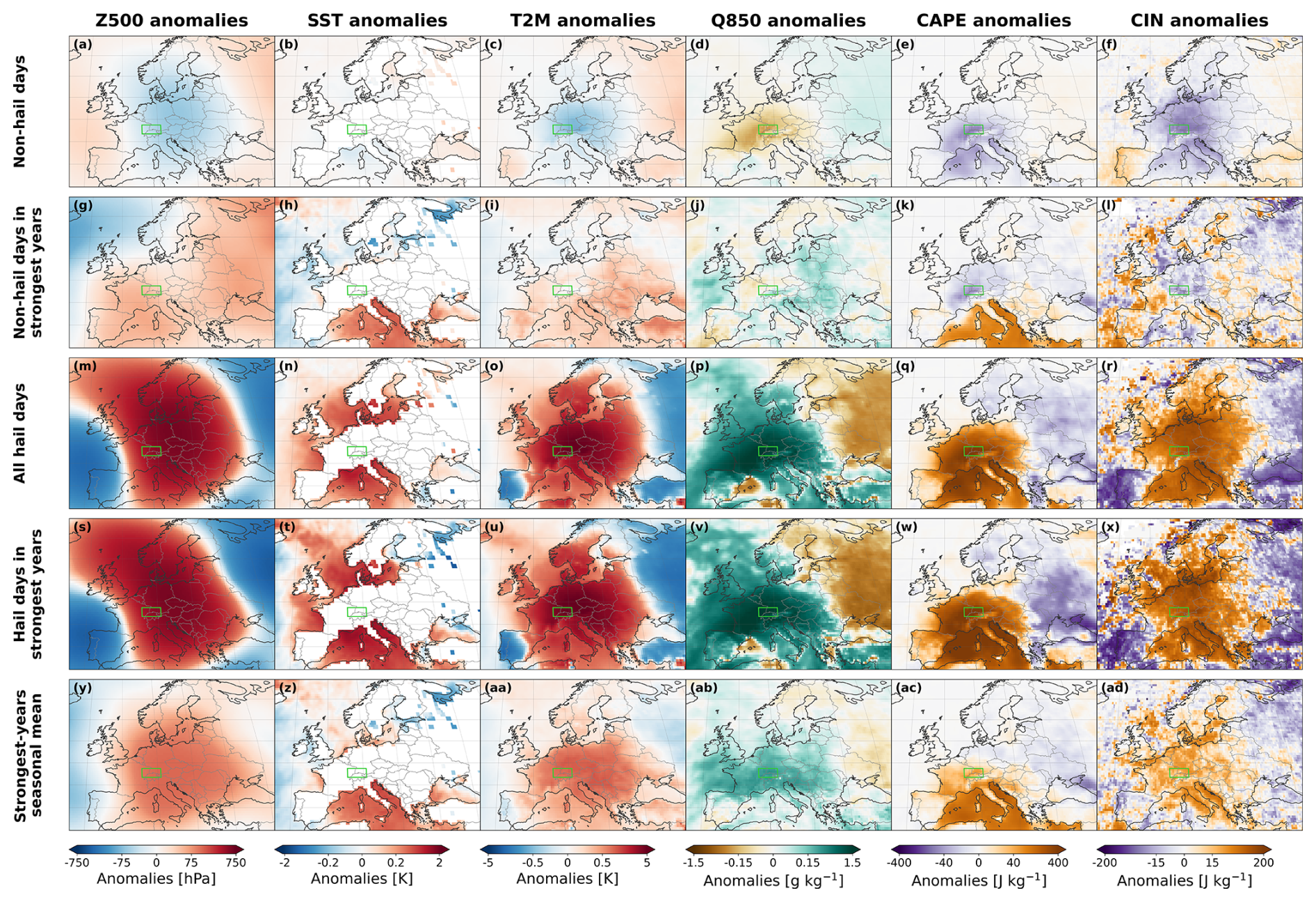
Figure 8Composite anomalies of large-scale and thermodynamic variables during hail and non-hail periods for northern Switzerland. Shown are anomalies in 500 hPa geopotential height (Z500), sea surface temperature (SST), 2 m temperature (T2M), 850 hPa specific humidity (q850), convective available potential energy (CAPE), and convective inhibition (CIN). Rows represent (top to bottom): (a–f) mean anomalies over all non-hail days, (g–l) mean anomalies over non-hail days during the ten most active hail seasons, (m–r) mean anomalies over all hail days, (s–x) mean anomalies over hail days during the ten most active hail seasons, and (y–ad) seasonal means of the ten most active seasons (April–September). Note that the color scales are logarithmic to accommodate the wide range of anomalies across all five rows.
The two hail day composites (rows 3 and 4) are themselves highly similar, demonstrating that hail days in average seasons and hail days in exceptionally active seasons arise from broadly the same type of environment. However, most anomalies are systematically stronger in the hail day composite of the most active seasons (row 4) than in the all-hail day composite (row 3; note the logarithmic color scaling used in the figure). This suggests that the physical processes associated with hail formation are qualitatively similar across seasons, but they occur with greater magnitude during particularly hail-active seasons.
The relatively small differences between Mediterranean SST anomalies on non-hail days in the most active seasons (row 2), on hail days (rows 3 and 4), and in the seasonal means (row 5), together with the weakly negative SST anomalies on all non-hail days (row 1), indicate that warm SST anomalies persist throughout much of active seasons rather than being confined to individual hail events. This persistence is consistent with the large heat capacity of the ocean and the consequently slow evolution of SSTs. These anomalies may therefore either exert a sustained influence on the lower-tropospheric environment, e.g., by enhancing moisture availability, or simply reflect the prevailing large-scale circulation throughout the season. Surface temperature anomalies likewise remain positive in the seasonal-mean and hail day composites (rows 2–5) compared to all non-hail days (row 1).
5.2 Southern Switzerland
South of the Alps, the large-scale flow patterns evident in the seasonal means are again recognizable in the hail day composites, although the contrast between hail day and seasonal-mean anomalies is more pronounced than in northern Switzerland (Fig. 9). On hail days, Z500 anomalies (rows 3 and 4) reveal a markedly stronger and more meridionally oriented trough-ridge configuration than in the seasonal mean (row 5), with the downstream ridge extending slightly farther into northeastern Europe. As in northern Switzerland, Mediterranean SST anomalies during hail days of the most active seasons are approximately twice as large as in the all-hail days composite and are also positive during non-haildays in the most active seasons (Fig. 9t, n, h). This indicates that warmer than average Mediterranean SSTs are a robust and persistent feature of hail-active summers in both regions, rather than being confined to individual hail events.
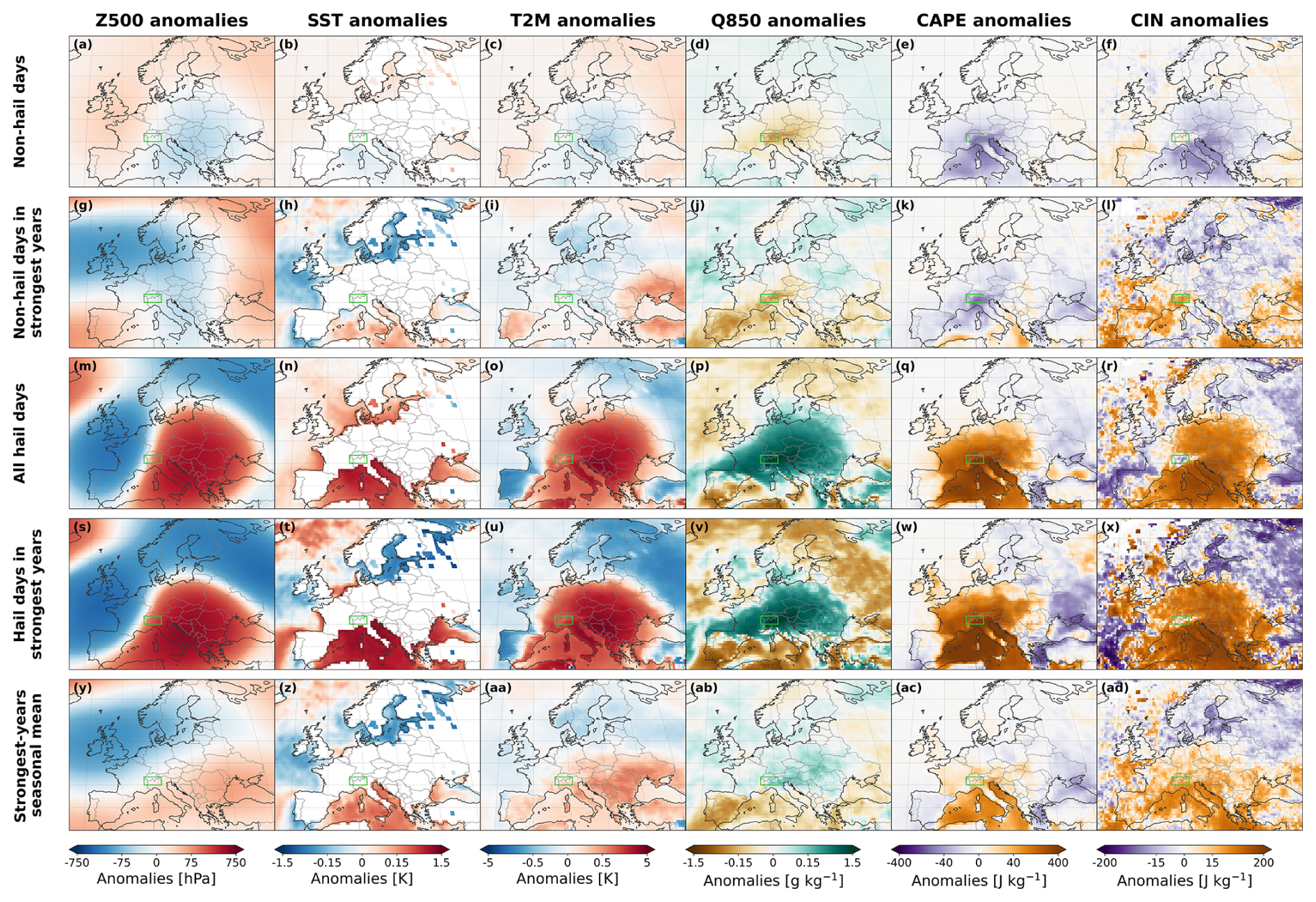
Figure 9Same as Fig. 8, but for southern Switzerland.
Near-surface temperature, low-level specific humidity, and CAPE exhibit substantially stronger anomalies over the study area and much of Central Europe on hail days in the most active seasons (row 4) than in the all-hail days composite (row 3). This suggests not only that the frequency of hail events may be enhanced, but the higher CAPE could also promote stronger updrafts during the most active hail seasons. CIN anomalies in the all-hail days composite are predominantly negative over the study area, reflecting weaker convective inhibition during average hail seasons compared to the most active hail seasons. In contrast to northern Switzerland, the non-hail day composite within the most active hail seasons (row 2) south of the Alps shows little indication of favorable preconditioning in mean Z500, near-surface temperature, or low-level moisture. This implies that these variables alone do not distinguish active from inactive days during hail-rich seasons. However, Mediterranean SST anomalies remain positive, and CIN anomalies are stronger relative to the all non-hail days composite (Fig. 9l, f). This combination points to the generally more frequent presence of a capping inversion during active seasons, consistent with repeated advection of warm, relatively dry air aloft and the potential repeated establishment of an elevated mixed layer.
Comparing both non-hail day composites (rows 1 and 2) with the hail day composites (rows 3 and 4) further highlights that differences in anomaly sign over Central Europe, particularly in Z500, CAPE, 850 hPa specific humidity, and 2 m temperature, indicate that the availability of instability, moisture, warm near-surface conditions, and a favorable large-scale circulation must be considered jointly to distinguish hail from non-hail days. Overall, seasonal-mean anomalies south of the Alps are weaker than those found north of the Alps (not shown), reflecting that southern Switzerland is climatologically closer to the convective threshold. Consequently, hail formation south of the Alps appears to be less dependent on strong seasonal-scale thermodynamic preconditioning and more sensitive to synoptic and mesoscale triggers acting within a climatologically already favorable environment.
The results from the previous two Sections show that hail-active seasons arise from the repeated occurrence of favorable large-scale upper-level flow patterns acting within, or actively establishing, thermodynamically favorable environments. To discuss which of the seasonal mean anomalies seen has the highest relative strength across variables and between regions and potentially has the strongest effect on hail activity, we also computed seasonal mean composites in standard deviation units (Fig. 10). This was done by dividing daily anomalies by the local hail-season standard deviation prior to compositing. In this framework, “strongest” denotes the largest standardized anomaly magnitude, i.e., the largest signal relative to typical background variability. Values are typically < 1 because they represent seasonal means rather than individual-day extremes.
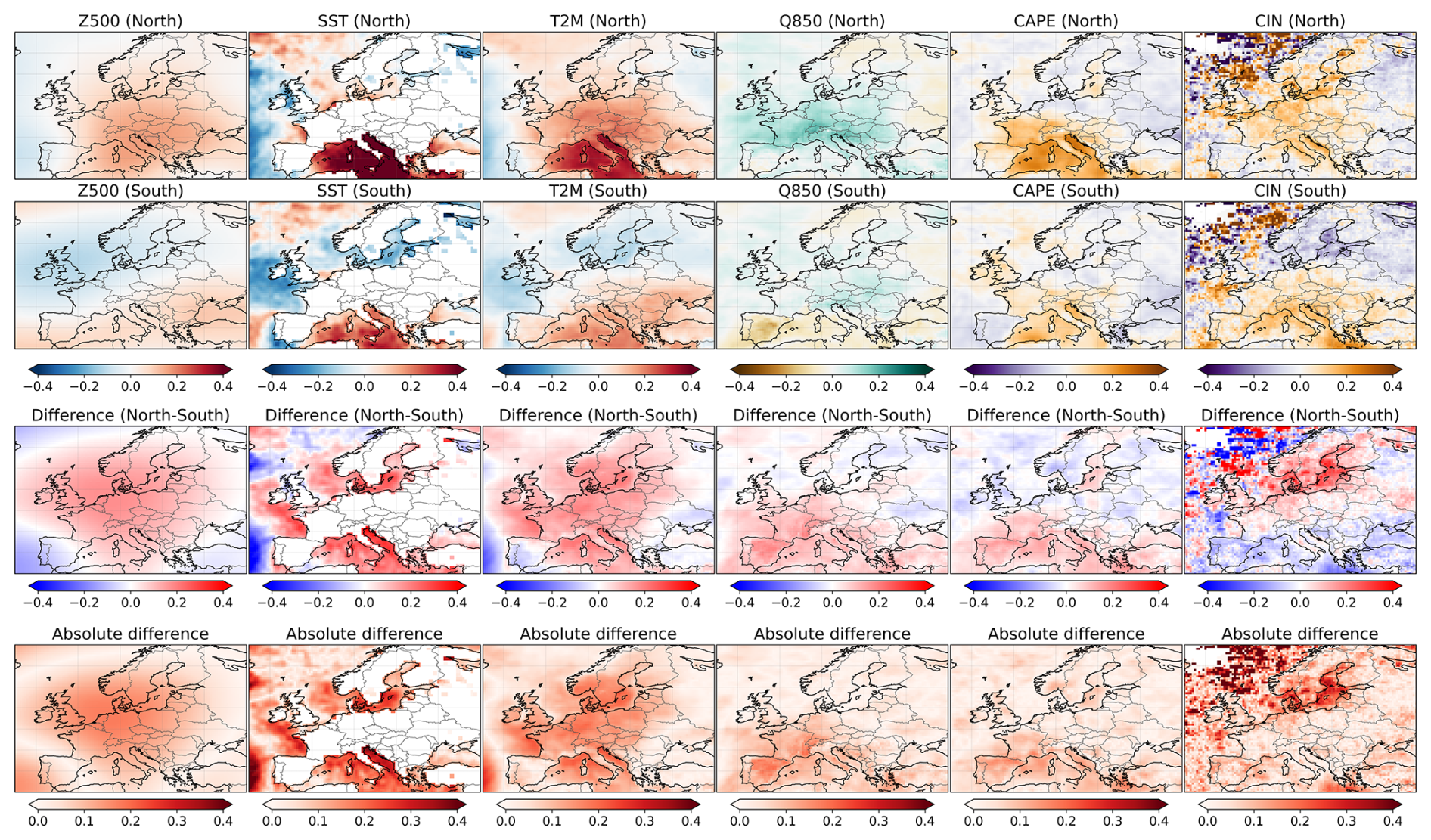
Figure 10Standardized mean anomalies of key atmospheric and thermodynamic variables during the ten most active hail seasons north and south of the Alps. Panels show anomalies in 500 hPa geopotential height (Z500), sea surface temperature (SST), 2 m temperature (T2M), 850 hPa specific humidity (q850), convective available potential energy (CAPE), and convective inhibition (CIN) for the northern (top row) and southern (second row) regions. The third row shows the their difference (North − South), and the bottom row the absolute magnitude of those differences. All fields are standardized by their interannual variability, allowing direct comparison of anomaly strength across variables and regions.
The standardized composites of Z500, SST, 2 m temperature, 850 hPa specific humidity, CAPE, and CIN reveal that active hail seasons north of the Alps are associated with markedly stronger surface and upper-level anomalies than those south of the Alps (Fig. 10). The largest anomalies occur in surface temperature and SST, highlighting that hail activity in northern Switzerland is temperature-limited as discussed in Feldmann et al. (2025). As mentioned, south of the Alps, the same thermodynamic anomaly patterns emerge but with smaller amplitudes. This indicates that even modest deviations from the mean state are sufficient to enhance hail frequency in southern Switzerland, as the climatological environment is already thermodynamically favorable for convection. This north–south contrast is consistent with Feldmann et al. (2025), who identified regions north of the Alps as a temperature-limited convective regime reliant on strong dynamical forcing, and the Alpine south and Mediterranean as a convectively favorable regime where weak synoptic perturbations can trigger storms, leading to more frequent convective outbreaks. Indeed there are overall more hail days south of the Alps (12 % of all days) than north of the Alps (10.3 %).
The comparison between seasonal means and hail-day-only composites further clarifies the interplay between the favorable background state throughout the active seasons and the conditions prevailing on individual hail days. In both regions, hail-day composites closely mirror the seasonal anomalies in Z500, CAPE, CIN, and near-surface thermodynamic fields, but with markedly stronger amplitudes, whereas non-hail days often display anomalies of opposite sign. In northern Switzerland active seasons are characterized not just by a single, persistent favorable background state or just by isolated extreme hail day environments, but by a combination of both, namely of a seasonally favorable preconditioned background (with positive sea and land surface temperatures) within which synoptic-scale or mesoscale disturbances repeatedly establish strongly hail-favorable thermodynamic and dynamical conditions that push the atmosphere beyond the convective threshold. The close similarity between hail day anomalies in climatological seasons and those in the most active seasons further indicates that hail-rich seasons are distinguished less by fundamentally different storm environments than by a higher recurrence of otherwise typical hail-favorable conditions. In contrast, south of the Alps, seasonal preconditioning is more limited and mainly expressed through persistent positive Mediterranean SST anomalies and enhanced convective inhibition, acting on an already near-threshold thermodynamic environment in which hail frequency is primarily controlled by recurrent synoptic and mesoscale triggering.
Lastly we aim to identify potential precursors of active hail seasons by analyzing atmospheric, oceanic, and land-surface conditions prior to the most active and inactive hail seasons, including the preceding winter, spring, and the full year before the hail season. Several coherent and statistically significant anomalies emerge, suggesting large-scale preconditioning mechanisms that may influence hail activity in the subsequent summer. The most relevant signals are discussed below.
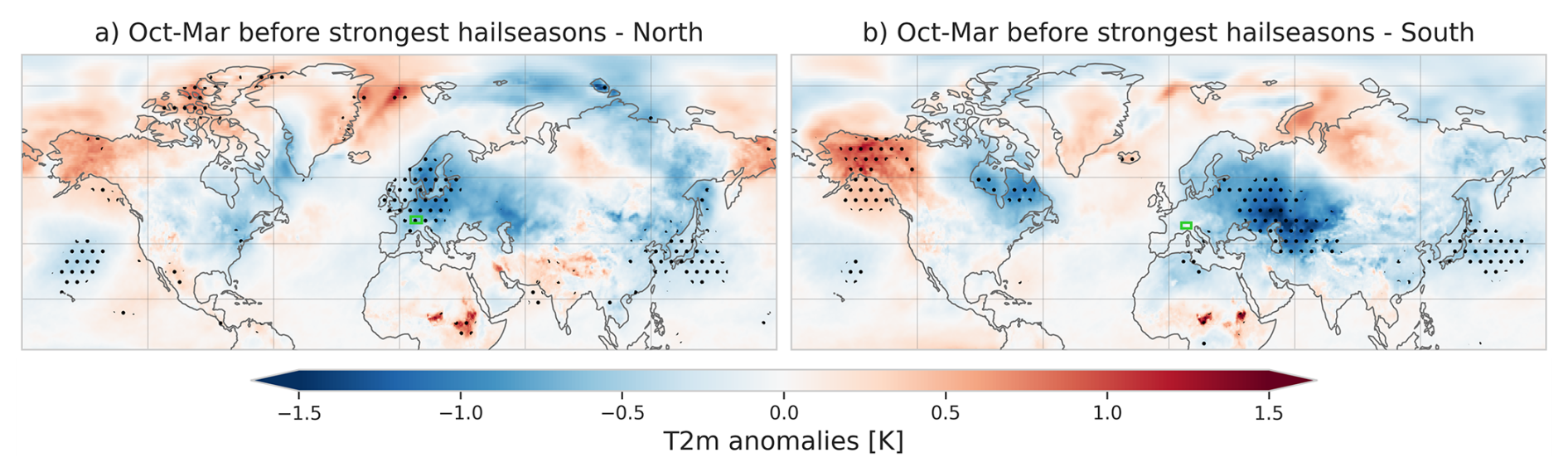
Figure 11Mean surface temperature anomalies over October to March preceding the ten most active hail seasons in northern and southern Switzerland. Panels (a) and (b) show anomalies prior to the most active hail seasons for the northern and southern regions. Stippling indicates statistical significance at the 95 % confidence level.
The preceding winters exhibit distinct 2 m temperature (t2m) anomalies for both study areas (Fig. 11). For active seasons in the northern study area, cooler-than-average surface temperatures occur over Central Europe and Scandinavia, whereas for the southern study area the cold anomalies extend across western Russia and Kazakhstan and are stronger and more spatially extensive. These patterns coincide with increased snow cover over the respective regions (see Appendix Fig. A3). Both regions also show the same temperature signatures over North America, with cold anomalies over northeastern North America and warm anomalies over Alaska and Canada, although the signal is more pronounced and significant for the southern region. These temperature patterns again correspond to positive snow-cover anomalies over colder northeastern North America, and negative anomalies over warmer Alaska (see Appendix Fig. A3). Alpine snow cover is near normal for the northern area and slightly reduced for the southern area (not significant). The patterns for inactive seasons exhibit mostly opposite signs (see Appendix Fig. A4).
In the Pacific sector, SST anomalies during active hail seasons show a colder-than-average eastern and central Pacific and a warmer-than-average Gulf of Alaska, mirroring the surface-temperature anomalies in the Pacific (Fig. 12). This pattern closely resembles the positive phase of the Pacific Decadal Oscillation (PDO, Mantua et al., 1997; Newman et al., 2016)). In inactive seasons the western Pacific SST anomalies show opposites signs to those in active hail seasons (see Appendix Fig. A5). The positive SST and 2 m temperature anomalies in the Gulf of Alaska coincide with increased recurrence of the mid-level (500 hPa) large-scale flow during January to April preceding the most active hail seasons for both regions, although the signal is significant only during April (the beginning of the hail season) in the south (Fig. 6). In summary, strong hail seasons in Switzerland are preceded by winters with enhanced Eurasian snow cover, widespread continental cooling, and Pacific SST anomalies resembling a positive PDO pattern.
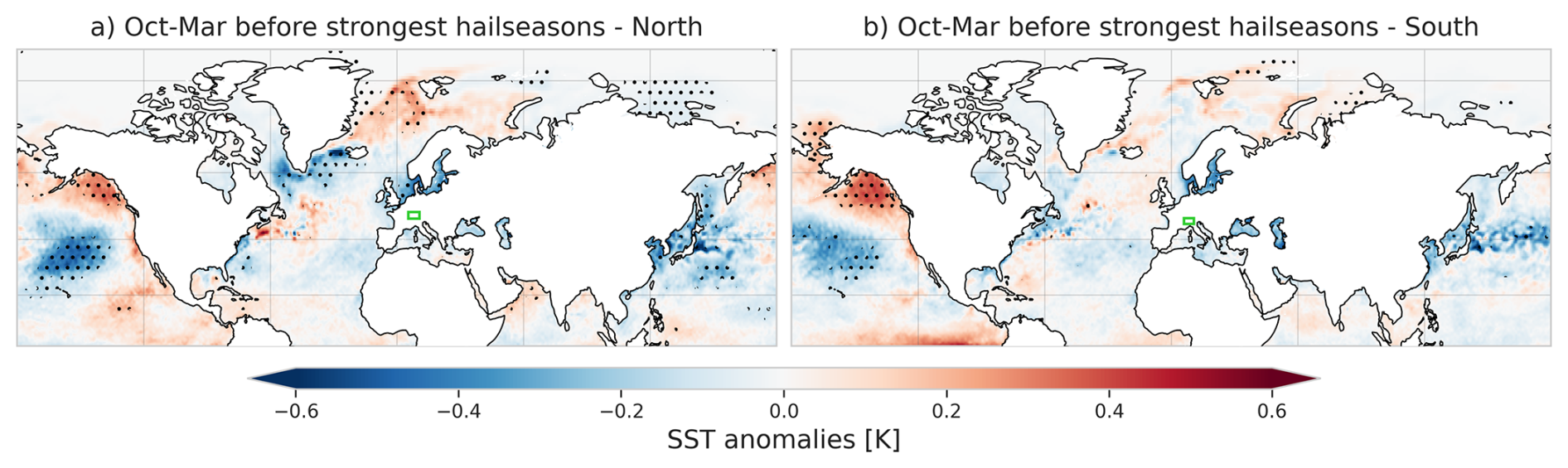
Figure 12As Fig. 11, but for sea surface temperature.
This study provides the first long-term, regionally resolved assessment of interannual hail variability in Switzerland, linking seasonal hail day frequency to atmospheric, oceanic, and land-surface anomalies across multiple spatial and temporal scales.Our results indicate that hail-active seasons are associated with the repeated occurrence of favorable large-scale circulation patterns embedded within, or actively establishing, thermodynamically favorable environments. The predominant seasonal-mean circulation, as well as the sign and magnitude of the associated thermodynamic and stability anomalies, differ between the two study regions. Corresponding analyses of the ten least active hail seasons (the Supplement) reveal largely opposite anomaly patterns, supporting the robustness of the identified relationships and indicating that hail-active and hail-inactive seasons are characterized by distinct large-scale environments.
8.1 Teleconnections and large-scale climate modes
Our results position annual hail variability within the broader context of large-scale teleconnection patterns that modulate atmospheric circulation over the North Atlantic-European sector. Previous studies have identified a complex and regionally dependent relationship between the NAO and convective storm activity. While Piper and Kunz (2017) and Piper et al. (2019) reported reduced observed thunderstorm activity during positive NAO phases over western and central Europe, they also found that positive NAO phases are associated with more thunderstorm-favorable thermodynamic environments. In contrast, Augenstein et al. (2025) reported increased thunderstorm activity during positive NAO phases over parts of western Europe and attributed the apparent discrepancy with Piper and Kunz (2017) primarily to seasonal effects.
Our Z500 anomaly patterns associated with active hail seasons in northern Switzerland project more strongly onto a positive NAO-like structure. However, additional correlation analyses reveal only weak relationships with the NAO, with opposing signs depending on study region and time scale (Appendix Figs. A1 and A2). This weak NAO signal is consistent with previous work showing that the NAO exerts competing dynamical and thermodynamical influences on convection. Negative NAO phases are associated with large-scale ascent through more frequent shortwave troughs but are often associated with reduced low-level moisture availability, whereas positive NAO phases suppress large-scale lifting while enhancing moisture transport into Europe (Piper et al., 2019). These competing effects can offset one another, leading to weak or regionally varying relationships between the NAO and convective activity.
In contrast, EA and SCAND patterns consistently exhibit the strongest correlations with hail frequency across all temporal aggregations (monthly, seasonal, annual, and various lead periods), with generally higher correlations south of the Alps. North of the Alps, the strongest correlations are positive for both EA and SCAND, in agreement with previous findings that positive phases of these modes enhance convection-favorable conditions across Europe by modifying meridional temperature gradients and steering large-scale flow anomalies (Piper et al., 2019). South of the Alps, the dominant circulation pattern, characterized by a deep trough over the British Isles and a ridge over the Mediterranean, resembles the positive EA phase or the negative SCAND phase, for which the highest correlations are found. The latter contrasts with parts of the existing literature and highlights that the same mode of variability can exert different, and even opposite, influences depending on region. Weaker correlations with the EAWR and WP patterns further suggest that hail variability is influenced by a combination of teleconnections rather than a single dominant mode such as the NAO.
Notably, winters preceding active hail seasons in both regions are characterized by Pacific SST anomalies resembling a positive phase of the PDO. This may either point to a simple co-ocurrence or to a potential role of low-frequency Pacific variability in modulating the North Atlantic–European circulation through large-scale teleconnection pathways, thereby preconditioning the atmosphere for enhanced hail activity in the subsequent summer. While a direct causal link between Swiss summer hail activity and preceding winter anomalies in Pacific SSTs (or related land-surface signals such as Eurasian snow cover or continental surface temperatures) cannot be firmly established, these precursor signals nonetheless suggest potential for seasonal predictability. Because SST anomalies evolve slowly, their state several months in advance can be predicted with greater skill than synoptic-scale atmospheric conditions or local moisture fields. Moreover, the fact that most regions display opposite anomaly patterns during inactive hail seasons compared to active ones (not shown) further supports potential predictive value of these precursor signals.
8.2 Role of surface boundary conditions
Surface boundary conditions modulate the thermodynamic environment in which hail-producing convection develops and can therefore influence both the frequency and intensity of convective storms. Mediterranean SST anomalies emerge as a coherent and persistent feature of hail-active seasons in both northern and southern Switzerland. The Mediterranean has been identified as an important moisture source for Switzerland (e.g., Sodemann and Zubler, 2010), and positive SST anomalies can enhance moisture availability through increased surface latent heat fluxes and by raising the moist static energy of continental air masses, even in the absence of direct advection (Byrne and O'Gorman, 2018).
The importance of the Mediterranean as moisture source differs between the two regions. South of the Alps, positive SST anomalies coincide with enhanced latent heat fluxes and southerly low-level flow, suggesting a more direct moisture contribution to hail-favorable environments. North of the Alps, by contrast, lower-tropospheric moisture anomalies over the Mediterranean are weaker, and enhanced moisture availability appears to be driven more by continental processes, such as increased evapotranspiration from wetter-than-average soils in areas adjacent to northern Switzerland (e.g., along the Atlantic coast), or by moisture transported from the Atlantic associated with the incoming trough.
Land–atmosphere coupling may further modulate these environments. Soil moisture anomalies exhibit memory on subseasonal to seasonal timescales and can influence near-surface temperatures through changes in evapotranspiration and sensible heating (Seneviratne et al., 2010). In addition, spatial soil-moisture gradients can support convective initiation by inducing mesoscale circulations that enhance low-level convergence and lift (Liu et al., 2022; Barton et al., 2025), potentially acting in combination with synoptic-scale forcing and orographic effects. In the midlatitudes, these gradients rarely trigger convection on their own but can enhance existing convective potential, whereas in the subtropics, climatological soil-moisture gradients can actively initiate convection Taylor et al. (2011).
Despite the presence of statistically significant SST and soil-moisture anomalies during hail-active seasons, it remains difficult to unambiguously determine whether these surface boundary conditions act primarily as drivers of enhanced hail activity or whether they arise as a response to the prevailing large-scale circulation. Resolving this causality would require targeted numerical sensitivity experiments that explicitly isolate the role of surface boundary conditions.
8.3 Role of elevated mixed layers and the British Isles trough for southern Switzerland
South of the Alps, composites during hail-active periods are consistent with the recurrent presence of an elevated dry layer. The co-occurrence of warm, relatively dry air aloft and moist near-surface conditions, together with positive CAPE and enhanced CIN anomalies, indicates a capped environment in which convective initiation is temporarily suppressed (Fig. 7). Such an elevated mixed layer (EML) can delay convection, allowing instability to accumulate and favoring more intense convective development once the cap is eroded by synoptic-scale ascent or orographic lifting. This configuration is dynamically consistent with the prevailing large-scale flow during active hail seasons south of the Alps, characterized by a trough over the British Isles, a ridge over southern Europe, and southwesterly flow advecting warm, relatively dry air toward the Alpine region. Similar environments have been documented for severe and giant-hail events in the Po Valley (De Martin et al., 2025).
Although the upper-level trough is centered north of the Alps, its downstream influence can affect convective development even south of the Alpine crest. Ahead of the trough, quasi-geostrophic ascent associated with positive differential vorticity and temperature advection promotes large-scale lifting and supports frontogenesis. In Switzerland, up to 45 % of hail events south of the Alps occur in pre-frontal environments, most commonly associated with cold fronts approaching from the northwest (Nisi et al., 2016; Schemm et al., 2016). The interaction between synoptic-scale forcing and Alpine orography can enhance low-level moisture convergence, orographic lifting, vertical frontal circulations, and deep-layer wind shear (Cacciamani et al., 1995; Nisi et al., 2018). Thus, even when the trough axis remains north of the Alps, its associated frontal structures and dynamical forcing can play a key role in triggering and organizing severe hail-producing convection in southern Switzerland.
8.4 Synthesis
The strong co-occurrence of significant atmospheric, oceanic, and land-surface anomalies across the same spatial and temporal scales highlights the multifaceted nature of hail season variability. No single factor, such as warm Mediterranean SSTs or local soil-moisture deficits, alone determines whether a season becomes hail-active; rather, it is the combined configuration of these elements that creates a conducive environment. This coupling helps explain why five of the ten most active hail seasons north of the Alps coincide with those south of the Alps: certain large-scale features, including anomalously warm Mediterranean SSTs, Central European ridging, and enhanced southerly moisture transport, simultaneously promote convective activity on both sides of the Alpine divide. At the same time, this overlap should be considered when interpreting the regional differences. Since half of the most active seasons are common to both regions, the contrasts identified between the northern and southern composites primarily arise from the remaining five region-specific seasons, which exhibit the strongest regional differences in the atmospheric anomaly patterns. They therefore highlight the atmospheric conditions that distinguish uniquely active seasons in each region, rather than representing entirely distinct circulation regimes.
Despite this overlap, the coherent differences identified in the circulation, thermodynamic, and surface-boundary anomalies indicate that Swiss hail variability is shaped by the interplay of region-specific, recurrent synoptic forcing, thermodynamic preconditioning, and slowly evolving boundary conditions. Multiple teleconnection patterns, particularly the EA and SCAND phases, show strong correlations with hail activity in both regions, while Pacific SST anomalies may provide valuable seasonal precursor signals. Taken together, these findings underscore the potential to improve (sub-)seasonal hail prediction by combining large-scale climate modes with regional circulation and land-atmosphere indicators operating across multiple spatial and temporal scales.
This study used a 64-year reconstruction of hail day occurrences (1959–2022) together with ERA5 data to diagnose the atmospheric, oceanic, and land-surface settings associated with hail-active seasons in Switzerland.
North of the Alps active hail seasons are characterized by a pronounced, zonally oriented positive–negative–positive Z500 anomaly pattern spanning the Atlantic and Central Europe. This circulation is associated with amplified meridional flow over the study area, a northward-displaced Atlantic jet, and a weakened subtropical jet over the Mediterranean. The resulting recurrent upstream flow regime repeatedly generates troughs over western Europe, providing persistent large-scale dynamical forcing throughout the hail season. These circulation patterns coincide with favorable local thermodynamic conditions, including positive temperature and specific humidity anomalies over northern Switzerland and anomalously warm Mediterranean SSTs. Together, these factors promote warm, moist, but relatively unsaturated boundary layers and a favorable vertical thermodynamic structure characterized by enhanced CAPE and moderate CIN. Moisture is supplied primarily through enhanced evaporation over adjacent continental regions with wetter-than-average soils or to Atlantic influences. The combined dynamical and thermodynamic conditions create an environment conducive to repeated hailstorm development in northern Switzerland. Among the analyzed variables, temperature exhibits the largest standardized anomalies, suggesting that it is the primary limiting factor for hail activity in this region.
South of the Alps, active hail seasons are linked to a large-scale dipole circulation characterized by enhanced blocking over Greenland, below-average geopotential heights over the British Isles, and anomalously high pressure across southern Europe and the Mediterranean. This pattern favors persistent southwesterly flow across Central Europe and is accompanied by pronounced horizontal gradients in temperature and soil moisture. Near the surface, the Mediterranean is anomalously moist, whereas adjacent continental regions are comparatively dry. In addition, the lower troposphere over the western Mediterranean features recurrent elevated dry layers, likely advected from the Iberian Peninsula, which contributes to moderately enhanced CIN over both the Mediterranean and the southern study region. Downstream of the Greenland block, recurrent Rossby wave breaking favors repeated trough formation north of the Alps, potentially influencing convective initiation and storm organization south of the Alpine crest through quasi-geostrophic forcing and pre-frontal environments. Compared with northern Switzerland, standardized anomalies in temperature, humidity, and CAPE are substantially weaker, indicating that the southern region is generally more conducive to convection even under relatively modest seasonal anomalies. Nevertheless, positive Mediterranean SST anomalies may enhance moisture transport toward southern Switzerland, thereby further supporting hail activity.
In both regions, active hail seasons are preceded in the winter before by enhanced Eurasian snow cover, continental cooling, and Pacific SST anomalies resembling a positive PDO phase. Although such precursors may represent co-occurrence rather than causation, they can still be valuable predictors for seasonal forecasting. The presence of strong and spatially coherent anomaly patterns implies predictive potential, supported by the fact that the anomalies associated with the most active hail seasons mostly exhibit opposite signs to those of the least active seasons. The corresponding analysis of hail-inactive seasons (not discussed but additional figures shown in Appendix A) yielded climatologically plausible and physically consistent signals, supporting the robustness of the patterns identified for hail-active seasons.
Many of the large-scale and surface variables identified here, such as Z500, SST, surface temperature, soil and boundary layer moisture show consistent, physically interpretable relationships with hail activity both north and south of the Alps. Some of these signals are shared between regions (e.g., warm Mediterranean SSTs and Central European ridging), while others are region-specific or emerge at different lead times, e.g. during or preceding the hail season. This diversity of temporally and spatially structured signals suggests that a combination of predictors could yield skillful (sub-)seasonal forecasts of hail activity. Future work should focus on exploiting these relationships through the development of data-driven prediction frameworks such as machine learning or hybrid physically based statistical models trained on the precursors and seasonal patterns identified in this study. We also recommend conducting similarly detailed analyses of seasonal hail variability in other regions. Extending this approach beyond Switzerland would help determine which of the mechanisms identified here are regionally specific and which represent more universal drivers of hail variability across Central Europe, complementing the short-timescale framework proposed by Feldmann et al. (2025).
Table A1Correlations between various modes of climate variability and the hail day time series for northern Switzerland. Correlations are computed across multiple temporal scales, including the hail season (April–September), individual seasons (DJF, MAM, JJA, SON), annual, and monthly periods, as well as for preceding intervals (the previous cold season and the previous year's SON). The final column (“Sum”) represents the total correlation across all periods for each index, indicating which mode of variability accounts for the largest portion of natural variability in hail day frequency. The bottom row (“Sum”) shows which temporal period exhibits the strongest overall relationship with the variability indices.
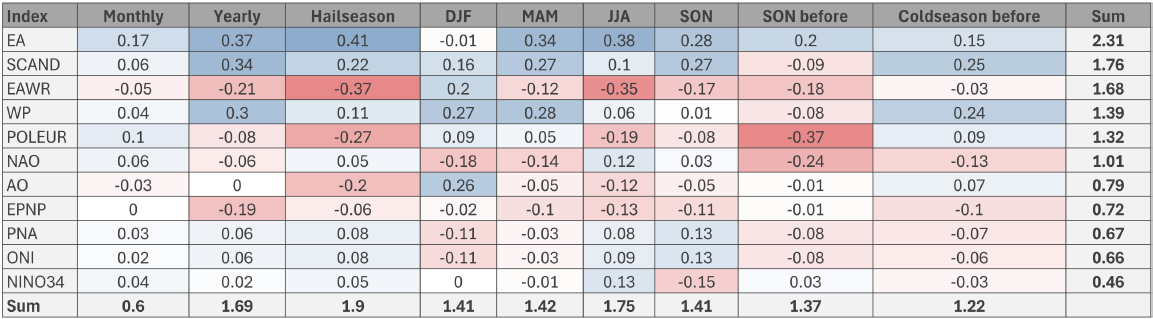
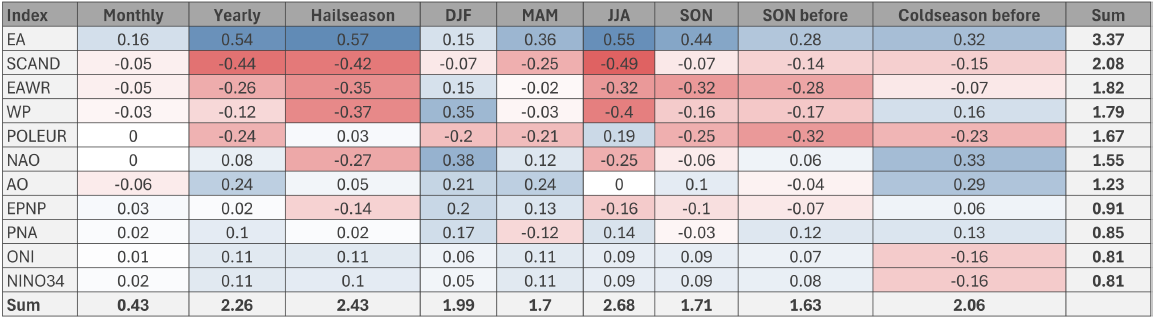

Figure A1Mean anomalies of PV during the ten most active hail seasons in northern (left) and southern (right) Switzerland. Stippling indicates areas statistically significant at the 95 % confidence level. The green box marks the respective study region.

Figure A2Mean anomalies of sea ice cover during the ten most active hail seasons in northern (left) and southern (right) Switzerland. Stippling indicates areas statistically significant at the 95 % confidence level. The green box marks the respective study region.
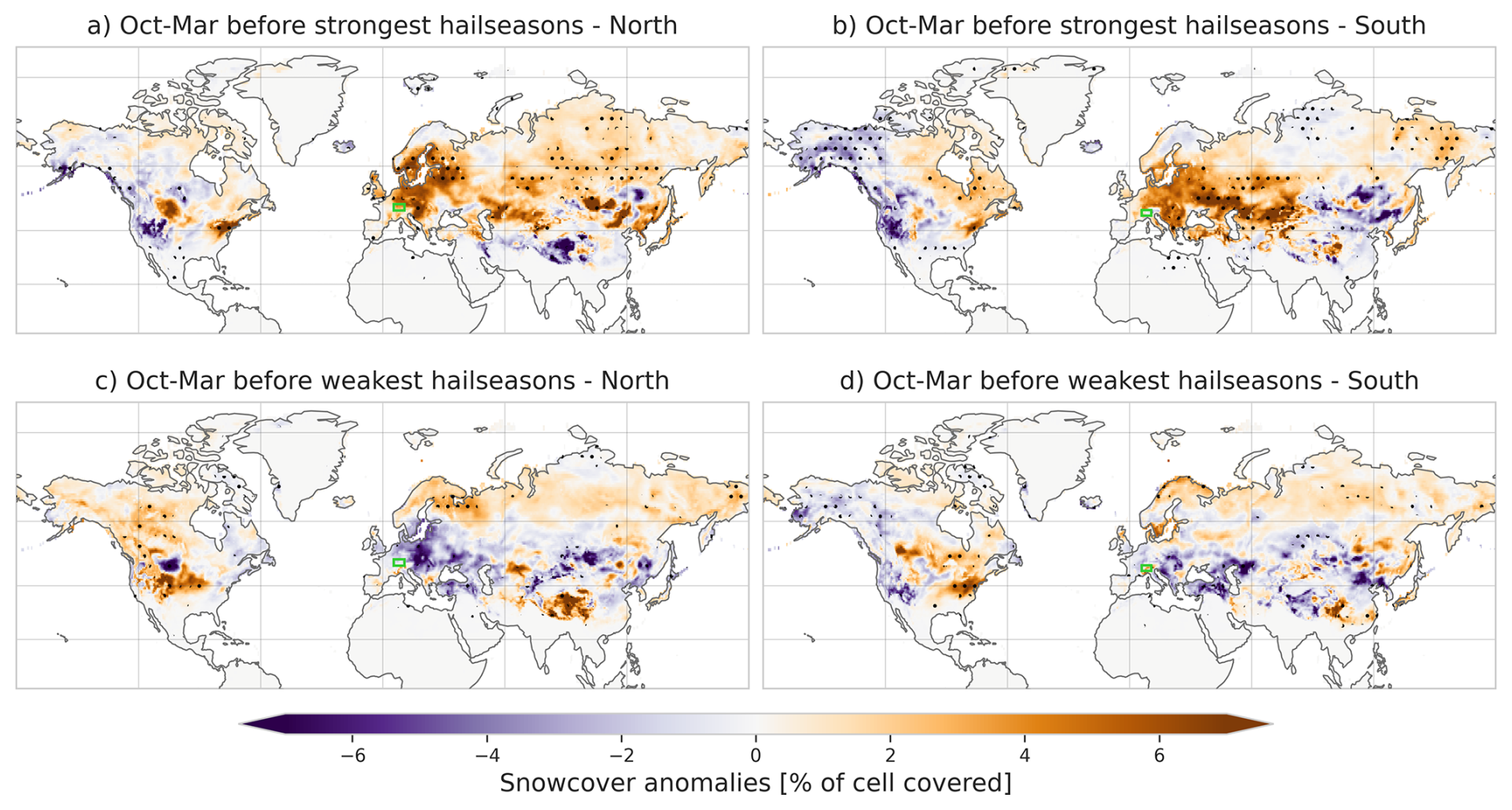
Figure A3Mean snow cover anomalies over October to March preceding the ten most active and least active hail seasons in northern and southern Switzerland. Panels (a) and (b) show anomalies prior to the most active hail seasons for the northern and southern regions, and panels (c) and (d) show anomalies prior to the weakest hail seasons for the northern and southern regions respectively. Stippling indicates statistical significance at the 95 % confidence level.
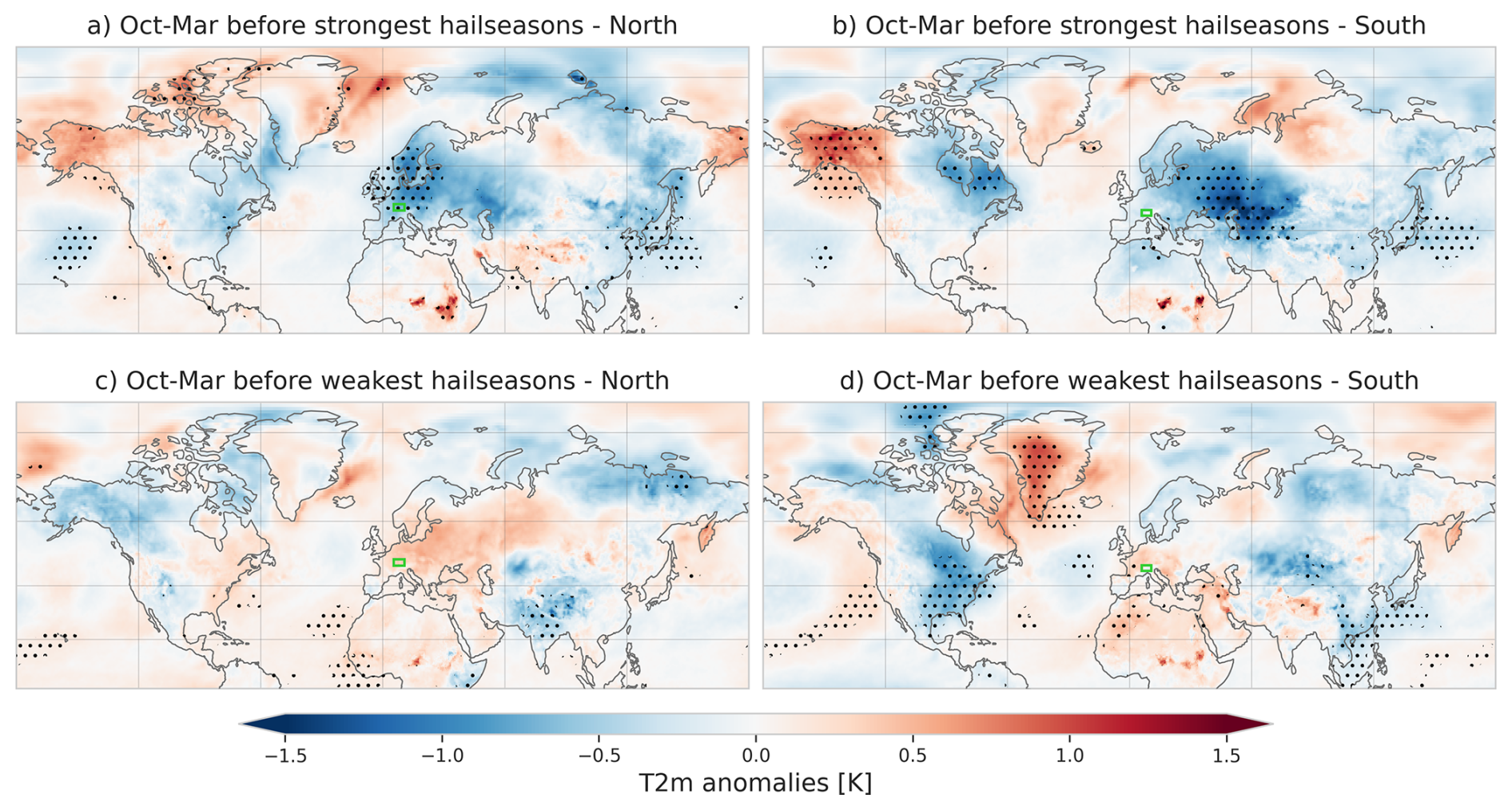
Figure A4Same as Fig. A3, but for 2 m temperature.
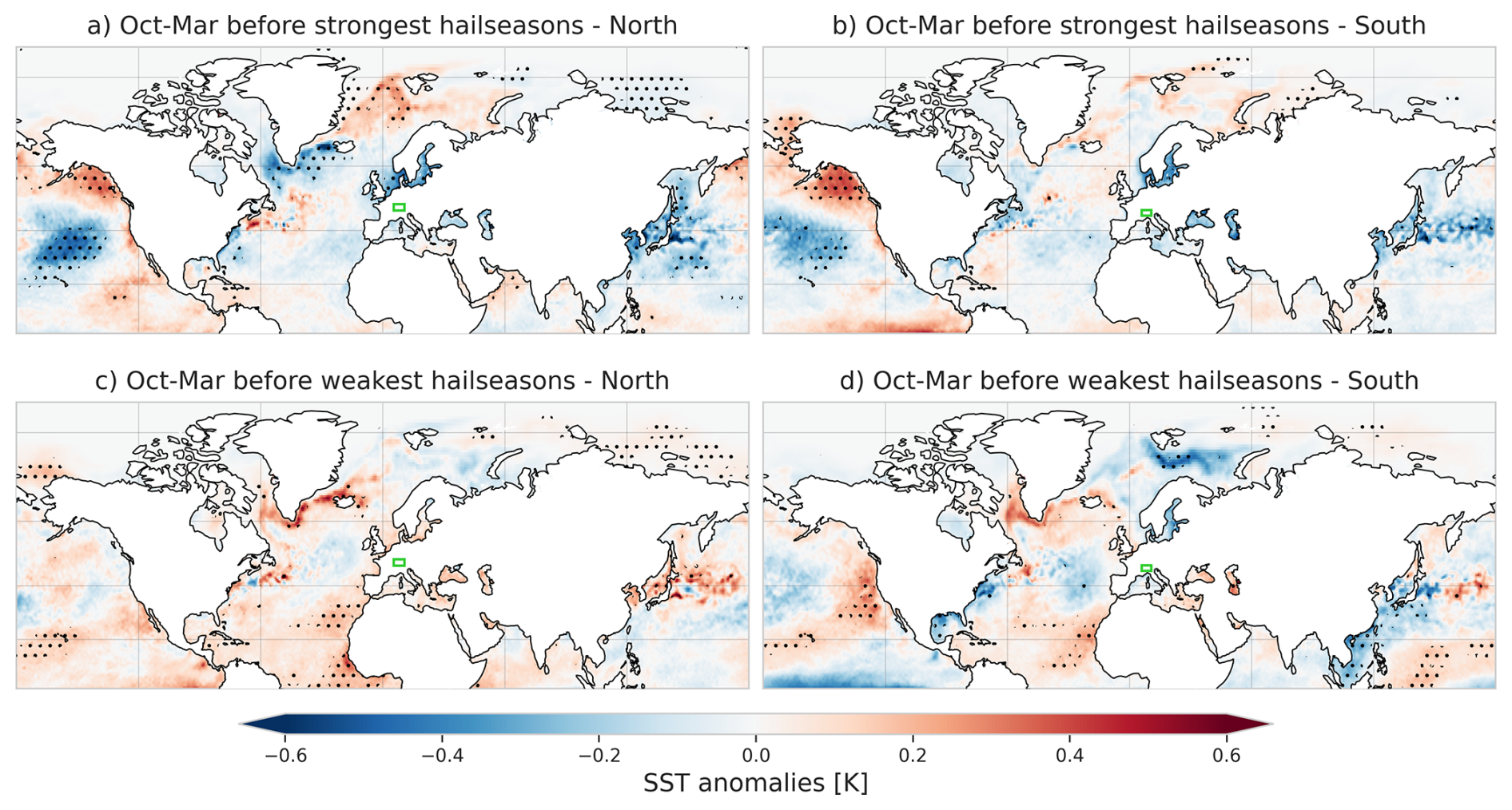
Figure A5Same as Fig. A3, but for sea surface temperature.
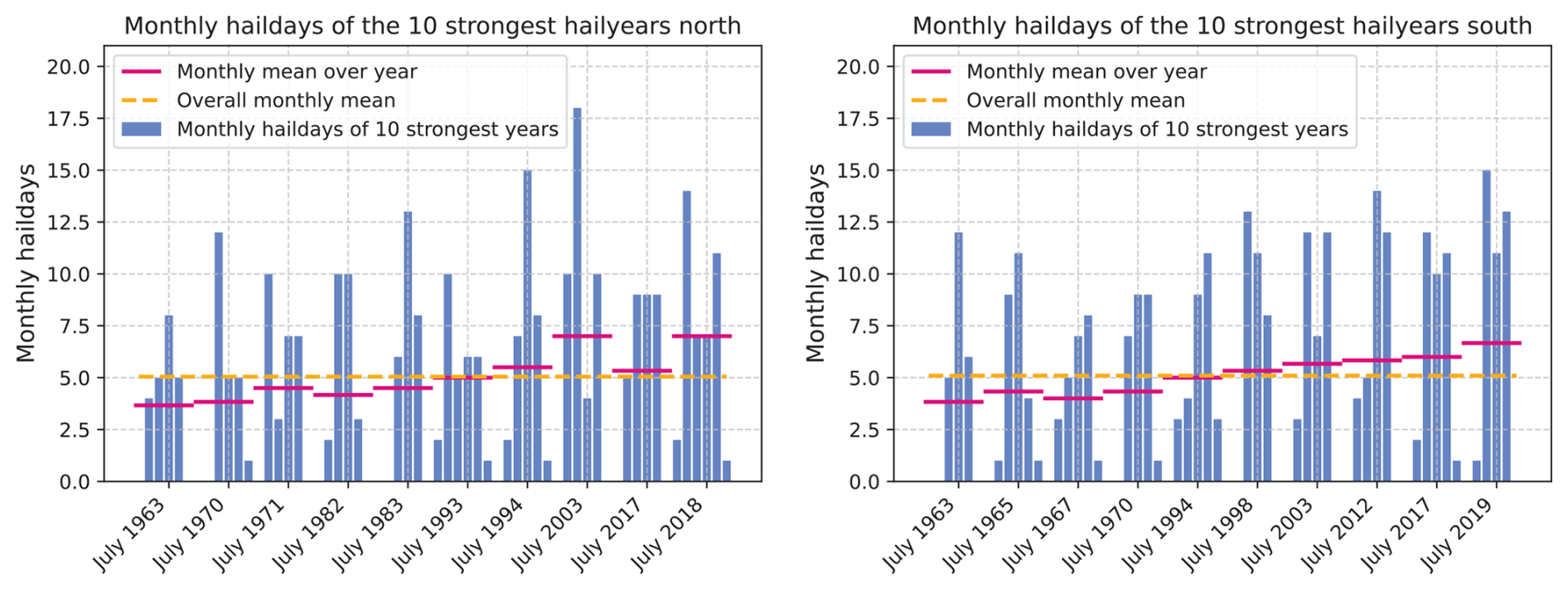
Figure A6Monthly hail days for the 10 most active hail seasons in (a) northern and (b) southern Switzerland. Blue bars show the number of hail days per month for each of these years. The magenta line indicates the mean monthly hail days within each year, while the yellow dashed line represents the long-term monthly mean across all years. This comparison highlights how the most active hail seasons exceed the climatological average and illustrates the variability of monthly hail activity among these peak seasons in both regions.
Table A3Overview of ERA5 predictors used in this study. All variables are provided on a 0.5° × 0.5° grid for 1959–2022; anomalies are computed with an 8-year 30 d moving window.
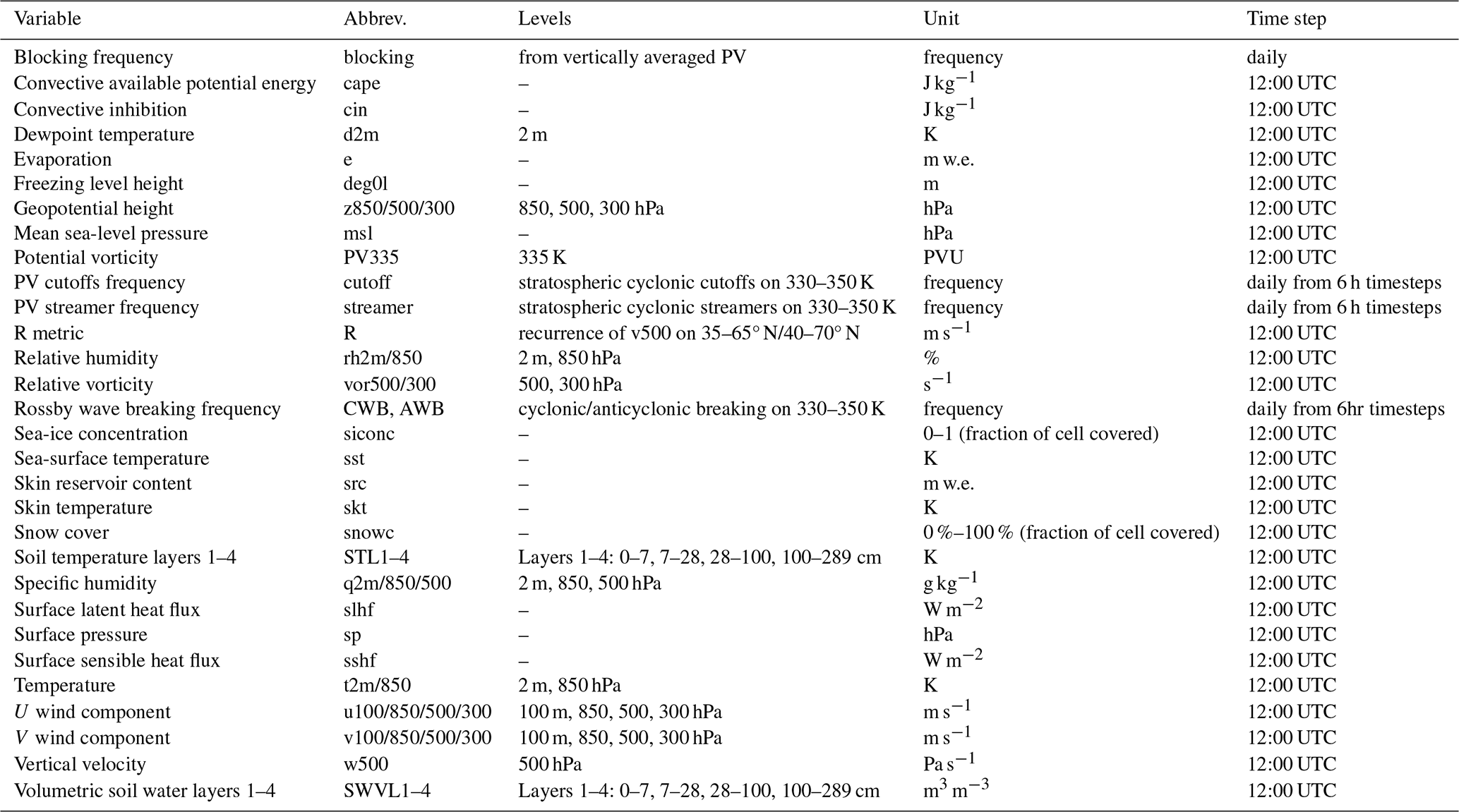
The reconstructed hail day time series can be found on Zenodo at https://doi.org/10.5281/zenodo.17353698 (Wilhelm, 2024). ERA5 data are accessible via the CDS data server: https://cds.climate.copernicus.eu/datasets (last access: 2 September 2026).
The supplement related to this article is available online at https://doi.org/10.5194/wcd-7-1681-2026-supplement.
LW: Conceptualization, data curation, methodology, visualization, writing (original draft, review and editing). OM: Supervision, conceptualization, methodology, writing (review and editing). MF, KS; CS: Discussions and writing (review and editing).
The contact author has declared that none of the authors has any competing interests.
Publisher's note: Copernicus Publications remains neutral with regard to jurisdictional claims made in the text, published maps, institutional affiliations, or any other geographical representation in this paper. The authors bear the ultimate responsibility for providing appropriate place names. Views expressed in the text are those of the authors and do not necessarily reflect the views of the publisher.
The authors gratefully acknowledge the financial support of the Schweizerischer Nationalfonds zur Förderung der Wissenschaftlichen Forschung. We also acknowledge the use of Grammarly and ChatGPT for language editing.
This research has been supported by the Schweizerischer Nationalfonds zur Förderung der Wissenschaftlichen Forschung (grant no. CRSII5201792).
This paper was edited by Johannes Dahl and reviewed by two anonymous referees.
Allen, J. T., Tippett, M. K., and Sobel, A. H.: Influence of the El Niño/Southern Oscillation on tornado and hail frequency in the United States, Nat. Geosci., 8, 278–283, https://doi.org/10.1038/ngeo2385, 2015. a
Allen, J. T., Molina, M. J., and Gensini, V. A.: Modulation of Annual Cycle of Tornadoes by El Niño–Southern Oscillation, Geophys. Res. Lett., 45, 5708–5717, https://doi.org/10.1029/2018GL077482, 2018. a
Allen, J. T., Giammanco, I. M., Kumjian, M. R., Jurgen Punge, H., Zhang, Q., Groenemeijer, P., Kunz, M., and Ortega, K.: Understanding Hail in the Earth System, Rev. Geophys., 58, https://doi.org/10.1029/2019RG000665, 2020. a, b
Augenstein, M.: Variabilität, Trends und serielles Clustering schwerer Gewitterereignisse im Bezug zu großräumigen atmosphärischen Bedingungen, KITopen, https://doi.org/10.5445/IR/1000179408, 2025. a
Augenstein, M., Mohr, S., and Kunz, M.: Influence of the North Atlantic Oscillation on annual spatio-temporal lightning clusters in western and central Europe, Nat. Hazards Earth Syst. Sci., 25, 4921–4939, https://doi.org/10.5194/nhess-25-4921-2025, 2025. a, b, c
Baggett, C. F., Nardi, K. M., Childs, S. J., Zito, S. N., Barnes, E. A., and Maloney, E. D.: Skillful Subseasonal Forecasts of Weekly Tornado and Hail Activity Using the Madden–Julian Oscillation, J. Geophys. Res.-Atmos., 123, https://doi.org/10.1029/2018JD029059, 2018. a
Barnston, A. G. and Livezey, R. E.: Classification, Seasonality and Persistence of Low-Frequency Atmospheric Circulation Patterns, Mon. Weather Rev., 115, 1083–1126, https://doi.org/10.1175/1520-0493(1987)115<1083:csapol>2.0.co;2, 1987. a
Barras, H., Martius, O., Nisi, L., Schroeer, K., Hering, A., and Germann, U.: Multi-day hail clusters and isolated hail days in Switzerland – large-scale flow conditions and precursors, Weather Clim. Dynam., 2, 1167–1185, https://doi.org/10.5194/wcd-2-1167-2021, 2021. a, b
Barrett, B. S. and Gensini, V. A.: Variability of central United States April–May tornado day likelihood by phase of the Madden-Julian Oscillation, Geophys. Res. Lett., 40, 2790–2795, https://doi.org/10.1002/grl.50522, 2013. a
Barton, E. J., Klein, C., Taylor, C. M., Marsham, J., Parker, D. J., Maybee, B., Feng, Z., and Leung, L. R.: Soil moisture gradients strengthen mesoscale convective systems by increasing wind shear, Nat. Geosci., 18, 330–336, https://doi.org/10.1038/s41561-025-01666-8, 2025. a, b
Boettcher, M., Röthlisberger, M., Attinger, R., Rieder, J., and Wernli, H.: The ERA5 Extreme Seasons Explorer as a Basis for Research at the Weather and Climate Interface, B. Am. Meteorol. Soc., 104, E631–E644, https://doi.org/10.1175/BAMS-D-21-0348.1, 2023. a
Brennan, K. P., Thurnherr, I., Sprenger, M., and Wernli, H.: Insights from hailstorm track analysis in European climate change simulations, Nat. Hazards Earth Syst. Sci., 25, 3693–3712, https://doi.org/10.5194/nhess-25-3693-2025, 2025. a
Byrne, M. P. and O'Gorman, P. A.: Trends in continental temperature and humidity directly linked to ocean warming, P. Natl. Acad. Sci. USA, 115, 4863–4868, https://doi.org/10.1073/pnas.1722312115, 2018. a
Cacciamani, C., Battaglia, F., Patruno, P., Pomi, L., Selvini, A., and Tibaldi, S.: A climatological study of thunderstorm activity in the Po Valley, Theor. Appl. Climatol., 50, 185–203, https://doi.org/10.1007/BF00866116, 1995. a
Cheng, K., Harris, L., Bretherton, C., Merlis, T. M., Bolot, M., Zhou, L., Kaltenbaugh, A., Clark, S., and Fueglistaler, S.: Impact of Warmer Sea Surface Temperature on the Global Pattern of Intense Convection: Insights From a Global Storm Resolving Model, Geophys. Res. Lett., 49, e2022GL099796, https://doi.org/10.1029/2022GL099796, 2022. a
Cook, A. R., Leslie, L. M., Parsons, D. B., and Schaefer, J. T.: The Impact of El Niño–Southern Oscillation (ENSO) on Winter and Early Spring U.S. Tornado Outbreak, J. Appl. Meteorol. Clim., 56, 2455–2478, https://doi.org/10.1175/jamc-d-16-0249.1, 2017. a
De Martin, F., Manzato, A., Carlon, N., Setvák, M., and Miglietta, M. M.: Dynamic and statistical analysis of giant hail environments in northeast Italy, Q. J. Roy. Meteor., 151, https://doi.org/10.1002/qj.4945, 2025. a, b
Doswell III, C. A.: The Distinction between Large-Scale and Mesoscale Contribution to Severe Convection: A Case Study Example, Weather Forecast., 2, 3–16, https://doi.org/10.1175/1520-0434(1987)002<0003:TDBLSA>2.0.CO;2, 1987. a, b, c, d, e, f, g
Doswell III, C. A. and Bosart, L. F.: Extratropical Synoptic-Scale Processes and Severe Convection, Meteor. Mon., 50, 27–70, https://doi.org/10.1175/0065-9401-28.50.27, 2001. a, b
Dowdy, A. J.: Seasonal forecasting of lightning and thunderstorm activity in tropical and temperate regions of the world, Scientific Reports, 6, 20874, https://doi.org/10.1038/srep20874, 2016. a, b
Emanuel, K.: On the Physics of High CAPE, J. Atmos. Sci., 80, 2669–2683, https://doi.org/10.1175/JAS-D-23-0060.1, 2023. a
Feldmann, M., Rotunno, R., Germann, U., and Berne, A.: Supercell Thunderstorms in Complex Topography – How Mountain Valleys with Lakes Can Increase Occurrence Frequency, Mon. Weather Rev., 152, 471–489, https://doi.org/10.1175/MWR-D-22-0350.1, 2024. a
Feldmann, M., Domeisen, D. I. V., and Martius, O.: A pan-European analysis of large-scale drivers of severe convective outbreaks, Weather Clim. Dynam., 6, 1089–1106, https://doi.org/10.5194/wcd-6-1089-2025, 2025. a, b, c, d, e
Fluck, E., Kunz, M., Geissbuehler, P., and Ritz, S. P.: Radar-based assessment of hail frequency in Europe, Nat. Hazards Earth Syst. Sci., 21, 683–701, https://doi.org/10.5194/nhess-21-683-2021, 2021. a
Francis, J. A. and Vavrus, S. J.: Evidence linking Arctic amplification to extreme weather in mid‐latitudes, Geophys. Res. Lett., 39, https://doi.org/10.1029/2012gl051000, 2012. a
Gallagher Re: Natural Catastrophe and Climate Report: 2023. Data, Insights, and Perspective, Executive Summary, https://www.ajg.com/gallagherre/-/media/files/gallagher/gallagherre/news-and-insights/2024/january/natural-catastrophe-and-climate-report-2023.pdf (last access: 2 September 2026), 2023. a
Gensini, V. A. and Allen, J. T.: U.S. Hail Frequency and the Global Wind Oscillation, Geophys. Res. Lett., 45, 1611–1620, https://doi.org/10.1002/2017GL076822, 2018. a
Gensini, V. A. and Marinaro, A.: Tornado Frequency in the United States Related to Global Relative Angular Momentum, Mon. Weather Rev., 144, 801–810, https://doi.org/10.1175/MWR-D-15-0289.1, 2016. a
Giaiotti, D., Nordio, S., and Stel, F.: The climatology of hail in the plain of Friuli Venezia Giulia, Atmos. Res., 67–68, 247–259, https://doi.org/10.1016/S0169-8095(03)00084-X, 2003. a
Gladich, I., Gallai, I., Giaiotti, D., and Stel, F.: On the diurnal cycle of deep moist convection in the southern side of the Alps analysed through cloud-to-ground lightning activity, Atmos. Res., 100, 371–376, https://doi.org/10.1016/j.atmosres.2010.08.026, 2011. a
Grams, C. M., Magnusson, L., and Madonna, E.: An atmospheric dynamics perspective on the amplification and propagation of forecast error in numerical weather prediction models: A case study, Q. J. Roy. Meteor. Soc., 144, 2577–2591, https://doi.org/10.1002/qj.3353, 2018. a
Hermann, M., Wernli, H., and Röthlisberger, M.: Drastic increase in the magnitude of very rare summer-mean vapor pressure deficit extremes, Nat. Commun., 15, 7022, https://doi.org/10.1038/s41467-024-51305-w, 2024. a
Hersbach, H., Bell, B., Berrisford, P., Hirahara, S., Horányi, A., Muñoz‐Sabater, J., Nicolas, J., Peubey, C., Radu, R., Schepers, D., Simmons, A., Soci, C., Abdalla, S., Abellan, X., Balsamo, G., Bechtold, P., Biavati, G., Bidlot, J., Bonavita, M., De Chiara, G., Dahlgren, P., Dee, D., Diamantakis, M., Dragani, R., Flemming, J., Forbes, R., Fuentes, M., Geer, A., Haimberger, L., Healy, S., Hogan, R. J., Hólm, E., Janisková, M., Keeley, S., Laloyaux, P., Lopez, P., Lupu, C., Radnoti, G., De Rosnay, P., Rozum, I., Vamborg, F., Villaume, S., and Thépaut, J.: The ERA5 global reanalysis, Q. J. Roy. Meteor. Soc., 146, 1999–2049, https://doi.org/10.1002/qj.3803, 2020. a
Kaderli, S.: skaderli/WaveBreaking: WaveBreaking v0.3.8, Zenodo [code], https://doi.org/10.5281/zenodo.14214463, 2024. a
Kretschmer, M., Coumou, D., Donges, J. F., and Runge, J.: Using Causal Effect Networks to Analyze Different Arctic Drivers of Midlatitude Winter Circulation, J. Climate, 29, 4069–4081, https://doi.org/10.1175/jcli-d-15-0654.1, 2016. a
Kumjian, M. R., Lombardo, K., and Loeffler, S.: The Evolution of Hail Production in Simulated Supercell Storms, J. Atmos. Sci., https://doi.org/10.1175/JAS-D-21-0034.1, 2021. a
Kunz, M., Wandel, J., Fluck, E., Baumstark, S., Mohr, S., and Schemm, S.: Ambient conditions prevailing during hail events in central Europe, Nat. Hazards Earth Syst. Sci., 20, 1867–1887, https://doi.org/10.5194/nhess-20-1867-2020, 2020. a
Lee, S.-K., Atlas, R., Enfield, D., Wang, C., and Liu, H.: Is There an Optimal ENSO Pattern That Enhances Large-Scale Atmospheric Processes Conducive to Tornado Outbreaks in the United States?, J. Climate, 26, 1626–1642, https://doi.org/10.1175/JCLI-D-12-00128.1, 2013. a
Lin, Y. and Kumjian, M. R.: Influences of CAPE on Hail Production in Simulated Supercell Storms, J. Atmos. Sci., 79, 179–204, https://doi.org/10.1175/JAS-D-21-0054.1, 2022. a
Liu, W., Zhang, Q., Li, C., Xu, L., and Xiao, W.: The influence of soil moisture on convective activity: a review, Theor. Appl. Climatol., 149, 221–232, https://doi.org/10.1007/s00704-022-04046-z, 2022. a, b
Mantua, N. J., Hare, S. R., Zhang, Y., Wallace, J. M., and Francis, R. C.: A Pacific Interdecadal Climate Oscillation with Impacts on Salmon Production, B. Am. Meteorol. Soc., 78, 1069–1079, https://doi.org/10.1175/1520-0477(1997)078<1069:APICOW>2.0.CO;2, 1997. a
Manzato, A., Davolio, S., Miglietta, M. M., Pucillo, A., and Setvák, M.: 12 September 2012: A supercell outbreak in NE Italy?, Atmos. Res., 153, 98–118, https://doi.org/10.1016/j.atmosres.2014.07.019, 2015. a
Manzato, A., Riva, V., Tiesi, A., and Marcello Miglietta, M.: Observational analysis and simulations of a severe hailstorm in northeastern Italy, Q. J. Roy. Meteor. Soc., 146, 3587–3611, https://doi.org/10.1002/qj.3886, 2020. a
Markowski, P. and Richardson, Y.: Mesoscale Meteorology in Midlatitudes, Wiley, 1 edn., ISBN 978-0-470-74213-6, https://doi.org/10.1002/9780470682104, 2010. a, b
Martius, O., Hering, A., Kunz, M., Manzato, A., Mohr, S., Nisi, L., and Trefalt, S.: Challenges and Recent Advances in Hail Research, B. Am. Meteorol. Soc., 99, ES51–ES54, https://doi.org/10.1175/BAMS-D-17-0207.1, 2018. a
Miller, D. E., Gensini, V. A., and Barrett, B. S.: Madden-Julian oscillation influences United States springtime tornado and hail frequency, npj Clim. Atmos. Sci., 5, 37, https://doi.org/10.1038/s41612-022-00263-5, 2022. a
Mohr, S., Wandel, J., Lenggenhager, S., and Martius, O.: Relationship between atmospheric blocking and warm‐season thunderstorms over western and central Europe, Q. J. Roy. Meteor. Soc., 145, 3040–3056, https://doi.org/10.1002/qj.3603, 2019. a
Mohr, S., Wilhelm, J., Wandel, J., Kunz, M., Portmann, R., Punge, H. J., Schmidberger, M., Quinting, J. F., and Grams, C. M.: The role of large-scale dynamics in an exceptional sequence of severe thunderstorms in Europe May–June 2018, Weather Clim. Dynam., 1, 325–348, https://doi.org/10.5194/wcd-1-325-2020, 2020. a, b, c
Mohr, S., Tonn, M., Augenstein, M., Sperka, C., Kavil Kambrath, G., and Kunz, M.: A 20-year spatio-temporal analysis of 3D radar-based hail tracks in Germany: trends and regional differences, Front. Environ. Sci., 14, 1736782, https://doi.org/10.3389/fenvs.2026.1736782, 2026. a
Molina, M. J., Timmer, R. P., and Allen, J. T.: Importance of the Gulf of Mexico as a climate driver for U.S. severe thunderstorm activity, Geophys. Res. Lett., 43, https://doi.org/10.1002/2016GL071603, 2016. a, b
Newman, M., Alexander, M. A., Ault, T. R., Cobb, K. M., Deser, C., Di Lorenzo, E., Mantua, N. J., Miller, A. J., Minobe, S., Nakamura, H., Schneider, N., Vimont, D. J., Phillips, A. S., Scott, J. D., and Smith, C. A.: The Pacific Decadal Oscillation, Revisited, J. Climate, 29, 4399–4427, https://doi.org/10.1175/JCLI-D-15-0508.1, 2016. a
Nisi, L., Martius, O., Hering, A., Kunz, M., and Germann, U.: Spatial and temporal distribution of hailstorms in the Alpine region: a long‐term, high resolution, radar‐based analysis, Q. J. Roy. Meteor. Society, 142, 1590–1604, https://doi.org/10.1002/qj.2771, 2016. a, b
Nisi, L., Hering, A., Germann, U., and Martius, O.: A 15-Year Hail Streak Climatology for the Alpine Region, Q. J. Roy. Meteor. Soc., 144, 1429–1449, https://doi.org/10.1002/qj.3286, 2018. a, b
Nisi, L., Hering, A., Germann, U., Schroeer, K., Barras, H., Kunz, M., and Martius, O.: Hailstorms in the Alpine region: Diurnal cycle, characteristics, and the nowcasting potential of lightning properties, Q. J. Roy. Meteor. Soc., 146, 4170–4194, https://doi.org/10.1002/qj.3897, 2020. a
Pfleiderer, P., Schleussner, C.-F., Kornhuber, K., and Coumou, D.: Summer weather becomes more persistent in a 2 °C world, Nat. Clim. Change, 9, 666–671, https://doi.org/10.1038/s41558-019-0555-0, 2019. a, b, c
Piper, D. and Kunz, M.: Spatiotemporal variability of lightning activity in Europe and the relation to the North Atlantic Oscillation teleconnection pattern, Nat. Hazards Earth Syst. Sci., 17, 1319–1336, https://doi.org/10.5194/nhess-17-1319-2017, 2017. a, b, c, d
Piper, D. A., Kunz, M., Allen, J. T., and Mohr, S.: Investigation of the temporal variability of thunderstorms in central and western Europe and the relation to large‐scale flow and teleconnection patterns, Q. J. Roy. Meteor. Soc., 145, 3644–3666, https://doi.org/10.1002/qj.3647, 2019. a, b, c, d, e, f
Punge, H. and Kunz, M.: Hail observations and hailstorm characteristics in Europe: A review, Atmos. Res., 176–177, 159–184, https://doi.org/10.1016/j.atmosres.2016.02.012, 2016. a
Richman, M. B.: Rotation of principal components, J. Climatol., 6, 293–335, https://doi.org/10.1002/joc.3370060305, 1986. a
Röthlisberger, M., Frossard, L., Bosart, L. F., Keyser, D., and Martius, O.: Recurrent Synoptic-Scale Rossby Wave Patterns and Their Effect on the Persistence of Cold and Hot Spells, J. Climate, 32, 3207–3226, https://doi.org/10.1175/JCLI-D-18-0664.1, 2019. a
Röthlisberger, M., Hermann, M., Frei, C., Lehner, F., Fischer, E. M., Knutti, R., and Wernli, H.: A New Framework for Identifying and Investigating Seasonal Climate Extremes, J. Climate, 34, 7761–7782, https://doi.org/10.1175/JCLI-D-20-0953.1, 2021. a
Schemm, S., Nisi, L., Martinov, A., Leuenberger, D., and Martius, O.: On the link between cold fronts and hail in Switzerland, Atmos. Sci. Lett., 17, 315–325, https://doi.org/10.1002/asl.660, 2016. a, b, c
Schmid, T., Gebhart, V., and Bresch, D. N.: Projected Changes in European Hail Damage Risk with 3 °C Global Warming Based on Km-Scale Regional Climate Model Simulations, SSRN [preprint], https://doi.org/10.2139/ssrn.5281477, 2025. a
Schulte-Fischedick, A., Feldmann, M., Hering, A., Nisi, L., Schwierz, C., and Schröer, K.: Observed hailstorm characteristics and emerging trends in the western Alpine region: a 20-year storm-scale analysis, Front. Environ. Sci., 14, 1783155, https://doi.org/10.3389/fenvs.2026.1783155, 2026. a
Schwierz, C., Croci‐Maspoli, M., and Davies, H. C.: Perspicacious indicators of atmospheric blocking, Geophys. Res. Lett., 31, L06125, https://doi.org/10.1029/2003GL019341, 2004. a
Seneviratne, S. I., Corti, T., Davin, E. L., Hirschi, M., Jaeger, E. B., Lehner, I., Orlowsky, B., and Teuling, A. J.: Investigating soil moisture–climate interactions in a changing climate: A review, Earth-Sci. Rev., 99, 125–161, https://doi.org/10.1016/j.earscirev.2010.02.004, 2010. a
Sodemann, H. and Zubler, E.: Seasonal and inter‐annual variability of the moisture sources for Alpine precipitation during 1995–2002, Int. J. Climatol., 30, 947–961, https://doi.org/10.1002/joc.1932, 2010. a
Sprenger, M., Fragkoulidis, G., Binder, H., Croci-Maspoli, M., Graf, P., Grams, C. M., Knippertz, P., Madonna, E., Schemm, S., Škerlak, B., and Wernli, H.: Global Climatologies of Eulerian and Lagrangian Flow Features based on ERA-Interim, B. Am. Meteorol. Soc., 98, 1739–1748, https://doi.org/10.1175/BAMS-D-15-00299.1, 2017. a
Steinfeld, D.: steidani/ConTrack: ConTrack v0.3.0, Zenodo [code], https://doi.org/10.5281/zenodo.4765560, 2021. a
Taylor, C. M., Gounou, A., Guichard, F., Harris, P. P., Ellis, R. J., Couvreux, F., and De Kauwe, M.: Frequency of Sahelian storm initiation enhanced over mesoscale soil-moisture patterns, Nat. Geosci., 4, 430–433, https://doi.org/10.1038/ngeo1173, 2011. a, b
Thompson, D. B. and Roundy, P. E.: The Relationship between the Madden–Julian Oscillation and U.S. Violent Tornado Outbreaks in the Spring, Mon. Weather Rev., 141, 2087–2095, https://doi.org/10.1175/mwr-d-12-00173.1, 2013. a
Thurnherr, I., Cui, R., Velasquez, P., Wernli, H., and Schär, C.: The effect of 3 °C global warming on hail over Europe, Authorea [preprint], https://doi.org/10.22541/au.173809555.59545480/v1, 2025. a
Tippett, M. K.: Robustness of Relations between the MJO and U.S. Tornado Occurrence, Mon. Weather Rev., 146, 3873–3884, https://doi.org/10.1175/MWR-D-18-0207.1, 2018. a
Tippett, M. K., Allen, J. T., Gensini, V. A., and Brooks, H. E.: Climate and Hazardous Convective Weather, Current Climate Change Reports, 1, 60–73, https://doi.org/10.1007/s40641-015-0006-6, 2015. a, b
Trapp, R. J. and Hoogewind, K. A.: Exploring a possible connection between U.S. tornado activity and Arctic sea ice, npj Clim. Atmos. Sci., 1, https://doi.org/10.1038/s41612-018-0025-9, 2018. a
Trefalt, S., Martynov, A., Barras, H., Besic, N., Hering, A. M., Lenggenhager, S., Noti, P., Röthlisberger, M., Schemm, S., Germann, U., and Martius, O.: A severe hail storm in complex topography in Switzerland – Observations and processes, Atmos. Res., 209, 76–94, https://doi.org/10.1016/j.atmosres.2018.03.007, 2018. a
Tuel, A. and Martius, O.: Persistent warm and cold spells in the Northern Hemisphere extratropics: regionalisation, synoptic-scale dynamics and temperature budget, Weather Clim. Dynam., 5, 263–292, https://doi.org/10.5194/wcd-5-263-2024, 2024. a, b, c
Van Den Hurk, B., Doblas-Reyes, F., Balsamo, G., Koster, R. D., Seneviratne, S. I., and Camargo, H.: Soil moisture effects on seasonal temperature and precipitation forecast scores in Europe, Clim. Dynam., 38, 349–362, https://doi.org/10.1007/s00382-010-0956-2, 2012. a
Wernli, H. and Sprenger, M.: Identification and ERA-15 Climatology of Potential Vorticity Streamers and Cutoffs near the Extratropical Tropopause, J. Atmos. Sci., 64, 1569–1586, https://doi.org/10.1175/JAS3912.1, 2007. a
Wilhelm, L.: Reconstructed hail days for northern and southern Switzerland from 1959 to 2022, Zenodo [data set], https://doi.org/10.5281/zenodo.17353698, 2024. a
Wilhelm, L., Schwierz, C., Schröer, K., Taszarek, M., and Martius, O.: Reconstructing hail days in Switzerland with statistical models (1959–2022), Nat. Hazards Earth Syst. Sci., 24, 3869–3894, https://doi.org/10.5194/nhess-24-3869-2024, 2024. a, b, c, d, e, f
- Abstract
- Introduction
- Data
- Methods
- Atmospheric, ocean and land-surface conditions during active hail seasons
- Comparison between seasonal composites and hail day composites
- Comparison of strongest anomalies per region
- Seasonal precursors of active hail seasons in northern and southern Switzerland
- Discussion
- Summary and conclusions
- Appendix A: Additional figures and tables
- Data availability
- Author contributions
- Competing interests
- Disclaimer
- Acknowledgements
- Financial support
- Review statement
- References
- Supplement
- Abstract
- Introduction
- Data
- Methods
- Atmospheric, ocean and land-surface conditions during active hail seasons
- Comparison between seasonal composites and hail day composites
- Comparison of strongest anomalies per region
- Seasonal precursors of active hail seasons in northern and southern Switzerland
- Discussion
- Summary and conclusions
- Appendix A: Additional figures and tables
- Data availability
- Author contributions
- Competing interests
- Disclaimer
- Acknowledgements
- Financial support
- Review statement
- References
- Supplement