
Articles | Volume 7, issue 3
https://doi.org/10.5194/wcd-7-1641-2026
© Author(s) 2026. This work is distributed under
the Creative Commons Attribution 4.0 License.
the Creative Commons Attribution 4.0 License.
https://doi.org/10.5194/wcd-7-1641-2026
© Author(s) 2026. This work is distributed under
the Creative Commons Attribution 4.0 License.
the Creative Commons Attribution 4.0 License.
Research article
| 
03 Sep 2026
Research article |
| 03 Sep 2026
| 03 Sep 2026
A life cycle definition of year-round weather regimes in the North Atlantic European region
Christian M. Grams
CORRESPONDING AUTHOR

Federal Office of Meteorology and Climatology, MeteoSwiss, Zurich-Airport, Switzerland
previously at: Institute of Meteorology and Climate Research (IMKTRO), Department Troposphere Research, Karlsruhe Institute of Technology (KIT), Karlsruhe, Germany
Related authors
Seraphine Hauser, Franziska Teubler, Michael Riemer, and Christian M. Grams
Weather Clim. Dynam., 7, 937–958, https://doi.org/10.5194/wcd-7-937-2026, https://doi.org/10.5194/wcd-7-937-2026, 2026
Short summary
Short summary
The relative roles of dry and moist processes in blocking formation are still not well understood, especially across different blocking types and regions. Using a potential vorticity framework, we study the evolution of large-scale anticyclonic circulation anomalies that are linked to four distinct blocking patterns. We find that the development of anomaly amplitude is shaped mainly by their pathway, which determines the balance between dry and moist contributions, rather than the blocking type.
Luise J. Fischer, David N. Bresch, Dominik Büeler, Christian M. Grams, Robin Noyelle, Matthias Röthlisberger, and Heini Wernli
Weather Clim. Dynam., 6, 1027–1043, https://doi.org/10.5194/wcd-6-1027-2025, https://doi.org/10.5194/wcd-6-1027-2025, 2025
Short summary
Short summary
Atmospheric flows over the North Atlantic can be meaningfully classified into weather regimes, and climate simulations suggest that the regime frequencies might change in the future. We provide a quantitative framework that helps assess whether these regime frequency changes are relevant to understanding climate change signals in precipitation. At least in our example application, in most regions, regime frequency changes explain little of the projected precipitation changes.
Annie Y.-Y. Chang, Shaun Harrigan, Maria-Helena Ramos, Massimiliano Zappa, Christian M. Grams, Daniela I. V. Domeisen, and Konrad Bogner
EGUsphere, https://doi.org/10.5194/egusphere-2025-3411, https://doi.org/10.5194/egusphere-2025-3411, 2025
Short summary
Short summary
This study presents a machine learning-aided hybrid forecasting framework to improve early warnings of low flows in the European Alps. It combines weather regime information, streamflow observations, and model simulations (EFAS). Even using only weather regime data improves predictions over climatology, while integrating different data sources yields the best result, emphasizing the value of integrating diverse data sources.
Marc Federer, Lukas Papritz, Michael Sprenger, and Christian M. Grams
Weather Clim. Dynam., 6, 211–230, https://doi.org/10.5194/wcd-6-211-2025, https://doi.org/10.5194/wcd-6-211-2025, 2025
Short summary
Short summary
Although extratropical cyclones in the North Atlantic are among the most impactful midlatitude weather systems, their intensification is not entirely understood. Here, we explore how individual cyclones convert available potential energy (APE) into kinetic energy and relate these conversions to the synoptic development of the cyclones. By combining potential vorticity thinking with a local APE framework, we offer a novel perspective on established concepts in dynamic meteorology.
Svenja Christ, Marta Wenta, Christian M. Grams, and Annika Oertel
Weather Clim. Dynam., 6, 17–42, https://doi.org/10.5194/wcd-6-17-2025, https://doi.org/10.5194/wcd-6-17-2025, 2025
Short summary
Short summary
The detailed representation of sea surface temperature (SST) in numerical models is important for the prediction of atmospheric blocking in the North Atlantic. Yet the underlying physical processes are not fully understood. Using SST sensitivity experiments for a case study, we identify a physical pathway through which SST in the Gulf Stream region is linked to the downstream upper-level flow evolution in the North Atlantic.
Joshua Dorrington, Marta Wenta, Federico Grazzini, Linus Magnusson, Frederic Vitart, and Christian M. Grams
Nat. Hazards Earth Syst. Sci., 24, 2995–3012, https://doi.org/10.5194/nhess-24-2995-2024, https://doi.org/10.5194/nhess-24-2995-2024, 2024
Short summary
Short summary
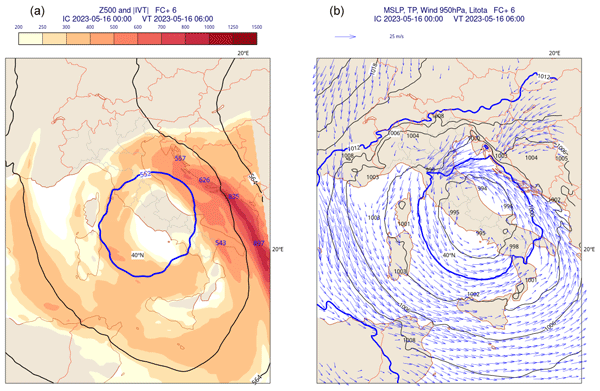
Extreme rainfall is the leading weather-related source of damages in Europe, but it is still difficult to predict on long timescales. A recent example of this was the devastating floods in the Italian region of Emiglia Romagna in May 2023. We present perspectives based on large-scale dynamical information that allows us to better understand and predict such events.
Moritz Deinhard and Christian M. Grams
Weather Clim. Dynam., 5, 927–942, https://doi.org/10.5194/wcd-5-927-2024, https://doi.org/10.5194/wcd-5-927-2024, 2024
Short summary
Short summary
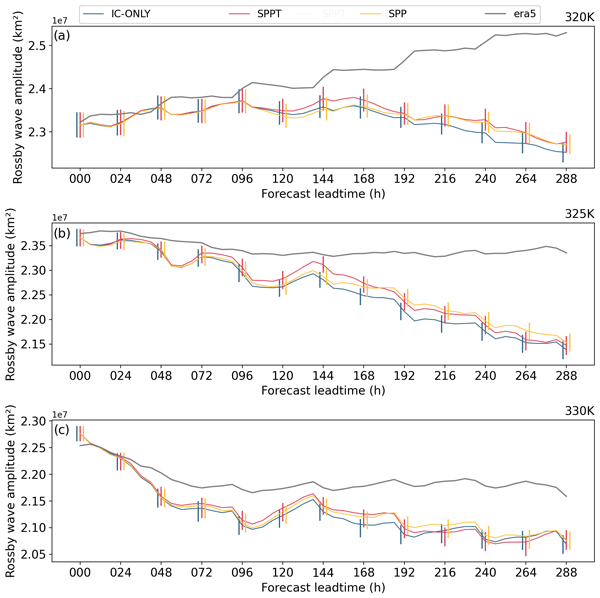
Stochastic perturbations are an established technique to represent model uncertainties in numerical weather prediction. While such schemes are beneficial for the forecast skill, they can also change the mean state of the model. We analyse how different schemes modulate rapidly ascending airstreams and whether the changes to such weather systems are projected onto larger scales. We thereby provide a process-oriented perspective on how perturbations affect the model climate.
Seraphine Hauser, Franziska Teubler, Michael Riemer, Peter Knippertz, and Christian M. Grams
Weather Clim. Dynam., 5, 633–658, https://doi.org/10.5194/wcd-5-633-2024, https://doi.org/10.5194/wcd-5-633-2024, 2024
Short summary
Short summary
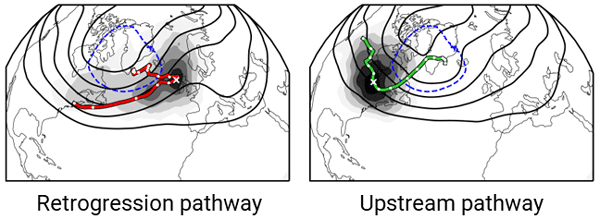
Blocking over Greenland has substantial impacts on the weather and climate in mid- and high latitudes. This study applies a quasi-Lagrangian thinking on the dynamics of Greenland blocking and reveals two pathways of anticyclonic anomalies linked to the block. Moist processes were found to play a dominant role in the formation and maintenance of blocking. This emphasizes the necessity of the correct representation of moist processes in weather and climate models to realistically depict blocking.
Marta Wenta, Christian M. Grams, Lukas Papritz, and Marc Federer
Weather Clim. Dynam., 5, 181–209, https://doi.org/10.5194/wcd-5-181-2024, https://doi.org/10.5194/wcd-5-181-2024, 2024
Short summary
Short summary
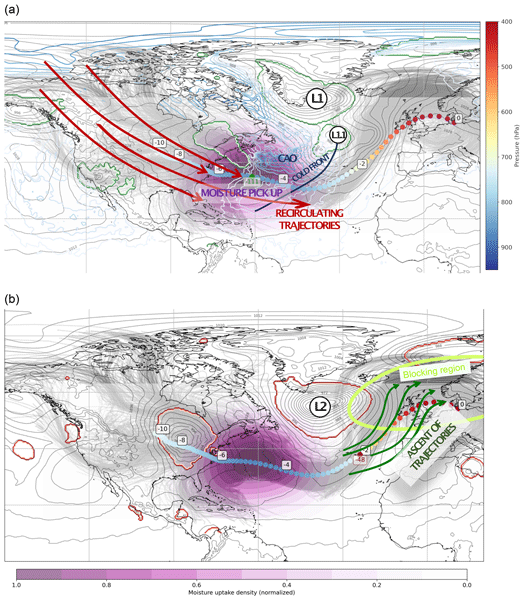
Our study links air–sea interactions over the Gulf Stream to an atmospheric block in February 2019. We found that over 23 % of air masses that were lifted into the block by cyclones interacted with the Gulf Stream. As cyclones pass over the Gulf Stream, they cause intense surface evaporation events, preconditioning the environment for the development of cyclones. This implies that air–sea interactions over the Gulf Stream affect the large-scale dynamics in the North Atlantic–European region.
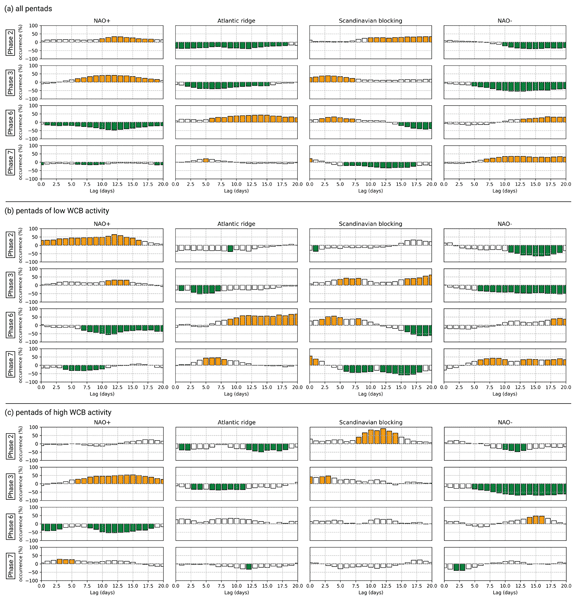
Julian F. Quinting, Christian M. Grams, Edmund Kar-Man Chang, Stephan Pfahl, and Heini Wernli
Weather Clim. Dynam., 5, 65–85, https://doi.org/10.5194/wcd-5-65-2024, https://doi.org/10.5194/wcd-5-65-2024, 2024
Short summary
Short summary
Research in the last few decades has revealed that rapidly ascending airstreams in extratropical cyclones have an important effect on the evolution of downstream weather and predictability. In this study, we show that the occurrence of these airstreams over the North Pacific is modulated by tropical convection. Depending on the modulation, known atmospheric circulation patterns evolve quite differently, which may affect extended-range predictions in the Atlantic–European region.
Annika Oertel, Annette K. Miltenberger, Christian M. Grams, and Corinna Hoose
Atmos. Chem. Phys., 23, 8553–8581, https://doi.org/10.5194/acp-23-8553-2023, https://doi.org/10.5194/acp-23-8553-2023, 2023
Short summary
Short summary
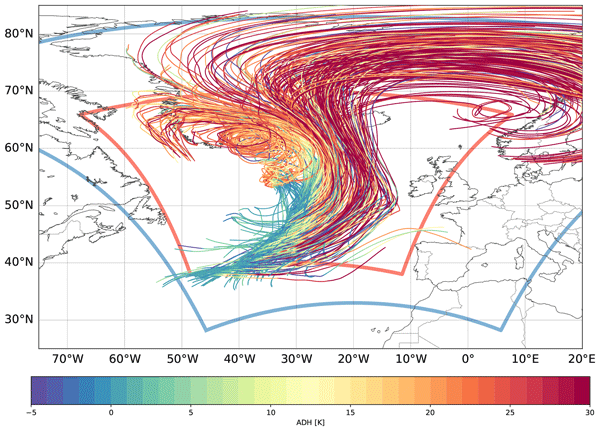
Warm conveyor belts (WCBs) are cloud- and precipitation-producing airstreams in extratropical cyclones that are important for the large-scale flow and cloud radiative forcing. We analyze cloud formation processes during WCB ascent in a two-moment microphysics scheme. Quantification of individual diabatic heating rates shows the importance of condensation, vapor deposition, rain evaporation, melting, and cloud-top radiative cooling for total heating and WCB-related potential vorticity structure.
Axel Seifert, Vanessa Bachmann, Florian Filipitsch, Jochen Förstner, Christian M. Grams, Gholam Ali Hoshyaripour, Julian Quinting, Anika Rohde, Heike Vogel, Annette Wagner, and Bernhard Vogel
Atmos. Chem. Phys., 23, 6409–6430, https://doi.org/10.5194/acp-23-6409-2023, https://doi.org/10.5194/acp-23-6409-2023, 2023
Short summary
Short summary
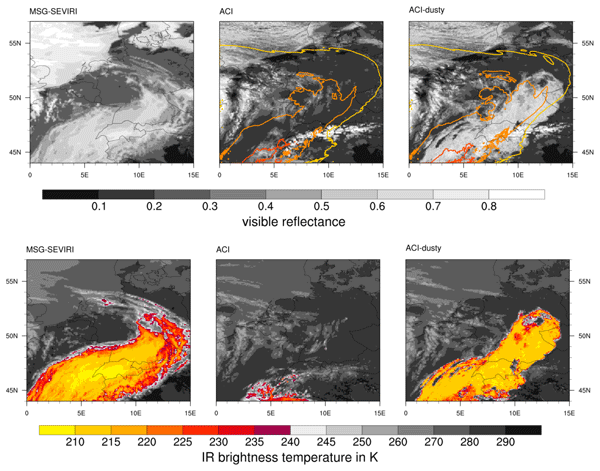
We investigate how mineral dust can lead to the formation of cirrus clouds. Dusty cirrus clouds lead to a reduction in solar radiation at the surface and, hence, a reduced photovoltaic power generation. Current weather prediction systems are not able to predict this interaction between mineral dust and cirrus clouds. We have developed a new physical description of the formation of dusty cirrus clouds. Overall we can show a considerable improvement in the forecast quality of clouds and radiation.
Seraphine Hauser, Franziska Teubler, Michael Riemer, Peter Knippertz, and Christian M. Grams
Weather Clim. Dynam., 4, 399–425, https://doi.org/10.5194/wcd-4-399-2023, https://doi.org/10.5194/wcd-4-399-2023, 2023
Short summary
Short summary
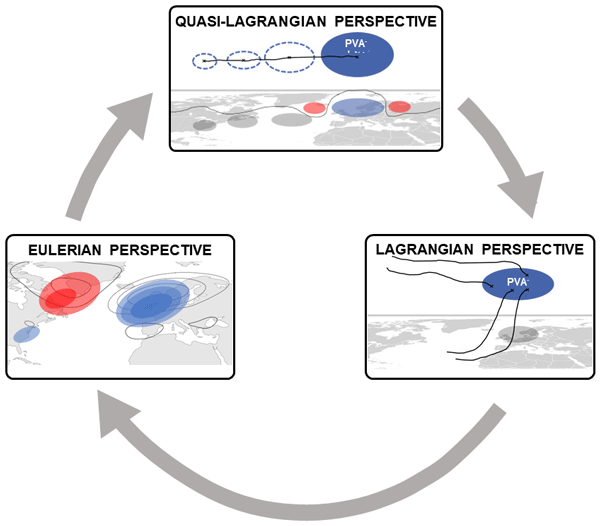
Blocking describes a flow configuration in the midlatitudes where stationary high-pressure systems block the propagation of weather systems. This study combines three individual perspectives that capture the dynamics and importance of various processes in the formation of a major blocking in 2016 from a weather regime perspective. In future work, this framework will enable a holistic view of the dynamics and the role of moist processes in different life cycle stages of blocked weather regimes.
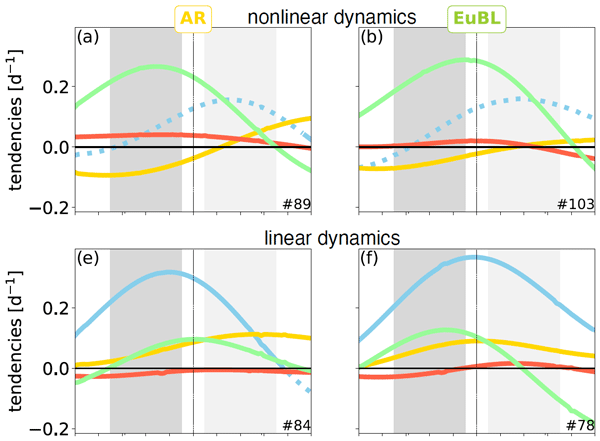
Franziska Teubler, Michael Riemer, Christopher Polster, Christian M. Grams, Seraphine Hauser, and Volkmar Wirth
Weather Clim. Dynam., 4, 265–285, https://doi.org/10.5194/wcd-4-265-2023, https://doi.org/10.5194/wcd-4-265-2023, 2023
Short summary
Short summary
Weather regimes govern an important part of the sub-seasonal variability of the mid-latitude circulation. The year-round dynamics of blocked regimes in the Atlantic European region are investigated in over 40 years of data. We show that the dynamics between the regimes are on average very similar. Within the regimes, the main variability – starting from the characteristics of dynamical processes alone – dominates and transcends the variability in season and types of transitions.
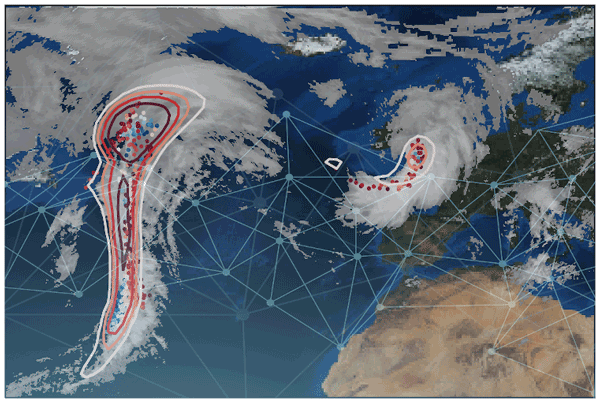
Julian F. Quinting and Christian M. Grams
Geosci. Model Dev., 15, 715–730, https://doi.org/10.5194/gmd-15-715-2022, https://doi.org/10.5194/gmd-15-715-2022, 2022
Short summary
Short summary
Physical processes in weather systems importantly affect the midlatitude large-scale circulation. This study introduces an artificial-intelligence-based framework which allows the identification of an important weather system – the so-called warm conveyor belt (WCB) – at comparably low computational costs and from data at low spatial and temporal resolution. The framework thus newly enables the systematic investigation of WCBs in large data sets such as climate model projections.
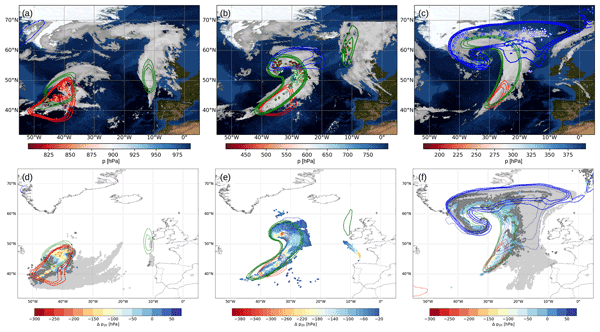
Julian F. Quinting, Christian M. Grams, Annika Oertel, and Moritz Pickl
Geosci. Model Dev., 15, 731–744, https://doi.org/10.5194/gmd-15-731-2022, https://doi.org/10.5194/gmd-15-731-2022, 2022
Short summary
Short summary
This study applies novel artificial-intelligence-based models that allow the identification of one specific weather system which affects the midlatitude circulation. We show that the models yield similar results as their trajectory-based counterpart, which requires data at higher spatiotemporal resolution and is computationally more expensive. Overall, we aim to show how deep learning methods can be used efficiently to support process understanding of biases in weather prediction models.
Seraphine Hauser, Franziska Teubler, Michael Riemer, and Christian M. Grams
Weather Clim. Dynam., 7, 937–958, https://doi.org/10.5194/wcd-7-937-2026, https://doi.org/10.5194/wcd-7-937-2026, 2026
Short summary
Short summary
The relative roles of dry and moist processes in blocking formation are still not well understood, especially across different blocking types and regions. Using a potential vorticity framework, we study the evolution of large-scale anticyclonic circulation anomalies that are linked to four distinct blocking patterns. We find that the development of anomaly amplitude is shaped mainly by their pathway, which determines the balance between dry and moist contributions, rather than the blocking type.
Luise J. Fischer, David N. Bresch, Dominik Büeler, Christian M. Grams, Robin Noyelle, Matthias Röthlisberger, and Heini Wernli
Weather Clim. Dynam., 6, 1027–1043, https://doi.org/10.5194/wcd-6-1027-2025, https://doi.org/10.5194/wcd-6-1027-2025, 2025
Short summary
Short summary
Atmospheric flows over the North Atlantic can be meaningfully classified into weather regimes, and climate simulations suggest that the regime frequencies might change in the future. We provide a quantitative framework that helps assess whether these regime frequency changes are relevant to understanding climate change signals in precipitation. At least in our example application, in most regions, regime frequency changes explain little of the projected precipitation changes.
Annie Y.-Y. Chang, Shaun Harrigan, Maria-Helena Ramos, Massimiliano Zappa, Christian M. Grams, Daniela I. V. Domeisen, and Konrad Bogner
EGUsphere, https://doi.org/10.5194/egusphere-2025-3411, https://doi.org/10.5194/egusphere-2025-3411, 2025
Short summary
Short summary
This study presents a machine learning-aided hybrid forecasting framework to improve early warnings of low flows in the European Alps. It combines weather regime information, streamflow observations, and model simulations (EFAS). Even using only weather regime data improves predictions over climatology, while integrating different data sources yields the best result, emphasizing the value of integrating diverse data sources.
Marc Federer, Lukas Papritz, Michael Sprenger, and Christian M. Grams
Weather Clim. Dynam., 6, 211–230, https://doi.org/10.5194/wcd-6-211-2025, https://doi.org/10.5194/wcd-6-211-2025, 2025
Short summary
Short summary
Although extratropical cyclones in the North Atlantic are among the most impactful midlatitude weather systems, their intensification is not entirely understood. Here, we explore how individual cyclones convert available potential energy (APE) into kinetic energy and relate these conversions to the synoptic development of the cyclones. By combining potential vorticity thinking with a local APE framework, we offer a novel perspective on established concepts in dynamic meteorology.
Svenja Christ, Marta Wenta, Christian M. Grams, and Annika Oertel
Weather Clim. Dynam., 6, 17–42, https://doi.org/10.5194/wcd-6-17-2025, https://doi.org/10.5194/wcd-6-17-2025, 2025
Short summary
Short summary
The detailed representation of sea surface temperature (SST) in numerical models is important for the prediction of atmospheric blocking in the North Atlantic. Yet the underlying physical processes are not fully understood. Using SST sensitivity experiments for a case study, we identify a physical pathway through which SST in the Gulf Stream region is linked to the downstream upper-level flow evolution in the North Atlantic.
Joshua Dorrington, Marta Wenta, Federico Grazzini, Linus Magnusson, Frederic Vitart, and Christian M. Grams
Nat. Hazards Earth Syst. Sci., 24, 2995–3012, https://doi.org/10.5194/nhess-24-2995-2024, https://doi.org/10.5194/nhess-24-2995-2024, 2024
Short summary
Short summary
Extreme rainfall is the leading weather-related source of damages in Europe, but it is still difficult to predict on long timescales. A recent example of this was the devastating floods in the Italian region of Emiglia Romagna in May 2023. We present perspectives based on large-scale dynamical information that allows us to better understand and predict such events.
Moritz Deinhard and Christian M. Grams
Weather Clim. Dynam., 5, 927–942, https://doi.org/10.5194/wcd-5-927-2024, https://doi.org/10.5194/wcd-5-927-2024, 2024
Short summary
Short summary
Stochastic perturbations are an established technique to represent model uncertainties in numerical weather prediction. While such schemes are beneficial for the forecast skill, they can also change the mean state of the model. We analyse how different schemes modulate rapidly ascending airstreams and whether the changes to such weather systems are projected onto larger scales. We thereby provide a process-oriented perspective on how perturbations affect the model climate.
Seraphine Hauser, Franziska Teubler, Michael Riemer, Peter Knippertz, and Christian M. Grams
Weather Clim. Dynam., 5, 633–658, https://doi.org/10.5194/wcd-5-633-2024, https://doi.org/10.5194/wcd-5-633-2024, 2024
Short summary
Short summary
Blocking over Greenland has substantial impacts on the weather and climate in mid- and high latitudes. This study applies a quasi-Lagrangian thinking on the dynamics of Greenland blocking and reveals two pathways of anticyclonic anomalies linked to the block. Moist processes were found to play a dominant role in the formation and maintenance of blocking. This emphasizes the necessity of the correct representation of moist processes in weather and climate models to realistically depict blocking.
Marta Wenta, Christian M. Grams, Lukas Papritz, and Marc Federer
Weather Clim. Dynam., 5, 181–209, https://doi.org/10.5194/wcd-5-181-2024, https://doi.org/10.5194/wcd-5-181-2024, 2024
Short summary
Short summary
Our study links air–sea interactions over the Gulf Stream to an atmospheric block in February 2019. We found that over 23 % of air masses that were lifted into the block by cyclones interacted with the Gulf Stream. As cyclones pass over the Gulf Stream, they cause intense surface evaporation events, preconditioning the environment for the development of cyclones. This implies that air–sea interactions over the Gulf Stream affect the large-scale dynamics in the North Atlantic–European region.
Julian F. Quinting, Christian M. Grams, Edmund Kar-Man Chang, Stephan Pfahl, and Heini Wernli
Weather Clim. Dynam., 5, 65–85, https://doi.org/10.5194/wcd-5-65-2024, https://doi.org/10.5194/wcd-5-65-2024, 2024
Short summary
Short summary
Research in the last few decades has revealed that rapidly ascending airstreams in extratropical cyclones have an important effect on the evolution of downstream weather and predictability. In this study, we show that the occurrence of these airstreams over the North Pacific is modulated by tropical convection. Depending on the modulation, known atmospheric circulation patterns evolve quite differently, which may affect extended-range predictions in the Atlantic–European region.
Annika Oertel, Annette K. Miltenberger, Christian M. Grams, and Corinna Hoose
Atmos. Chem. Phys., 23, 8553–8581, https://doi.org/10.5194/acp-23-8553-2023, https://doi.org/10.5194/acp-23-8553-2023, 2023
Short summary
Short summary
Warm conveyor belts (WCBs) are cloud- and precipitation-producing airstreams in extratropical cyclones that are important for the large-scale flow and cloud radiative forcing. We analyze cloud formation processes during WCB ascent in a two-moment microphysics scheme. Quantification of individual diabatic heating rates shows the importance of condensation, vapor deposition, rain evaporation, melting, and cloud-top radiative cooling for total heating and WCB-related potential vorticity structure.
Axel Seifert, Vanessa Bachmann, Florian Filipitsch, Jochen Förstner, Christian M. Grams, Gholam Ali Hoshyaripour, Julian Quinting, Anika Rohde, Heike Vogel, Annette Wagner, and Bernhard Vogel
Atmos. Chem. Phys., 23, 6409–6430, https://doi.org/10.5194/acp-23-6409-2023, https://doi.org/10.5194/acp-23-6409-2023, 2023
Short summary
Short summary
We investigate how mineral dust can lead to the formation of cirrus clouds. Dusty cirrus clouds lead to a reduction in solar radiation at the surface and, hence, a reduced photovoltaic power generation. Current weather prediction systems are not able to predict this interaction between mineral dust and cirrus clouds. We have developed a new physical description of the formation of dusty cirrus clouds. Overall we can show a considerable improvement in the forecast quality of clouds and radiation.
Seraphine Hauser, Franziska Teubler, Michael Riemer, Peter Knippertz, and Christian M. Grams
Weather Clim. Dynam., 4, 399–425, https://doi.org/10.5194/wcd-4-399-2023, https://doi.org/10.5194/wcd-4-399-2023, 2023
Short summary
Short summary
Blocking describes a flow configuration in the midlatitudes where stationary high-pressure systems block the propagation of weather systems. This study combines three individual perspectives that capture the dynamics and importance of various processes in the formation of a major blocking in 2016 from a weather regime perspective. In future work, this framework will enable a holistic view of the dynamics and the role of moist processes in different life cycle stages of blocked weather regimes.
Franziska Teubler, Michael Riemer, Christopher Polster, Christian M. Grams, Seraphine Hauser, and Volkmar Wirth
Weather Clim. Dynam., 4, 265–285, https://doi.org/10.5194/wcd-4-265-2023, https://doi.org/10.5194/wcd-4-265-2023, 2023
Short summary
Short summary
Weather regimes govern an important part of the sub-seasonal variability of the mid-latitude circulation. The year-round dynamics of blocked regimes in the Atlantic European region are investigated in over 40 years of data. We show that the dynamics between the regimes are on average very similar. Within the regimes, the main variability – starting from the characteristics of dynamical processes alone – dominates and transcends the variability in season and types of transitions.
Julian F. Quinting and Christian M. Grams
Geosci. Model Dev., 15, 715–730, https://doi.org/10.5194/gmd-15-715-2022, https://doi.org/10.5194/gmd-15-715-2022, 2022
Short summary
Short summary
Physical processes in weather systems importantly affect the midlatitude large-scale circulation. This study introduces an artificial-intelligence-based framework which allows the identification of an important weather system – the so-called warm conveyor belt (WCB) – at comparably low computational costs and from data at low spatial and temporal resolution. The framework thus newly enables the systematic investigation of WCBs in large data sets such as climate model projections.
Julian F. Quinting, Christian M. Grams, Annika Oertel, and Moritz Pickl
Geosci. Model Dev., 15, 731–744, https://doi.org/10.5194/gmd-15-731-2022, https://doi.org/10.5194/gmd-15-731-2022, 2022
Short summary
Short summary
This study applies novel artificial-intelligence-based models that allow the identification of one specific weather system which affects the midlatitude circulation. We show that the models yield similar results as their trajectory-based counterpart, which requires data at higher spatiotemporal resolution and is computationally more expensive. Overall, we aim to show how deep learning methods can be used efficiently to support process understanding of biases in weather prediction models.
Cited articles
Barnston, A. G. and Livezey, R. E.: Classification, Seasonality and Persistence of Low-Frequency Atmospheric Circulation Patterns, Mon. Weather Rev., 115, 1083–1126, https://doi.org/10.1175/1520-0493(1987)115<1083:CSAPOL>2.0.CO;2, 1987. a
Bell, B., Hersbach, H., Simmons, A., Berrisford, P., Dahlgren, P., Horányi, A., Muñoz‐Sabater, J., Nicolas, J., Radu, R., Schepers, D., Soci, C., Villaume, S., Bidlot, J., Haimberger, L., Woollen, J., Buontempo, C., and Thépaut, J.: The ERA5 global reanalysis: Preliminary extension to 1950, Q. J. Roy. Meteor. Soc., 147, 4186–4227, https://doi.org/10.1002/qj.4174, 2021. a, b
Bezdek, J. C.: Pattern Recognition with Fuzzy Objective Function Algorithms, Springer US, Boston, MA, ISBN 978-1-4757-0452-5, https://doi.org/10.1007/978-1-4757-0450-1, 1981. a
Bloomfield, H. C., Brayshaw, D. J., and Charlton-Perez, A. J.: Characterizing the Winter Meteorological Drivers of the European Electricity System Using Targeted Circulation Types, Meteorol. Appl., 27, e1858, https://doi.org/10.1002/met.1858, 2020. a, b
Brunner, M. I., Mittermeier, M., Anderson, B., Büeler, D., and Muñoz-Castro, E.: Spatially Compounding Drought-Flood Events Are Favored by Atmospheric Blocking Over Europe, Water Resour. Res., 61, e2024WR039622, https://doi.org/10.1029/2024WR039622, 2025. a, b
Büeler, D., Ferranti, L., Magnusson, L., Quinting, J. F., and Grams, C. M.: Year-Round Sub-Seasonal Forecast Skill for Atlantic–European Weather Regimes, Q. J. Roy. Meteor. Soc., 147, 4283–4309, https://doi.org/10.1002/qj.4178, 2021. a, b, c
Cattiaux, J., Quesada, B., Arakélian, A., Codron, F., Vautard, R., and Yiou, P.: North-Atlantic dynamics and European temperature extremes in the IPSL model: sensitivity to atmospheric resolution, Clim. Dynam., 40, 2293–2310, https://doi.org/10.1007/s00382-012-1529-3, 2013. a
Chan, P. W., Catto, J. L., and Collins, M.: Heatwave–Blocking Relation Change Likely Dominates over Decrease in Blocking Frequency under Global Warming, npj Clim. Atmos. Sci., 5, 1–8, https://doi.org/10.1038/s41612-022-00290-2, 2022. a
Chang, A. Y.-Y., Bogner, K., Grams, C. M., Monhart, S., Domeisen, D. I. V., and Zappa, M.: Exploring the Use of European Weather Regimes for Improving User-Relevant Hydrological Forecasts at the Subseasonal Scale in Switzerland, J. Hydrometeorol., 24, 1597–1617, https://doi.org/10.1175/JHM-D-21-0245.1, 2023. a, b
Chang, A. Y.-Y., Harrigan, S., Ramos, M.-H., Zappa, M., Grams, C. M., Domeisen, D. I. V., and Bogner, K.: Exploring Hybrid Forecasting Frameworks for Subseasonal Low Flow Predictions in the European Alps, EGUsphere [preprint], https://doi.org/10.5194/egusphere-2025-3411, 2025. a, b
Charlton-Perez, A. J., Ferranti, L., and Lee, R. W.: The Influence of the Stratospheric State on North Atlantic Weather Regimes, Q. J. Roy. Meteor. Soc., 144, 1140–1151, https://doi.org/10.1002/qj.3280, 2018. a, b
Charlton-Perez, A. J., Aldridge, R. W., Grams, C. M., and Lee, R.: Winter Pressures on the UK Health System Dominated by the Greenland Blocking Weather Regime, Weather and Climate Extremes, 25, 100218, https://doi.org/10.1016/j.wace.2019.100218, 2019. a
Dawson, A. and Palmer, T. N.: Simulating weather regimes: impact of model resolution and stochastic parameterization, Clim. Dynam., 44, 2177–2193, https://doi.org/10.1007/s00382-014-2238-x, 2015. a
Dawson, A., Palmer, T. N., and Corti, S.: Simulating regime structures in weather and climate prediction models: REGIMES IN WEATHER AND CLIMATE MODELS, Geophys. Res. Lett., 39, https://doi.org/10.1029/2012GL053284, 2012. a, b
Domeisen, D. I. V., Grams, C. M., and Papritz, L.: The role of North Atlantic–European weather regimes in the surface impact of sudden stratospheric warming events, Weather Clim. Dynam., 1, 373–388, https://doi.org/10.5194/wcd-1-373-2020, 2020. a, b, c
Dorrington, J. and Strommen, K. J.: Jet Speed Variability Obscures Euro-Atlantic Regime Structure, Geophys. Res. Lett., 47, e2020GL087907, https://doi.org/10.1029/2020GL087907, 2020. a, b
Dorrington, J., Strommen, K., and Fabiano, F.: Quantifying climate model representation of the wintertime Euro-Atlantic circulation using geopotential-jet regimes, Weather Clim. Dynam., 3, 505–533, https://doi.org/10.5194/wcd-3-505-2022, 2022a. a, b, c
Dorrington, J., Strommen, K., Fabiano, F., and Molteni, F.: CMIP6 Models Trend Toward Less Persistent European Blocking Regimes in a Warming Climate, Geophys. Res. Lett., 49, e2022GL100811, https://doi.org/10.1029/2022GL100811, 2022b. a
Dorrington, J., Grams, C., Grazzini, F., Magnusson, L., and Vitart, F.: Domino: A New Framework for the Automated Identification of Weather Event Precursors, Demonstrated for European Extreme Rainfall, Q. J. Roy. Meteor. Soc., 150, 776–795, https://doi.org/10.1002/qj.4622, 2024a. a
Dorrington, J., Wenta, M., Grazzini, F., Magnusson, L., Vitart, F., and Grams, C. M.: Precursors and pathways: dynamically informed extreme event forecasting demonstrated on the historic Emilia-Romagna 2023 flood, Nat. Hazards Earth Syst. Sci., 24, 2995–3012, https://doi.org/10.5194/nhess-24-2995-2024, 2024b. a
Drücke, J., Borsche, M., James, P., Kaspar, F., Pfeifroth, U., Ahrens, B., and Trentmann, J.: Climatological Analysis of Solar and Wind Energy in Germany Using the Grosswetterlagen Classification, Renew. Energ., https://doi.org/10.1016/j.renene.2020.10.102, 2020. a
Duchon, C. E.: Lanczos Filtering in One and Two Dimensions, J. Appl. Meteorol., 18, 1016–1022, https://doi.org/10.1175/1520-0450(1979)018<1016:LFIOAT>2.0.CO;2, 1979. a
Fabiano, F., Meccia, V. L., Davini, P., Ghinassi, P., and Corti, S.: A regime view of future atmospheric circulation changes in northern mid-latitudes, Weather Clim. Dynam., 2, 163–180, https://doi.org/10.5194/wcd-2-163-2021, 2021. a
Falkena, S. K. J., de Wiljes, J., Weisheimer, A., and Shepherd, T. G.: Revisiting the Identification of Wintertime Atmospheric Circulation Regimes in the Euro-Atlantic Sector, Q. J. Roy. Meteor. Soc., 146, 2801–2814, https://doi.org/10.1002/qj.3818, 2020. a, b
Faranda, D., Masato, G., Moloney, N., Sato, Y., Daviaud, F., Dubrulle, B., and Yiou, P.: The Switching between Zonal and Blocked Mid-Latitude Atmospheric Circulation: A Dynamical System Perspective, Clim. Dynam., 47, 1587–1599, https://doi.org/10.1007/s00382-015-2921-6, 2016. a
Ferranti, L., Corti, S., and Janousek, M.: Flow-dependent verification of the ECMWF ensemble over the Euro-Atlantic sector: Flow-Dependent Verification of the ECMWF Ensemble over the Euro-Atlantic Sector, Q. J. Roy. Meteor. Soc., 141, 916–924, https://doi.org/10.1002/qj.2411, 2015. a, b, c, d, e, f, g
Fischer, L. J., Bresch, D. N., Büeler, D., Grams, C. M., Noyelle, R., Röthlisberger, M., and Wernli, H.: How relevant are frequency changes of weather regimes for understanding climate change signals in surface precipitation in the North Atlantic–European sector? A conceptual analysis with CESM1 large ensemble simulations, Weather Clim. Dynam., 6, 1027–1043, https://doi.org/10.5194/wcd-6-1027-2025, 2025. a, b, c
Gerighausen, J.: Die Rolle von Wetterregimen für Bodenwetterextreme in Europa, Bachelor thesis, Karlsruhe Institute of Technology (KIT), https://www.imktro.kit.edu/5733.php (last access: 21 August 2026), 2022. a
Gerighausen, J., Dorrington, J., Osman, M., and Grams, C.: Collection of Figures to Explore Intra-Regime Weather Variability of North Atlantic-European Year-Round Weather Regimes as Supplementary Dataset for Gerighausen et al. (2024), Zenodo, https://doi.org/10.5281/zenodo.12923703, 2024. a, b, c
González-Alemán, J. J., Grams, C. M., Ayarzagüena, B., Zurita-Gotor, P., Domeisen, D. I. V., Gómara, I., Rodríguez-Fonseca, B., and Vitart, F.: Tropospheric Role in the Predictability of the Surface Impact of the 2018 Sudden Stratospheric Warming Event, Geophys. Res. Lett., 49, e2021GL095464, https://doi.org/10.1029/2021GL095464, 2022. a, b
Grams, C. M.: Year-round North Atlantic-European Weather Regimes in ERA5 reanalyses (Version 1.0), Zenodo [data set], https://doi.org/10.5281/zenodo.17080146, 2025. a, b, c, d
Grams, C. M., Magnusson, L., and Ferranti, L.: How to Make Use of Weather Regimes in Extended-Range Predictions for Europe, ECMWF Newsletter, Autumn 2020, https://www.ecmwf.int/en/newsletter/165/meteorology/how-make-use-weather-regimes-extended-range-predictions-europe (last access: 21 August 2026), 2020. a, b, c, d
Hannachi, A., Straus, D. M., Franzke, C. L. E., Corti, S., and Woollings, T.: Low-Frequency Nonlinearity and Regime Behavior in the Northern Hemisphere Extratropical Atmosphere, Rev. Geophys., 2015RG000509, https://doi.org/10.1002/2015RG000509, 2017. a
Harr, P. A., Anwender, D., and Jones, S. C.: Predictability Associated with the Downstream Impacts of the Extratropical Transition of Tropical Cyclones: Methodology and a Case Study of Typhoon Nabi (2005), Mon. Weather Rev., 136, 3205–3225, https://doi.org/10.1175/2008MWR2248.1, 2008. a
Hauser, S., Mueller, S., Chen, X., Chen, T.-C., Pinto, J. G., and Grams, C. M.: The Linkage of Serial Cyclone Clustering in Western Europe and Weather Regimes in the North Atlantic-European Region in Boreal Winter, Geophys. Res. Lett., 50, e2022GL101900, https://doi.org/10.1029/2022GL101900, 2023a. a, b, c
Hauser, S., Teubler, F., Riemer, M., Knippertz, P., and Grams, C. M.: Towards a holistic understanding of blocked regime dynamics through a combination of complementary diagnostic perspectives, Weather Clim. Dynam., 4, 399–425, https://doi.org/10.5194/wcd-4-399-2023, 2023b. a
Hauser, S., Teubler, F., Riemer, M., and Grams, C. M.: A quasi-Lagrangian perspective on the role of dry and moist processes in the formation of blocked North Atlantic–European weather regimes, Weather Clim. Dynam., 7, 937–958, https://doi.org/10.5194/wcd-7-937-2026, 2026. a, b, c
Hersbach, H., Bell, B., Berrisford, P., Hirahara, S., Horányi, A., Muñoz‐Sabater, J., Nicolas, J., Peubey, C., Radu, R., Schepers, D., Simmons, A., Soci, C., Abdalla, S., Abellan, X., Balsamo, G., Bechtold, P., Biavati, G., Bidlot, J., Bonavita, M., De Chiara, G., Dahlgren, P., Dee, D., Diamantakis, M., Dragani, R., Flemming, J., Forbes, R., Fuentes, M., Geer, A., Haimberger, L., Healy, S., Hogan, R. J., Hólm, E., Janisková, M., Keeley, S., Laloyaux, P., Lopez, P., Lupu, C., Radnoti, G., De Rosnay, P., Rozum, I., Vamborg, F., Villaume, S., and Thépaut, J.: The ERA5 global reanalysis, Q. J. Roy. Meteor. Soc., 146, 1999–2049, https://doi.org/10.1002/qj.3803, 2020. a, b
Hersbach, H., Bell, B., Berrisford, P., Biavati, G., Horányi, A., Muñoz Sabater, J., Nicolas, J., Peubey, C., Radu, R., Rozum, I., Schepers, D., Simmons, A., Soci, C., Dee, D., and Thépaut, J.-N.: ERA5 hourly data on pressure levels from 1940 to present, Copernicus Climate Change Service (C3S) Climate Data Store (CDS) [data set], https://doi.org/10.24381/cds.bd0915c6, 2023. a
Hochman, A., Messori, G., Quinting, J. F., Pinto, J. G., and Grams, C. M.: Do Atlantic-European Weather Regimes Physically Exist?, Geophys. Res. Lett., 48, e2021GL095574, https://doi.org/10.1029/2021GL095574, 2021. a, b
Kiefer, S. M., Ludwig, P., Lerch, S., Knippertz, P., and Pinto, J. G.: The Role of Weather Regimes for Subseasonal Forecast Skill of Cold-Wave Days in Central Europe, EGUsphere [preprint], https://doi.org/10.5194/egusphere-2024-2955, 2024. a
Kimoto, M. and Ghil, M.: Multiple Flow Regimes in the Northern Hemisphere Winter. Part II: Sectorial Regimes and Preferred Transitions, J. Atmos. Sci., 50, 2645–2673, https://doi.org/10.1175/1520-0469(1993)050<2645:MFRITN>2.0.CO;2, 1993. a
Klaus, S. T.: The Connection between the Madden-Julian Oscillation and European Weather Regimes and Its Modulation by Low Frequency Forcings, Master thesis, ETH Zurich, ETH Research Collection, https://doi.org/10.3929/ethz-b-000238793, 2017. a, b
Lee, R. W., Woolnough, S. J., Charlton-Perez, A. J., and Vitart, F.: ENSO Modulation of MJO Teleconnections to the North Atlantic and Europe, Geophys. Res. Lett., 46, 13535–13545, https://doi.org/10.1029/2019GL084683, 2019a. a, b
Lee, S. H., Furtado, J. C., and Charlton-Perez, A. J.: Wintertime North American Weather Regimes and the Arctic Stratospheric Polar Vortex, Geophys. Res. Lett., 46, 14892–14900, https://doi.org/10.1029/2019GL085592, 2019b. a
Lin, H., Brunet, G., and Derome, J.: An Observed Connection between the North Atlantic Oscillation and the Madden–Julian Oscillation, J. Climate, 22, 364–380, https://doi.org/10.1175/2008JCLI2515.1, 2009. a
Madonna, E., Li, C., Grams, C. M., and Woollings, T.: The Link between Eddy-Driven Jet Variability and Weather Regimes in the North Atlantic-European Sector, Q. J. Roy. Meteor. Soc., 143, 2960–2972, https://doi.org/10.1002/qj.3155, 2017. a
Matsueda, M. and Kyouda, M.: Wintertime East Asian Flow Patterns and Their Predictability on Medium-Range Timescales, SOLA, 12, 121–126, https://doi.org/10.2151/sola.2016-027, 2016. a, b, c
Matsueda, M. and Palmer, T. N.: Estimates of Flow-Dependent Predictability of Wintertime Euro-Atlantic Weather Regimes in Medium-Range Forecasts, Q. J. Roy. Meteor. Soc., 144, 1012–1027, https://doi.org/10.1002/qj.3265, 2018. a
MeteoSchweiz: Das letzte Halbjahr zeigte sich bisher sehr neblig, https://www.meteoschweiz.admin.ch/ueber-uns/meteoschweiz-blog/de/2025/02/nebliges-halbjahr.html (last access: 21 August 2026), 2025. a
Mockert, F., Grams, C. M., Lerch, S., and Quinting, J.: Windows of Opportunity in Subseasonal Weather Regime Forecasting: A Statistical-Dynamical Approach, arXiv [preprint], https://doi.org/10.48550/arXiv.2505.02680, 2025. a, b, c, d
Mohr, S., Wilhelm, J., Wandel, J., Kunz, M., Portmann, R., Punge, H. J., Schmidberger, M., Quinting, J. F., and Grams, C. M.: The role of large-scale dynamics in an exceptional sequence of severe thunderstorms in Europe May–June 2018, Weather Clim. Dynam., 1, 325–348, https://doi.org/10.5194/wcd-1-325-2020, 2020. a
Namias, J.: The Index Cycle and Its Role in the General Circulation, J. Atmos. Sci., 7, 130–139, https://doi.org/10.1175/1520-0469(1950)007<0130:TICAIR>2.0.CO;2, 1950. a
NCL: The NCAR Command Language (Version 6.2.1), UCAR/NCAR/CISL/TDD, Boulder, Colorado [software], https://doi.org/10.5065/D6WD3XH5, 2014. a, b, c
Neal, R., Fereday, D., Crocker, R., and Comer, R. E.: A Flexible Approach to Defining Weather Patterns and Their Application in Weather Forecasting over Europe, Meteorol. Appl., 23, 389–400, https://doi.org/10.1002/met.1563, 2016. a, b, c
Neal, R., Robbins, J., Crocker, R., Cox, D., Fenwick, K., Millard, J., and Kelly, J.: A Seamless Blended Multi-Model Ensemble Approach to Probabilistic Medium-Range Weather Pattern Forecasts over the UK, Meteorol. Appl., 31, e2179, https://doi.org/10.1002/met.2179, 2024. a, b
Osman, M., Beerli, R., Büeler, D., and Grams, C. M.: Multi-Model Assessment of Sub-Seasonal Predictive Skill for Year-Round Atlantic–European Weather Regimes, Q. J. Roy. Meteor. Soc., 149, 2386–2408, https://doi.org/10.1002/qj.4512, 2023. a, b
Palmer, T. N.: Extended-Range Atmospheric Prediction and the Lorenz Model, B. Am. Meteorol. Soc., 74, 49–66, https://doi.org/10.1175/1520-0477(1993)074<0049:ERAPAT>2.0.CO;2, 1993. a
Papritz, L. and Grams, C. M.: Linking Low-Frequency Large-Scale Circulation Patterns to Cold Air Outbreak Formation in the Northeastern North Atlantic, Geophys. Res. Lett., 45, 2542–2553, https://doi.org/10.1002/2017GL076921, 2018. a, b, c
Pasquier, J. T., Pfahl, S., and Grams, C. M.: Modulation of Atmospheric River Occurrence and Associated Precipitation Extremes in the North Atlantic Region by European Weather Regimes, Geophys. Res. Lett., 46, 1014–1023, https://doi.org/10.1029/2018GL081194, 2019. a, b, c
Pfahl, S. and Wernli, H.: Quantifying the Relevance of Atmospheric Blocking for Co-Located Temperature Extremes in the Northern Hemisphere on (Sub-)Daily Time Scales, Geophys. Res. Lett., 39, L12807, https://doi.org/10.1029/2012GL052261, 2012. a
Pickering, B., Grams, C. M., and Pfenninger, S.: Sub-National Variability of Wind Power Generation in Complex Terrain and Its Correlation with Large-Scale Meteorology, Environ. Res. Lett., 15, 044025, https://doi.org/10.1088/1748-9326/ab70bd, 2020. a
Reinhold, B. B. and Pierrehumbert, R. T.: Dynamics of Weather Regimes: Quasi-Stationary Waves and Blocking, Mon. Weather Rev., 110, 1105–1145, https://doi.org/10.1175/1520-0493(1982)110<1105:DOWRQS>2.0.CO;2, 1982. a
Rex, D. F.: Blocking Action in the Middle Troposphere and Its Effect upon Regional Climate – I. An Aerological Study of Blocking Action, Tellus, 2, 196–211, https://doi.org/10.3402/tellusa.v2i3.8546, 1950a. a
Rex, D. F.: Blocking Action in the Middle Troposphere and Its Effect upon Regional Climate: II. The Climatology of Blocking Action, Tellus, 2, https://doi.org/10.3402/tellusa.v2i4.8603, 1950b. a
Santos, J. A., Belo-Pereira, M., Fraga, H., and Pinto, J. G.: Understanding Climate Change Projections for Precipitation over Western Europe with a Weather Typing Approach, J. Geophys. Res.-Atmos., 121, 2015JD024399, https://doi.org/10.1002/2015JD024399, 2016. a, b
Santos-Alamillos, F. J., Pozo-Vázquez, D., Ruiz-Arias, J. A., Lara-Fanego, V., and Tovar-Pescador, J.: Analysis of Spatiotemporal Balancing between Wind and Solar Energy Resources in the Southern Iberian Peninsula, J. Appl. Meteorol. Clim., 51, 2005–2024, https://doi.org/10.1175/JAMC-D-11-0189.1, 2012. a
Schaller, N., Sillmann, J., Anstey, J., Fischer, E. M., Grams, C. M., and Russo, S.: Influence of Blocking on Northern European and Western Russian Heatwaves in Large Climate Model Ensembles, Environ. Res. Lett., 13, 054015, https://doi.org/10.1088/1748-9326/aaba55, 2018. a
Scherrer, S., Begert, M., and Croci-Maspoli, M.: Eine neue Beschreibung des Klimaverlaufs und Bestimmung des aktuellen Klimazustands – MeteoSchweiz, Fachbericht MeteoSchweiz, 285, 24 pp., https://doi.org/10.18751/PMCH/TR/285.KlimaVerlauf/1.0, 2023. a, b
Schwierz, C., Croci-Maspoli, M., and Davies, H. C.: Perspicacious Indicators of Atmospheric Blocking, Geophys. Res. Lett., 31, L06125, https://doi.org/10.1029/2003GL019341, 2004. a
Simmons, A. J.: Trends in the tropospheric general circulation from 1979 to 2022, Weather Clim. Dynam., 3, 777–809, https://doi.org/10.5194/wcd-3-777-2022, 2022. a, b
Soci, C., Hersbach, H., Simmons, A., Poli, P., Bell, B., Berrisford, P., Horányi, A., Muñoz-Sabater, J., Nicolas, J., Radu, R., Schepers, D., Villaume, S., Haimberger, L., Woollen, J., Buontempo, C., and Thépaut, J.-N.: The ERA5 Global Reanalysis from 1940 to 2022, Q. J. Roy. Meteor. Soc., 150, 4014–4048, https://doi.org/10.1002/qj.4803, 2024. a, b, c, d
Spaeth, J., Rupp, P., Osman, M., Grams, C. M., and Birner, T.: Flow-Dependence of Ensemble Spread of Subseasonal Forecasts Explored via North Atlantic-European Weather Regimes, Geophys. Res. Lett., 51, e2024GL109733, https://doi.org/10.1029/2024GL109733, 2024. a, b, c
Spensberger, C., Madonna, E., Boettcher, M., Grams, C. M., Papritz, L., Quinting, J. F., Röthlisberger, M., Sprenger, M., and Zschenderlein, P.: Dynamics of Concurrent and Sequential Central European and Scandinavian Heatwaves, Q. J. Roy. Meteor. Soc., 146, 2998–3013, https://doi.org/10.1002/qj.3822, 2020. a, b
Sprenger, M. and Wernli, H.: The LAGRANTO Lagrangian analysis tool – version 2.0, Geosci. Model Dev., 8, 2569–2586, https://doi.org/10.5194/gmd-8-2569-2015, 2015. a
Spuler, F. R., Kretschmer, M., Kovalchuk, Y., Balmaseda, M. A., and Shepherd, T. G.: Identifying Probabilistic Weather Regimes Targeted to a Local-Scale Impact Variable, Environmental Data Science, 3, e25, https://doi.org/10.1017/eds.2024.29, 2024. a
Strommen, K., Christensen, H. M., and Bloomfield, H. C.: Balancing Informativity and Predictability in Circulation Type Forecasts: A Case Study of Energy Demand in Great Britain, Meteorol. Appl., 32, e70078, https://doi.org/10.1002/met.70078, 2025. a, b
Teubler, F., Riemer, M., Polster, C., Grams, C. M., Hauser, S., and Wirth, V.: Similarity and variability of blocked weather-regime dynamics in the Atlantic–European region, Weather Clim. Dynam., 4, 265–285, https://doi.org/10.5194/wcd-4-265-2023, 2023. a
Vautard, R.: Multiple Weather Regimes over the North Atlantic: Analysis of Precursors and Successors, Mon. Weather Rev., 118, 2056–2081, https://doi.org/10.1175/1520-0493(1990)118<2056:MWROTN>2.0.CO;2, 1990. a, b, c, d
Vautard, R. and Legras, B.: On the Source of Midlatitude Low-Frequency Variability. Part II: Nonlinear Equilibration of Weather Regimes, J. Atmos. Sci., 45, 2845–2867, https://doi.org/10.1175/1520-0469(1988)045<2845:OTSOML>2.0.CO;2, 1988. a
Vautard, R., Legras, B., and Déqué, M.: On the Source of Midlatitude Low-Frequency Variability. Part I: A Statistical Approach to Persistence, J. Atmos. Sci., 45, 2811–2844, https://doi.org/10.1175/1520-0469(1988)045<2811:OTSOML>2.0.CO;2, 1988. a
Wandel, J., Büeler, D., Knippertz, P., Quinting, J. F., and Grams, C. M.: Why Moist Dynamic Processes Matter for the Sub-Seasonal Prediction of Atmospheric Blocking Over Europe, J. Geophys. Res.-Atmos., 129, e2023JD039791, https://doi.org/10.1029/2023JD039791, 2024. a, b
White, C. J., Carlsen, H., Robertson, A. W., Klein, R. J., Lazo, J. K., Kumar, A., Vitart, F., Coughlan de Perez, E., Ray, A. J., Murray, V., Bharwani, S., MacLeod, D., James, R., Fleming, L., Morse, A. P., Eggen, B., Graham, R., Kjellströ m, E., Becker, E., Pegion, K. V., Holbrook, N. J., McEvoy, D., Depledge, M., Perkins-Kirkpatrick, S., Brown, T. J., Street, R., Jones, L., Remenyi, T. A., Hodgson-Johnston, I., Buontempo, C., Lamb, R., Meinke, H., Arheimer, B., and Zebiak, S. E.: Potential Applications of Subseasonal-to-Seasonal (S2S) Predictions, Meteorol. Appl., 24, 315–325, https://doi.org/10.1002/met.1654, 2017. a
White, C. J., Domeisen, D. I. V., Acharya, N., Adefisan, E. A., Anderson, M. L., Aura, S., Balogun, A. A., Bertram, D., Bluhm, S., Brayshaw, D. J., Browell, J., Büeler, D., Charlton-Perez, A., Chourio, X., Christel, I., Coelho, C. A. S., DeFlorio, M. J., Monache, L. D., Giuseppe, F. D., García-Solórzano, A. M., Gibson, P. B., Goddard, L., Romero, C. G., Graham, R. J., Graham, R. M., Grams, C. M., Halford, A., Huang, W. T. K., Jensen, K., Kilavi, M., Lawal, K. A., Lee, R. W., MacLeod, D., Manrique-Suñén, A., Martins, E. S. P. R., Maxwell, C. J., Merryfield, W. J., Muñoz, Á. G., Olaniyan, E., Otieno, G., Oyedepo, J. A., Palma, L., Pechlivanidis, I. G., Pons, D., Ralph, F. M., Reis, D. S., Remenyi, T. A., Risbey, J. S., Robertson, D. J. C., Robertson, A. W., Smith, S., Soret, A., Sun, T., Todd, M. C., Tozer, C. R., Vasconcelos, F. C., Vigo, I., Waliser, D. E., Wetterhall, F., and Wilson, R. G.: Advances in the Application and Utility of Subseasonal-to-Seasonal Predictions, B. Am. Meteorol. Soc., 1, 1–57, https://doi.org/10.1175/BAMS-D-20-0224.1, 2021. a, b, c, d
Winters, A. C., Keyser, D., and Bosart, L. F.: The Development of the North Pacific Jet Phase Diagram as an Objective Tool to Monitor the State and Forecast Skill of the Upper-Tropospheric Flow Pattern, Weather Forecast., 34, 199–219, https://doi.org/10.1175/WAF-D-18-0106.1, 2019. a
Woollings, T., Hannachi, A., and Hoskins, B.: Variability of the North Atlantic Eddy-Driven Jet Stream, Q. J. Roy. Meteor. Soc., 136, 856–868, https://doi.org/10.1002/qj.625, 2010. a
Woolnough, S. J., Vitart, F., Robertson, A. W., Coelho, C. a. S., Lee, R., Lin, H., Kumar, A., Stan, C., Balmaseda, M., Caltabiano, N., Yamaguchi, M., Afargan-Gerstman, H., Boult, V. L., Andrade, F. M. D., Büeler, D., Carreric, A., Diaz, D. A. C., Day, J., Dorrington, J., Feldmann, M., Furtado, J. C., Grams, C. M., Koster, R., Hirons, L., Indasi, V. S., Jadhav, P., Liu, Y., Nying'uro, P., Roberts, C. D., Rouges, E., and Ryu, J.: Celebrating 10 Years of the Subseasonal to Seasonal Prediction Project and Looking to the Future, B. Am. Meteorol. Soc., 105, E521–E526, https://doi.org/10.1175/BAMS-D-23-0323.1, 2024. a
Yiou, P. and Nogaj, M.: Extreme Climatic Events and Weather Regimes over the North Atlantic: When and Where?, Geophys. Res. Lett., 31, https://doi.org/10.1029/2003GL019119, 2004. a
Zubiate, L., McDermott, F., Sweeney, C., and O'Malley, M.: Spatial Variability in Winter NAO–Wind Speed Relationships in Western Europe Linked to Concomitant States of the East Atlantic and Scandinavian Patterns, Q. J. Roy. Meteor. Soc., 143, 552–562, https://doi.org/10.1002/qj.2943, 2017. a
Short summary
The study discusses key characteristics, impact on surface weather, and trends of year-round North Atlantic European weather regimes for 1950–2024. Novel insight is gained in inter-annual variability and recent trends in regime occurrence. Regimes are important because they affect weather in Europe for several days to a few weeks and enable weather forecasts several weeks ahead. Regimes also affect extremes, such as heat waves. Data is published at Zenodo (https://doi.org/10.5281/zenodo.17080145).
The study discusses key characteristics, impact on surface weather, and trends of year-round...


