
Articles | Volume 7, issue 2
https://doi.org/10.5194/wcd-7-857-2026
© Author(s) 2026. This work is distributed under
the Creative Commons Attribution 4.0 License.
the Creative Commons Attribution 4.0 License.
https://doi.org/10.5194/wcd-7-857-2026
© Author(s) 2026. This work is distributed under
the Creative Commons Attribution 4.0 License.
the Creative Commons Attribution 4.0 License.
Research article
| 
29 May 2026
Research article |
| 29 May 2026
| 29 May 2026
The role of Rossby wave breaking in the formation and maintenance of tropical-extratropical cloud bands over the South Pacific

Institute of Earth Surface Dynamics, University of Lausanne, Lausanne, Switzerland
Andries Jan De Vries
Institute of Earth Surface Dynamics, University of Lausanne, Lausanne, Switzerland
Daniela I. V. Domeisen
Institute of Earth Surface Dynamics, University of Lausanne, Lausanne, Switzerland
Institute for Atmospheric and Climate Science, ETH Zürich, Zürich, Switzerland
Related authors
Romain Pilon and Daniela I. V. Domeisen
Geosci. Model Dev., 17, 2247–2264, https://doi.org/10.5194/gmd-17-2247-2024, https://doi.org/10.5194/gmd-17-2247-2024, 2024
Short summary
Short summary
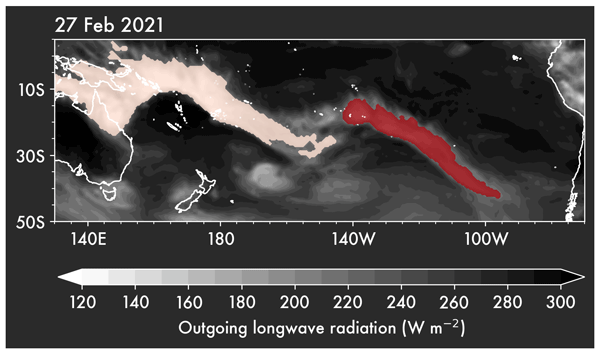
This paper introduces a new method for detecting atmospheric cloud bands to identify long convective cloud bands that extend from the tropics to the midlatitudes. The algorithm allows for easy use and enables researchers to study the life cycle and climatology of cloud bands and associated rainfall. This method provides insights into the large-scale processes involved in cloud band formation and their connections between different regions, as well as differences across ocean basins.
Edgar Dolores-Tesillos, Praveen K. Pothapakula, Christian Zeman, and Daniela I. V. Domeisen
EGUsphere, https://doi.org/10.5194/egusphere-2026-5758, https://doi.org/10.5194/egusphere-2026-5758, 2026
This preprint is open for discussion and under review for Weather and Climate Dynamics (WCD).
Short summary
Short summary
We tested whether increasing climate-model resolution and changing how convection is represented improve the simulation of heatwaves. Using a hierarchy of global atmosphere-only simulations, we found that finer resolution does not consistently reduce heatwave biases. Heatwave persistence depends on regional interactions among convection, rainfall, land conditions, and large-scale circulation, showing that higher resolution alone is not enough.
Andries-Jan de Vries, Steven B. Feldstein, Georgios Fragkoulidis, Priyanka Yadav, and Daniela I. V. Domeisen
EGUsphere, https://doi.org/10.5194/egusphere-2026-5324, https://doi.org/10.5194/egusphere-2026-5324, 2026
This preprint is open for discussion and under review for Weather and Climate Dynamics (WCD).
Short summary
Short summary
Much of the annual precipitation in the arid Middle East falls on only a few days per year, with relevance to drought and flooding. This study quantifies the separate and joint influence of the Madden-Julian Oscillation and midlatitude Rossby waves on daily precipitation variability in the Middle East during the wet season. We find that the tropical and extratropical forcing mechanisms operate largely independent of another and exert an approximately equal influence on precipitation anomalies.
Andries-Jan de Vries, Steven B. Feldstein, Jake W. Casselman, Georgios Fragkoulidis, Jos Lelieveld, and Daniela I. V. Domeisen
Weather Clim. Dynam., 7, 1479–1505, https://doi.org/10.5194/wcd-7-1479-2026, https://doi.org/10.5194/wcd-7-1479-2026, 2026
Short summary
Short summary
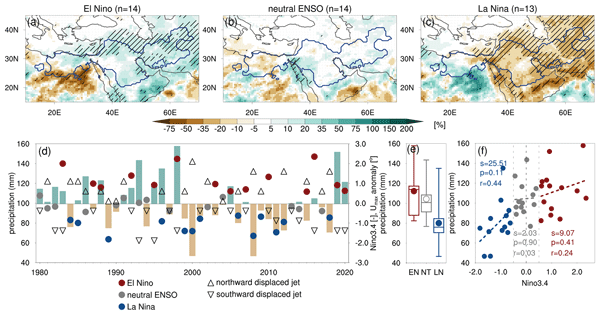
Precipitation in the arid Middle East experiences large yearly variation with direct relevance to drought and flooding. This study quantifies the influence of El Niño-Southern Oscillation on Middle East precipitation variability at local and regional scales during the cool season. Three mechanisms contribute to precipitation anomalies: a meridional shift in the subtropical jet, a barotropic Rossby wave response in the extratropics, and a baroclinic response in the regional tropical circulation.
Liping Wang, Gang Chen, Xiuyuan Ding, Haijun Yang, and Daniela I. V. Domeisen
EGUsphere, https://doi.org/10.5194/egusphere-2026-4150, https://doi.org/10.5194/egusphere-2026-4150, 2026
Short summary
Short summary
We investigate low-frequency Northern Hemisphere stratospheric variability using reanalysis and three multi-century climate model simulations. We identify an intermittent oscillation with a period of about 15 years. This signal is closely connected to the surface North Atlantic Oscillation and tends to precede it, whereas its link to North Pacific circulation is weaker. These results help improve our understanding of stratosphere-surface coupling on multi-year to multi-decadal timescales.
Rachel Wai-Ying Wu, Dominik Büeler, Maria Pyrina, Jonathan Day, Adel Imamovic, Vincent Humphrey, and Daniela I.V. Domeisen
EGUsphere, https://doi.org/10.5194/egusphere-2026-2465, https://doi.org/10.5194/egusphere-2026-2465, 2026
Short summary
Short summary
Compound heat-drought events threaten health, agriculture, and energy. Using ECMWF sub-seasonal hindcasts, we find that physical coupling increases forecast skill by ~10 % relative to assuming event independence. However, skill drops significantly where land-atmosphere interactions – namely soil moisture feedbacks – are misrepresented. We identify European regions where these forecasts are most reliable and highlight physical biases as the primary barrier to accuracy elsewhere.
Lara C. Mercier, Hilla Afargan-Gerstman, Matthew D. K. Priestley, Jens H. Christensen, and Daniela I. V. Domeisen
EGUsphere, https://doi.org/10.5194/egusphere-2026-1805, https://doi.org/10.5194/egusphere-2026-1805, 2026
Preprint archived
Short summary
Short summary
The study examines how extreme extratropical cyclones in the North Atlantic will change in a warming climate using historical and future projections of CMIP6 models. It shows that while near-surface temperature gradients are weakening, increased moisture is likely to make future storms more intense, suggesting a shift toward moisture-driven dynamics. Our findings provide new insights for improving long-term climate adaptation and risk management for high-impact weather in the midlatitudes.
Mélanie Coleman, Andries-Jan de Vries, Caroline Roberts, and Daniela I. V. Domeisen
EGUsphere, https://doi.org/10.5194/egusphere-2026-1827, https://doi.org/10.5194/egusphere-2026-1827, 2026
Short summary
Short summary
This study compares flood impacts between countries in the European Union (EU) and in the Middle East and North Africa (MENA). We find that floods cause four times more fatalities in the MENA region, while they inflict more economic losses in the EU. By comparing recorded impacts and survey data available in the EU only, we find that the population overestimates flood risk in northern EU countries but underestimates it in southern EU countries relative to other natural hazards.
Pauline Rivoire, Sonia Dupuis, Antoine Guisan, Pascal Vittoz, and Daniela I. V. Domeisen
Nat. Hazards Earth Syst. Sci., 26, 1183–1205, https://doi.org/10.5194/nhess-26-1183-2026, https://doi.org/10.5194/nhess-26-1183-2026, 2026
Short summary
Short summary
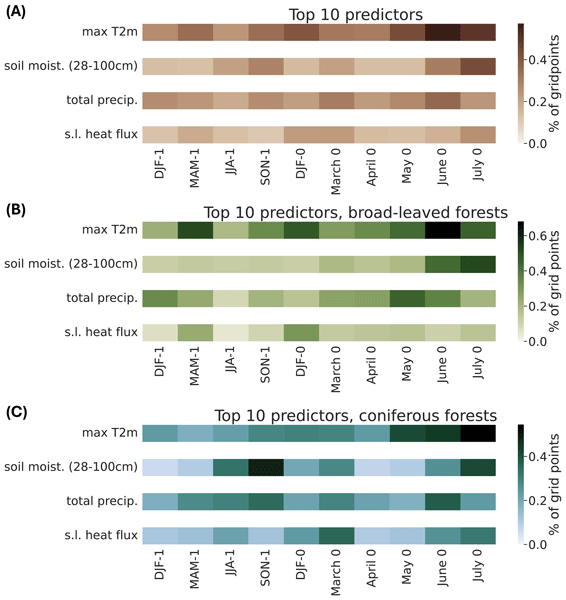
Our study investigates the temperature, precipitation, humidity, and soil moisture conditions leading to the browning of the European forests in summer. Using a Random Forest model and satellite measurements of vegetation greenness, we identify key conditions to predict forest damage. We conclude that hot and dry conditions in spring and summer are adverse conditions. The conditions during the preceding year can also have an impact, with the relevant period varying by forest type.
Monika Feldmann, Daniela I. V. Domeisen, and Olivia Martius
Weather Clim. Dynam., 6, 1089–1106, https://doi.org/10.5194/wcd-6-1089-2025, https://doi.org/10.5194/wcd-6-1089-2025, 2025
Short summary
Short summary
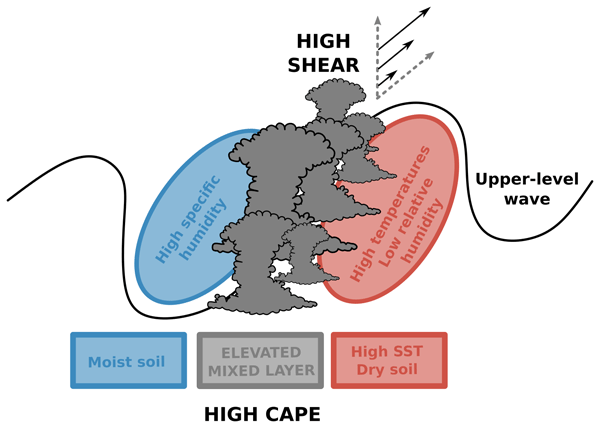
Severe thunderstorm outbreaks are a source of major damage across Europe. Using historical data, we analysed the large-scale weather patterns leading to these outbreaks in eight different regions. Three types of regions emerge: those limited by temperature, those limited by saturation, and those overall favourable for thunderstorms, consistent with their associated weather patterns and the general climate. These findings help explain regional differences and provide a basis for future forecast improvements.
Wolfgang Wicker, Emmanuele Russo, and Daniela I. V. Domeisen
Weather Clim. Dynam., 6, 965–979, https://doi.org/10.5194/wcd-6-965-2025, https://doi.org/10.5194/wcd-6-965-2025, 2025
Short summary
Short summary
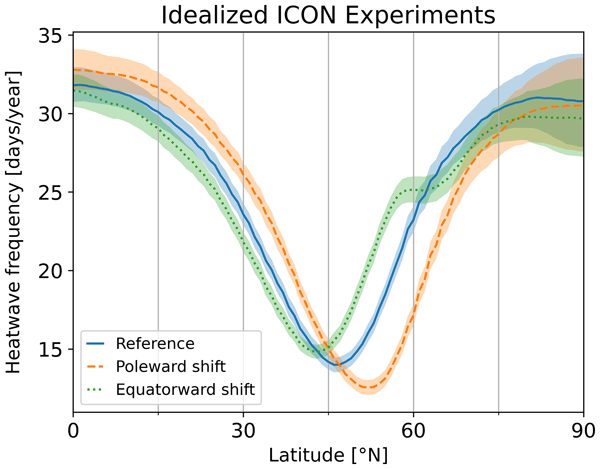
Heatwaves are becoming more frequent, but the contribution by atmospheric circulation changes is unclear. Experiments with an idealized model that simulates atmospheric dynamcis, but excludes clouds, radiation, and moisture, show how a poleward storm track shift increases the eastward phase speed of Rossby waves and reduces mid-latitude heatwave frequency. A comparison with real data for the Southern Hemisphere is attempted.
Annie Y.-Y. Chang, Shaun Harrigan, Maria-Helena Ramos, Massimiliano Zappa, Christian M. Grams, Daniela I. V. Domeisen, and Konrad Bogner
EGUsphere, https://doi.org/10.5194/egusphere-2025-3411, https://doi.org/10.5194/egusphere-2025-3411, 2025
Short summary
Short summary
This study presents a machine learning-aided hybrid forecasting framework to improve early warnings of low flows in the European Alps. It combines weather regime information, streamflow observations, and model simulations (EFAS). Even using only weather regime data improves predictions over climatology, while integrating different data sources yields the best result, emphasizing the value of integrating diverse data sources.
Lou Brett, Christopher J. White, Daniela I. V. Domeisen, Bart van den Hurk, Philip Ward, and Jakob Zscheischler
Nat. Hazards Earth Syst. Sci., 25, 2591–2611, https://doi.org/10.5194/nhess-25-2591-2025, https://doi.org/10.5194/nhess-25-2591-2025, 2025
Short summary
Short summary
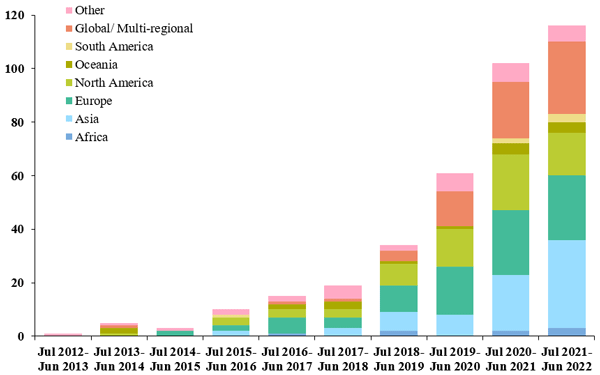
Compound events, where multiple weather or climate hazards occur together, pose significant risks to both society and the environment. These events, like simultaneous wind and rain, can have more severe impacts than single hazards. Our review of compound event research from 2012–2022 reveals a rise in studies, especially on events that occur concurrently, hot and dry events, and compounding flooding. The review also highlights opportunities for research in the coming years.
Bastien François, Khalil Teber, Lou Brett, Richard Leeding, Luis Gimeno-Sotelo, Daniela I. V. Domeisen, Laura Suarez-Gutierrez, and Emanuele Bevacqua
Earth Syst. Dynam., 16, 1029–1051, https://doi.org/10.5194/esd-16-1029-2025, https://doi.org/10.5194/esd-16-1029-2025, 2025
Short summary
Short summary
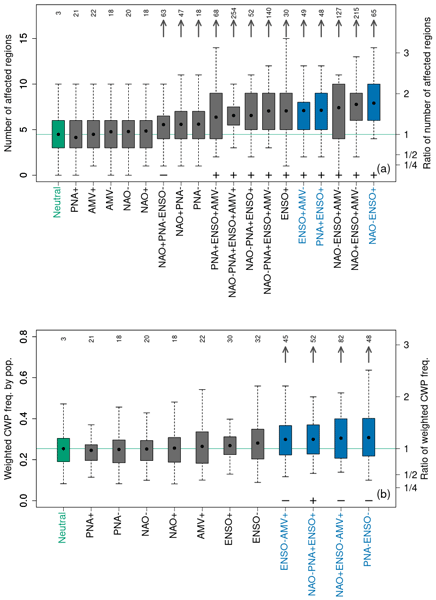
Spatially compounding wind and precipitation (CWP) extremes can lead to severe impacts on society. We find that concurrent climate variability modes favor the occurrence of such wintertime spatially compounding events in the Northern Hemisphere and can even amplify the number of regions and population exposed. Our analysis highlights the importance of considering the interplay between variability modes to improve risk management of such spatially compounding events.
Chaim I. Garfinkel, Zachary D. Lawrence, Amy H. Butler, Etienne Dunn-Sigouin, Irene Erner, Alexey Y. Karpechko, Gerbrand Koren, Marta Abalos, Blanca Ayarzagüena, David Barriopedro, Natalia Calvo, Alvaro de la Cámara, Andrew Charlton-Perez, Judah Cohen, Daniela I. V. Domeisen, Javier García-Serrano, Neil P. Hindley, Martin Jucker, Hera Kim, Robert W. Lee, Simon H. Lee, Marisol Osman, Froila M. Palmeiro, Inna Polichtchouk, Jian Rao, Jadwiga H. Richter, Chen Schwartz, Seok-Woo Son, Masakazu Taguchi, Nicholas L. Tyrrell, Corwin J. Wright, and Rachel W.-Y. Wu
Weather Clim. Dynam., 6, 171–195, https://doi.org/10.5194/wcd-6-171-2025, https://doi.org/10.5194/wcd-6-171-2025, 2025
Short summary
Short summary
Variability in the extratropical stratosphere and troposphere is coupled, and because of the longer timescales characteristic of the stratosphere, this allows for a window of opportunity for surface prediction. This paper assesses whether models used for operational prediction capture these coupling processes accurately. We find that most processes are too weak; however downward coupling from the lower stratosphere to the near surface is too strong.
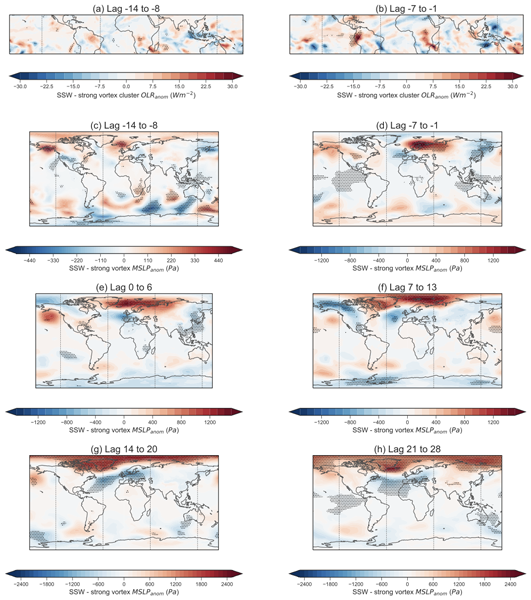
Rachel W.-Y. Wu, Gabriel Chiodo, Inna Polichtchouk, and Daniela I. V. Domeisen
Atmos. Chem. Phys., 24, 12259–12275, https://doi.org/10.5194/acp-24-12259-2024, https://doi.org/10.5194/acp-24-12259-2024, 2024
Short summary
Short summary
Strong variations in the strength of the stratospheric polar vortex can profoundly affect surface weather extremes; therefore, accurately predicting the stratosphere can improve surface weather forecasts. The research reveals how uncertainty in the stratosphere is linked to the troposphere. The findings suggest that refining models to better represent the identified sources and impact regions in the troposphere is likely to improve the prediction of the stratosphere and its surface impacts.
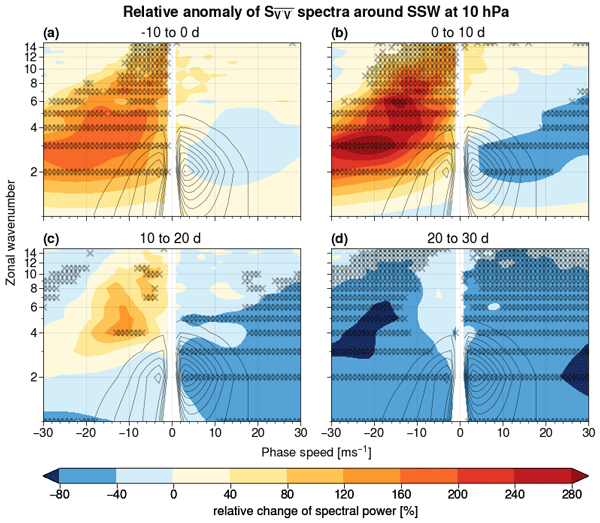
Michael Schutte, Daniela I. V. Domeisen, and Jacopo Riboldi
Weather Clim. Dynam., 5, 733–752, https://doi.org/10.5194/wcd-5-733-2024, https://doi.org/10.5194/wcd-5-733-2024, 2024
Short summary
Short summary
The winter circulation in the stratosphere, a layer of the Earth’s atmosphere between 10 and 50 km height, is tightly linked to the circulation in the lower atmosphere determining our daily weather. This interconnection happens in the form of waves propagating in and between these two layers. Here, we use space–time spectral analysis to show that disruptions and enhancements of the stratospheric circulation modify the shape and propagation of waves in both layers.
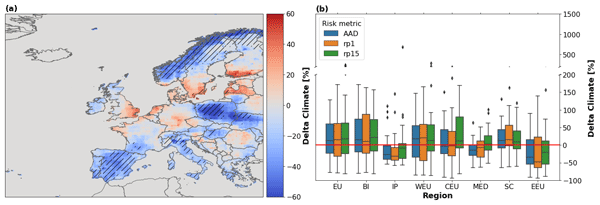
Luca G. Severino, Chahan M. Kropf, Hilla Afargan-Gerstman, Christopher Fairless, Andries Jan de Vries, Daniela I. V. Domeisen, and David N. Bresch
Nat. Hazards Earth Syst. Sci., 24, 1555–1578, https://doi.org/10.5194/nhess-24-1555-2024, https://doi.org/10.5194/nhess-24-1555-2024, 2024
Short summary
Short summary
We combine climate projections from 30 climate models with a climate risk model to project winter windstorm damages in Europe under climate change. We study the uncertainty and sensitivity factors related to the modelling of hazard, exposure and vulnerability. We emphasize high uncertainties in the damage projections, with climate models primarily driving the uncertainty. We find climate change reshapes future European windstorm risk by altering damage locations and intensity.
Romain Pilon and Daniela I. V. Domeisen
Geosci. Model Dev., 17, 2247–2264, https://doi.org/10.5194/gmd-17-2247-2024, https://doi.org/10.5194/gmd-17-2247-2024, 2024
Short summary
Short summary
This paper introduces a new method for detecting atmospheric cloud bands to identify long convective cloud bands that extend from the tropics to the midlatitudes. The algorithm allows for easy use and enables researchers to study the life cycle and climatology of cloud bands and associated rainfall. This method provides insights into the large-scale processes involved in cloud band formation and their connections between different regions, as well as differences across ocean basins.
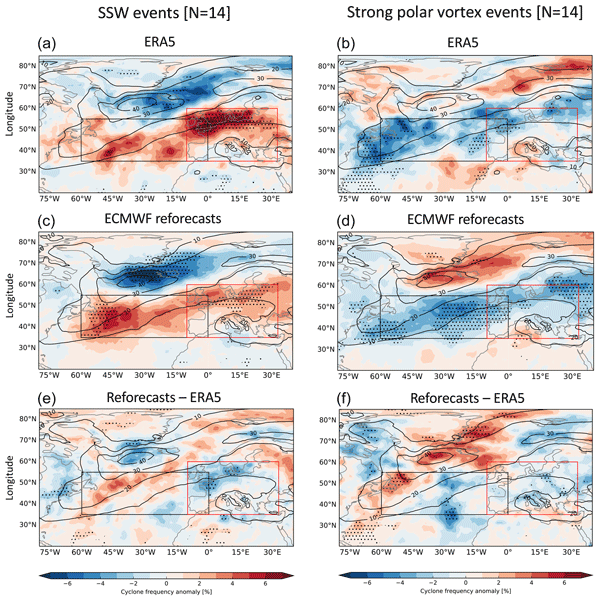
Hilla Afargan-Gerstman, Dominik Büeler, C. Ole Wulff, Michael Sprenger, and Daniela I. V. Domeisen
Weather Clim. Dynam., 5, 231–249, https://doi.org/10.5194/wcd-5-231-2024, https://doi.org/10.5194/wcd-5-231-2024, 2024
Short summary
Short summary
The stratosphere is a layer of Earth's atmosphere found above the weather systems. Changes in the stratosphere can affect the winds and the storm tracks in the North Atlantic region for a relatively long time, lasting for several weeks and even months. We show that the stratosphere can be important for weather forecasts beyond 1 week, but more work is needed to improve the accuracy of these forecasts for 3–4 weeks.
Maria Pyrina, Wolfgang Wicker, Andries Jan de Vries, Georgios Fragkoulidis, and Daniela I. V. Domeisen
EGUsphere, https://doi.org/10.5194/egusphere-2023-3088, https://doi.org/10.5194/egusphere-2023-3088, 2024
Preprint withdrawn
Short summary
Short summary
We investigate the atmospheric dynamics behind heatwaves, specifically of those occurring simultaneously across regions, known as concurrent heatwaves. We find that heatwaves are strongly modulated by Rossby wave packets, being Rossby waves whose amplitude has a local maximum and decays at larger distances. High amplitude Rossby wave packets increase the occurrence probabilities of concurrent and non-concurrent heatwaves by a factor of 15 and 18, respectively, over several regions globally.
David Martin Straus, Daniela I. V. Domeisen, Sarah-Jane Lock, Franco Molteni, and Priyanka Yadav
Weather Clim. Dynam., 4, 1001–1018, https://doi.org/10.5194/wcd-4-1001-2023, https://doi.org/10.5194/wcd-4-1001-2023, 2023
Short summary
Short summary
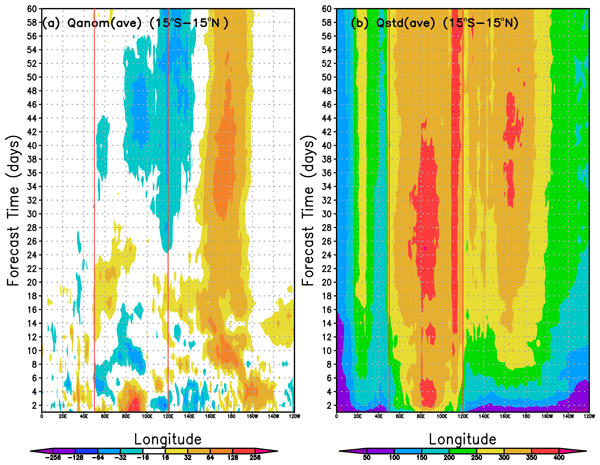
The global response to the Madden–Julian oscillation (MJO) is potentially predictable. Yet the diabatic heating is uncertain even within a particular episode of the MJO. Experiments with a global model probe the limitations imposed by this uncertainty. The large-scale tropical heating is predictable for 25 to 45 d, yet the associated Rossby wave source that links the heating to the midlatitude circulation is predictable for 15 to 20 d. This limitation has not been recognized in prior work.
Gabriel Chiodo, Marina Friedel, Svenja Seeber, Daniela Domeisen, Andrea Stenke, Timofei Sukhodolov, and Franziska Zilker
Atmos. Chem. Phys., 23, 10451–10472, https://doi.org/10.5194/acp-23-10451-2023, https://doi.org/10.5194/acp-23-10451-2023, 2023
Short summary
Short summary
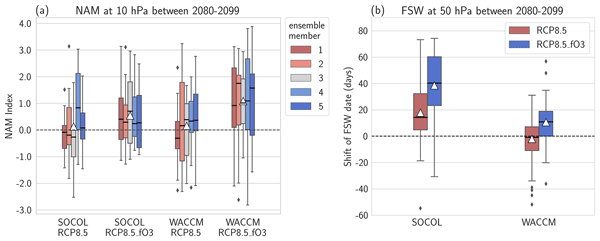
Stratospheric ozone protects the biosphere from harmful UV radiation. Anthropogenic activity has led to a reduction in the ozone layer in the recent past, but thanks to the implementation of the Montreal Protocol, the ozone layer is projected to recover. In this study, we show that projected future changes in Arctic ozone abundances during springtime will influence stratospheric climate and thereby actively modulate large-scale circulation changes in the Northern Hemisphere.
Jake W. Casselman, Joke F. Lübbecke, Tobias Bayr, Wenjuan Huo, Sebastian Wahl, and Daniela I. V. Domeisen
Weather Clim. Dynam., 4, 471–487, https://doi.org/10.5194/wcd-4-471-2023, https://doi.org/10.5194/wcd-4-471-2023, 2023
Short summary
Short summary
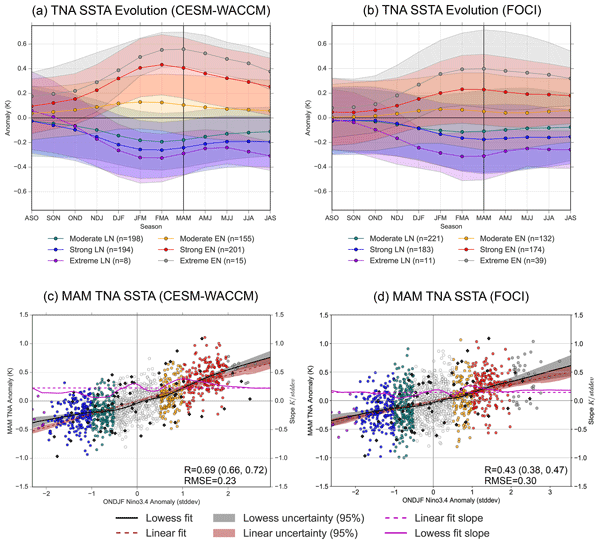
El Niño–Southern Oscillation (ENSO) has remote effects on the tropical North Atlantic (TNA), but the connections' nonlinearity (strength of response to an increasing ENSO signal) is not always well represented in models. Using the Community Earth System Model version 1 – Whole Atmosphere Community Climate Mode (CESM-WACCM) and the Flexible Ocean and Climate Infrastructure version 1, we find that the TNA responds linearly to extreme El Niño but nonlinearly to extreme La Niña for CESM-WACCM.

Raphaël de Fondeville, Zheng Wu, Enikő Székely, Guillaume Obozinski, and Daniela I. V. Domeisen
Weather Clim. Dynam., 4, 287–307, https://doi.org/10.5194/wcd-4-287-2023, https://doi.org/10.5194/wcd-4-287-2023, 2023
Short summary
Short summary
We propose a fully data-driven, interpretable, and computationally scalable framework to characterize sudden stratospheric warmings (SSWs), extract statistically significant precursors, and produce machine learning (ML) forecasts. By successfully leveraging the long-lasting impact of SSWs, the ML predictions outperform sub-seasonal numerical forecasts for lead times beyond 25 d. Post-processing numerical predictions using their ML counterparts yields a performance increase of up to 20 %.
Wolfgang Wicker, Inna Polichtchouk, and Daniela I. V. Domeisen
Weather Clim. Dynam., 4, 81–93, https://doi.org/10.5194/wcd-4-81-2023, https://doi.org/10.5194/wcd-4-81-2023, 2023
Short summary
Short summary
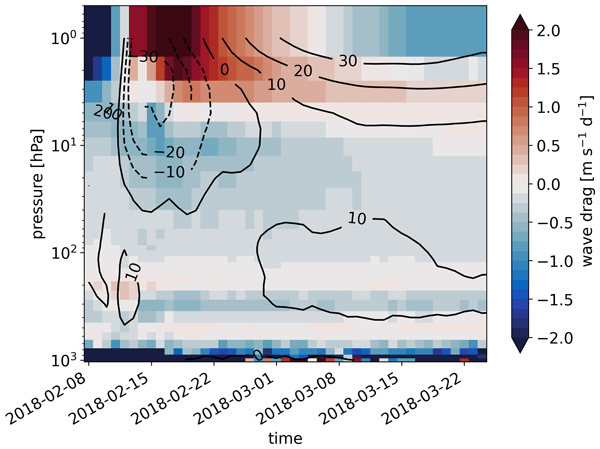
Sudden stratospheric warmings are extreme weather events where the winter polar stratosphere warms by about 25 K. An improved representation of small-scale gravity waves in sub-seasonal prediction models can reduce forecast errors since their impact on the large-scale circulation is predictable multiple weeks ahead. After a sudden stratospheric warming, vertically propagating gravity waves break at a lower altitude than usual, which strengthens the long-lasting positive temperature anomalies.
Marina Friedel, Gabriel Chiodo, Andrea Stenke, Daniela I. V. Domeisen, and Thomas Peter
Atmos. Chem. Phys., 22, 13997–14017, https://doi.org/10.5194/acp-22-13997-2022, https://doi.org/10.5194/acp-22-13997-2022, 2022
Short summary
Short summary
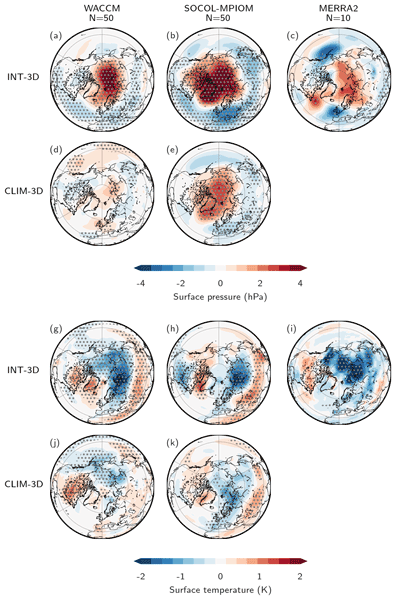
In spring, winds the Arctic stratosphere change direction – an event called final stratospheric warming (FSW). Here, we examine whether the interannual variability in Arctic stratospheric ozone impacts the timing of the FSW. We find that Arctic ozone shifts the FSW to earlier and later dates in years with high and low ozone via the absorption of UV light. The modulation of the FSW by ozone has consequences for surface climate in ozone-rich years, which may result in better seasonal predictions.
Nora Bergner, Marina Friedel, Daniela I. V. Domeisen, Darryn Waugh, and Gabriel Chiodo
Atmos. Chem. Phys., 22, 13915–13934, https://doi.org/10.5194/acp-22-13915-2022, https://doi.org/10.5194/acp-22-13915-2022, 2022
Short summary
Short summary
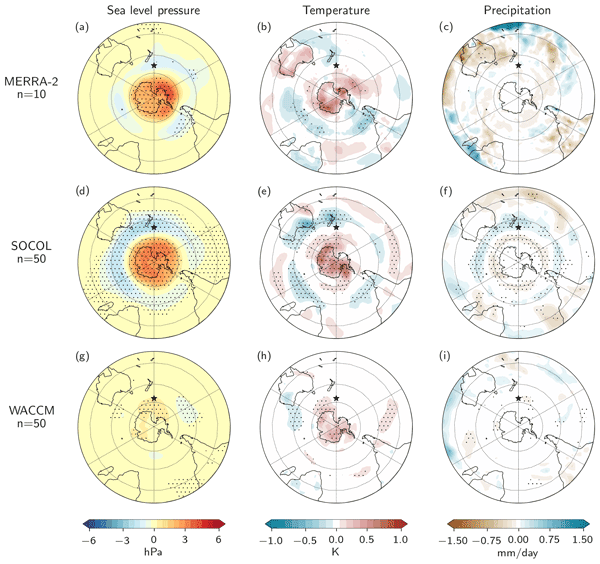
Polar vortex extremes, particularly situations with an unusually weak cyclonic circulation in the stratosphere, can influence the surface climate in the spring–summer time in the Southern Hemisphere. Using chemistry-climate models and observations, we evaluate the robustness of the surface impacts. While models capture the general surface response, they do not show the observed climate patterns in midlatitude regions, which we trace back to biases in the models' circulations.
Jake W. Casselman, Bernat Jiménez-Esteve, and Daniela I. V. Domeisen
Weather Clim. Dynam., 3, 1077–1096, https://doi.org/10.5194/wcd-3-1077-2022, https://doi.org/10.5194/wcd-3-1077-2022, 2022
Short summary
Short summary
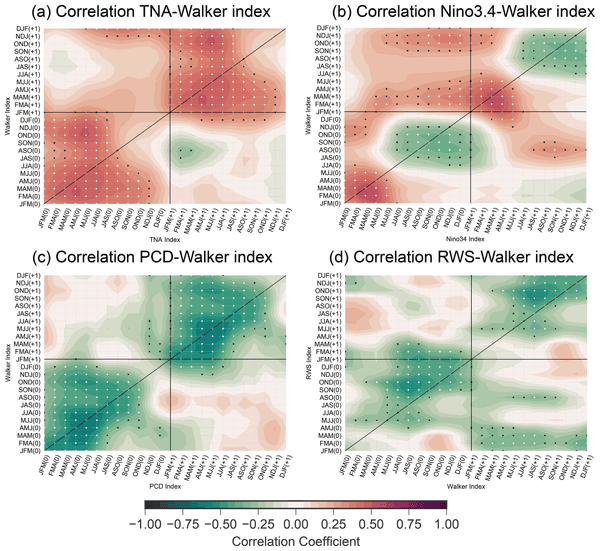
Using an atmospheric general circulation model, we analyze how the tropical North Atlantic influences the El Niño–Southern Oscillation connection towards the North Atlantic European region. We also focus on the lesser-known boreal spring and summer response following an El Niño–Southern Oscillation event. Our results show that altered tropical Atlantic sea surface temperatures may cause different responses over the Caribbean region, consequently influencing the North Atlantic European region.
Zachary D. Lawrence, Marta Abalos, Blanca Ayarzagüena, David Barriopedro, Amy H. Butler, Natalia Calvo, Alvaro de la Cámara, Andrew Charlton-Perez, Daniela I. V. Domeisen, Etienne Dunn-Sigouin, Javier García-Serrano, Chaim I. Garfinkel, Neil P. Hindley, Liwei Jia, Martin Jucker, Alexey Y. Karpechko, Hera Kim, Andrea L. Lang, Simon H. Lee, Pu Lin, Marisol Osman, Froila M. Palmeiro, Judith Perlwitz, Inna Polichtchouk, Jadwiga H. Richter, Chen Schwartz, Seok-Woo Son, Irene Erner, Masakazu Taguchi, Nicholas L. Tyrrell, Corwin J. Wright, and Rachel W.-Y. Wu
Weather Clim. Dynam., 3, 977–1001, https://doi.org/10.5194/wcd-3-977-2022, https://doi.org/10.5194/wcd-3-977-2022, 2022
Short summary
Short summary
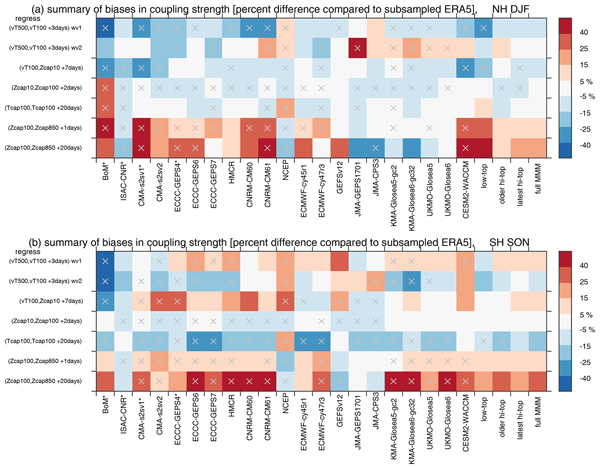
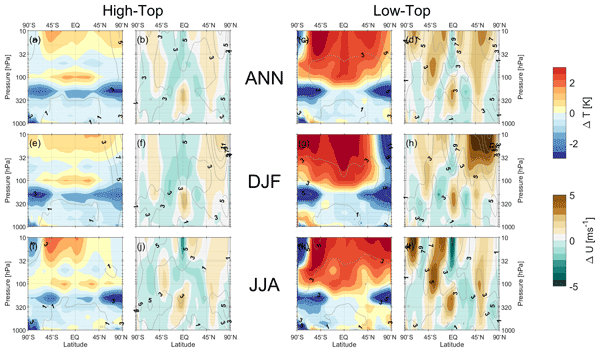
Forecast models that are used to predict weather often struggle to represent the Earth’s stratosphere. This may impact their ability to predict surface weather weeks in advance, on subseasonal-to-seasonal (S2S) timescales. We use data from many S2S forecast systems to characterize and compare the stratospheric biases present in such forecast models. These models have many similar stratospheric biases, but they tend to be worse in systems with low model tops located within the stratosphere.

Rachel Wai-Ying Wu, Zheng Wu, and Daniela I.V. Domeisen
Weather Clim. Dynam., 3, 755–776, https://doi.org/10.5194/wcd-3-755-2022, https://doi.org/10.5194/wcd-3-755-2022, 2022
Short summary
Short summary
Accurate predictions of the stratospheric polar vortex can enhance surface weather predictability. Stratospheric events themselves are less predictable, with strong inter-event differences. We assess the predictability of stratospheric acceleration and deceleration events in a sub-seasonal prediction system, finding that the predictability of events is largely dependent on event magnitude, while extreme drivers of deceleration events are not fully represented in the model.
Matthias Röthlisberger, Barbara Scherrer, Andries Jan de Vries, and Raphael Portmann
Weather Clim. Dynam., 3, 733–754, https://doi.org/10.5194/wcd-3-733-2022, https://doi.org/10.5194/wcd-3-733-2022, 2022
Short summary
Short summary
We examine the palette of synoptic storylines accompanying unusually long wet spells in Europe. Thereby, we identify a hitherto not documented mechanism for generating long wet spells which involves recurrent Rossby wave breaking and subsequent cutoff replenishment. Understanding the synoptic processes behind long wet spells is relevant in light of projected changes in wet spell characteristics as it is a prerequisite for evaluating climate models with regard to such events.

Andries Jan de Vries, Franziska Aemisegger, Stephan Pfahl, and Heini Wernli
Atmos. Chem. Phys., 22, 8863–8895, https://doi.org/10.5194/acp-22-8863-2022, https://doi.org/10.5194/acp-22-8863-2022, 2022
Short summary
Short summary
The Earth's water cycle contains the common H2O molecule but also the less abundant, heavier HDO. We use their different physical properties to study tropical ice clouds in model simulations of the West African monsoon. Isotope signals reveal different processes through which ice clouds form and decay in deep-convective and widespread cirrus. Previously observed variations in upper-tropospheric vapour isotopes are explained by microphysical processes in convective updraughts and downdraughts.
Peter Hitchcock, Amy Butler, Andrew Charlton-Perez, Chaim I. Garfinkel, Tim Stockdale, James Anstey, Dann Mitchell, Daniela I. V. Domeisen, Tongwen Wu, Yixiong Lu, Daniele Mastrangelo, Piero Malguzzi, Hai Lin, Ryan Muncaster, Bill Merryfield, Michael Sigmond, Baoqiang Xiang, Liwei Jia, Yu-Kyung Hyun, Jiyoung Oh, Damien Specq, Isla R. Simpson, Jadwiga H. Richter, Cory Barton, Jeff Knight, Eun-Pa Lim, and Harry Hendon
Geosci. Model Dev., 15, 5073–5092, https://doi.org/10.5194/gmd-15-5073-2022, https://doi.org/10.5194/gmd-15-5073-2022, 2022
Short summary
Short summary
This paper describes an experimental protocol focused on sudden stratospheric warmings to be carried out by subseasonal forecast modeling centers. These will allow for inter-model comparisons of these major disruptions to the stratospheric polar vortex and their impacts on the near-surface flow. The protocol will lead to new insights into the contribution of the stratosphere to subseasonal forecast skill and new approaches to the dynamical attribution of extreme events.
Chen Schwartz, Chaim I. Garfinkel, Priyanka Yadav, Wen Chen, and Daniela I. V. Domeisen
Weather Clim. Dynam., 3, 679–692, https://doi.org/10.5194/wcd-3-679-2022, https://doi.org/10.5194/wcd-3-679-2022, 2022
Short summary
Short summary
Eleven operational forecast models that run on subseasonal timescales (up to 2 months) are examined to assess errors in their simulated large-scale stationary waves in the Northern Hemisphere winter. We found that models with a more finely resolved stratosphere generally do better in simulating the waves in both the stratosphere (10–50 km) and troposphere below. Moreover, a connection exists between errors in simulated time-mean convection in tropical regions and errors in the simulated waves.
Adam A. Scaife, Mark P. Baldwin, Amy H. Butler, Andrew J. Charlton-Perez, Daniela I. V. Domeisen, Chaim I. Garfinkel, Steven C. Hardiman, Peter Haynes, Alexey Yu Karpechko, Eun-Pa Lim, Shunsuke Noguchi, Judith Perlwitz, Lorenzo Polvani, Jadwiga H. Richter, John Scinocca, Michael Sigmond, Theodore G. Shepherd, Seok-Woo Son, and David W. J. Thompson
Atmos. Chem. Phys., 22, 2601–2623, https://doi.org/10.5194/acp-22-2601-2022, https://doi.org/10.5194/acp-22-2601-2022, 2022
Short summary
Short summary
Great progress has been made in computer modelling and simulation of the whole climate system, including the stratosphere. Since the late 20th century we also gained a much clearer understanding of how the stratosphere interacts with the lower atmosphere. The latest generation of numerical prediction systems now explicitly represents the stratosphere and its interaction with surface climate, and here we review its role in long-range predictions and projections from weeks to decades ahead.
Cited articles
Allen, G., Vaughan, G., Brunner, D., T. May, P., Heyes, W., Minnis, P., and K. Ayers, J.: Modulation of tropical convection by breaking Rossby waves, Q. J. Roy. Meteorol. Soc., 135, 125–137, https://doi.org/10.1002/qj.349, 2009. a, b
Appenzeller, C. and Davies, H. C.: Structure of stratospheric intrusions into the troposphere, Nature, 358, 570–572, https://doi.org/10.1038/358570a0, 1992. a
Barnes, M. A., Reeder, M. J., and Ndarana, T.: Rossby Wave Breaking Morphologies on the Southern Hemisphere Dynamical Tropopause, J. Climate, 38, 4825–4844, https://doi.org/10.1175/JCLI-D-24-0461.1, 2025. a
Black, A. S., Risbey, J. S., Chapman, C. C., Monselesan, D. P., II, T. S. M., Pook, M. J., Richardson, D., Sloyan, B. M., Squire, D. T., and Tozer, C. R.: Australian Northwest Cloudbands and Their Relationship to Atmospheric Rivers and Precipitation, Mon. Weather Rev., 149, 1125–1139, https://doi.org/10.1175/MWR-D-20-0308.1, 2021. a
Brown, J. R., Lengaigne, M., Lintner, B. R., Widlansky, M. J., van der Wiel, K., Dutheil, C., Linsley, B. K., Matthews, A. J., and Renwick, J.: South Pacific Convergence Zone dynamics, variability and impacts in a changing climate, Nat. Rev. Earth Environ., 1, 530–543, https://doi.org/10.1038/s43017-020-0078-2, 2020. a, b, c, d, e, f
de Vries, A. J., Feldstein, S. B., Riemer, M., Tyrlis, E., Sprenger, M., Baumgart, M., Fnais, M., and Lelieveld, J.: Dynamics of tropical–extratropical interactions and extreme precipitation events in Saudi Arabia in autumn, winter and spring, Q. J. Roy. Meteorol. Soc., 142, 1862–1880, https://doi.org/10.1002/qj.2781, 2016. a
de Vries, A. J., Ouwersloot, H. G., Feldstein, S. B., Riemer, M., El Kenawy, A. M., McCabe, M. F., and Lelieveld, J.: Identification of Tropical-Extratropical Interactions and Extreme Precipitation Events in the Middle East Based On Potential Vorticity and Moisture Transport, J. Geophys. Res.-Atmos., 123, 861–881, https://doi.org/10.1002/2017JD027587, 2018. a, b
de Vries, A. J., Armon, M., Klingmüller, K., Portmann, R., Röthlisberger, M., and Domeisen, D. I. V.: Breaking Rossby waves drive extreme precipitation in the world's arid regions, Commun. Earth Environ., 5, 493, https://doi.org/10.1038/s43247-024-01633-y, 2024. a, b
Delforge, D., Wathelet, V., Below, R., Lanfredi Sofia, C., Tonnelier, M., van Loenhout, J. A. F., and Speybroeck, N.: The EM-DAT Emergency Events Database Archive, Open Data @ UCLouvain [data set], https://doi.org/10.14428/DVN/I0LTPH, 2024. a
Fröhlich, L. and Knippertz, P.: Identification and global climatology of upper-level troughs at low latitudes, Meteorol. Z., 17, 565–573, https://doi.org/10.1127/0941-2948/2008/0320, 2008. a
Fröhlich, L., Knippertz, P., Fink, A. H., and Hohberger, E.: An Objective Climatology of Tropical Plumes, J. Climate, 26, 5044–5060, https://doi.org/10.1175/JCLI-D-12-00351.1, 2013. a, b, c
Funatsu, B. M. and Waugh, D. W.: Connections between Potential Vorticity Intrusions and Convection in the Eastern Tropical Pacific, J. Atmos. Sci., 65, 987–1002, https://doi.org/10.1175/2007JAS2248.1, 2008. a, b, c
Griffiths, G. M., Salinger, M. J., and Leleu, I.: Trends in extreme daily rainfall across the South Pacific and relationship to the South Pacific Convergence Zone, Int. J. Climatol., 23, 847–869, https://doi.org/10.1002/joc.923, 2003. a
Hart, N. C. G., Reason, C. J. C., and Fauchereau, N.: Cloud bands over southern Africa: seasonality, contribution to rainfall variability and modulation by the MJO, Clim. Dynam., 41, 1199–1212, https://doi.org/10.1007/s00382-012-1589-4, 2013. a
Hart, R. E. and Grumm, R. H.: Using Normalized Climatological Anomalies to Rank Synoptic-Scale Events Objectively, Mon. Weather Rev., 129, 2426–2442, https://doi.org/10.1175/1520-0493(2001)129<2426:UNCATR>2.0.CO;2, 2001. a
Hersbach, H., Bell, B., Berrisford, P., Biavati, G., Horányi, A., Muñoz Sabater, J., Nicolas, J., Peubey, C., Radu, R., Rozum, I., Schepers, D., Simmons, A., Soci, C., Dee, D., and Thépaut, J.-N.: ERA5 hourly data on single levels from 1940 to present, Copernicus Climate Change Service (C3S) Climate Data Store (CDS) [data set], https://doi.org/10.24381/cds.adbb2d47, 2018. a
Hersbach, H., Bell, B., Berrisford, P., Hirahara, S., Horányi, A., Muñoz-Sabater, J., Nicolas, J., Peubey, C., Radu, R., Schepers, D., Simmons, A., Soci, C., Abdalla, S., Abellan, X., Balsamo, G., Bechtold, P., Biavati, G., Bidlot, J., Bonavita, M., De Chiara, G., Dahlgren, P., Dee, D., Diamantakis, M., Dragani, R., Flemming, J., Forbes, R., Fuentes, M., Geer, A., Haimberger, L., Healy, S., Hogan, R. J., Hólm, E., Janisková, M., Keeley, S., Laloyaux, P., Lopez, P., Lupu, C., Radnoti, G., de Rosnay, P., Rozum, I., Vamborg, F., Villaume, S., and Thépaut, J.-N.: The ERA5 global reanalysis, Q. J. Roy. Meteorol. Soc., 146, 1999–2049, https://doi.org/10.1002/qj.3803, 2020. a
Kiladis, G. N. and Weickmann, K. M.: Extratropical Forcing of Tropical Pacific Convection during Northern Winter, Mon. Weather Rev., 120, 1924–1939, https://doi.org/10.1175/1520-0493(1992)120<1924:EFOTPC>2.0.CO;2, 1992. a
Knippertz, P. and Martin, J. E.: Tropical plumes and extreme precipitation in subtropical and tropical West Africa, Q. J. Roy. Meteorol. Soc., 131, 2337–2365, https://doi.org/10.1256/qj.04.148, 2005. a, b
Kodama, Y.: Large-Scale Common Features of Subtropical Precipitation Zones (the Baiu Frontal Zone, the SPCZ, and the SACZ) Part I: Characteristics of Subtropical Frontal Zones, J. Meteorol. Soc. JPN Ser. II, 70, 813–836, https://doi.org/10.2151/jmsj1965.70.4_813, 1992. a
Kumar, V. V., Deo, R. C., and Ramachandran, V.: Total rain accumulation and rain-rate analysis for small tropical Pacific islands: a case study of Suva, Fiji, Atmos. Sci. Lett., 7, 53–58, https://doi.org/10.1002/asl.131, 2006. a
Lorrey, A., Dalu, G., Renwick, J., Diamond, H., and Gaetani, M.: Reconstructing the South Pacific Convergence Zone Position during the Presatellite Era: A La Niña Case Study, Mon. Weather Rev., 140, 3653–3668, https://doi.org/10.1175/MWR-D-11-00228.1, 2012. a
Matthews, A. J.: A multiscale framework for the origin and variability of the South Pacific Convergence Zone, Q. J. Roy. Meteorol. Soc., 138, 1165–1178, https://doi.org/10.1002/qj.1870, 2012. a
Matthews, A. J., Hoskins, B. J., Slingo, J. M., and Blackburn, M.: Development of convection along the SPCZ within a Madden-Julian oscillation, Q. J. Roy. Meteorol. Soc., 122, 669–688, https://doi.org/10.1002/qj.49712253106, 1996. a
McIntyre, M. E. and Palmer, T. N.: Breaking planetary waves in the stratosphere, Nature, 305, 593–600, https://doi.org/10.1038/305593a0, 1983. a
Murthy, V. S. and Boos, W. R.: Understanding the vertical structure of potential vorticity in tropical depressions, Q. J. Roy. Meteorol. Soc., 145, 1968–1991, https://doi.org/10.1002/qj.3539, 2019. a
Niznik, M., Lintner, B. R., Matthews, A. J., and Widlansky, M. J.: The Role of Tropical–Extratropical Interaction and Synoptic Variability in Maintaining the South Pacific Convergence Zone in CMIP5 Models, J. Climate, 28, 3353 – 3374, https://doi.org/10.1175/JCLI-D-14-00527.1, 2015. a
Oertel, A., Boettcher, M., Joos, H., Sprenger, M., and Wernli, H.: Potential vorticity structure of embedded convection in a warm conveyor belt and its relevance for large-scale dynamics, Weather Clim. Dynam., 1, 127–153, https://doi.org/10.5194/wcd-1-127-2020, 2020. a
Peters, D. and Waugh, D. W.: Influence of Barotropic Shear on the Poleward Advection of Upper-Tropospheric Air, J. Atmos. Sci., 53, 3013–3031, https://doi.org/10.1175/1520-0469(1996)053<3013:IOBSOT>2.0.CO;2, 1996. a
Pilon, R.: romainpilon/cloudbandPy: v1.2.2 - Bug Fix, Version v1.2.2, Zenodo [code], https://doi.org/10.5281/zenodo.14639920, 2025. a
Pilon, R.: Supporting Files for The Role of Rossby Wave Breaking in the Formation and Maintenance of Tropical-Extratropical Cloud Bands over the South Pacific, Zenodo [code], https://doi.org/10.5281/zenodo.19919573, 2026. a
Pilon, R. and Domeisen, D. I. V.: cloudbandPy 1.0: an automated algorithm for the detection of tropical–extratropical cloud bands, Geosci. Model Dev., 17, 2247–2264, https://doi.org/10.5194/gmd-17-2247-2024, 2024. a, b, c, d
Portmann, R., Sprenger, M., and Wernli, H.: The three-dimensional life cycles of potential vorticity cutoffs: a global and selected regional climatologies in ERA-Interim (1979–2018), Weather Clim. Dynam., 2, 507–534, https://doi.org/10.5194/wcd-2-507-2021, 2021. a, b
Rosa, E. B., Pezzi, L. P., Quadro, M. F. L. d., and Brunsell, N.: Automated Detection Algorithm for SACZ, Oceanic SACZ, and Their Climatological Features, Front. Environ. Sci., 8, https://doi.org/10.3389/fenvs.2020.00018, original Research, 2020. a
Sagero, P. O., Pratap, A., Magiri, R., Ongoma, V., and Okello, P.: Validation of ERA5 rainfall data over the South Pacific Region: case study of Fiji Islands, Meteorol. Atmos. Phys., 136, 28, https://doi.org/10.1007/s00703-024-01025-z, 2024. a
Stan, C., Straus, D. M., Frederiksen, J. S., Lin, H., Maloney, E. D., and Schumacher, C.: Review of Tropical-Extratropical Teleconnections on Intraseasonal Time Scales, Rev. Geophys., 55, 902–937, https://doi.org/10.1002/2016RG000538, 2017. a
Takahashi, K. and Battisti, D. S.: Processes Controlling the Mean Tropical Pacific Precipitation Pattern. Part II: The SPCZ and the Southeast Pacific Dry Zone, J. Climate, 20, 5696–5706, https://doi.org/10.1175/2007JCLI1656.1, 2007. a
Telcik, N. and Pattiaratchi, C.: Influence of Northwest Cloudbands on Southwest Australian Rainfall, J. Climatology (Cairo), 2014, 671394, https://doi.org/10.1155/2014/671394, 2014. a
Thorncroft, C. D., Hoskins, B. J., and McIntyre, M. E.: Two paradigms of baroclinic-wave life-cycle behaviour, Q. J. Roy. Meteorol. Soc., 119, 17–55, https://doi.org/10.1002/qj.49711950903, 1993. a
Tubi, A. and Dayan, U.: Tropical Plumes over the Middle East: Climatology and synoptic conditions, Atmos. Res., 145-146, 168–181, https://doi.org/10.1016/j.atmosres.2014.03.028, 2014. a
van der Wiel, K., Matthews, A. J., Joshi, M. M., and Stevens, D. P.: Why the South Pacific Convergence Zone is diagonal, Clima. Dynam., 46, 1683–1698, https://doi.org/10.1007/s00382-015-2668-0, 2016. a, b, c
Vincent, D. G.: The South Pacific Convergence Zone (SPCZ): A Review, Mon. Weather Rev., 122, 1949–1970, https://doi.org/10.1175/1520-0493(1994)122<1949:TSPCZA>2.0.CO;2, 1994. a
Waugh, D. W. and Funatsu, B. M.: Intrusions into the Tropical Upper Troposphere: Three-Dimensional Structure and Accompanying Ozone and OLR Distributions, J. Atmos. Sci., 60, 637–653, https://doi.org/10.1175/1520-0469(2003)060<0637:IITTUT>2.0.CO;2, 2003. a
Waugh, D. W. and Polvani, L. M.: Climatology of intrusions into the tropical upper troposphere, Geophys. Res. Lett., 27, 3857–3860, https://doi.org/10.1029/2000GL012250, 2000. a
Webster, P. J. and Holton, J. R.: Cross-Equatorial Response to Middle-Latitude Forcing in a Zonally Varying Basic State, J. Atmos. Sci., 39, 722–733, https://doi.org/10.1175/1520-0469(1982)039<0722:CERTML>2.0.CO;2, 1982. a
Wernli, H. and Sprenger, M.: Identification and ERA-15 Climatology of Potential Vorticity Streamers and Cutoffs near the Extratropical Tropopause, J. Atmos. Sci., 64, 1569–1586, https://doi.org/10.1175/JAS3912.1, 2007. a, b
Widlansky, M. J., Webster, P. J., and Hoyos, C. D.: On the location and orientation of the South Pacific Convergence Zone, Clim. Dynam., 36, 561–578, https://doi.org/10.1007/s00382-010-0871-6, 2011. a
Zilli, M. T. and Hart, N. C. G.: Rossby Wave Dynamics over South America Explored with Automatic Tropical–Extratropical Cloud Band Identification Framework, J. Climate, 34, 8125–8144, https://doi.org/10.1175/JCLI-D-21-0020.1, 2021. a, b, c, d
Zilli, M. T., Hart, N. C. G., Coelho, C. A. S., Chadwick, R., de Souza, D. C., Kubota, P. Y., Figueroa, S. N., and Cavalcanti, I. F. A.: Characteristics of tropical–extratropical cloud bands over tropical and subtropical South America simulated by BAM-1.2 and HadGEM3-GC3.1, Q. J. Roy. Meteorol. Soc., 149, 1498–1519, https://doi.org/10.1002/qj.4470, 2023. a
Short summary
South Pacific cloud bands are vital rain sources. Using historical weather data, we investigated how atmospheric waves from the midlatitudes shape these cloud bands. We found that long-lasting cloud bands require sustained high-altitude waves to continuously steer tropical moisture southward. These persistent events occur strictly during the summer. Understanding this dynamic link is essential for improving climate models and predicting how regional rainfall patterns may change in the future.
South Pacific cloud bands are vital rain sources. Using historical weather data, we investigated...


