
Articles | Volume 7, issue 2
https://doi.org/10.5194/wcd-7-915-2026
© Author(s) 2026. This work is distributed under
the Creative Commons Attribution 4.0 License.
the Creative Commons Attribution 4.0 License.
https://doi.org/10.5194/wcd-7-915-2026
© Author(s) 2026. This work is distributed under
the Creative Commons Attribution 4.0 License.
the Creative Commons Attribution 4.0 License.
Research article
| 
12 Jun 2026
Research article |
| 12 Jun 2026
| 12 Jun 2026
Predictability of cyclones associated with heavy precipitation events in the Sahara
Guorong Ling
Institute for Atmospheric and Climate Science, ETH Zurich, Zurich, Switzerland
Hilla Afargan-Gerstman
CORRESPONDING AUTHOR

Oeschger Centre for Climate Change Research, Institute of Geography, University of Bern, Bern, Switzerland
The Fredy and Nadine Herrmann Institute of Earth Sciences, The Hebrew University of Jerusalem, Jerusalem, Israel
Related authors
No articles found.
Yair Rinat, Moshe Armon, and Efrat Morin
Hydrol. Earth Syst. Sci., 30, 4565–4585, https://doi.org/10.5194/hess-30-4565-2026, https://doi.org/10.5194/hess-30-4565-2026, 2026
Short summary
Short summary
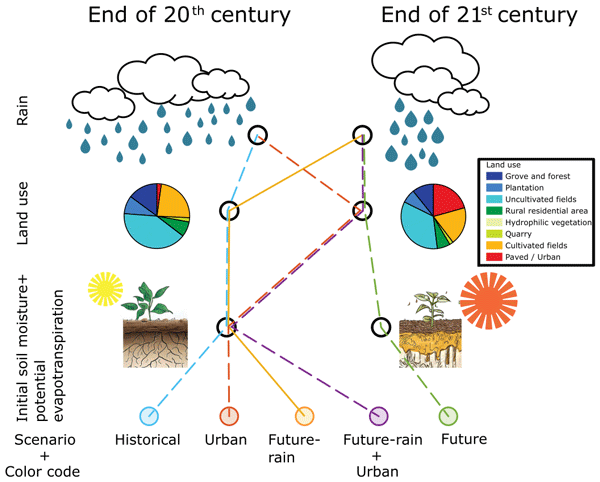
In the coming decades Mediterranean floods are expected to change due to increased urbanization and climate change. We simulate floods under different conditions and show that future rainfall will likely reduce flood magnitudes, but increased urbanization will make them higher. Flood intensification is more pronounced at upstream sections and when soil moisture is high. As future flood trends may change between different regions further research is needed to cope with upcoming challenges.
Ellina Agayar, Moshe Armon, Michael Sprenger, and Heini Wernli
Nat. Hazards Earth Syst. Sci., 26, 3025–3043, https://doi.org/10.5194/nhess-26-3025-2026, https://doi.org/10.5194/nhess-26-3025-2026, 2026
Short summary
Short summary
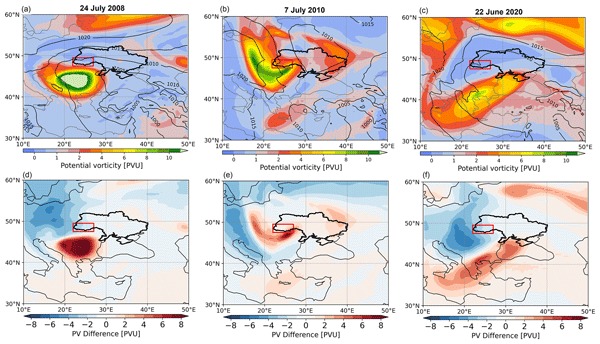
This study investigates the hydrometeorological features of the major floods of 2008, 2010, and 2020 in western Ukraine. All cases were linked to upper-level potential vorticity (PV) anomalies. We also conducted a climatological analysis of PV structure associated with 22 summer heavy precipitation events (2000–2022), highlighting their key role in determining the location and intensity of flood-inducing rainfall events in the Carpathians.
Lara C. Mercier, Hilla Afargan-Gerstman, Matthew D. K. Priestley, Jens H. Christensen, and Daniela I. V. Domeisen
EGUsphere, https://doi.org/10.5194/egusphere-2026-1805, https://doi.org/10.5194/egusphere-2026-1805, 2026
Preprint archived
Short summary
Short summary
The study examines how extreme extratropical cyclones in the North Atlantic will change in a warming climate using historical and future projections of CMIP6 models. It shows that while near-surface temperature gradients are weakening, increased moisture is likely to make future storms more intense, suggesting a shift toward moisture-driven dynamics. Our findings provide new insights for improving long-term climate adaptation and risk management for high-impact weather in the midlatitudes.
Blanca Ayarzagüena, Amy H. Butler, Peter Hitchcock, Chaim I. Garfinkel, Zac D. Lawrence, Wuhan Ning, Philip Rupp, Zheng Wu, Hilla Afargan-Gerstman, Natalia Calvo, Alvaro de la Cámara, Martin Jucker, Gerbrand Koren, Daniel De Maeseneire, Gloria L. Manney, Marisol Osman, Masakazu Taguchi, Cory Barton, Dong-Chan Hong, Yu-Kyung Hyun, Hera Kim, Jeff Knight, Piero Malguzzi, Daniele Mastrangelo, Jiyoung Oh, Inna Polichtchouk, Jadwiga H. Richter, Isla R. Simpson, Seok-Woo Son, Damien Specq, and Tim Stockdale
Weather Clim. Dynam., 7, 411–437, https://doi.org/10.5194/wcd-7-411-2026, https://doi.org/10.5194/wcd-7-411-2026, 2026
Short summary
Short summary
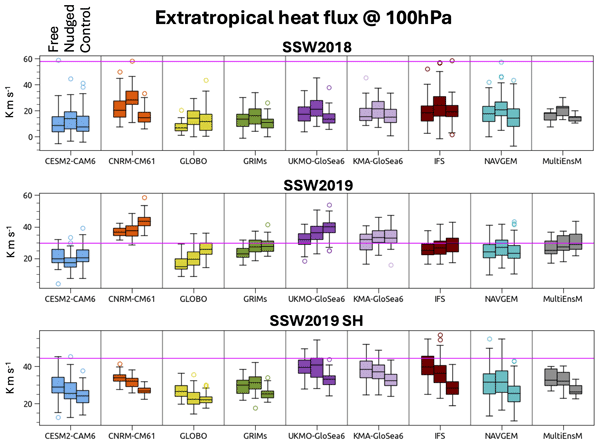
Sudden Stratospheric Warmings (SSWs) are known to follow a sustained wave dissipation in the stratosphere, which depends on both the tropospheric and stratospheric states. However, the relative role of each state is still unclear. Using a new set of subseasonal to seasonal forecasts, we show that the stratospheric state does not drastically affect the precursors of three recent SSWs, but modulates the stratospheric wave activity, with impacts depending on SSW features.
Joëlle C. Rieder, Franziska Aemisegger, Elad Dente, and Moshe Armon
Hydrol. Earth Syst. Sci., 29, 1395–1427, https://doi.org/10.5194/hess-29-1395-2025, https://doi.org/10.5194/hess-29-1395-2025, 2025
Short summary
Short summary
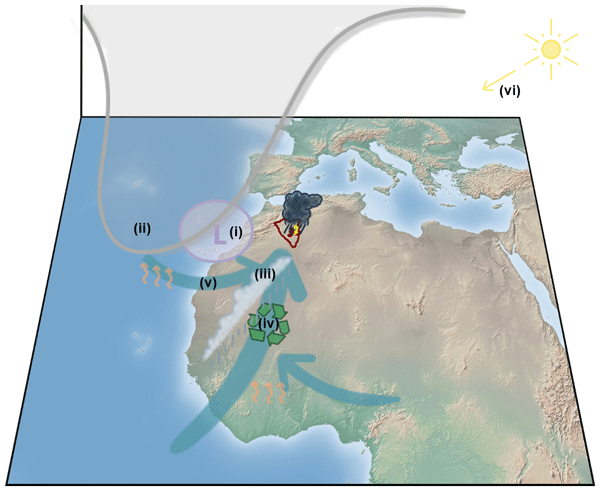
The Sahara was wetter in the past and may become wetter in the future. Lake remnants are evidence of the desert’s wetter past. If the Sahara gets wetter in the future, these lakes may serve as a water resource. However, it is unclear how these lakes get filled and how moisture is carried into the desert and converted into rain in the first place. Therefore, we examine processes currently leading to the filling of a dry lake in the Sahara, which can help assess future water availability.
Philip Rupp, Jonas Spaeth, Hilla Afargan-Gerstman, Dominik Büeler, Michael Sprenger, and Thomas Birner
Weather Clim. Dynam., 5, 1287–1298, https://doi.org/10.5194/wcd-5-1287-2024, https://doi.org/10.5194/wcd-5-1287-2024, 2024
Short summary
Short summary
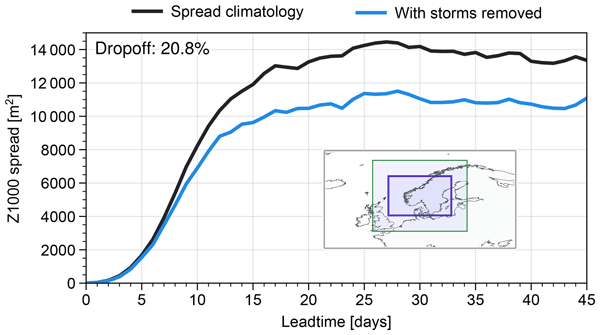
We quantify the occurrence of strong synoptic storms as contributing about 20 % to the uncertainty of subseasonal geopotential height forecasts over northern Europe. We further show that North Atlantic storms are less frequent, weaker and shifted southward following sudden stratospheric warming events, leading to a reduction in northern European forecast uncertainty.
Ellina Agayar, Franziska Aemisegger, Moshe Armon, Alexander Scherrmann, and Heini Wernli
Nat. Hazards Earth Syst. Sci., 24, 2441–2459, https://doi.org/10.5194/nhess-24-2441-2024, https://doi.org/10.5194/nhess-24-2441-2024, 2024
Short summary
Short summary
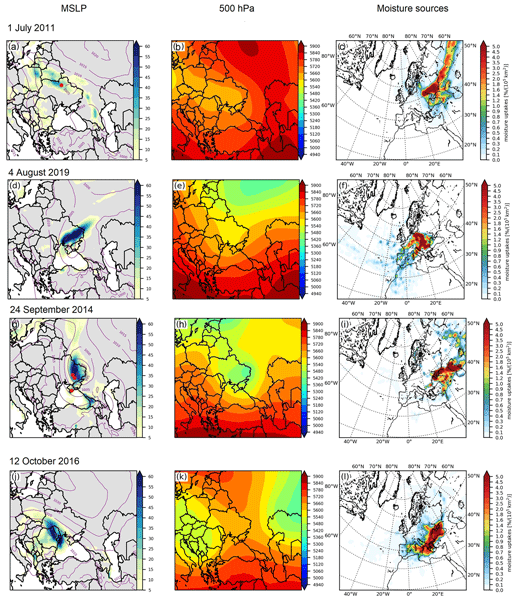
This study presents the results of a climatological investigation of extreme precipitation events (EPEs) in Ukraine for the period 1979–2019. During all seasons EPEs are associated with pronounced upper-level potential vorticity (PV) anomalies. In addition, we find distinct seasonal and regional differences in moisture sources. Several extreme precipitation cases demonstrate the importance of these processes, complemented by a detailed synoptic analysis.
Luca G. Severino, Chahan M. Kropf, Hilla Afargan-Gerstman, Christopher Fairless, Andries Jan de Vries, Daniela I. V. Domeisen, and David N. Bresch
Nat. Hazards Earth Syst. Sci., 24, 1555–1578, https://doi.org/10.5194/nhess-24-1555-2024, https://doi.org/10.5194/nhess-24-1555-2024, 2024
Short summary
Short summary
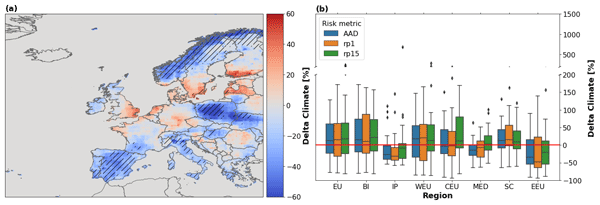
We combine climate projections from 30 climate models with a climate risk model to project winter windstorm damages in Europe under climate change. We study the uncertainty and sensitivity factors related to the modelling of hazard, exposure and vulnerability. We emphasize high uncertainties in the damage projections, with climate models primarily driving the uncertainty. We find climate change reshapes future European windstorm risk by altering damage locations and intensity.
Hilla Afargan-Gerstman, Dominik Büeler, C. Ole Wulff, Michael Sprenger, and Daniela I. V. Domeisen
Weather Clim. Dynam., 5, 231–249, https://doi.org/10.5194/wcd-5-231-2024, https://doi.org/10.5194/wcd-5-231-2024, 2024
Short summary
Short summary
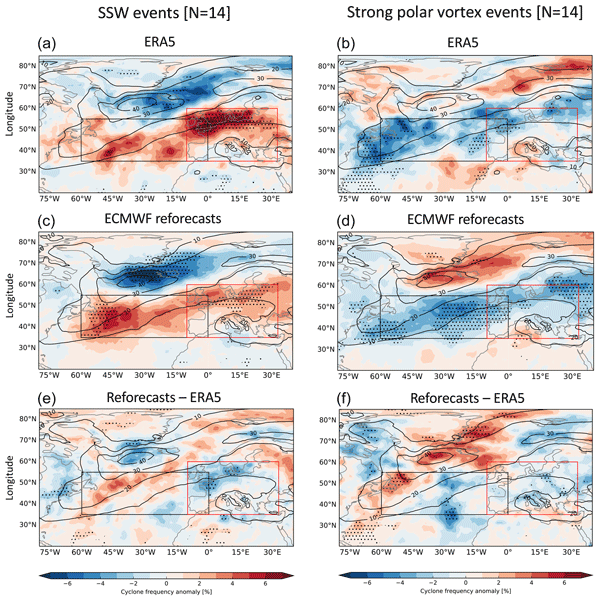
The stratosphere is a layer of Earth's atmosphere found above the weather systems. Changes in the stratosphere can affect the winds and the storm tracks in the North Atlantic region for a relatively long time, lasting for several weeks and even months. We show that the stratosphere can be important for weather forecasts beyond 1 week, but more work is needed to improve the accuracy of these forecasts for 3–4 weeks.
Haggai Eyal, Moshe Armon, Yehouda Enzel, and Nadav G. Lensky
Earth Surf. Dynam., 11, 547–574, https://doi.org/10.5194/esurf-11-547-2023, https://doi.org/10.5194/esurf-11-547-2023, 2023
Short summary
Short summary
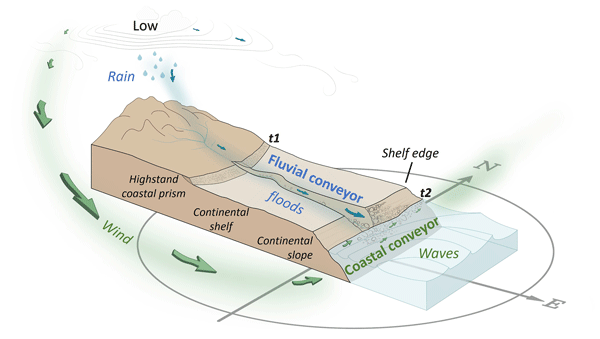
Extracting paleoenvironmets from sedimentologic and geomorphic records is a main goal in Earth sciences. We study a chain of processes connecting causative Mediterranean cyclones, coeval floods, storm waves generated by mesoscale funneled wind, and coastal gravel transport. This causes northward dispersion of gravel along the modern Dead Sea coast, which has also persisted since the late Pleistocene, resulting in beach berms and fan deltas always being deposited north of channel mouths.
Francesco Marra, Moshe Armon, and Efrat Morin
Hydrol. Earth Syst. Sci., 26, 1439–1458, https://doi.org/10.5194/hess-26-1439-2022, https://doi.org/10.5194/hess-26-1439-2022, 2022
Short summary
Short summary
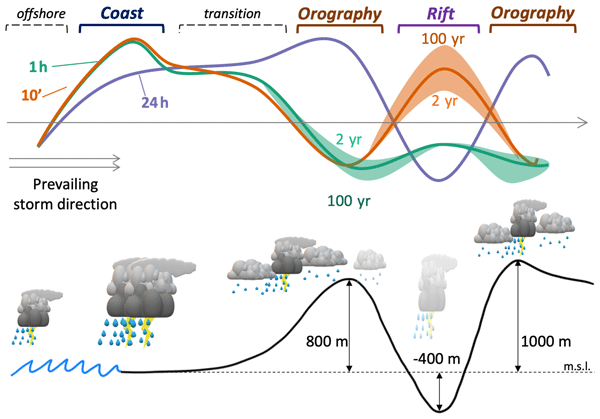
We present a new method for quantifying the probability of occurrence of extreme rainfall using radar data, and we use it to examine coastal and orographic effects on extremes. We identify three regimes, directly related to precipitation physical processes, which respond differently to these forcings. The methods and results are of interest for researchers and practitioners using radar for the analysis of extremes, risk managers, water resources managers, and climate change impact studies.
Yoav Ben Dor, Francesco Marra, Moshe Armon, Yehouda Enzel, Achim Brauer, Markus Julius Schwab, and Efrat Morin
Clim. Past, 17, 2653–2677, https://doi.org/10.5194/cp-17-2653-2021, https://doi.org/10.5194/cp-17-2653-2021, 2021
Short summary
Short summary
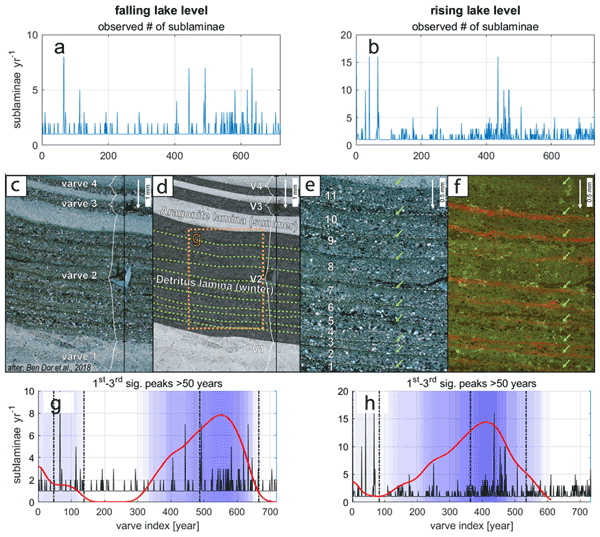
Laminated sediments from the deepest part of the Dead Sea unravel the hydrological response of the eastern Mediterranean to past climate changes. This study demonstrates the importance of geological archives in complementing modern hydrological measurements that do not fully capture natural hydroclimatic variability, which is crucial to configure for understanding the impact of climate change on the hydrological cycle in subtropical regions.
Cited articles
Afargan-Gerstman, H., Büeler, D., Wulff, C. O., Sprenger, M., and Domeisen, D. I. V.: Stratospheric influence on the winter North Atlantic storm track in subseasonal reforecasts, Weather Clim. Dynam., 5, 231–249, https://doi.org/10.5194/wcd-5-231-2024, 2024. a, b
Alpert, P. and Ziv, B.: The Sharav Cyclone: observations and some theoretical considerations, J. Geophys. Res., 94, 18495–18514, https://doi.org/10.1029/jd094id15p18495, 1989. a
Ammar, K., El-Metwally, M., Almazroui, M., and Abdel Wahab, M.: A climatological analysis of Saharan cyclones, Clim. Dynam., 43, 483–501, https://doi.org/10.1007/s00382-013-2025-0, 2014. a
Armon, M., Dente, E., Smith, J. A., Enzel, Y., and Morin, E.: Synoptic-scale control over modern rainfall and flood patterns in the Levant drylands with implications for past climates, J. Hydrometeorol., 19, 1077–1096, https://doi.org/10.1175/JHM-D-18-0013.1, 2018. a
Armon, M., Shmilovitz, Y., and Dente, E.: Anatomy of a foreseeable disaster: lessons from the 2023 dam-breaching flood in Derna, Libya, Science Advances, 11, eadu2865, https://doi.org/10.1126/sciadv.adu2865, 2025. a, b
Baumgart, M., Riemer, M., Wirth, V., Teubler, F., and Lang, S. T.: Potential vorticity dynamics of forecast errors: a quantitative case study, Mon. Weather Rev., 146, 1405–1425, 2018. a
Belachsen, I., Marra, F., Peleg, N., and Morin, E.: Convective rainfall in a dry climate: relations with synoptic systems and flash-flood generation in the Dead Sea region, Hydrol. Earth Syst. Sci., 21, 5165–5180, https://doi.org/10.5194/hess-21-5165-2017, 2017. a
Berry, G., Thorncroft, C., and Hewson, T.: African easterly waves during 2004–analysis using objective techniques, Mon. Weather Rev., 135, 1251–1267, https://doi.org/10.1175/MWR3343.1, 2007. a
Black, J., Johnson, N. C., Baxter, S., Feldstein, S. B., Harnos, D. S., and L'Heureux, M. L.: The predictors and forecast skill of Northern Hemisphere teleconnection patterns for lead times of 3–4 weeks, Mon. Weather Rev., 145, 2855–2877, https://doi.org/10.1175/MWR-D-16-0394.1, 2017. a
Candogan Yossef, N., van Beek, L. P. H., Kwadijk, J. C. J., and Bierkens, M. F. P.: Assessment of the potential forecasting skill of a global hydrological model in reproducing the occurrence of monthly flow extremes, Hydrol. Earth Syst. Sci., 16, 4233–4246, https://doi.org/10.5194/hess-16-4233-2012, 2012. a
Chaqdid, A., Tuel, A., El Fatimy, A., and El Moçayd, N.: Extreme rainfall events in Morocco: spatial dependence and climate drivers, Weather and Climate Extremes, 40, 100556, https://doi.org/10.1016/j.wace.2023.100556, 2023. a
Copernicus Climate Change Service (C3S): ERA5 hourly data on single levels from 1940 to present, Copernicus Climate Change Service (C3S) Climate Data Store (CDS) [data set], https://doi.org/10.24381/cds.adbb2d47, 2023. a
Cordeira, J. M., Ralph, F. M., Talbot, C., Forbis, J., Novak, D. R., Nelson, J. A., Mahoney, K., Weihs, R., Slinskey, E., and Delle Monache, L.: A summary of U.S. watershed precipitation forecast skill and the National Forecast-Informed Reservoir Operations Expansion Pathfinder effort, Weather Forecast., 40, 1529–1542, https://doi.org/10.1175/WAF-D-24-0188.1, 2025. a
Cuthbert, M. O., Taylor, R. G., Favreau, G., Todd, M. C., Shamsudduha, M., Villholth, K. G., MacDonald, A. M., Scanlon, B. R., Kotchoni, D. O., Vouillamoz, J. M., Lawson, F. M., Adjomayi, P. A., Kashaigili, J., Seddon, D., Sorensen, J. P., Ebrahim, G. Y., Owor, M., Nyenje, P. M., Nazoumou, Y., Goni, I., Ousmane, B. I., Sibanda, T., Ascott, M. J., Macdonald, D. M., Agyekum, W., Koussoubé, Y., Wanke, H., Kim, H., Wada, Y., Lo, M. H., Oki, T., and Kukuric, N.: Observed controls on resilience of groundwater to climate variability in sub-Saharan Africa, Nature, 572, 230–234, https://doi.org/10.1038/s41586-019-1441-7, 2019. a
Dayan, U. and Abramski, R.: Heavy rain in the Middle East related to unusual jet stream properties, B. Am. Meteorol. Soc., 64, 1138–1140, https://doi.org/10.1175/1520-0477(1983)064<1138:HRITME>2.0.CO;2, 1983. a
De Vries, A. J., Tyrlis, E., Edry, D., Krichak, S. O., Steil, B., and Lelieveld, J.: Extreme precipitation events in the Middle East: dynamics of the Active Red Sea Trough, J. Geophys. Res.-Atmos., 118, 7087–7108, https://doi.org/10.1002/jgrd.50569, 2013. a, b
De Vries, A. J., Armon, M., Klingmüller, K., Portmann, R., Röthlisberger, M., and Domeisen, D. I. V.: Breaking Rossby waves drive extreme precipitation in the world's arid regions, Communications Earth and Environment, 5, 493, https://doi.org/10.1038/s43247-024-01633-y 2024. a, b, c
Domeisen, D. I. V., White, C. J., Afargan-Gerstman, H., Muñoz, Á. G., Janiga, M. A., Vitart, F., Wulff, C. O., Antoine, S., Ardilouze, C., Batté, L., Bloomfield, H. C., Brayshaw, D. J., Camargo, S. J., Charlton-Pérez, A., Collins, D., Cowan, T., del Mar Chaves, M., Ferranti, L., Gómez, R., González, P. L. M., González Romero, C., Infanti, J. M., Karozis, S., Kim, H., Kolstad, E. W., LaJoie, E., Lledó, L., Magnusson, L., Malguzzi, P., Manrique-Suñén, A., Mastrangelo, D., Materia, S., Medina, H., Palma, L., Pineda, L. E., Sfetsos, A., Son, S.-W., Soret, A., Strazzo, S., and Tian, D.: Advances in the subseasonal prediction of extreme events: relevant case studies across the globe, B. Am. Meteorol. Soc., 103, E1473–E1501, https://doi.org/10.1175/BAMS-D-20-0221.1, 2022. a
El-Fandy, M.: The effect of the sudan monsoon low on the development of thundery conditions in Egpyt, Palestine and Syria, Q. J. Roy. Meteor. Soc., 74, 31–38, https://doi.org/10.1002/qj.49707431904, 1948. a
Elless, T. J.: Predictability of African easterly waves in an operational ensemble prediction system, PhD thesis, University at Albany, State University of New York, https://doi.org/10.54014/K5ZC-ZFZ3, 2018. a
Engelstaedter, S., Washington, R., Flamant, C., Parker, D. J., Allen, C., and Todd, M.: The Saharan heat low and moisture transport pathways in the central Sahara – multiaircraft observations and Africa-LAM evaluation, J. Geophys. Res.-Atmos., 120, 4417–4442, https://doi.org/10.1002/2015JD023123, 2015. a
Ferranti, L., Corti, S., and Janousek, M.: Flow-dependent verification of the ECMWF ensemble over the Euro-Atlantic sector, Q. J. Roy. Meteor. Soc., 141, 916–924, 2015. a
Fink, A. H. and Knippertz, P.: An extreme precipitation event in southern Morocco in spring 2002 and some hydrological implications, Weather, 58, 377–387, https://doi.org/10.1256/wea.256.02, 2003. a
Flaounas, E., Dafis, S., Davolio, S., Faranda, D., Ferrarin, C., Hartmuth, K., Hochman, A., Koutroulis, A., Khodayar, S., Miglietta, M. M., Pantillon, F., Patlakas, P., Sprenger, M., and Thurnherr, I.: Dynamics, predictability, impacts and climate change considerations of the catastrophic Mediterranean Storm Daniel (2023), Weather Clim. Dynam., 6, 1515–1538, https://doi.org/10.5194/wcd-6-1515-2025, 2025. a
Froude, L. S.: Regional differences in the prediction of extratropical cyclones by the ECMWF Ensemble Prediction System, Mon. Weather Rev., 137, 893–911, https://doi.org/10.1175/2008MWR2610.1, 2009. a
Froude, L. S. R., Bengtsson, L., and Hodges, K. I.: The predictability of extratropical storm tracks and the sensitivity of their prediction to the observing system, Mon. Weather Rev., 135, 315–333, https://doi.org/10.1175/MWR3274.1, 2007. a
Gaetani, M., Messori, G., Zhang, Q., Flamant, C., and Pausata, F. S. R.: Understanding the mechanisms behind the northward extension of the West African monsoon during the mid-holocene, J. Climate, 30, 7621–7642, https://doi.org/10.1175/JCLI-D-16-0299.1, 2017. a
Gilleland, E., Ahijevych, D., Brown, B. G., Casati, B., and Ebert, E. E.: Intercomparison of spatial forecast verification methods, Weather Forecast., 24, 1416–1430, https://doi.org/10.1175/2009WAF2222269.1, 2009. a
Grazzini, F. and Vitart, F.: Atmospheric predictability and Rossby wave packets, Q. J. Roy. Meteor. Soc., 141, 2793–2802, 2015. a
Hauser, S., Cavallo, S. M., Magnusson, L., Martin, J. E., and Parsons, D. B.: Exceptionally poor and good medium-range forecasts of the large-scale circulation over Europe in ERA5 reforecasts, Q. J. Roy. Meteor. Soc., 152, e70117, https://doi.org/10.1002/qj.70117, 2026. a
Hersbach, H., Bell, B., Berrisford, P., Hirahara, S., Horányi, A., Muñoz-Sabater, J., Nicolas, J., Peubey, C., Radu, R., Schepers, D., Simmons, A., Soci, C., Abdalla, S., Abellan, X., Balsamo, G., Bechtold, P., Biavati, G., Bidlot, J., Bonavita, M., De Chiara, G., Dahlgren, P., Dee, D., Diamantakis, M., Dragani, R., Flemming, J., Forbes, R., Fuentes, M., Geer, A., Haimberger, L., Healy, S., Hogan, R. J., Hólm, E., Janisková, M., Keeley, S., Laloyaux, P., Lopez, P., Lupu, C., Radnoti, G., de Rosnay, P., Rozum, I., Vamborg, F., Villaume, S., and Thépaut, J.-N.: The ERA5 global reanalysis, Q. J. Roy. Meteor. Soc., 146, 1999–2049, https://doi.org/10.1002/qj.3803, 2020. a, b, c
Hogan, R. J., Ferro, C. A., Jolliffe, I. T., and Stephenson, D. B.: Equitability revisited: why the “equitable threat score” is not equitable, Weather Forecast., 25, 710–726, https://doi.org/10.1175/2009WAF2222350.1, 2010. a, b
Kalma, J. D. and Franks, S. W.: Rainfall in arid and semi-arid regions, in: Understanding Water in a Dry Environment: Hydrological Processes in Arid and Semi-arid Zones, edited by: Simmers, I., CRC Press, London, https://doi.org/10.1201/9780203971307-7 31–80, 2003. a
Kelley, O. a.: Where the least rainfall occurs in the Sahara Desert, the TRMM radar reveals a different pattern of rainfall each season, J. Climate, 27, 6919–6939, https://doi.org/10.1175/JCLI-D-14-00145.1, 2014. a
Kelso, N. V. and Patterson, T.: Introducing Natural Earth Data – naturalearthdata.com, Geographia Technica, 5, 82–89, 2010. a
Korfe, N. G. and Colle, B. A.: Evaluation of cool-season extratropical cyclones in a multimodel ensemble for eastern North America and the western Atlantic Ocean, Weather Forecast., 33, 109–127, https://doi.org/10.1175/WAF-D-17-0036.1, 2018. a
Lavaysse, C., Flamant, C., Janicot, S., Parker, D. J., Lafore, J. P., Sultan, B., and Pelon, J.: Seasonal evolution of the West African heat low: a climatological perspective, Clim. Dynam., 33, 313–330, https://doi.org/10.1007/s00382-009-0553-4, 2009a. a
Lavaysse, C., Flamant, C., Janicot, S., Parker, D. J., Lafore, J.-P., Sultan, B., and Pelon, J.: Seasonal evolution of the West African heat low: a climatological perspective, Clim. Dynam., 33, 313–330, https://doi.org/10.1007/s00382-009-0553-4, 2009b. a
Leutbecher, M. and Palmer, T. N.: Ensemble forecasting, J. Comput. Phys., 227, 3515–3539, https://doi.org/10.1016/j.jcp.2007.02.014, 2008. a
Li, W., Wang, Z., and Peng, M. S.: Evaluating tropical cyclone forecasts from the NCEP Global Ensemble Forecasting System (GEFS) reforecast version 2, Weather Forecast., 31, 895–916, https://doi.org/10.1175/WAF-D-15-0176.1, 2016. a
Ling, G., Afargan-Gerstman, H., and Armon, M.: Predictability of cyclones associated with heavy precipitation events in the Sahara, Zenodo [code], https://doi.org/10.5281/zenodo.19557134, 2026. a
Maranan, M., Fink, A. H., Knippertz, P., Francis, S. D., Akpo, A. B., Jegede, G., and Yorke, C.: Interactions between convection and a moist vortex associated with an extreme rainfall event over southern West Africa, Mon. Weather Rev., 147, 2309–2328, https://doi.org/10.1175/MWR-D-18-0396.1, 2019. a
Martius, O., Schwierz, C., and Davies, H.: Far-upstream precursors of heavy precipitation events on the Alpine south-side, Q. J. Roy. Meteor. Soc., 134, 417–428, 2008. a
Mason, B. J.: Numerical weather prediction, Contemp. Phys., 27, 463–472, https://doi.org/10.1080/00107518608211024, 1986. a
Middleton, N. J. and Thomas, D. S. G.: World Atlas of Desertification, Edward Arnold, London, https://doi.org/10.1002/ldr.3400030407, 1992. a
Moawad, M. B., Abdel Aziz, A. O., and Mamtimin, B.: Flash floods in the Sahara: a case study for the 28 January 2013 flood in Qena, Egypt, Geomat. Nat. Haz. Risk, 7, 215–236, https://doi.org/10.1080/19475705.2014.885467, 2016. a
Morin, E., Marra, F., and Armon, M.: Dryland precipitation climatology from satellite observations, in: Satellite Precipitation Measurement: Volume 2, edited by: Levizzani, V., Kidd, C., Kirschbaum, D. B., Kummerow, C. D., Nakamura, K., and Turk, F. J., Vol. 69 of Advances in Global Change Research, Springer International Publishing, Cham, https://doi.org/10.1007/978-3-030-35798-6_19, 843–859, 2020. a, b
Neu, U., Akperov, M. G., Bellenbaum, N., Benestad, R., Blender, R., Caballero, R., Cocozza, A., Dacre, H. F., Feng, Y., Fraedrich, K., Grieger, J., Gulev, S., Hanley, J., Hewson, T., Inatsu, M., Keay, K., Kew, S. F., Kindem, I., Leckebusch, G. C., Liberato, M. L. R., Lionello, P., Mokhov, I. I., Pinto, J. G., Raible, C. C., Reale, M., Rudeva, I., Schuster, M., Simmonds, I., Sinclair, M., Sprenger, M., Tilinina, N. D., Trigo, I. F., Ulbrich, S., Ulbrich, U., Wang, X. L., and Wernli, H.: IMILAST: a community effort to intercompare extratropical cyclone detection and tracking algorithms, B. Am. Meteorol. Soc., 94, 529–547, https://doi.org/10.1175/BAMS-D-11-00154.1, 2013. a
Ngoungue Langue, C. G., Lavaysse, C., Vrac, M., Peyrillé, P., and Flamant, C.: Seasonal forecasts of the Saharan heat low characteristics: a multi-model assessment, Weather Clim. Dynam., 2, 893–912, https://doi.org/10.5194/wcd-2-893-2021, 2021. a
Nicholson, S. E.: Rainfall and atmospheric circulation during drought periods and wetter years in West Africa, Mon. Weather Rev., 109, 2191–2208, https://doi.org/10.1175/1520-0493(1981)109<2191:RAACDD>2.0.CO;2, 1981. a
Nicholson, S. E.: The nature of rainfall variability over Africa on time scales of decades to millenia, Global Planet. Change, 26, 137–158, https://doi.org/10.1016/S0921-8181(00)00040-0, 2000. a
Palmer, T.: The primacy of doubt: evolution of numerical weather prediction from determinism to probability, J. Adv. Model. Earth Sy., 9, 730–734, https://doi.org/10.1002/2017MS000999, 2017. a
Peyrillé, P., Lafore, J.-P., and Redelsperger, J.-L.: An idealized two-dimensional framework to study the West African Monsoon. Part I: Validation and key controlling factors, J. Atmos. Sci., 64, 2765–2782, https://doi.org/10.1175/JAS3919.1, 2007. a
Pfahl, S. and Wernli, H.: Quantifying the relevance of cyclones for precipitation extremes, J. Climate, 25, 6770–6780, https://doi.org/10.1175/JCLI-D-11-00705.1, 2012. a
Rex, D. F.: Blocking action in the middle troposphere and its effect upon regional climate, Tellus, 2, 275–301, https://doi.org/10.3402/tellusa.v2i4.8603, 1950. a
Rieder, J. C., Aemisegger, F., Dente, E., and Armon, M.: Meteorological ingredients of heavy precipitation and subsequent lake-filling episodes in the northwestern Sahara, Hydrol. Earth Syst. Sci., 29, 1395–1427, https://doi.org/10.5194/hess-29-1395-2025, 2025. a, b
Rinat, Y., Marra, F., Armon, M., Metzger, A., Levi, Y., Khain, P., Vadislavsky, E., Rosensaft, M., and Morin, E.: Hydrometeorological analysis and forecasting of a 3 d flash-flood-triggering desert rainstorm, Nat. Hazards Earth Syst. Sci., 21, 917–939, https://doi.org/10.5194/nhess-21-917-2021, 2021. a
Roebber, P. J.: Visualizing multiple measures of forecast quality, Weather Forecast., 24, 601–608, https://doi.org/10.1175/2008WAF2222159.1, 2009. a
Rubin, S., Ziv, B., and Paldor, N.: Tropical plumes over eastern North Africa as a source of rain in the Middle East, Mon. Weather Rev., 135, 4135–4148, https://doi.org/10.1175/2007MWR1919.1, 2007. a
Rudeva, I., Gulev, S. K., Simmonds, I., and Tilinina, N.: The sensitivity of characteristics of cyclone activity to identification procedures in tracking algorithms, Tellus A, 66, 24961, https://doi.org/10.3402/tellusa.v66.24961, 2014. a
Rupp, P., Spaeth, J., Afargan-Gerstman, H., Büeler, D., Sprenger, M., and Birner, T.: The impact of synoptic storm likelihood on European subseasonal forecast uncertainty and their modulation by the stratosphere, Weather Clim. Dynam., 5, 1287–1298, https://doi.org/10.5194/wcd-5-1287-2024, 2024. a
Russell, J. O. and Aiyyer, A.: The potential vorticity structure and dynamics of African easterly waves, J. Atmos. Sci., 77, 871–890, https://doi.org/10.1175/JAS-D-19-0019.1, 2020. a
Sánchez, C., Methven, J., Gray, S., and Cullen, M.: Linking rapid forecast error growth to diabatic processes, Q. J. Roy. Meteor. Soc., 146, 3548–3569, 2020. a
Schepanski, K., Wright, T. J., and Knippertz, P.: Evidence for flash floods over deserts from loss of coherence in InSAR imagery, J. Geophys. Res.-Atmos., 117, 1–10, https://doi.org/10.1029/2012JD017580, 2012. a
Sharon, D.: The spottiness of rainfall in a desert area, J. Hydrol., 17, 161–175, https://doi.org/10.1016/0022-1694(72)90002-9, 1972. a
Skinner, C. B. and Poulsen, C. J.: The role of fall season tropical plumes in enhancing Saharan rainfall during the African Humid Period, Geophys. Res. Lett., 43, 349–358, https://doi.org/10.1002/2015GL066318, 2016. a
Slingo, J. and Palmer, T.: Uncertainty in weather and climate prediction, Philos. T. Roy. Soc. A, 369, 4751–4767, https://doi.org/10.1098/rsta.2011.0161, 2011. a
Spaeth, J., Rupp, P., Osman, M., Grams, C., and Birner, T.: Flow-dependence of ensemble spread of subseasonal forecasts explored via North Atlantic-European weather regimes, Geophys. Res. Lett., 51, e2024GL109733, https://doi.org/10.1029/2024GL109733, 2024. a
Sprenger, M., Fragkoulidis, G., Binder, H., Croci-Maspoli, M., Graf, P., Grams, C. M., Knippertz, P., Madonna, E., Schemm, S., Škerlak, B., and Wernli, H.: Global climatologies of Eulerian and Lagrangian flow features based on ERA-Interim, B. Am. Meteorol. Soc., 98, 1739–1748, https://doi.org/10.1175/BAMS-D-15-00299.1, 2017. a, b
Stan, C., Zheng, C., Chang, E. K.-M., Domeisen, D. I. V., Garfinkel, C. I., Jenney, A. M., Kim, H., Lim, Y.-K., Lin, H., Robertson, A., Schwartz, C., Vitart, F., Wang, J., and Yadav, P.: Advances in the prediction of MJO teleconnections in the S2S forecast systems, B. Am. Meteorol. Soc., 103, E1426–E1447, https://doi.org/10.1175/BAMS-D-21-0130.1, 2022. a
Stephenson, D. B., Casati, B., Ferro, C. A. T., and Wilson, C. A.: The extreme dependency score: a non-vanishing measure for forecasts of rare events, Meteorol. Appl., 15, 41–50, https://doi.org/10.1002/met.53, 2008. a
Tamarin-Brodsky, T. and Harnik, N.: The relation between Rossby wave-breaking events and low-level weather systems, Weather Clim. Dynam., 5, 87–108, https://doi.org/10.5194/wcd-5-87-2024, 2024. a
Trzeciak, T. M., Garcia-Carreras, L., and Marsham, J. H.: Cross-Saharan transport of water vapor via recycled cold pool outflows from moist convection, Geophys. Res. Lett., 44, 1554–1563, https://doi.org/10.1002/2016GL072108, 2017. a
Tsvieli, Y. and Zangvil, A.: Synoptic climatological analysis of “wet” and “dry” Red Sea troughs over Israel, Int. J. Climatol., 25, 1997–2016, https://doi.org/10.1002/joc.1232, 2005. a
Tucker, C. J., Dregne, H. E., and Newcomb, W. W.: Expansion and contraction of the Sahara Desert from 1980 to 1990, Science, 253, 299–301, https://doi.org/10.1126/science.253.5017.299, 1991. a
Vitart, F., Ardilouze, C., Bonet, A., Brookshaw, A., Chen, M., Codorean, C., Déqué, M., Ferranti, L., Fucile, E., Fuentes, M., Hendon, H., Hodgson, J., Kang, H.-S., Kumar, A., Lin, H., Liu, G., Liu, X., Malguzzi, P., Mallas, I., Manoussakis, M., Mastrangelo, D., MacLachlan, C., McLean, P., Minami, A., Mladek, R., Nakazawa, T., Najm, S., Nie, Y., Rixen, M., Robertson, A. W., Ruti, P., Sun, C., Takaya, Y., Tolstykh, M., Venuti, F., Waliser, D., Woolnough, S., Wu, T., Won, D.-J., Xiao, H., Zaripov, R., and Zhang, L.: The subseasonal to seasonal (S2S) prediction project database, B. Am. Meteorol. Soc., 98, 163–173, https://doi.org/10.1175/BAMS-D-16-0017.1, 2017. a
Wernli, H. and Schwierz, C.: Surface cyclones in the ERA-40 dataset (1958–2001). Part I: Novel identification method and global climatology, J. Atmos. Sci., 63, 2486–2507, https://doi.org/10.1175/JAS3766.1, 2006. a
Wirth, V. and Eichhorn, J.: Long-lived Rossby wave trains as precursors to strong winter cyclones over Europe, Q. J. Roy. Meteor. Soc., 140, 729–737, 2014. a
Wirth, V., Riemer, M., Chang, E. K., and Martius, O.: Rossby wave packets on the midlatitude waveguide – a review, Mon. Weather Rev., 146, 1965–2001, 2018. a
Yin, J., Gao, Y., Chen, R., Yu, D., Wilby, R., Wright, N., Ge, Y., Bricker, J., Gong, H., and Guan, M.: Flash floods: why are more of them devastating the world's driest regions?, Nature, 615, 212–215, https://doi.org/10.1038/d41586-023-00626-9, 2023. a
Yokochi, R., Ram, R., Zappala, J. C., Jiang, W., Adar, E., Bernier, R., Burg, A., Dayan, U., Lu, Z.-T., Mueller, P., Purtschert, R., and Yechieli, Y.: Radiokrypton unveils dual moisture sources of a deep desert aquifer, P. Natl. Acad. Sci. USA, 116, 201904260, https://doi.org/10.1073/pnas.1904260116, 2019. a
Zhang, F., Sun, Y. Q., Magnusson, L., Buizza, R., Lin, S.-J., Chen, J.-H., and Emanuel, K.: What is the predictability limit of midlatitude weather?, J. Atmos. Sci., 76, 1077–1091, https://doi.org/10.1175/JAS-D-18-0269.1, 2019. a
Zheng, C., Chang, E. K.-M., Kim, H., Zhang, M., and Wang, W.: Subseasonal to seasonal prediction of wintertime Northern Hemisphere extratropical cyclone activity by S2S and NMME models, J. Geophys. Res.-Atmos., 124, 12057–12077, https://doi.org/10.1029/2019JD031252, 2019. a, b
Zheng, M., Chang, E. K., and Colle, B. A.: Ensemble sensitivity tools for assessing extratropical cyclone intensity and track predictability, Weather Forecast., 28, 1133–1156, 2013. a
Ziv, B., Saaroni, H., Etkin, A., Harpaz, T., and Shendrik, L.: Formation of cyclones over the East Mediterranean within Red-Sea Troughs, Int. J. Climatol., 42, 577–596, https://doi.org/10.1002/joc.7261, 2022. a
Short summary
This research examines how well storms that bring heavy rain to the Sahara can be predicted. Using satellite observations and ensemble weather forecasts, we show that predictability varies by season, location, and circulation pattern, with an upper limit of about ten days. These insights can improve early flood warnings and support better planning for scarce water resources in desert regions.
This research examines how well storms that bring heavy rain to the Sahara can be predicted....


