Articles | Volume 7, issue 1
https://doi.org/10.5194/wcd-7-439-2026
© Author(s) 2026. This work is distributed under
the Creative Commons Attribution 4.0 License.
https://doi.org/10.5194/wcd-7-439-2026
© Author(s) 2026. This work is distributed under
the Creative Commons Attribution 4.0 License.
The role of atmospheric circulation changes in Western European warm season heat extremes

Douwe Sierk Noest
Royal Netherlands Meteorological Institute (KNMI), De Bilt, the Netherlands
Institute for Environmental Studies, Vrije Universiteit Amsterdam, Amsterdam, the Netherlands
Royal Netherlands Meteorological Institute (KNMI), De Bilt, the Netherlands
Vikki Thompson
Royal Netherlands Meteorological Institute (KNMI), De Bilt, the Netherlands
Dim Coumou
Institute for Environmental Studies, Vrije Universiteit Amsterdam, Amsterdam, the Netherlands
Related authors
No articles found.
Duncan Pappert, Alexandre Tuel, Dim Coumou, Mathieu Vrac, and Olivia Martius
Weather Clim. Dynam., 6, 769–788, https://doi.org/10.5194/wcd-6-769-2025, https://doi.org/10.5194/wcd-6-769-2025, 2025
Short summary
Short summary
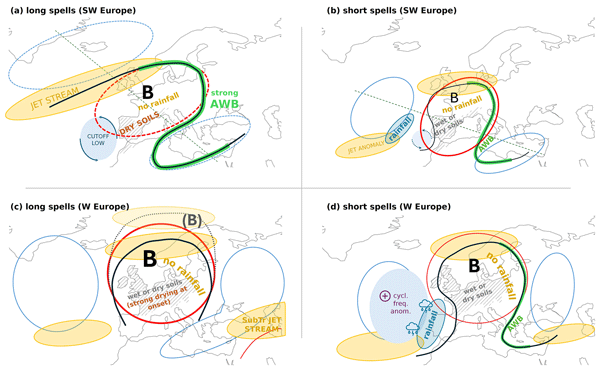
This study compares the dynamical structures that characterise long-lasting (persistent) and short hot spells in Western Europe. We find differences in large-scale atmospheric flow patterns during the events and particular soil moisture evolutions, which can account for the variation in event duration. There is variability in how drivers combine in individual events. Understanding persistent heat extremes can help improve their representation in models and ultimately their prediction.
Vikki Thompson, Sjoukje Y. Philip, Izidine Pinto, and Sarah F. Kew
EGUsphere, https://doi.org/10.5194/egusphere-2024-1136, https://doi.org/10.5194/egusphere-2024-1136, 2024
Preprint archived
Short summary
Short summary
In October 2023 Storm Babet brought flooding and strong winds to the UK. We show that similar events are more likely when the North Atlantic sea surface temperatures are higher. The North Atlantic exhibits multidecadal variability impacting the sea surface temperatures. This suggests that trends in storms similar to Babet are driven by multidecadal variability more than climate change. Increasing our knowledge of the causes of extreme weather can allow us to prepare and adapt for future changes.
Chiem van Straaten, Dim Coumou, Kirien Whan, Bart van den Hurk, and Maurice Schmeits
Weather Clim. Dynam., 4, 887–903, https://doi.org/10.5194/wcd-4-887-2023, https://doi.org/10.5194/wcd-4-887-2023, 2023
Short summary
Short summary
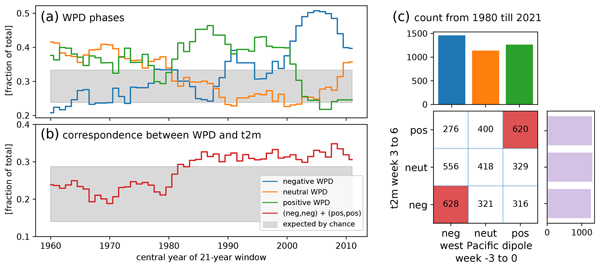
Variability in the tropics can influence weather over Europe. This study evaluates a summertime connection between the two. It shows that strongly opposing west Pacific sea surface temperature anomalies have occurred more frequently since 1980, likely due to a combination of long-term warming in the west Pacific and the El Niño Southern Oscillation. Three to six weeks later, the distribution of hot and cold airmasses over Europe is affected.
Giorgia Di Capua, Dim Coumou, Bart van den Hurk, Antje Weisheimer, Andrew G. Turner, and Reik V. Donner
Weather Clim. Dynam., 4, 701–723, https://doi.org/10.5194/wcd-4-701-2023, https://doi.org/10.5194/wcd-4-701-2023, 2023
Short summary
Short summary
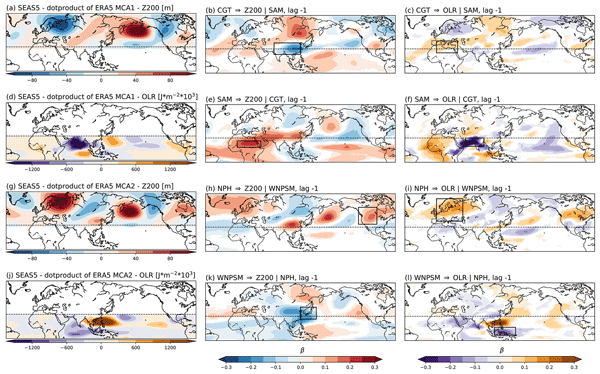
Heavy rainfall in tropical regions interacts with mid-latitude circulation patterns, and this interaction can explain weather patterns in the Northern Hemisphere during summer. In this analysis we detect these tropical–extratropical interaction pattern both in observational datasets and data obtained by atmospheric models and assess how well atmospheric models can reproduce the observed patterns. We find a good agreement although these relationships are weaker in model data.
Steven J. De Hertog, Felix Havermann, Inne Vanderkelen, Suqi Guo, Fei Luo, Iris Manola, Dim Coumou, Edouard L. Davin, Gregory Duveiller, Quentin Lejeune, Julia Pongratz, Carl-Friedrich Schleussner, Sonia I. Seneviratne, and Wim Thiery
Earth Syst. Dynam., 14, 629–667, https://doi.org/10.5194/esd-14-629-2023, https://doi.org/10.5194/esd-14-629-2023, 2023
Short summary
Short summary
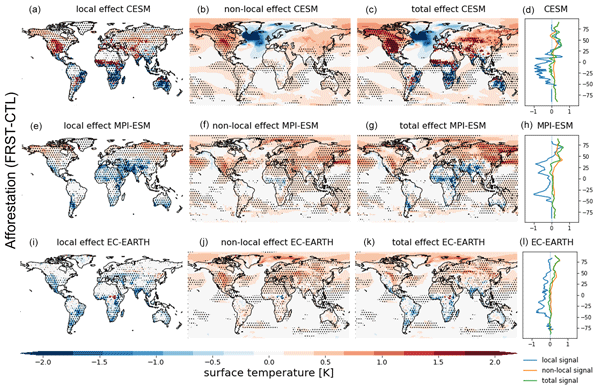
Land cover and land management changes are important strategies for future land-based mitigation. We investigate the climate effects of cropland expansion, afforestation, irrigation and wood harvesting using three Earth system models. Results show that these have important implications for surface temperature where the land cover and/or management change occur and in remote areas. Idealized afforestation causes global warming, which might offset the cooling effect from enhanced carbon uptake.
Efi Rousi, Andreas H. Fink, Lauren S. Andersen, Florian N. Becker, Goratz Beobide-Arsuaga, Marcus Breil, Giacomo Cozzi, Jens Heinke, Lisa Jach, Deborah Niermann, Dragan Petrovic, Andy Richling, Johannes Riebold, Stella Steidl, Laura Suarez-Gutierrez, Jordis S. Tradowsky, Dim Coumou, André Düsterhus, Florian Ellsäßer, Georgios Fragkoulidis, Daniel Gliksman, Dörthe Handorf, Karsten Haustein, Kai Kornhuber, Harald Kunstmann, Joaquim G. Pinto, Kirsten Warrach-Sagi, and Elena Xoplaki
Nat. Hazards Earth Syst. Sci., 23, 1699–1718, https://doi.org/10.5194/nhess-23-1699-2023, https://doi.org/10.5194/nhess-23-1699-2023, 2023
Short summary
Short summary
The objective of this study was to perform a comprehensive, multi-faceted analysis of the 2018 extreme summer in terms of heat and drought in central and northern Europe, with a particular focus on Germany. A combination of favorable large-scale conditions and locally dry soils were related with the intensity and persistence of the events. We also showed that such extremes have become more likely due to anthropogenic climate change and might occur almost every year under +2 °C of global warming.
Raed Hamed, Sem Vijverberg, Anne F. Van Loon, Jeroen Aerts, and Dim Coumou
Earth Syst. Dynam., 14, 255–272, https://doi.org/10.5194/esd-14-255-2023, https://doi.org/10.5194/esd-14-255-2023, 2023
Short summary
Short summary
Spatially compounding soy harvest failures can have important global impacts. Using causal networks, we show that soy yields are predominately driven by summer soil moisture conditions in North and South America. Summer soil moisture is affected by antecedent soil moisture and by remote extra-tropical SST patterns in both hemispheres. Both of these soil moisture drivers are again influenced by ENSO. Our results highlight physical pathways by which ENSO can drive spatially compounding impacts.
Paolo Scussolini, Job Dullaart, Sanne Muis, Alessio Rovere, Pepijn Bakker, Dim Coumou, Hans Renssen, Philip J. Ward, and Jeroen C. J. H. Aerts
Clim. Past, 19, 141–157, https://doi.org/10.5194/cp-19-141-2023, https://doi.org/10.5194/cp-19-141-2023, 2023
Short summary
Short summary
We reconstruct sea level extremes due to storm surges in a past warmer climate. We employ a novel combination of paleoclimate modeling and global ocean hydrodynamic modeling. We find that during the Last Interglacial, about 127 000 years ago, seasonal sea level extremes were indeed significantly different – higher or lower – on long stretches of the global coast. These changes are associated with different patterns of atmospheric storminess linked with meridional shifts in wind bands.
Sjoukje Y. Philip, Sarah F. Kew, Geert Jan van Oldenborgh, Faron S. Anslow, Sonia I. Seneviratne, Robert Vautard, Dim Coumou, Kristie L. Ebi, Julie Arrighi, Roop Singh, Maarten van Aalst, Carolina Pereira Marghidan, Michael Wehner, Wenchang Yang, Sihan Li, Dominik L. Schumacher, Mathias Hauser, Rémy Bonnet, Linh N. Luu, Flavio Lehner, Nathan Gillett, Jordis S. Tradowsky, Gabriel A. Vecchi, Chris Rodell, Roland B. Stull, Rosie Howard, and Friederike E. L. Otto
Earth Syst. Dynam., 13, 1689–1713, https://doi.org/10.5194/esd-13-1689-2022, https://doi.org/10.5194/esd-13-1689-2022, 2022
Short summary
Short summary
In June 2021, the Pacific Northwest of the US and Canada saw record temperatures far exceeding those previously observed. This attribution study found such a severe heat wave would have been virtually impossible without human-induced climate change. Assuming no nonlinear interactions, such events have become at least 150 times more common, are about 2 °C hotter and will become even more common as warming continues. Therefore, adaptation and mitigation are urgently needed to prepare society.
Steven J. De Hertog, Felix Havermann, Inne Vanderkelen, Suqi Guo, Fei Luo, Iris Manola, Dim Coumou, Edouard L. Davin, Gregory Duveiller, Quentin Lejeune, Julia Pongratz, Carl-Friedrich Schleussner, Sonia I. Seneviratne, and Wim Thiery
Earth Syst. Dynam., 13, 1305–1350, https://doi.org/10.5194/esd-13-1305-2022, https://doi.org/10.5194/esd-13-1305-2022, 2022
Short summary
Short summary
Land cover and land management changes are important strategies for future land-based mitigation. We investigate the climate effects of cropland expansion, afforestation, irrigation, and wood harvesting using three Earth system models. Results show that these have important implications for surface temperature where the land cover and/or management change occurs and in remote areas. Idealized afforestation causes global warming, which might offset the cooling effect from enhanced carbon uptake.
Kathrin Wehrli, Fei Luo, Mathias Hauser, Hideo Shiogama, Daisuke Tokuda, Hyungjun Kim, Dim Coumou, Wilhelm May, Philippe Le Sager, Frank Selten, Olivia Martius, Robert Vautard, and Sonia I. Seneviratne
Earth Syst. Dynam., 13, 1167–1196, https://doi.org/10.5194/esd-13-1167-2022, https://doi.org/10.5194/esd-13-1167-2022, 2022
Short summary
Short summary
The ExtremeX experiment was designed to unravel the contribution of processes leading to the occurrence of recent weather and climate extremes. Global climate simulations are carried out with three models. The results show that in constrained experiments, temperature anomalies during heatwaves are well represented, although climatological model biases remain. Further, a substantial contribution of both atmospheric circulation and soil moisture to heat extremes is identified.
Fei Luo, Frank Selten, Kathrin Wehrli, Kai Kornhuber, Philippe Le Sager, Wilhelm May, Thomas Reerink, Sonia I. Seneviratne, Hideo Shiogama, Daisuke Tokuda, Hyungjun Kim, and Dim Coumou
Weather Clim. Dynam., 3, 905–935, https://doi.org/10.5194/wcd-3-905-2022, https://doi.org/10.5194/wcd-3-905-2022, 2022
Short summary
Short summary
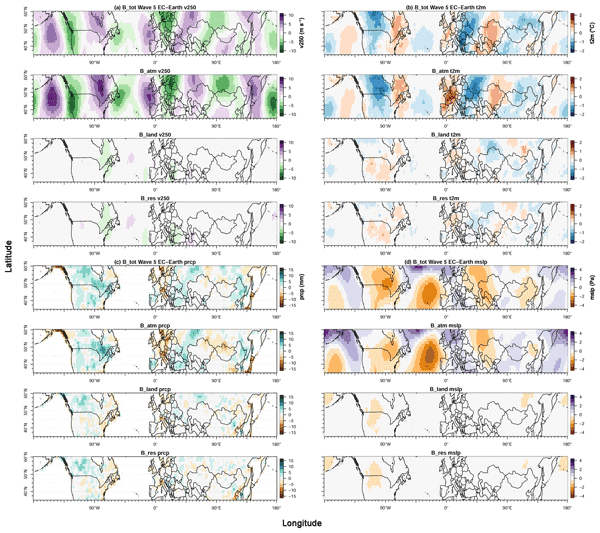
Recent studies have identified the weather systems in observational data, where wave patterns with high-magnitude values that circle around the whole globe in either wavenumber 5 or wavenumber 7 are responsible for the extreme events. In conclusion, we find that the climate models are able to reproduce the large-scale atmospheric circulation patterns as well as their associated surface variables such as temperature, precipitation, and sea level pressure.
Raed Hamed, Anne F. Van Loon, Jeroen Aerts, and Dim Coumou
Earth Syst. Dynam., 12, 1371–1391, https://doi.org/10.5194/esd-12-1371-2021, https://doi.org/10.5194/esd-12-1371-2021, 2021
Short summary
Short summary
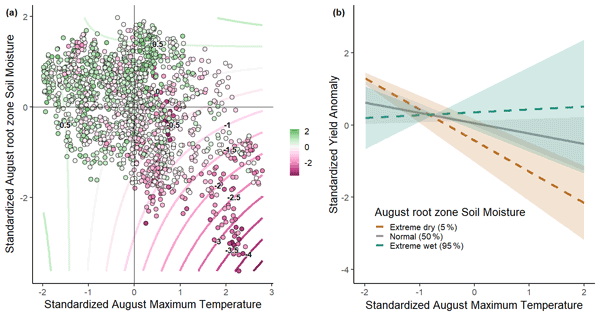
Soy yields in the US are affected by climate variability. We identify the main within-season climate drivers and highlight potential compound events and associated agricultural impacts. Our results show that soy yields are most negatively influenced by the combination of high temperature and low soil moisture during the summer crop reproductive period. Furthermore, we highlight the role of temperature and moisture coupling across the year in generating these hot–dry extremes and linked impacts.
Cited articles
Andrews, M. B., Ridley, J. K., Wood, R. A., Andrews, T., Blockley, E. W., Booth, B., Burke, E., Dittus, A. J., Florek, P., Gray, L. J., Haddad, S., Hardiman, S. C., Hermanson, L., Hodson, D., Hogan, E., Jones, G. S., Knight, J. R., Kuhlbrodt, T., Misios, S., Mizielinski, M. S., Ringer, M. A., Robson, J., and Sutton, R. T.: Historical Simulations With HadGEM3-GC3.1 for CMIP6, J. Adv. Model. Earth Syst., 12, e2019MS001995, https://doi.org/10.1029/2019MS001995, 2020.
Cornes, R. C., Van Der Schrier, G., Van Den Besselaar, E. J. M., and Jones, P. D.: An Ensemble Version of the E-OBS Temperature and Precipitation Data Sets, J. Geophys. Res. Atmospheres, 123, 9391–9409, https://doi.org/10.1029/2017JD028200, 2018.
D'Andrea, F., Duvel, J., Rivière, G., Vautard, R., Cassou, C., Cattiaux, J., Coumou, D., Faranda, D., Happé, T., Jézéquel, A., Ribes, A., and Yiou, P.: Summer Deep Depressions Increase Over the Eastern North Atlantic, Geophys. Res. Lett., 51, e2023GL104435, https://doi.org/10.1029/2023GL104435, 2024.
Davini, P. and D'Andrea, F.: From CMIP3 to CMIP6: Northern Hemisphere Atmospheric Blocking Simulation in Present and Future Climate, J. Clim., 33, 10021–10038, https://doi.org/10.1175/JCLI-D-19-0862.1, 2020.
Dong, B. and Sutton, R. T.: Drivers and mechanisms contributing to excess warming in Europe during recent decades, Npj Clim. Atmospheric Sci., 8, 41, https://doi.org/10.1038/s41612-025-00930-3, 2025.
Fischer, E. M., Seneviratne, S. I., Vidale, P. L., Lüthi, D., and Schär, C.: Soil Moisture – Atmosphere Interactions during the 2003 European Summer Heat Wave, J. Clim., 20, 5081–5099, https://doi.org/10.1175/JCLI4288.1, 2007.
García-León, D., Casanueva, A., Standardi, G., Burgstall, A., Flouris, A. D., and Nybo, L.: Current and projected regional economic impacts of heatwaves in Europe, Nat. Commun., 12, 5807, https://doi.org/10.1038/s41467-021-26050-z, 2021.
He, Y., Huang, J., Li, D., Xie, Y., Zhang, G., Qi, Y., Wang, S., and Totz, S.: Comparison of the effect of land-sea thermal contrast on interdecadal variations in winter and summer blockings, Clim. Dyn., 51, 1275–1294, https://doi.org/10.1007/s00382-017-3954-9, 2018.
Hersbach, H., Bell, B., Berrisford, P., Hirahara, S., Horányi, A., Muñoz-Sabater, J., Nicolas, J., Peubey, C., Radu, R., Schepers, D., Simmons, A., Soci, C., Abdalla, S., Abellan, X., Balsamo, G., Bechtold, P., Biavati, G., Bidlot, J., Bonavita, M., De Chiara, G., Dahlgren, P., Dee, D., Diamantakis, M., Dragani, R., Flemming, J., Forbes, R., Fuentes, M., Geer, A., Haimberger, L., Healy, S., Hogan, R. J., Hólm, E., Janisková, M., Keeley, S., Laloyaux, P., Lopez, P., Lupu, C., Radnoti, G., De Rosnay, P., Rozum, I., Vamborg, F., Villaume, S., and Thépaut, J.: The ERA5 global reanalysis, Q. J. R. Meteorol. Soc., 146, 1999–2049, https://doi.org/10.1002/qj.3803, 2020.
Horton, R. M., Mankin, J. S., Lesk, C., Coffel, E., and Raymond, C.: A Review of Recent Advances in Research on Extreme Heat Events, Curr. Clim. Change Rep., 2, 242–259, https://doi.org/10.1007/s40641-016-0042-x, 2016.
IPCC: Climate Change 2021 – The Physical Science Basis: Working Group I Contribution to the Sixth Assessment Report of the Intergovernmental Panel on Climate Change, 1st Ed., Cambridge University Press, https://doi.org/10.1017/9781009157896, 2021.
IPCC: Climate Change 2023: Synthesis Report. Contribution of Working Groups I, II and III to the Sixth Assessment Report of the Intergovernmental Panel on Climate Change, edited by: Core Writing Team, Lee, H. and Romero, J., IPCC, Geneva, Switzerland, Intergovernmental Panel on Climate Change (IPCC), https://doi.org/10.59327/IPCC/AR6-9789291691647, 2023.
Jézéquel, A., Yiou, P., and Radanovics, S.: Role of circulation in European heatwaves using flow analogues, Clim. Dyn., 50, 1145–1159, https://doi.org/10.1007/s00382-017-3667-0, 2018.
Kamae, Y., Watanabe, M., Kimoto, M., and Shiogama, H.: Summertime land–sea thermal contrast and atmospheric circulation over East Asia in a warming climate – Part I: Past changes and future projections, Clim. Dyn., 43, 2553–2568, https://doi.org/10.1007/s00382-014-2073-0, 2014.
Kjellstrom, T., Butler, A. J., Lucas, R. M., and Bonita, R.: Public health impact of global heating due to climate change: potential effects on chronic non-communicable diseases, Int. J. Public Health, 55, 97–103, https://doi.org/10.1007/s00038-009-0090-2, 2010.
KNMI Climate Explorer: Select a daily field, KNMI [data set], https://climexp.knmi.nl/selectdailyfield2.cgi?id=someone@somewhere (last access: 20 May 2024), 2022.
Kornhuber, K., Osprey, S., Coumou, D., Petri, S., Petoukhov, V., Rahmstorf, S., and Gray, L.: Extreme weather events in early summer 2018 connected by a recurrent hemispheric wave-7 pattern, Environ. Res. Lett., 14, 054002, https://doi.org/10.1088/1748-9326/ab13bf, 2019.
Kornhuber, K., Bartusek, S., Seager, R., Schellnhuber, H. J., and Ting, M.: Global emergence of regional heatwave hotspots outpaces climate model simulations, Proc. Natl. Acad. Sci., 121, e2411258121, https://doi.org/10.1073/pnas.2411258121, 2024.
Liu, L. and Zhang, X.: Effects of temperature variability and extremes on spring phenology across the contiguous United States from 1982 to 2016, Sci. Rep., 10, 17952, https://doi.org/10.1038/s41598-020-74804-4, 2020.
Lopez, A., Fung, F., New, M., Watts, G., Weston, A., and Wilby, R. L.: From climate model ensembles to climate change impacts and adaptation: A case study of water resource management in the southwest of England, Water Resour. Res., 45, 2008WR007499, https://doi.org/10.1029/2008WR007499, 2009.
Lorenz, R., Stalhandske, Z., and Fischer, E. M.: Detection of a Climate Change Signal in Extreme Heat, Heat Stress, and Cold in Europe From Observations, Geophys. Res. Lett., 46, 8363–8374, https://doi.org/10.1029/2019GL082062, 2019.
Noest, D. S.: Western_EU_warm_season_heat_extremes, GitHub [code], https://github.com/douwe3/Western_EU_warm_season_heat_extremes (last access: 10 January 2026), 2025.
Palmer, T. E., McSweeney, C. F., Booth, B. B. B., Priestley, M. D. K., Davini, P., Brunner, L., Borchert, L., and Menary, M. B.: Performance-based sub-selection of CMIP6 models for impact assessments in Europe, Earth Syst. Dyn., 14, 457–483, https://doi.org/10.5194/esd-14-457-2023, 2023.
Patterson, M.: North-West Europe Hottest Days Are Warming Twice as Fast as Mean Summer Days, Geophys. Res. Lett., 50, e2023GL102757, https://doi.org/10.1029/2023GL102757, 2023.
Ridley, J., Menary, M., Kuhlbrodt, T., Andrews, M., and Andrews, T.: MOHC HadGEM3-GC31-LL model output prepared for CMIP6 CMIP historical (20230220), Earth System Grid Federation (ESGF) [data set], https://doi.org/10.22033/ESGF/CMIP6.6109, 2019.
Rousi, E., Kornhuber, K., Beobide-Arsuaga, G., Luo, F., and Coumou, D.: Accelerated western European heatwave trends linked to more-persistent double jets over Eurasia, Nat. Commun., 13, 3851, https://doi.org/10.1038/s41467-022-31432-y, 2022.
Schiemann, R., Athanasiadis, P., Barriopedro, D., Doblas-Reyes, F., Lohmann, K., Roberts, M. J., Sein, D. V., Roberts, C. D., Terray, L., and Vidale, P. L.: Northern Hemisphere blocking simulation in current climate models: evaluating progress from the Climate Model Intercomparison Project Phase 5 to 6 and sensitivity to resolution, Weather Clim. Dyn., 1, 277–292, https://doi.org/10.5194/wcd-1-277-2020, 2020.
Seneviratne, S. I., Corti, T., Davin, E. L., Hirschi, M., Jaeger, E. B., Lehner, I., Orlowsky, B., and Teuling, A. J.: Investigating soil moisture–climate interactions in a changing climate: A review, Earth-Sci. Rev., 99, 125–161, https://doi.org/10.1016/j.earscirev.2010.02.004, 2010.
Shaw, T. A. and Voigt, A.: Tug of war on summertime circulation between radiative forcing and sea surface warming, Nat. Geosci., 8, 560–566, https://doi.org/10.1038/ngeo2449, 2015.
Shaw, T. A., Arias, P. A., Collins, M., Coumou, D., Diedhiou, A., Garfinkel, C. I., Jain, S., Roxy, M. K., Kretschmer, M., Leung, L. R., Narsey, S., Martius, O., Seager, R., Shepherd, T. G., Sörensson, A. A., Stephenson, T., Taylor, M., and Wang, L.: Regional climate change: consensus, discrepancies, and ways forward, Front. Clim., 6, 1391634, https://doi.org/10.3389/fclim.2024.1391634, 2024.
Shiogama, H., Tatebe, H., Hayashi, M., Abe, M., Arai, M., Koyama, H., Imada, Y., Kosaka, Y., Ogura, T., and Watanabe, M.: MIROC6 Large Ensemble (MIROC6-LE): experimental design and initial analyses, Earth Syst. Dynam., 14, 1107–1124, https://doi.org/10.5194/esd-14-1107-2023, 2023.
Singh, J., Sippel, S., and Fischer, E. M.: Circulation dampened heat extremes intensification over the Midwest USA and amplified over Western Europe, Commun. Earth Environ., 4, 432, https://doi.org/10.1038/s43247-023-01096-7, 2023.
Smith, D. M., Gillett, N. P., Simpson, I. R., Athanasiadis, P. J., Baehr, J., Bethke, I., Bilge, T. A., Bonnet, R., Boucher, O., Findell, K. L., Gastineau, G., Gualdi, S., Hermanson, L., Leung, L. R., Mignot, J., Müller, W. A., Osprey, S., Otterå, O. H., Persad, G. G., Scaife, A. A., Schmidt, G. A., Shiogama, H., Sutton, R. T., Swingedouw, D., Yang, S., Zhou, T., and Ziehn, T.: Attribution of multi-annual to decadal changes in the climate system: The Large Ensemble Single Forcing Model Intercomparison Project (LESFMIP), Front. Clim., 4, 955414, https://doi.org/10.3389/fclim.2022.955414, 2022.
Sousa, P. M., Barriopedro, D., García-Herrera, R., Ordóñez, C., Soares, P. M. M., and Trigo, R. M.: Distinct influences of large-scale circulation and regional feedbacks in two exceptional 2019 European heatwaves, Commun. Earth Environ., 1, 48, https://doi.org/10.1038/s43247-020-00048-9, 2020.
Sulikowska, A. and Wypych, A.: Seasonal Variability of Trends in Regional Hot and Warm Temperature Extremes in Europe, Atmosphere, 12, 612, https://doi.org/10.3390/atmos12050612, 2021.
Tatebe, H. and Watanabe, M.: MIROC MIROC6 model output prepared for CMIP6 CMIP historical (20230220), Earth System Grid Federation (ESGF) [data set], https://doi.org/10.22033/ESGF/CMIP6.5603, 2018.
Tatebe, H., Ogura, T., Nitta, T., Komuro, Y., Ogochi, K., Takemura, T., Sudo, K., Sekiguchi, M., Abe, M., Saito, F., Chikira, M., Watanabe, S., Mori, M., Hirota, N., Kawatani, Y., Mochizuki, T., Yoshimura, K., Takata, K., O'ishi, R., Yamazaki, D., Suzuki, T., Kurogi, M., Kataoka, T., Watanabe, M., and Kimoto, M.: Description and basic evaluation of simulated mean state, internal variability, and climate sensitivity in MIROC6, Geosci. Model Dev., 12, 2727–2765, https://doi.org/10.5194/gmd-12-2727-2019, 2019.
Thompson, V., Coumou, D., Galfi, V. M., Happé, T., Kew, S., Pinto, I., Philip, S., De Vries, H., and Van Der Wiel, K.: Changing dynamics of Western European summertime cut-off lows: A case study of the July 2021 flood event, Atmospheric Sci. Lett., 25, e1260, https://doi.org/10.1002/asl.1260, 2024a.
Thompson, V., Philip, S. Y., Pinto, I., and Kew, S. F.: The influence of the Atlantic Multidecadal Variability on Storm Babet-like events, EGUsphere [preprint], https://doi.org/10.5194/egusphere-2024-1136, 2024b.
Vautard, R., Yiou, P., D'Andrea, F., De Noblet, N., Viovy, N., Cassou, C., Polcher, J., Ciais, P., Kageyama, M., and Fan, Y.: Summertime European heat and drought waves induced by wintertime Mediterranean rainfall deficit, Geophys. Res. Lett., 34, 2006GL028001, https://doi.org/10.1029/2006GL028001, 2007.
Vautard, R., Van Aalst, M., Boucher, O., Drouin, A., Haustein, K., Kreienkamp, F., Van Oldenborgh, G. J., Otto, F. E. L., Ribes, A., Robin, Y., Schneider, M., Soubeyroux, J.-M., Stott, P., Seneviratne, S. I., Vogel, M. M., and Wehner, M.: Human contribution to the record-breaking June and July 2019 heatwaves in Western Europe, Environ. Res. Lett., 15, 094077, https://doi.org/10.1088/1748-9326/aba3d4, 2020.
Vautard, R., Cattiaux, J., Happé, T., Singh, J., Bonnet, R., Cassou, C., Coumou, D., D'Andrea, F., Faranda, D., Fischer, E., Ribes, A., Sippel, S., and Yiou, P.: Heat extremes in Western Europe increasing faster than simulated due to atmospheric circulation trends, Nat. Commun., 14, 6803, https://doi.org/10.1038/s41467-023-42143-3, 2023.
Whan, K., Zscheischler, J., Orth, R., Shongwe, M., Rahimi, M., Asare, E. O., and Seneviratne, S. I.: Impact of soil moisture on extreme maximum temperatures in Europe, Weather Clim. Extrem., 9, 57–67, https://doi.org/10.1016/j.wace.2015.05.001, 2015.
White, R. H., Kornhuber, K., Martius, O., and Wirth, V.: From Atmospheric Waves to Heatwaves: A Waveguide Perspective for Understanding and Predicting Concurrent, Persistent, and Extreme Extratropical Weather, Bull. Am. Meteorol. Soc., 103, E923–E935, https://doi.org/10.1175/BAMS-D-21-0170.1, 2022.
Wilks, D. S.: “The Stippling Shows Statistically Significant Grid Points”: How Research Results are Routinely Overstated and Overinterpreted, and What to Do about It, Bull. Am. Meteorol. Soc., 97, 2263–2273, https://doi.org/10.1175/BAMS-D-15-00267.1, 2016.
Wu, L. and Zhang, J.: The relationship between spring soil moisture and summer hot extremes over North China, Adv. Atmos. Sci., 32, 1660–1668, https://doi.org/10.1007/s00376-015-5003-0, 2015.
Yang, J., Zhou, M., Ren, Z., Li, M., Wang, B., Liu, D. L., Ou, C.-Q., Yin, P., Sun, J., Tong, S., Wang, H., Zhang, C., Wang, J., Guo, Y., and Liu, Q.: Projecting heat-related excess mortality under climate change scenarios in China, Nat. Commun., 12, 1039, https://doi.org/10.1038/s41467-021-21305-1, 2021.
Zampieri, M., D'Andrea, F., Vautard, R., Ciais, P., De Noblet-Ducoudré, N., and Yiou, P.: Hot European Summers and the Role of Soil Moisture in the Propagation of Mediterranean Drought, J. Clim., 22, 4747–4758, https://doi.org/10.1175/2009JCLI2568.1, 2009.
Short summary
Spring and summer heat extremes in Western Europe have intensified much faster than the global average since 1950. Spring warming is mainly driven by thermodynamical effects, while circulation changes explain over a third of local trends, with more frequent southerly flow patterns contributing. Climate models capture extreme trends in individual runs but underestimate observed warming. Open questions about forced change versus natural variability remain.
Spring and summer heat extremes in Western Europe have intensified much faster than the global...